/


Автор: Sakaev K.
Теги: chess board games chess combinations chess games
ISBN: 954-878-24-8
Год: 2006

Текст
dJII!IP
Current Theory and Practice Series
Editorial Panel:
1M O.Biriukov, 1M S.Klimov,
1M S.Soloviov
1M Semko Semkov
Technical Editor:
Translation by:
GM Evgeny Ermenkov
Cover design by Kalojan Nachev
Copyright @ 2006 by Konstantin Sakaev
Printed in Bulgaria by "Chess Stars" Ltd. - Sofia
ISBNIO: 954 878 24-8
ISBN13: 978 954 8782 48-7
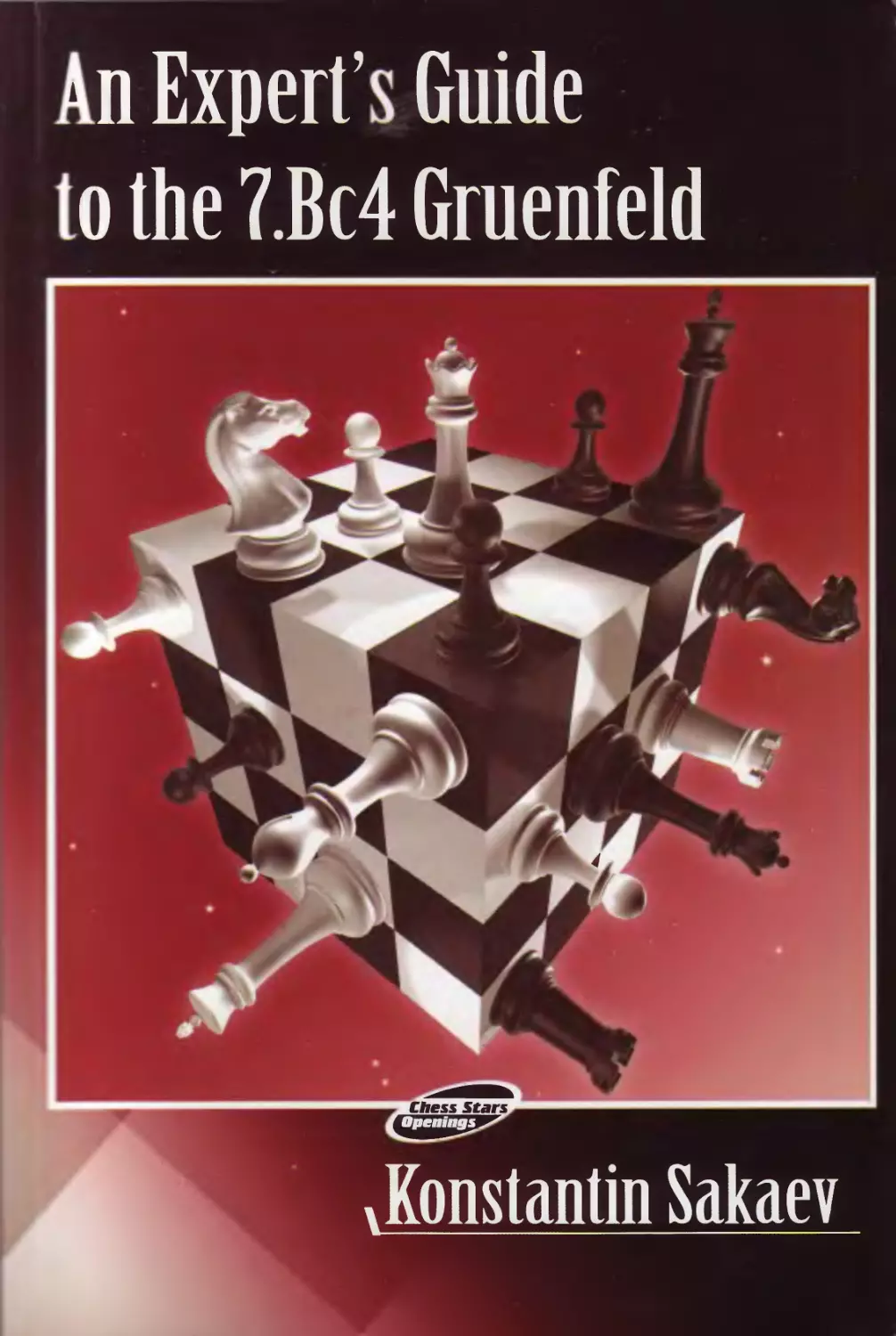
An Expert's Guide to the
7.i.c4 Gruenfeld
1.d4 ltJf6 2.c4 g6 3.ltJc3 d5 4.cxd5 ltJxd5
5.e4ltJxc3 6.bxc3 i.g7 7.i.c4
Konstatin Sakaev
Chess Stars 2006
www.chess-stars.com
Other CHESS STARS books
Repertoire books:
Opening for White According to Kramnik 1.Nf3 by Khalifman
Volume 2: Anti-Nimzo-Indian, Anti-Queen's Indian, English, Knight Tango
Volume 3: Maroczy, English (l...cs), Modern, Dutch
Volume 4: Queen's Gambit Accepted, Slav, Semi-Slav
Volume 5: Queen's Gambit Declined
Opening for White According to Anand 1.e4 by A. Khalifman
Volume 1: Petroff, Ruy Lopez without 3...a6
Volume 2: Ruy Lopez with 3...a6
Volume 3: Caro -Kann; 1. .c6, 2...g6
Volume 4: 1...d6, 1...g6...and others
Volume 5: Alekhine's Defence, 1...b6 and other rare lines
Volume 6: French Defence, 3.Nc3 dxe4; 3...Nf6
Volume 7: French Defence, 3.Nc3 Bb4
Opening for Black According to Karpov by Khalifman
Caro-Kann, Queen's Indian, Nimzo-Indian, Catalan, English, Reti
Current theory and practice series:
1. The Queen's Gambit Accepted by Sakaev and Semkov
2. How to Get the Edge Against the Gruenfeld by Sakaev
3. Challenging the Sicilian with 2.a3! by Bezgodov
4. Latest trends in the Semi-Slav: The Anti-Meran by Sakaev and Semkov
5. The Safest Sicilian by Delchev and Semkov, 2006
Game collections
Bogoljubow. The Fate of a Chess Player by S. Soloviov
Capablanca. Games 1901 - 1224, Second Revised Edition
Capablanca. Games 1925 -1939 Second Revised Edition
Alexander Alekhine. Games
Volume 1: 1902 - 1922
Volume 2: 1923 - 1934
Volume 3: 1935 - 1946
Boris Spassky's 400 Selected Games by Soloviov, 556 pages + photos
Super Tournaments 2003, 456 pages + colour photos
Super Tournaments 2002, 556 pages + colour photos
Super Tournaments 2000, 448 pages + colour photos
Shirov's One Hundred Wins by Soloviov 316 pages, interviews, biography,
photos, hardcover or softcover
Leko's One Hundred Wins by S. Soloviov 340 pages, biography, photos
More details at www.chess-stars.com
Contents
Part 1
1.d44Jf6 2.c4 g6 3.4Jc3 d5 4.cxd54Jxd5 5.e44Jxc3 6.bxc3 ig7 7..tc4
1 various; 7...0-0 8.4Je2 without 8...VNd7 and 8...4Jc6 . . . . . . . . . . 10
2 7... 0- 0 8.lD e2 W d 7 . . . . . . . . . . . . . . . . . . . . . . . . . . . . . . . . . . . . 30
3 7...0-0 8.ltJe2 4Jc6. . . . . . . . . . . . . . . _ . . . . . . . . . . . . . . . . . . . . . . .54
4 7. . . c5 8.ltJ e 2 with out 8...ltJ c 6 . . . . . . . . . . . . . . . . . . . . . . . . . . . . .84
5 7...c5 8.ltJe2 4Jc6 9.ie3 various; 9...cd 10.cd b5. . . . . . . . . . . . 97
6 7...c5 8.ltJe2 4Jc6 9.ie3 cd 10.cd WaS. . . . . . . . . . . . . . . . . . . . .105
Part 2
7...c5 8.ltJe2 ltJc6 9.ie3 0-0
7 10. b1; 10. c1; 10.0-0 WaS; 10...4Ja5; 10...e6 . . . . . . . . . . . . . . 120
8 10.0-0 cd 11.cd without 11...4Ja5. . . . . . . . . . . . . . . . . . . . . . . . . . 138
9 10.0-0 cd 11.cd ttJa512.id3 without 12...b6. _ . . . . . . . . . . . . . . 145
10 10.0-0 cd 11.cd ltJa5 12.id3 b6 . . . . . . . . . . . . . . . . . . . . . . . . . .151
11 10.0-0 Wc711. c1 without 11... d8 . . . . . . . . . . . . . . . . . . . . . . . . 164
12 10.0-0 Wc7 11. c1 d8 . . . . . . . . . . . . . . . . . . . . . . . . . . . . . . . . . 175
13 10.0-0 id7 . . . . . . . . . . . . . . . . . . . . . . . . . . . . . . . . . . . . . . . . . 188
Part 3
7...c5 8.ltJe2 ltJc6 9.ie3 0-0 10.0-0 ig4 11.f3
14 11...id7. . . . . . . . . . . . . . . . . . . . . . . . . . . . . . . . . . . . . . . . . 201
15 11. ..4Ja5 12.id5. . . . . . . . . . . . . . . . . . . . . . . . . . . . . . . . . . . . . . . . . 207
16 11...4Ja5 12..id3 cd 13.cd e6 14. a4 . . . . . . . . . . . . . . . . . . 217
5
Part 4
7...c5 8.tDe2 tDc6 9.ie3 0-0 10.0-0 ig4 11.f3tDa5 12.id3 cd 13.cd ie6
14. d5
17 14...i.al15.\Wa1 f6 without 16. b1 and 16.ih6. . . . . . . . . . . . 229
18 14... a115.'Wal f616.gbl. . . . . . . . . . . . . . . . . . . . . . . . . . . . . . .248
19 14...i.al15.\Wa1 f6 16. h6 various; 16... e8 17. b1. . . . . . . . . 275
20 14... al15.'Wal f616.ih6 e8 17.ci>h1 without 17... c8 . . . . . 283
21 14... a115.\Wa1 f6 16. h6 e8 17. h1 c8 . . . . . . . . . . . . . . . 292
Part 5
7...c5 8.lDe2 lDc6 9.ie3 0-0 10.0-0 ig4 11.f3 tDa5 12.id3 cd 13.cd ie6
14. c1
22 14...i.a2 15.d5; 15.\Wa4 ib316.\Wb4 b617..tg5 . . . . . . . . . . . . . .312
23 14... a2 15.\Wa4 .tb316.\Wb4 b617. c3 . . . . . . . . . . . . . . . . . . . . .319
24 14...ia2 15.\Wa4 ie616.d5 d717.\Wa3; 17.\Wb4 b5; 17...b6. . .333
25 14... a2 15.\Wa4 .te616.d5 id717.1!Bb4 e618.'Dc3 b6 . . . . . . . 338
26 14....ta2 15.\Wa4 .te616.d5 .id717.\Wb4 e6 18.tDc3 ed . . . . . . . 345
Part 6
7...c5 B.tDe2 tDc6 9..te3 0-0 10.0-0 ig4 11.f3tDa5 12.ixf7 xf713.fxg4
xfl14. xf1
27 14... \W d 7. . . . . . . . . . . . . . . . . . . . . . . . . . . . . . . . . . . . . . . . . 351
28 14... \W d6 . . . . . . . . . . . . . . . . . . . . . . . . . . . . . . . . . . . . . . . . . 360
29 14...cd 15.cd e5 16.d5; 16. c1 . . . . . . . . . . . . . . . . . . . . . . . . . . . 381
30 14...cd ls.cd e5 16.i>gl . . . . . . . . . . . . . . . . . . . . . . . . . . . . . .397
Illustrative Games. . . . . . . . . . . . . . . . . . . . . . . . . . . . . . . . . . . . . . . . . . . 410
6
Preface
The Gruenfeld Defence (1.d4l2Jf6 2.c4 g6 3.l2Jc3 dS) appeared as
an original opening relatively recently. It began to be played at a
really high level during the 30ies of the 20 th century and quite rarely
at that. White used to react even then in the most aggressive and
natural way - he was occupying the centre immediately with: 4.cxdS
liJxd5 5.e4. After 5...liJxc3 6.bxc3 i.g7 White had to face the problem
how to develop later? The players gradually began to understand
that every possible set-up had some drawbacks too. If White played
7.t2Jf3, then the knight was usually pinned unpleasantly later with
i.c8-g4, while 7.i.e3 c5 8. d2 was slowing the development of the
kingside considerably.
Presently, both 7.l2Jf3 and 7..te3 are quite popular opening sys-
tems, with plenty of nuances and fine points and they lead to com-
plicated opening battles. I am trying with this book to increase the
number of adherents of the line 7..tc4! followed by 8.4Je2. The dawn
of the popularity of the variation was marked by great players like
David Bronstein and Efim Geller, but Boris Spassky made the most
significant contribution to its development. He won so many bril-
liant games that he managed to prove that the placement of the
white knight on e2 is not as passive as it seemed at first sight. The
knight defends the c3 and d4 pawns and can go to f4 at an oppor-
tune moment joining in the attack. Sometimes that knight helps
the advance of the h-pawn and often it supports the offence with
the f-pawn not standing in its way forward.
Nowadays, the 7.i.c4 system is an integral part of the opening
repertoire of numerous top-class grandmasters including the World
Champion Topalov.
7
I have tried to touch that subject in writing back in the year
2004 - I published a book in English about that system and it en-
joyed a great popularity allover the world. It turned out that the
main topic of interest of the chess fans was whether a top-level pro-
fessional player was going to share with the public his sacred nov-
elties and secret analyses? I will answer that question for the skep-
tics - yes - I decided to give it a try! I have collected all the avail-
able theoretical material, I have worked on it and I have added
plenty of my original analyses, which had been accumulated in the
process of preparation for my games as well as especially intended
for the book itself.
In order to illustrate some typical ideas I have chosen some 20
outstanding winning games for White and they have been com-
mented just for the book (The comments of some games that were
made before or published beforehand, were once again reworked
and contributed to, especially for the book.). In fact, not all these
games are pertinent to the state of the contemporary theory, but
they tend to always demonstrate some typical plan or maneuver,
which can be realized in practice.
The book is oriented partially to represent the point of view of
White and it is intended to help players create problems for Black
in the Gruenfeld Defence. Naturally, I hope it would be interesting
for the players who enjoy playing the Gruenfeld Defence with Black
as well.
This book has summarized the contemporary theory up to March
10 2004.
Konstantin Sakaev
March 2006
8
Part 1
1.d4 4Jf6 2.c4 g6 3.4Jc3 d5 4.cxd5 4Jxd5 5.e4 4Jxc3
6.bxc3 iLg7 7.iLc4
At the beginning of Part 1, I
will deal with some seldom
played lines in which Black does
not put White's centre under
immediate pressure, but he
plans to do that successfully
later. This way of playing used
to be quite popular at the dawn
of the development of the system,
when the theory of the variation
had been started from scratch.
White had then to try to find over
the board the best piece set-up
in every particular case. Nowa-
days, Black does not try often
that approach anymore and that
is hardly surprising. White ob-
tains a considerable advantage
in all lines with a simple and
straightforward play and Black
is doomed to defend a passive
position without any good pros-
pects (Chapters 1-4).
I will analyze in Chapters S-
6, variations in which Black is
trying to exploit the fact that
White's king has not castled, so
that he can disrupt the coordi-
nation of White's pieces. It turns
out however, that the means that
Black uses to achieve that aim
are hardly suitable for the pur-
pose.
GM P.Svidler, GM Luke Mc
Shane and GM B.Avrukh tried to
introduce the line 10..: aS, but
it became clear that Black was
falling back in development con-
siderably. I am going to prove in
my book that Black's prospects
are clearly worse in that case.
After 10...bS, White will be
forced to exchange his bishop,
but then Black weakens the c-file
considerably and in particular
the cS and c6-squares. The read-
ers will be easily convinced -
Black will be left with numerous
problems to worry about. There
is an interesting idea for White
in this line, recommended by
O.Biriukov - 11.i.d5 i.d7 12.l:.c1
l:.c8 13.0-0 0-0 14.i.c6 l:.c6 15.l:.c6
i.c6 16.dS i.d7 17: d2 a5 18.l:.c1
b4 19.ttJd4 e6 20.d6!?
9
Chapter 1
1.d4 'ZJf6 2.c4 g6 3.4Jc3 d5 4.cxd5
4Jxd5 5.e4 4Jxc3 6.bxc3 g7 7. c4
We are going to deal with
some rare variations for Black on
moves 7, 8 and 9.
The idea of all of them is to
develop the pieces on the queen-
side first and only then start ac-
tive actions in the centre. Black
refrains from the immediate c7-
c5 (with the exception of the line
that we analyse at the end of the
Botvinnik variation) and devel-
ops his knight to c6 and a5 and
his bishop to b7.
Naturally that plan has some
drawbacks too.
Black presents his opponent
with a free hand to act on the
kingside, avoiding the immedi-
ate active counterplay in the cen-
tre. White can start an aggres-
sion along the h-file with h4-
h5xg6, and then exchange the
10
dark-squared bishops or bring
his queen to the open h-file. He
can feel safe in the centre be-
cause it is very sound in case
Black does not attack it early
with c7-c5.
White can also castle and
then play e5, lbe2-f4, g4 and
h4-h5. So White has plenty of
additional possibilities in case
Black shuns the immediate
counterattack in the centre with
cS and lbc6. That is in fact the
main drawback of the moves that
we intend to deal with now.
Castling for Black in this po-
sition is naturally his strongest
move. His other possibilities ei-
ther transpose to the lines after
c) 7...0-0, or they present White
with plenty of other opportuni-
ties that he does not have in the
main variations. We will analyze
thoroughly here a) 7... d7 and
b) 7...lbc6.
Black has also some other
moves, which are just bad:
7.. ..iJ..e6? - He creates delib-
erately numerous weaknesses
in his camp and that is hardly
advisable. 8..iJ..xe6 fxe6 9.lbf3
ctJc6 (He loses a pawn in case
of: 9...0-0 10. b3 d7 11.ctJg5+-
Bartuszat - Groschupff, Mee-
rane 1954; after 9... d7 10. b3,
it would not work for Black to
try: 10...c5, because of 11.ctJg5
cxd4 12.ctJxe6 and White wins
material, for example: 12...i..e5
13.cxd4 i..xd4 14.i.b2 i..xb2
15. xb2 1:tgB 16. b3 1:thB 17.
c3+-) 10.1:tb1 b6 and here in-
stead of: 11.ctJg5 d7 12. g4 e5
13. xd7+ <iitxd7 14.d5 ctJa5 15.
0-0 + , it would be much more en-
ergetic for White to play 11.h4,
for example: 11... d7 12.h5 e5
13.d5 ttJa5 14.ctJg5 c6 15.ctJe6+-
and his advantage is decisive:
15...i..f616.hxg6 hxg617.1:txhB+
i.xhB lB. g4 <iitf7 19. h3 <iitgB
(19...cxd5 20.ttJg5+-) 20. h6+-,
or 13...ttJdB 14.hxg6 hxg6 15.
1:txhB+ i..xhB 16.ctJh4 d6 17.
g4 <iitf7 1B.c4 ttJb7 19.1:tb3 +
1:tg3, or 1:tf3+;
7 . . . c6. This move is practi-
cally unnecessary for Black - he
must counterattack White's cen-
tre in the Gruenfeld Defence
with his pawn on c5. Moreover,
on move seven - the line 7.i..b5+
c6 is quite popular and White
even plays B.i..c4, considering
that Black's extra tempo for the
move c7-c6 is immaterial. Now,
after White has been presented
with free extra time he should
choose some other active plan,
for exam pIe: B. f3 0-0 9. ctJe2,
followed by h2-h4-h5;
7...a6, Labahn - Heyken,
Hamburg 2001. Black has lost a
7.ilc4
tempo for his development on
the last move and White must
play here energetically - B. f3
(He should not start an attack
along the h-file before Black has
castled.) B...O-O 9.eS c5 10.ctJe2
ctJc6 11.i..e3t and later h2-h4-h5
with a powerful initiative;
The move 7.. .e6 - closes the
diagonal of the bishop on cB and
it enables White to play: B.ctJf3
c5 9.i..e3 ctJc6 10.0-0 cxd4 11.
cxd4 a6 12. d2 b5, so now in-
stead of the retreat of the bishop
to the e2-square, as it was played
in the game Al.Potapov - Ste-
phenson, Montreal 199B, White
had better play 13.i..b3, for ex-
ample: 13...0-0 14J:tfd1 i.b7
15.i.h61:tcB 16.i..xg7 rtixg7 17.d5
exd5 1B.i..xd5t and he would
have a considerable positional
pressure;
The move 7... ttJd 7 - shares
the same drawback as 7.. .e6: it
covers the diagonal of Black's
own light-squared bishop. B.ttJf3
0-0 (or B...ttJf6 9. b3 0-0 and
here White's simplest line is
10.e5 and in case of 10...ctJe4
11.0-0 + , followed by e1, Black's
knight will be seriously endan-
gered. It would have been the
lesser evil for Black to have
weakened the dark squares, but
to ensure the d5-square for the
retreat of the knight after e4-e5:
9...e6 10.e5 ctJd5 11.0-0t, al-
though his kingside has been
considerably compromised.) 9.
0-0 ctJb6 10.i.b3 c5. Later in the
game Uhlig - Behrmann, corr.
11
Chapter 1
1996, there followed: 11.dxc5
ctJd 7 12.i.e3 c7 13. d5 i.xc3?!
(013...ctJf6 14. d3 i.g4 + ) 14.
.:tac1 i.g7 15.c6t ctJf6 (15...ctJb6!?)
16. b5 bxc617..:txc6 b7 18. c4
i.e6 19..:txe6 fxe6 20. xe6+ <iith8
21.e5 ctJg8 22.ctJg5+-. It would
have been much simpler for
White to have prevented i.g4
with 11.h3 2= and follow later
with: i.f4, d2 and i.h6, or e2,
.:td1 and d4-d5;
7.. .e5 - seems to be too risky,
since it weakens the a3-fS and
a2-g8 diagonals, meanwhile
Black's king remains still
stranded in the centre.
White can try to immediately
refute that move in the follow-
ing fashion:
8.ctJf3 (It is not good for White
to win the exchange with: 8. b3
0-0 9.i.a3 exd4 10.i.xffi xffi 11.
.:td1 ctJc6 12.cxd4 ctJxd4, because
Black's compensation is more
than sufficient, Siebert - Feindt,
Internet 2001.) 8...exd4 9.cxd4
ctJc6 10.i.e3 i.g4 (It is preferable
for Black to play immediately:
10...0-0 11.0-0 i.g4 + , or 11.h3
ctJa5 12.i.e2 c5 + ) 11.i.d5 d7
12..:tb1 0-0 (but not 12...0-0-0??
12
13. b3 b6 14. c4+- Frisco - For-
tress, Internet 1999, 14...ctJb8
15.ctJg5+-) 13.0-0 + and White
preserves a slight advantage (In-
stead, it is worse for him to fol-
low with: 13..:txb7 ctJa5 14..:tb1 c6
15.i.b3 ctJxb3 16.axb3 f5 );
8.i.a3 ctJc6 9.d5!? (It deserves
attention for White to play here:
9. b3 d7 10.ctJf3 ctJa5 11. b5
xb5 12.i.xb5+ i.d7 13.i.d3 +
and he has a slight edge in that
endgame, for example after:
13...exd4 14.cxd4 i.g4 15..:tc1 + )
9...ctJa5 10. a4+ c6 11.dxc6 ctJxc6
12.ctJf3 + and Black lags consid-
erably in development.
In case of 8...exd4, White fol-
lows with: 9. b3 d7 (It is infe-
rior for Black to try: 9... f6 10.
cxd4 ctJc6 11.ctJe2 ctJxd4 12.ctJxd4
xd4 13.i.xf7+- Brause - Quist,
FICS 1995.) 10.ctJf3 ctJc6 (10...
dxc3 11..:td1+-) 11.cxd4 ctJa5
12. c2 ctJxc4 13. xc4. Black can-
not castle, while White is domi-
nant in the centre and Black's
attempt 13... e6, leads after
14. xc7 xe4+ 15.<iitd2 i.h6+ 16.
<iitc3 c6+ 1 7. xc6+ bxc6 18.
.:tab 1 t to a position in which he
cannot prevent the penetration
of White's rook to the b7, or e7-
squares. So, after 8.i.a3, Black
can capture White's d4-pawn in-
deed, but he encounters great
problems, because his king re-
mains stranded in the centre.
Black has also played 7...b6.
This rare move Timman tried to
resurrect against Jussupow in
1986. He was not successful and
quite understandably so. The
move presents White with an
even greater choice at this mo-
ment, than on the next move.
8. f3 (This is obviously the most
energetic line - White is trying
to bring his queen as close as
possible to the black king. 8.liJe2
leads to the line 8...b6, that we
are going to deal with later. It is
also interesting for White to play
8.liJf3 i.b7? 9.i.xf7+-; 8...0-0
9.0-0 i.b7 10" c2 liJc6 11. e1
d7 12. b1 e6 13.i..a3 fd8
14.h4 liJa5 15.i.f11' with some
advantage Korchnoi - Timman,
Brussels 1988, or 10" e2 liJc6,
Donner - Lombardy, Amsterdam
1974, and now instead of devel-
oping the bishop to b2, White had
to play 11.i.g5!? + with some
edge.) 8...0-0 9.e5 (It was also
good for White to play 9.4Je2 liJc6
10.h4 liJa5 11.i.d3 e5 12.i.a3 e8
13.h5 d7 14. d1 a4 15.i.c1 c5
16.d5 xa2 17.i..h6!-7, and White
had an overwhelming attack
against the enemy king, which
after 17...i.h8 18.i.b5! d8 19.
i.g5 b3 20.hxg6 fxg6 21. xh7!
<iitxh7 22. f7+ i.g7 23.i.f6 g8
24.i.e8 lead to a checkmate in
the game Jussupow - Timman,
Tilburg (m/9) 1986. Black evi-
dently had better go into an
endgame with - 14... g4!? 15.
xg4 i.xg4 16.f31', although
White would have had better
chances even then.) 9...i.a6 (It
is too passive for Black to play
9...c6 10.4Je2 d7 11.h4 g4
12. xg4 i.xg4 13.h5 c8 14.hxg6
7..iLc4
hxg6 15.liJf4:t Balashov - Ree,
Wijk aan Zee 1973, and Black's
position was critical because of
the threats f3 and e6.) 10.i.d5
(White does not need to accept
the exchange sacrifice after
10. xa8 i.xc4 11. f3 f6 <x; , be-
cause Black's initiative is rather
dangerous Kane - Benko, EI
Paso 1973.) 10...c6 11.i.b3 c7
(It is obviously better for Black
to play 11... d7 12.liJe2 e6 13.
0-0 c5 - and Black is almost safe
although after 14J:td1 liJc6 15.
i.g5 cxd4 16.cxd4 i.xe2 17. xe2
liJb4 18.h4 1:tfc8 19.h5 b5 20.
g41' White has the initiative
because of the idea d4-d5 Jussu-
pow - Timman, Bugojno 1986.)
12.h4 c5 13.h5, and Black gets
checkmated again: 13.. .cxd4
14.cxd4 gxh5 15.1:txh5 i.b7 16.
d3+- Jussupow - Timman,
Tilburg (m/7) 1986. It is not any
better for Black to play 12...4Jd7.
Mter White's best move 13.i.f4,
Black's position becomes very
difficult. (The immediate reac-
tion 13.h5? is bad, due to 13...
ctJxe5 + - that is the idea of the
move 12...liJd7.) 13.ooe6 14.h5
fc8 (or 14...g5? 15.h6 i.h8
16. h5+- Wiegel - Jurgensen,
corr. 1974) 15.hxg6 hxg6 16. h3
c5 17.i.h6 (but not 17.i.xe6 fxe6
18. xe6+ <iitf8 19.i.h6 i.xh6
20.':xh6 cxd4= and White is
forced to give a perpetual; or
17.. (h7+ <iitf8 18.i.h6 i.xh6 19.
xh6+ <iite8 20. e3 cxd4 21.cxd4
c3+ 22. xc3 ':xc3 23. h8+ liJf8
24.liJe2 + ) 17...cxd4 18.i.xg7
13
Chapter 1
xc3+ 19. xc3 dxc3 20.0-0-0
and White's position is practi-
cally winning: 20... xg7 21.':xd7
.: d 8 22.': e 7 .: e 8 (22... f8 23.
1:tc7+-) 23.':xe8 ':xe8 24.ctJ£3+-.
Black cannot change much ifhe
plays 11.. .ctJd7 a move earlier:
12.h4 i.xeS 13.hS i.g7 14.hxg6
hxg6 lS. g3 e6 16.i.gS c8 17.
h4 1:te8 Richert - Riesenbeck,
corr. 1989 and here White's sim-
plest win would have been: 18.
h7 f8 19..tf4 eS 20.i.h6+-.
Had Black played on move
sixteen -16...ctJf6, then it is good
for White to follow with 17. h4
':e8 and here not - 18.ctJ£3 eS
19.ctJxeS ':xeS+ 20.dxeS d3 21.
c4 c3+ 22. e2 xeS+ 23.i.e3 oo ,
or 18.1:th3 eS 19.i.xf6 xf6 20.
h7+ f8 21.':£3 exd4+ 22. d1
e7 , because Black has excel-
lent counterplay in both cases,
but simply: 18.0-0-0 e7 19. b2
cS (19...eS 20.dxeS xeS 21.ctJ£3
f5 22.ctJd4 eS 23.f4 d6 24.
.th6 f8 2S.f5+-) 20.ctJ£3 i.e2 21.
ctJeS i.xd1 22..:txd1 cxd4 23.cxd4
1:tec8 24.ctJg4+.
a) 7... d7
The move-order chosen by
14
Black enables White to develop
his bishop much more actively
than usual in the system that we
are presently analyzing.
8.ctJf3
Black has covered the diago-
nal for his light-squared bishop
with his last move and White
should not be afraid of the pin
i.c8-g4 anymore.
8...0-0
In case of: 8...bS 9..tb3 i.b7
10.0-0 0-0 11. e2 cS 12.i.f4
cxd4 13.cxd4 g4 14. e3 ctJc6,
A.Shashin - Karasev, Leningrad
1975, lS.i.h6 ctJaS 16.i.xg7 xg7
17.dS + , or lS...i.xh6 16. xh6
ctJaS 17 .':fe1 + - White is com-
pletely dominating in the centre
and Black's bishop on b7 is evi-
dently misplaced.
9.0-0 b6
Mter 9...cS 10..te3 cxd4 11.
cxd4 b612.1:tc1.ta613. b3 i.xc4
14. xc4 b7 lS.dS ctJa6 16.ctJd4
':ac8 17.ctJc6 + White had an over-
whelming positional advantage
in the game Gruenberg - Don-
chev, Polanica Zdroj 1985.
In case of: 9.ooctJc6 10.i.f4
ctJaS 11..te2 b6 12.ctJeS e8
White should not try to exchange
pieces: 13.ctJc4 ctJxc4 14.i.xc4
i.b7 lS.£3 eS 16.dxeS i.xeS 17.
i.xeS xeS 18. d4, as he did in
the game Cobo Arteaga - Bilek,
Havana 1966; it is clearly supe-
rior for White to continue with
the simple move 13.':b1 t and
since Black has no counterplay
against his opponent's centre -
White manages to deploy his
pieces much more actively in
comparison to the main lines.
10. e2 ctJc6
10...i.b7 11.i.f4 g4 12. e3
ctJc6 13.i.e2 d7 14.i.h6 ctJa5
15.i.xg7 xg7 16.4Je5 d6 and
here, instead of: 17.4Jg4 c5
18. h6+ h8 19.d5 f5, van der
Heijden - Kramer, Netherlands
1986, (Black managed to under-
mine White's centre quite suc-
cessfully, meanwhile it was dif-
ficult to understand why White
had to lose so much time in or-
der to place his queen on the h6-
square.) it deserved attention for
White to follow with 17 .f41', with
the idea f4-ffi.
I. ..t. "' *.
''''' . . , . ,
. . .,.
. . .
. . .
_ U _ _
. .
U .t.z.J.
. .iV '
, , %+ . F?
.; _oM,
11.i.f4 lLJa5 12.4Je5 e8 13.
i.b5 c6 14.i.a4 h8 and here
White failed in his attempt to
exploit his lead in development
and extra space with the imme-
diate: 15.d5 i.b7 16. ad1 c8 17.
c4 f6 18.4Jxc6 4Jxc6 19.dxc6 i.xc6
20.i.xc6 xc6 21. d5 ac8, be-
cause Black had a very good po-
si tion in the game B.arczay -
Bilek, Miskolc 1963. That means
that White must play one more
developing move - 15J adl and
in answer to Black's prepared
7..iLc4 CLJc6 8.CLJe2
move 15...f6, to continue with
16.4Jd3 e5 17.i.g3 e7 18.f41'
with a powerful initiative.
b) 7...4Jc6
This move does not have so
evident drawbacks as the rest of
Black's rarely played lines on
move seven. There arises a
transposition to the variation 7...
0-0 8.4Je2 4Jc6 quite often. We
will now analyze only these pos-
sibilities for Black in which he
refrains from immediate castling
short ( Generally speaking, after
castling the game transposes to
the variations that we are ana-
lyzing in our Chapter 3), but as
we are going to see quite soon,
Black can hardly profit from that
in any meaningful way.
8.4Je2 4Ja5
About 8...0-0 - see 7...0-0
8.4Je2 ctJc6; 8...b6 9.0-0 0-0 - see
7...0-0 8.4Je2 4Jc6 9.0-0 b6;
8...e5 9.i.e3 0-0 10.0-0 - see
7...0-0 8.4Je2 4Jc6 9.0-0 e5.
8...h6 9.0-0 0-0 10.i.e3 + -
and in comparison to the usual
lines, arising after 7...0-0 8. 4Je2
4Jc6, Black has simply lost a
tempo for the move h6, moreover
15
Chapter 1
after d2 he must lose addi-
tional time in order to protect his
h6-pawn.
8...i.d7 9.i.e3 ctJa5 10.i.d3 e5
11..:tb1 0-0 12.0-0 + - Black's set-
up is not in harmony with the
placement of his bishop on the
d7-square. There was only one
game played with the move
8...i.d7 and it continued with
12.... (h4?! (12.... (e7 13.f41') 13.
d2 f6?! 14.£3 ':f7 lS.dxeS and
Black lost a pawn at the end,
Roberts - Gaiefsky, Detroit 1992.
8.... (d7. This is a risky move
- Black has not castled yet and
he places his queen on the same
diagonal with his knight and
king too. 9.i.b5 (That is White's
most principled answer.) 9...
O-O?! This is a dubious move.
Black can hardly obtain a suffi-
cient compensation for the piece.
(It would have been preferable
for him to have avoided that:
9...a6 10" (a4 .:tb8 11.i.xc6 bxc6
12.i..a3 :t - White manages to de-
stroy Black's pawn-structure on
the queenside, or: 10.i.a4 b5 11.
i.c2 i.b7 12.0-0 + and White pre-
serves a slight edge in both
cases.) 10.d5 a6 11.i..a4 (11.dxc6
xd1+ 12. xd1 axbS) 11... g4
12.0-0 (White had better capture
that piece: 12.dxc6 xg2 13..:tg1
xe4 14. c2 + , because Black's
two pawns are not a sufficient
compensation in that middle
game. It is worse for White to
play: 13.ctJg3 i.xc3+ 14.i.d2 i.d4
15..:tf1 .:td8, because Black's
counterplay is dangerous.) 12...
16
ctJeS 13.f4 i.d7 14.i.xd7 ctJxd7
15.h3 h4 16. i.e3 ':fd8 17.i.f2
h5 18.':b1 c6 19.c4 b5 (19...cxd5
20.cxd5 b5 + ) 20.cxb5 axb5 (It is
not good for Black to try here:
20...cxd5 21.b6 dxe4 22.b7 ':ab8
23.i.a7 + ; but he could have at-
tempted instead to hold the po-
sition with the move: 20...cxb5,
although White preserves a clear
advantage, due to Black's weak-
ness on c6.) 21.dxc6 ctJe5 22.4Jd4!
ctJc4 (or 22..: xd1 23..:tfxd1 4Jc4
24.ctJxb5) 23. xh5 gxhS 24.
ctJf5+- and White easily pressed
his material and positional ad-
vantage home in the game Tim-
man - Olafsson, Buenos Aires
1980.
9.i.d3 b6
About 9...0-0 10.0-0 - see
7...0-0 8.ctJe2 4Jc6 9.0-0 4JaS
10 .i.d3.
10.0-0 i.b7
As for 10...0-0 11.i.g5 - see
7...0-0 8.ctJe2 4Jc6 9.0-0 4JaS
10.i..d3 b6 11.i.g5.
11.i..g5 d7 12.1fid2 O-O-O!?
.."' "
.*hOO om
ft R\Wl & . &
e! .. ..
....,..,, H""" fi,..,, ; .... '/
. . .,
. . .
Z y
. D .
. D . .
. LD"
. ,
'" . . .:
/
This is an original idea, which
was tried by B.Gulko against
N.Rashkovsky. White cannot
open the a-file, while Black's
knight is on the a5-square, but
indeed as the game Rashkovsky
- Gulko, Minsk 1985 showed,
White can create some threats
against the enemy king with the
help of c3-c4-c5. Meanwhile, it is
not quite clear what the advan-
tages are for Black to have his
king on the queenside. 13. abl
h6 14..te3 f5 15.£3 e6 16.c4 <iitb8
17 .d5 + ( ttJd4, ttJf4) 17... a4
18. fcl (18.ttJf4!?) 18... he819.
ttJc3 .txc3 20. xc3 g5 21.c5
fxe4 22..tb5 xa2 23..txe8
xe8 24.c6 .tc8 25.d6 cxd6 26.
.txb6 axb6 27. b4 exf3 28.
xb6+ .tb7 29.gxf3 c8 30.c7
- and Black resigned.
In conclusion - the idea for
Black to castle long in this posi-
tion seems to us to be extremely
risky.
c) 7...0-0
8.ttJe2
White can choose an un-
ordinary and risky line, recom-
mended by GM L.Polugaevsky if
he wants to avoid an opening
argument in the main lines with:
8..te3 c5 9.ttJe2 ttJc6 10. c1!? (in-
stead of 10.Q-0), and after 10...
7.ilc4 0-0 8. tLJe2
cxd4 11.cxd4 a5+ retreat with
the king - 12.<iitf1, in order to
push later the h-pawn forward
and start playing for a check-
mate (see Chapter 7).
The move 8... d7 is analyzed
in Chapter 2, 8...ttJc6 - in Chap-
ter 3, while 8...c5 - in Chapter 4
after the following order of
moves 7...c5 8.ttJe2 0-0.
In this chapter we will deal
with c2) 8...b6, as well as with
some other rarely played moves,
from which we will analyze thor-
oughly - cl) 8...e5.
Black's other possibilities are:
8...e6 - does not help Black's
counterplay at all and it weak-
ens the kingside considerably.
White should better exploit that
with the standard attack - 9.h4
and the position is going to re-
semble the one arising after:
8...b6 9.h4, except with the quite
dubious move 8...e6 included. As
you will see later, in the main
lines of the 8...b6-system, White
even places his bishop on the d5-
square and then he retreats it
back to b3. So, Black has lost a
tempo in fact. In the game Lin-
dinger - Schierholz, Germany
1995, in which that position
arose, there followed: 9...ttJd7
10.h5 + c5 11.hxg6 fxg6 (or 11...
hxg6 12. d3 and White's attack
along the h-file will be practically
decisive) 12.i.xe6+ <iith8 13.
d3+- and Black's position is
utterly hopeless.
It is just a loss of time for
Black to play here: 8.. ..tg4 9.£3
17
Chapter 1
i.d7 10.0-0. The maneuver of the
bishop (SLg4-d 7) reminds us of
the main line - 7.. .c5 8.ltJe2 0-0
9.0-0 ltJc6 10.SLe3 SLg4 11.f3 cxd4
12.cxd4 ltJa5 13.SLd3 SLe6, but it
contradicts the very idea of
10...SLg4. In that line Black's
purpose is to force the move f3,
so that after 14.d5, in the line in
which White sacrifices the ex-
change, he has to option to check
from the b6-square at an oppor-
tune moment. Of course, the
main idea of that particular ma-
neuver of the bishop is to force
the retreat of White's bishop on
c4 and to enable Black to play
jLe6. Here, the bishop on g4 will
have to retreat to the d7-square
and Black's loss of time becomes
senseless.
8...SLd7. This move does not
seem to be purposeful at all,
since it does not attack White's
centre and it even closes the d-
file for Black. Additionally, just
like in the lines 7.. .c6 and 8.. .c6,
Black can have the arising posi-
tions with an extra tempo, be-
cause White often provokes the
move SLc8-d7 himself with the
check from the b5-square. 9.0-0
ltJc6 (or 9...c5 10.d5 b5 11.SLd3 c4
12.SLc2 ltJa6 13.SLe3 + and later
White follows with ltJe2-d4, or
SLe3-d4) 10.SLe3 h8 (This move
is difficult to understand - in
case Black wishes to continue
with £'7-f5, he could have done
that by removing White's bishop
on c4 with his knight from the
a5-square. It is advisable for him
18
to play: 10...ltJa5 11.SLd3 c5
12.d5 =t ) 11.. (d2 ltJa5, Pakula -
Lubicki, Krynica 1998 (11.. .f5
12.f3 :i= ), 12.jLd3 :i= - Black's loss of
time will hardly be fatal; never-
theless White's opening advan-
tage is indisputable.
8...c6. We have already men-
tioned in our notes to the move
7...c6 - this is simply a loss of
time for Black. 9.h4 b5 (In case
of 9...h5 10.ltJf4 h7, White
should not continue with: 11.
ltJxh5 a5 12.ltJxg7 xc3+ 13.
d2 xc4 14.ltJf5 gxf5 15. h6+
g8, Hauschild - Oest, Germany
1992, because he cannot achieve
anything more than a perpetual.
He has to follow instead with the
simple move 11.e5 + - Black's king
is quite vulnerable and if he
wishes to organize some counter-
play he will have to play c6-c5,
thus admitting to his mistake
and the time wasted.) 10.SLb3 a5
11.h5 a4 12.SLc2 c5 13.hxg6 hxg6
14. b1 - and Black will have to
comply with the transposition to
the line 8... d7 9.h4, except that
he has already lost a tempo.
8.. .ltJd 7. As usual in this
opening, this move has an essen-
tial drawback - the knight pre-
cludes the natural development
of the bishop and in general it is
quite passive on the d7-square.
White can try to exploit that with
a move, which has not been
played in practice yet - 9.h4 with
the following eventual develop-
ments: 9...c5 (9...ltJb6 10.SLb3 h5
11.ltJf4 + ; 9...ltJf6 10.e5 + and h4-
h5) 10. e3 (After 10.h5, Black
has at his disposal a non-stan-
dard resource: 10...cxd4 11.cxd4
tDc5 and the consequences are
a bit unclear: 12.hxg6 hxg6
13" c2 tDe6 14.i.e3 tDxd4 15.
SLxd4 xd416.0-0-0 e5 17.tDxd4
exd4 18. d2 f600; 13.f3 i.e6
14. xe6 tDxe6 15.SLe3 a5+ 16.
<it>r2 :fd8 ; 16. d2 t;[xd2+ 17.
<it>xd2 :fd800) 10... c7 (or imme-
diately 10...lLJf6 11.f3 - the line
11.e5 tDd5 12.h5 ..te6 13. d3 pre-
sents Black with some counter-
play - 11...cxd4 12.cxd4 b5 13.
i.d3 a6 14.g4t - and contrary to
the main lines Black has no
counterplay against White's cen-
tre.) 11. b3 tDf6 12.e5 tDg4 13.
.tf4 =t , White has an overwhelm-
ing advantage in the centre,
while Black has no counterplay
at all.
8...a6 - the idea of that move
is to prepare b7 -b5; but Black
could have done that in another
fashion - 8... d7 and that would
have been more consistent with
the problem of his development.
9.h4 (This is a logical attempt by
White to punish Black for his
lag in development.) 9...hS 10.
tDf4 e6 11.g4 b5 12. b3 c5 13.
gxh5 - White has already opened
the position on the kingside and
Black's defence is extremely
problematic. 13...c4 14. c2 e5
15.ltJd5 exd4 16.hxg6 (or 16.cxd4
e6 17.h6 :e8 18.hxg7 xd5 19.
£3 f5 ) 16...d3. That move helps
Black to complicate White's task
to materialize his advantage. (In
7.ilc4 0-0 8.t2Je2
case of 16.oofxg6, White wins
with: 17.i..g5 a518.h5 d319.
hxg6 xc3+ 20. f1 :a7 21. h5
dxc2 22.SLf6+-) 17.SLxd3 cxd3 18.
.i.g5 ..txc3+ (18...f6 19. h5+-)
19.tZJxc3 (It is also possible for
White to play here: 19. f1 f6
20. h5 t;[d7 21.SLh6 :le8 22.
tDxc3 + , with the idea to follow
with lLJd5, or 21...i.xal 22.SLxfB
:Xa7 23. e7+-) 19... d4 20.:Ic1
fxg6 21..te3 c4 22.1igl <it>h7 23.
h5 (23.tDd5!? xe4 24..:txc8+-, or
23... xa2 24.1:tc7+ i.d7 25.tZJb6)
23...g5 24..:txg5 Jl..h3 25. b3 e6
26. xc4 i.xc4 27.lLJd5+- and
White can easily press his advan-
tage home.
It seems too dangerous for
Black to weaken the a2-g8 diago-
nal: 9...e5 10.h5 SLe6. (Mter the
move 10...ttJc6, which does not
create so many weaknesses,
White cannot head up with his
queen to the h-file in order to cre-
ate checkmating threats, but he
does not need that so much. He
can simply continue with: 11.
hxg6 hxg6 12. e3 .:te8 13.£3 tDaS
14.i..d3 =t , followed by d2 and
h6 and his initiative is quite
stable. It is also good for White
to try: 12. h6 xh6 13.:xh6
g5 14..:th2 + ) 11.i..xe6 fxe6 12.
hxg6 hxg6 13. h6 (It is even
more energetic for White to con-
tinue with: 13.t;[b3 d7 14.dxe5
i.xe5 lS.i.h6 + , because Black's
kingside is considerably compro-
mised.) 13... ffi 14.£3 g5 lS. xg7
xg7 16.tDg3 .:th8 17.tDh5+ f7
18. f2 g6, Beldi - Wicht, 1989
19
Chapter 1
and here the simplest line for
White would have been - 19.
dxe5::!: and Black is a pawn down,
while his king is seriously endan-
gered.
It seems more principled for
Black to play: 9...b5 10.i..b3 c5,
having in mind that he can
counter Bd5 with a7 - that is
the point behind the move a7-a6.
Well, White's initiative is quite
strong even then: 11.h5 lL)c6 (It
is more prudent for Black to de-
fend with 11...c4 12.i..c2t, but
after having pushed his pawn to
the c4-square, he does not have
the typical counterplay against
White's d4-pawn for that open-
ing.) 12.i..d5 i..d7 13.hxg6 hxg6
14. d3 and White's attack is
very dangerous: 14...cxd4 (or
14...e615. h3 e816. h7+ fB
17.SLh6+-) 15.i..xc6 i..xc6 16. h3
f5 17. h7+ f7 18.exf5 d6
19.i..h6 g8 20.4Jxd4::!:.
cl) 8...e5?!
. A / . ' .
.sa / .JL
. . 7" ,d
.,. .,.,
. . .,
- .
. Dt!J. .
. .
u .
t!J . .liJ t!J
, + iV
,/ / /
This move is very risky now,
because Black has immediate
difficulties with the defence of
the f7 -square.
9.SLa3
20
This is White's most prin-
cipled reaction. He could have
played instead 9.0-0 4Jc6, trans-
posing to the variation 8...4Jc6
9.0-0 e5, which we analyze in out
Chapter 3.
9... e8 lO. b3
N ow, Black has great prob-
lems with the defence of his f7-
pawn, particularly if you have in
mind that White can also open
the f-file with the help of the
move £2-f4.
lO... f6
Black can temporarily defend
the f7-square at the cost of los-
ing a couple of tempi with:
10...SLe6 11.d5 i..c8 12.0-0 b6
13.f4 SLa6 (or 13...exf4 14.4Jxf4 t
and Black cannot continue with
14...4Jd7 15.4Je6 fxe6 16.dxe6
h8 17..:tad1 +-, because he loses
the game without even manag-
ing to complete his development)
14.f5 + . Black is totally cramped
and he has no counterplay what-
soever. His attempt at blocking
the position: 14...i..xc4 15. xc4
c5, fails after: 16.dxc6 b5 17. d5
b6+ 18.4Jd4!? d8 (18...exd4
19.fxg6+-), but here instead of
the beautiful, but quite unclear
sacrifice - 19.fxg6 xd5 20.gxf7 +
h8 21.fB + i..xfB 22. xf8+ g7
23.exd5 exd4 24. af1 dxc3+ 25.
h1 4Jxc6 26. xa8 b4 27.i..c1
b5 28. af8 xd5 29. 8f5 d6
30. g5+ h8 31. g300 - that
leads by force to a position in
which Black's king is vulnerable,
but he has the material advan-
tage, Yurtaev - Khachian, Sochi
1997, White had to play: 19..tc5
"fflc7 (or 19....:txd5 20..txb6 lIxd4
21.cxd4 axb6 22.d5+-; 19... "ffla5
20.fxg6 lIxd5 21.gxf7+ h8 22.
f8 + .txf8 23.lIxf8+ g7 24.4Je6
h6 25.lIf6+ h5 26..:tafl and
White checkmates) 20.4Jxb5:t -
and this time White remains
with a material advantage.
11.f4!? exf4
Black gives up the centre
completely with: 11...exd4 12.e5
"fflf5 13.cxd4:t and it becomes dif-
ficult to even imagine how he can
counterattack it, since it would
not work for him to play: 13...4Jc6
14.d5 and the move 14...4Ja5 is
unplayable due to the double-at-
tack 15. a4+-.
12.e5 h4+?!
Black's more resilient defence
here is 12... "fflf5!, for example:
13.g4 (Meanwhile, it deserves
attention for White to try the
positional approach - 13.0-0 g5
14.4Jg3 g6 15.4Je4 h6 16.lIae1 t
and his compensation for the
pawn is more than sufficient.)
13...fxg3 (13..."ffld7 14.4Jxf4t)
14.4Jxg3 (14J Ifl gxh2 15..txf7+
Wh8 16.0-0-0 "fflg5+ 17. b2 lId8
18.e6! tZJc6 00 ; 14.hxg3 .te6 15.
.txe6 "fflxe6 16."fflxb7 tZJc6 00 ) 14...
"fflf3 15.lI£1 "ffle3+ and now, in-
stead ofGM M.Krasenkow's rec-
ommendation - 16.tZJe2 h8
17..txf7 .tg4 18.lI£2 lId8 oo , it is
much better for White to follow
with 16. dl and it becomes clear
that White's king must put up
with a series of checks indeed,
which are in fact harmless, while
7.ilc4 0-0 8. e2 b6 9.h4
Black loses his f7 -pawn with
nearly disastrous consequences.
He can try to save his f7-pawn
with the move 16...Be6, but sud-
denly White counters that with
17..tc1- and Black's queen gets
trapped.
13.g3! fxg3 14..txf7+ h8
15.0-0-0 g2 16.lIhg1 .:td8
17.e6. White's passed pawn is
not only going forward, but it
paralyzes Black's queenside in
the process. Later in the game
Lputian - Yegiazarian, Erevan
2000, there followed: 1 7...tZJc6?
(017..."fflg5+ 18.Wbl! tZJc619."fflc2
"fflf6 20. e4:t) 18J Ixg2 "ffle4
19.1Idg1+- b5 20. c2! e3+ 21.
Wb1 .txe6 22..txe6 xe6 23.
tZJf4 c4 (23..."fflf7 24.tZJxg6+-)
24.tZJxg6+ hxg6 25. xg6 lId7
26. h5+ g8 27. h6 "ffld3+
28. b2 and Black resigned in
view of the line 28... "fflh7 29. "ffle6+
lIf7 30. xg7+-.
c2) 8...b6
This is the Simagin variation
- with the idea to fianchetto the
light-squared bishop on b7. Later
it turned out that White's attack-
ing prospects after that move
21
Chapter 1
were too great and Black pre-
ferred the moves 8.... ld7 and
8...tZJc6, that we are going to deal
with further in this chapter.
9.htt
. .t illit. k.
a };
w ?fI _& . 0 &
- - .- -
"", h""" %-",, ;. ... ..." '/
. .i.
- - -
. . .
. . ;
, Wl _ _
, . .
. .ttJD .
"'l, + .1:
,,/
This is extremely effective
after this order of moves. Black
had so many disasters in this line
that he started looking for some
other moves instead of 8...b6.
The moment White starts his
kingside offensive with h4 - the
move b7-b6 becomes obsolete.
We will now analyze c2a)
9...iLa6 and c2b) 9...liJc6.
Black's other possibilities are:
In the game Platonov - Sim-
kin, Dnepropetrovsk 1964, he
prevented opening of the h-file
with the move 9...h5 and he coun-
tered 10.tZJf4 with 10...iLa6. The
game continued with: 11.iLd5
(White would not change much
ifhe plays 11.il.b3, without of the
inclusion of the moves iLd5 and
c6: 11.... ld6 12.e5 iLxe5 and it is
not advisable for him to continue
with 13. f3 - 13.dxe5 t;lxe5= -
13...il.g7 14.g4 hxg4 15.t;lxg4
t;lc6 16.JIh3 iLc8, or 14J:th3 tZJc6
15.JIg3 e6 16.iLe3 liJe7; 16.tZJxh5
liJxd4 17.cxd4 t;lxd4. The follow-
22
ing sacrifice is with quite unclear
consequences: 11.tZJxg6 xc4
12.tZJxf8 c5 13. t;lxh5 xf8 14.JIh3
lZJd7 15.JIg3 lZJf6 16" 1f3 <it>h8.)
11...c6 12..tb3 d6, with the idea
to play either c6-c5, or e7-e5;
White continued with 13.e5, but
that led to the sharing of the
point after: 13...il.xe5 14.dxe5
xe5+ 15.iLe3 xc3+ 16.iLd2
e5+ 17.iLe3 t;lc3+ 18. d2 - and
a draw was agreed. It is evident
that White's simplest decision
would have beenjust not to avoid
the trade of the light-squared
bishops, since it does not solve
any of Black's numerous prob-
lems: 11. t;le2 i..xc4 (or 11... t;lc8
12.l1Jxg6+-; 11...il.xd4 12..:th3
iLxc4 13. t;lxc4 iLg7 14.liJxg6+-)
12. t;lxc4 e6 and here after 13.g4
hxg4 14.h5 g5 15.h6t - Black's
king is quite vulnerable;
The move 9...il.b7 does not
prevent the accomplishment of
White's plans at all and having
in mind that the h-file will soon
be opened Black can hardly af-
ford that - 10. d3 and now:
the move 10...e5 exposes the
king too much after 11.h5 t;lf6
12.hxg6 hxg6 13. t;lh3+- Razu-
vaev - Gutman, Rostov 1976;
10...liJc6 11.h5 ttJa5 12.hxg6,
and Black is forced to part with
a pawn in order to avoid the
worst: 12...liJxc4 13.gxh7+ h8
14. xc4 iLxe4 15.tZJf4 + Bajec -
Gheorghiu, Ljubljana i969, and
Black's position was very worri-
some - his king was very weak
and could have got checkmated
at some moment by a white
knight from g6;
Black's attempt to bring his
knight into the defence: 10...l2Jd7
11.h5l2Jf6, Fedorowicz - Bidwell,
San Mateo 1989, can be best
countered by White with: 12.hg
hxg6 (12...SLxe4 13.SLxf7 h8 14.
.:txh7+ l2Jxh7 15" lh3+-) 13.e5+-
and his attack is decisive;
Black would not change much
with: 10.... ld7 11.h5 t;lg4 (He
just blunders a pawn with 11...
b5? 12.SLxbS. The counter mea-
sure - 12...SLxe4 13. t;lxe4 t;lxb5
14. t;lxa8l2Jc6, does not work, be-
cause of 15..:tb1!+-. It is equally
hopeless for Black to try: 12...
t;lg4 13.l2Jg3 c5 14.hxg6 hxg6
15.SLh6 SLxh6 16..:txh6 t;lg5 17.
t;ld2 1-0 Tolush - Simagin, Le-
ningrad 1951; Black's position is
very bad too after: 11.. .e5 12.
hxg6 hxg6 13. t;lg3 SLxe4 14. t;lh4
.:te8 15.t;lh7+ f8 16.SLh6+- and
he either gets checkmated, or
he loses a lot of material, Fran-
ssila - Kekki, Finland 2001.)
12.l2Jg3 (or simply 12.£3, since the
line: 12...t;lxg2 13..:tg1 t;lh3 14.
hxg6--t is extremely dangerous
for Black) 12.. .l2Jd 7 13.hxg6 hxg6
14..:th3 4Jf6 15.£3 t;ld7 16.SLh6
..txh6 17..:txh6 g7 and White's
attack ended up in a swift check-
mate: 18. t;le3 l2Jh 7 (1800 ..:th8
19.12Jf5+-) 19..:th3 .:th8 20. t;lh6+
g8 21.t;lxg6+ f8 22.t;lxf7#
Ardin - Miller, England 1993;
Black's most tenacious de-
fence here is - 10...h6, Garcia
Vicente - Semenova, Poland
7. c4 0-0 8. e2 b6 9.h4
1979, in order to prevent open-
ing of the h-file. Still, for example
after: 11.h5 (11.l2Jf4 e6; 11.f4l2Jc6)
11...g5 12.f4 gxf4 13.4Jxf4, the
position of the black king has
been seriously compromised, i.e.:
13...e6 14.e5 c5 15.SLb3, followed
by SLc2 with a powerful attack.
9...e5 (This is also very risky
because Black cannot cover the
a2-g8 diagonal with the move e6
anymore.) 10.h5. The play is
now more or less forced: 10...
exd4 11.hxg6 hxg6 12.cxd4 t;le7
13. t;ld3 (It also deserves atten-
tion for White to follow with
13.t;lb3!? in order to prevent
Black's bishop from being devel-
oped to the e6-square.) 13...l2Jc6
(In case of 13...SLe6, Venalainen
- Muir, corr. 1971, White can
simply exchange on e6 and fol-
low that with SLh6, as well as
he can try: 14.SLa3 SLxc4 15.
t;lh3!; 14...c5 15.d5, since it is
too bad for Black to capture on
a1: 15...SLxal16.dxe6 fxe6 17.e5
t;lf7 18. t;lh3+-, because White's
threats are decisive. Black has
also tried in practice: 13....:te8
14.SLh6 and here either: 14...
t;lxe4 15. t;lxe4 .:txe4 16.SLxg7
xg7 17.SLd5+-; or 14...l2Jc6
15.SLxg7 xg7 16. t;ld2! t;lb4
1 7.SLd5 t;lxd2+ 18. xd2 SLb7
19..:tac1 +-; 16...t;lxe4 17.0-0-0!
t;le7 18. t;lh6+ f6 19..:td3 ..tg4
20..:thh3! l2Jxd4 21..:txd4 SLxe2
22..:tf4+ 1-0 Berliner - Messere,
corr. 1965; or 14...SLh8 15.e5 SLe6
16..i.xe6 t;lxe6 17.l2Jf4 t;lc6 18.
f1 + - Black barely manages to
23
Chapter 1
defend his kingside. In the lat-
ter variation, it is less precise for
White to play 15.0-0-0, because
Black can capture the pawn -
15... t;fxe4 16. t;fxe4 11xe4 and in
case of 17 .ttJc3 ttJd5, he has
the resource: 17...11e8 18.tZJd5
.tb7 19.ttJxc7 c8 - and despite
the fact that he is still worse af-
ter 20.iLf4, he has avoided being
checkmated.) 14.iLa3 (White did
not get much after 14..th6 iLxh6
15 .11xh6 g7 16.11h2 .tb7 17.
0-0-0;1; in the game Stocek -
Jansa, Lazne Bohdanec 1997).
White evidently achieves a great
advantage in the complications
after: 14...ttJb4 15: lg3 tZJc2+ (or
15....te6, Schuh - Gruenberg,
Germany 1982, 16.11c1 + ) 16.<it>d1
tZJxa3 17: lxg6. Black is practi-
cally forced to give up his queen
now: 17...11d8 18.iLxf7 + tfixf7
(18...<it>f8 19.11h8+) 19.11h8 <it>xh8
20. tfixf7 + , and Black will hardly
be able to defend his stranded
knight as well as his king simul-
taneously.
c2a) 9....ta6
Looks too risky: after Black
presents White with an addi-
24
tional tempo to bring his queen
into the attack with tfid3 fol-
lowed by tfih3 and places his
knight quite unfavorably on top
of that.
lO..txa6 tZJxa6 11.h5 c5
11... tfid7 12.hxg6 fxg6 (It is
hopeless for Black to play: 12...
hxg6 13. tfid3+- Stean - Zecevic,
Bar 1977.) 13. t;fb3+ e6 (Black can
somehow try to hold the position
thanks to that move.) 14..te3 c5
(It is more prudent for him to
defend with 14.. .c6, Marquez -
El Amri, Buenos Aires 1978, but
that would not solve all his prob-
lems either: 15.':d1 tZJc7 16..tf4
11ae8 17.':d3 11£7 18.':dh3 .th8
19..te3 11efS 20.tZJg1!? .tf6 21.
ttJf3 h5 and here after the simple
move 22.tZJh4 + , Black will have
to exchange his bishop on f6 for
the knight in order to be able to
protect his g6-pawn.) 15.11d1
cxd4 16.cxd4 tZJc7 17.tZJf4 + and
White preserves a great posi-
tional advantage, Borwell -
McLardy, England 1967.
12.hxg6 hxg6
The other possible capture is
at least equally dangerous:
12.. .fxg6 13. tfib3+ 11£7 14.11xh7
e5 (14.. .cxd4 15.iLh6+- Podgorny
- Sajtar, Prague 1954) 15.iLh6
<it>xh 7 16. tfixf7 <it>xh 6 17.0-0-0
t;fg5+ (Now, Black can defend
against the check along the h-file
with his queen thanks to his
move fourteen.) 18.f4 tfixg2 (18...
tfih4 19. tfie7! iLf6 20. tfib7) 19.11g1
tfixe4 20.f5 tfie3+ 21. <it>d1 (21.
<it>b2! tfixe2+ 22.<it>a3+-) 21...
t;ld3+ 22. e1 t;lb1+ 23. f2??
(23. d2 t;lxf5 24J:th1+ g5 25.
t;lxg7 +-) 23... t;lxf5+ and in the
game Schut - Timmerman, corr.
1976, White resigned, but just a
move before that his position was
easily winning. Instead of the
seemingly attractive check from
the g5-square, Black had to play
instead: 17...t;lh4 18.1:.d3 (18.
t;lb7 1:.f8 19.tZJg3 f6 20.1:.h1+
g5 and White's queen would be
away from the kings ide and
there would be no imminent
checkmate in sight.) 18.. .1:.f8
19. t;lxa7 t;lg5+ 20.f4 xg2 21.
dxe5 c4 and Black would have
remained with an extra piece.
It is evident that on his move
fifteen White had to refrain from
the idea to checkmate his oppo-
nent and simply try to hold on to
his material advantage: 15.
dxe5 t;ld3 16.t;ld5 1:.d8 17. xd3
1:.xd3 18.1:.h3 1:.xh3 19.9xh3 .txe5
20.f4:t, or 15... t;le7 16.11h3 xe5
17. t;l c4:t.
13. d3
White's threats along the h-
file are much more dangerous
than any possible counterplay by
Black.
7.iic4 0-0 8. e2 b6 9.h4
13... c8 14. g3 cxd4 15.
cxd4 tZJb4
Black's other attempts would
not work either:
after 15... t;lc2, Meriste -
Grusman, corr. 1966, White's
simplest winning line is: 16. h3
f6 17..th6 t;lc8 (17 ....txh6 18.
t;lxh6 f7 19.t;lh7+-) and here
even 18. t;lb3+ e6 19.1iJf4+-;
or 15... t;le6 16.f3 (It also de-
serves attention for White to try
here the immediate 16. t;lh2!?--t)
16...tZJb417. h4f618.t;lh7+ f7
19.1iJf4 tZJc2+ 20. f2 t;lc4 21.
t;lxg6+ g8 22.d5 t;ld4+ 23. g3
t;lxa124.tZJe6 f5 25. h7+ f7 26.
tZJg5+ e8 27.t;lg6+ d8 28.
liJe6+ Wc8 29.liJxf8 and the game
Womack - Menzel, corr. 1970
ended up in a win for White af-
ter: 29... t;lf6 (29....txf8 30. c6+
b8 31..tf4+-) 30. e8+ b7 31.
d7+ a6 32.tZJe6 t;lg6+ 33. f2
.te5 34. a4+ b7 35. c6+ b8
36.1:.h8+ with a checkmate to fol-
low. White's attack seems to be
quite convincing, but Black over-
looked an amazing resource on
his move 19 and that was -
1900.tZJd3+!, deflecting White's
knight and threatening to trap
his opponent's queen on the h7-
square. White had to play then:
20.tZJxd3 1:.h8 21. t;lxg6+, but that
position could be better only for
Black: 21... xg6 22.11xh8 t;lc4
23.tZJf4+ fl 24.1:.xa8 t;lc3+. Well,
White could have also played a
bit better, preventing Black
from being able to create the
threat 11f8-h8: 19..th6 11g8 20.
25
Chapter 1
CDf4 and White wins, for example
after: 20.... lc4 21.. lxg6+ f8
22. xg7+-.
16: lh4 f5
After 16...f6 17" lh7+ f7
18. h6 g8 19.1iJf4 t;lc3+ 20.
e2, White's king avoids easily
the checks: 20... t;lc4+ 21. f3
t;lc3+ 22. g4+- Fuderer - Filip,
Gothenburg 1955.
17: h7+ f7
1B. h6! (It is worse for White
to play 18.liJf4 t;lc6, as well as
18. h6 CDd3+ 19. d2 t;le6, fol-
lowed by h8 Laschek - Herzig,
corr. 1957) 1B....:gB, and now
White has the amazing move
19. c1 (He cannot achieve any-
thing with: 19.0-0 fxe4 20.liJg3
CDd3 21.liJxe4 t;lf500) - White's
rook is under the enemy knight's
fork, but it thus frees the knight
from the defence of the c3-
square. White is evidently win-
ning already: 19...liJd3+ (19...
t;le6 20.liJf4 t;lxe4+ 21. f1+-)
20. d2 liJxc1 21.CDf4 (White is
now threatening to capture on g6
as well as liJe6+.) 21... t;lc6 22.e5
and he is winning, since the
threat - e6+ is impossible to
parry.
26
c2b) 9...CDc6
.-*- : *.
. . .i.i
. . mi.
. . . .
.iL" .
_ g _ h
. .
u .
. .ttJB
' 0+ 'iV ' .
, ,/ /, ,!?,:
This is probably the only
move that gives Black some
chances to defend against the
kingside attack.
10. d5!?
This move was introduced in
the tournament practice by
B.Spassky. White is practically
forcing the moves t;ld7 and e6,
and the position of the black king
is becoming even more danger-
ous.
10..: d7
10... d7 - Black's bishop is
obviously not well placed here
in view of the move b7-b6,
which he has already played.
11.h5 e6 12. b3 liJa5 13.e5 (It
also deserves attention for White
here to follow with: 13.hxg6
fxg6 14. t;ld3 t;lf6 15. t;lg3t) 13...
c5 14. t;ld3 CDxb3 15.axb3 cxd4
16.cxd4 f5 17.hxg6 hxg6 18.CDf4
g5 (Black would hardly fare
much better defending his g6-
pawn with a move like 18...t;lg5
- his queen might come under
attack by White's bishop on c1:
19. t;lh3 JIfc8 20. e3 c3 21.
CDd5+-; 20... t;lg4 21. t;lh2!? with
the idea to follow with CDxe6
and £2-f3, although White could
have simply traded queens win-
ning Black's g6-pawn. 21....:c3
22.. h7+ ciJrl 23.d5:t; 21...ciJ£'1
22.tZJxe6 .txe6 23.f3 h5 24.
gl:t) 19.1ZJg6 .tc6 (19....:e8
20. h3 .tc6 21. h7+ ciJIl 22.
h5 ciJg8 23.lZJh8+-) 20. h3!
xd4 21.lZJe7 ciJf7 22. h5+ ciJxe7
23..ta3+ ciJd7 24.':d1 xd1+
25. xd1+ .td5 26.':h7 and Black
resigned.
It is too passive for Black to
play 10...iLb7 11.h5, and White's
attack is very powerful, for ex-
ample: 11...e6 12..tb3lZJa5 (both
12..: f6 13.e5 e7 14.hxg6 fxg6
15.lZJf4 lZJd8 16. g4 ':£5 17. h3
iLh8 18.lZJxg6 1-0 Plischki -
Novotny, Litomysl 2004; and
12...g5 13.h6 .tf6 14.e5 .te7 15.f4
lZJa5 16.iLc2 £5 17.exf6 ':xf6 18.
fxg5 1:.£'1 19. d3+- Thirion -
Doudon, corr. 1994 are bad) 13.
hxg6 hxg6 14. d3 lLJxb3 (Black
fails to do anything admirable
with: 14...c5 15. h3 ':e8 16.
h7+ ciJrs 17.e5 lZJxb3 18.axb3
d5 19.iLg5+-, because White
has the unavoidable threat -
.tf6, Frederiks - Hosnedl, corr.
1995) 15.axb3 £5 (15...e5 16. h3
f6 17.d5 c8 18. h7+ f7 19.
iLh6 1ig8 20.f4:t, and Black was
defenceless in the game Petran
- Krnic, Belgrade 1977) 16. g3
(It is also good for White to play
here 16.e5, since in case Black
captures 16...i..xe5 - otherwise
White's kingside attack is run-
ning unopposed and for free -
there would follow: 1 7.lZJf4 iLg7
7..ii..c4 0-0 8. e2 b6 9.h4
18.ttJxg6 ':f6 19..tg5 iLxg2 20.
':gl .tb7 21.ttJf4+- Migicovsky-
Hryniw, corr. 1999.) 16....txe4
(16... f6 17 .e5 £'1 18.lZJf4+-;
16...ciJrl 17.ttJf4 g5 18.lZJh3 g4 19.
lZJg5+) 17. xg6 f6 (17... e8
18. h7 + ciJf7 19.iLh6 ':g8 20.
lZJf4+-) 18. h5 ( .tg5) 18...e5
(18... e7 19.1LJf4+-; in case of
18....:fe8, it is quite sufficient
for White to continue with:
19..tg5 f7 20. h7+ ciJrs 21.lZJf4
':ec8 22.1:.h6+- .txh6 23. h8+
g8 24.tZJg6+-; it is possibly
better for Black to try here:
18...f4, but White can simply
capture that pawn - 19.iLxf4:t)
19. h 7 + ciJf7 20.':h6 d8 (20...
e7 21.JIg6 :g8 22.iLh6+-; 20...
JIh8 21.1:.xf6+ ciJxf6 22.dxe5+
ciJrl 23.e6+ ciJf6 24..tg5+-) 21.
':g6 ':g8 22..th6 and Black re-
signed, because in case of 22...
f8, White wins with 23.dxe5
and ':f6+, Timman - Riemersma,
Rotterdam 1997.
11.h5 e6
Black is in fact losing a tempo
in case of: 11...i..a6 12.hxg6 hxg6
13.ttJf4 e6 14. g4 - and Black
failed to repel the white bishop
from b3, while after 14....:fd8
White has the sacrifice 15.iLxe6
fxe6 16. xg6 with a victorious
attack: 16....tc4 17. h7+ ciJ£'1
18.lZJh51:.g8 19.':h3+-, and Black
was defenceless against the
threats lZJxg7 and the check
from f3 in the game Spassky -
Timman, Amsterdam 1977 (see
Game 1).
12.iLb3
27
Chapter 1
12...SLa6
Black's position is quite diffi-
cult after 12...e5 13.hxg6 hxg6
14..th6 .txh6 lS.11xh6 g7 16.
d2 SLa6 17.tbg3, threatening
ttJf5+ Finegold - De Boer, Wijk
aan Zee 1992. White's win in that
game was seemingly quite con-
vincing: 17..: g4 (17....:th8 18.
tbhS+! gxhS 19: g5+-) 18. d5
(18.ttJhS+? gxhS 19..:txc6 xe4+)
18....tb7 19..:th5!? gxhS (White's
attack is decisive if Black does
not capture the rook.) 20.4Jf5+
f6 21...txc6 ..txc6 22.dxe5+
xeS (22... e6 23.ttJd4+ d7 24.
tbxc6+ c800) 23. d4+ e6 24.£3
(24.ttJg7=) 24... xg2 2S. c4+
WeSt (25... d7 26.0-0-0+ c8
27 " lxc6:t) 26: xc6 xf3? 27.
xc7+ xe4 28.tbg3+ d3 29.
d6+ c4 30" lb4+ dS 31.
.:td1+ t;lxd1+ 325Ji>xd1 and White
turned his material advantage
into a whole point. Still, accord-
ing to GM Y. Seirawan's analy-
sis, after the correct line for
Black: 26... gl+ 27. e2 t;lh2+!
(27..: xa1? 28. xc7+ f6 29.
d6+ g5 30. h6#) 28.<it>d3 (28.
e3 t;tf4+) 28....:tfd8+! 29. c4
.:tac8oo White can hardly attack
Black's king successfully in that
28
position.
It is evident that White can-
not achieve more than a draw
with the piece sacrifice, so we
have to analyze for him some
other possibilities on move nine-
teen: 19..:th3 :Ih8 (19... f4 20.
dxe5 xd2+ 21. xd2:t) 20.dxeS
(20.ltJfS+? gxfS) 20..J [xh3 21.
gxh3 f300.
White should obviously sim-
ply capture the pawn: 19.dxeS!?
and he maintains his advantage
easily: 19... h8 20. xh8 .:lxh8
21.e6:t fxe6 (21...f6 22..:ld1 h4
23. e2 h2 24. c4+-) 22..txc6
.txc6 23. d4+ h7 (23... g8 24.
d8+-) 24. c4+-, capturing on
c7; or 19...ltJxeS 20. xb7 .:lad8
21. dS c6 22..:th2 (22.c4 cxdS
23.cxdS ttJc4 24. c1 ttJeS 2S. f1
.:tc8=) 22...cxdS 23. h6+ f6
24..:th4 c8 (24... e6 2S.f4 ttJd3+
26. d2 dxe4 27. g5+ g7 28.
ttJh5+-) 2S. t;le3 e6 26. f1 e7
27.:Ie1 :t - and Black's king is
stranded in the centre in a board
full of pieces.
Black's best chance possibly
is: 12...ttJaS (eliminating the dan-
gerous bishop immediately)
13.hxg6 (or 13. d3 eS 14.hxg6
hxg6 lS. g3lZJxb3 16.axb3 e7
17: h2 Berkes - Navara, Bala-
tonlelle 2003, with a strong at-
tack for White) 13...fxg6 (As
usual, it is too dangerous for
Black to capture with his h-
pawn: 13.. .hxg6 14. d3 e5 15.
g3 ctJxb3 16.axb3 .:te8 17. h4
f6 18. h7+ f7 19..th6 .:tg8
20.dxe5. In case of 20...fxeS,
White wins immediately with
the move 21.':h3+-; Black is
therefore forced to play: 20... "fic6
21.exf6 "fixf6 22..txg7 ':xg7 23.
"fih4+-, but White materialized
his extra pawn in the game Ha-
rikrishna - Azmaiparashvili,
Pune 2004.) 14. "fid3 tZJxb3 15.
axb3 c5, Klima - Oral, Czech Re-
public 2001 (or 15.... f7, Pili-
nosian - Shemagonov, corr. 1991,
16. "fig3 - it is also possible for
White to follow with 16.£3!? :t -
16....i.b7 17.e5 and then .th6
with a slight edge), so now after
16..th6 :t , White maintains his
positional advantage.
13.hxg6 hxg6 14.tZJf4 ':fe8
14... e7 15.':h3 (It is worse
for White to continue with 15.
g4, due to 15...tZJxd4 - this is a
typical tactical strike, whenever
Black's bishop is on the a6-
square, since it cuts off the fl-
square for White's king - 16.
tZJxg6 tZJc2+ 17..txc2 .txc3+ 18.
.td2 .txd2+ 19. xd2 ':fd800) 15...
tZJa5 16.tZJh5 .th8 (It is also bad
for Black to capture the piece:
16...gxh5 17. xh5 f6 18."fih7+
f7 19..th6 11g8 20.':g3 f8
21..txg7 ':xg7 22..txe6+ <it>xe6
23.11xg7, because he has to give
up his queen in order to avoid
being checkmated.) 17. d2 and
White's threats were decisive in
the game Enricci - Palmo, corr.
1994.
7..ii..c4 0-0 8. e2 b6 9.h4
14...tZJa5 15."fif3 c5 16."fih3
':fe8 17. h 7 + <it>f8 18.tZJxg-6+!
(White has a crushing attack.)
18...fxg6 19.':h3 ':e7 20..th6':f7
(or 20....txh6 21."fih8+ <it>f7 22.
11£3+ with a checkmate) 21. "fih8+
<it>e7 22..tg5+ .tf6 23..txf6+ ':xf6
24. xa8 cxd4 25.':h7 + 11f7 26.
"fih8 ':xh7 27. xh7+ <it>e8 28.
xg6+ 1-0 Smith - Cartagena,
Email1999.
Bad is 14...11fd8 15.tZJxe6! fxe6
16. g4, and he has to waste
additional time for 16....tc8,
with disastrous consequences:
17. xg6 tZJxd4 (1 7... "fif7? 18.
':h8!+-) 18.11h3! tZJxb3 (18....:f8
19.cxd4+-) 19. h7 + <it>f8 20.':£3+
f7 21..i.h6+- and Black loses
plenty of material, Cramling -
Kindermann, Hamburg 1991.
15.11h3 (White can also play
here 15.l2Jxe6!? fxe6 16. g4--t
with an attack.) 15...tZJa5 16. g4
c6 17.tZJxg6 + Stocek - Oral,
Czech Republic 1998, and once
again White's attack is very pow-
erful.
29
Chapter 2
1.d4 4Jf6 2.c4 g6 3.4Jc3 d5 4.cxd5
4Jxd5 5.e4 4Jxc3 6.bxc3 iLg7 7.iLc4
0-0 8.4Je2 d7
This is one of the acceptable
ways to play the line with b6,
.tb7, ttJc6-aS, decreasing the
power of the immediate h4-hS
attack in the process.
9.0-0
Should White play 9.h4, Black
has the resource 9...bS, organiz-
ing some counterplay immedi-
ately: 10..tdS c6 11..tb3 as 12.h5
a4 13.iLc2 cS (Black is forced to
play actively notwithstanding
the creation of some pawn weak-
nesses.) 14.hxg6 fxg6 15..th6
.txh6 16JIxh6 cxd417.liJxd4 JIa6
18J:tb1 eS 19.1iJxb5 "fflf7 20.f3
xa2, and White fails to exploit
the misplacement of the black
queen on a2: 21.liJc71Ia7 22.liJd5
liJc6 23.JIa1 "fflb2 24.lIh2 ..te6
25.JIxa4 JIxa4 26..txa41Ia8fZ and
Black has a sufficient counter-
30
play, Polugaevsky - Gulko, Tbi-
lisi 1978.
In the game Azmaiparashvili
- Epishin, Tallinn 1986, White
had some advantage after 9.JIb1
b6 10.0-0 .tb7 (The position,
arising after 10....ta6 11..txa6
liJxa6 12..te3 is analyzed in our
book after the following order of
moves: 9.0-0 b6 10..te3 iLa6
11..txa6liJxa6 12.JIb1.) 11.f3liJc6
12..tbS (This is a quite standard
idea for this line - White pre-
vents the manoeuvre liJc6-a5,
and if Black starts repelling that
bishop with a6 and bS, his queen-
side gets weakened and particu-
larly the cS square.) 12...JIfd8 (In
spite of all 12...a6 13..ta4 b5
14..tb3 ttJa5 15..ta3 + with a
slight edge for White was Black's
best chance, Milov - Yermolin-
sky, Groningen 1998.) 13.dS "fflc8
14..tgS! .tf6 15..txf6 exf6 16.
.txc6 .txc6 17. "ffld4 t, and the
position was too perilous for
Black in the game, Azmaipara-
shvili - Epishin, Tallinn 1986.
Black can try to exploit the
circumstance that in the 9.JIb1
variation White postpones his
castling and he can attack the e4
and g2-pawns with the move
9... g4, after which the only way
for White to defend both pawns
is to make a move with his knight
on e2 and thus to enable Black
to exchange queens: 10.ltJf4 (It
also deserves some attention for
White to try here: 10. f4 xg2
11.ltJg3 h3 12. xc7 ltJc6 13.
b500) 10... xd1+ 11.<i!txd1. The
arising endgame however, is not
so good for Black:
11...c6 12. a3 e8 13.e5 e6?!
- this move compromises the
dark squares (o13...b5 14. b3
a5 15. c2 ltJa6 16.\t>e2 + ) 14.<i!te2
(White should seriously consider
here the alternative: 14.ltJe2!?
with the idea to bring his knight
to the e4-outpost via the g3-
square.) 14...b6 15..i.d6 f8 (15...
b7!?) 16..i.xf8 <i!txf8 17 .h4 a6
18..txa6 ltJxa6 19.1tJd3 1:.ac8 (or
19...c5 20.dxc5 ltJxc5 21.ltJxc5
bxc5 22. b7 + ) 20. b3 c7 21.h5
<i!tg7 (21...c5 22. a3 ltJb8 23.dxc5
bxc5 24.hxg6 hxg6 25.1:.h4 + )
22.f4 ltJb8 23.ltJf2 ltJd7 24.ltJe4 +
and White maintains his advan-
tage due to the vulnerability of
the f6 and d6-squares and the
possibility to transfer his rook to
the. h3-square along the third
rank, Baumbach - Burger, corr.
2000;
11...e6 12.d5. This move is
played with the idea to force
Black to either exchange on d5,
so White's knight can occupy
that outpost, or to make him
close the centre with the move
7.ilc4 0-0 8.tLJe2 d7 9.0-0
e6-e5, after which White clearly
dominates in the centre. It is also
possible for him to continue with
12.h4!?, maintaining presently
the pawn-structure flexible.
12...e5 (or 12...1:.e8 13.<i!tc2 e5
14.ltJd3 c6 15.a4 b6 16.a5 b5
17. a2 f8 18.dxc6 ltJxc6, Novo-
sad - Fluegel, Email 2002 and
here after: 19. d5 d7 20.Itxb5,
Black's compensation for the
pawn should not be enough:
20...ltJd4+ 21.cxd4 xb5 22. xa8
c8+ 23.<i!td2 h6+ 24.Wd1:t, or
20... ab8 21. xb8 xb8 22.
e3:t) 13.ltJd3 c6 14. e3 b6
15. b3 ( c4) 15... d7 (Black's
bishop is placed even worse af-
ter: 15.. . b7 16.c4 c5 1 7.a4 :t
Hebert - Burger, corr. 1995.)
16.c4 c5 17.a4 :t f5 18.f3 fxe4
19.fxe4 ltJa6 20.a5 fc8 21.<i!te2!
(White's king is safe from checks
on the e2-square after Black's
possible captures: ltJc7 -e8-d6xc4
(e4).) 21...ltJc7 22. c2 1:.ab8
23. f2! ( g3) 23... g4+ (23...
ltJe8 24..tg3:t) 24. <it>e I! ltJa6 25.
axb6 axb6 26.<it>d2 ltJb4 27.ltJxb4
cxb4 28. xb4 f8 29. hb1!?
.i.xb4+ 30. xb4 a8 31. a4:t -
and White's advantage should be
practically sufficient to win the
game, Hebert - Burger, corr.
1992.
9...b6
About 9...ltJc6 10. e3 - see
8...ltJc6 9.0-0 d7 10. e3.
Black fails to equalize with
9...b5 10. d3 c5 11.1:.b1 a6
(Black's pawn-structure on the
queenside is destroyed after:
31
Chapter 2
11...c4 12. c2 ltJa6 Sarak - Pane,
corr. 1994 and here White can
continue with the simple line:
13.a4 bxa4 14. xa4:t) 12.dS c4
(In case of 12..: d6, it is quite
enough for White to follow with
13.c4 :t and Black will be left ei-
ther with a weakness on cS, or
after: 13...b4 14.f4t, White's ini-
tiative on the kingside will be
overwhelming, Mackie - Bee-
cham, corr. 2001.) 12.dS c4 13.
c2 e6 14.dxe6 fxe6 lS.a4 bxa4
16. xa4 "ffic7 17. f4 eS (but
not 17..Jixf4 18.ltJxf4 "ffixf4 19.
"ffid8+ "ffif8 20. "ffic7+-, and White
wins material) 18. xeS "ffixeS 19.
"ffid4 "ffixd4 20.ltJxd4 :t and Black
remains with numerous weak-
nesses in the endgame, Naumkin
- Semeniuk, Riga 1988.
9.. .Itd8. This move is obvi-
ously too provocative - Black
weakens his f7 -pawn prior to the
development of his queenside.
White can continue with the
calm move 10. e3, after which
the game transposes to the usual
lines, for example: 10...b6 11.
"ffid2 ltJc6 - see 9...b6 10. e3 ltJc6
11. "ffid2 Itd8 - variation c3b2, but
he can also try to emphasize the
drawbacks of Black's last move
with:
10. "ffib3 e6 11. g5 Itf8 12.
Itad1 b6 13.ltJg3 (It is now a bit
too risky for White to try: 13.f4
ltJc6 14.dS ltJaS 15.dxe6 "ffic6
16.exf7 + <i!th8 00 ; it deserved at-
tention for him instead to play:
13.dS eS 14. c1!? - 14.f4 h6 -
14... a6 lS.f4 exf4 16. xf4t; it
32
is safer for Black to defend with:
14...ltJa6 lS. a3 ltJcS 16. xcS
bxcS :t ) 13... a6 14. xa6 ltJxa6
lS.eS (15.Itfe1!? + ) lS...h6 16. f6
xf6 17.exf6 c6 18.c4 ltJc7 19.
"ffie3 <i!th7 20.ltJe4 Ith8 21.Itd3
<i!tg8 + - and White is better in-
deed, but Black's position is solid
enough, Kohl- Glasl, corr. 1981;
It is also possible for White to
continue with the immediate
10.f4 and the following eventual
developments:
10...cS 11.f5 bS 12. dS b7
13.fxg6 xdS 14.gxh7+ <i!th8
lS.exdS:t;
10...bS 11. b3 b7 12.ltJg3 b4
(12...cS 13.fSt) 13.fS bxc3 14.
xf7 + <i!txf7 IS. "ffib3+ dS (or
lS...<i!te8 16."ffig8+ f8 17.fxg6
"ffixd4+ 18. e3+-) 16.fxg6+ <i!tg8
17.gxh7+ <i!txh7 18.exdS xd4+
19.<i!th1 "ffixdS 20. "ffic2+ <i!th8 21.
ItfS+- - and Black's king re-
mains absolutely bare;
10...ltJc6 11.f5 ltJaS 12. d3 cS
13. e3t - now the placement of
White's pawn on the f5-square is
very favourable for him.
White has already completed
the necessary development of
his kingside and he must choose
his subsequent plan. We are go-
ing to analyze the following main
lines: a) 10.e5, with the idea to
place the bishop on e3, the knight
on f4 and to follow that with h2-
h4-h5, b) 10.f4, with the idea to
attack the f7 -square and finally
the calm move c) 10. e3.
It also deserves attention for
White to consider 10.1:.b1, with
the idea to develop his bishop to
a more active square than on e3
- for example on g5, which we
have analyzed after the follow-
ing order of moves: 9.1:.b1 b6
10.0-0.
a) 10.e5!?
White can now freely try to
attack on the kingside with e5,
ctJe2-f4, g4 and h4-h5 because
Black was too slow with his coun-
terattack in the centre.
White sometimes plays with
similar ideas the move 10. d3,
in order to follow that with eS
and to bring his queen to the g3-
square. Black should counter
that with: 10... b7 11.e5 e6 (in
order to prevent e5-e6) and on
the next move 12...c5= - see for
more details on that line - the
notes to the game Gligoric -
Vaganian, Odessa 1975, (Game
2).
10... b7
In the game Moehring - Pri-
byl, Hradec Kralove, 1978, after
10... a6 11. b3lLJc6 12.1:.e1 <i!th8
13.e6 fxe6 14.ctJf4 e5 White sac-
rificed a piece with: 15.lLJxg6+!?
hxg6 16.1:.e3 e6 17. g4 1:.ae8
7.ilc4 0-0 8.tLJe2 tftd7 9.0-0 b6 10.e5
18. xg6, and had a powerful at-
tack for it.
II.ctJf4 e6 12. g4 c5 13. e3
But not 13.ctJxe6? 1:.e8-+.
13...ctJc6 14.1:.adl cxd4 15.
cxd4 ctJe7!
This is much stronger than
15.. .1:.fd8 16.h4 1:.ac8 17.h5 ctJb4
18. b3 e4?! (It is better for
Black to play: 18... d5 19.1tJxdS
ltJxd5 20. g5 1:.e8 21.hxg6 fxg6t
with only a slight edge for White,
Kotenko - Nesis, corr. 1978.)
19.h6! f5 20. g3:t. Black can-
not capture on h6 here and
White's positional advantage is
undisputed, Balashov - Gulko,
Moscow 1976.
16.h4
The point is that Black can
counter 16.d5, with the power-
ful resource 16... c8! and his
queen is unpinned: 17.d6 (17.
b3 exdS + ) 17... xc4 18.dxe7
1:.fe8 19.1:.d7 c6 + .
16...h5
Black should obviously pre-
vent the move h4-h5, because
now the pawn-break g2-g4 leads
to a weakening of White's king-
shelter, otherwise White cannot
make any progress on the king-
side. Should Black refrain from
playing h7-h5, he might be faced
with serious difficulties: 16...
:ac8 17. b3 dS and here in-
stead of the exchange on d5, as
it was played in the game Botik
- Necesany, corr. 1980, it would
have been much stronger for
White to have continued with:
18.h5!?, for example: 18.. . xb3
33
Chapter 2
19.axb3 ctJd5 20.hxg6 hxg6 21.
ctJh3 1Ic3 22.ctJg5 1Ixb3 23: h4
1Ic8 24: h7+ \t>f8 25.ctJe4 1Ic7
(25... c6 26.1Ic1-7) 26. g5-7 and
White's attack is overwhelming
- he is threatening Bg5-f6 to say
the least.
17: e2 ctJd5
Now, no matter how White
captures on d5 - his resources
would hardly be sufficient for a
break in the centre as well as for
a successful kingside attack.
18. xd5 xd5 19.94 d8
19...hxg4 20. xg4 h4-h5.
20.ctJxd5 xd5 21.gxh5 e4
22.hxg6 xh4 23. f3
23.gxf7+ 1Ixf7= xe5.
23...fxg6 24. g2 h5
25.f4 1Iad8= and here even
after d4-d5, White can hardly
obtain any real advantage, be-
cause his king is too vulnerable:
26.d5 exd5 27.1Ixd5 1Ixd5 28.
xd5+ 1If7 29.1Icl e2 30. d2
f3 31. f2 xf2+ 32. xf2
1Ixf4 33.e6 1Ie4 34.1Ic7 1Ixe6
35. xa7 1Id6 36.a4 d4 37.
xd4 1Ixd4 38.a5= and the op-
ponents agreed to a draw in that
position in the game Baumbach
- Vukcevic, Belgrade 1979.
34
b) 10.f4
This is an attempt by White
to exploit his lead in develop-
ment by organizing a direct at-
tack along the f-file. Black should
try to create some counterplay
against White's centre with c7-
c5 and exchange his powerful
bishop on c4, particularly for his
knight if possible.
10... b7 II. d3
11.ctJg3 is the other possibil-
ity for White to defend his e4-
pawn. 11...ctJc6 12. e3 e6 13.f5
e5 (It would have been better for
Black to have opened the posi-
tion with: 13...exf5!? 14.exf5
1Iae8 15. d2 ctJa5 16..td3 d5
and ctJa5-c4.) 14.f6 h8 15.d5
ctJa5 16..te2 c6 17.c4 + (Now,
Black's bishop on h8 is com-
pletely isolated and he has no
counterplay to compensate that
at all.) 17...cxd5 18.cxd5 d6
19. g5 1Ifd8 20. e1 1Iac8 21.
ctJf5-7 gxf5 22. g3 1Ic3 23. e3+
\t>f8 24. h6+ \t>e8 25. xc3 xf6
26.1Ixf5 \t>e7 27 . af1 +- Deretic -
Drcar, corr. 1977. Or 12.f5 ctJa5
13. b3 c5 14.e5 ctJxb3 15.axb3
cxd4 16.cxd41Ifd8 17. e3 d5 .
Black has the bishop pair; he
wins a pawn, while White's at-
tacking prospects are quite
bleak. Still, in the game Gil
Capape - Lalic, Murcia 1990,
Black made a tactical blunder
and even lost that wonderful po-
sition: 18. e2 xb3 19.h4 dc8
20. f2 c3 21. e1 ac8 22.fxg6
hxg6 23.hS xe3? (23...aS oo )
24. xe3 !lc3 25. f4 !lxg3 26.e6
dS 27.exf7+ .i1-xf7 28. xe7 dS
29.h6+- Gil Capape - Lalic,
Murcia 1990.
It is much more logical for
Black to exploit the absence of
White's knight on e2 for an im-
mediate counterattack against
the d4-pawn: 11...cS 12..i1-e3 (It
is not good for White to play 12.
dxcS, because of: 12....i1-xc3; 12.eS
cxd4 13.cxd4 liJc6 14..i1-e3 !lad8
- and Black is already threaten-
ing to capture on d4 and he has
a very good game.) 12...cxd4 13.
cxd4 ttJc600 - Black's counter
chances are quite sufficient.
11...4Jc6
It is not good for Black to play:
11...e6? 12.f5 + - because he only
enhances his opponent's attack
like that.
Black blunders a pawn by
playing: 11...bS? 12.ii.xbS, since
here he cannot follow with:
12....i1-xe4 (or 12.... e6 13.ltJg3 cS
14.dS b6 1S..i1-e3 and Black has
no compensation whatsoever,
Kaspi - Muse, Berlin 1994)
13. xe4 xbS 14. xa8ttJc6 and
because of the tactical possibil-
ity 1SJ:b1! - White saves his
queen from danger and he re-
7.il..c4 0-0 8.tZJe2 tftd7 9.0-0 b6 10.£4
mains with extra material.
12.f5
It is also possible for White to
play here 12.a3 with the idea to
avoid the exchange of his light-
squared bishop. In the game
Ershov - N esis, COIT. 1978, Black
continued with: 12... ad8 13.eS
(It is not good for White to fol-
low with 13.f5, due to 13...l2Je5;
but it was worth for him to try
instead the prophylactic move
13.i.a2!?, in order to continue
with f4-f5 on his next turn. The
advance of White's pawn to eS
enables Black to block the cen-
tre and the kingside and his po-
sition becomes superior.) 13...e6
14.ttJg3 0a5 1S.ii.a2 cS 16..i1-e3
c8 17. f2 cxd4 18.cxd4 .i1-dS
19 .liJe4liJc4 20 ..i1-xc4 xe4 + - the
centre has been blocked and
White remains with a "bad"
bishop.
12...ttJa5
13.i.b3
It is understandable that
White players are reluctant to
present their opponents with the
two bishop advantage, so they
have tried in several games the
line: 13..i1-a6 .i1-xa6 14. xa6, de-
35
Chapter 2
spite the fact that White's queen
becomes a bit isolated at the edge
of the board:
In the game Vaganian - Ma.
Tseitlin, Kragujevac 1974, White
obtained some advantage after
the rather optimistic variation:
14..: a4 15. g5 f6. This move
compromises Black's position
considerably. (It is much safer for
him to play instead 15...:fe8!?
16.ctJf4 t). 16. c1 c5 17.ctJf4 cxd4
18.fxg6 hxg6 (or 18...dxc3 19.
gxh7 + <it>xh7 20. 'ffid3+-) 19.ctJxg6
:f7 20. d3 'ffic4? (20.. .dxc3?
21.ttJxe7 + xe7 22. 'ffid5+-; 20...
e5! 21.cxd4 'ffixd4+ 22.'ffixd4
exd4t - and Black is probably
slightly worse due to his "bad"
bishop on g7, but not much any-
way...) 21.'ffixd4! (but not 21.
'ffixc4? ttJxc4 22.cxd4 d8 23.:d1
f5tz) 21... 'ffixd4+ 22.cxd4 :d8
23. a3 <it>h 7 24.ctJe5 ff8 25.
ctJf3+- and White remains with
a solid extra pawn;
14...c5.15.'ffid3 (15.dxc5 'ffic6 00 )
15...cxd4 16.cxd4 :ad8 (This is
much simpler for Black than the
retreat of the knight: 16...ctJc6
17 . b2 :ac8 18.:ad1 ttJb4 19.
'ffib3 'ffib5 20.ttJf4 'ffic4 21. 'ffia3 -
21.'ffixc4 :xc4 22.a3 ctJc6 23.
ttJd500 - 21...a5 22.e5 'ffixa2 23.
'ffixa2 4Jxa2 24.ttJd5 :fe8 25.f6
exf6 26.ctJxf6+ xf6 27. xf6 :e6
28.:f3 ctJb4 29.d5 :d8 30.d6
tDc600 - and Black does not risk
losing at all, Ekstroem - Wed-
berg, Boras 1979.) 17. e3 b500
ttJc4. It is inconceivable how
White can profit from the place-
36
ment of his pawn on the f5-
square.
13...c5
It is also not bad for Black to
trade White's light-squared
bishop immediately: 13...ctJxb3
14.axb3 a5 15. g5 c5? (Black
should better play here 1500.
gxf5!? - this was recommended
by GM Bent Larsen - 16.:xf5 f6
17. h4 e6, followed by f6-f5 and
he remains with a bishop pair
and an excellent counterplay.)
16.d5 + gxf5 17.:xf5 a6 18. g3
<it> h 8 19.ttJ f 4 f6 20 . 'ffi h 3 ? ( 20 .
h4!?) 20... e8 21. h6 i..c8
22. xg7+ xg7 23.ctJe6+ (023.
'ffif3 xf5 24.exf5 h8 25.ctJe6t)
23... xe6 24.dxe6 a4 + . After
the exchange of the knight for
White's bishop, Black's king is
already safe and he has a good
counterplay against White's
pawn-weaknesses. 25. h5 g6
26.bxa4 xe4 27.:h4 'ffic2 28.
'ffie3 :ad8 29.h3 <it>h8 30.:c1 d2
31.:e1 :g8 + - and following the
exchange of the queens, Black is
clearly better in that endgame,
O.Rodriguez - Larsen, Orense
1975.
14.d5 c4!? 15. xc4 ctJxc4
16. 'ffixc4
7.ilc4 0-0 8.tLJe2 d7 9.0-0 b6 10.ile3
Black has excellent diagonals
for his bishops and a superior
game for his temporary pawn-
sacrifice. 16...1:.ac8 (This is
much more energetic for Black
than the line: 16...a5 17.. b3
a6 18.1:.£2 gxf5 19.exf5 a4 20.
xb6 xe2 21.1:.xe2 xc3 22.
b2 1:.ab8 23. £2 xb2 24.1:.xb2
1:.xb2 25. xb2 xd5 26. b4 :t
Sarran - Cimolai, corr 1988.
White preserves a slight advan-
tage due to the vulnerability of
his opponent's king.) 17. d3
a4 18. d2 (It deserved atten-
tion for White to try here 18.
g5.) 18... a6 19. e3 c2 20.
1:.acl d3 21.1:.fel xe3+ 22.
xe3 xe2 (Black could have
equalized easily with: 22...gxf5
23.exf5 1:.fd8 24.1:.cd1 c4=;
24. f4 xc3 ) 23.1:.xe2 1:.c4
24. g5 xc3 25.1:.ec2 (25.<it>f1 f6
26. e3 1:.fc8 27.:ec2 gxf5 28.
d2:t; 27...b5 28. xa7 b400)
25... d4+ 26.<it>f11:.xc2 27.:xc2
f6 28. h6 1:.d8 29.g4 c5 30.
f4 <it>f7 31.<it>e2 + . In the game
Vaisser - Ma.Tseitlin, Novosi-
birsk 1971, White managed to
maintain a slight edge in the
endgame and later he had con-
siderable winning chances, but
as we had already mentioned,
Black could have equalized im-
mediately on move 22. The game
later followed with: 31...gxf5
32.gxf5 1:.g8 33. g3 <it>e8 34.<it>f3
<it>d7 35.1:.c4 1:.c8 36.e5 fxe5 37.
1:.h4 d4 38.1:.xh7 1:.c3+ 39.<it>g4
<it>d6 40.h4 :c8 41.h5 1:.g8+ 42.
<it>h4 <it>xd5 43.1:.xe7 <it>e4 44.f6
<it>f3 45.f7 (45.h6!? e4 46. e5
xe5 47. 1:.xe5 e3 48.f7 1:.f8 49.
h 7 e2 50. <it> g5+- , or 47... <it>f 4 48.
f7 1:.f8 49. 1:.e7 <it>f5 5 O.h 7 +-)
45...1:.g4+ 46. <it>h3 1:.xg3+ 47.<it>h2
1:.g2+, draw.
c) 10. e3
This is a calm move and
White opts with it for a slight
advantage. He plans to place his
queen on d2 and to follow that
with e3-h6, in order to trade
the dark-squared bishops and
thus to exploit the weak dark
squares around Black's king.
This attacking scheme is particu-
larly dangerous for Black with
queens present on the board, be-
cause White has some additional
attacking resources like - h2-h4-
h5, d2(e3)-g5, ttJe2-g3 and then
to h5, f5, or the e4-squares, e4-
e5 etc. Black can avoid the ex-
change of the bishops indeed, but
he should play at first 1:.f8-d8, so
the he can counter e3-h6 with
g7 -h8. Still, the dangers for
Black's kingside are far from
over even in that case, because
White can follow for example
with f2-f4-f5. Black will have
37
Chapter 2
some counterplay against
White's centre - c7 -cS, the pin
along the d-file and he can also
make use of his powerful bishop
on the h8-square.
White's other possibility is to
leave his bishop on e3 and to ad-
vance his f-pawn. Black must ei-
ther reply with £7-f5, in order to
r strict White's kingside offen-
sive, or he must counterattack
White's centre urgently.
Black has two main lines in
that position. At first he can play
c2) 10... b7, which seems to be
quite logical, he attacks White's
e4-pawn prior to the develop-
ment of his knight to c6, or c3)
10...ltJc6, which is possibly less
principled at that moment, but
in fact it is the more important
line theoretically, because that
position may be reached by
transposition in the variation:
8. . . ltJc6 9. 0-0 d 7 10. e3 b 6.
Black plays sometimes cl) 10...
a6 too.
cl) 10...i.a6
Black complies with having
his knight on a very unfortunate
position after the exchange of the
active white bishop on the a6-
square, but he plans later to pre-
pare somehow c7-cS, to develop
his rooks and to gradually equal-
ize. It looks like White's task to
obtain something more thanjust
a minimal edge will be extremely
difficult.
11.i.xa6
11.i..dS ltJc6 12. a4 b7 13.
38
ltJf4 ad8 14. c2 e6 1S. b3
ltJaSoo Gligoric - Gulko, Niksic
1978. Black exchanges White's
bishop and he obtains a good
game.
11...ltJxa6
12. b3
White has tried some other
moves in that position in order
to get some edge, but quite un-
successfully:
12. d2 - White should prob-
ably not let Black's queen to the
weakened light squares on the
queenside - a4 and c4. 12... fd8
13. adl a4 (It deserved atten-
tion for Black to try here 13...
cS!?, preserving the contact of his
queen with the kingside and if
14.f4, then 14...cxd4 15.cxd4 £5f2,
or 14.dS a4 1S.ltJg3 e6 00 ) 14.f4
cS 1S.f5 cxd4 16.cxd4 J:.ac8 17.
tL\c3 t'fe8 18.tL\dS (White could
have played here 18. c1 t, with
the idea to follow with ltJdS or
f2.) 18...ltJc7 19.1tJxc7 (White
would have preferred not to ex-
change the knights, but after the
logical move 19.1ZJf4, Black has
the resource 19...ttJb500) 19...:txc7
20. f2 J:.dc8 21.eS c2oo and
Black's counterplay is quite suf-
7...tc4 0-0 8.tZJe2 d7 9.0-0 b6 10...te3
ficient, Fahnenschmidt - Muse,
Germany 1990;
12.f4 - this move is a bit too
risky. Now, Black can play 12...
c5, with the following eventual
developments: 13.d5 (It is also
interesting for White to continue
with: 13.f5 cxd4 14.cxd4 ac8 15.
b1 t - and although he cannot
profit too much from the activity
of his rook along the f-file, Black
has no active counterplay in
sight.) 13...e6 14.. d3 b5 (or
14...ltJc7 15.d6 ad8 16. ad1
tbe8 17.e5 f6 18. e4 f7 19.1tJg3
b7 20. c4t) 15. ad1 (15.a4!?
c416. d2 b4 17...td400) 15... fd8
16.d6 c4 17. c2 e5 18. d5t - and
despite Black's counterattack
against his opponent's centre,
White obviously manages to
push his pawn to the d6-square
and keep it there. Still, it is
stronger for Black to play here
12.. .f5, because it is principled
for him to block White's pawn-
centre on the light squares. 13.eS
e6 14.c4 fd8 (Black could have
tried here the line: 14...c6!? 15.a4
ltJc7, in order to follow with b6-
bS and to deploy his knight on
the d5-outpost.) 15.ltJc3 ltJb4
16J tf2 c5 17.d5 b5 18.ltJxb5 ltJxd5
19.cxd5 xb5 20.d6:t and White
had a great advantage, having
restricted his opponent's bishop
in the game Tikkanen - Hintik-
ka, Kirjepeli 1990. Meanwhile,
as we have already mentioned,
Black did not defend in the best
possible way at all.
12. b1 and now:
In the game Buj - Sangui-
netti, Buenos Aires 1958, there
followed: 12... fd8 13. b3 (13.
c4!?) 13...c5 14. b5 (14. fd1 + )
14... xb5 15J!xb5 cxd4 16.cxd4
ac8 17. b2 :c4= and Black's
counterplay was quite real. In
general, the idea to exchange
queens on the b5-square does not
seem good for White at all;
12...c5. White does not
achieve much here with: 13.dxcS
xdl 14. fxd1 tbxc5 15...txcS
bxc5 16. d7 (16. b7 fd8) 16...
fb8 - because he fails to pen-
etrate his enemy's position and
to capture the pawn easily. It is
also rather unclear if he follows
with: 13.d5 f5 14.ltJf4 ltJc7. It
seems wiser for White to play the
calm move 13. b3!? + with only
a slight advantage. Meanwhile,
it is not quite clear why he had
to place his rook on the b1-square
in the first place;
After 12.... 'c6, in the game
Gomez Esteban - Bofill Mas,
Almeria 1989, White played:
13. d3 a4 14. b5 xb5 15.
xb5 fd8 16. c1 e5 17.g3 c6
18. bb1 tjjc7 19. d1 ac8 20.a4
and the opponents agreed to a
draw. It seems like White should
not be so eager to provoke the
exchange of queens. He would
not have achieved anything spe-
cial with the line: 14.c4 c5 (14...
xa2 15. fdl!+-) 15.ltJc3 (or
15.d5 ltJb4 16. b3 xa2; 15. b3
xb3 16.axb3 cxd4 17.ltJxd4 fc8
18.f3 tOc5 19J tfd1 a5=) 15... d7
16.d5 f5 . White can also try
39
Chapter 2
13. c2!?, with the idea to pre-
pare c3-c4 and not to let Black's
queen to the a4-square; mean-
while Black can place his queen
on another light square and that
is c4: 13... c4 (13..J tfd8 14.c4 :t )
14.ctJg3 (14.ctJf4 eS) 14...cS IS.
b3 xb3 16.axb3 cxd4 17.cxd4
Itfc8 18.Itfc1 ctJb4=.
12..J:Ifd8
It is much more active for
Black to play: 12...cS 13.Itfd1 :t .
After 12.. .c6 13.Itfd1 ctJc7
14.Itac1 e6 lS.f3 xb3 16.axb3
Itfd8 1 7. c4 :t the endgame is
slightly better for White, Leitao
- Costa, Porto Alegre 1994. It
looks like the set-up with a queen
on b3 and rooks on c1 and d1 is
the best for White under the cir-
cumstances.
13.a4 c5 14.Itfdl cxd4 15.
cxd4 Itac8 16.Itacl e6
17.f3 (17.ctJc3 ctJb818.dS ctJa6)
The adversaries agreed to a draw
in that position in the game
Gustafsson - Avrukh, Ermioni
Argolidas 200S, although evi-
dently White still has a small
edge, for example: 17... e7
( b4; 17...ctJb818. bS + -after
the exchange on the bS-square,
40
Black's knight will be misplaced,
while after 18...lLJc6, Black will
be in trouble following: 19.dS
ctJe7 20. xd7 Itxd7 21.dxe6 Itxd1
22.Itxd1 fxe6 23.Itd7t) 18.Itc4 +
and White still remains with a
slight advantage - Black has his
knight on a6 to worry about.
c2) 10....tb7
This move is quite logical -
Black attacks at first the e4-
pawn in order to force White to
play some not so useful move for
him and he accomplishes the
maneuver ctJb8-c6-aS only subse-
quently.
11.f3
It is still premature for White
to play 11.dS?!, because of 11...
c6 12..td4 cxdS 13..txg7, Hutt -
Nesis, corr. 1973 and here after
13..J:Ic8! + Nesis - it is only
Black who can be better in that
position.
White does not achieve much
with 11. d3. Black should not
play 11...ctJc6, but he must
counter with the immediate
11... cS 12.Itc1 ctJc6= Korelov -
Nesis, USSR 1973 and in fact he
has saved a tempo for the ma-
7.it.c4 0-0 8.tLJe2 'l;Jd7 9.0-0 b6 10.it.e3
neuver ttJc6-a5, because White's
bishop has retreated from the c4-
square anyway.
White has also tried in prac-
tice 11.lLJg3 lLJc6 (It seems quite
reasonable for Black to follow
here with 11...c5, in order to
make use of the fact that White's
knight is not protecting the d4-
pawn at the moment, for ex-
ample: 12. d2 cxd4 13.cxd4
ctJc6?, or 12.dxc5 c700) 12J c1
(12.f4l2JaS 13.i.d3 c5 ) 12...l2Ja5
13.i.d3 l1fd8 14. d2 (14.f4 cSCX))
14...cS lS.dS c416.i.c2 e6 17.i.h6
exdS 18.i..xg7 xg7 19. g5,
Cramling - Claudio Gonzalez,
Oviedo 1993 and here after:
19... h8 20.e5 l2Jc6 21.f4 e7,
White has a powerful initiative
for the sacrificed pawn, but is it
enough for him to claim the ad-
vantage remains unclear?
11...ttJc6
It is still premature for Black
to continue with 11...cS, because
of 12.dS - and Black's knight re-
mains on a very passive position
on the b8-square. Now, it is too
dangerous for Black to play the
unnecessarily active move 12...
b5 13.i.d3 c4 14.i.c2 e6 1S.dxe6
xe6 16.ttJd4 d7 17.J:b1 a6 18.
a4 bxa4 19.i.xa4 c7 20.Itf2!
i.c8 21.Itd2 + - because his pawn-
structure on the queenside is left
in ruins, Pytel - Pioch, Poland
1974.
11...Itd8 (The idea of that
move is evidently to avoid the
possible pin of the knight, for
example after: 11.. .l2Jc6 12.i.bS.)
12: b3!? This is an interesting
attempt by White to emphasize
the drawbacks of the move-order
chosen by Black. (White trans-
poses to the usual lines after:
12. d2 ttJc6 - see 11...l2Jc6 12.
d2 Itd8.) 12...e6 13.Sl.g5 Ite8 14.
J:fd1 c6 (It is better for Black
to follow here with: 14...l2Jc6
15.d5 exd5 16.i..xd5 ctJa5 17.
i.xb7; 16... ItfS 17. c2 + ) 15.a4
.ta6 16.:ab1 .txc4 17. xc4 h6
18.i.h4 b7 19. a2l2Ja6 20.i.f2
i.f8 21.c4 + . White enjoys a space
advantage. The game Kupka -
Vokralova, Rimavska Sobota
1975, continued with: 21...l2Jb4
22. b3 a5 23.l2Jc3 Itac8 24.eS
J:ed8 25.ttJe4 cS 26.dxcS Itxd1+
27.Itxd1 bxc5 28.ttJd6 i.xd6 29.
xd6 "'ffic7 30."'ffie3 + .
We will now analyze in details
the standard plan for the Gruen-
feld Defence with: c2a) 12. d2,
followed by i.h6, as well as the
more original plan beginning
with: c2b) 12.i.b5.
White has many other possi-
bilities too, for example in the
famous game Spassky - Larsen,
Beverwijk 1967, he played 12.
Itc1 - see Game 3.
41
Chapter 2
c2a) 12. d2l2Ja5
Black can hardly create any
counterplay without the move
l2Jc6-a5. For example after 12...
Itfd8, Carparelli - Kostic, Men-
drisio 1989, 13.i.h6 i.h8 14.
Itad1 + he will still have to play:
14..! Ja5 15.i.d3 - transposing
to the variation 12...l2Ja5 13.i.d3
Itfd8.
He cannot solve his problems
with: 12...e5 13.d5 (13.Itad1!? + )
13...l2Ja5 14.i.d3 c5 15.i.h6 (15.
c4 + ) lS...c4, Vidal Alvarez -
Varela Fernandez, Aviles 1991
and here after the natural move
16.i.c2 + , Black is still too far
from equality: White trades bish-
ops on g7 and follows that with
f3-f4 and later either f4-f5, or he
exchanges on e5 and continues
with g5.
13.i.d3 c5
13...Itfd8 14.i.h6. This move
is an integral part of White's plan
anyway. (Meanwhile, he could
have started with 14.Itad1 too,
for example: 14...Itac8 15.i.h6
i.h8 16.h4 cS 17.d5 e6 18.c4 exd5
19.cxd5 c4 20.i.c2 and White's
attacking prospects on the king-
side seem to be much more real
than Black's passed c-pawn:
20...i.a6 21.Itfe1 c3 22..i [f4 l2Jc4
23.h5 l2Jb2 24.Itc1 i.d3 2S. e3
i.xc2 26.Itxc2 b5 27.l2Jd4 ttJc4 28.
f2l2Ja3 29.Itcc1 Itc4 30.Ited1 a5
31.l2Jc6 Ita8 32. h4 f6 33. g3
ct;f7 34.hxg6+ hxg6 35.e5 fxe5 36.
l2Jxe5+ i.xe5 37. xe5+- Baum-
bach - Vokralova, Rimavska
Sobota 1975.) 14...i.h8 15.Itad1
42
i.c6. This counterplay seems to
be too exotic. (It is more natural
for Black to play: 15...c5 16.d5 e6
17.c4 + ; 16...c4 17.i.c2 - but not
now 17...e6, because of 18.dxe6
and Black loses at least a pawn,
since White will play on his
next move l2Jf3-d4 with an over-
whelming dominance in the cen-
tre and on the kingside, while
Black's bishop on the b7-square
remains a pathetic sight..) 16.
g5. White redeploys his queen
to the kingside and he prepares
the advance of his f-pawn to the
f5-square. Black has failed to or-
ganize any effective counterplay
due to his strange bishop-maneu-
vers. 16... e8 17.f4 i.a4 18.Itd2
c5 19.f5 cxd4 20.cxd4 e5 (20...
Itac8 21.fxg6 hxg6 22.e5 ) 21.d5
Itac8 22.l2Jg3 . White's powerful
kingside attack is running un-
opposed, while practically all
Black's pieces are misplaced
and totally idle. Later, in the
game Vijayalakshmi - Zhu Chen,
Jodhpur 2003, there followed:
22...f6 23. g4 ttJc4 24.Itdf2 i.d7
2S. e2 ttJd6 26.fxg6 hxg6 27.
Itxf6 i.xf6 28.Itxf6 ct;h7 29.Itxd6
ct;xh6 30. h5+ ct;g7 31. g5 ct;h7
32. h4+ ct;g7 33.l2Jh5+ gxh5 34.
g5+ ct;f8 35.Ith6+- - and Black
could have resigned on the spot.
14.i.h6
(diagram)
14...cxd4
It is not so precise for Black
to play here: 14...Itfd8 15.i.xg7
ct;xg7 16.d5 e5 17.c4 i.a6 18. c3
f6 19.f4 + . There arose a typical
7.iic4 0-0 8.tLJe2 "IfId7 9.0-0 b6 10.iie3
pawn-structure in the centre
with a clear advantage for White.
Black's knight is perfectly placed
on the d6-square, but still he has
a lot of problems to solve. At first,
his "good" bishop is practically
doing nothing. Secondly, after
the exchange on e5, Black will
have difficulties protecting the
e5-pawn, and fighting for the
open f-file and eventually de-
fending his king against an even-
tual attack at the same time.
White's maneuvers in the next
game are quite instructive in-
deed: 19... d6 20.1:.f2 1:.f8 21.
1:.afl 1:.ae8 22.g3 (White does not
need to worry about the possibil-
ity exf4 anymore - now, he will
capture on f4 with the pawn and
gradually he will prepare the
standq.rd pawn-break e4-eS.)
22...i.c8 23.<it>g2 lbb7 24.lbcl
i.d7 25.i.c2 lbd8 26.lbd3 lDf7
27.h4 e7 28.1:.el lbd6 29.i.dl
<it>g8 30.fxe5 fxe5 31.1:.xf8+ xf8
32.lbf2 f6 33.1:.e3 i.c8 34.i.g4
(White wishes to ensure the g4-
square for his knight and accord-
ingly an access to the weak f6
and h6-squares.) 34... e7 35.
i.xc8 lbxc8 36.1:.£3 lbd6 37.lbg4
<t>h8 38. d3 h5 39.lbf2 <it>g7
40.lbh3 f8 41.1:.xf8 <it>xf8 42.
lbg5. White maintains his pres-
sure despite the simplifications
- his pieces are much more ac-
tive and he has a protected
passed-pawn. 42...<it>e8 43.a4lbf7
44.lbxf7 xf7 45. d2 d7 46.
g5 d6 47. h6 f6 48. h7
<it>f8 49. xa7 g5 50. a8+ <it>e7 51.
b7+ <it>f8 52. c6 1-0 Polugaev-
sky - Plachetka, Moscow 1977.
It is evident that White has
no checkmating attack on the
kingside and so Black can ex-
change on h6 himself: 14...i.xh6
15. xh6 cxd4 16.cxd4 lbc6 17.
i.b5 d6 18.1:.fdl (It also de-
serves attention for White to play
18.1:.adl!? - the problem for him
how to deploy his rooks is rather
complex, but here possibly he
should not place his second
rook on the cl-square to be ex-
changed.) 18...1:.ac8 19.e5 (It was
probably wiser for White to play
here 19.1:.acl!? + and to postpone
his active actions in the centre.)
19...lbxe5. This is a clear mistake
for Black. (He had to play instead
19... a3 and the game would
have become quite unclear: after
20.lbg3, Black already counters
with 20...lDxe5; while in case of
20.1:.dbl, with the idea to trans-
fer the rook along the third rank,
then Black has 20...lba5; and fi-
nally after 20.1:.abl, Black can
follow with. 20...1:.fd8, but not
20... xa2, because of 21.4Jc3
a3 22.lbe4.) 20.dxe5 c5+
A.Smirnov - Karasev, Tallinn
2000 and here White's simplest
43
Chapter 2
line would have been 21.:d4
fd8 (It is obviously impossible
for Black to capture the bishop,
because of h4 and White check-
mates.) 22. ad1 xd4 23.lDxd4
d8 24. f4+- - Black has noth-
ing to attack the d4-square with
anymore and after 24... xd4
2S. xd4 xbS 26. d8+- his po-
si tion is hopeless.
15.i.xg7 xg7 16.cxd4 ac8
1 7 . ac 1 +
It is also interesting for White
to preserve the heavy pieces on
the board with: 17. ad1lDc4 18.
i.xc4 xc4 19.dS fc8 20.lDd4 +
- and he still maintains the ad-
vantage, mostly because of the
well-familiar unfortunate black
bishop on the b7 -square.
The opponents agreed to a
draw in that position in the game
Karpov - Kavalek, Montilla
1976, but I think that was a bit
premature. Black still has some
problems, despite the exchange
of the rooks. For example, in the
game Serov - Karasev, St Peters-
burg 2005, there followed later:
17...e6 18.h4 :xcI19. xcl (We
have already mentioned that
White could have complied with
44
the exchange of the second pair
of rooks as well with the move
19. xc1 + ) 19...lDc6 (19... d8!? + )
20. b5 + lDxd4?? 21. a1 e7
22. xd4+-. Naturally, Black was
not obliged to blunder a piece
indeed, but still he was too far
from equality in that game.
c2b) 12.i.b5
We have already seen that
idea in the game Azmaiparashvi-
Ii - Epishin, Tallinn 1986. White
makes use of the placement of
Black's queen on d7 in order to
either hinder the maneuver tLJc6-
as and c7-cS, or to provoke 12...
a6 13.i.a4 bS, which will weaken
Black's queenside pawns as well
as the cS-square and it will make
his bishop on b7 even worse.
N ow, we will analyze thor-
oughly c2bl) 12...e6 and c2b2)
12...a6.
c2bl) 12...e6
Black has tested in practice
too:
12... d8 - in this fashion he
in fact transposes (losing a tempo
in the process) to the variation:
800.tLJc6 9.0-0 b6 without the
7.it.c4 0-0 8.tLJe2 "IfId7 9.0-0 b6 10..i.e3
move d7. 13. d2lba5 14.1:.adl
c8, Bokor - Liptay, Budapest
1965 and here White's simplest
line would be 15.i.h6 =t and in
case of c7-c5 - d4-d5;
12..: d6 13.e5 d5 (The fol-
lowing sacrifice is evidently in-
correct: 13...lLJxe5 14.dxe5 xe5
15. d3 a6 16.i.c4 + ) 14.1:.bl e6
15. d2lba5 16.i.gS c6 17. d3 f6
18.exf6 i.xf6 19.i.xf6 1:.xf6 20.
lZJg3 (The vulnerability of Black's
e6-pawn, his unsafe king and
the weak e4 and e5-squares
are much more important for
the evaluation of the position,
than Blac-k's counterplay in the
centre with c6-c5.) 20. ..1:.af8
21.1:.fel c5 22.lLJe4 1:.f5 23.dxc5
d8 (23...bxc5 24.1:.b5 i.a6 25.
1:.xa5 i.xd3 26.1:.xc5 + ) 24.cxb6
i.xe4 25.fxe4 1:.£2 26.1:.e2 1:.2f7
27. e3 axb6 28.1:.eel :d7 29.
e2 1:.d6 30.1:.edl 1:xdl+ 31.
1:.xdl:t and White's material ad-
vantage seems to be quite suffi-
cient to be converted into a full
point, Baumbach - Nesis, corr.
1983.
13.1:.bl
This move is standard in this
set-up for White - he not only
removes his rook away from the
scope of action of Black's bishop
on g7, but he also deploys it on
an open file and that prevents
Black's thematic move c7-c5 in
many variations.
13...1:.ad8
Naturally, Black can remove
his queen immediately: 13... e7
14. cl. (It also seems promising
for White to try: 14. a4 lLJa5
15. b4 xb4 16.cxb4 a6 17...td3
lbc6 18.1:.fcl and here Black must
attack White's d4-pawn outright
in order to try to hold the posi-
tion: 18...1:.fd8 19.1:.b31:.ac8 20.e5
lbe7 21.i.g5 i.f8 22.i.e4 d5
23.1:.a3 1:.d7 24.i.xe7 - but still,
he will be too far from equality
after White's move 24.1:.xa6,
threatening to capture on e7 and
b6 - 24...i.xe7 25..txd5 1:.xd5 26.
:xa6 iL.xb4, Tukmakov - Ma.
Tseitlin, Leningrad 1971 and
Black manages to maintain the
material balance, since White
does not achieve anything with:
27.1:.xb6 .td2 28.1:.cc6 .te3+ 29.
f1 xd4 30.lLJxd4 1:.xd4 31.1:b2
g5=) 14...lLJa5 15.1:.dl!? c6 16...td3
e5 1 7..th6 .tc8 18. xg7 xg7
19. b2 i.e6 20.dxe5 c5+ 21.
llJd4 xe5 22. £21'. White has a
clear-cut plan for the develop-
ment of his initiative on the
kingside: 22...1:.ae8 23.f4 c7
24.e5 (It is even sharper for him
to play 24.f5!? i.c4 25.f6+, with
the following eventual develop-
ments: 25... h8 26. h4 1:.e5 27.
i.xc4 lLJxc4 28.lbf5! gxf5 29.Itd3
1:.xe4 30. h6 1:.g8 31.1:.h3+-;
26... d6 27..i.xc4 lbxc4 28.:d3
1:.e5 29. h6 g8 30.1:.h3 h5
31.1:.xh5 gxh5 32.1:.fl1') 24...f6
25.exf6+ 1:.xf6 26.:el (White can
maintain his initiative too with:
26.f5 .td5 27.1:.el1') 26...c5 27.
lbxe6+ 1:.fxe6 28.g3 e7 29.1:.xe6
xe6 30.1:.dl - Black has practi-
cally equalized and the oppo-
nents agreed to a draw in the
45
Chapter 2
game, Hort - Huebner, Hamburg
1979. Meanwhile, we have al-
ready indicated to you that
White could have posed much
more serious problems for Black
earlier in that game.
14.i.gS f6 IS.i.h4 gS 16.i.f2
fS 1 7.exfS exfS 18.lbg3 +
White has no direct threats
at the moment indeed, but the
weaknesses on Black's kingside,
caused by the advance of his
g- and f-pawns can become a
telling factor in the future battle.
18... 'itff7 19.1:.el CiJe7 20.i.d3
<it>h8. N ow, Black's position
gradually crumbles. (Still, even
after the recommendation by the
commentators - 20...i.c8, Black
remains with plenty of problems
to worry about: 21: c1 i.f6 22.
c2 i.g7 23.1:.e2lbd5 24. 1:.be11')
21. b3 g4 22.fxg4 fxg4 23.
xf7 1:.xf7 24.CiJhS i.h6? (It
would have been a more resilient
defensive line for Black to have
given up his bishop: 24...CiJd5
25.CiJxg7 xg7 26.c4 lbf4 27.
i.f1 =t ) 2S.i.h4!+- i.f8 26.i.f6+
<it>g8 27 .i.eslbdS 28.c4lbb4 29.
i.e4 i.xe4 30J:ixe4 i.e7 31.
1:.xg4+ <it>fS 32.CiJg7+- and White
46
pressed his material advantage
home in the game Hort - Gulko,
Polanica Zdroj 1977.
c2b2) 12...a6
13.i.a4
After 13.i.d3, GM S.Atalik
recommends: 13...1:.fd8 14.1:.b1
CiJe5 15.c4 b5 and Black has
counterplay.
13...bS
It is too passive for Black to
play here: 13... c8 14.1:.c1 CiJa5
15.c4 i.c6 16.c5 b5 17.i.b3 b4
18.d5 i.b5 19.1:.e1 i.xe2 20. xe2
CiJxb3 21.axb3 e6 22. c4 + and
White's pawns in the centre
are extremely dangerous. Later,
in the game Pein - Gutman,
Manchester 1980, there followed
22...exd5 23.exd5 a5 24.i.f4 1:.d8
25.1:.e7 f5 26.d6 cxd6 27.cxd6
a4 (This is the only available
counterplay for Black.) 28.bxa4
b3 29.g4! f6 30.i.e5! xf3
31.1:.f1 1:.xa4 32. xa4 e3+ 33.
<it>h1 i.xe5 34. c4 h8 35.d7 b2
36.1:.e8+ <it>g7 37. xf7 + <it>h6
38. f8+ g5 39. e7+ and Black
resigned.
14.i.b3 lbaS
It seems worse for Black to
7.Jlc4 0-0 8. e2 'IfId7 9.0-0 b6 10.Jle3
continue with: 14...e5 15: d2
liJa5 16.1:.fd1liJxb3 17.axb3 exd4
18.i.xd4 i.xd4+ 19.cxd4 + , be-
cause the dark squares in his
camp are so weak that White's
knight is much stronger than
Black's bishop, Karpov - Ga-
vrikov, Mazatlan 1988. The
game followed with: 19...£5 20.e5
i.d5 21. e3 c6 22.liJf4 1:.fe8
23.1:.a5 b7 24.liJd3 b6 25.b4
i.e6 26.liJc5 1:.a7 27.h4 i.c8 28.d5
cxd5 29.1:.xd5 1:.ae7 30. d4 c7
31.f4 1:.g7 32.1:.a3 + and White's
positional advantage was over-
whelming.
Mter 14...e6, besides what
was played in the game van de
Werken - H.Kramer, corr. 1988
- 15.1:.c1 (15. c1!? + ) 15...liJa5
16.c4 (or 16.liJf4!? liJxb3 17.axb3
a5 18.liJd3 + ) 16...c6 17. c2 + , it
deserved attention for White to
transfer his knight immediately
with: 15.liJf4!? b4 (otherwise
White simply deploys his knight
to the c5-square and his posi-
tional advantage becomes almost
decisive) 16.liJd3 bxc3 17.liJc5
c8 18.1:.c1 1:.d8 (18...liJxd4? 19.
i.xd4 1:.d8 20.e5 i.xe5 21.i.xe5
1:.xd1 22.1:.fxd1+-; 18...i.xd4?!
19.i.xd4 1:.d8 20.i.d5 exd5 21.
i.f6 1:.d6 22.e5 + ) 19.d5 1:.b8 (Or
19...exd5 20.i.xd5 liJe7 21.i.xb7
1:.xd1 22.1:.fxd1 e8 23.i.xa8
xa8 24.liJa4, followed by Nxc3
and White remains with a mate-
rial and positional advantage as
well.) 20. e1 liJd4 (20...exd5
21.i.xd5 liJa5 22.liJxb7 liJxb7
23.1:.xc3! i.xc3 24. xc3 liJd6
25. f6+-; 21...i.a8 22.1:.xc3! + )
21.dxe6ctJxe622.1:.xc3 + .
15. c2 (Or 15. c1 1:.fd8 16.
a3 liJxb3 17.axb3 a5 18. fd1
d6oo with a very complicated
position, Begic - Atalik, Bosnian
League 2000.) and later, for ex-
ample: 15...e6 16.1:.ac1 i.c6 17.
d2 liJc4 18.i.xc4 bxc4 19.i.h6
i.xh6 20. xh6 1:.ab8 21.1:.b1 e7
22.e5 + . Black's weakened dark
squares make us evaluate this
position clearly in favour of
White, but it is not so easy for
him to make any progress, since
his knight has no easy access to
the best possible squares for it
and Black has some serious
counter chances on the queen-
side. Later in the game Pytel -
Jansa, Stockholm 1975, there
followed: 22... a3 23. d2 1:.b5
24.1:.xb5 axb5 25.1:.b1 1:.a8 26Jlb2
e7 27. f4 ctig7 28.h4 h6 29.ctif2
and the opponents agreed to
dra w.
I believe that White's best line
here is: 15.liJf4! with the idea to
follow with liJf4-d3-c5 and he re-
mains with a clear advantage.
47
Chapter 2
c3) 10...lbc6
This position is often reached
after some other move-orders.
White chooses different lines
here and we are going to deal in
details with: c3a) 11.1:.c1 and
c3b) 11: d2.
11.e5 - this activity is a bit
premature. 11...i.b7 12.e6 (In-
stead of that risky move, it
deserved attention for White
to have tried 12.lbf4!?) 12...fxe6
13.lbf41:.f6 14. g4 <it>h8 lS.i.xe6
(lS.4Jxe6 lbaS-+) lS... d6 16.
fe1? (White had better play
here: 16.dS lbeS oo , or 16.i.b300)
16...1:.afB (or immediately 16...
gS 17. xgS i.h6 + ) 17.g3 gS 18.
xgS 1:.xe6 19.4Jxe6 xe6 20.dS
d7-+ and Black's advantage is
decisive, Comp - Lalic, Benasque
1990.
11.f4 - this advance is too
risky. 11...e6 12.f5 exf5 13.exf5
lbaS (In case Black had contin-
ued here with 13... e7!?, White
probably would have had to sac-
rifice the exchange with: 14. d2
i.xf5oo lS.1:.xf5 gxf5 16.llJg3 d7
17.1:.f1 lbe7 18.i.h6 00 ; 16...4JaS
17.i.d3 and White has good at-
tacking chances, at the cost of
48
some material, though...) 14.
i.d3 iLb7 lS. d2 c6 16.1:.f2lbc4
17.i.xc4 xc4 18.i.h6 1:.fe8 19.
i.xg7 xg7 20.f6+ and the pow-
erful f6-pawn provides White
with excellent attacking pros-
pects: 20...<it>h8 21.lbf4 i.a6 (21...
cS 22.4Jh3 ) 22.lbh3 e6 23.1:.£3
d6 24.lbgS f8 2S.1:.h3 hS
26. e1 1:.xe1+ 27. xe1 iLc4 28.
e4 e8 29. xhS 1-0 Garcia
Palermo - Mrdja, Alba Adriatica
1988. Or 11...lZJaS 12.i.d3 i.b7 (It
deserved attention for Black to
defend here with: 12...fS!? 13.
exfS gxfS 14.4Jg3 i.b7 lS.4JhS
1:.f7!?, blocking White's attack on
the light squares.) 13.fS 1:.ad8
14.4Jf4!? cS lS.eS cxd4 16.cxd4.
Black has captured the f5-pawn,
but he has come under a danger-
ous attack: 16...gxf5 17. hS e6
18.1:.ad1 e7 (or 18...lbc6 19.dS
lbxeS 20.dxe6 fxe6 21.i.xffi 1:.xf5
22.1:.xd7 4Jxd7 23. d1 + ) 19.94
i.e4 20.gxf5 exf5 21.i.xe4 fxe4
22.<it>h1 lbc4 23.iLc1 e3 24.1:.g1,
b7+ (24...<it>h8 2S. g3 Itg8
26. h3 h6 27 .1:.g1 fB 28.e6+-)
2S.dS e7 26. h6 xeS 27.
1:.xg7+ xg7 28.1:.g1 xg1+ 29.
<it>xg1 1:.d6 30. gS+ <it>h8 31. e7
and Black resigned in the game
Fodor - Nemeth, corr. 1981.
11.i.b5 a6 12.i.a4 (It de-
serves attention for White to
follow here with: 12.i.d3!? i.b7
13.1:.b1 Itad8 14. d2 llJaS and
after some transposition of
moves we have reached a posi-
tion from the game Kramnik -
Svidler, Tilburg 1998 - see varia-
7.iic4 0-0 8.tLJe2 d7 9.0-0 b6 10.iie3
tion 11. d2.) 12...b5 13..tb3lba5
14. d2 i.b7 15.lbg3 e6 16.i.h6
lbxb3 17.axb3 i.xh6 18. xh6 ffi
19.1:.fe1 f4 (It is better for Black
to play: 19...b4 20J ac1 1:.£7, with-
out the inclusion of the move ffi-
f4, because that only diminishes
his possibilities.) 20.lbfl a5 21.
lbd2 b4 22..1:[ac1 c5 23.tZJ£3 cxd4
24.cxd4 ac8 25. xc8 xc8 26.
lbg5 (26.h4!? + ) 26... d7 27. h3
i.c8 (27...1:.e8 28. h4 c7 29.
e5f) 28. d1 (28.1:.c1!? + ) 28... e7
29. h6 g7 30. xg7+ 'it;xg7
31.:c1 + and the endgame is
clearly worse for Black, Steen-
bekkers - Gerwen, Boxtel 1987.
c3a) 11.1:.cl!?
White removes his rook away
from the scope of action of the
bishop on g7 (and that enables
him to play d4-d5 and c3-c4 in
some variations) and he deploys
it along the c-file, which might
be opened after c7 -c5 and the
subsequent exchange of pawns
on d4; meanwhile, it is not so
clear, whether that is the most
useful move for White in that
position.
11...i.b7
It is hardly worth for Black
to clarify the situation in the cen-
tre, prior to the completion of his
development: 11...lba5 12.i.d3 c5
13.d5 c4 14.i.b1 e6 15.dxe6 xe6
16.lbd4 e7 17. d2 i.b7 18.i.h6
1:.fe8 19.i.xg7 'it;xg7 20.1:.ce1
1:.ad8 21..1:[e3 f6 (It was better for
Black to have attacked the key-
d4-knight outright with: 21...
lbc6!? 22.1:.h3 'it;g8 23. h6 f6
24.lbxc6 i.xc6 25.e5 ffi 26..txf5
.txg2 27.'it;xg2 gxf5 00 ) 22.1:.h3
.tc8 23. h6+ 'it;g8 24.:g3 g7
25. c1 d7 26.h4f and White
has good attacking chances
against the weakened black king,
Hartston - Vreeken, England
1974. White should have chosen
the more aggressive set-up with
a proud knight on the d5-out-
post: 16.LiJf4!? d7 17.lbd5t and
then either i.d4, or e2 and .1:[d1.
Black's pieces seem to be a bit
misplaced in that case.
12: d2
12.i.d3 lba5 13.c4 (It is pref-
erable for White not to clarify
the situation in the centre and
to play instead 13. d2!?) 13...e6
14. d2 f5 15.£3 (In case of: 15.
exffi gxf5 - 15...exf5?! 16.i.h6 -
Black's counterplay is sufficient
to compensate the miniscule
weakening of his king.) 15...fxe4
16.fxe4 .1:[xfl+ 17.1:.xfl and the
opponents agreed to a draw in
the game Zilberberg - L.Barczay,
corr. 1970. Indeed, after, for ex-
ample 17...1:.d8, it is far from
clear how White can improve his
position.
49
Chapter 2
12.i.bS a6 13.i.a4 (It de-
serves attention for White to try
here: 13.i.d3!? lbaS 14. d2, but
it is not easy to see how he can
profit from the placement of
Black's pawn on the a6-square
with his rook on c1. White's rook
should better be on b1 in order
to prevent effectively Black move
c7 -cS.) 13...bS 14.i.c2 1:.ad8 lS.a4
eS 16.axbS axbS 17.dS lbaS 18.
.td3 c6. Black has undermined
White's centre and he has a good
game: 19.1:.a1 :a8 20.i.cS 1:.fb8
21.d6 i.c8 22. b1 e6 23. b4
ttJb3 Toran - Larsen, Beverwijk
19S9.
12...ttJa5
The line: 12...e6 13..th6 lbaS
14.i.xg7 xg7 lS.i.d3 cS leads
to a transposition of moves.
13..td3 c5 14.i.h6
Following 14.d5, Black
counters with 14.. .c4 lS.i.b1 e6,
undermining White's centre.
14...e6
Or 14...eS lS.dS + .
15.i.xg7 xg7 16: le3
The dark squares on Black's
kingside are vulnerable and that
provides White with a long-last-
ing initiative, even in case the
rooks are exchanged along the c-
fil e.
It is less precise for White to
follow with: 16.h4 e7 17. f4 (In
case of 17.hS, Black plays: 17...
h4 18.hxg6 hxg6 19.93 e7oo
and his rook reaches the h8-
square.) 17...lbc6 18.eS cxd4
19.cxd4 lbb4 20.i.c4 1:.ac8 21.hS
i.dSoo. Presently, White has no
so
access to the f6-square and
Black's counter chances are
quite sufficient, Starck - Gross,
Leipzig 1981.
16...1:.ac8 1 7.h4 cxd4 18.
cxd4 1:.xc1 19.1:.xc1 1:.c8 20.
1:.xc8 xc8 21.h51'
There are still queens present
on the board (Black had no pos-
sibility to trade them anyway...)
and White preserves good at-
tacking chances. Black's impre-
cise defence led him to a swift
disaster after: 21...f6 (21... d8!?)
22.e5 f5 23. g5 f8 24.lbf4+-
and he was faced with unavoid-
able material losses in the game,
Neidhardt - Gutzeit, Hessen
1992.
c3b) 11. d2
This is evidently White's most
7.fl..c4 0-0 8.t8e2 'tf/d7 9.0-0 b6 lO.fl..e3
logical move. He can place his
rook from a1 to many different
squares, not only on c1, but on
d1 as well, while the move d2
will be useful for him anyway.
Black has tried in this position:
c3bl) 11...il.b7, c3b2) 11...1:d8
and c3b3) 11...tiJa5.
c3bl) 11...i.b7 12.Jl.h6
White has tested at a high
level the move 12.SLb5!? with the
idea to force Black to weaken his
b6-pawn with the move a7-a6,
and to follow that with RbI, in
order to prevent temporarily the
undermining pawn-break c7-c5.
12...a6 13.il.d3lDa5 14J ab1 (14.
h6!?) 14..J [ad8. Here, it de-
served attention for White to
continue with: 15.il.h6!? e5 16.
xg7 xg7 17. g5 (17.f4 exd4
18.cxd4 f5) 17...f6 1S: g3t. In
the game Kramnik - Svidler,
Tilburg 1998, there followed: 15.
c4 f5 16.exf5 gxf5 17J [bd1 (It is
also interesting for White to try
here 17.c5!? with the following
eventual variation: 17.. .f4 18.
lDxf4 xf4 19.il.xf4 d5 20..txh7
xh7 21. d3+ g8 22. g6, win-
ning a third pawn, having al-
ready a rook for two light pieces,
although Black's army units are
very active in that middle game.)
17...e5 lS.dxe5 xe5 19.c5 d5
20.f3 lDc4 21..il.xc4 xc4 22.
xdS xdS 23.1:xdS+ ct;f7 24.
d2 bxc5 25.SLf2 and the oppo-
nents agreed to a draw.
12... ad8
About 12...lDa5 13.il.d3 c5
14.SLxg7 xg7 - see 11...ttJa5.
13.iL.xg7 xg7 14. adl e5
This is hardly the best line for
Black, because it enables White
to organize a powerful kingside
attack. It is better for Black to
play instead: 14...liJa5 15.il.d3 c5
16.d5 e6 17.c4 + .
15.il.d5 1!fe7 16.f4
16...exd4?! Black loses an
important tempo with that move.
(He had better play: 16...f6 17.
lOg3t) 17.f5! gxf5 (17...f6 IS.
tiJf4 + , followed by lbf4-e6, would
have enabled White to win at
least the exchange.) 18.lLJg3 h8
19.1'iJxf5+- and Black's king-
shelter has been turned into
ruins: 19...1!ff6 20.cxd4 g6 21.
c1 l:d7 22. c3 lDdS 23. g3
iL.xd5 24.:txg6 fxg6 25.ttJg3+-
and White remained with a de-
cisive material advantage in the
game Spraggett - Hebert, Bou-
cherville 1979.
c3b2) 11..J td8
That is a natural and useful
move - after iL.e3-h6, Black has
the possibility g7-hS and he
will have an additional attack
along the d-file; meanwhile the
51
Chapter 2
drawback of that idea is that the
removal of the rook from the de-
fence of the f7 -square adds
venom to White's possible direct
attack with f2 f4-f5.
12. adl
The move 12.iL.h6 presents
Black with an additional possi-
bility - 12...lDe5 (One of the
games played in the year 2001
continued with: 12...iL.h8 13.f4
lDa5 14.iL.d3 c5 15.e5 cxd4 16.
cxd4 iL.b7 17 . ac1 d5 18. f3
ac8 19. c2lDc6 and Black had
good counterplay.) 13.iL.b3 iL.a6
14.iL.xg7 xg7 15.f4 lDg4 (15...
ltJc4 16. d3?) 16.f5 d6 17.g3
lDf6 18.fxg6 hxg6 19. f2 c6
20.e5ltJd5 21..txd5 (21. af1 f8)
21... xd5 (Black had to follow
here with 21... xd5, so that to be
able to counter 22.lDf4 with
22.00iL.b7 with a quite unclear
game.) 22.lDf4 c4 23.e6 f5 24.g4
.tb7 25.gxf5 g5 26.f6+- and
White's attack is overwhelming,
Crafty - ZChess, London 2000.
12...iL.b7 13.iL.b5
It deserves attention for
White here to try: 13.iL.h6!? iL.h8
14.f4, because Black has post-
poned the undermining pawn-
52
break c7-c5. There might follow:
14.oolDa5 15.iL.d3 c5 16.d5 f5 17.
lDg3 fxe4 18.iL.xe4 lDc4 19. e2
and f4-f5 with a dangerous at-
tack for White.
13...a6 14.iL.d3 b5
Black had to consider here the
immediate 1400.lDa5!? - since the
purposefulness of the move b6-
b5 for him is rather questionable.
15.f4
White could have also tried
here 15.iL.h6!? =t , so that his
bishop after f2-f4 does not re-
main locked behind his pawn-
chain situated on dark squares
throughout.
. "U .*%
.i. ' i
i. . .i
i. . .
. D D
.
.
. ltJ. %
. ,
. . :
15...lDa5 (It is better for
Black to continue here with
15...f5 and after the following
eventual developments: 16.exf5
gxf5 17.lDg3 e6 18.lDh5 lDe7
19.1Dxg7 xg7 - his position re-
mains quite solid, despite the
absence of his dark-squared
bishop.) 16.f5 ac8 17.fxg6
hxg6 18.iL.h6 d6 19.iL.xg7
rJiixg7 20.e5-7 (White has plenty
of additional resources to attack
the g6-square - d2-g5, lDe2-f4,
e5-e6 etc.) 20... c6 21. g5lDc4
22. f3 (22. f2!?) 22... b6 23.
7.iic4 0-0 8.ttJe2 "tf/d7 9.0-0 b6 10.iie3
g3 lDb2 24.iL.xg6 xg6 25.
'tfixe7 'tfixg3 26.lbxg3 lbxd1 27.
'tfif6+ and White's attack is
checkmating, Halfdanarson -
Lekander, Ybbs 1968.
c3b3) 11...lba5
12.iL.d3 iL.b7
Or 12...c5 13.iL.h6 iL.b7 14.
iL.xg71;;xg7 15.d5!? (15. f4lbc6
16. fd1 e5 17.dxe5 'tfie7 18.
iL.c4 lDxe5 19.iL.d5 lDc6 20.lbg3t
Maier - Riediger, Austria 2001.
It is possibly better for White to
place his queen on the e3-square
- 15. 'tfie3 :t , so that it can protect
the d4-pawn without coming un-
der attack. It is also interesting
for him to try 15. ad1!?, without
determining the placement of
the queen for the time being.)
15.. .e6 (It is not good for Black
to play 15...c4, because of 16.
iL.xc4 lDxc4 17. 'tfid4 + ; 15...e5 16.
c41' f2-f4.) 16.c4 :t - and White
activates his pawn-centre quite
favourably.
12... d8 13. ad1 (13.iL.h6!?)
13... 'tfia4 (This idea is not so good
for Black in that particular case,
because he fails to prevent the
move iL.e3-h6, by attacking the
a2-pawn anyway.) 14.iL.h6 iL.h8
(Black cannot capture White's
pawn here: 14...iL.xh6 15. 'tfixh6
'tfixa2 16.lbf4-7 iL.b7 1 7 .e5+-)
15.f4 (The bishop on h6 is now
completely isolated. It is better
for White to follow here with: 15.
iL.g5 e8 16.lbg3 + - and Black's
pieces are discoordinated.) 15...
lbc4 16. 'tfic1 (or 16.iL.xc4 'tfixc4
17.£5 c5) 16...£5 17 . f2lbd6 18.e5
lbflp. and Black's counterplay
was quite sufficient in the game
Szilagyi - Liebert, Stary Smo-
kovec 1975.
13. ad1
White can also play here at
first 13.iL.h6.
13... ad8 14.iL.h6 c5 15.
iL.xg7 1;;xg7 16. 'tfi g5
It deserved attention for
White to continue with 16. e3!?
16...f6 17. 'tfig3 h8
This position arose in the
game Asanov - Tseshkovsky,
USSR 1985. White could have
preserved his initiative by play-
ing: 18.h4 + , with the idea to
follow with h4-h5, e4-e5 and
lbe2-f4.
53
Chapter 3
1.d4 ttJf6 2.c4 g6 3.ttJc3 d5 4.cxd5
ttJxd5 5.e4 ttJxc3 6.bxc3 $Lg7 7.$Lc4
0-0 8.ttJe2 ttJc6
9.0-0
The idea of the move 8...ctJc6
is to counter 9.h4 with 9...4Ja5
with a good counterplay for
Black. (It is also interesting to
play 9...e5!? 10.iL.e3 exd4 11.cxd4
e7oo Lazarev - Gruenberg, Ger-
many 1992.) 10.iL.b3 (Or 10.iL.d3
c5 11.iL.e3 cxd4 12.cxd4 ctJc6 13.
iL.c4 ctJa5 14..td3 ctJc6 15.iL.c4
ctJa5 1/ 2 Hertneck - Berndt, Ger-
many 2001. The other possibil-
ity for White led to a very sharp
position in the game 13.e5 a5+
14. f1 d8 15.h5 iL.e6oo Spassky
- Sajtar, Bucharest 1953) 10...c5
11.h5 (In the game Bykhovsky -
Zilberstein, USSR 1983, White
got an advantage after 11.dxc5
c7 12.iL.e3 iL.d7 13.h5 iL.b5 14.
hxg6 hxg6 15. d5 + , but Black
could have played better, for ex-
54
ample with the move 12... d8.)
11...ctJxb3 12.axb3 cxd4 13.cxd4
d7 14.hxg6 hxg6 15. d3 b6
16. d2 fc8oo, and Black had a
powerful counterplay in the
game Spassky - Stein, USSR
1964.
Black can answer 9.iL.g5 quite
effectively with e7-e5 (the white
bishop is not protecting the d4-
square): 9... d7 10. d2 (It is
also possible for White to con-
tinue with 10.0-0 e5 11.dxe5
ctJxe5 12.iL.d5 h6 13.iL.e3 c6 14.
iL.b3 e7 15.iL.d4 d8= Razuvaev
- Vaganian, Minsk 1979. Black
had a good position although
White had some initiative due to
the threat f4-f5) 10...e5 11. d1
(This move enables Black to at-
tack e4 and g2. White achieves
nothing much with 11.d5 ctJa5
12.iL.d3 c6 13.c4 b6 14.Ilc1 iL.a6
Tisdall - Gulko, Thessaloniki
1988, and Black has a good
counterplay on the queenside.)
11...exd4!? (Or 11... g4 12.0-0
xe4 13.ctJg3 g4 14.h3 d7
15.iL.h6 00 Beliavsky - Milos,
Szirak 1987. White had enough
for the pawn but not more.)
12.cxd4 g4, and White's com-
pensation for the material defi-
cit was insufficient according to
Ftacnik.
Black now has a choice be-
tween: a) 9...e5, b) 9...b6 and c)
9...tiJa5.
About 9... d7 10.i.e3 b6 -
see Chapter 2, variation 8... d7
9.0-0 b6 10.i.e3 tiJc6.
Black has also tried here:
9...a6 - This is a very dubi-
ous move, because its only idea
(to prepare b7-b5) is much rather
harmful for Black, since he only
compromises his position by ad-
vancing his queenside pawns.
10.i.e3 i.d7, Crafty - Zarkov,
1999 (That is another incompre-
hensible move, after which it be-
comes quite clear that a7-a6 - is
just a loss of time.) and now
White should follow just like in
the standard lines with - 11. d2
and then i.h6 and adl;
9...e610.i.e3 ttJa5 (Or 10...b6
11. d2 :te8 12.i.b5!? i.d7. Here
in the game Chow - Martinovsky,
Prarie 1987, White continued
with: 13.i.d3 ctJa5 14.l:.c1 + . He
did not have to retreat his bishop
- instead he could have tried
13J: ab1!?) 11.i.d3 f5 (Black
could have followed here with:
11...cS 12.l:.c1 cxd4 13.cxd4 b6,
transposing to lines from Chap-
ter 10.) 12. c1 b613.i.h6 f7 14.
i..xg7 1;;xg7, Pastore - Marson,
Treviso Lega 1996, 15" e3 + -
Black has compromised his dark
squares too much;
9...i..g4 10.£3 iLd7. That is a
7.it.c4 0-0 8. t2Je2 t2Jc6 9.0-0 e5
rather awkward maneuver for
Black and now the placement of
his bishop on d7 enables White
to continue with: 11.iLg5 h6
12.i.e3 e6 13. d21;;h7, Dillon-
Jimenez Alvarez, Gijon 2000,
14J :ad1 + - Black has evidently
played several useless moves in
this type of position.
a) 9...e5
This move is not so typical for
the Gruenfeld Defence and Black
entices his opponent to close the
centre with d4-d5, after which
there arises a complex closed
position, meanwhile the fact that
Black's pawn has been left on the
c7 -square is much rather is his
favour, because his knight has
the wonderful additional c5-
square. Now, White has three
basic possibilities: al) 10.d5, the
concrete tactical line - a2) 10.
i.a3 and the move that main-
tains the tension in the centre-
a3) lO.i.e3.
al) 10.d5
White does not achieve the
advantage in principle after clos-
ing the centre in this line. Black
55
Chapter 3
usually retreats to a5 with his
knight and takes it to c5 or d6
later, solving his problems in the
openIng.
10...tZJa5 11.iL.d3
Or 11.iL.b3 b6 12.c4 e7 13.
iL.e3 tZJb7 14.iL.a4 tZJc5= - and
White does not achieve much af-
ter bringing his bishop to c6
Arakhamia - Akopian, Moscow
1989.
11...b6
11. ..iL.g4?!. It is not easy to
understand why Black should
lose time to force White's pawn
to the f3-square - £2-f3. 12.f3
iL.d7 13.c4 c6 (Here, it deserved
attention for Black to play 13...
c5, in order after b7 -b6, to ma-
neuver the knight to the d6-
square via b7. Meanwhile, after
he has already developed his
light-squared bishop, he does not
have the possibility iL.c8-a6 any-
more.) 14.iL.d2 b6 (It is too risky
for Black to let White double his
pawns; instead it is better for
him to continue with: 14...cxd5
15.cxd5 'u'c8 16.'u'c1 + ) 15.iL.xa5
bxa5 16.'u'b1 (White had to con-
sider here too the possibility 16.
c5!?t, with the idea to advance
his pawns in the centre.) 16...
g5 17. c1 e7 18.'u'b7 cxd5 19.
cxd5 'u'fc8 20. b2 c5+ 21.<i!th1
'gc7? (Black would have been
clearly worse after: 21... d6 22.
iL.b5 :t - because he would have
been left with a "bad" bishop and
a greatly compromised pawn-
structure.) 22.'u'c1 +- and Black
loses material, Marie - Damary,
56
Erevan 1996.
Black has also tried in prac-
tice the immediate move - 11...
c5, although it only restricts his
possibilities. White often tries to
provoke that move even losing
some time in the process. . . There
might follow: 12.c4 f5 13.f3 b6
14.iL.d2 tZJb7 15.a4 f4 16.a5 tZJxa5
17.iL.xa5 bxa5 18. a4 'gf6 19.
xa5 e7 20.tZJc3 iL.f8, Panczyk
- Pribyl, Warsaw 1981, 21.'u'fb1 +
and White's advantage is only
minimal.
It is too passive for Black to
play: 12...b6 13.iL.d2 tZJb7 14.a4
a5 15.'u'b1 f5, Trubizin - Mikheev,
Tula 2002. Here, White had bet-
ter exchange on f5 and he would
have preserved a slight advan-
tage, because despite the fact
that the queenside has been
blocked, White maintains good
prospects on the kingside and in
the centre.
11...c6 12.iL.a3 (White can
play immediately 12.c4 b6!?, but
not 12...b5 13.cxb5 cxd5 14.iL.a3
'u'e8 15.tZJc3 iL.b7 16.iL.b4 + - Black
does not need to change the char-
acter of the position from a closed
one into an open one and facili-
tate the actions of his opponent
on the queenside Rashkovsky -
Yermolinsky, USSR 1985.) 12...
'u'e8 13.c4 b6 (Just like we have
mentioned before, it is not worth
for Black to play 13...b5 14.cxb5
cxd5 15. a4 a6 16.b6t and
White had the edge in the game
Murey- Sokolowski, Paris 1990.)
14.iL.b4 (14.'u'c1. In case Black
plays c6-c5, it would become ob-
vious that White has already
played two useless moves - ':c1
and iL.a3. Therefore - 14... c5 15.
i.b2 b7 16. g3 h4 and in the
game Bilobrk - Rogulj, Zadar
1995, White had, in order to pre-
pare the pawn-break f2-f4, to re-
treat with his knight immedi-
ately, or 16. c2 ctJd6 17.f4 and
here instead of: 17...f5 18.fxe5
fxe4 19.iL.xe4 iL.xeS 20.iL.xe5
:xe5 21.i..xg6 + Ribeiro - Mosco-
so, IECC 1998, Black had better
play: 17... e7 18.!ice1 exf4 19.
ctJxf4 iL.xb2 20. xb2 e5, estab-
lishing a blockade on the dark
squares. 18.f5?! gxf5 19.exf5? e4.)
14...iL.f8 15.iL.c3 ctJb7 16.ctJc1 ctJc5
17.':e1 .ta6 18.iL.f100 - the posi-
tion is complicated but Black has
solved the opening problems
more or less, Gagunashvili -
Aronian, Athens 2001. It be-
comes evident now that White
has problems to prove his advan-
tage in the arising positions with
a closed centre and a black pawn
on the c7 -square. The point is
that Black's knight can easily
be deployed to the wonderful
blocking c5, or d6-squares and he
thus obtains excellent counter-
play on the kingside after f7-f5
and d8-g5.
12.iL.b2
This move was recommended
by GM A.Beliavsky. Its idea is
that in case of opening of the
game in the centre, the bishop on
b2 will be very well placed after
c3-c4. In fact, it is quite difficult
7.iic4 0-0 8. e2 c6 9.0-0 e5
to find a better place for the
bishop, because if White places
it on a3, then after c7 -c5, he will
have to retreat it back to b2, or
to the c1-square. The defect of
the said move is that Black is not
forced to deploy his pawn on c5,
but he can place there his knight
after a while.
The other possibilities for
White are:
12.c4 f5 13.ctJc3 c6 and here
surprisingly it proved to be quite
dubious for White to open the
centre with: 14.dxc6?! ctJxc6
15.iL.a3 fLf7 16.c5 iL.e6 17. a4
tDd4 18.:ad1 bxc5 19. xc5 c7
20 . a 5? .: x c 5 !! 21. x c 5 iL. f8
22. xe5 iL.d6 23. xd4 .txh2+
24. xh2 xd4 + Zueger - Kin-
dermann, Munich 1989;
12.f4 - This undermining
move is a bit too early. Black for-
tifies his position easily on the
dark squares in the centre:
12...exf4 13.iL.xf4 iL.g4 14.h3
iL.xe2 15. xe2 e7 16.!iac1 iL.e5
17. g4 iLxf4 18. xf4 fLae8 19.
hl e5 20. d2 liJb7 21. cel
tbc5 - and the dark squares in
the centre are so vulnerable that
only White might have problems
in that position, Del Rey - De la
Villa Garcia, Aceimar 1995;
12.1:b1 - The usefulness on
this rook on the b1-square is
rather questionable. 12...c6 13.
a3 c5 14.iL.c1 (White has spent
too much time in order to pro-
voke the move c7-c5.) 14...f5 and
here the following line proved to
be bad for White: 15.f4?! fxe4
57
Chapter 3
16.i..xe4 d6 (Black is much bet-
ter prepared for the opening of
the game in the centre.) 17.h3
i.d7 18. d3 1:ae8 19.c4 exf4 20.
i.xf4 e7 21.lDg3 h4 22.i.d6
i.d4+ 23/it)h2 1:f2! + Wilder -
Gulko, USA 1988;
White played some rather ar-
guable moves in the game Garcia
Palermo - Ftacnik, Manila 1992:
12.a4 c6 13.c4 ffi 14.i.a3 (The
same maneuver allover again. ..)
14...cS 1S.lDc3 i.d7 16.i.c1 f4
17.i..e2 and after 17... h4, g6-
g5-g4 Black had good counter
chances.
12...f5
That is a quite opportune
moment for that planned under-
mining move, since now White
does not achieve anything
favourable by exchanging on ffi.
Here, it deserved attention
for Black to have tried GM
A.Beliavsky's recommendation:
12...c6!? 13.c4 bSoo.
Black has also played in prac-
tice: 12...cS 13.c4, but here al-
ready the move 13...f5, can be
countered by White with the
powerful resource: 14.exffi! gxffi
1S.lDg3 i..d7 16J e1 e4 (It is un-
comfortable for Black to defend
his hanging pawns on eS and ffi,
so he has decided to advance one
of them, which of course enables
White to undermine it with f2-
f3.) 17.i.xg7 xg7 18.i.f1 gS
19.f3 ae8. Now, this typical
blocking sacrifice is not so effec-
tive anymore, because White de-
ploys simply his knight to the d3-
S8
square and he unblocks his cen-
tre easily. (Black had better play:
19...exf3 20. xf3:t - but his po-
sition would have remained dif-
ficult anyway, due to his weak-
nesses on the kingside and his
misplaced knight at the edge of
the board.) 20.fxe4 f4 21. d2:t
eS 22.lDhl h8 23.1:ac1 lDb7
24. c3 lDd6 2S.lDf2 f7 26. f3
i.c8 27. h1 gS 28.eS lDffi 29.
e6+- and Black could have just
resigned in the game Timo-
shenko - Topakian, Hartberg
1991.
13.13
If here 13.exf5, then Black
plays 13...gxffi 14.c4 c6 oo , attack-
ing White's dS-pawn.
13... "f!ie7
This is an imprecise move ac-
cording to Beliavsky - White now
has the motive i.b2-a3. Black
had better play the move 13...c6
immediately.
14. hl i.d7
Now, following: 14...c6 15.c4
i.a6 16. a4, Black cannot ex-
change on dS, because his queen
comes under attack after i.c1-a3.
15.c4 fxe4
It deserves attention for
Black to play 1S...lDb7, because
after the standard reaction
from White: 16.exffi gxffi 17 .1:e 1
lDcS 18.lDg3 1:ae8, he cannot in-
crease easily his pressure against
Black's eS and ffi-pawns.
16.fxe4 i.g4
Black did not capture later on
e2, so that move proved to be
unnecessary. Instead, he could
have tried: 16..J [xf1+ 17. xf1
f8 and ctJa5-b7 - and the posi-
tion would have remained ap-
proximately equal.
17 : a4 - White is threaten-
ing now iL.a3. (Later, in the game
Beliavsky - Ftachnik, Istanbul
2000, Black played quite hesi-
tantly and he lost, but his posi-
tion had remained solid enough
for a long time.) 17... g5 (It de-
served attention for Black to
have continued with the block-
ing plan 17...c5!?, followed later
by a deployment of the knight to
the d6-square.) 18.ctJgl d2.
This move is played with the idea
to provoke the move a3, so
that White's queen occupies the
square for the bishop and later
to deploy the knight to c5. This
whole idea does not work how-
ever. (It deserved attention for
Black to have followed with
18... e3!? - Beliavsky.) 19. a3
tLJb7 (Beliavsky considers here
as the best for Black-19... e3!?
20J [ae1 g5 21.iL.c1 h4 22.g3
h5 23. e7 iL.f6 24. xc7 f7
25. d6 iL.e7 26. c7 iL.f6=; 22.
iL.d2! ctJb7 23.iL.b4, but White still
maintains the advantage.) 20.
7.Jt..c4 0-0 8. e2 c6 9.0-0 e5
iL.cl a5 21. xa5 ctJxa5 22.
iL.a3 xfl 23.:lxfl iL.f8 (Black
had better continue here with:
23...ctJb7 24.h3 iL.d7 25.ctJf3 e8 :t )
24.iL.b2 iL.d6 25.h3 iL.d7 26.ctJf3
:le8 27.c5! bxc5 28.iL.a6. White
has succeeded in keeping Black's
knight away on the a5-square
and he has a clear advantage.
The game followed with: 28...iL.c8
(or 28...ctJb7 29.iL.xb7 b8 30.
iL.xe5 xb7 31.iL.c3:t) 29.iL.xc8
(Here, according to Beliavsky,
White could have achieved a
great advantage after: 29.iL.b5!
e7 30. c1:t, followed by iL.b2-
a3.) 29... xc8 30.ctJxe5 iL.xe5 (or
30.. . e8? 31.ctJg4+-) 31.iL.xe5
ctJc4 32.iL.f4 e8 33.e5 (33. e1
ctJe5) 33...ctJb6 34. d1 d8 35.d6
cxd6 36.iL.g5 e8 37.exd6 - and
White is still playing for a win
in that endgame, but objectively
Black should be able to manage
to draw at the end.
a2) 10.iL.a3
10...1:e8 11.iL.xf7+
This is the idea of White's pre-
vious move. The position is just
equal after 11.d5ctJa5 12.iL.d3 b6
(12...c6 - see line al) 13.iL.b4
59
Chapter 3
ttJb7= Rasuvaev - Smejkal, Ger-
many 1991.
II... xf7 12. b3+ i.e6
It is too risky for Black; nev-
ertheless it has never been re-
futed yet - the line: 12... f6!?
13.f4 i.h6 14.fxe5+ (14.d5!?) 14...
g7 15.11f6 (In case of 15.e6,
Black follows with: 15...i.xe6
16.d5 ttJa5 17. b4 e3+ 18. hl
c5; 17" a4 e3+ 18. h1 i.g4;
but it deserves attention for
White to play 15.h3!?, with the
idea to prevent Black's bishop
from coming to the g4-square
and White has some positional
compensation.) 15...i.g4! (or
15... h8 16.i.c1 i.g7 17.i.g5--7
Topalov) 16.11f7+ (or 16. xb7
llJxe5 17.dxe5 i.xe2 + ) 16... h8
17. xb7 ttJxe5! 18.:xc7 (Mter:
18.dxe5 i.e3+ 19. h1 :b8 + 20.
d5 xd5 21.exd5 i.xe2 22.e6
i.c4 23.:d7 g8 - White's pawns
cannot advance any further, or
20. a6 :b6 21. c4 i.e6 22. xc7
xf7 23. xf7 l1xe5 - and only
Black can fight for the win...)
18...CtJd7 (Black can make a draw
if he so wishes: 18...11b8!? 19.
xa7 l1a8 20. b7 l1b8=) 19.i.d6
l1c8 20.ttJg3 (or 20.h3 :xc7 21.
i.xc7 c8 22. xc8 l1xc8 23.hxg4
l1xc7 24.11bl ttJb6 + - Tukmakov)
20...:xc7 21.i.xc7 g5 22.h3
e3+ 23. h2 xc3 24.11£1 i.e6
25.d5 i.g8 26.i.f4 (26. xa7!?)
26...i.xf4 27.:xf4 ttJf6! 28. a6
g7! 29. xa7+ i.f7 - Black has
managed to neutralize White's
attack and he won the game sub-
sequently, Topalov - Tukmakov,
60
Palma de Mallorca 1992.
13.d5 ttJa5 14.dxe6+ :xe6
15. a4 c6 16.:adl c7
White is able to penetrate his
enemy's position after the follow-
ing line: 16... b6? 17.:d7+ g8
18.ttJg3 :ae8 19.ttJf5! i.f8 (or
19...gxf5 20.exf5 l1f6 21. g4:f7
22.:xf7 <i!txf7 23. h5+-) 20.i.b4
b5 21. d1 c5 (or 21...i.xb4
22.cxb4 xb4 23.11g7 + f8 24.
d7+-) 22.i.xa5 gxf5 23.exf5
116e7 24. d5+ h8 25.:xe7 l1xe7
(or 25...i.xe7 26. xe5+ g8
27.11e1+-) 26.f6 :d7 27. xe5
g8 (27... xa5 28.f7+ i.g7 29.
f8 #) 28. e8 c6 29.i.d8 :d5
30.f7+ g7 31.i.e7 1-0 Kraai -
Hasangatin, Pardubice 1997.
I 7.c4
White should not let the black
knight go to the excellent c4-
square. It is too unclear to play
17.f4 b5 18. c2 ttJc4 19.f5 :f6
20. c5 i.f8 21.i.f2 g8oo Ftacnik
- Vaganian, Moscow 1985.
17 .l1d3 g8 (Black is not
planning to fight for the d-file.
Instead he is just trying to bring
his knight back into action.)
18.c4! (Or 18.11fd1 b5 19. c2,
Haik - Ristic, Stockholm 1987,
19... b6, ttJc4, l1f8, !ief6 -
Tukmakov.) 18... f8 19.:fd1 11f6!
20.f3! (Or 20.:d7? b6 and
White will have to retreat his
rook back to the fl-square.)
20...i.xa3 21.:xa3 b6 22. b4
:d8 23.!iad3 :ff8= - Black has
managed to fight successfully for
the open file and he has equal-
ized, Volke - Tukmakov, Gronin-
gen, 1990. The following line is
critical: 22J Iad3 e7 23J Id7
c5+ 24.<it>h1 f7! 25. xf7 <it>xf7
26. d7+ <it>g8 27. d1 - White
gives up a pawn, but after: 27...
liJxc4 28. c1oo (Tukmakov) 28...
liJe3 29. e1 fB (or 29... fB 30.
h4 h6 31. h3 e8 32. d3liJc4
33. xh6 e6 34.f4) 30. h4 1tf7
31. xf7 <it>xf7 32. xh7 + <it>f6, he
regains it and the position re-
mains approximately equal.
17...b6
17...<it>g8 18.4:Jc1 fB 19.5l.xfB
:xf8 20.liJb3 liJxb3 21.axb3t
White had a slight edge because
of his superior .pawn structure
and the prospects to dominate on
the d-file, Campos Moreno -
Tukmakov, Osuna 1991.
18. d3
18.4:Jc1 a6 19.1iJb3 4:Jb7.
18... d8 19. fdl 1txd3 20.
:xd3 a6
-
. . -
//, "'>: ..
.* i
i i. .i.
. .
. /:uu
iV. . . .
. . .
. .'tJ
,
. .
/
Black is trying to bring his
knight into the action via the c4-
square, because he cannot re-
treat it back to b7 anyway, since
the a7-pawn in hanging. 21.liJc3
(21. d1 <it>e8) 21...Sl.f6 (21...Sl.f8?
22. £3+-; 21...b5 22.cxbS axb5
23. d1 <it>e8 24.Sl.d6t) 22.Sl.b4
7.ilc4 0-0 8.tLJe2 tLJc6 9.0-0 e5
ttJxc4 (Mter: 22...i..e7 23.Sl.xa5
bxa5 24. d1t - White's pawn-
structure is superior, but Black
preserves good chances to draw.)
23. xa6 b5 24.g3 Sl.e7 25.Sl.xe7
<it>xe7 26.a4 liJb2 27 . d2 liJxa4
28.liJxa4 bxa4 29. xa4 + , and
White maintains the advantage,
because his king is much better
protected in this heavy pieces
middle game, Illescas Cordoba -
Sion Castro, Spain 1995.
a3) 10.Sl.e3
We will analyze thoroughly in
this position the moves a3a)
10...liJa5 and a3b) 10... e7.
Black has tried some other
possibilities too:
It is too weak for him to play:
10... h4 11.£3 liJaS 12. d3 e6
13.d5 Sl.d7 14. d2 e7 15.c4 b6
16.c5:t - because then he is forced
to retreat with his queen losing
time in the process, Organisciak
- Jablonski, Rzeszow 2000;
About 10...exd4 11.cxd4liJa5
12.Sl.d3 - see 10...ttJa5 11.Sl.d3
exd4 12.cxd4;
10.. . e8 11.£3 b6 12. d2ttJa5
13.Sl.b5 c6, Fedorovsky - Lion,
Internet 2004, 14.Sl.d3 Sl.e6 and
61
Chapter 3
Black had a very good game.
White had better play instead:
12.Sl.b5!? i..d7 (Black's bishop is
not as active on that square as
on b7.) 13J Ib1 + and White has
managed to neutralize the pres-
sure against his centre;
10...<it>h8, Sapiecha - Vann,
Bucks 1988. The idea of that
move for Black is to prepare
£'7-£5. 11.. d2 fie7 12.i.d5!? d7
(If 12...exd4 13.cxd4 lbb4, then
14.Sl.c4 - and Black cannot cap-
ture on e4, because his knight is
hanging. He is forced to play:
14...ltJc6 15.f3 + , but White main-
tains a great advantage in the
centre.) 13J Iab1 t and White pre-
serves his initiative. It is not
good for Black to follow with:
1300.b6, due to: 14.dxeS Sl.xe5
15.ltJd4 + .
a3a) 10...ttJa5 11.Sl.d3 b6
Or 11...exd4 12.cxd4 c5 13.d5!
Sl.xa1 14. xal + 15.Sl.c5; 15.
h6 - this sacrifice is even more
favourable for White here, than
in the main line, because the
dark squares in Black's camp are
even more vulnerable, due to the
absence of his e7-pawn.
11...c6 12.dxeS (or 12.f4 exd4
13.cxd4 f5 14.e5 ..5l.e6 00 ; 12. d2
Si.e6 Smith - G.Browne, 1993)
12...Sl.xe5 13.f4 Sl.g7 14. c2 :t , fol-
lowed by ttJg3 and e4-e5 later.
11...c5 12.dxe5 c4 (or 12...
Sl.xeS 13.f4 c4 14.Sl.c2 Sl.g7 15.
ltJd4t) 13.Sl.c2 Sl.xe5 14.ltJd4 :t -
White has the edge with his pow-
erful knight on the d4-outpost.
62
12. cl
In case of 12. d2, Black fol-
lows with: 12...exd4 13.cxd4 c5
14.dxc5 Sl.xa1 15J Ixa1 bxc5 16.
c3 f6, but White preserved
some compensation for the ex-
change in the game Golubovic -
Nestorovic, Nis 1993.
It is interesting for White to
try analogously to the game
Sakaev - Hrachek, Herceg N ovi
2001, 12. c2, removing the
queen away from the d-file and
protecting the c3-pawn. In case
Black continues with 12...i.b7,
then White has the resource:
13.dxe5 Sl.xeS 14J Iad1 e7 15.f4
Sl.g7 16.ltJg3 + .
12...iLb7 13. 't!1 d2
It is too sharp for White to
continue with: 13.f4 exd4 14.cxd4
e8 15.e5 (Mter: 15. c2 c8 16.
b 1 Sl.xe4 1 7 . xe4 £5 18.i.xf5
gxf5 19. f3 d5, Black remains
in a good position, having de-
stroyed White's centre, Frank -
Wittmann, Germany 1996.) 15...
cS! 16.dxcS dS 17.1:£2 ed8 18.
lic3 ltJc4 t and Black seized the
initiative in the game Marin -
Ghinda, Buzias 1991.
13... d7 14.Sl.h6
Or 14.f4 f5 15.fxe5 fxe4 16.
Si.c2 ltJc4 1 7.Sl.b3 Si.dSoo.
14...c5
It is too dubious for Black to
play 14...f5?!, prior to White's
move £2-f4, because of: 15.exf5 e4
16. c2 gxf5 17.Sl.xg7 'l;:fxg7 18.
ttJf4 + (M.Marin).
15.Sl.xg7 <it>xg7 16.f4!? f5
17.d5
17.exf5 e4 + .
17...fxe4 18. xe4 ttJc4 19.
d3 ttJd6
It deserves attention for
Black to continue here with: 19...
'ffla4 20.f5 ttJd6 21.c4 a6.
20.c4 b5 21.cxb5 c4 22: e3
'fflxb5 23J:tbl (or 23.ttJc3 b6 + )
23... e8 24.ttJc3. The game
Marin - Navrotescu, Buzias
1991, followed later with: 24...
exf4? 25. d4+ g8 (or 2S... h6
26.1:t£3+-) 26.1:txb7!+- ttJxb7 27.
d611f7 28. dS1:td8 29.ttJe41:txd6
30.Sl.xf7+ and White won. Ac-
cording to GM M.Marin, Black
had better follow with: 24...
:xf4D 25.11xf4 exf4 26. d4+
(or 26: xf4 e7 27.1:txb7? ltJxb7
28.d6 ltJxd6! 29.Sl.xa8 e1+)
26... h6! (or 26... g8 27.1:txb7
tDxb7 28.d6:t) 27.1:tfl h8!= and
Black would have equalized, for
example: 28. 'ffld2 e5 29.11xf4
g7. It is quite evident that
White should note the move
12. c2!? in this variation.
a3b) 10... e7
(diagram)
That is a logical move, which
forces White to either protect his
7.ilc4 0-0 8. tL)e2 tL)c6 9.0-0 e5
e4-pawn, which is presently
rather uncomfortable for him, or
he must reduce the tension in the
centre with the move d4-dS.
11. c2 ltJa5
I t is not so good for Black
to exchange here: 11...exd4 12.
cxd4 1:td8 13.1:tad1 ltJb4 14. d2
h8 lS.f3? c6?! 16.a3 ltJa6 17.
xa6 bxa6 18.1:tc1:t - because
he has not only surrendered
his centre, but he has compro-
mised deliberately his pawn-
structure as well, Dietrich -
Paetzold, corr. 1997.
In case of 11...b6, White obvi-
ously does not achieve any ad-
vantage with the logical attempt
to occupy the centre additionally
with the move - 12.f4. Black
counters that with: 12...exd4
13.cxd4 (13.ttJxd4 Sl.b7==), but
here not: 13... f5?! 14.liJg3ttJxd4
15. 'fflf2 - and two black pieces
come under attack and the best
that he has under the circum-
stances is the line -lS...11ad8 (Or
15... e6 16.Sl.xd4 xd4 17. xd4
b4 18.liJf5! gxf5 19.11£3+- and
White's attack is just crushing.)
16.exf5 ttJc2 17.11ae1ltJxe1 18.
11xe1:t - but White's two light
pieces are obviously stronger
63
Chapter 3
than Black's rook and a pawn in
that middle game.
White maintains his advan-
tage too in the line: 13.. .ttJa5
14.Sl.d3 c5 15.e5 (The thematic
sacrifice would not work for
White in that line: 15.d5? Sl.xa1
16.:xa1 c4 17.Sl.xc4 Sl.f5! + , be-
cause Black destroys White's
centre.) 15...cxd4 16.ttJxd4;!; and
White maintains some pressure.
Meanwhile, Black can equal-
ize after: 13...ltJb4 14. b1 c5 and
here:
15.a3 ttJc6 (or 15...Sl.a6 16.
xa6 ltJxa6 17.e5= - Black's
knight on a6 will enter the ac-
tions via the c5-square.) 16.e5
cxd4 17.ltJxd4ttJxd4 (or 17.... c5
18. 'fffd3 ltJa5 19.iLa2;!;) 18.Sl.xd4
Sl.e6= - and the position will be
more or less balanced after the
simplifications;
15.e5 cxd4 (The tactical strike
would not work for Black: 15...
b5? 16.dxc5 - 16.iLxb5 :b8oo -
16...bxc417. 'fffxb4:t and he has no
compensation for the pawn,
while in case of: 15...iLf5 16. 'fffb3
ltJc2, it is interesting for White
to follow with: 17.d5!? ltJxa1
18.:xa1 oo - and he is a whole ex-
change down, moreover he has
given up his rook not even for
Black's bishop on g7; neverthe-
less his centre is extremely pow-
erful.) 16.ttJxd4 Sl.b7= - Now,
Black's knight is much better
placed than in the variation
13...ttJa5, (He has the possibility
to play ttJb4-d5 at some mo-
ment.), moreover White's queen
64
is not so well deployed too.
It is obviously stronger for
White to follow with 12.Sl.d5,
having in mind that Black's
knight is pinned, while the
bishop on d5 cannot be easily
repelled from the centre after the
move e7-e5. 12.00Sl.b7. In the
closed pawn-structure after the
exchange: 13.Sl.xc6 xc6 14.d5
Sl.d7 15.c4, Black maintains
good chances, because his light-
squared bishop supports the
planned pawn-break g5-g4: 15...
c5 (In case of: 15...f5 16.f3 f4
17.Sl.f2 g5 18.c5 g4 19.<it>h1 h5!
20.c6 Sl.c8oo - White has naturally
squeezed Black's position consid-
erably on the queenside, but he
can hardly make any progress;
meanwhile Black has an excel-
lent counterplay on the king-
side.) 16.dxc6 (Or 16.a4 f5 17.£3
f4 18.Sl.f2 g5t - and Black has
again a good kingside counter-
play.) 16...iLxc6 17.ltJc3 ac8
18. 'fffe2= - White can hardly be
better here with this weak c4-
pawn. Meanwhile, after: 13.dxe5
Sl.xeS 14.f4 iLg7 15J ad1;!;, he has
good hopes to maintain an ad-
vantage, because he is very ac-
tive in the centre and his queen-
side pawn-weaknesses seem to
be immaterial.
12.Sl.d3 c5
Here, again in case of 12...b6,
it is good for White to follow with
13.dxe5! (In the game Prusikin
- Ftacnik, Germany 2002, White
played: 13J ab1 f5!? 14.exf5 iLxf5
15.Sl.xf5 xfS 16.ttJg3 :f7 17.
be1 d8 18.ttJe4 d7 19.dxe5
Sl.xe5=. Instead, it was quite
good for White to have tried:
13.f4 exd4 14.cxd4 c5 15.e5 cxd4
16.ttJxd4 + , reaching the same
favourable situation for him as
in the variation: 11...b6 12.f4
exd4 13.cxd4 ttJa5 14.i.d3. It is
also interesting for White to opt
for: 13J ad1!? c5 14.dc5.) 13...
Sl.xe5 14.f4 i.g7 15.ttJg3t - and
he maintains his initiative in
that pawn-structure thanks to
his mobile central pawns.
13.dxc5!?
This positional idea is quite
familiar in the Gruenfeld De-
fence. White breaks his pawn
chain on the queenside, but it is
not so easy for Black to attack
these pawns and one of them is
extra after all! Black usually
counters that plan with b6,
exchanging the c5-pawn and
then he plays along the open a
and c-files, but unfortunately all
that does not work in this posi-
tion: 13... e6 14.f4 + Sakaev -
Hracek, Herceg Novi 2001 (see
Game 4).
b) 9...b6
7.ilc4 0-0 8.tLJe2 tLJc6 9.0-0 b6 10.ilg5
Now, we will analyze Black's
possible plans in which he post-
pones or completely refrains
from the maneuver ttJc6-a5.
10.i..g5
Here after b6, the idea e7-e5
is less effective for Black - there-
fore it is worth for White to de-
velop his bishop to a more active
square - g5.
About 10. e3 see Spassky -
Huebner, Tilburg 1979 (Game 5).
White has often tried in that
position the move 10.e5 - we
have already analyzed that idea
in Chapter 2 and we have come
to the conclusion that the weak-
ening of the d5-square provides
Black with quite sufficient
counter chances despite White's
initiative on the kingside.
10. . . i. b 7 and later:
11.h4 ltJa5 12.i.d3 c5 13.iLe3
d7 14.ltJf4 cxd4 15.cxd4, Naum-
kin - Sarno, Citta di Asti 1994
and here Black had to play:
15...liJc6, with the following
eventual developments: 16.h5
ttJxd4 1 7 . c4 (After: 1 7.hxg6
hxg6 18.lbxg6 fd8 19.1bf4 i..xe5
20. h5 d6 - it is not quite clear
how White's attack can progress
any further...) 17.. . fd8 18.hxg6
65
Chapter 3
hxg6 19.e6 (or 19.ttJxg6 iLxg2! + )
19...ttJxe6 20" xd7 xd7 21.
ttJxe6 iLxa1 22. xa1 c8 23.Sl.b3
Sl.d5 and in this situation the
rook and two pawns are not
weaker at all than two light
pIeces;
Mter: 11.f4 ttJa5 12.Sl.d3 d5
13.1:f2 e6 (13...c5!?) 14.ttJg3 d7
15. e3 ad8 16.1:d2 Sl.d5 17. e2
c6 18.1:ad1 liJc4 + - it is only
White who can have problems in
this position, E.Kristiansen -
Schuler, Rowy 2000;
11.liJf4ttJa5 12.iLd3 c5 13.iLe3
!lc8 14. g4 (Or 14. e2 cxd4
15.cxd4 e6 - and in the game
Ftacnik - Kindermann, Debre-
cen 1989, the opponents agreed
to a draw; 14.h4 cxd4 15.cxd4
ttJc6 16.iLe4 d7oo and fd8 with
a good counterplay for Black.)
14...ttJc6 15. ad1 cxd4 16.cxd4
ltJb4! 17 .iLb 1, Gligoric - Sax,
Vrbas 1977 and after 17...ttJd5=
Black exchanges his oponent's
f4-knight and then White's king-
side attacking chances seem to
be quite problematic.
10... b7
About 10...liJa5 11. d3 - see
9...liJa5 10.iLd3 b6 11.Sl.g5; as for
10... d7 11. d2 iLb7 - see 10...
iLb7 11. d2 d7, variation b2.
10... d6 11.e5 (Here, the
simplest for White is not to pay
attention to Black's queen ma-
neuver and to follow with: 11.
d2 iLb7 12. ad1, transposing
to the line b1.) 11... d7 12.iLb5
(Or 12. d2 ttJa5 13.iLd3 c5 14.
iLh6 d8 15.iLxg7 rtixg7 16. ad1
66
cxd4 17.cxd4 iLb7=; it deserves
attention for White to play: 12.e6
fxe6 13.ttJf4 ttJd8 14. e1 d6
15. g4 f5 16. ad1 00 ) 12...a6
(Mter the cold-blooded answer
12...e6, White cannot win mate-
rial at all, for example: 13.c4 a6
14.iLa4 iLb7 15.d5 exd5 16.cxd5
b5 1 7 .dxc6 xc6 - and Black is
better.) 13.iLxc6 xc6 14.Sl.xe7
1:e8 15.iLh4 iLe6 00 - Black man-
aged to block White's pawns on
the light squares in the game
Silman - Martinovsky, corr. 1981.
11. d2
White has tried in several
games the move 11.f4. It is seem-
ingly attractive and aggressive
too, but White fails to protect his
centre after that. 11...ttJa5 12.
iLd3 c5. Black must strive to
counterattack White's centre
immediately. 13.d5 (It is not good
for White to play: 13.f5?! cxd4
14.cxd4 iLxd4+ 15.ttJxd4 xd4 +
- because he remains without
compensation for the sacrificed
material.) 13...f6! 14.Sl.h4 f5
15. c1 (Or 15.ttJg3 fxe4 16.iLxe4
ttJc4t - Black's knight is de-
ployed to the ideal blocking d6-
square and his position is at least
equal.) 15...fxe4 16.Sl.xe4 ttJc4
17. d3 ttJd6 18. f3, Gligoric -
Hartston, Moscow 1977 and here
after: 18...c4 19. d2 ttJf5 20.iLf2
e6, Black's position is better.
Following 11. d2, we will
analyze two possibilities for
Black to avoid the pin along the
d8-h4 diagonal: b1) 11... d6
and b2) 11... d7.
About 11.. .l2JaS 12.Sl.d3 - see
variation c2.
11...Itc8 - it seems better for
Black to first open the c-file and
to place his rook there only later.
12.Itad1 d7 13.Sl.bS d6 14.e5
fia3. As a result of some quite
dubious moves for Black, his
queen ended up really endan-
gered and White made a good use
out of that with: lSJ b1 f6 16.Itb3
fiaS 17. b2 and Black cannot
avoid the material losses: 17...
i.a6 18.Sl.xc6 Sl.xe2 19J e1 a6,
Volke - Zuse, Baden-Baden 1993
and here White's simplest line
would have been: 20.Ita3 d3
21.Sl.c1 Sl.g4 22. b3+ <it>h8 23.
Sl.e4+-, or 20... c4 21.Sl.d7 Itcd8
22. xe2 xe2 23.Sl.e6+ <it>h8 24.
Itxe2 fxgS 2S.Itxa7+-.
hI) 11... d6
This move is connected
with an amusing trap - 12.eS?
lDxeS, Ftacnik - Gulko, Biel1988
and here since White cannot cap-
ture: 13.dxe5 c6-+, he will have
to continue the fight without a
pa wn.
12.Itadl4:Ja5
12...e6 13.Sl.d3 (13.Sl.h6!?)
7.ilc4 0-0 8. CLJe2 CLJc6 9.0-0 b6 10.ilg5
13...lDaS (It deserved attention
for Black to follow with: 13...eS
14.d5 lDaS lS.c4 :t and if lS...ffi,
then 16.exffi gxf5 17.lDg3 e4 18.
Sl.e2 c6 19.5l.f4t) 14.e5 c6 lS.£3
- and the opponents agreed to a
draw in the game Stohl - Gross,
Trinec 1988, although White was
slightly better due to the vulner-
ability of the f6-square.
The move 12...Itad8 - has the
drawback that Black does not
have the possibility to play e7-
e6, or e7-eS, because of the pin
along the h4-d8 diagonal. 13.
Sl.dS!? c8 (with the idea to
prepare e7-e6), Seul - Hausner,
Germany 1990 (It is also possible
for Black to try here: 13...4:JaS
14.Sl.xb7 4:Jxb7 lS.Sl.h6 + ) and
here instead of the too risky
move - 14.f4, White had better
play: 14. Sl.h6 e6 lS.Sl.b34:Ja5 16.
Sl.xg7 <it>xg7 17.lDg3 4:Jxb3 18.
axb3 f5 19.f3 + - and Black's dark
squares are too weakened.
It is also interesting for White
to continue with 13. e3 e5.
There might follow, for example:
13...4:JaS 14.Sl.d3 cS 1S.dS c4 16.
Sl.c2 f6 (in order to prepare e7-
e6, or e7 -e5) 17.Sl.h4 (or 17.Sl.h6
Sl.xh6 18. xh6 e6) 17 . .eS (17...e6
18.e5!) 18.dxe6 xe6 19.4:Jd4t -
this set-up is quite favourable for
White with his powerful knight
on the d4-outpost.
13.Sl.d3 c5
Black has also tried in prac-
tice here 13...eS, with the idea
to exploit the placement of
White's bishop on gS and to
67
Chapter 3
attack White's d4-pawn. 14.Sl.h6
(or 14.dxeS xeS lS.f4 cS+
16. <ii?h1 ttJc4 + ) 14.. J Iae8 lS.f3
d8 16. gS f6 17. h4 Sl.xh6 18.
xh6 fe819.<ii?h1 f8 20. h4t.
White has some initiative in-
deed, thanks to the compromised
black king, but still he cannot
organize any effective attack, at
least because Black is attacking
his d4 and e4-pawns. The game
later followed with 20... <it>g7
21.dxeS. The drawback of that
move is that White destroys his
central pawns. (It also deserves
attention for White to try: 21.
g3 <it>h8 22.Sl.bS!? Sl.c6 - 22...c6
23.Sl.d3 f3-f4 - 23.Sl.xc6 ttJxc6
24.dSttJaS 2S.f4 t) 21...fxeS 22.f4
e7 23. g3 exf4 24.ttJxf4 eS
2S.h4 d6 (Black could have cap-
tured that pawn: 2S...Sl.xe4 26.
Sl.xe4 xd1 27J xd1 xe4 28.
gS!? ffi 29. xffi gxffi 30. d7+
<ii?h6 31. xc7 e4 32.g3 c4=;
28.ttJhS+ <ii?h8 29.ttJf6 e2 30.
xc7 lie7 31. d8+ <it>g7 32.ttJe8+
<it>g8 - and the game would have
ended up in a perpetual.) 26.
de1 <ii?g8 27. e3 cS 28. ef3 c4
29.Sl.b1 Sl.c6 30. f2, Shliperman
- Kudrin, USA 1999 and after
the correct reaction for Black -
30... dd8!?, the position would
have remained completely un-
clear.
White can also try to start
some immediate actions on the
kingside and in the centre with:
16.Sl.xg7 (instead of 16. gS) 16...
<ii?xg7 17.f4 exd4 18.cxd4 fe8
and White has certain problems
68
with the defence of his centre:
19.dS (or 19.fS? Sl.xe4 20.f6+
<ii?g8 21. h6 f8; 19. c2 ttJc6
20.dS ttJb4 21. c3+ f6 22.Sl.b1
ttJxdS) 19...c6 20. b2+ <ii?g8 (The
move 20...f6 weakens Black's
king considerably, because of:
21.ttJd4 cxdS 22.eS fxeS 23.fxeS
xeS? 24. de1 +-; 23... xeS 24.
ttJf3; 23... cS 24. f2 e7 2S.e6
f8 26. g3 <ii?h8 27. eS+ <ii?g8
28. c1 ttJc4 29.Sl.xc4 dxc4 30.
xf8+ xf8 31. xc4 Sl.a6 32.
c1 t) 21.dxc6 (After: 21.ttJd4
cxdS 22.eS cS 23. c1 ttJc4 24.
f2 - White has some compen-
sation for the pawn, but it would
be extremely difficult for him to
advance his kingside pawns.)
21... xc6 22.ttJg3 cS+ 23.<ii?h1
ttJc4 and Black's counterplay is
quite sufficient.
14.d5
White can also give up the
idea d4-dS altogether: 14. ad1
cxd4 lS.cxd4 ac8 16.Sl.xg7 <ii?xg7
17.dS ttJc4 18.Sl.xc4 xc4 19.
ltJd4 :t and he had some edge in
the game Maksimovic - Gross,
Nuremberg 1989. White's knight
here is more useful than Black's
bishop, moreover White can con-
tinue with f2-f4-f5 at some oppor-
tune moment, creating problems
for Black's king.
14...e6
Mter 14...c4 lS.Sl.c2 e6 16.
dxe6 xe6 17.ttJd4 :t , or 17.ttJf4
eS 18.ttJdS :t , White has a clear
advantage.
14...eS lS.f4 f5 16.fxeS Sl.xeS
(or 16... xeS 17.Sl.f4 e7 18.
exf5:t) 17 .Sl.h6 f6, Cramling -
Ftacnik, Haninge 1989 (In case
of: 17 ...Sl.xh2+ 18. h1, the ex-
change sacrifice is insufficient
for Black: 18...Sl.e5 19.5l.xfB l:.xfB,
because of: 20.exffi xd5 21.ttJf4
c6 22.ttJe6:t) 18.exf5! Sl.xh2+
19. h1 Sl.e5 (or 19... xd5 20.
g5+-; 19...gxf5 20.Sl.g5 f7 21.
Sl.xf5t) 20.fxg6 hxg6 21. g5:t -
and Black's king is quite vulner-
able in all these variations.
15.c4 Sl.a6
Following: 15...exd5 16.cxdS
c4 17 .Sl.b1 fe8 18.Sl.e3 ac8 19.
ttJc3 e5 20. c1 ed8 21.f4t,
White's mobile pawn-centre is
much more important than
Black's queenside passed pawns.
In the game Calleri - Altrock,
Email 1999, there followed:
21... e8 22.f5 b5 23.fxg6 hxg6
24. f2 d6 25.Sl.d4 b4 26.iLxg7
and White had a clear advan-
tage, so that after 26... c:ii;xg7, he
could have simply captured the
pawn with 27. xa7 and re-
treated with his queen later.
16. cl
The idea behind the place-
ment of White's queen on that
square would become clear later.
7.il..c4 0-0 8.CLJe2 CLJc6 9.0-0 b6 10.il..g5
He would not have achieved
anything much with the line:
16. c1 exd5 17.cxd5?!, due to:
17.. . Sl.xd3 18. xd3 f5! 19.f3 (or
19.ttJf4 fxe4 20. xe4 ae8 21.
ttJe6 f5 + ) 19...fxe4 20.fxe4ttJc6 +
(B.Gulko).
In the game Yusupov - Gulko,
Hastings 1989, White continued
with: 16. c2 exd5 17.exd5 d7
(Black is defending against Sl.d2
and a4.) 18.ttJg3 ae8 (It was
not good for Black to play 18...
g4, because of 19.ttJe4.) 19.
Sl.d2?! (According to GM Gulko,
White had to follow with: 19. fe1
xe1+ 20. xe1 l:.e8=) 19...ttJb7
20.ttJe4 ttJd6 21.ttJxd6 xd6.
White tried to obtain some edge
in that position (After some
calmer moves, the position would
have remained equal.) with the
help of the line: 22. a4 (22. fe1
Sl.c8=) 22...Sl.c8 23. xa7 Sl.eS
24.h3 (It is too bad for White to
try: 24.Sl.h6? Sl.xh2+ 25. h1 Sl.f4
26.Sl.xfB xfB 27. gl h6 28.g3
Sl.g4-+. He had to play instead:
24.f4 Sl.d4+ 25. h1 Sl.g4 26. b1
Sl.e2! 27 .Sl.xe2 xe2 28. xb6
d8 and despite the loss of
two pawns, Black's counterplay
against White's king would have
been extremely powerful; 26.
de1 a8 27. e7 xe7 28. xe7
xa2 29.Sl.c1 - White is still not
losing yet.) 24...Sl.d4 25. h1 (or
25. a3 Sl.xh3 26.gxh3 g3+
27. h1 xh3+ 28.c:ii;gl e5-+)
25... f6 26.Sl.e3 Sl.xh3 27.Sl.xd4
cxd4 28.d6 e5 29.f4 e3 30. b7
h4 31. gl Sl.xg2-+ and Black
69
Chapter 3
won in the game Yusupov -
Gulko, Hastings 1989.
16...exd5 17.exd5
It is again impossible for
White to capture with the c-
pawn: 1 7.cxd5 Sl.xd3 18.!lxd3
!lfe8 19.ttJg3 ttJc6 L\ttJd4t.
17...!lae8
It is too risky for Black to try
to gobble White's a2-pawn: 17...
e5 18.!lfel b2 19.5l.e7:t, fol-
lowed by d6-d7.
18.ttJg3 d7 19.!lfel f5
Should Black try to exploit
the defenselessness of the a4-
square by playing 19... a4,
White can counter that with
20.l2Je4 and Black has no time to
win any material: 20...f5 (or
20...Sl.xc4 21.ttJf6+ Sl.xf6 22.Sl.xf6
L\ h6+-) 21.ttJd6 (White pen-
etrates on the e7 -square.) 21...
!lxe1+ 22.!lxe1 xa2 23.!le7 Sl.d4
24.Sl.h4. Black has no defence
against the transfer of White's
queen to the e-file, for example:
24...Sl.b2 25. el Sl.xc4 26.!le8!
i..xd5 27.!lxfB+ <it>xf8 28. e7+
<it>g8 29. d8+ <it>g7 30.ttJe8+ <it>g8
31.ttJf6+ <it>g7 32.ttJxd5+-.
The difference between the
placement of White's queen on
the cl and c2-squares can be best
illustrated by the amazing varia-
tion: 19...!lxe1+ 20.!lxe1 !le8 and
here the e1-square is protected,
so White can continue with
21.ttJe4t, threatening to check
from the f6-square.
Finally, White maintains his
edge too in the line: 19...ttJb7
20J xe8 (or 20.ttJe4 f5) 20...!lxe8
70
21.ttJe4 :t , threatening again the
dangerous check on f6.
20.ttJe2! and White exploited
later the vulnerability of the e6-
square, so he organized a dan-
gerous attack and he won the
game following: 20...ttJb7 21.l2Jf4
!lxel+ (21...h6 22.ttJxg6 hxg5
23.ttJxfB !lxfB 24. xg5 d8 25.
!le7:t) 22.!lxel !le8 23.ttJe6 Sl.h8
24.ttJc7! !lxel+ 25. xel xc7
26. e8+ <it>g7 27.Sl.d2!+- d8
28.Sl.c3+ <it>h6 29. e3+! g5
30.f4 g4 31.Sl.xh8 dl+ 32.
Sl.f1ttJd6 33. h3+ h5 34. c3
ttJe8 35.d6 dl 36. h3+ 1-0
Beliavsky - Gulko, Linares 1990.
b2) 11... d7
12.Sl.b5
We have already met this idea
(except with a white bishop on
7.ilc4 0-0 8.f:Je2 f:Jc6 9.0-0 f:Ja5 10.ild3
e3) in the Chapter 2.
It is too aggressive for White
to play here: 12.f4 ltJa5 13. d3
c5 14. e3 cxd4 15.cxd4 e6 16.
:adl :ac8 17.iLbl i.a6 18.:fe1
a4fZ, because Black's counter-
play was quite sufficient in the
game Arlandi - Hracek, Istanbul
:2003.
It is quite good for him in-
stead to continue with 12.i.h6
and he preserves his advantage,
\\?hich leads to variation c3bl
Chapter 2, the difference being
that White's bishop goes to the
h6-square via g5 and not via
the e3-square as in the above-
mentioned line.
12... 6 13.i.d3 ltJa5
13.. .e6 14.eS (It deserves at-
tention for White here to try
14.:ab1 + and that is in fact the
idea behind the move i.b5 - he
can now prevent Black's under-
mining move c7-c5, by attacking
the b6-pawn.) 14...ltJa5 (It is
safer for Black to continue here
\vith 14...ltJe7 15.:ab1 + ) 15.l2Jg3
c5? (or lS...f6 16.exf6 i.xf6 17.
l.xf6 :xf6 18J tfel + ) and here
\Vhite followed with the surpris-
ing move - 16.l2JhS! and Black's
position was immediately in ru-
ins: 16...f6 (or 16...g:xh5 17.3l.f6
l.xf6 18. h6 and White check-
mates; 17.. .h6 18. f4 d5 19.
f3+-) 17.l2Jxf6+ i.xf6 18.i.xf6
cxd4 19.cxd4 xd4 (or 19... d5
20.f3 xd4+ 21. h1 fif7 22.
:fd1 + ) 20. h6 :xf6 21.exf6 xf6
22.fiac1 and White remained
\vith a material advantage in the
game, Lytchak - Lukin, St Pe-
tersburg 1999.
14.:abl
Preventing the counterplay
with c7 -c5.
14...i.c6 15.:fcl e6 16.e5 +
Jussupow - Berndt, Bundesliga
2001. White stopped the enemy
counterplay and had the better
position. The game later followed
with: 16...f6 17.exf6 i.xf6 18.
i.xf6 gxf6 19.f3 bS (This move
compromises the dark squares
additionally, but Black had prob-
lems to organize some counter-
play anyway.) 20. g5 gaffi 21.a4
ltJc4 22.axb5 axb5 23.i.xc4 bxc4
24.ltJg3 i.d5 25.:e1 + and White
maintains a clear advantage,
because of the vulnerability of
the dark squares in Black's camp
and his numerous pawn-weak-
nesses.
c) 9...ttJa5 lO.i.d3
The variations in this chap-
ter often transpose to these ana-
lyzed in Chapter 10 - it is suffi-
cient for Black to play c7-c5 and
to exchange on d4 or to Chapter
7 - when White develops his
- bishop to e3. Meanwhile, the fact
71
Chapter 3
that presently Black does not
attack White's d4-pawn (as he
usually does in the lines ana-
lyzed in Chapters 1-3), enables
Whi te to develop his bishop to a
more active position - the g5-
square.
We will now analyze in details
the moves: cl) lO...3l.e6 and c2)
lO...b6.
About 10...c5 11.3l.e3 - see
Chapter 7, variation c2; as for
10...e5 11.3l.e3 - see 9...e5 10.
3l.e3 l2Ja5 11.3l.d3; 10... d7 11.
3l.e3 gd8 12. d2 b6, Lewan-
dowski - A.Geller, USSR 1953 -
see 8... d7 9.0-0 b6 10.3l.e3l2Jc6
11. d2l2Ja5 12.3l.d3 gd8 - Chap-
ter 2, variation c3b3.
In case of 10...3l.d7, it de-
serves attention for White to play
11.St.g5, developing his bishop
actively, followed by d2 and
3l.h6, exploiting the fact that
Black has covered the d-file him-
self.
Mter: 10.. .e6 11...te3 b6 12.
d2 3l.b7, Valdivia - Aguerreber-
ry, Rosario 2001, White should
probably try the purposeful move
- 13.h4t h5.
10. . . c6 - This is a peculiar
move and its idea is to prevent
White's pawn-break d4-d5,
which could have followed, for
example after 10...St.e6. Its main
drawback however is that Black
refrains from playing c7 -c5 pres-
ently. 11.3l.g5 h6, Georgiades -
Kleopas, Cyprus 1991 (It is bet-
ter for Black to play here 11...
3l.e6, transposing to the varia-
72
tion: 10...St.e6 11.St.g5 c6.) 12.3l.e3
(White thus wins a tempo by at-
tacking Black's h6-pawn.) 12...
3l.e6 and here White could have
prevented his opponent from oc-
cupying the c4-square with:
13. c1 h7 and 14.c4!? c5 15.
d5!? - Now, thanks to the com-
promised black kingside, the ex-
change sacrifice for White is even
more effective than in the main
line, for example: 15...St.xa1 16.
xa1 b6 17. e5t f4, e4-e5 -
and Black has great problems to
defend his king.
cl) lO...3l.e6
This idea has been played re-
cently by GM Yandemirov almost
in his every game. Black's plan
has a solid positional basis - he
wishes to occupy the weakened
c4-square, without exchanging at
first the c-pawns, but it still looks
a bit extravagant. White's at-
tempts to refute it should be con-
nected with attacks against
Black's bishop on e6 with: d4-d5
or f2-f4-f5.
11.3l.g5
White develops his bishop
outside of his pawn-chain, before
7.ilc4 0-0 8.f:Je2 f:Jc6 9.0-0 f:Ja5 10.ild3
playing £2-f4. It is much worse
for him to play like that immedi-
ately: 11.f4 f5 12.e5 d 7 13. c2
-1Jc4 14JIdl lIfd8 15.lIbl b500
with a complete blockade for
Black, Truskavetsky - Yande-
mirov, Vladimir 2004.
Naturally, it is a serious al-
ternative for White to play here
11.d5, exploiting the tempo pre-
sented by Black. 11...St.g4 (Fol-
lowing 11...St.d7, White should
not play: 12.St.e3 c6 13.c4 b6 14.
d4 e5 15.St.c3lDb7 16.f4 c7 17.
fxe5 St.xe5 18.St.xe5 xe5 19. d2
tZJc5= Anokhin - Gurgenidze,
Batumi 1961, but 12.lIb1, analo-
gously to the game Shariyazda-
nov - Yandemirov, Moscow 2004.
The difference in the placement
of the pawns on £2, or on f3 is
hardly so important in that po-
sition.) 12.f3 St.d7 13.lIbl (White
removes his rook under attack
and he is preparing c3-c4.) 13...c6
14.c4 e6!? That is a very risky
move for Black - he enables
White to push d5-d6 and he will
have great problems to cope with
White's pawn there. (It would
have been better for him to have
prevented c4-c5 beforehand:
14...b6 15.f4. This is with the idea
to prepare the pawn-advance e4-
e5. 15...e6 16.d6 e5 17.St.b2 c5 18.
xe5 St.xe5 19.fxe5 lDc6 20.lDf4
CDxe5 21.lDd5 St.e6 22.St.e2 r:J;;g7 00
- and White's passed d6-pawn
has been cut off from the rest of
his pieces. The game is quite un-
clear after: 15.St.b2 St.xb2 16.
lIxb2 e6 17.lId2 e700) 15.St.a3 (or
15.St.d2 cxd5 16.cxd5 exd5 17.
exd5,lIe800) 15...lIe8 16.d6 c5.
That is a positional pawn-sacri-
fice with the idea to bring Black's
knight to the c5-square and to
encircle White's passed d6-pawn
( After 16... b 6 17. c 5 lD b 7 18.
c2 =!: , White's prospects are
clearly better - Black's position
is cramped, moreover White's d6-
pawn is reliably protected.)
17.St.xc5 b6 18.St.a3 lDb7 19.5t.c2
%Xc8 20.St.b3 (It deserved atten-
tion for White here to redeploy
his pieces: 20. d3lDc5 21. e3 e5
22.lIfdl. Black has great prob-
lems to regain his pawn in that
case, for example: 22...St.e6 23.
St.b3 lIc6 24.lDc3 =!: ) 20...lDc5 21.
d2 lIc6 22.%Xbd1 b8 (or 22...e5
23.lDc3 St.f8 24.St.xc5 bxc5 25.
St.a4 + M!xd6 26. xd6 St.xd6 27.
%Xxd6+-) 23.lDc3 St.xc3 (It de-
served attention for Black to try
here 23...a6!?, keeping the posi-
tion elastic and not letting
White's knight to the b5-square.)
24. xc3. Black made a draw
somehow in that position, but
his compensation for the pawn
was hardly sufficient: 24...e5
25.lId5 lIxd6 26.1:xe5 (It is obvi-
ously better for White to con-
tinue with 26.St.xc5, with the
idea after 26...lIxd5 27.cxd5 lIc8,
to follow with: 28.f4! exf4 29.
f6 lIxc5 30.e5 + , advancing his
powerful central pawns.) 26...
lId3 27.lIxe8+ xe8 28. c2 e5
29.St.b2 f4 30.St.a1 e3+ 31.
<it>hl lDxb3 32.axb3 lId2 33. c3
xc3 34.St.xc3 lId3 35.lIcl a5 and
73
Chapter 3
Black had good chances for a
draw in the game Shariyazdanov
- Yandemirov, Moscow 2004.
11...c6 12.f4!
This is an attempt by White
to question Black's idea by at-
tacking his bishop on e6.
Black's position is quite ac-
ceptable after the calmer line:
12.a4 a6 13Jie1 b5 14.axb5 axb5
15.lLJf4 3l.b3 16. g4 f6 17.3l.h4
c8 18. g3 e5 19.dxe5 fxe5
20.lLJe2 d7 21.lLJc1 3l.e6, be-
cause White's pieces are not so
well placed after all, Gulko -
Yandemirov, Moscow 2004.
12...f5
It is too risky for Black to
allow the further advance of
White's f-pawn: 12...i.c4 13.f5
d7 14.lIf3 (It also deserved at-
tention for White to try with
similar ideas the line: 14.f6!?
exf6 15.3l.xf6 ':ae8 16. c2 + , Ko-
balia, since Black could have pre-
vented that favourable set-up for
White following the move-order
in that game.) 14... lIfe8 (Black
could have created more prob-
lems for White with the move
14..Jiad8!? and he would not be
able to continue like in the game
with: 15.3l.xc4lLJxc4 16. d3, be-
cause of 16...lLJe5. Meanwhile af-
ter: 15. d2 f6 - Black does not
allow White to play ffi-f6 - 16.
i.e3 gxffi 17J xf5 b5 18J a£1 t;
16...e5! 17.fxg6 hxg6 18.lIg3 f7
19.1I£1 + - and in connection with
Black's kingside weaknesses, he
has plenty of problems to worry
about.) 15.3l.xc4lLJxc416. d3 b5
74
(or 16...lLJd6 17.fxg6 fxg6 18.e5 + )
17.lIafl e5? (Once again, here it
is better for Black to continue
with: 17...f6 18.ii.c1 e5! 19.fxg6
hxg6 20J g3 f7 21.lIg4t, but he
has the same problems on the
kingside as in the variation 14...
lIad8.) 18.fxe6 xe6 (or 18...
lIxe6? 19.1Ixf7 xf7 20.lIxf7
xf7 21.e5+-; 18...fxe6 19Jif7
xf7 20.':xf7 xf7 21.e5 + ) 19.
lLJg3! and it turned out that
Black's knight on the c4-square
was placed quite beautifully
indeed, but in fact he had no real
counterplay at all and White's
kingside initiative was develop-
ing effortlessly. 19... g4 (or 19...
c5 20.lIxf7 xf7 21.lIxf7 xf7
22.e5+-) 20.h4 (or immediately
20.3l.f6!?) 20...h6 21.lIf4 e6 22.
3l.f6 3l.f8 23.e5 lLJb6 24.h5 g5
(or 24...lLJd5 25. hxg6 lLJxf4 26.
lIxf4+-) 25.lIffi lLJd5 (25... xa2
26.lLJe4+-) 26. lLJe4 3l.e7 (or 26...
lLJf4 27.lI1xf4 gxf4 28.lIg5+! hxg5
29.4Jxg5+-) 27.l2Jxg5 hxg5 28.
IXxg5+ fB 29.lIg8+! and in view
of the unavoidable checkmate
Black resigned, Kobalia - Yan-
demirov, Moscow 2004.
13.ltJg3 fxe4
: '/ ..
u *_
.. . . . ' ..
.. ..
, u!f,: "d ,!f,: " "'
.i..t.'
'% . .
,
. i
,!f,:
.
.
. . . ,
, . .:
7.Ji..c4 0-0 8. f)e2 f)c6 9.0-0 f)a5 10.Ji..d3
Later in the game Yevseev -
Yandemirov, Vladimir 2004,
there followed: 14.St.xe4 d7 (or
14...St.f5 15.St.xf5 gxf5 16.4Jh5 + ;
14...i..d5 15. g4 c4 16.f5
Yevseev) 15. c2 (or 15.St.d3 c5! + ;
15. a4 b6 16.1:ae1 St.c4 17.1:£2
e6= Yevseev) 15...St.c4. Now, in
order to prevent the blockade on
the light squares 16.1:£2 e6 17.
-1:Jf1 St.d5 18.4Je3 lLJc4=, White
sacrificed the exchange: 16.f5?!
i.xf1 17. xf1 ClJc4 18. e1 (or
18.fxg6 1:xfl+ 19.1LJxfl h6! + e5;
18.St.d3 b5 19.1:e1 1:ae8 20.fxg6
h6 21.St.c1 e5 + ) 18...e5 19.fxg6,
but as the game showed, he did
not obtain a sufficient compen-
sation for it: 19...h6 20. e2 (or
20.St.c1 exd4 21.lLJf5 1:ae8 22.
.:tJxh6 Si.xh6 23.i.xh6 f6 + 4Jd6,
':fe6 Yandemirov) 20...4Jd6 21.
.tc2 1:ae8 22.St.e3 exd4 23.cxd4
b5 24.i£.b3+ lLJc4 + Yevseev -
Yandemirov, Vladimir 2004.
Instead of all that, White had
to continue with:
14.lLJxe4 b6 and here it was
also possible for him to have
tried: 15. e2 d7 (or 15....tf5
16.g4 St.c8 17.lLJg3t, taking the
f5-square away from Black.)
16.1:.ae1 St.f5 (Or 16....td5 17.4Jf2
Itae8 18.lLJg4 + , deploying the
knight to the e5-outpost.) 17.lLJ£2
(It is also interesting for White
to follow with: 17 .h3 ae8 18.g4
.txe4 19. xe4 + ) 17...1:ae8 (or
17...e6 18.St.a6!? + g2-g4) 18.h3 :t
and 15.lLJg3, reaching the same
position as in the game, except
that with a bishop on d3, so that
Black does not have the tempo
St.e6-c4, necessary for the de-
fence against the pawn-march
f4-f5. After: 15... d7 16. c2
Si.c4 17.f5, Black can capture the
pawn: 17...St.xd4+ 18. hl St.f6
19.1:adl, but after for example:
19...St.xd3 20.1:xd3 e8 21.St.h6
f7 22. df31', White's initiative
on the kingside is more than suf-
ficient to compensate for the sac-
rificed pawn.
c2) lO...b6
11.i..g5
About 11.St.e3 c5 - see Chap-
ter 7, variation c2
Black has a choice in that po-
sition - to play immediately c2b)
11...c5, enabling White to push
the pawn 12.d5, making use of
the fact that his bishop is pres-
ently preventing Black's under-
mining move e7 -e6, or to refrain
from advancing the c-pawn with
- c2a) 11... d7, as well as the
moves:
11.. .h6 12.St.e3 e5, Huwer -
Bott, corr. 1995, 13. d2 (White
exploits the weakening of Black's
kingside and he wins an addi-
tional tempo to develop a piece.)
75
Chapter 3
13... h7 14JIad1 i: - and in com-
parison to the similar structure
in the variation 9...e5 10. e3
lLJa5 11. d3, the inclusion of the
weakening moves h6 and h7 on
one side and "ffid2 - on the other
side, is definitely in favour of
White;
The move 11... "ffid6 - enables
White to play e4-e5 with tempo
at some opportune moment.
12. "ffid2 (It is also interesting for
him to play immediately: 12.e5
"ffid7 13."ffid2, but as a rule in case
of e4-e5, White usually develops
his bishop on e3 and not on g5,
so that he can protect his back-
ward d4-pawn.) 12...e6. This is a
too risky weakening of the dark
squares for Black. (He had bet-
ter play here: 12...c5 13.i.h6 cxd4
14. xg7 <;t;xg7 15.cxd4 + ) 13.e5
"ffic6 14.lLJg3 b7 15.lLJe4 lLJc4
16."ffie2 b5 17.£3 + - Black has no
counterplay at all in that posi-
tion, while the weakening of the
dark squares on the kingside
might become a telling factor in
the future, Toelsae - Allen, corr.
1994.
11... b7 - White can counter
c7-c5 in that position with d4-d5,
so the bishop move has the draw-
back that it occupies the b7-
square and Black's knight on a5
cannot enter the actions via that
square in that closed pawn-
structure. 12. "ffid2 c5 (About
12..."ffid7 - see 11..."ffid7 12.. d2
b7.) 13.d5 c4 (Or 13..."ffid7
14.f!ad1 c4 15. b1 "ffid6 16.lLJd4
a6 17.f4 h6 18. h4 lIac8 19.f5t
76
and White had a powerful king-
side initiative in the game Ar-
khangelsky - Harrison, corr.
1987; 13...f6 14. h6 e5 15. xg7
xg7 16.f4 t - and Black's knight
on a5 is out of action.) 14. c2
"ffid7 15.lIad1 a6 (Black loses a
tempo in order to transfer his
knight to the c5-square.) 16. h6
lLJb7 17 .i.xg7 xg7 18.eS lLJc5
19.12Jf4 + . White has an obvious
advantage in the centre, while
Black's king shelter is consider-
ably compromised. Later, in the
game Goldenberg - Mohrlok,
corr. 1989, there followed: 19...
"ffig4 20."ffid4 "ffig5 21.lIfe1 lIad8
22.d6 e6 23.lIe3 g8 24.lIg3 "ffih6
25.lIh3 "ffig5 26.lLJh5 lLJd7 27.f4
"ffig4 28. "ffif2+- - White trapped
his enemy's queen and he won
the game.
c2a) 11... "ffid7 12. "ffid2 c5
12.. .e6 - This move is played
with the idea to prevent at first
d4-d5 and to play c7-c5 only later.
13. h6 b7 14. xg7 xg7 15.
h4 + . As usual in similar posi-
tions, White has a slight advan-
tage, because of the weakened
dark squares on Black's king-
side. Later, in the game De
Mauro - Hamson, corr. 1985,
there followed: 15...c5 16.lIad1
(It deserved attention for White
to play: 16.h5 f!ac8 17.lIac1 + , not
letting Black's knight to the c4-
square.) 16...lIac8 17.h5 cxd4
18.cxd4 lLJc4 19. "ffig5 (It is evi-
dently better for White to play
here 19. "ffif4 t, avoiding attacks
7.ilc4 0-0 8. e2 c6 9.0-0 a5 10.ild3
against the queen of the type -
h 7 - h 6, or f7 - f6.) 19... h 6 (019... f6
20" g3 l2Jb2 21.1:cl l2Jxd3 22.
xd3 f5fZ) 20: g3 l2Jb2 (or 20...
b5 21.hxg6 fxg6 22.St.xc4 1:xc4
23. e5 + ) 21.hxg6! l2Jxdl ( 021...
fxg6 22. e5+ <it>g8 23.St.b5t)
22.l2Jf4! f5 23.l2Jh5+ <it>g8 24.g7!
:[£7 25. g6 and Black was com-
pletely defenseless, despite his
great material advantage. 25...
xd4 (or 25...fxe4 26. xh6 1:f5
27. h8+ <it>f7 28.g8 + 1:xg8 29.
h7+ <it>e8 30. xg8+ cj;e7 31.
ttJg3 + ) 26. xh6 1:xg7 27.1:xdl!
fxe4 (or 27...1:f7 28.St.c2 b2
29.1:d3 f4 30.St.b3+-) 28.St.e2 and
Black lost.
It is too dangerous for
Black to postpone undermining
White's centre and to try to pre-
serve his bishop on g7 - 12...1:d8
13.St.h6 St.h8 14.1:adl St.b7 15.
g5! e6 16.e5! c5 17 .l2Jf4 + Filip-
Korchnoi, Bucharest 1954. White
has a great advantage in connec-
tion with the idea l2Jh5-f6.
12.. .1:e8 13.1:adl (It is also
good for White to play analo-
gously to the game that we have
just followed - Filip - Korchnoi,
Bucharest 1954, 13.St.h6 St.h8
14.1:adl and in case Black tries
to open the e-file for his rook with
the move 14...e5, then White can
counter that with: 15.dxe5 St.xe5
16.f4 and he has a powerful
kingside initiative, for example:
16.. .St.h8 1 7.f5 St.b7 18.fxg6 hxg6
19.5t.c4!? xd2 20.St.xf7+ cj;h7
21.St.xd2 lIxe4 22.lLJf4 + ; 21...1:e7
22.l2Jg3 + - White's pawn might
be weak indeed, but it is still ex-
tra...) a4 14.St.h6l2Jc4 15.St.xc4
xc4 16.St.xg7 <it>xg7 and here
instead of 17.1:fel, Hasanov -
Yandemirov, Kazan 1995, White
had to play immediately 17.
l2Jg3 + , leaving his rook on the
fl-square, in case he opts for
the plan with the pawn-advance
f2-f4-f5. Generally speaking,
Black's bishop is inferior to
White's knight in this pawn-
structure; meanwhile Black has
problems with the defence of his
king.
Following 12...St.b7, White
has tried several moves in prac-
tice:
13.1:acl e6 (After: 13...c5 14.
d5 c415.St.c2 e5, Browne-Aaron,
USA 1977, White is better in case
of: 16.dxe6 xe6 17.l2Jd4t) 14.h4
c5 15.St.h6 e7 16.1:fdl lIfd8
17. e3 lLJc6 18.St.b5 St.xh6 19.
xh6 1:ac8 20.f3 cxd4 21.cxd4
l2Jb4 22. d2 - and White's posi-
tion is better although it is not
so easy to find the right plan for
him to improve his position,
Vyzmanavin - Panchenko, Lviv
1987;
After 13.1:abl e6 14.lIfdl
1:ac8 15.f3 cS 16.St.bS St.c6 17.
dxc5 xd2 18.1:xd2 bxc5 19.
St.a6 + , the endgame is advanta-
geous for White, Dydyshko -
Thipsay, Bangalore 1981;
In the game Browne - Kinder-
mann, Dortmund 1990, Black
succeeded in obtaining a good
game after practically the most
natural move for White in this
77
Chapter 3
position - 13JIadl c5 14.d5 e6
15.c4 St.a6 16: c2 exd5 17.exd5
lIfe8 18.lLJg3 (18.h3 lLJb7=) 18...
g4 and White failed to protect
his c4-pawn in a normal fashion.
Later, the game followed with:
19.3l.d2 (or 19.f4 h6 20.h3 xg3
21.lIf3 3l.d4+ 22.<it>h1 lIe1+ 23.
3l.fl xf3 24.gxf3 lIxdl 25. xd1
hxg5-+) 19...3l.xc4 20.3l.xa5 3l.xd3
21.:xd3 c4! (or 21.oobxa5 22.
xc5) 22.lIc3 bxa5 23.lIxc4 :ac8
- and Black had the initiative -
his bishop was stronger than his
opponent's knight and White's
d5-pawn was vulnerable. It is
obvious that White should bet-
ter avoid pushing the pawn in
that position: 14.3l.h6 cxd4 15.
cxd4 lIac8 16.3l.xg7 <it>xg7 17.d5
<it>g8 18. g5 lLJc4 19.1LJd4 + - and
Black's bishop on b7 was obvi-
ously misplaced, Lautier - Os-
tenstad, Reykjavik 1988.
Therefore, it is worth for
White to play 13.St.h6 immedi-
ately and to determine the place-
ment of his rook only later. There
might follow:
13...e6 14.3l.xg7 <it>xg7 15.h4 + .
In the game Razuvaev - Karasev,
USSR 1972, Black was slightly
worse and he chose the risky
move 15...f5, weakening his king
considerably. The game contin-
ued with: 16.exf5 exf5 17. g5
lIae8 18.lLJf4 e7 19. g3 <it>h8 20.
d5 d6 21.c4 St.c8 22.lIfel lLJb7
23.h5 <it>g7 24.hxg6 hxg6 25.lIe6
St.xe6 26. xg6+ h8 27.lLJxe6+-
and White won;
13...lIad8 14.3l.xg7 <it>xg7,
78
Filho - Lima, corr. 1981 and here
besides the usual reaction for
White 15.lIad1, it deserves atten-
tion for him to play 15.c4 - this
is an attempt to fortify the cen-
tre, making use of the fact that
Black was too slow with the move
c7-c5. There might follow: 15...e5
16.d5 d6 17. c3 f6 18.f4 (but
not 18.c5 xc5 19. xc5 bxc5 20.
lIfcl c4 21.3l.xc4 C6fZ) 18...lIfe8
19.1Iacl c5 20.f5t and White en-
joys a space advantage and a
powerful kingside initiative;
13...3l.xh6 14. xh6 e5 15.f4 (It
is simpler for White to play 15.
lIad1!? + ) 15...f5!? That is an in-
teresting counterattack in the
centre by Black, but White has a
more than sufficient resource to
counter it with: 16.fxe5 fxe4 17.
St.c2 c5 18.lLJg3! cxd4 19.1LJxe4
d5 (or 19...St.xe4 20.St.xe4 lIad8
21.lIxfB+ lIxfB 22.lIdl + ) 20.lIf6
xe5 21.lIafl e7 22. g5 lIxf6
(or 22... g7 23.cxd4 + ) 23.lLJxf6+
<it>h8, Chabanon - Salaun, Mont-
pellier 1992, 24.cxd4 St.a6 25.lI,dl
lIfB 26.lLJe4t White has a passed
pawn in the centre and an ini-
tiative, while in case Black tries
to win White's a2-pawn with:
26... f7 27.h3 xa2, then White
plays: 28. e5 <it>g8 29.lLJg5 xc2
30. e6+ <it>g7 31. e7+ h6 32.
lLJe6 + - and Black cannot capture
the rook, because of the check-
mate and White wins at least the
exchange after: 32... f2+ 33. h2
f6 34. xfB+ xfB 35.lLJxfB+-.
13.St.h6
In case of 13.d5, then Black
7.ilc4 0-0 8.f:Je2 f:Jc6 9.0-0 f:Ja5 10.ild3
has with a queen on d7 the im-
mediate undermining move -
13...e6 (White has failed to re-
move his rook from the a1-
square, so he cannot support his
centre with c3-c4, therefore
Black is not obliged to play 13...
c4 himself.) 14.dxe6 fxe6 15.
ad1 c4!? 16.3l.c2 xd2 17J xd2
e5 18.3l.a4 3l.e6 19J fd1 l2Jb7=
and Black is going to maintain
the balance in that endgame,
Yezersky - Lukin, St Petersburg
1993.
13...cxd4
About 13.. .3l.b7 14.:ad1- see
12.. .3l.b7 13.:ad1 c5 14.3l.h6.
Or 13...3l.xh6 14" xh6 e5,
Gerold - Klompus, corr. 1987.
This is the idea behind the ex-
change on h6 - Black wishes to
force White to close the centre
after the trade of the dark-
squared bishops. On the other
hand, White can exploit the
placement of his queen on the h6-
square and he can refrain from
closing the centre with: 15.f4
( f5-f6) 15...exd4. Mter the im-
mediate: 16.f5 f6 17.fxg6, Black
loses in case of: 17...c4 18.e5!
hxg6 (or 18...cxd3 19.exf6+-)
19.3l.xg6 "ffig7 20. "ffih5+-, because
he cannot preserve the material
balance in that open position,
due to the exposed placement of
his king. He can try to hold the
position with the help of the line:
17...hxg6 18.cxd4 g7 19."ffie3
cxd4 20.lLJxd4 i.d7 21JIac1, al-
though White maintains his ad-
vantage even then, thanks to
Black's numerous weaknesses. It
is even simpler for White to play
at first: 16.cxd4 cxd4 17.f5 f6
18.fxg6 hxg6 19. "ffixg6+ "ffig7 20.
"ffih5 + , because Black's king re-
mains practically bare. . .
14.3l.xg7 xg7
..t. /",od
,no .if. , . ,
. . .,.
. . .
. . . .
. .
u£. .
. 1ZJ
00
" . .:
15.cxd4 + and White pre-
serves a minimal edge, as it is
usual in similar positions, due to
the compromised dark squares
on Black's kingside, Kokosinski
- Neil, ICCF 1989.
c2b) 11...c5 12.d5
12...c4
This is a quite logical move in
case Black wishes to undermine
White's centre with the help of
the move e7-e6, but since White
cannot play at that moment c3-
c4 anyway, because his rook is
79
Chapter 3
hanging, it deserves attention for
Black to have waited for White
to playa move with the rook on
a1.
12....tb7 - This move is
hardly useful for Black after the
centre has already been closed.
13. d2 tfic7 14.:ad1 lIad8 15.c4
.ta6 16.lIc1 St.c8 (Black has
achieved what he was after - he
has let his rook to the d8-square,
but he has lost several tempi and
it was hardly worth it...) 17.f4 f6
18.i..h4 and in order to play e7-
e5, without being afraid of the
exchange on e5, Black, in the
game Salvado - Fernandez, corr.
1996, played 18...St.h6 and White
had better counter that with
19.1Icd1 + and if 19...e5, then 20.
c3, after which White is threat-
ening to capture on e5, while in
case of 20....tg4, he has the re-
source 21.fxe5 and Black will be
forced to enter the unfavourable
variation for him: 21....te3+ 22.
<it>h1 i..d4 23.11Jxd4 cxd4 24. xd4
.txd1 (24...l2Jc6 25.d6 f7 26. a1
St.xd1 27.St.xf6 il.g4 28..txd8+-,
or 26...l2Jxe5 27. xf6+-) 25.exf6
(25.lIxd1l2Jc6!) 25....tg4 (or 25...
llJc6 26. e3 .tg4 27 .h3 + ) 26.f7 +
lIxf7 27.lIxf7 <it>xf7 28. f6+ e8
29.c5!+- .tb5+.
12...f6 13..te3 (Now, White's
bishop can come back, because
the move f7-f6 has weakened the
e6-square.) 13...c4 14..tc2 e6 (In
the closed position after: 14...e5
15.f4 i= f4-f5, or fxe5, White's
prospects are somewhat better.)
15.dxe6 .txe6 16.l2Jd4 .tf7 -
80
Black's bishop has been placed
on the good f7-square and he fol-
lowed later with llJa5-c6, equal-
izing gradually the game: 17. tfie2
e7 18.h4 :ac8 19.h5 lIfd8 20.
hxg6 hxg6 21.f4 (or 21.lIad111Jc6
22.11Jxc6 lIxc6 23.f!xd8+ tfixd8=)
21...11Jc6 22.lIad111Jxd4 23.St.xd4
f5 24J fe1 xd4+ 25.cxd4 fxe4
26..txe4 f6 27.d5 c3 Donner
- Hartoch, Leeuwarden 1971. It
is obvious that White did not
need to exchange on e6 himself:
It would have been better for him
to have played 15. d2 - because
the d5-pawn might have turned
in perspectiv into a powerful
passed pawn: 15...ffi 16.exffi gxf5
17.d6t, or 15...exd5 16.exd5 :e8
17.lIad1 + .
12...f5 - That attempt to un-
dermine White's centre compro-
mises Black's kingside consider-
ably. 13.lIc1 c4 (so that White
cannot protect his d5-pawn with
the move c3-c4) 14..tb1 fxe4 15.
.txe4 d6 16.lLJg3t. White's d5-
pawn is vulnerable indeed, but
Black cannot attack it effectively,
while his weaknesses on e6 and
e7 are a serious reason for him
to worry about. Later, in the
game Mercadal- Jimenez, corr.
1995, there followed: 16....tb7
17.lIe1 b5. That is a loss of time.
(Black had better play 17...lIad8
18..tf3 lIf7 and he is threaten-
ing to capture on d5, but White
manages to defend his pawn: 19.
e2 d7 - in case of 19....txd5,
White will follow with 20..txe7
- 20. ed1 t h4-h5; and here,
7.ii.c4 0-0 8. tL)e2 ctJc6 9.0-0 tL)a5 10.ii.d3
contrary to White, Black's plan
for further actions is rather un-
clear.) 18.St.f3 lIae8 19. e3 (Or
19.ttJe4 "fflc7 20. g4 .i.g4-e6 and
later h4-h5, exploiting Black's
compromised kingside.) 19...a6
20.ttJe4 "fflc7 21.ttJg5 c8 22.d6
xd6 (It is too bad for Black to
play: 22...exd6 23. "ffld5+ \t>h8 24.
i.b6! xe125. xel "fflxb6 26.t:tJf7
Ilxf7 27.Y!ixf7, because White
checkmates.) 23. "fflxd6 exd6 24.
i.d5+ \t>h8 25.ttJf7 lIxf7 26. xf7 +
- Black's compensation for the
exchange is quite insufficient.
12... "ffld7 13.lIb1 c4 14. c2 e5.
In the game Zhukova - Yegia-
zarian, Batumi 2002, White com-
plied with a closed pawn-struc-
ture and he played: 15. d2ltJb7
16.ttJg3 ttJd6, but it was impos-
sible to play £2-f4 immediately
with a bishop on g5, because
Black would have countered that
with h7-h6. He had to return the
bishop to the e3-square at first.
Well, that was hardly so impor-
tant in that closed position...
White played: 17.a4 f6 18.i.e3
.tb7 19.f4 .th6 20.f5 .txe3+
21. "fflxe3 "ffle7 22.:£2 c8 23.fxg6
hxg6 24.lIbf1 d7 + - and he had
the initiative, but Black's posi-
tion was solid enough. He could
have countered White's activity
on the kingside with the move f6-
ffi just in case. It deserved atten-
tion for White to try too 15.dxe6,
because after 15...fxe6 16. "fflxd7
.txd 7 1 7 . fd 1 + - White would
have been dominant on the only
open file in that endgame and
after 15..."fflxe6 16.ttJd4 + , he
would have maintained the ini-
tia ti ve as well.
Black has also tried in prac-
tice two other moves with the
same idea - to prepare e7-e5:
12... "ffld6 13J b1 e5 14.c4 ffi
15.f3 (White's standard reaction
- 15.exffi gxffi 16.f3, so that he
can attack the eS-square along
the semi-open e-file, would not
work here because of: 16...e4 17.
fxe4 fxe4 and White cannot play
18.St.xe4?, due to 18..."ffle5-+)
1S...f4 16.i.h4 .i.f6 17.i.e1 (Black
has closed the position and he
has occupied some space on the
kingside, but he has not equal-
ized completely yet.) 17...ttJb7
18.t:tJc3 g5 19..i.c2 lffe7 20..i.a4
liJd6 21. c6 .:tb8 22.ttJb5 (It is
more precise for White to play
here 22. "ffle2 + ) 22...<it>h8 (Black
should have preferred here 22...
liJxc4 - because the break of the
blockade is not fatal for Black at
all, for example: 23.d6 f7 24.
a4liJe3 25. £2 :d8 26J td2 a6 + ,
or 24.d7 b7 25.liJd6 t:tJxd6 26.
xd6 .i.xc6 27: xc6 hlbd8 28.
:d1 "fflxa2 00 ) 23.liJxd6 "fflxd6 24.
c3 lIg8 25.g4 + . Black has no
attack on the kingside, while
White has at his disposal the
plan with a4-a5 and subsequent
pressure against the b6-pawn. In
the game Tukmakov - Stean,
Graz 1972, Black opened the po-
sition in an attempt to organize
some counterplay. His position
crumbled just in a few moves:
25...fxg3 26.hxg3 h3 27.1I£2
81
Chapter 3
g4?! 28.f4 h5? 29. d2+- exf4
30.e5 xe5 31. xf41Ig5 32.lIe1
and Black resigned.
12. . . c7 - Black intends to
close the centre with the move
e7-e5, without covering the
diagonal for his bishop on c8
and without occupying the d6-
squatre with the queen, because
it has to be taken by his knight.
13. d2 e5 14. h6 (or 14.dxe6
xe6 15.liJf4 e500; 14. e3!?)
14...liJb7 15.i.xg7 xg7 16.f4
exf4 17J1xf4 (or 17. xf4 xf4
18.:txf4 f6=) 17... e7 18. e3
(18.:taf1liJd6) 18... d7 19.1Iaf1
lIae8 and after the trade of the
dark-squared bishops, Black for-
tified his position on the dark
squares in the game Maksimovic
- Nestorovic, Niska Banja 1996.
It deserved attention for White
to play instead: 13.lIc1 e5 (or
13...c4 14..tb1 e6 15. d2 exd5
16.exd51') 14.c4 f5 15. d2 liJb7
and later he could follow either
with 16.f3, with a plan analogous
to the one in the game Tukmakov
- Stean, Graz 1972, or with:
16.exf5 gxf5 17. c3liJd6 18.liJg3
and then lIe 1, in order to force
Black to advance the pawn - e5-
e4 and later to undermine it with
the move f2-f3.
Finally, Black can try to get
rid of the pin against the e 7-
pawn in a radical fashion with:
12...h6 13. h4 g5 14.i.g3 e6
15 .f4 1'. White has a powerful ini-
tiative in that position, thanks to
the weakening of Black's king-
side. Later in the game Kharlov
82
- Timofeev, Elista 2001, there
followed: 15...exd5 16.exd5 f5
(This move practically forces
White to sacrifice a piece; Black
would not have solved his prob-
lems either, after his two other
possibilities recommended by
GM Krasenkow: 16...g4 13.f51',
or 16...i.g4 17.fxg5 hxg5 18.
d21' - and White would have
maintained clearly better pros-
pects in both cases, due to Black's
compromized kingside.) 17.fxg5
hxg5 18.d61' e8 19. d2 f4 20.
i.xf4! Now, Black's king is com-
pletely devoid of any pawn-shel-
ter. 20...gxf4 21.liJxf4 e5 22.
ttJg6 lIxf1+ 23.lIxf1 xd6 24.
e2 and White's attack was
decisive in the game Kharlov -
Timofeev, Elista 2001. It contin-
ued later with: 24.. . b7 (or 24...
e6 25. e4 d4+ 26. h1+-)
and here White could have fin-
ished his opponent off outright
with: 25. h5 xc3 (or 25... f6
26.liJe5 xe5 27. g6+) 26. g5
i.g7 27 .liJe7 + h8 28. g6 -
(M.Krasenkow).
13. c2 d6
13... d7 - This way to pre-
pare the undermining move e7-
e6 for Black has the drawback
that after: 14. d2 e6, Rucker -
Kretschmer, corr. 1989, his
queen precludes the bishop from
capturing on e6 and after: 15.
dxe6 xe6 (Or 15...fxe6 16. xd7
.txd7 17Jlad1 + and the endgame
is favourable for White.) 16.liJf4 =t ,
followed by liJfd5, White main-
tains the advantage.
7.ii.c4 0-0 8. €Je2 tZJc6 9.0-0 tLJa5 10.ild3
14. d2
It is useless for White to oc-
cupy the weakened d4-square
immediately: 14.lDd4 e5 15.dxe6
fxe6 16.f4 e5oo.
14...f5
This undermining move is
quite logical for Black, although
it weakens the e6-square.
In case of 14...e5, or 14...e6,
the simplest for White is to fol-
low with: 15.dxe6 xe6 16.ttJd4 + .
Black has also tested in prac-
tice the line: 14...iLd7 15. f4
a3 (or 15...iLe5 16.iLxe5 xe5
17.f4t and e4-e5 to follow...)
16.iLe3 (16.iLh6 + ) 16..JIad8 17.
d4 e5 18.dxe6 iLxe6 19" e3
f6!?oe ttJc6, Moehring - Liebert,
Goerlitz 1972. It would have
been better for White to have
advanced his central pawn: 16.e5
:tfd8 17 .ttJd4 t.
15.lIadl
It also looks good for White
to continue with 15.lOd4 fxe4
(Black fails to equalize after:
15...f4 16.lIael e5 17.dxe6 iLxe6
18.e5! + iLxe5 19. e7 1!ixe7 20.
xe5+-; 16...iLd7 17.e5 iLxe5
18.CDf3 iLf6 19. xf4 1!ia3 20.
!LJe5t) 16.iLxe4 ttJb7 17.tzJc6t -
White has a clear advantage
with his powerful knight on the
c6-square.
15...fxe4
Mter 15...e5 16.dxe6 xd2 17.
xd2 xe6 18.ttJd4 c8 19.1Ie1 + ,
the endgame is favourable for
White.
16. tzJg3
Or 16. xe4 tzJb7 17. e3 tbc5.
16... b7 17.ltJxe4 d7 18.
lIfe 1 t
The exchange of the bish-
ops - 18..th6, enables Black to
play: 18...lIad8 19.i..xg7 xg7
20. d4+ (or 20. e3 iLxd5) 20...
g8 21.tzJg5 .txd5 (or 21... xd5
22. g4 c6 23.iLe4 f6 24.
lIxd8 xd8 25.iLxb7 ttJxb7 26.
xc4 + ) 22.iLe4 c6 23.iLxg6
xd4 24.i..xh 7 + h8 25.cxd4
lId5oo.
N ow, in order for Black to
have some counterplay against
White's d5-pawn, he must play:
18... f5 19.d6 (Or 19.1ZJcS bxc5
20.iLxf5 xf5 21.lIxe7 iLfB 22.
eeloo) 19...exd6 (Or 19...:d5
20.dxe7! lIxd2 21.:xd2 .td5
22.lIedl + ) 20.ttJxd6 :d5 21. f4
lIf8 (or 21... xc3 22J1e7+-)
22. g3 ( lIe7) 22....iLe5 (or
22...lIxdl 23.iLxd1 + ) 23.lIxe5
11xdl+ 24..i.xdl xd6 25..i.e2 +
and White had the two bishop
advantage, while Black's king
position was compromised con-
siderably.
83
Chapter 4
1.d4 ttJf6 2.c4 g6 3.ttJc3 d5 4.cxd5
lDxd5 5.e4lDxc3 6.bxc3 iLg7 7.iLc4
c5
This is a natural and strong
move - Black has developed his
bishop to g7 and allowed the op-
ponent to build up a powerful
pawn-centre in order to attack it
later. He often castles before
playing c7-c5, but that usually
leads only to a simple transposi-
tion of moves.
8.ttJe2
This development of White's
knight is quite typical for the
system that we are analyzing -
it should be deployed here in or-
der for him to be able to parry
the possible pin c8-g4 with the
move £2-f3.
We will deal now in this
chapter with the different possi-
bilities for Black on his move
eight: a) 8...ttJd7, b) 8..: 'a5, c)
8...cxd4 and d) 8...0-0, besides
84
the main line: 8.. .lZJc6 9.0-0 0-0
(or by a transposition of moves -
8.. .0-0 9.0-0 lZJc6), to which the
rest of our chapters have been
devoted.
His other lines are:
About 8...a6 9.0-0 lZJc6 10.
e3 0-0 - see 8.. .ttJc6 9. e3 0-0
10.0-0 a6 - Chapter 7; as for
8.. .e6 9.0-0 0-0 10. e3 lZJc6 -
see 8.. .lZJc6 9. e3 0-0 10.0-0 e6
- Chapter 7;
8... "ffic7 9. f4 "ffia5 (about
9...e5 10.dxe5 xe5 11. xe5
"ffixe5 12. d5 0-0 13.0-0 - see
variation dl - 8...0-0 9.0-0 "ffic7
10. f4) 10.0-0 0-0 11J b1 a6.
There arises a position analo-
gous to the variation 8... "ffia5,
except that White has an extra
tempo. He can exploit that in sev-
eral different ways, for example
with: 12. "ffic1lZJc6 13.iLh6 b5 14.
xg7 r3;;xg7 15. d5 b7 16. "ffie3t
- and White has managed to ac-
complish the thematic exchange
of the dark-squared bishops a
move earlier;
8.. . g4 - This move is in fact
just a loss of time. 9.f3 d7
10. e3 cxd4 11.cxd4 0-0. Now,
\Vhite can either choose 12.0-0 =!: ,
or he can try the more energetic
plan with a direct kingside at-
tack: 12.h4 lOc6 13.h5 lOa5 14.
l.d3 Iic8 15. t;[d2 (It also deserves
attention for White to play 15.
:b1!?, in order by attacking
Black's b7 -pawn to prevent tem-
porarily lba5-c4 and to prepare
d4-d5 at the same time. His pros-
pects are evidently superior
then.) lS...1:1e8 (Black had better
try here: lS...lOc4 16. xc4 xc4,
in order to be able to counter
17.St.h6 (17. f2!?) with 17... xh6
18. xh6 aS+ and since after
19.<ft>£2 g5, White's queen gets
trapped on the h6-square, he
must retreat it back to d2 aim-
ing at a transfer to a slightly su-
perior endgame.) 16. h6 St.h8
1 7 .e5 iLe6 18. gS+- and White's
attack is checkmating, Spreng-
Fletzer, Roncegno 1988.
a) 8...tZJd7 9.0-0 c7
The idea of this line is to en-
able Black, in comparison to the
variation 8...0-0 9.0-0 "ffic7 10.
f4 eS, which we are going to
analyze a bit later, to capture on
e5 with the knight instead of
7. c4 c58.tLJe2
with the queen. He would loses
plenty of tempi in case he has to
take with the queen, while cap-
turing with the knight in the cen-
tre may turn out to be very pur-
poseful.
About 9...0-0 - see line d.
10. f4 e5 11.dxe5 xe5
Mter 11...lbxeS, Black comes
under an annoying pin: 12. d5
0-0 13.iLg3 .te6 14.lbf4 Iife8
lS.1:1b1 liab8 16.lbxe6 (It also
deserves attention for White to
try here another plan: 16.c4
16... d7 17.lbd3 c6 18. h1
Iibd8 19. b3 e7 20.lZJxe5 xeS
and he could have maintained
his advantage by playing: 21.
xeS xeS 22.f4 tfig7 23.eS + . In
the game Portisch - German,
Stockholm 1962, there followed:
21.f4 iLd4 22.f5 i..xd5 23.exd5 b6
- Black somehow neutralized
White's powerful pressure in the
centre and he obtained a quite
acceptable position.) 16...fxe6 17.
i..c4 (or 17.f4 exd5 18.fxe5 IIbd8
19.exd5 Sl.xe5 20.Sl.xe5 xeS 21.
c4 + ) 17... e7 (or 17...a6 18. b3
c6 19. xe5 xe5 20.f4 g7 21.
f5t; 17... h8 18. b3 + ) 18. a4
(18.i..xe5 i..xe5 19.f4 .i.xc3 20.f5
i.d4+ 21.<it>h1 h4cc) 18.. J a8
(18...a6 19J b6) 19. e2 + , fol-
lowed by £2-f4 and a retreat of
the bishop to the c4-square, from
where it attacks Black's vulner-
able e6-pawn.
12. xe5 lOxe5 13. d5
White has played here much
more often in practice the ex-
change: 13.St.b5+ .i.d7, but it is
85
Chapter 4
not favourable for him at all. This
bishop should not be traded - it
should instead occupy an all-im-
portant central square.
13...lLJg4
This is a logical move; other-
wise Black risks ending up in a
very passive position without
any real counter chances, since
he has allowed White to build a
powerful centre, for example af-
ter: 13...0-0 14.f4lLJg4 15. d3 + ,
or 14.h3 1:td8 15.f4 lLJc4 16. d3
lLJb6 17.c4 + .
14.liJg3 hS IS.hiel lLJxh2
16.eS lLJg4 17.e6
This is quite understandable
- Black is so far back in develop-
ment.
17 ... xe6 18. xe6 fxe6 19.
1:txe6+ f7
20. dS (Now, Black can only
defend by exploiting the vulner-
able placement of White's rook
on e6 and by attacking his
queen.) 20...lLJf6 (It is obviously
much worse for him, despite with
similar ideas, to try: 20...1:thd8
21. c4 g7 22. e4; 21...bS 22.
1:tc6+ bxc4 23.1:txc7+ e6 24.1:tel+
d6 2S.1:tg7 1:tg8 26.1:tge7 + ; 20...
g7? 21. gS+-) 21. c4 bS 22.
86
1:tc6+ bxc4 23.1:txc7 + e6 24.
1:tel+ d6 2S.1:tce7. White re-
gains easily his pawn and he
maintains his advantage: 2S...
1:tae8 26.1:tle6+ dS 27.1:teS+
c6 28.1:tSe6+ dS 29.1:txe8
lLJxe8 30.1:txg6 lLJc7 31.1:tgS+
c6 32.lLJe4 lLJdS 33. h2 + and
the endgame is clearly superior
for White, Teschner - Smyslov,
Monte Carlo 1969.
b) 8... aS
This queen-sortie is evidently
premature. Contrary to many
other schemes of the Gruenfeld
Defence, here White's a2-pawn is
defended by the bishop and he
can castle, while Black's queen
not only occupies an important
base for his knight, but it can
also come under attack (1:tbl-bS,
cl-d2).
9.0-0 0-0 10.1:tbl
That is a multi-purpose move
- the rook is removed from the
dangerous long a1-h8 diagonal
and meanwhile White creates
the threats 1:tbl-bS, or d4-dS, pre-
venting the development of
Black's bishop on c8.
10...cxd4
10.. .a6 11.iLe3 (11..i.g5 cxd4
12.iLxe7 e8 13.iLb4 'ffic700) 11...
. d7. Here, in the game Franco-
Cespedes, Antioquia 1995, White
played obviously incorrectly:
12.dxc5 lDxc5 13. d5? iLe6 14.
xc5 'ffixc5 15.iLxc5 iLxc4 + . His
move 12 is a mistake. He would
not have fared much better with
the line: 12.iLd5 d8 13.iLxb7
xb7 14. xb7 xa2 either. It is
not so clear what happens after:
12. 'ffic1 b5 (12...lLJf6 13.e5 lDg4
14.iLg5 + ) 13.iLd5 (13..i.b3 i..b7
14.d5 + ) 13... a7 14.dxc5 c7
15.lLJd4lDxc5 (15...lLJe5 16.f4lLJc4
17.iLxc4 bxc4 18.c6t) 16.lLJc6
xc6 17.iLxc6 lLJa4 18.iLd2 lDxc3
- Black has a pawn for the ex-
change and quite decent counter
chances.
It looks like the best for White
now is to restrict his opponent's
possibilities with the move 12.a4
- Black cannot play b7 -b5 and he
will have problems without that
move: 12. ..liJb6 (or 12.. . d8
13. 'ffi b 3 + ; 12 . . .lLJ f6 13 . e 5 lLJ g 4
14...tf4 + ; 12...b6 13.e5 + and in
case of 13...iLb7, White follows
with 14.e6) 13.iLb3 c4 (13...iLd7
14.dxc5+-; 13...cxd4 14.cxd4 iLd7
15.e5:t iLd2 - and Black's queen
is endangered) 14.iLc2t - Now,
Black will have to lose time to
retreat his knight from the b6-
square and White preserves a
clear advantage.
II.cxd4 lbc6
The move 11...e6 is not good
for Black, since it weakens t:be
d6-square. 12.iLf4 lLJc6 13.iLd6
7..1lc4 c5 8. tLJe2
e8 (It is not any better for Black
to continue with: 13... d8 14.e5 +
- his rook occupies a square,
which is needed for the retreat
of his queen.) 14.e5 d8 15.lDc3 +
- Black lags in development and
his dark squares are vulnerable,
Stange - Sparreboom, Vlissingen
2002.
12.iLe3 a6
12...'ffic7 13.'ffic1 a6. This is
only weakening Black's position.
(It was obviously better for him
to follow with: 13... d8, but even
then after for example: 14. d1
iLd7 15.iLf4 + Black's position is
rather cramped.) 14. d1 d8
15.iLb3 'ffid7 16.d5lLJe5, Janoska
- Zoltan, Hungary 2003 and here
White could have obtained an
overwhelming advantage with
the simple line: 17.f4 lDg4 18.
iLb6 e8 19. 'ffic2 + .
It is also possible for White to
continue with: 13. c1 'ffid6 14.f4
iLg4 15.d5 a3 16.iLb3 (the fol-
lowing line deserves attention
too: 16.'ffid2 lLJa5 17.iLd3t) 16...
lbd4 17.i.xd4 i..xe2 18. xe2
iLxd4+ 19.\t>h1 ac8 20. cd1 t
and White is dominant in the
centre in this position with op-
posite coloured bishops. Later, in
the game Dommes - Fedorov,
Leningrad 1971, there followed:
20... 'ffib4 21.e5 a5 22.d6 e6 (22...
exd6 23.e6 + ) 23.f5! a4 (23...gxf5
24. f4+-) 24.fxe6 axb3 25.e7
bxa2 26.exf8 xf8 27. xa2+-.
13. 'fficl
White is better too following:
13.d5lLJe5 14.iLb6 a3 15.iLb3 + ,
87
Chapter 4
but he should not be so much in
a hurry to push the central
pawn, since Black does not have
any useful moves at his disposal.
13..J:Ib8
Otherwise it is inconceiv-
able how Black can develop his
queenside.
14..i.f4 e5
Now, instead of the quite un-
clear move 15.d5, Gomez Cama-
cho - Gonzalez Zamora, Tenerife
2001, 15.. .exf4 16.dxc6 f3 17.gxf3
Bh3, White could have won a
pawn with: 15..i.d2 "fflc7 (or 15...
"ffld8 16.d5 C£Je7 17 ..i.xa6 + ) 16.d5
liJd4 17.liJxd4 exd4 18..i.xa6 + .
c) 8...cxd4 9.cxd4
9...0-0
About 9...ttJc6 10.iLe3 - see
8...ttJc6 9..i.e3 cd 10.cd Chapter
88
5; as for 9.. .a6 10.0-0 0-0 11..i.e3
C£Jc6 - see 8.. .C£Jc6 9..i.e3 cxd4 10.
cxd40-0 11.0-0 a6 (Chapter 8).
9... a5+?! 10..i.d2 a3 (The
best that Black could have done
here was to lose some time and
go back with his queen - 10...
d8.) 11J:Ib1 C£Jc6? (Once again
Black had better retreat his
queen -11... d6 12..i.f4 + ) 12.d5
ttJe513..i.b4 f3 14. a41-0 Dan-
ner - Bodrogi, Budapest 1994.
9... c7. Now, contrary to
some other lines with "ffl d8-c7 ,
Black's queen already attacks
the bishop on c4 and White can-
not play iLc1-f4. On the other
hand Black's queen is rather
exposed on the open c-file and
he will have to remove it from
there sooner or later. 10.iLb3
0-0 11.0-0 (It is not so clear for
White to play in this position:
11..i.f4 e5 12.dxe5 .i.xe5 13..i.xe5
xe5 - after the exchange of the
c-pawns, he cannot protect his
bishop on d5 with the move c3-
c4 - and as a consequence he will
not enjoy such dominance in the
centre as for example in the line
8... c7 9..i.f4.) 11...ttJc6 12..i.e3
1:Id8 13 .1:Ic 1 e6 and here instead
of: 14.f4 b6 15.e5 llJaS 16..i.c2
ttJc4, Wood - Cassar, corr. 1993,
it deserved attention for White
to continue with: 14.d5 exd5
15.exd5 e7 16..i.c5 f6 (16...
h4 17. d2 + ) 17.liJg3 C£Je5 (17...
ttJa5 18..:te1 C£Jxb3 19..i.e7 a6
20.axb3 + ) 18.1:Ie1 t and he would
have a dangerous central passed
pawn and a powerful initiative.
9... g4 10.f3 d7 11. e3
c7 12J c1 ttJc6 13.0-0 0-0.
Here, White tried to exploit
the unfavourable placement of
Black's queen on c7 in the game
Cova - Bruni, corr. 1975 and he
played 14. xf7+ .:txf7 15.d5 .:td8
(15...e6!?) 16.dxc6 xc6 17. b3
b8 18..:tfd1.:txd1+ 19..:txd1 f8
20.ttJd4 xd4 21..:txd4 + , but in
general the idea to exchange the
light-squared bishop did not im-
press at all. It would have been
better for him to follow with:
14.f4 (in order after d4-d5 to pre-
vent Black's knight from coming
to the e5-square) 14...e6 15.d5
(15.e5!?t i\ttJe2-g3-e4) 15...exd5
16.exd5 ttJa5 17. d3 (17.d6!?t)
17... d8 (17... d6 18. c5 xd5
19. xf8 xf8 20. xg6 + ) 18.f5
:e8 19: ld2t - and there arises
a position resembling one of the
main lines - (8...ttJc6 9.0-0 0-0
10. e3 g4 11.f3 ttJa5 12. d3
cxd4 13.cxd4 e6 14J [c1 xa2
15. a4 e6 16.d5), except that
the material is equal. White has
a strong dS-pawn and a power-
ful initiative.
10.0-0 e6
About 10...ttJc6 11. e3 - see
Chapters 8-10; 10...ttJd7 11. g5
- see variation d2: 8...0-0 9.0-0
tZJd7 10. gS cxd4 11.cxd4.
10... g4 11.£3 d7, Lilligan
- Bandy, USA 1980 and here
White must simply continue with
his development: 12. e3ttJc6 13.
:c1 + and the fact that Black has
managed to provoke the move £2-
£3 can hardly be in his favour.
7.it..c4 c5 8. tL)e2 0-0 9.0-0
11. a3
This is a straightforward at-
tempt at exploiting the vulner-
ability of the dark squares and
it seems quite effective.
11....:te8 12.e5 ttJc6
13. d6 (White is trying to
deploy his knight on the e4-out-
post.) 13...lZJa5 (Or 13...b6 14.
b5 and the natural move 14...
b7 is bad, because of: 15. a4
d7 16.d5 exd5 17.ttJd4 .:tac8
18..:tac1 +-) 14. d3 b6 15.lZJg3
b716. b5 (or 16.l2Je4 xe417.
xe4 .:tc8 18..:tc1ttJc400) 16... c6
1 7 . xc6 ttJxc6 18.ttJe4 t - the
weakness of the d6-square is
much more impor ant than the
vulnerability of the d5-square.
d) 8...0-0 9.0-0
We will now deal in details
89
Chapter 4
with: dl) 9..: c7 and d2) 9...
lDd 7.
Main line is 9...lDc6 10.i..e3 -
see Chapters 7-30;
Black's other possibilities are:
9..: a5 - see variation b; 9...
cxd4 10.cxd4 - see variation c;
about 9.. .e6 10.i..e3 lDc6 11.
d2 "ffic7 12J tac1, Hemmert -
Hoffmann, Hessen 1994 - see
Chapter 11, line c, after the fol-
lowing order of moves 7...c5
8.lDe2ttJc6 9.i..e3 0-0 10.0-0 c7
11J c1 e6 12. d2;
In case of 9... a6, Tozer -
James, England 1996, White
should follow simply with 10..i.e3
and Black has hardly anything
better than 10.. .llJc6, transpos-
ing to a variation that we have
already analyzed after the fol-
lowing order of moves: 8...ttJc6
9.i..e3 0-0 10.0-0 a6 - see Chap-
ter 7;
About 9...i..g4 10.£3 d7 11.
iLe3 lDc6 12. b1 - see Chapter
14; as for 11...cxd4 12. cxd4 ttJc6
- see Chapter 8; 11...e6 12. d2
lDc6 13.ii.h6 + - Black's maneu-
vers with the light-squared
bishop are clearly disadvanta-
geous for him.
dl) 9... c7
This move is in fact not so sel-
dom played. Its idea is to attack
the white bishop on c4.
10.i..f4
That is White's most prin-
cipled answer.
10...e5 11..txe5 i..xe5 12.
dxe5 xe5 13.i..d5
90
Black has surrendered the e5-
outpost and he permitted White
to trade the dark-squared bish-
ops. As a result the dark squares
around his king have been con-
siderably weakened and that
would enable White to organize
a direct attack £2-f4-f5 and later
depending on circumstances ei-
ther f5-f6, or an exchange on g6,
followed by an attack against the
f7-pawn. Black is so far back in
development that the tourna-
ment practice has shown that his
defence is extremely problem-
atic.
13...lDd 7
Black's defence is not any
easier after: 13... g7 14.f4 e7
15J tb1 lDc6 16. "ffid2 lDd8, Ilic -
Gajic, Caorle 1989, because here
White could have continued with
the straightforward line: 17.f5 f6
18.lDf4 - and Black has practi-
cally no useful moves left, since
it would not work for him to fol-
low with 18...lD£?, at least be-
cause of: 19.iLe6 gxf5 (or 19...lDe5
20.i..xc8 1:tfxc8 21.lDd5 d7 22.
fxg6+-) 20: d5+-.
Black cannot reach any origi-
nal positions with the move
13... c7, Wallis-Landau, Bour-
nemouth 1939, 14.f4 ltJc6 - see
13...ttJc6, or 14...lDd7 - see 13...
ttJd 7.
He has more often played:
13...ltJc6 14.f4 and here:
14.... h5 - this is an attempt
by Black to hamper White's on-
slaught, by transferring the
queen to the kingside, but it can-
not change the evaluation of the
position. 15. e1 (15.ltJg3!? xd1
16.:fxd1 + ) 15...i.e6 16.ttJg3 (16.
bl!? i.xdS 17.llJg3 + ) 16... h4
17. f2 (17.i.xc6 bxc6 18. e3
c419.:f2 e7 20.f5t) 17..J ac8
18.f5 i.xdS 19.exd5 ttJe5 20. f4
xf4 21. xf4 llJd300 - White's
play can easily be improved at
several moments, Kramer - van
den Bosch, Amsterdam 1954;
14... c7 lS.fS e5 (Black's
position is very difficult too in
case of: 15...ttJe5 16. d2 ttJg4
17.ttJg3 + ci;;g7? 18. g5 ttJf6 19.
fxg6 fxg6 20. xf6+- Nguyen Anh
Dung-Goundar, Novi Sad 1990.)
16. d2gxf517.ttJg3fxe418. ae1
e6 19.i.xe4 :ad8 20. c1 d5
(Black has no squares for his
queen: 20... g7 21.ttJh5+-) 21.
xd5 xdS 22. h6 1-0 Dydysh-
ko - Litvinov, Minsk 1980;
14... e7 15. d2 (Here after:
15.f5 liJe5 16. d2, Black has the
active possibility 16... h4.) 15...
e6 16.fS i.xd5 17.exd5 :fe8
18.llJg3llJe5 19. ael h4 20.ttJe4
(It would have been better for
White to have exchanged on g6
beforehand: 20.fxg6 fxg6 21.ttJe4
ttJd7 22.llJd6 + ; 20...hxg6 21.l2Je4
f5 22.ltJxe5 + ; 21...ci;;g7 22.ttJd6
7..i..c4 c5 8. ti)e2 0-0 9.0-0
:h8 23.h3 + ) 20.. .ltJc4 21: c2 e5
(Black had to play here: 21...gxf5
22.g3 h6 23. xf5 ttJe3 24.ttJf6+
xf6 25.:xe3 + ) 22.fxg6 hxg6
23. d3 b5 24.ttJf6+ g7 25. xe5
ttJxe5 26. e3+- Graf - Anev,
Chania 1997.
14.f4 e7
After 14... c7 15.c4 llJb6
16.ttJe3 d8 17:i lf3 h4 18.e5
g4 19. e3ttJxdS 20.cxd5 b6 21.
ttJe4+- - White's positional ad-
vantage is overwhelming, Bars
- Fahrbaeh, Germany 1996.
15.c4 ttJb6
Or 15...ttJf6 16.ttJc3 :d8, Ba-
bur - Katki, corr. 1954, 17.eS
ttJg4 18. f3+-.
16.ttJc3 i.e6 17. d3 :fd8
It is almost the same after:
17... fe8 18.a4 ad8 19.a5lDd7
20. g3 lZJf6 21.:ae1 i.xd5 22.
cxd5 c4 23. f2 liJg4 24. d4 f6
25.e5+- Ilic - Anie, Caorle 1987.
18.a4 !:.ac8 19.a5 liJa8 20.
g3ttJc7 21.15 i.xd5 22.exd5+-
Black's pieces are extremely
passive, his f6-square is weak
and White can organize an at-
tack against his king at any mo-
ment. In the game Gligoric -
Wexler, Buenos Aires 1960, there
91
Chapter 4
followed: 22...ttJe8 23.f6 d6 24.
g5 h6 25. xh6 ttJxf6 26.ttJb5
e5 27.1:ael b2 28. f4 a6
29.1:bl c2 30.ttJa7 - and Black
resigned.
d2) 9...ttJd7
Contrary to the main lines
Black now places his knight to a
passive position on d7, instead of
to an active position on c6. He
plans to develop his queenside in
the following fashion - a6, bS,
i.b7 and later to try to under-
mine White's pawn centre with
e7-e6, or e7-eS (in case White
plays d4-dS). This plan is too
complex and too long and mean-
while Black does not exert any
pressure against White's pawn
centre in the process.
lO.i.g5
This move is considered pres-
ently to be the best and it was
played for the first time in the
game Bronstein - Botvinnik,
Moscow (m/2) 19S1. Black plans
to take his queen to the queen-
side (usually to the c7 square)
and so he must play h6 in order
to avoid the attack against the
e7-pawn, weakening his king in
92
the process even more.
White's task to fight for an
advantage after 10.i.e3, is much
harder for example: 10... c7
11. c1 (It is ineffective for
White to play 11.1:c1 b6 12.eS e6
13.ttJg3 i.b7 14.f3 a6 lS.a4 i.c6
16.ttJe4 bS 17.axbS axbS 18.i.d3
c4 19.i.b1 i.xe4 20.i.xe4 l:a3
21. d2 f5 22.exf6ttJxf6= Ilivitzki
- Averbakh, Tula 19S0, and
Black was completely safe, or
11... b8 12.i.b3 e6 13.f4 c4
14.i.c2 aS lS.g4, Schoen -
Gutman, New York 1987, and
now Black had the quite stan-
dard reaction: lS...f5!?oo with a
sufficient counterplay.) 11...b6
12.ttJf4 e6 13.dS ttJeS (After
13...eS White has a positional
pawn sacrifice aimed at piece
domination: 14.d6!? 00 b8 (The
game Rovner - Tolush, USSR
1947, continued with: 14... xd6
lS.1:d1 b8 16.ttJdS bS 17. b1 a6
18.a4 and White's initiative was
very powerful and he was about
to regain his pawn at any mo-
ment. Black played the move
16...bS quite prematurely in-
deed, it would have been better
for him to have tried 16.. .ttJf6
instead, but even then White
would have had a full compen-
sation for the pawn.) lS.l2JdS
xd6 16.i.gS b8 17.1:d1 h8
18.i.e71:e8 19.i.bS b7 20.1:b1 +
Tolush - Kotov, Moscow 1948.
Black has no sensible moves
left.) 14.i.e2 c4 (otherwise White
will play c4.) lS.i.d4 l:e8 16.dxe6
fxe6 17. e3 i.b7 18. ad1 c6
19.f3 b500 and the game was un-
clear, Borisenko - Lilienthal,
Tula 1950.
," , .
.t. o *_
'. i i
, , .
. R .iR
. .
m .
. . .
0 . .
. .
t..z.J fi
" . . %
lO...h6
10.... c7?! - This is a bad
move, after which Black either
loses material, or his position
remains very passive. 11.i.xe7
::e8 (After 11...cxd4 12.i.xf8
it>xf8 13..11..b3 dxc3 14.1:c1 +- -
Black remains an exchange down
without any compensation what-
soever.) 12.d5! (Now Black can-
not capture the bishop due to the
fork.) 12.. .. e5. This is the only
I)1ove that enables Black to pre-
serve the material equality. (It is
too bad for him to try: 12...i.fB
13.i.xfB xfB 14..ii.d3+- Garcia
Vicente - Emberger, corr. 1981.)
13.d6 xe4 (In case of: 13...ttJb6,
Eidenfeldt - Brask, corr. 1955,
White's simplest line is: 14.i.b5
d7 15.i.xd7ttJxd7 16. a4ttJb6
17. c2 + - and Black has prob-
lems regaining his pawn.) 14.
d5 f5 15.ttJg3 f4 16.1:e1!
xc3 1 7 .tlJe2 (In the game Hej-
duk - Foglar, corr. 1955, White
organized a direct attack with:
17.1:e4 d2 18.i.xf7 - this deci-
sion is somewhat dubious -
7.iic4 c5 8. e2 0-0 9.0-0
18... \t>xfl 19. f3+ <it>g8 20 .1:d 1
c2? 21JIc4 ttJe5 22. d5+ <it>g7
23.1:xc3! xc3 24.ttJe4 b2 25.
f6+ <it>h6 26. xc5 e2 27. c1+
and Black resigned in view of the
unavoidable checkmate. He had
to play instead 20... b2oo and the
position would have been rather
unclear.) 17...1fie5 18.ttJxc3 xc3
19.1:c1 + - Black's extra pawn is
completely immaterial, due to
his enormous lag in development
and his vulnerable dark squares.
10.. .cxd4 11.cxd4ttJb6 12.i.b3
.11..g4 13.£3 i.d7 14.1:bl i.c6 15.
1fid2 (White should have tried
here the move 15.a4, in order to
deprive Black's bishop of the b5-
square and to create the threat
- a4-a5 at the same time. He
would have achieved a great
advantage then, for example:
15...h6 16.i.e3; or 15...a5 16.d5
.11..e8 17.i.e3t; or 15... d716.a5 + ;
or 15...a6 16.d5 i.e8 17.i.e3t -
and Black's position is rather
cramped.) 15... d7 16.1:fd1 (Af-
ter 16.d5 i.b5 17.1:fdl ttJc4 18.
b4 ttJd6 - Black improved the
placement of his knight and he
had a quite acceptable game:
19.ttJd4 1:fc8 20.1:bcl l:xc1 21.
l:xc1 a5 22. d2 a4 23.i.dlttJc4
24. f2 i.a6 25.i.e2 l:c8oo Wit-
schel- BehrII:1ann, Email1996.)
16...i.b5 (16...1:fc8 17.ttJc3; 16...
i.a417.i.xa4ttJxa418. b4 + ) 17.
ttJc3 i.c4 + and White's advan-
tage is only minimal.
10 . . .ttJ f6 11. f3 ( I tis m u c h
more energetic for White to con-
tinue here with: 11.e5 ttJd5 12.
93
Chapter 4
xd5 xd5 13. xe7 e8 14.
d6 + , because Black's compen-
sation for the pawn is insuffi-
cient, while in case of 11...tlJd7,
he can simply play: 12. b3t and
it becomes obvious that Black
has lost too much time on knight-
maneuvers.) 11...cxd4 12.cxd4 h6
13..1e3 e6 14. d2 <it>h7 15. ac1
b6 16.ctJf4 e7?! (Instead, Black
should have completed his devel-
opment first: 16....1b7 17. fd1 + )
17.e5 ctJe8 18. d3 b7 19.tLJh5!?
(In the game Zhukova - Petren-
ko, Elista 2004, there followed:
19.11c3 ctJc7 20. c2 - 20. fc1
ctJd5 21.ctJxd5 xd5 22. c7 a3
- 20...lZJd5 21. xg6 - so Black
did not capture the piece and lost
the game, meanwhile the conse-
quences of the line: 21...fxg6
22.ctJxg6 ttJxe3 23. xe3 fc8 24.
xc8 f7 25. c2 xg6 were far
from clear...) 19... h4 (19... d8
20J c3 + ) 20.ttJxg7 ctJxg7 21. c7
d5 22. fcl + - Black's kingside
is quite vulnerable without
the dark-squared bishop, while
White will counter 22...ctJf5 with
23.g3 h5 (or 23... d8 24..1xf5
exf5 25.i..xh6 h8 26..1g5+-)
24.g4 h3 25.gxf5 xf3 26.fxg6+
<it>g8 27.gxf7+ xf7 28. xf7+-.
Black fails to equalize too
after: 10...ctJb6 11..1b3 c7 (11...
c4 12..1c2 c7 13. d2 e6 14.f3.
This move is not necessary.
White should better go to g3 with
the knight immediately. 14...ctJd7
15.e5 ttJb6 16.ttJg3 + - The dark
squares on Black's kingside are
extremely vulnerable. Later, in
94
the game Corinthios - Moreira,
corr. 1971, there followed: 16...
ctJd5 17.ctJe4 b6 18.ctJf6+ ctJxf6 19.
exf6 i.h8 20.i..f4 d7 21.i..e4
b7 22. e5 d5 23.'lftg5 d8 24.
xd5 exd5 25.f4 and White's
attack was running smoothly
and unopposed, or 12...£5 13. d2
fxe4 14. xe4 c7 15.ttJg3 f5
16..1xf5 gxf5 17.ctJh5 11f7 18.
fel + - and Black had numer-
ous weaknesses in his camp to
worry about in the game Ta-
boada - Dunn, carr 1999.) 12.
d2 e5 (Black only loses time
after: 12... <it>h8 13. h6 i..d7 14.
xg7 + <it>xg7 15. g5 (15.ctJg3!?)
15...c4 16. c2 f6 17. e3 e5 18.f4
ae8 19.dxe5 fxe5 20.f5 c6
21.ctJg3 ttJc8, Taborska - Kolar,
Klatovy 2002 and here it de-
served attention for White to fol-
low with 22.:tadl!? + and Black's
position would have been very
passive. He should have tried
instead 12... e8!?, with the idea
to prevent the exchange of the
dark-squared bishops, 13. adl +
Letelier - Eliskases, Mar del
Plata 1951.) 12...e5 13. adl e8
14.d5 (White does not achieve
much by closing the centre. It is
much better for him to continue
with: 14.dxe5 xe5 15.f3 + ) 14...
c4 15. c2 d7. Black thus man-
ages to deploy his knight on the
wonderful d6-square and White's
task to maintain an advantage
becomes very hard. In the game
M.Socko - Petrenko, Leon 2001
there followed: 16.h4 (It is not
good for White to play instead
16.f4 h6 17.i.h4 exf4.) 16...llJc8
17 .hSttJd6 18.h6 i.h8 19.f4 t;lcS+
20. hl exf4 21" xf4 fS 22.exfS
.lxfS 23.i.xfS ttJxfS 24. g4 i.eS
- the sacrifice on f5 is fruitless
and Black's position is quite ac-
ceptable.
It is evident that White had
to play 13.i.h6 instead and
Black's best defence against that
is: 13..J e8 14.i.xg7 xg7 lS.
e3t f4, but White preserves
his initiative, because it is too
dangerous for Black to try: 13...
xh6 14. xh6 l:e8 lS.f4 , for
example: lS...exd416.fS gxffi 17.
f3 xe4 (or 17..: e5 18. g3+
h8 19.i.xf7 l:d8 20.ttJf4+-) 18.
f4 .
11.i.e3
11... c7
In case of 11... aS 12. b1
lbb6 13.i.b3 cxd4 14.cxd4 i.d7
15.ttJf4 e6 16.1:e1 l:ac8 White or-
ganizes the pawn break 17.dSt
with an advantage Chekhov -
F.Aguado, Barcelona 1984.
11.. .ttJb6 12.i.b3 cxd4 13.cxd4
..tg4 14.f3 i.d7 IS. d2 i.bS
16.1:fe1 (White achieves only a
draw with: 16.i.xh6 i.xh6 17.
xh6 i.xe2 18. xg6+ h8=; but
7. Jic4 c5 8. t2)e2 0-0 9.0-0
it deserves attention for him to
continue with 16.1:ac1!?) 16...
ttJc4 17.i.xc4 i.xc4 18.1:ac1 bSfZ
- Black counterplay is sufficient,
Beland - Vinkes, email 1999.
White could have prevented
Black's pieces from activating
with the help of: 16. d2 h7
17. b4, threatening a4-aS and
Black's compensation for the
pawn is only miniscule: 17...aS
18. xaS tDc4 19. xd8 l:fxd8 20.
f2 + ) 16. d2 h7 17.1:fc1 + -
Black's knight is just miserably
placed on the b6-square.
12. c1
Black should neutralize pos-
sible threats to the g6-point and
so he has to repel the bishop and
play c4. His pressure against
White's centre disappears then
and White has a free hand to act
against Black's kingside.
12...a6
The other possibility was
12...1:b8 13.ttJf4 bS 14.i.b3 c4
lS.i.c2 l:d8 16. f3 i.b7 17. h3
eS 18.ttJe2 hS 19.f4t and White
had excellent prospects to attack
Black's weakened kingside in the
game Murey - Gutman, Holon
1986. The game followed with:
19...exd4 20.ttJxd4 (It seemed
purposeful for White to prevent
the appearance of the black
knight on the d3-square with the
move 20.cxd4!?, with the idea to
proceed with f4-fS, for example:
20...ttJf6 21.fS ; or 20...1:e8 21.
ffi and if 21...i.xe4, then 22.i.f4
d8 23. xb8 + ) 20...i.c8 (Black
preserved greater possibilities of
9S
Chapter 4
organizing some counterplay af-
ter: 20...lbc5 21.e5 - 21.lbxb5
"f!le7</l - 21...lbd3 22J tb1 + ) 21.
"f!lh4 :e8 22.h3 (22.e5!?) 22...:b6
23.e5 lbc5 24."f!lf2 b4 (It is pref-
erable for Black to play here:
24...lbd3 25.i.xd3 cxd3 26. "f!ld2 + )
25.lbf5 gxf5 26.i.xc5 :a6 27.
i.d6 (27.cxb4 :xa2 28.:a1 :xa1
29.:xa1 a6 30. "f!ld4+-) 27... "f!ld8
28.i.d1 :xd6 29.exd6 "f!lxd6 30.
i.a4 e4 31.:cd1 "f!le7 32.cxb4 -
Black's compensation for the ex-
change is evidently insufficient.
The move 12.. .lbb6, just like
on move 11, provides White with
a clear edge: 13.i.b3 c4 14.i.c2
i.d7 15. d2 h7 16.lbg3 e6
17.e5t. This move opens the b1-
h 7 diagonal for the bishop on c2
and creates the threat to con-
tinue with lbh5 in the future.
Later, in the game Juergens -
Bilo, Detmold 1960, Black's
kingside was crushed: 17...lbd5
18.:fe1 lbxe3 19.:xe3 "f!ld8 20.
lbh5 "f!lg5 21. "f!le2 :ac8 22.f4 "f!le7
23. g4 :h8 (Black had better
defend with: 23...i.h8 24.:g3
:g8 + ) 24.:g3 g8 (It was just
necessary for Black to fight on
with: 24...:hg8 + ) 25.i.xg6 fxg6
26. "f!lxg6 f8 27. "f!lxg7 + "f!lxg7
28.lbxg7+- and White won.
13. d2
96
According to D.Bronstein,
White's best move here is 13.
lbf4!?, threatening to capture on
g6 already. Black cannot play
13...b5 because of 14.i.d5 - and
the rook on a8 is hanging con-
trary to the game Murey - Gut-
man, Holon 1986.
13... h7 14.i.d3 b5
The game Bronstein - Bot-
vinnik, Moscow (m/2) 1951, con-
tinued with 15.lbf4 e5 16.lbd5
"f!ld6 17.dxc5 lbxc5 18.c4 lbxd3
19. "f!lxd3 :d8 20.c5 (it was bet-
ter for White to play 20.:fd1 + )
20... "f!lc6 21.:fd 1 i.e6 22.:d2
:d7 23.:cd1 a5 and Black had
a sufficient counterplay on the
queenside.
White had to play instead
15.e5!? (recommended by D.
Bronstein) or 15.f4!?t - and he
would have preserved some ini-
tiative on the kingside in both
cases.
Chapter 5
1.d4 ctJf6 2.c4 g6 3.ctJc3 d5 4.cxd5
ttJxd5 5.e4ctJxc3 6.bxc3 i:.g7 7.i:.c4
c5 8.ctJe2 ttJc6 9.JLe3
9....cxd4
We are going to analyse in
this chapter lines dealing with
early attempts by Black to cre-
ate counterplay against White's
uncastled king with the idea to
disrupt the coordination of his
pIeces.
The other possibilities, with
the exception of 9...0-0, as a
rule, only transpose to positions
that we are going to analyze in
our next chapters:
In case of9...lLJaS 10. d3 cxd4
11.cxd4 0-0 12.0-0 - see Chap-
ters 9-10;
After 9.. .e6 10.0-0 (following
10.dS lLJeS 11. xcS lLJxc4 12.
a4+ d7 13. xc4, Lyubimov-
Willempie, corr. 1998, 13.. .:tc8
14. b4 as IS. a3 "f!lc7 16. d4 eS
17. e3 c4 OO , Black could have
prevented White from castling
and he would have some compen-
sation for the pawn, because of
his couple of powerful bishops.)
10.. .0-0 11. d2 - see Chapter 7,
variation c3;
Or 9... aS 10.0-0 0-0 (It is a
mistake for Black to play 10...
bS?, because of 11. dS b7
12. xc6+ xc6 13.dS d8 14.
c2 b7 lS. xcS c8, Bosch -
Sergent, Bethune 2001 and
here White's simplest line would
be: 16. d4 xd4 17 .lLJxd4+-)
11. b1!, or 10...cxd4 11.cxd4
0-0 12. b1 - see Chapter 7,
variation cl;
The line 9... c7 10. c1 0-0
11.0-0, transposes to Chapters
11-12, while the variation: 9...
g4 10.£'3 d7 (10...lLJaS?? 11.
fxg4 lLJxc4 12. a4+- Jardin -
Gilardi, Val Maubuee 1989) 11.
0-0 0-0 leads to positions ana-
lyzed in Chapter 14.
10.cxd4 b5
About 10... aS - see Chapter
6, while about 10...0-0 11.0-0 -
see Chapters 8-10.
Black transposes to Chapters
9-10 with the variation: 10...lLJaS
97
Chapter 5
11. d3 (In case of the careless
line: 11.i.b5+?! i.d7 12. a4
tLJc600 H.Schneider - Freitag,
Weiler 1993, White loses all his
chances to obtain any opening
advantage.) 11...0-0 12.0-0,
while 10... g4 11.f3 d7 (Black
cannot play 11...ctJa5?? before
castling, because of 12.fxg4llJxc4
13. a4+ d7 14. xc4+- B.Ro-
gers - Owens, Lansing 1987.)
12.0-0 0-0 13J!b1 is dealt with
in Chapter 14.
11.i.d5
The tactical complications af-
ter 11.i.xb5 a5+ 12.ctJc3 xc3+
13.i.d2 xd4 14.i.xc6+ .1d7 15.
i.xa8 xal16. xa1 i..xa1 = lead
to an absolutely equal position.
In case of 11.i.b3 Black can
play 11...0-0 12.0-0 (the line
12. c1 ctJa5 13.0-0 just trans-
poses to the same position)
12...tLJa5 (it is less precise for
Black to play 12...i.b7 due to
13.d5 ctJa5 14.i.d4 + ) 13.:c1
(White does not achieve anything
after 13..1d5 i.b7 14.i..xb7 ctJxb7
15. b3 a6 16.a4 ctJaS, because
Black can counter 17. b4 with
17...ctJc6=, and if 17. d3, then
17...ctJc4=) 13...e6 (after 13...
i.a6?! 14.d5 b4 15.:e1l2Jxb3 16.
xb3 i.xe2 1 7 .:xe2 a5 18.nc6
b8 19. c4 nc8 20.g3 i.c3 21.
d2 i.xd2 22.:xd2 + in the game
Pachman - Jimenez, Havana
1967, White occupied the c-file.
He preserves better chances af-
ter 13...i.b7 14.d5 + , as well as
after 13...i.g4 14.f3 ctJxb3 15.
xb3 i.d7 16.d5 i= ) 14.d5 lbxb3
98
15. xb3 exd5 16.exd5 16...i.d7!?
(16...a5?! is insufficient for Black
due to 17.i.c5 :e8 18.tLJd4 + , but
Black can play instead 16...a6
17.:fd1 i.g4 18.f3 i.d7 19.tLJd4
:e8 20.tLJc6 h4 21.i.f2 g5= as
in the game Doncenko - V.Kozlov,
Vladivostok 1990) 17.tLJd4 (if
17.i.d4, Black can play 17...i.h6!
18.!:tcd1 :e8oo and avoid the
trade of the dark-squared bish-
ops) 17...a6 18.ctJc6 h4oo with a
rather complicated game.
11...i.d7
But not 11....1b7?! because of
12. b3 + .
12.%!cl
White has also played here
12.0-0 0-0 13. d2 (it is still
not too late for White to trans-
pose to the main line with 13.:c1
nc8), but after 13...e6 14.i.xc6
xc6 15.f3 by playing 15..J:Ic8!
(after 15...a5 in the game Naum-
kin - Baikov, Moscow 1992, with
the help of 16.:ac1! :c8 17.i.h6t
White could have achieved some
edge) 16.:ac1 d7 17.i.h6 i.xh6
18. xh6 b4= Black could have
equalized.
12...nc8 13.0-0
This is the universally ac-
7.iLc4 c5 8.tLJe2 tLJc6 9.Jie3 cd lO.cd b5 11. d5
cepted order of moves, but pos-
sibly White should better play:
13.i.xc6!? :xc6 14.':xc6 ..txc6
15.d5 ££.d7 16.. d2! (In case of
16.0-0 a5!, Black has no prob-
lems at all after: 17. d2 xd2
18...txd2 0-0 19.:c1 :c8 20.
xc8+ xc8= Sapi - Juhasz,
Hungary 1992, as well as after:
17. b3 0-0 18J c1 c819.:xc8+
xc8= Papp - Khechumyan,
Budapest 1999.) 16...aS (There is
another way for Black to trans-
pose to the main line - 16...0-0
17.0-0 a5, because here after
17...f5?! and 18. xa7 fxe4 19.
d4 ..txd4 20. xd4 a5 21.:a1
f5 22.h3 + Grosso - Pena Go-
mez, corr. 2000, Black was left
with numerous pawn-weak-
nesses to worry about.) 17.0-0
(The exchange of the bishops -
17 ...td4 ..txd4 18.ttJxd4, following
18...0-0 19.0-0 b4 20.:c1 b6
21.e5 a4 22.e6 fxe6 23.dxe6 ..tc8
Quiroga - Lambrakis, corr. 1999,
led to a position in which Black
preserved some counterplay,
\vhich was enough to keep the
balance. Capturing with the
queen - 18. xd4 after 18...0-0
19.0-0 b8=, was also good
enough to equalize.) 17...0-0
18. c1 and later just like in the
text of the main line. In case
White exchanges on c6 before
castling - he reduces Black's
choice considerably.
13...0-0
It is too risky to play 13...e6?!,
because after 14...txc6 :xc6 IS.
xc6 xc6 16.d5 exd5 17. c2!
d7 18. c5-7 in the game Spas-
sky - Witkowski, Riga 1959,
Black's king was stranded in the
centre and White had a strong
attack.
Mter 13...llJa5 14.:xc8 xc8
(the other capture - 14.....txc8
after 15.a4 a6, Krug - HeidI,
Hessen 1998, 16.axb5 ..txb5
17.:e1 0-0 18.tLJc3 c6 19...ta2
e6 20. d2 + leaves White with
better chances too) 15. d2 d8
(after 15...ttJc4 16.i..xc4 bxc4 17.
b4 + Black loses a pawn; follow-
ing 15... a6 Dussol- Zarrouati,
France 1989, it is very good for
White to play: 16. b4t and
Black will have problems to
castle, because he must take
care about the defence of his e7-
pawn, for example: 16. ..ttJc6 17.
c5 0-0 18.:c1 IIc8 19.i..xc6
i..xc6 20.d5 + ) 16. g5! h6 (in case
of 16...0-0 17. xe7 xe7 18.
xa5 + Black again remains a
pawn down) 17. e3 e6 18.i..b3
i..c6 19.d5!? (White can also play
here 19.f3!? h5 20.d5t with a
powerful initiative) 19...exd5
20.i..c5 OO in the game Piskov -
Krasenkow, Moscow 1989, Black
had problems to castle safely.
It looks like a loss of time for
Black to play here: 13...a5. Mter
14. xc6!? (in answer to 14. b3,
in the game Barber-Jones, corr.
1994, Black had to continue
with: 14...0-000) 14...:xc6 15.
':xc6 xc6 16.d5 i.d7, it is worth
testing in practice the line:
17. d4!? (about 17. d2 O-O-see
13...0-0) 17...0-0 18. ..txg7 <t>xg7
99
Chapter 5
19. d4+ <it>g8 20. a7 b4 21.nc1 +
and White's pieces penetrate
easily his opponents camp.
14.i.xe6
White concedes the bishop
pair advantage to Black in order
to seize the initiative on the
queenside and in the centre. As
the game Grigorian - Chekhov,
USSR 1976, showed after 14. d2
aS IS. b2 e6 16.i.b3 b4=
Black's task is much simpler.
14...nxe6
Black should not avoid the
trade of a pair of rooks. In case
of 14...i.xc6 White can play lS.dS
i.d7 (Mter lS...Ji.b7 16.i.xa7 na8
17.i.d4 nxa2 18.ttJc3 naS 19.
i.xg7 <it>xg7 20. d4+ <it>g8 21.
fd1 a8 22.nb1 + , Black's bS-
pawn is very weak, Knaus -
Francisco, corr. 1999.) 16.i.xa7
a8 (Mter 16... aS due to the
fact that Black did not exchange
a pair of rooks he would need to
consider the line 17.i.cS!? xa2
18.i.xe7 fe8 and now after
19.nxc8 i.xc8 20.d6 i.d7 21.ttJf4
b4 22.4JdS + White gets a clear
advantage because the threat
23.ttJb6 is very unpleasant for
Black.) 17.i.d4 nxa2 18..1xg7
<it>xg7 19. d4+ <it>g8 20.ttJc3 na6
21.eS b6 22. b4 + and in the
game Campos Moreno - Santos
Santos, Spain 2001, White had a
great advantage.
15.nxe6 ..txe6 16.d5 i.d7
17. d2
Contrary to the line that we
analysed in our notes to Black's
move 14, the capture of the pawn
100
17.i.xa7 is hardly productive for
White. After 17... a5 18.i.d4
(the line 18.i.cS xa2 19.i.xe7
ne8 20.d6 b4 21.ttJf4 is not effec-
tive, because of 21...b3 22.ttJdS
b2 Black's passed b-pawn gives
hini a powerful counterplay and
White does not have 23.ttJb6? due
to 23...i.bS-+) 18... a2 19.i.xg7
<it>xg7 20. d4+ <it>g8 21.ttJf4 (In
case of 21.ctJc1, Nagel - Barth,
Wiesbaden 2000, Black should
strive to enter an endgame with:
- 21... a4!?=) 21... c4!? (after
21...na8?! White has the power-
ful reply 22.d6 + , but Black can
play instead 21... a4!? which
leads after 22. eS ne8 23.d6
exd6 24. xd6 i.e6= to an equal
position) 22. xc4 bxc4 23J c1
nc8 24. <it>f1 g7 (after 24...c3
2S.<it>e2 + as in the game S.Kiselev
- Baikov, Moscow 1990, the c-
pawn is only causing trouble for
Black) 2S. <it>e 1 <it>f6= and Black's
chances are at least equal.
17...a5 1S.ne1
White occupies the c-file with
the rook in order to exploit the
weakness of the c6-square later.
The tentative move 18.a3 en-
ables Black to play 18...f5!? (it is
also possible to play the calmer
18...e6!? 19.ctJd4 exdS 20.exdS
a8 21.ctJb3 b4 22.axb4 axb4
23. xb4 xdS 24. d2 i.c6= as
in the game Kalantarian - Bai-
kov, Azov 1991) 19.ctJg3 fxe4 (It
is weaker for Black to play
19...b4?! because after 20.axb4
axb4 in the game Anikaev -
Lukin, Moscow 1990, with 21.
7. c4 c5 8.tLJe2 tLJc6 9.ile3 cd lO.cd b5 11.ild5
xb4 f4 22.iLb6 t;le8 23.l2Je2 f3
24.gxf3 xf3 25.iLd4 e5 26.dxe6
xe6 27.iLxg7 <it>xg7 28.. d4:t
White could have achieved a
great advantage.) 19...fxe4 20.
!tJxe4 iLf5 21.ctJc5 b4 22.axb4
axb4 23. xb4 xdS= and Black
equalizes.
The other possibility for
White here is: 18.ctJd4 e6 19.
c1 exd5 20.exd5 b4 21.h3 e8
22.ctJc6 iLxc6 23. xc6!? :t (He ob-
tains only a dead-even position
\vith the variation: 23.dxc6 xd2
24..txd2 iLe5= Sakaev - Najer,
Sochi 2005.) and we reach a po-
sition, which is analogous to the
one that we have analyzed in
our notes to Black's move 21 in
line b.
Presently, Black's attempts at
creating some counterplay are
connected with the variations a)
18...f5 and b) 18...b4.
In case of 18.. .e5 (with the
idea to prevent White's knight
from coming to the d4-square),
Black should consider White's
possibility 19.d6? Now, it would
be very difficult for Black to fight
against his opponent's passed
pawn, because his dark-squared
bishop is restricted by his own
eS-pawn.
a) 18...f5 19.exf5
White did not achieve any-
thing after 19.iLd4 iLxd4 (Black
has also tried here 19...eS!?
20.iLc5 f7=) 20. xd4 fxe4 21.
ctJg3 iLf5= in the game Najer -
V.Kozlov, Moscow 1999. The at-
tempt to hold the centre with
19.f3 after 19...fxe4 20.fxe4 iLeS
(it was also possible for Black to
play 20...e5!? 21.a3 f7=) 21.iLd4
(in case of 21.ctJd4 b4= like in the
game Cramling - Sion Castro,
Linares 1991, the prospects were
about equal) 21... b8 22.iLxe5
xeS 23. d4 g5= M.Marin -
Lalev, Berlin 1989, lead to an
equality.
19...iLxf5 20. c5 b4 21.ctJd4
iLd7
The game Kuligowski - Maci-
ejewski, Poznan 1976, reached
that position. The prophylactic
move 22.h3! + (the abovemen-
tioned game continued 22. c2
iLeS 23. e4 iLf6 24.h3 + with
some edge for White) was ensur-
ing a comfortable advantage for
White.
101
Chapter 5
b) 18...b4
19.12Jd4
It is not good for White to play
19.iLd4, because of 19...eS! 20.
iLc5 (after 21.iLe3, P.Nielsen -
Sutovsky, Reykjavik 2004, Black
could have played the attractive
line 21.... b8=, with the idea to
follow with 22.. J tc8) 20.. J te8
21.l2Jg3 b8 22.l2Jf1 c8oo Zil-
berstein - Lukin, USSR 1974
and Black's position is at least
equal.
19...e6
This counterstrike in the
centre is absolutely necessary
for Black; otherwise he might
quickly fall into trouble. For ex-
ample after: 19... a8 20.l2Jc6
iLxc6 21. xc6 c8 22. d3 b7
23. b5! (Black's last rank is vul-
nerable now.) 23... d7 24. c5 +
and White's pieces penetrate
Black's camp, McCraw - Fran-
cisco, corr. 1999.
20. c5!?
This is a multi-purpose move.
White fortifies his d5-pawn and
he simultaneously prepares to
attack Black's queenside pawns.
In case of: 20.iLh6 iLxh6 21.
xh6 exd5 22.exdS f6 23.l2Jc6
102
xc6 24.dxc6 c8 25. e3 b2
26. d1 xa2 27.c7 b2 oo Lakic
- Chekhov, Banja Luka 1976,
White has some compensation
for the pawn, but nothing more,
while after: 20.l2Jc6 iLxc6 21. xc6
exd5 22.exd5 d7 23. c5, Black
preserves the balance as well
with the help of the line: 23...iLc3
24. d3 a4!=.
White has not tried in prac-
tice yet the move 20.d6!? Thus,
he can prevent opening of the e-
file (the weakness of the last
rank might be very important in
some lines) and so he can neu-
tralize temporarily the activity of
enemy's light-squared bishop,
thanks to the e6-pawn. Black's
most principled move here, al-
though not the best, is 20... a8?!
(After the calm line 20...iLa4
21.l2Jc6 iLxc6 22. xc6 a8 23.
c4 + , or 20...iLe5 21.iLf4 iLxf4
22. xf4 + White is slightly bet-
ter.). See our analysis: 21. c7
d8 22.l2Jb3! (in case of 22. d3
iLeS! 23.iLg5 .txd6 24..txd8
xd8 25. c1 iLe8 26. d1 iLe5 00
Black has an excellent compen-
sation for the exchange) 22.
l2Jb3! iLc3 (Black loses a piece
after 22... xe4 23.l2Jc5 b1+ 24.
c1 xc1+ 2S.iLxc1 .tbS 26.d7
iLf6 27. c8 cj;g7 28. xd8 iLxd8
29.l2Jb7 .tf6 30.d8 iLxd8 31.
l2Jxd8+-; following 22...iLc6 23.
iLgS f6, it is very strong for
White to continue with 24.
d4!+-; if 22...iLeS, then 23.f4
iLc3 24. d3 iLc6 25.l2Jc5 + ) 23.
d1! (23. d3 .ic6 24.£3 .te500)
7..i..c4 c5 8.C2Je2 C2Jc6 9..i..e3 cd lO.cd b5 ll. d5
23....tc6 (in case of 23....teS
24Jia7, after 24.... xe4 2S.l2JcS
a4 26.l2Jxe4 .txdI27.iLb6+-, as
\vell as after: 25.. .. b8 25.l2JxaS
xd6 26.ltJb7 .txh2+ 27 . <it>h 1 +-
Black's position is just terrible)
24..tg5! (24.. f3 .te8!00) 24. ..f6
2S.lDcS! .teS (2S. ..fxgS 26.. f3
.1e8 27 .lDxe6+-) 26.lDxe6! 1:xd6
27Jlg7+ <it>h8 28. xd6l! (That is
the point!) 28.. ..txd6 29..txf6 h6
(It is even worse for Black to play
here 29...hS, because of 30.lDgS
..txh2+ 31. <it> hI +- ) 3 0 J xg6+ <it> h 7
31J g7+ h8 32.e5!.tf8 33Jla7+
g8 34Jlxa8 .txa8 3S.lDxffi <it>xfB
36..td8 a4 37..taS b3 38.axb3
axb3 39.i.c3 .tdS 40.f3+-.
20...exd5 21.exd5 e8?!
This is a natural move and it
is practically the only move that
Black has played in that position.
Still, having in mind how dan-
gerous White's d-pawn might
become, it is worth for Black to
try here the move 21. . . .teS . Now,
after 22.lDc6 .txc6 23. xc6 (in
case of 23.dxc6 t;lxd2 24..txd2
:1d8! 2S..ie1 .tc7=, White suf-
fers, because of the lack of an
escape-square for his king on the
last rank) 23...t;ld7 24.h3 + and
Black must still fight for the
draw, despite the fact that he has
managed to stop White's passed
pawn relatively early.
22.4Jc6 t;lh4
After 22....txc6 23.dxc6 "fic7
(Black loses immediately in case
of23...1Ld4?, because of24.c7+-.
His attempt to simplify the posi-
tion, exploiting the weakness of
the first rank after: 23... t;lxd2 24.
.ixd2 .tffi 2SJ xaS %Id8 26.i.el
1:tdl 27.<it>f1 1:tcl 28.1:ta6 b3 29.
axb3 iLb4 30.1:a8+ <it>g7 31. 1:e8
.i.xel 32.%lxel :xc6 33.b4+-,
leads to a lost rook and pawn
endgame for him. In case of:
23....tfB 24. t;lxd8 1:xd8 2S.1:tcl
1:tc8 26..tf4 f6 27.h4 <it>f7 28.c7 + ,
Black can hardly save the game
either.) 24.g3 + , White's passed c-
pawn remains extremely danger-
ous.
p .
. X .
..i..i.i
.lb. BiB
I""
. . ""'/
. "
.
. .
. ID11 rli
. H
23.d6!
This is a very powerful move.
White will have the possibility to
play the move lDc6-e7+ in many
lines and thus he will be able to
cover the e-file with tempo.
Capturing of the a5-pawn
would have been much weaker.
For example after 23.lDxaS,
Black can follow with the pow-
erful move 23... t;lh4! 00 and White
will be forced to weaken the a8-
hI diagonal with the move g2-g3,
since he cannot play 24.h3?, be-
cause of 24...iLxh3! 2S.gxh3
t;lxh3 26.f4 iLc3-+.
After 23.%IxaS, Black's best
line to fight for equality is to
play: 23... .tc3! {in case of 23...
103
Chapter 5
e4 24. xb4 c2 25.h3!, Black
must still prove that his compen-
sation for the missing pawns is
sufficient) 24. d1 (following
24. d3.tf5 2S. d1, White must
retreat with his queen to the first
rank anyway, while the place-
ment of Black's bishop on f5 (con-
trolling the bl-square) enables
him to play: 2S...b3! 26.axb3
.txa5 27 .l2JxaS b400) 24... e4!
(As long as Black's bishop re-
mains on the d7-square, he can-
not play the pawn-break 24...
b3, because of 25.1:a3! + , while
in case of 24... c4, White has
enough time to include the move
2S.h3!?, because after 2S....txc6
26.1:cS! xa2 27.dxc6 1:c8 28.c7 +
his passed pawn is extremely
powerful.) 2S.1:cS 1:a8 26.l2Ja5
.tg4 27. cl d3 oo and it is in-
conceivable how White can im-
prove his position.
23...a4
Black is trying to distract
White at the cost of a pawn.
23...iLc3 24. d3 + , and White
had the advantage, because of
his powerful passed d-pawn and
the weakness of Black's queen-
side pawns, Polugaevsky - Ba-
girov, Tbilisi 1978.
It looks like Black cannot stop
White's passed pawn in case of:
23....txc6 24.1:xc6 e4 25.1:c7!
(after 2S.1:cS 1:d8 26.f3 e6
27.1:dS a4=, Black's counterplay
on the queenside is still not good
enough to equalize.) 2S...1:d8 (in
case of 2S....teS, White has 26.
f3! h4 27.g3 and Black's coun-
104
terattack 27.. ..txg3 would not
work because of the line: 28.d7!
1:d8 29.1:c8+-; after 2S....tc3
26. d1 .teS, it is very strong for
White to follow with: 27.1:e7! 1:d8
28..th6 + ) 26.d7 e6 27..tgS .tf6
(the move 27... f6 28..te3 + , cov-
ers the diagonal for the bishop
on g7 and it weakens the shelter
of Black's king too) 28.h4! + .
24.ctJxb4!? (The other possi-
bility for White here is: 24.ctJe7+
<it>f8!? 2S.1:c7 1:d8 26..tgS e4
27. c1!, but it is much more
complex. In the main line after:
27... <it>e8 28.l2Jg8! 1:b8 29..tffi <it>f8
30.1:xd7 <it>xg8 31.1:e7 d5 32.d7
.txf6 33.1:e8+ <it>g7 34.1:xb8 + ,
White obtains a material advan-
tage with practically super-hu-
man efforts.) 24....te5 25.h3
1:e6 26.1:d5 e4 27.1:d3 b7 (in
case of the active move for Black
27...a3?!, Sakaev - Kurnosov,
Copenhagen 200S, White had
better play 28.l2Ja6! and the
threat 29.ctJcS+-, would have cre-
ated terrible difficulties for
Black) 28.a3!? + . White should
not need to put up too much of
an effort to press his material
advantage home.
Chapter 6
1.d4 CZJf6 2.c4 g6 3.ttJc3 d5 4.cxd5
ttJxd5 5.e4 ttJxc3 6.bxc3 iLg7 7.iLc4
c5 8.ttJe2 ttJc6 9.iLe3 cxd4 lO.cxd4
a5
Now, just like in Chapter 5,
Black is trying to discoordinate
his opponent's pieces, making
use of the fact that White's king
has not castled yet.
11..td2
Black's chances to equalize
would have been much greater
if White had complied with the
exchange of queens with the
move 11. d2. For example after
11... xd2+ 12.<it>xd2 0-0 13Jlhd1
(in case of 13.%Iac1 Itd8 14.d5
tiJa5fZ in the game Kozma -
Dolezal, Prague 1954, Black had
some counterplay because the
white king was in the centre of
the board) 13...lLJa5 14..td5 (if
14..td3, then 14....te6= and the
black pieces occupy he c4-square)
14...e6 15..tb3 b6 16.%Iac1 .tb7=
as in the game Harestad - Foga-
rasi, Senec 1998, and Black had
no problems whatsoever.
The black queen now has
three main possibilities to re-
treat: a) 11..: a3, b) 11..: h5
and c) 11..: d8.
All the other possibilities for
Black are worse here. For ex-
ample after: 11.... b6, White
wins an important tempo in or-
der to evacuate his rook away
from the a1-h8 diagonal and af-
ter 12.%Ib1 d8, Portalo - Mo-
rillo, Coria del Rio 2005, he can
play: 13.d5! lLJe5 14..tb5+ .td7
15..txd7+ xd7 16..tc3 0-0 17.f4
lDg418..txg7 xg7 19. d4+ g8
20.0-0 + , so he obtains an over-
whelming advantage.
The same drawback is typical
for the move 11... c7 too. After
12.%Ic1 0-0 13.0-0 %Id8 (it is not
any better for Black to play:
13... d8 14..tc3 lLJa5 15..td3
.th6 16.f4 a6, Ambrosewicz -
Tietze, corr. 1980 and here, it
would have been very good for
White to follow with 17.d5!, be-
cause Black's attempt to under-
mine his centre with 17...e6
would not work, because of:
105
Chapter 6
18..ie5 b6+ 19..id4 d8 20.d6
xd6 21..icS + ) 14.dS l2JeS IS.
.tb3 d6, Retamal - Barre-
nechea, Santiago 1998, White's
simplest line here would have
been 16..ic3 + , followed by f2-f4.
a) 11..: a3
Tournament practice has al-
ready shown that Black's queen
is not well placed on the a3-
square. As a result of that, Black
is often forced to resort to tactics
in order to evacuate it away from
entrapment.
12.11bl
White uses the opportune
moment to take his rook away
from the a1-h8 diagonal in order
to organize the pawn-thrust in
the centre d4-dS.
12...0-0
The d4-pawn is untouchable:
12...l2Jxd4? because of the line
13.l2Jxd4 .txd4 14..ibS+ <Et>f8
lS..ih6+-.
After 12... d6, Seifert - Ow-
czarzak, Swidnica 1998, White
can play: 13.dS! l2JeS 14..ib5+
.id7 lS..ixd7+ xd7 16..ic3 0-0
17.f4 l2Jg4 18..ixg7 <Et>xg7 19.
d4+ <Et>g8 20.0-0 + . He can obtain
106
an excellent position in the same
fashion after 11... b6 too.
13.0-0
The immediate 13.dS? is a
mistake due to 13...l2JeS 14..ib4
and Black has the surprising tac-
tical strike 14... f3! and after
lS.0-0 (White cannot capture
that queen because after lS.gxf3
he gets checkmated spectacu-
larly lS...l2Jxf3+ 16.<Et>f1 .ih3#)
xe4 + White loses a pawn.
13....ig4
Black cannot solve his prob-
lems with 13... d6 because of
14..ie3!? (White can also play
14..if4, but then Black must an-
swer with 14... a3!?00, because
after 14... d8 lS..ie3 + , or 14...eS
lS.dxeS xd1 16.Itfxd1 l2Jxe5
17..idS + White's advantage is
evident.) 14...Itd8 lS. b3 e6
16.eS + and Black has a long way
to go before the completion of the
development of his queenside.
The move 13...aS weakens
Black's queenside considerably.
White has a very pleasant choice
to make, for example: 14.dS (It
is also good for White to play
14.eS with the idea to trap the
enemy queen with the help of the
move .id2-c1, and that forces
Black to compromise his position
in the centre with - 14...e6
lS..igS f6 16.exf6 .ixf6 17..txf6
Itxf6 18.dS exdS 19..ixdS+ g7
20.l2Jg3 f8 21.l2Je4 Itf5, Lukacs
- M.Pavlov, Baile Herculane
1982 and here White had the
powerful resource 22.Itb6! + )
14...l2Je5 lS..ibS d6 (after IS...
7.ilc4 c5 8.CZJe2 CZJc6 9.ile3 cd lO.cd 'If/a5 11.ild2
xa2 16" c1 +-, Black's queen
gets trapped; the move lS...e6
would not bring Black any solace
after: 16. c1 d6 17. a4 + and
White is threatening 18. a3) 16.
a4 lDg4 17. f4 eS 18. xeS
4JxeS, Scheichel - Muniz, Tee-
side 1973. Now, after the simple
line: 19.f4 b6+ 20. d4 xd4+
21.lDxd4 lDg4 22J Ifc1 + White's
advantage is overwhelming.
14.d5
This is the beginning of tacti-
cal complications.
14...b5
The move 14...lDeS? in answer
to lS. b4+- leads to the loss of
the black queen. Mter 14...lDd4
and lS..tb4 .txe2 16..txa3 .txd1
17. fxd1 fc8 18..tfi c7 19.eS! +
as in the game Gulko - Spiri-
donov, Sofia 1967, the bishop pair
and the powerful pawn centre
ensures White's overwhelming
advantage.
Black can try to save his
queen with the help of the move
14... cS, but after lS.dxc6 xc4
16.f3 e6 17.cxb7 ad8 18. e1!
(The careless 18.<&t>h1? after
18... xa2 in the game Kalis-
vaart - Golod, Vlissingen 1999,
gave Black excellent counter-
chances.) The tactical complica-
tions are over and White has won
a pawn. Black's bishop pair is a
sufficient compensation and the
position is quite unclear. White
takes has queen away from the
pin with his last move. 18... a6
(In case of 18... cS+ 19. f2!
iLxa2 20. c1 d6 21..tf4 eS 22.
.te3 d7 23. aS .te6 24. a6
b8 2S. b1 b3 26.lDc1-1=-Black
can stop White's passed b-pawn
only at the expense of consider-
able material losses.) 19. f4
xa2 (This is the beginning of a
new series of tactical complica-
tions. Mter 19... c4 20. c7 b8
21. xb8 xb8 22. f2 1:xb7 23.
d1 + Black will just be left an
exchange down.) 20.b8 xb8
21. xb8 xb8 22. xb8 b6+
23. f2 xb8 24.lDd4 b6 2S.
xa2 xd4+ 26.<&t>h1 + . White has
all the chances to press his ad-
vantage home.
15..tcl!
This is White's most precise
move.
15....txe2
Mter lS... d6 16. xbS lDd4
17.f3 lDxbS, Hevesi - Csapo,
107
Chapter 6
Hungury 1992, White's simplest
line is 18.fxg4:t and he remains
with an extra pawn.
In case of 15.. " c5 16..ixb5
lDe5 (or 16...lDd4 17..ie3 xb5
18. xb5 .ixe2 19..ixd4 .ixd1 20.
xd1 .txd4 21J Ixd4+- Barnsley
- Wollin, Great Britain 1976 and
Black remains a pawn down in a
rook and pawn endgame) 17..ie3
a3 18. d2 a6 19J Ib3 d6 20.
.td3 £5, in the game Galonska -
Thiel, Germany 1995, Black's
initiative could have been neu-
tralized by White with: 21..id4
.txe2 22..ixe2 fxe4 23..ie3 + .
White's two bishop advantage
and the weakness of Black's
e4-pawn make his defence ex-
tremely difficult.
16. xe2 c3 17.dxc6!
The variation: 17..ixb5 lDd4
18. d3 lDxb5 19. xb5 c2 20.
.ta3 fe8 21. b3 xe4 22. fe1
h4 :t Fridstein - B.Bilunov,
USSR 1967, leaves Black with
somewhat better chances for a
successful defence.
1 7... xc4
If 17...bxc4, then 18..ie3 + .
18. xc4 bxc4 19. b4 c3
20. c4 + as in the game I.So-
108
kolov - Ristic, Yugoslavia 1986,
and the difference in strength
between the passed c-pawns was
evident enough.
b) 11... h5
12.d5
White is making use of the
fact that capturing on a1 is
unfavourable for Black right
now. In case of 12..ic3?! after
12... g4 13.lDg3 0-0 14.£3 g5
15.\t>f2 by playing 15... d8! (af-
ter 15...e5 16.d5 e7 17.d6 d8
18.Itb1 lDd4 19.1De2 xd6 20.
.ib4 c7 21..ixfB .txfB oo in the
game Korchnoi - Ma.Tseitlin,
Israel 1992, Black had an excel-
lent compensation for the ex-
change) 16..td5 h4 + Black was
even slightly better.
12...lDe5 13..ib5+ .id7 14.
.ixd7+ lDxd7 15. bl!
It is weaker for White to play
15.Itc1 due to 15...0-0 16. c7
(White has nothing after 16.0-0
because of 16...Itfc8 17.£3 e5 18.
Itb1 and now in the game Naum-
kin - Alterman, Formia 1994,
Black could have equalized with
the simple 18...b6=) 16... fd8 17.
b1 (after 17" c2 .ie5 18. xb7
7. c4 c5 8.C2Je2 C2Jc6 9. e3 cd lO.cd 'If/a5 11. d2
':dc8 19.. b1 tbcs 20. Itb4 g4 +
as in the game Milov - Mikhalev-
ski 1992, Black had better pros-
pects) 17...b6 18..if4 and now in
the game Bondarevsky - Kate-
tov, Moscow 1946, after 18...e6
19.dxe6 fxe6 20.f3 aS+ 21..id2
eS (Black can also play 21...
a4 22.0-0 Itac800) 22..if4 a5=
the position was equal.
15...0-0
After IS... g4, Williams -
Wittmann, Thessaloniki 1984,
White has the powerful resource
16. a4! (after the trade of the
queens with 16.4Jg3 xd1+ 17.
xd1 b6 + Black's defence is
much easier) and now after
16...bS (Black can also play the
timid 16...b6, but then after
17.tbf4.teS 18.h3 gS 19.93 f6
20.Itc 1 + his pieces are rather
misplaced and the pin of the
knight on d7 is hurting badly.)
17.ItxbS 0-0 (after 17... xg2
18.Itg1 h3 19.Itb3 xh2 20.Itb7
d8 21..iaS+- Black is bound to
lose plenty of material) 18.4Jg3 +
Black's compensation for the
pawn is insufficient.
16.0-0 b6
16...tbcS 17..ib4! Black will
have to compromise his pawn
structure on the queenside now.
17...b6 (Nter 17...tbxe418..ixe7
':fe8 19.Itxb7 + Black was losing
a pawn.) 18..ixcS bxcS 19. c2 + .
White has better prospects due
to the weak black cS-pawn.
17..ib4!?
It is less precise to play 17.f3,
although even then after 17...
Itfc8 18..te3 tbeS 19.Itb3 tbc4 20.
.if2 + in the game J.Pinter - Witt-
mann, Budapest 2000, White
preserved some edge.
The game might follow with:
1 7..J:tfe8 (in case of 17... eS 18.
Itc1 + , White, prior to Black,
takes immediately the open c-file
under control) 18.f3 Itfe8 19.
:tel + , and White's prospects are
clearly better. Black's pieces are
forced to defend the e7-pawn as
well as the c6-square against
the penetration of the enemy's
knight.
e) 11... d8
This is the most principled
line. Black increases the pres-
sure against the white d4-pawn.
White can choose now between
e1) 12.d5 and e2) 12..ie3.
109
Chapter 6
cl) 12.d5
White clarifies the situation
in the centre because it is un-
favourable for Black to capture
on a1 right now.
12...lDe5
13..tc3
Black does not mind simplifi-
cations in principle. After 13.
.tbS+ .td7 14..txd7+ xd7 (it is
better to capture with the queen,
because after 14...lDxd7 lSJ:tc1
0-0 16.0-0 + White is slightly
better) lS..tc3 1:tc8 (in answer to
lS... g4?! in the game Veingold
- Dvoirys, Budapest 1989, White
should have accepted bravely the
piece sacrifice, because after
16.f4! xg2 17.1:t£1 + Black's com-
pensation for the piece is insuf-
ficient) lS..J Ic8 16.0-0 0-0 (the
exchange sacrifice 16...lDf3+?!
17 .gxf3 xc3 18.lDxc3 .txc3
19.1:tc1 .teS 20.<it>g2 + is not cor-
rect) 17.f4 lDc4 18..txg7 <it>xg7
19. d4+ <it>g8= and the position
is approximately equal.
In case of 13.1:tc1 0-0 14.0-0
Black can play 14....td7! (14...
lDxc4?! lS.1:txc4 e6 16..tc3 exdS
17.exdS + Rashkovsky - Dvoirys,
USSR 1986; lS....td7 16. b3 bS
110
17.1:tc2 + ) lS: b3 (if lS..tc3, then
after lS...1:tc8 16..tb3 .tbS
Black has an excellent counter-
play) lS...bS 16..td3 a6= and
White has hardly any advan-
tage.
13...0-0 14..tb3 b6
After Black's risky adventure:
14....tg4?! lS.f3 .thS, following:
16.0-0 d7 17.lDg3 lDxf3+ 18.
1:txf3.txf3 19: xf3 .txc3 20. xc3
1:tac8 21. d4+- Jordan - Zwanz-
ger, Germany 2000, White ma-
terialized easily his advantage.
In case of Black's humble
move -14....td7, White proceeds
with his plan to trade the dark-
squared bishops - lS.f4 lDg4
16..txg7 <it>xg7 17. d4+ <it>g8,
J.Donner - Ree, Leeuwarden
1977, and here after the quite
evident move 18.0-0 + , White
maintains a great advantage.
Black has not tested in prac-
tice yet 14...gS (trying to prevent
the move £2-f4) lS. d2 h6 16.
0-0 + , but White preserves his
edge due to Black's compromised
kingside.
15.f4
White's alternative here is
the move lS.0-0. Black will have
to fight for equality then with
lS....td7!? (after 1S....tg4 16.h3
.txe2 17. xe2 1:tfc8 18.1:tac 1 as
19..td2 hS in the game A.Shnei-
der - Huzman, Kherson 1989,
White could have played 20.
1:txc8+ 1:txc8 21.<it>h2 lDd7 22.f4
lDcs 23..tc4 + with some edge due
to the bishop pair.) 16.a4 (other-
wise the black bishop can go to
7.it..c4 c5 8.CLJe2 CLJc6 9.it..e3 cd lO.cd '/;Xa5 11.it..d2
the a6-f1 diagonal via the b5-
square) 16....:Iac8oo.
15...ltJd7
It looks attractive for Black to
play here 15...ltJg4?! with the
idea to create some threats
against the white king, but that
move turns out to be unsatisfac-
tory. After 16...td4 a5+ (the
simplifications after 16.....txd4
17. xd4 xd4 18.ltJxd4 ltJf6
19.e5 ltJe4 20J c1 + or 18.....td7
19. e2 lifc8 20.e5 lic5 21.h3ltJh6
22.liac1 liac8 23.lixc5 lixc5 24.
g4 + De Sa - Urquiza, corr. 2000
lead to a difficult endgame for
Black) 16... a5+ 17. d2 xd2+
18. xd2 and the attempt to pro-
voke complications with 18...e5?!
(after 18...ltJf6?! 19.e5 ltJe4+ 20.
e3+- Black's position is hope-
less, but it is possibly more stub-
born to play 18.....txd4 19.1tJxd4
l:d8 20.h3 ltJf6 21. e3 + , or 18...
l:d8 19.h3 ltJf6 20. e3 + , al-
though Black's position remains
very difficult in both cases) is
followed by 19.h3 exd4 (19...
lZJf6 20.fxe5 ltJxe4+ 21. e3 ..tf5
22.g4 ..th6+ 23.ltJf4+-) 20.hxg4
g5 (after 20.....txg4 21.e5 ..txe2
22. xe2+- Black can hardly
save the game despite the oppo-
site coloured bishops. He can
prolong his resistance with 20...
d3 21.lZJc3 lie8 22.liae1..txg4 23.
xd3 + ) 21.g3 ..txg4 22.e5+- and
Black's position was hopeless in
the game Kramnik - Svidler,
Dortmund 1998.
16...txg7 xg7 1 7 .lie 1 lid8
The attempt to create some
coun terplay with 17.. .ltJf6?! after
18.e5 b4+ 19. f2ltJe4+ 20. e3
ltJc5 21. d4 xd4+ 22.ltJxd4 b6
23...td1..tb7 24...tf3 + in the game
Atalik - Berndt, Halkidiki 2002,
lead to a difficult endgame for
Black.
Black cannot solve his prob-
lems with: 17... b4+ 18. d2
xe4, because after: 19.0-0 f5
20.ltJg3 f6 21.life1 lid8 22.
h1! oo , White has an excellent
compensation for the pawn (ac-
cording to GM S.Attalik's analy-
sis), because of the lack of mob i-
lization of Black's queenside. His
attempt to complete his develop-
ment with 22...b6?!, might lead
after a line like, for example:
23.!ic6 h4 24. d4+ g8 25.d6
e6 26.lixe6! ltJc5 27.lie7 ..te6
28.!ixe6 ltJxe6 29...txe6 fxe6
30.!ic7 h6 31.ltJe4+-, to a total
disaster.
18.lie4 e5!
Black is trying to block
White's central pawns on the
dark squares. This is the best de-
CISIon.
Mter 18...ltJf6 19. d4 xd4
20.lixd4 ..tg4 21.h3 (21.ltJg3 .:tac8
22.h3 ..td7 VBarskij) 21.....td7
111
Chapter 6
(White should not mind his
knight being exchanged - 21...
xe2 22. xe2 ac8 23J hd1 + )
22.e5 ctJe8 23. f2 ac8 24.g4 +
and the game steers into an
endgame in which White enjoys
a space advantage.
19. al e8
Black needs to play very pre-
cisely. Mter 19...f6?! 20. c3 exf4
21.lLJxf4lLJe5 22. c7 + h8 23. f1
..td7 24.lLJe6 l:dc8 (or 24.....txe6
25. xf6 gl+ 26. f1 xh2 27.g3
h5 28.dxe6+-) 25.l:xf6 xc7
26. f8+ xf8 27. xe5+- in the
game P.Nielsen - McShane,
Copenhagen 2003, Black had to
resign coming under a crushing
attack.
20. c3 g8 21.f5
In case of21. f1 exf4 22.lLJxf4
lLJe5 oo , or 21. b4 d6 22.0-0 exf4
23.lLJxf4 lLJe5 oo , according to the
analysis of GM M.Krasenkow,
Black manages to deploy his
knight to the powerful blocking
outpost on e5, while after 21...ta4
exf4 22. b4 d6 23.0-0 g5 oo ,
White must still prove that his
compensation for the sacrificed
pawn is sufficient.
21...gxf5 22.exf5 lLJf600
. A .. .
A..L A...
, i. .i.i
illi1 .
-
. . .
. . .
. .
. .QJ. ,
112
The game Parker - McShane,
Rethymnon 2003, reached that
position with mutual chances.
c2) 12...tc3!?
Contrary to the line cl White
intends here to keep the tension
in the centre.
12...0-0
In case of 12.....td7 13. d2
c8 14. c1 0-0 15.0-0, after
some transposition, the position
becomes quite identical to the
main line.
The move 12.. ...tg4?! fails to
force White to clarify his inten-
tions in the centre. Mter 13.£3
..td7 14. d2 0-0 15.h4! it is quite
probable that Black's only ac-
ceptable answer is 15...h6 (in
case Black allows the opening of
the h-file he comes under a
dangerous attack: 15...h5 16.g4!
hxg4 17.h5 gxf3 18.lLJf4--7; 15...
c7 16. c1 fd8 17...tb3 b6
18.h5--7 Lukacs - van Mil, Lilla-
fured 1989; 15... c8 16...tb3 b5
17.h5 b6?! 18.hxg6 hxg6 and
here in the game Yevseev -
Vokarev, St Petersburg 2005,
White could have acquired a de-
cisive advantage with: 19. g5!
7.it.c4 c5 8.tLJe2 tLJc6 9...te3 cd 10.cd '/;Xa5 11...td2
e6 20: h4 Iifd8 21.iLd2!-?). The
drawback of Black's last move is
that after White pushes d4-d5,
Black's h6-pawn becomes often
endangered. According to GM
D.Yevseev's analysis, White can
try to exploit that by playing:
16.Iid1 c8 17.iLb3 b5 (Should
Black try here 17...e6, White
should already forget about his
breakthr ugh in the centre d4-
d5 in favour of the line: 18.h5!?
g5 19.0-0 + with the idea to con-
tinue with his kingside attack
according to the scheme e4-e5
and f3-f4.) 18.d5 tLJe5 (18... xc3
19. xc3 ttJa5 20. e3 + ) 19. xe5
xe5 20. xh6 iLg7 (White's at-
tack is decisive after 20..: a5+
21. f1! g7 22. g5+ .i.f6 23.
g3-?) 21. d2 (Black's defense
is much easier after the exchange
of queens - 21" g5 a5 22.d6
e6 ) 21...a5 22.h5 a4 23. c2
b6 (23...1fic7 24..i.d3 + ) 24.hxg6
fxg6 25.Iib1! + (White creates
the threat 26. xa4 in that fash-
ion, while after 25. d3 b4f1
Black could have obtained some
counterplay on the queenside.)
and Black's compensation for the
pawn is insufficient.
13.1fid2
White is not in a hurry to
castle short and solidifies his
position in the centre. The point
is that he intends to use the h-
pawn in order to attack the black
king in some lines.
Mter the natural move 13.
0-0 White must consider 13...
g4!? (after 13... d7 14.Iib1 is
insufficient for White due to
14..: c7!=, while after 14.Iic1
c8 15. b3 as in the game Piket
- J.Polgar, Wijk aan Zee 1998,
Black could have played 15...
c7!?= with equality. It is how-
ever quite obvious that White
could have played 14.1fid2! in
answer to 13... d7, transposing
to the main lines of the varia-
tion.) 14.f3 d7 and after the
move f2-f3 has been provoked,
White must watch for the possi-
bility of b6 with a check, every
time he thinks about pushing d4-
dS. There might follow: 15.Iibl
(after 15.1fid2, Black can play
15...Iic800) 15... c7 (It is also in-
teresting for Black to play here
15...Iib8, with the idea after
16.1fid2 a6 17.a4, to inflict the
spectacular tactical strike: 17...
b5! 18.axb5 axb5 19.il.xb5 :xb5
20.Iixb5 tUxd4, Ugo Szabados,
corr. 1950, but we have to men-
tion, for the sake of objectivity,
that after the best line for White:
21.ltJxd4!? xb5 22.ltJxb5 b6+
23.ltJd4 e5 24. d1 Iic8 25.f4
exd4 26.i..xd4 xd4+ 27. xd4
iLxd4+ 28. xd4 + , Black will have
to work hard for the draw in the
113
Chapter 6
rook and pawn endgame.) 16.
d2 a6 (The attempt to equalize
tactically with - 16... lLJxd4 does
not work due to the line 17...txf7!
xf7 18. xd4 e5 19...te3 + ) 17.
..tb3 (in answer to 17.a4, Vas-
concelos - Pires, Linares 1999,
Black has the powerful resource
17 ...lLJxd4!? 18. xf7 + .:txf7 19.
xd4 ..txd4+ 20. xd4 e5 21. b4
b5 oo , with mutual chances and
after 17.a3 b5 18. a2oo, and if
17.d5, then after 17...lLJe5 18. b3
..tb5fl Black's pieces are very
active in the centre of the board)
17...b5 18. h1 (in case of 18.d5
you can witness the negative as-
pects off2-f3 and after 18... b6+
19..:tf2 ..txc3 20.lLJxc3 lLJe5fl
Black has a quite sufficient
counterplay, because it is far
from easy to repel the strong
knight away from the centre -
21.f4? lLJg4-+) 18... b6= and as
the game Beliavsky - Svidler,
Madrid 1998, showed Black's
prospects are definitely not
worse.
13.....td7
In case of 13... g4 14.f3 d7
15.h4! the game transposes to
the variation, which we have al-
ready analyzed in our notes to
Black's move 12.
After 13... d6 14.0-0 .:td8
15..:tad1, Black has problems to
create any counterplay. For ex-
ample after: 15...e5 16.d5 c5
17...td3 ltJd4 (follow ng 17.. .lLJe7
18. b2, Black's position is again
difficult, because the natural
move 18...f6 19...tb4 b6 20.
114
a3+-, loses a piece for him,
while after 18... d6, White has
the powerful resource 19.f4!1')
18.lLJxd4 exd4 19...tb4 c7 20.
.:tc1 e5 21.f4 h5 22..:tc7 .:tb8
23..:tfc1 +-, and Black's position
turned out to be strategically
hopeless, Cruz Filho - Almeida
Soares, Rio de Janeiro 1948.
14.0-0
It seems very attractive to
start an attack against the black
king with 14.h4. Things are far
from clear, though...Mter 14...
.:tc8 (in case of 14...h5 15..:td1 .:tc8
16...tb3 there arises a position
that we are going to deal with
later, after the order of moves -
14... c8 15...tb3 h5 16.!idl) 15.
..tb3 (it is interesting for White
to play here 15.h5!? and now it
is bad for Black to respond with
15...lLJe5?! because of 16.dxe5
.:txc4 17..:td1 + , as well as with
15... b6?! due to 16.hxg6 hxg6
17 ..:td1 + , but after 15...e5! 16.
hxg6 hxg6 00 the position is quite
unclear) 15...h5 16.f3 (if 16..:td1
then after 16... h7 Black is OK
after 17.f3 h6!fl, as well as af-
ter 17 .0-0 c7!=) 16...e6 17..:td1
e7 and White must evidently
7.it.c4 c5 8.tLJe2 tLJc6 9.it.e3 cd 10.cd 'If/a5 11...td2
comply with the equality - 18.
g5= or 18. e3=. In the game
Radjabov - Svidler, Plovdiv 2003,
White tried to fight for more with
18.f4?!. As a result of 18...1:fd8
19.e5 b5! 20.f5 exf5 21.lZJf4 "the
cold-blooded" 21... h7! (but not
21...ltJxe5? because of 22.ltJd5!
f3+ 23. f2 ltJxd2 24.ltJxe7+
f8 25:ltJxg6+ fxg6 26. b4+
e8 27.1:xd2 + , and after 21...
i.e6 22. xe6 fxe6 23.liJxg6 a3
24.0-000 the position is with mu-
tual prospects) 22.0-0 b4 23. b2
4Ja5 24. f2 b5 25.1:fe1 c4 +
and Black managed to parry
White's threats keeping his ex-
tra pawn.
14...1:c815.1:acl
It is too premature to play
15. b3 due to 15...b5! 16.1:ac1
b6= and Black managed to
equalize in the game Sakaev -
Avrukh, Israel 1998.
15...a6
Black is trying to create some
counterplay on the queenside
where he has a pawn majority.
If 15...e6, then after 16. b3 h4
(in case of 16... b5 the move
17.d5 + is even stronger) 17.d5
exd5 18. xg7 xg7 in the game
Kouatly - van Mil, Belgium 1988,
White played 19. xd5 + and pre-
served some edge due to his ac-
tive pieces.
Black's attempt at solving the
problems tactically with the help
of: 15...ltJe5?, is not working, be-
cause after: 16.dxe5 1:xc4 17.
1:fd1 1:c7 18.e6 fxe6 19. xg7
xc1 20.liJxc1 xg7 21. xd7+-,
he loses a piece.
The other possibility for him
- 15...b5?, fails too, because of:
16. xb5 ltJxd4 17.ltJxd4 :xc3
(17... xd4 18. xd4+- and Black
cannot regain his bishop, due to
the checkmating threat on the
g7-square.) 18. xc3 xb5 19.
1:fd1 a4 20. d3+- and Black
cannot restore the material bal-
ance.
16. b3!
White retreats his bishop in
anticipation of the move b7 -b5
and prepares d4-d5. It is weaker
to play 16. fd1 because after
16...b5 17. b3 b6 18.d5 (in case
of 18. g5 as in the game Korobov
- Avrukh, Istanbul 2003, Black
can continue with 18...b4 19. a1
liJa5! without being afraid for
the future of his e7-pawn, be-
cause after 20.1:txc8? 1:txc8 21.
xe7 liJxb3 22.axb3 g4 23. cl
1:xc1+ 24.liJxc1 c6 + White is
clearly worse, and even after the
relatively best 20.ltJf4 ltJxb3
21.axb3 xc1 22.1:xc1 d6 +
Black's chances are preferable
due to his bishop pair) 18...i.xc3
(it is weaker for Black to play
18...tLJe5?! because after 19. d4
115
Chapter 6
d6 20.f4 COc4 21. xc4 bxc4
22...txg71;;xg7 23. d4 + his pawn
structure is compromised) 19.
xc31LJa5 20. g31LJxb3 21.axb3
a500 and the position is unclear.
White can also try 16.a3!? b5
17...ta2 b6 18.d5 ttJe5 19...td4
d6 20.f4 lLJc4 21..txc4 .txd4+
22.4Jxd4 llxc4 23.llxc4 bxc4
24. c3 bB (but not 24... c5?!
because of 25.':b1! f5 26J b7 + )
25.h3 f6! And now in the game
Sakaev - Ma.Tseitlin, Israel
199B, White could have pre-
served a small edge with the
move 26.1;;h1! :t .
16...e6
After 16...b5 White plays with
an even greater effect 17.d5 + and
Black can hardly survive against
the onslaught of the white cen-
tral pawns. For example after
17.....txc3 (the move 17...lLJe5?! is
only increasing White's pressure
in the centre after 18.f4 tOc4
19...txc4 ..txc3 20J xc3 xc4
21. xc4 bxc4 22. d4:t, and also
after the simple 18..td4 + ) 18.
xc3 (this is more precise than
lB. xc3 ltJa5 19. d4 e6 + , be-
cause White may need that rook
to develop his initiative on the
kingside) 1B...tOa5 (lB...tOe5 is
not so good now, just like on the
previous move, due to 19. xcB
.txc8 20.f4:t) 19.e5 (White should
not postpone that move with the
e-pawn, because aft.er 19.ctJd4
b6 + , or 19. xc8 jLxc8 20. d4
e6 + Black's defence is much
easier) 19...f6 (after 19...Itxc3
20. xc3 + Black must consider
116
additionally White's threat to
manoeuvre the knight along the
route lLJd4-c6) White can in-
crease the pressure with the help
of 20.1:te3! (the exchange 20.exf6
exf6 + would just be a positional
concession in this situation). The
following line is quite indicative:
20...4Jxb3 (in case of 20...COc4
21.i..xc41:txc4 22.e6! Black loses
immediately with 22.....tc6 due to
23.:d1..tb7 24J th3+, while after
22...il.c8 23J dl + Black's position
is again very difficult because of
the annoying white pawns.)
20...lLJxb3 2l.axb3 .i.f5 22.lLJg3
fxe5 23.1:txe5 e6 24. h6 d3
(The black king is quite exposed
and he has plenty of weaknesses
after 24...exd5 25.lLJxf5 Itxf5
26.':xf5 gxf5 27. e6+ 1Jg7 28.
xf5 + and White has a great
advantage.) 25. fe1 llc2 27.
ltJh1!! + and Black has problems
defending his e6-pawn.
1 7.d5 exd5 18...txg7
White's alternative here is
the move 18...txd5!? .txc3 and
now the capture 19.1:txc3 enables
White to dominate along the c-
file. For example after 19... h4
(in case of 19...b5 20.1:tfc1 ltJe7
21.tOf4 + the black pieces are very
passive, while after 19... e7
White pushes the f-pawn for-
ward energetically - 20.f4! .te6
2l.f5 ..txd5 22.exd5 Itfd8 23.f6
f8 24.ttJg3 lLJe5 25. xc8 xc8
26.lLJe4t and develops a power-
ful initiative. Black's best de-
fence probably is: 19...il.e6 20.
ttJf4 g5!?, but after 21.h4! e5
7...tc4 c5 8.tLJe2 c6 9...te3 cd 10.cd 'If/a5 11...td2
22.h5t he is not out of the woods
vet.) 20.h3 (White can weaken
0/
Black's queenside pawns addi-
tionally with 20 .1:.b 1 b5 21.11a3,
but after 21...4Jb8 22.4Jd4 e7
Black's position is still quite
defendable mostly because of
the control over the c-file.) 20...
b5 (20....te6 21.ttJf4 + ) 21.11fc1
(White can also try here 21J:td1
tDe7 22. b3 =t ) 21..J:tfd8 (21...tLJe7
22..tb7:t) 22: e3 l':iJe7 23.iLb3t
and White exerts some positional
pressure.
18...\t>xg7 19...txd5
The game Sakaev - McShane,
Germany 2003 (see Game 7),
reached that position. Black had
to cover the a1-h8 diagonal im-
mediately with the move 19...
f6 (Black played instead 19...
f6?! in the game and after 20.
lbf4 e7 21.h3 :fd8 22: e3 h8
23. b6 i..e8 24.11b1 l1b8 White
could have played 25.lZJe6! lid6
26.ttJc5 + and exploit the weak e6-
square to regroup his forces
favourably.), but even then after
20.4:Jf4!? (if 20. e3, Black can
equalize with 20...iLe6=, while
after 20.f4 ..tg4 21.h3 i..xe2 22.
xe2 lDb4 23. Itxc8 Itxc8 24. b3
d4+ 25.<t>h2 tLJd3 Black has
good counterplay) 20...b5 (if
20...Itfd8, White can play 21.
e3 + avoiding the pin along the
d-file, because the black knight
can not join the action so easily
as long as the black pawn is on
b7.) 21.ltJd3 d4 22.1:.fdl ttJe7
23.ttJc5 xd2 24.1:.xd2 + and
White preserves some advantage
mostly because of his active
pIeces.
117
Part 2
1.d4 CLJf6 2.c4 g6 3.CLJc3 d5 4.cxd5 ctJxd5 5.e4 CLJxc3
6.bxc3 g7 7.SLc4 c5 8.CLJe2 CLJc6 9.SLe3 0-0
I will analyze in this part
schemes in which Black avoids
complicated forced lines and he
tries at first to calmly complete
his development, solving in the
process the problem with his
bishop on c8. Understandably,
White should fortify his centre
and he must try to seize the
initiative behind the cover of
his wonderful pawn-centre. It
is worth noting that Black's
knight, which has been deliber-
ately placed on the a5-square
by him, often remains an impar-
tial witness in the process of
White's occupation of the c-file
and the preparation of the
pawn-break d4-d5. He often uses
the weakened c6-square (after
Black plays b7 -b6) in order to
118
establish there his powerful
knight.
White has also another plan
- to exchange the dark-squared
bishops on h6 and to develop his
initiative on the dark squares on
the kingside. He then advances
his h-pawn and he often pushes
forward his e-pawn; that is e4-
e5 with a pawn on the d4-square.
This idea is not anti-positional at
all, because Black's knight on a5
does not participate in the fight
for the central squares. Gener-
ally speaking, it is quite interest-
ing and enjoyable to play with
White and he has many differ-
ent plans, which provide him
with excellent prospects, but the
lines are not so forced in Chap-
ters 7-11.
In Chapter 12, I am analyz-
ing an ancient, but still quite
logical piece set-up for Black. He
postpones the development of his
bishop on c8 and he frees the d8-
square for his rook. He increases
the pressure against White's d4-
pawn in that fashion and he cre-
ates a dangerous X-ray pressure
for White along the d-file. The
drawbacks of that plan are that
Black's f7-square gets weakened
in the process and White can ex-
ploit that by advancing his f-
pawn and also the fact that Black
determines the position of his
queen a bit too early.
The system with the develop-
ment of the bishop - 10... d7
(Chapter 13) - is becoming
quite popular lately and it has
been played numerous times
quite successfully by GM Peter
Svidler. Black is not so keen or
creating some immediate pres-
sure against White's centre, but
he is trying instead to organize
some counterplay on the queen-
side. He occupies the c-file and
he advances his a and b-pawns.
His queen enjoys the wonderful
a5-square in that scheme. All
would have been just perfect for
Black, in case White did not have
the wonderful resource - 11.
.:tbl!. He avoids the X-ray juxta-
position of his rook with Black's
bishop on g7 in that fashion
and he thus forces Black simul-
taneously to tie up his pieces
with the defence of the b7-pawn.
After the game Sakaev - Belov,
Krasnoyarsk 2003, it already
seems that Black would have to
place that system in a deep
reserve.. .He has tried recently,
instead of 11...a6, the move
11..: c7 rather successfully
(The author of this book failed to
obtain any serious advantage
against GM Boris Avrukh at the
European Club Championship
in Izmir in the year 2004.). The
readers will see in this chapter
how they should fight against
that new and rather fashionable
system.
119
Chapter 7
1.d4 ttJf6 2.c4 g6 3.ttJc3 d5 4.cxd5
ttJxd5 5.e4 ttJxc3 6.bxc3 i:.g7 7.i:.c4
c5 8.ttJe2 ttJc6 9. e3 0-0
This is no doubt the best and
the most natural line for White
on move ten - c) 10.0-0. We de-
vote the rest of our chapters to
it. Now, in this chapter, we are
analyzing some other moves,
which are seldom played in the
grandmaster practice: a) 10J [bl
and b) 10. cl, both of them with
the idea to remove the rook from
the scope of action of Black's
bishop on g7.
a) 10. bl
N ow, contrary to the variation
10J cl, against that move, Black
should better play not: 10.. .cxd4
II.cxd4 a5+, because in that
case White's rook is better placed
on the bl-square - Black cannot
develop easily his light-squared
bishop - but he must play in-
stead:
120
10...l2Ja5 11. d3 cxd4 12.
cxd4 b6
This is Black's simplest reac-
tion to White's set-up. The game
thus transposes to the variation:
10.0-0 cxd4 II.cxd412Ja5 12. d3
b6 (see Chapter 10) with the
somewhat strange move :bl -
since White's rook now is useless
on the b-file, because it is at-
tacking the well-protected b6-
pawn.
13.0-0
After 13.h4, Kouatly-Zueger,
Schweiz 1990, with the idea for
White to attack on the kingside,
making use of the fact that his
opponent lags considerably in
development, it deserves atten-
tion for Black to follow with:
13...e5 14.d5 f5 15.h5 f4 16. d2
g5!? 17. xa5 bxa500 (Kasparov)
- and White's pawn-structure is
superior indeed, but he has given
up his bishop and his weak h5-
pawn precludes his castling
short.
13...e6 14. d2
White's other possibility to
fight for the advantage is -
14. a4 b715. fdl c816. d2.
This move is played with the idea
7.Jic4 c5 8.tlJe2 tlJc6 9.Jie3 0-0 10.J:bl
to force Black to retreat his
knight, so that his queenside ac-
tions are not so effective any-
more. (In case of 16.4Jf4, Black
can play: 16... \,;/h4 17.g3 \,;/f6 00 ;
17.d5 e5 18.4Je2 xd5 19".g3 \';/g4
20.h3 c6 21. \';/xc6 \';/xe2 22. d7
xa2 23.\';/xa7 1::.a8 24.\';/xb6
4Jc4= Kasparov. The best for
White is to follow with: 18. d2
exf4 19...txa5 ..txd5 20.exd5 bxa5
21.d6t. It is possibly even sim-
pler for Black to defend with:
1 7 . . . ex d 5 18 . g 3 \';/ f6 19 .ttJ x d 5
e6=) 16...4Jc6 17 . c3 \,;/h4!
Black's queen retreats to an ac-
tive and also safe enough posi-
tion, after the deployment of
White's dark-squared bishop on
the c3-square. 18. e1 (or 18.
a1?! 1::.fd8 19.1::.bc1 a6 + Kaspa-
rov) 18...1::.fd8 19.f3 \';/e7. Black
has created some counterplay
against White's d4-pawn and he
has equalized. Later, in the game
Korchnoi - Kasparov, Reykjavik
1988, there followed: 20. b5?!
(20. f2=) 20...a6! 21. xa6 xa6
22. xa6 4Jxd4 23. f2?? (23.
4Jxd4 xd4=) 23...1::.a8!-+ 24.
d3 (24. \';/c4 bS-+) 24.. . a3
25.4Jxd4 (25.1::.b3 4Jxf3!-+) 25...
xd3 26.1::.xd3 \,;/d7 and Black
materialized easily his material
advantage.
14... b7
N ow, there arises the same
position as in variation bl, Chap-
ter 10, except that White's rook
is on the b1-square. We have to
see how that circumstance influ-
ences the chances of both sides.
15. h6
In our Chapter 10, in an
analogous position, we have rec-
ommended: 15.h4 1::.c8 (Black
cannot capture that pawn: IS...
\';/xh4 16. g5 \';/g4 17.f3 \,;/h5 18.
ttJg3 xd4+ 19.1::.f2 xf2+ 20.
xf2+-) and here you can see the
difference between the place-
ment of White's rook on cl and
on b1: White does not achieve
anything after: 16.h54Jc4 17.
xc4 1::.xc4, since he cannot ex-
change the dark-squared bish-
ops: 18'f3 \,;/d7 and it is not good
for him to follow with 19. h6, be-
cause of 19.. . xh6 20. xh61::.c2
21.1::.f2 a6 and White loses his
d4-pawn.
Therefore he is forced to con-
tinue with 16.1::.fc1 and Black has
countered that in the tourna-
ment practice with: 16...\,;/d7
(Now, evidently Black can cap-
ture the pawn: 16... \';/xh4 17 . g5
\';/g4 00 and White cannot follow
with: 18.f3 \,;/hS 19.4Jg3? xd4+
20. f1 \,;/h2-+, meanwhile it is
quite unclear how he can try to
trap Black's queen if at alL..) 17.
h6 (17 .h51::.xc1 + 18.1::.xc11::.c8=.
This was recommended by Kas-
parov and that position, after
121
Chapter 7
some transposition of moves,
was tested in the game Perdomo
- Semerene, Brazil 2000, which
followed with: 19.hxg6 hxg6 20.£3
xc1+ 21.fixc1 and the oppo-
nents agreed to a draw. In fact,
in comparison to the variations
in which White places his rook
on the c1-square immediately,
Black has an extra tempo.)
17 ... xc1+ 18. xc1 xh6 19.
fixh6 c8 (or 19...4Jc6 20. fie3
d8 21. b5 a6 22. xc6 xc6
and Black has an excellent game
after: 23.4Jf4 b7 24. d1 fia4 ,
but in case of 23. d1 + White's
position is still preferable.)
20. xc8+ fixc8 21.h5 and after
21... a6 and the exchange of
the bishops, Black should man-
age to hold the position, Vettel-
Pfrommer, Germany 1989.
15. fc1 fid7 (It is also not bad
for Black to play 15...fie7!? im-
mediately.) 16. b5 fie7 17.f3
ac8 18.h4 xc1+ 19. xc1 c8
20. xc8+ xc8 21. fic1 and in the
game Ehs - Kropik, Ybbs 2001,
the adversaries agreed to a draw
in an approximately equal posi-
tion.
15... c8
Black should also consider
here: 15... fie7!? 16. xg7 xg7oo,
followed by fd8 and ttJc6, as we
have already recommended in an
analogous position in our chap-
ter ten.
16. xg7 xg7 17. fdl
It is too risky for White to opt
for: 17.f4 f5 18.d5 fxe4 19. xe4,
Amerllahi - Jacobi, Munster
122
1996, because after: 19...exd5
20.4Jd4 4Jc4 21. fif2 fif6, or 20.
d3 4Jc4, he will have great
problems to prove that his com-
pensation for the pawn is suffi-
cien t.
Pl.:":
. "
-*- ., ,
m' . _
· .,.,.
. . .
. D .
. . .
. 'tJ r4
. ,
. .
17...tf1e7 18.fif4 fd8 19.e5
d5= and Black obtained a very
good position in the game Con-
quest - Smejkal, Prague 1989,
because White had to lose addi-
tional time in order to defend his
a2-pawn. Meanwhile, Black will
play fl-f5 after a couple of moves
and following White's capturing
en passant - the weaknesses on
d4 and e6 will eventually balance
each other.
Generally speaking, after
10.11.bl, Black has the possibility
to transpose to the variations
from Chapter 10, in which White's
move ten is practically an impre-
cision, which enables Black to
equalize easily.
b) 10. cl
This line was often played at
a very high level during the 90ies
of the last century until finally
Black found a clear-cut plan for
equali ty.
7...tc4 c5 8.tlJe2 tlJc6 9...te3 0-0 10.lIcl cd 11.cd "lfta5 12.)j;f1
10...cxd4 II.cxd4 \';!a5+ 12.
1t>f1
This is the idea of the 10.1::.c1
variation - White loses his cas-
tling rights, but he leaves his
rook on the hI-square and later
he opens the h-file.
He does not achieve anything
much by exchanging queens:
12. ,{;/d2 '{;/xd2+ 13. xd2 1::.d8 -
since White cannot profit from
his powerful centre, while his
king is so misplaced. Now, after
the natural line: 14.d5 e6 (recom-
mended by GM L.Ftachnik)
15.1::.hd 1 (or 15...tg5 f6 16.i..f4
lba5 17...tbS i..d7=) 15...exd5 16.
exd5 lba5 17. e1lbxc4 18.1::.xc4
b600 he achieves nothing from the
openIng.
The other moves are not any
better for White:
14. c3 GtJa5 15. b2 GtJxc4+
16.1::.xc4 b6 1 7 .1::.d 1 f5 18.£3 fxe4
19.fxe4 i..b7= and White's king
is obviously misplaced, Grotnes
- Elsness, Norway 2000;
14J1hdlGtJxd4 15.GtJxd4 i..xd4
16.i..xd41::.xd4+ 17. e31::.xdI18.
.:Ixdl and here Black develops
easily his pieces after: 18.. ...tg4
19.£3 1::.c8 20.i..d5 i..e6 21...txe6
fxe6 22.1::.d 7 f7 23.1::.xb7 1::.c2
24.1::.xa7 1::.xg2 25.h4 1::.h2 26.
a4 .:Ixh4= and the endgame is
rather drawish, Juptner - Mi-
kuev, Czech Republic 2000;
14.i..d5 GtJxd4 (It also de-
serves attention for Black here
to follow with: 14...e5 IS.i..g5
1::.d6 16.dxe5 GtJxeS.), so now,
since White has no advantage in
case of: 15.GtJxd4 e6 16.GtJb5 exdS
17.lbc7 dxe4+ 18. c2 i..d 7 19.
GtJxa81::.xa8 oo and Black has a suf-
ficient compensation for the,ex-
change, Lopez Abad - Podesta,
Buenos Aires 1993, White must
try the pawn-sacrifice: 15.i..xd4
e6 16.i..xg7 xg7 17.GtJd4 exd5
18.e5 .:Id7 19.1::.c3 .:Ie7 (19...b6
20.1::.hcl i..a6 21.1::.c7 .:Iad8 22.
e6 + ) 20 .1::.hc 1 i..f5 - and his com-
pensation for the pawn seems to
be satisfactory, but not more.
White can hardly achieve any
advantage by playing 12.i..d2 ei-
ther, analogously to the varia-
tion, which we analyze in our
Chapter 6 - the line: 9... cxd4
10.cxd4 '{;/a5 11...td2. The differ-
ence between these two lines is
the inclusion of the moves 0-0
and 1::.c1 - but it is in favour of
Black. He can exploit that, for
example with: 12...,{;/h5. (After
the order of moves: 9... cxd4
10.cxd4 a5 11.i..d2 ,{;/h5, White
is capable of playing: 12.d5 GtJe5
13.i..b5+ i..d 7 14.i..xd 7 + GtJxd 7
15.1::.bl. Now, he does not have
the possibility to check from the
b5-square.) 13...tc3 (Here the
move 13.d5, allows Black to trade
123
Chapter 7
White's light-squared bishop and
he obtains a good game after
that: 13...ctJe5 14.ctJg3 \';!xd1+ 15.
xd1 ctJxc4 16.:xc4 e6 + Braek-
kan - Ostenstad, GausdaI1995.)
13... \';!g4. This queen-maneuver
is encountered rather often in
the Gruenfeld Defence, but
Black's queen goes to that square
much more frequently from d7.
The attack against the g2 and e4-
pawns forces White to exchange
queens: 14.ctJg3 \';!xd1+ 15.:xd1
:d8. Now, White must either re-
treat with his knight - 16.ctJe2
(Such maneuvering with a piece,
here and there, can hardly bring
White any advantage.) 16... d7
17.0-0 :ac8= -, or he must play
16.e5 (weakening his d4-pawn
and the d5-square) 16... d7 17.
b3 :ac8= - and Black has a
very good game in both cases,
since White must lose plenty of
time due to the unstable place-
ment of his bishops along the
c- file.
12... a3
This is the most precise way
for Black to obtain a good posi-
tion. The main idea behind
that move is to free the a5-square
124
for the knight in order to orga-
nize some counterplay on the
queenside.
We will now analyze thor-
oughly the moves: bl) 13.\,;!d2,
b2) 13.:c3 and b3) 13.\,;!b3.
White's other possibilities
are:
In case of the immediate
move 13.d5, Black's simplest re-
action is 13...ctJa5 14. d3 d7t,
followed by :ac8;
After 13.e5 g4 14. \,;!b3 \';!xb3
15.axb3 ttJa5 16.f3 d7 17. £2
:ac8 18. d2 ctJxc4 19.bxc4 f6 -
Black has the two bishop advan-
tage and excellent prospects,
Abdulla - Konguvel, Calcutta
2002;
Or 13. b3 e5 14.d5 ctJd4 15.
ctJxd4 exd4 16...tf4 d7 17.f3
:ac8 18. f2 a5 19.\,;!d3 b5 20.d6
:c3 - White was busy improving
the placement of his king and
Black managed to organize a
dangerous counterplay on the
queenside, Krutti - Keatinge
Clay, Harkany 1999;
13.h4 g4. Now White cannot
play £2-f3, because his bishop on
e3 is hanging (this is another
plus of the placement of Black's
queen on the a3-square). His d4-
pawn is seriously endangered.
White has tried in practice here:
14. \,;!d2, Hauschild - Plischki,
Germany 1996, 14...:fd8 15.f3
and now despite all, Black can
still play 15.. .ctJxd4 and after 16.
fxg4 - 16...ctJf3 and his threats
are very dangerous, for example:
1 7 . \';! c 2 \';! x e 3 18 . gx f3. \';! x f3 +
7.it.c4 c5 8. f)e2 f)c6 9.Jie3 0-0 10.lIcl cd 11. cd tffa5 12. Wf1
19. gl e3+ 20. f1 d2 + - and
\Vhite's position is very difficult;
14.i..b3 i..xe2+ 15. xe2 ac8
It is too early for the move 15...
b2+, Lie - Johansen, Gausdal
2002, 16. c2 ltJxd4+ 17.ii.xd4
'-dxd4 18. xd4 i..xd4 19. c7 + )
16.d5 (or 16.h5 b2+; 16. c2
:fd8t) 16...l2Je5t - and White's
king has remained stranded in
the centre;
White should not play 14.h5
either, because Black can simply
capture: 14...i..xh5! 15.11xh5
gxh5 16.lZJg3 i..xd4 (16... d6 + )
17.i..xd4lZJxd4 18.lZJxh5 d6-+.
hl) 13: d2 Itd8
14.d5
Black can just take bravely on
d4 in answer to White's other
moves:
14.h4, Liardet - Miton, Ge-
neve 1999, 14...lZJxd4 15. c3 d6
16. d3 (or 16.ltJxd4 i..xd4 17.
i..xd4 xd4 18. xd4 l1xd4 + -
and White's e4-pawn is hanging)
16...e5 + , or 15.i..xd4 i..xd4 16.h5
b2 17. f4 e6 + and White's
compensation for the pawn is
obviously insufficient;
14.f3, Nussbaumer - Kalod,
Aschach 1999, 14...ltJxd4 15.
c3 (or 15.lZJxd4 SLxd4 16.i..xd4
lIxd4-+) 15... a5 (Now, Black
can even try for more than he
obtains in the line: 15... d6
16.ttJxd4 i..xd417.SLxd4 xd418.
xd4 xd4 19. e2 i..d7 20.
i..d5=) 16.lZJxd4 i..xd4 17.i..xd4
e5 18.i..d5 exd4 19.Itd3 xd2 20.
xd2 i..e6 21. xd4 i..xd5 22.exd5
ac8 + ;
14.Itd1 4Jxd4 (or 14...4Ja5
15.SLd3 i..d7 16.h4 h5 Ll ac8,
ttJc4t) 15.i.xd4 e5 16.i.d5 exd4
17 .l2Jxd4 h8 18.tDc2 c5 + and
Black has the two bishop advan-
tage in an open position, Lafram-
boise - Gravel, Montreal 2003.
14...lZJe5 15.i..b5
In case of 15.i..b3, GM I.Gure-
vich recommends 15...b6, with
the idea to follow with i..a6 and
4Jd3 and if 16.f4, then 16...ttJg4
17.SLd4 e5 (or 17...i..xd4 18. xd4
i..a6 19. dl d6 20.e5 c5 + ) 18.
i..b2 e7 19.h3 llJf6 - and no
matter what happens in the cen-
tre, White has great problems
with his king stranded in the
middle of the board without
castling.
15...b6
In case Black plays 15...a6,
then after 16. c5, he must per-
form just heroic deeds in order
to preserve his queen: 16... f3!
Kobylkin - Khamrakulov, Me-
norca 1996, 17.i..xe7 i..h3 18.lZJf4
axb5 (The other possibility for
Black seems to be in favour of
White: 18...i..h6 19.ttJxh3 xd2
20.gxf3 i..xc1 21.i..xd8 axb5 22.
125
Chapter 7
f6 4Jd7 23. g2.) 19.4Jxh3 xe4
20. xd8 xd8 00 and Black has
compensation for the exchange.
16.f4?!
White is in trouble after that
move.
There have been some recom-
mendations for him to play in-
stead: 16. d4 a6 1 7 . xa6
xa6t; or 16.l:.c3 a5 1 7 .a4 a6
18. b3 xd2 19. xd2 xb5
20.axb5 ac8 + ; or 16.4Jd4 a6
17. xa6 xa6+ 18. e2 a3t-
but White's situation is quite
dubious in all lines, because of
his lag in development.
Still, the commentators have
overlooked the possi bili ty -
16. c3, which enables him to
exchange the queens and trans-
fer to a complicated endgame.
Mter the following eventual de-
velopments: 16... xc3 17.4Jxc3
f5 18. g5 f8 19.£3 a6 20. e2 b5
21. f2 b7, there arises an un-
clear position, in which Black's
chances are mostly connected
with ac8 and 4Jc4.
16...4Jg4 17. d4
17...e5!
Opening of the position, while
his king is misplaced, can be
126
quite troublesome for White.
Later, in the game Ftacnik -
I.Gurevich, Biel 1993, there fol-
lowed: 18. b2 (18.dxe6 xe6 + ;
18.h3 exd4 19.hxg4 xg4 20. c4
e3 + ; 18.fxe5 4Jxe5 19. b2
e7 + ) 18... xa2 19.1:.al (19.h3
exf4 20.4Jc3'be3+ 21. gl b3 + ;
19.4Jc3 b3 20. c6 b8 21.h3
4Je3+ 22. xe3 xb2 + ; 19. c4
4Je3+; 19. c3 a6 20. a1 xa1
21. xa1 xb5 22. e1 ac8 23.
b3 a6t) 19... b3 20. c6 b8
21. xa7 4Je3+ 22. f2 4Jc4 23.
c3 xb2 24. xc4 + exf4 25.
d3 g4 26. el f6 27. cl
(27. d1 f8-+) 27... f8 + and
Black ended up with a material
and positional advantage, Fta-
cnik - I.Gurevich, Biel1993.
b2) 13. c3 d6
14.h4
Or 14.l:.d3 'baS 15. dS (15.
b5 d7 + ) 15...e6 16. f4 a6
17. b3 d7 and Black creates
powerful threats: 18.h4 b5 19.
e3 4Jxb3 20.axb3 xd4-+ De
Wolf - Mikhalevski, Vlissingen
1999.
14. d2 d8 15.l:.d3 b6 16.£3
(16. f4 b4) 16... b7 17. f4
7.Jic4 c5 8.tZJe2 tZJc6 9.Jie3 0-0 10.lIcl cd 11.cd rf/a5 12. f1
b4 18. d5 ac8 19. f2 e6
20. xc6 xd2 21. xd2 1::.xc6 -
Black has no problems whatso-
ever, Franic - Rade, Mravinci
1993.
14.f3 4Ja5 (It is also possible
for Black to follow here with:
14...4Jxd4 15.e5 4Jxe2 16.exd6
lbxc3 17. d2 exd6 00 ; 15.4Jxd4 e5
16. d3 exd4 17. xd4 e6=)
15. d3 e6 16. f4 b4 17. d2
b6 18. c7 d6 19. f4 d8 20.d5
i..d7 21. a6 e6 22.dxe6 xe6
23. c2 c8 24. b5 a6 - and the
position is quite opened, so Black
should not have any worries
while White's king is so mis-
placed, Browne - Kudrin, Phila-
delphia 1992.
14...h5
Black has other possibilities
too - for example he can capture
on d4 and the variations are
more or less analogous to the
lines after 14.f3 4Jxd4.
15. d3 4Ja5
Black should not close the
centre altogether: 15...e5 16.d5
4Ja5 17 . b5 b6 18. c1! - now
White's king is quite safe in the
middle of the board and he can
seize the initiative: 18... d8
19. a3 f6 20. g3 g4 21.f3
d7 22. xd7 xd7 23. h3 dd8
24.g4t Boor - Kudrin, Philadel-
phia 2004.
(diagram)
16. f4. This is White's only
chance to fight for the opening
advantage. (Otherwise he can-
not preserve his light-squared
bishop, because it is not good for
..i.. , ,, *
,. ' ,
u , . r, "'
. .,.
. .
.. . . . i
. D .
.
.
. .t2JD
. . .
him to play: 16. b5 a6 17. a4
b5 18. c2 4Jc4 + ) 16...e5 (16...
b6? 17. c7+-) 17.dxe5 xd3
18. xd3 4Jc6 19. c4 (In case of
19. c5 d8 20. c2 e6 - White
has not completed his develop-
ment yet and Black regains eas-
ily his pawn with a very good
game.) 19... d8 20. d5 e6
21. c54Jxe5 - and White should
already think about equalizing
with his vulnerable king on the
fl-square.
b3) 13. b3
13... d6
This is evidently even better
for Black than the transition into
an endgame with 13... xb3.
Later, in the game Kamsky -
Anand, Las Palmas 1995, there
followed: 14. xb3 (This move is
with the idea to free the c-file and
127
Chapter 7
to penetrate with the rooks along
it.) 14... d7 15.f4 fc8 16. f2 (or
16.d5 tiJa5 17. xc8+? xc8 18.
xa7 tiJxb3 19.axb3 b5 20. e1
c2 + ) 16...4Ja5 17.d5 4Jxb3 18.
axb3 b2! 19. xc8+ xc8 20.
xa7 c2 (Black's active pieces
more than compensate his sac-
rificed pawn.) 21. f3 (or 21. e3
g4 22. e1 xe2 23. xe2 c1+
24. d3 xe2 2S. xe2 xf4=)
21...ffi 22.exffi (22.e5 d200) 22...
xf5 23. d1 a3 24. e3 d6
25.h3 a2 26.4Jd4 d7 27. c1
f7 28.g4 h5! 00 . Black's compen-
sation for the pawn is quite suf-
ficient and after: 29. g3 a5
30.4Je6 xe6 31.dxe6+ xe6, the
game soon ended in a draw.
Instead of White's move fif-
teen, which presents Black with
a tempo for c8, we must also
consider the immediate pawn-
break 15.d5, after which 15...
4Je5 is still not good for Black:
16. c7 fc8 (or 16...bS 17.f4 4Jg4
18. xd7 4Jxe3+ 19. f2 4Jc4 20.
xe7+-) 17 . xb7 as 18.f4 a4
19. d1 4Jc4 20. xd7 4Jxe3+ 21.
f2 + . On the other hand after
15...4Ja5, Black should not be
afraid of the penetration of
White's rook: 16. c7 fd8 17.
d2 4Jxb3 18.axb3 b5 (It is more
accurate for Black to play here
18...b6, avoiding the weakening
of the dark squares.) 19. a5
ac8 20. b7 b8 21. xd8 xb7
22.f4 (22. xe7 f5=) 22... f8
23. f2, Goletto - Martin, France
2001 and here the simplest road
to equality for Black is the line:
128
23... e8 24. a5 b4 25. c1 f5
26. c4 fxe4 27. xe4 ffi 28. xb4
d7==.
14. d5
14.e5 d8; 14. c3 e6.
14...4Ja5 15. b5
Or 15. a4 d8 (15... b6 16.
d2 4Jc6 17 . xc6 bxc6 00 ) 16. d2
4Jc6 17. xc6 bxc6 00 - White can
capture that pawn indeed, but
his king remains on the f1-
square in that open position, so
Black's compensation is more
than sufficient.
15... d8
Mter 15... b6 16. xb6 axb6
17.f3 e6 18. b3 4Jxb3 19.axb3
a3 20. f2! d7 21. a1 xb3
22. hb1 xb1 23. xb1 c6 24.
xb6 a8 25.4Jc3 a3, in the
game Atalik - M.Rytshagov,
Cappelle la Grande 1997, the
opponents agreed to draw hav-
ing in mind the forced simplifi-
cations after the move 26.d5.
16. c5
16. d2 4Jc6.
16... d7! 17. xa5 b6 18.
d2 bxc5 19. xa8 cd! 20. xd4
xd4 21. xd4 xa8, and since
White cannot play here: 22.
xd7? d8 23. a4 xe4! 24. b3
d2 25.4Jg3 d4!-+ (S.Atalik),
Black remains in a superior po-
sition with material equality
present on the board.
Presently, the plan for White
including 1 O. cl and 12.)j;f1 has
almost disappeared from the
grandmaster practice. Black has
found an order of moves after
which White fails to organize any
attack on the kingside, while his
king, deprived of castling rights,
remains a serious long-term li-
ability in his position.
c) 10.0-0
The diagrammed position is
a key starting point of several
systems that we are going to
analyse in different chapters in
the following order: 10...cxd4
(Chapters 8-10), 10... c7 (Chap-
ters 11-12), 10...ii.d7 (Chapter
13) and 10...ii.g4 (Chapters 14-
30).
In this chapter we will pay
main attention to the rather rare
lines, such as: c1) 10... a5, c2)
10...'Da5 and c3) 10...e6.
The rest of the moves in
this position are not so popular,
but still it is worth mentioning
7.Jic4 c5 8.f)e2 f)c6 9.Jie3 0-0 10.0-0
the move 10...b6 (Black's try to
exert some pressure against
White's centre with the help of
the move 10.. .e5?!, backfires be-
cause after: 11.dxc5 h4 12.£'3
d8 13.ii.d5 ii.e6 14.c4 4Je7 15.
b3 + Gonzalez Dominguez -
Greciano, Collado Villalba 2003,
he not only loses a pawn, but he
presents White with a wonder-
ful outpost on the d5-square.)
planning to develop the light-
squared bishop on the long a8-
hI diagonal. In that case after
11.dxcS! c7 (if 11...bxc5 12.
xd8 xd8 13.ii.xc5 ii.b7 14.
ad 1 1:dc8 in the game Marta -
Micaloni, Italy 1998, White could
have retreated his bishop -
15.ii.e3 + remaining with a solid
extra pawn) 12.4Jd4 'De5 (It is
not adviseable for Black to play
12...ii.b7 due to 13.cxb6 axb6
14.4Jb5 e5 15.ii.d5 e6 and now
in the game L.Christiansen -
Jansa, Luzern 1982, by playing
16.f4 b8 17.ii.c4 + White could
have achieved a clear advantage)
White can play 13.ii.e2! (13.4Jb5
b8 lS.4Ja3 bS Knaak - Ftac-
nik, Bratislava 1983) introduced
in the tournament practice by
GM L.Portisch, gaining the up-
per hand. The game Portisch -
Ftacnik, Wijk aan Zee 1985 con-
tinued: 13...ii.b7 (Black loses af-
ter 13... d8? due to 14.4JbS+-,
but maybe it was better to play
13...bxcS 14.'DbS c6, although
after IS. dS! xd5 16.exd5 a6
17.4Ja3 + recommended by GM
R.Simic, White still has the
129
Chapter 7
edge.) 14.cxb6 axb6 (Here by
playing 14.... xc3 lS. c1!? a3
16. c7 il.xe4 Black can restore
the material balance, but after
17 .lDb5 a5 18.f3 il.f5 19.ttJxa 7 .
xa2 20.il.b5 + White's passed b-
pawn becomes really dangerous.)
15.ttJb5 c6 16.f3 ttJc4 (Black
loses after 16...f5? because of
17. b3+ h8 18.ttJd4+-, after
16... fd8 White has 17. b3 + ,
while in case of 16... fc8, with
the idea to manoeuvre the knight
along the route ttJd7-c5-a4,
White has the excellent resource
17.a4! + ) 17.il.xc4 xc4 18. '{;fb3 + ,
and Black's bishop pair is still
not a sufficient compensation for
the pawn.
Black plays only very seldom
10...a6. White can counter that
with 11. b1!? (in case of 11.dxc5
il.d7 12. b1, he is able, if he
wishes, to transpose to positions
from Chapter 13, variation c)
11...ttJa5 (if 1100. c7, Sebih -
Rojas, Thessaloniki 1988, then
with the help of: 12.il.f4! eS
13.il.g3 e7 14.dxe5 lDxe5 15.'
il.d5t, White can occupy the d5-
square, while in case of: 11.. .cxd4
12.cxd4, after some immaterial
transposition of moves, there
arises the situation in the game
Korchnoi - Magrabi, Bordeaux
(simultan) 1989, in which after:
12... b5 13.il.d5 il.d7 14.il.g5 h6
15.il.h4 + , White managed to pre-
serve some pressure against
Black's position.) 12.il.d3 c4 (in
case of 12...b5, White has the
powerful resource 13.a4 + , forcing
130
Black to clarify his pawn-struc-
ture on the queenside.) 13. c2
b5 14. d2 e5 15. h6 ttJc6 16.d5
ttJe7 1 7 . xg7 rJitxg7 18.f4 t and in
the game Franz - Weber, Ger-
many 1998, White managed to
seize the initiative on the king-
side.
cl) 10... a5
11. bl!?
White prevents the natural
development of Black's queen-
side with that move and he also
creates the threat 12. b5.
11...a6
Black cannot really threaten
White's d4-pawn with the help
of the line: 11...cxd4 12.cxd4
d8, because after: 13. b3! e6
14.d5 exd5 15.il.xdS c7 16. fc1
e7 17.f3 ttJe5 18.il.c5t, White
seizes completely the initiative,
DIms - Dhlendorf, Germany
2001.
12. d5
This move serves the same
strategy quite consistently and
that is - White creates maximal
difficulties for Black to develop
his pieces on the queenside.
12...cxd4
After 12...:d8 13. b3!? e6
14. xc6 bxc6 15.dxc5 + Porte -
Broersen, Hengelo 2000, Black
loses a pawn and his bishops re-
o .
maIn passIve.
13.cxd4 e6
Opening of the game with the
move: 13...e5?! is extremely dan-
gerous for Black, because his
queenside is not developed at all,
for example: 14.dxe5 4Jxe5 15.f4
lZJg4 16. b6 a3 17.:f3 e7
18.:c1 e8 19.:c7+- M.Horvath
- Wilkie, Thessaloniki 1988.
14. xc6 bxc6 15: c2 d7
16.:b7 c8 17. b3 d7 18.
c3 + A.Graf - Pandavos, Greece
1995.
Black has the two bishop ad-
vantage, but his pawn-structure
is too far from being perfect and
his c6-pawn is very weak. This
last circumstance is tremen-
dously important for the correct
evaluation of the position, be-
cause Black's light-squared
bishop (the one without an op-
ponent) remains extremely pas-
sive, while White's plan is crys-
tal clear - he must bring his
knight to the c5-square, via c1-
d3 (or b3).
7. c4 c5 8.fJe2 fJc6 9. e3 0-0 10.0-0
c2) 10...4Ja5
11. d3
White has no other good
move, since he would not like
to retreat his bishop to the b3-
square, where it can be ex-
changed by Black's knight.
11...b6
The same position, after the
previous exchange of pawns in
the centre - 11...cxd4 12.cxd4,
has been analyzed in Chapters
9-10.
As a rule in similar positions,
in which the pawn-structure in
the centre is still variable, it is
unfavourable for Black to reduce
the tension with the move 11...
c4?!. I would like to illustrate
White's possibilities with a frag-
ment of the game Tarjan - Maya
Cortez, La Valetta 1980, in which
after 12. c2 b5 (Black tried to
defend here in another fashion:
12...b6 13. d2 e5, in a game,
which was played much later -
Deriabina - Petrenko, St Peters-
burg 2005, but even then after:
14.f4!? f6 15.:f2 e7 16.:af1
d7 17.liJg31', followed by 18.
dxe5 fxe5 19.f5, Black had prac-
tically nothing left to counter
131
Chapter 7
White's actions with...) 13. d2
e6 14. h6 f5 15. xg7 'ii;xg7
16.:tfe1 d6 17.h4 h6 18.:tad1
b7 19.exf5 exf5 20.d5 :tae8
21.ltJf41' and White had a pow-
erful initiative.
The move 11...Bg4, having in
mind the absence of the knight
on the c6-square, does not cre-
ate any serious threats against
White's d4-pawn. It can only be
considered as a provocation,
aimed at forcing White to play
the move £2-f3. Mter 12.:tb1 (It
seems also good for White to try
here the move 12.h3!?, with the
idea after: 12...cxd4 13.cxd4
e6, to sacrifice the exchange
with the move: 14.d5!, just like
in the lines that we have ana-
lyzed in Chapter 9) 12...f5 13.exffi
cxd4, in the game Haik - Lom-
bardy, Amsterdam 1985, White
could have played: 14. xd4!?
xd4 15.cxd4 xffi 16.lLJg3 xd3
1 7. xd3t and having exchanged
the dark-squared bishops, White
seizes the initiative on the king-
side.
12.:tcl
In case of 12.dxc5 bxc5 13.
xc5 c7 14...td4 e5 15. e3
llJc4 OO , Black obtains an excellent
compensation for the pawn, be-
cause his knight occupies the
important c4-outpost.
(diagram)
12... b7
If Black postpones the devel-
opment of his queenside and he
plays instead 12...e6, with the
idea to prevent White's possibil-
132
ity d4-d5, then it deserves atten-
tion for White to try: 13.dxc5 c7
14.cxb6 axb6 15.c4 a6, as it was
played in one of the games of the
semi-final Candidates Match be-
tween Polugaevsky Korchnoi,
Evian (ml10) 1977. White could
have played here: 16.c5!? bxc5
17.':'xc5 d6 18. xa6 xa6 19.
a4 xe2 20.:txa5 :txa5 21.
xa5 + and Black would have
been forced to a long and labori-
ous fight for a draw.
In case of 12...e5, White has
two possibilities at his disposal:
he can either block the centre, or
he can capture the pawn on c5.
If you have followed carefully our
previous notes, you will have
no problems to understand and
to predict White's correct reac-
tion. Mter 13.dxc5! (It is obvi-
ously weaker for him to play
13.d5?!, because Black has the
opportunity to easily transfer his
knight to the powerful blocking
d6-square with: 13...c4 14. c2
d7 15.:tb1 lLJb7 16. a4 xa4
17. xa4 llJd6 18.f3 f5? Seifert -
Zezulkin, Bayern 1999.) 13... e6
(Following the standard move -
13... c7, GM S.Shipov recom-
mends for White to preserve his
extra pawn with the help of
the line: 14.cxb6 axb6 15.c4
e6 16.c5 bxc5 17.':'xc5 d7
18.lZJc1!? + , but it is possibly even
stronger for him to continue with
14.c4!?t, in order later to rede-
ploy his knight to the d5-outpost
via c3.) 14.c4! (In case Black's
knight manages to reach the ex-
cellent c4-square, then his com-
pensation for the pawn would be
more than sufficient.) 14...bxc5
15. xc5 ':'e8 16. e3 1:e7 (Black
chooses White's bishop on d3 as
a target for his counterplay,
otherwise, for example after:
16..J c8 17.c5 + White's passed c-
pawn would have become quite
dangerous.) 17. c2 ':'d7 18.
fd1 lZJc6 (Black is threatening
19...lZJb4.) 19.a3 a5 (It is evi-
dently a bit better for Black to
play 19....:.b8, recommended by
GM M.Golubev, because after
20.lZJc31ZJd4, White would hardly
comply with Black's powerful
knight on d4, so he would be
forced to surrender to Black the
two bishop advantage: 21. xd4
exd4 22.lZJd5 + ) 20.lZJc3! (White
gives back his extra pawn in or-
der to parry Black's eventual
counterplay along the d-file -
20. c3 ':'ad8fZ) 20... xa3 (Here
already, in case of 20.. .'tJd4,
White may ignore Black's knight
and he can follow with - 21.
b2 + ) 21.lZJd5t and White main-
tained his initiative, thanks to
his powerful knight on the d5-
outpost in the game Topalov -
Svidler, Linares 2006.
7. c4 c5 8.t2)e2 t2)c6 9. e3 0-0 10.0-0
The move 12... c7, in combi-
nation with the maneuver lZJc6-
a5, reduces the pressure against
White's d4-pawn, so he remains
with a free hand to organize
some aggressive actions on the
kingside. After: 13.lZJf4! (it is not
good for White to play here:
13.d5?!, because of 13...e5!00,
while after 13. d2 b7 14. h6
':'ad8!?, Black is threatening to
increase the pressure against
White's d4-pawn with the move
'tJa5-c6, so White will be more or
less forced to enter the variation:
15. xg7 xg7 16. e3 e5 17.d5
c4, Furman - Taimanov, Tbilisi
1959 and here only the line:
18. c2! c8 19.f4 f6! + , leaves for
White somewhat better chances.
We must also mention here the
possibility 13.h4!?, which has
been tested in only one game
until now - Kharlov - A.Timo-
feev, Moscow 2002.) 13.. . b7 (in
case of 13...e6, it is good for
White to follow with: 14.e5! b7
15. g4 ':'ad8 16.h4 'tJc6 17.h5 +
Forgacs - Rissanen, corr. 1999)
14.e5! d7 (after 14.. .':'ad8 15.
g4 'tJc6 16. fd1 e6 17.h4 d7
18.h5 , White managed to orga-
nize an overwhelming attack
against the black king in the
game Kavalek - Tseshkovsky,
Manila 1976) 15.h4 e6 (Black's
defence will not be any easier
even after some simplifications,
for example: 15...cxd4 16.cxd4
':'ac8 17 . xc8 ':'xc8 18.e6 fxe6 19.
g4 c6, Berczes - Szeberenyi,
Budapest 2005 and here it would
133
Chapter 7
have been very strong for White
to play: 20.h5! and his attack
would have been victorious.)
16.h5 4Jc6 17.hxg6 hxg6, Juhnke
- Cordes, Germany 1977 and
White would have maintained a
dangerous initiative with the
move 18. g4 t.
13.d5
In similar positions, after the
previous exchange of pawns on
d4, which have been analyzed in
Chapter 10, White acts in abso-
lutely the same fashion. Accept-
ing the pawn-sacrifice with:
13.dxc5 bxc5 14...txc5 c7 15.
e3 4Jc4 oo is not favourable for
White at all, the same like on
move twelve.
13...c4
White has clarified his pawn-
structure in the centre and the
move c5-c4 is much more justi-
fied now, than on move eleven.
In case Black postpones that
move - White will be very happy
to place a pawn of his own on the
c4-square. For example after:
13... d7 14.c4!? ..ta6 15.f4 e6 16.
f5! exf517.exf5 fe818...tf4
ad8, Donner - Darga, Hengelo
1968, White could have pro-
134
ceeded with his kingside initia-
tive with the move: 19...tg5!t. In
case of 13...e5, Stamenkovic -
N estorovic, Belgrade 1994,
White should start to prepare
immediate kingside actions with
the move 14.f4!? + .
14...tc2 e6
Black must necessarily fight
against White's centre right
now! After: 14... c7 15.4Jd4
ad8 16.f4 c8 17.f5 4Jb7 18.
4Jc6 + , White managed to achieve
everything that he could have
possibly dreamed about in the
game Razuvaev - V.Kozlov, Mos-
cow 1972.
In case of14... d7 15.4Jd4 e5
16.dxe6 fxe6 17. g4 ..tc8, it de-
serves attention for White to
play: 18.e5!? Mter 18.. ...txe5,
Portisch - Uhlmann, Zagreb
1965, he could have played 19.
cd1 g7 20.f4 OO and he would
have an excellent compensation
for the sacrificed pawn. Black
would have great problems to
complete his development with-
out giving up his e6-pawn.
15.dxe6 fxe6 16.llJd4
White can also fight for the
advantage in the endgame after:
16.f4 xdl17. cxd1 fd8 18.e5
f8 19.4Jd4 ..tc5 20.<it>f2 + , as he
did in the game Vyzmanavin -
Chiburdanidze, Sochi 1989.
16... e7 17. g4 e5 18...tg5
..tf6
Following 18... e8, A.Will-
iams - Rayner, Brighton 1977,
Black should consider White's
possibility 19.4Je6!t
19.ttJf5 (this is the beginning
of a forced line) 19... c7 (after
19...gxf5 20. xf6 fxg4 21. xe7 + ,
White has the advantage thanks
to his bishop pair) 20. xf6 :txf6
21. g5 :tafS 22.ttJh6+ <it>h8 23.
ttJg4 e6 24.:tcd1 e7 25.h4 +
Gligoric - Pachman, Moscow
1956. Black's kingside has been
compromised, because of the ab-
sence of the dark-squared bish-
ops; moreover his e5-pawn needs
permanent protection. All these
factors provide White with an
edge.
c3) 10...e6
11. d2!?
White plans to trade the dark-
squared bishops in order to seize
the initiative on the kingside.
The straightforward ap-
proach 11.f4, after 11.. . d7 12.
7.ilc4 c5 8. tL)e2 tL)c6 9.ile3 0-0 10.0-0
dxc5 lZJa5 13. d3 c7 14. e1
:tad8 15.:td1 a4 16.:td2 :tfe8 OO ,
presented Black with a sufficient
compensation for the pawn in the
game, Cooper - Davies, Birming-
ham 2002.
The move 11.:tc1 seems to be
somewhat tentative. Mter 11...
e7!? 12. d2 b6 13. h6 b7
14. xg7 <it>xg7 15. e3 :tac8
16. g3 :tfd8 17.:tfd1 ttJa5 18.
d3 cxd4 19.cxd4 :txc1 20.:txc1
ttJc6fZ, Black managed to orga-
nize some counterplay against
White's d4-pawn, Remlinger -
Dvoirys, Gausdal1991.
In case of 11.:tb1, it is possible
for Black to follow with: 11.. .cxd4
12.cxd4 ttJa5 13. d3 b6 14. a4.
Now, contrary to the analogous
variation with the previous trade
of pawns on d4, which we have
analyzed in Chapter 10, the ab-
sence of the white rook on c1 is
very important. Mter: 14... d7
(It seems even more natural for
Black to play here: 14... b7!?
15.:tfd1 :tc8 16. d2 ttJc6 17. c3
h4 18. e1 :tfd8 19.f3 e7=, as
it was played (with a certain
transposition of moves) in the
game Korchnoi - Kasparov,
Reykjavik 1988.) 15. b5 xb5
16. xb5 e8 17. b4 c6 18.
ttJg3 :tfc8 19.:tbc1 d7= and
Black managed to equalize in the
game Leoni - Davies, Bratto
2000.
11... a5
This move is played with the
idea to trade queens after: 12...
cxd4 13.cxd4 xd2.
135
Chapter 7
It is also logical for Black
to exchange immediately pawns
in the centre with 11...cxd4
12.cxd4 with the idea to organize
some pressure subsequently
with the move 12...b6. In this
case, White should take care at
first about the safety of his
d4-pawn with the move 13.
flad1I?, because it might become
vulnerable after the trade of
the dark-squared bishops. (The
straightforward move 13.1iacl,
after 13.. .i.b7 14.£3 flc8 15J c2
4Ja5 16..td3 flxc2 17" xc2 d7
18.flcl flc8 19.. b2 flxcl+ 20.
xc1 a6=, enabled Black to sim-
plify the position in the game
Bolduc - Caprioglio, corr. 2001.
White does not achieve anything
after: 13..tg5, because Black is
not forced to reduce the pressure
against White's d4-pawn and
he can play: 13.... d7I 14.flad1
4Ja5 15. d3 i.b7 16.h4 fc8
17.h5 lLJc4 18. xc4 flxc4 19.h6
.tfBoo and he obtained excellent
counter chances in the game
A.Graf - Baramidze, Lausanne
2001.) 13...4Ja5 (in case of 13...
.tb7 14.e5 4Ja5 15..td3 c8,
Hurme - Sioris, Dresden 1969,
White can organize an attack
with 16. h6 d5 17.f3, followed
by f4 and lLJg3-h5) 14. d3 i.b7
15..i.h6 flc8 16. f4I? (This move
is much more precise than: 16.
.txg7 r:3dg7 17. f4, because Black
can counter all that with 17...
f6I?00) 16... c7 17. h4 fd8
18. xg7 r:3dxg7 19.f4I (19.e5 lLJc6
20.i.e4 a6?) 19. ..f5 20.ctJg3
136
':xd4 21. exf5 exf5 (following
21... d8, White is not forced to
trade queens - 22. h3I and af-
ter 22...exf5, he can continue
with: 23.tzJxf5+! gxf5 24. xf5
and his attack is overwhelming,
which can be illustrated by the
following line: 24....:xd1 25.
xh 7 + r:3df8 26. h6+ r:3df7 27.
g6+ r:3de6 28. h3+ r:3df6 29.
f5+ r:3de7 30. f7+-) 22..txf5I
(after 22.4Jxf5+ gxf5 23. xf5
flxdl 24. xh7+ f8 25. h8+
r:3df7 26. h5+ r:3dfB, White man-
aged only to draw in the game
Pytel - Straat, England 1975)
22.00 c5 23. r:3dhl 1!f8 24..i.e6t
and White maintains a danger-
ous initiative.
12. b2
White should better avoid the
possible exchange of queens.
12...cxd4 13.cxd4 b6
The move 13... b4 practically
forces the trade of queens, but
Black loses time in the process.
After: 14. xb4 l2Jxb4 15.flfcl
(White should not allow the move
15.. .lLJc2.) 15.. .fld8 16.flab14Jc6
17 .fld1 + and White is clearly bet-
ter, because of his superior de-
velopment.
14.flac 1
White has also tried in prac-
tice here 14. b5, but after 14...
b4 15. xb4lLJxb4 16.flfc1 b7
17 . d2 (17.flabl a5Ioo; 17.a3 a6
18.axb4 axb5 19.f3 flxa120. xal
fla8 21.flxa8+ xa8=) 17.. .lLJa6
18. c6 xc6 19.:xc6 flfd8 20.
1ic4 fld7 21.flac1 f5 22.exf5
exf5=, Black had a good position
in the game Flear - Marzolo,
France 2004.
14... b7 15.:lfdl :lac8
16.llJf4!
Black's queen is not so com-
fortable now. Additionally, he
should worry about the possible
sacrifice of his opponent's knight
on the e6-square. White's at-
tempt to cover the b4-square
against the possible trade of
queens with the move 16.a3,
turned out to be just a loss of
time and after: 16... h5 17.f3
:lfd8 18.CLJf4 g5 19. f2 e7=,
Black managed to solve all his
problems in the opening in the
game van Wely - McShane,
Reykjavik 2003.
16...e5
This is the most principled
move for Black. In case of 16...
7. c4 c5 8.tLJe2 tLJc6 9. e3 0-0 10.0-0
b4, the complications after:
17. xb4 CLJxb4 18.CLJxe6! + turn
out to be in favour of White at
the end.
1 7 . d2
It is insufficient for White to
play: 17.CLJe6?!, because of 17...
fxe6 18. xe6+ <it>h8 19.d5 CLJd4
20. xc8 fIxc8 21.fIxc8+ xc8oo.
17... a4 18.CLJd5 CLJxd4
Mter 18...:lfe8? 19. b5 xd4
20. b1 a6 21. c4+-, Black will
be forced to give up his queen,
because of White's threat 22.
e3.
19.1lJe7+ <it>h8 20.llJxc8 fIxc8
21. d3 +
Black has some compensation
for the sacrificed exchange, be-
cause of his powerful knight on
d4 and his pawn, but that is
hardly enough.
137
Chapter 8
1.d4 ttJf6 2.c4 g6 3.ttJc3 d5 4.cxd5
lLJxd5 5.e4 ttJxc3 6.bxc3 g7 7. c4
c5 8.ttJe2 ttJc6 9.il.e3 0-0 10.0-0
cxd4 II.cxd4
Black does not have to worry
now about the cS-pawn, after this
exchange of pawns in the centre,
nevertheless this must be consid-
ered as a small positional conces-
sion. White's pieces are better
developed and as a result he usu-
ally manages to occupy the open
c- file first.
Mter the trade of pawns on
the d4-square, Black's aggressive
maneuver with the queen to the
queenside is not so effective any-
more. For example after: 11...
aS 12.:b1, the game trans-
poses to a line that we have al-
ready analyzed in Chapter 7 af-
ter the following order of moves:
10... aS IIJ:Ibl cxd4 12.cxd4. In
case Black makes up his mind in
favour of the line: 11... c7, then
it is good for White to play:
138
12.f!c1 e6 (after 12...f!d8 13. b3
e6 14. bS d6 lS. xc6 bxc6
16. f4 + Barrmeyer - Stueh-
meier, Verden 2004, Black's c6-
pawn will need permanent de-
fence, while in case of: 12... d8
13. d2 a6 14.f!fd1ltJa5 lS. d3t
van Leberghe - Kukina, Tallinn
1997, or 12... aS 13. b3 d8
14. d1 CLJa5 lS. d3 b6 16. d2
b7 17. h6t Jaskula - Nass,
Germany 1999, White can now
develop his kingside initiative
effortlessly. He plans to trade the
dark-squared bishops and follow
that with the pawn-advance h2-
h4-hS.) 13.dS :d8 and in the
game D.Marshall - Scoville, Se-
attle 1988, White could have ob-
tained an overwhelming advan-
tage with the help of: 14. gS!
:d6 (after 14...:d7?! lS. e1
exd5 16.exd5 tDeS 17.Ji.b5+-,
Black loses material, while in
case of 14...f6 lS. d2 ltJeS 16.
b3 d6 17.CLJf4 + , he cannot pre-
vent the penetration of the white
knight to the dS-square.) IS..if4
CLJeS 16. b3 + and the pin along
the b8-h2 diagonal is extremely
annoying for Black.
7. c4 c5 8.t2Je2 t2Jc6 9. e3 0-0 10.0-0 cd 11.cd
The move 11...a6 for Black is
also not so attractive for him af-
ter the previous exchange of
pawns on d4. White plays: 12.
:cl! (We have already analyzed
the position after 12.:bl in our
Chapter 7, while we were dis-
cussing the move 10.. .a6.) 12...
d7 (Black cannot play: 12...
bS??, because ofI3. dS+-; while
in case of 12...e6 he should con-
sider 13.dS exdS 14. xdS + Col-
bus - Zeitz, Fischbach 1993 and
White maintains a powerful
piece-pressure in the centre; af-
ter 12...'tJaS 13..i.d3 bS 14. d2
b7 15. h6 b6 16. xg7 xg7
17.h4 fIfc8 18.hSt Razuvaev -
Arikok, Geneve 1990, White had
a dangerous initiative on the
kingside.) 13.dS ttJeS (It is not
any better for Black to play
13...ttJaS, because 14. d3 bS
IS. d2 fIc8 16.:ixc8 xc8 17.
:ic 1 + and in the game Feierfeil -
Hobl, Klatovy 1997, Black lost
the fight for the c-file; moreover
White was threatening the quite
unpleasant line: 18.:xc8 xc8
19. xaS+-) 14. b3 fIc8, P.Kon-
dratiev - Averbakh, Sverdlovsk
19S1 and here after: IS.fIxc8!?
xc8 16.f4 ttJc4 (16...ttJg4 17.
d4 + ; 17. b6 + ) 17. d4 + , White
could have achieved an over-
whelming advantage.
Black can still transpose to
the main lines with the move
11... g4 that we are going to deal
with in Chapter 7, and after 12.£3
ttJaS (It is obviously bad for Black
to play 12... e6?!, because after
13. xe6 fxe6 14.fIbl b6 IS. a4
d7 16.:ifdl + De Souza Mendes
- Tavares da Silva, Sao Paulo
1967, Black's pawn-structure is
compromised considerably. In
answer to 12... c8, White should
play 13.fIbl + , while after 12...
d7 13.fIbl :ic8 14. d3 ttJaS
lS.dS! there arises a position
from Chapter 9 line b - see
16...fIc8 17.dS!) 13. xf7+ (It is
not adviseable for White to part
with his light-squared bishop
just like that - 13.fIcl?! ttJxc4
14J xc4 d7 IS. b3 a6 16.ttJc3
bS 17.fIcS fIc8= Balashov - Sa-
von, Moscow 1971, 13. b3?! d7
14.:b1 e6 IS. d2 bS 16.:fdl
ttJxb3 17.axb3 fIc8= Razuvaev -
Ftacnik, Moscow 1985, or 13.
bS?! d7 14.:bl xb5 IS.fIxbS
fIc8= Ftacnik - W.Schmidt, Trna-
va 1984) 13...fIxf7 14.fxg4 :xfl+
lS.<it>xfl and we reach positions
analysed in Chapters 27-30, or
in case of 13. d3 e6 14.dS!? the
game transposes to the really
sharp lines in Chapters 17-21.
Black has tried some other
moves in the diagrammed posi-
tion, besides those that we have
already mentioned i.e.: a) 11...
b6, b) 11... d7 and 11...ttJa5
(Chapters 9-10).
a) 11...b6
In this line, after the ex-
change of pawns in the centre (on
the d4-square), Black usually
develops his light-squared bishop
on c8 to the long a8-hl diagonal.
In general however, this idea is
139
Chapter 8
hardly successful for Black in
that position and presently it is
played very seldom.
12.':'cl
Black's knight is temporarily
unprotected and White makes
use of that to attack it with
tempo, taking his r.ook away
from the X-ray attack of the black
bishop on g7 against the a1-
square.
12... b7
The move 12...e6 turned out
to be very bad for Black in the
game Molander - Karttunen,
Vammala 1995, because of 13.
b5 lZJa5 (if 13...lZJe7, then 14.
f4! and White is threatening to
capture Black's queen with the
move 15. c7) 14. d2 a6 15. d3
b7 16. a4 + and Black has
great problems to defend his vul-
nerable queenside. Mter 12...
llJa5 13. d3 the game trans-
poses to variations from Chap-
ter 10.
13. b5!?
It is premature to play 13.
dS because after 13...lZJe5! 14.
b5 d6 15.f4 lZJg4 16. d4
Black has the powerful resource
16...e5! and in the game Sei-
raw an - Granda Zuniga, Zagreb
1987, White had to comply with
the line 17.h3! exd4 18.hxg4
fIac8 oo , because 17 .dxe6? was not
good due to 17... xe6 18. xg7
xe4!-+.
13....:.c8
In case of 13.. .lZJa5 14. d5
Black's attempt to get rid of the
annoying advanced d5-pawn
140
with 14...e6 enabled White with
the help of 15.dxe6 fxe6 16.lZJf4
g5 17. d7 ':'f7 18.lZJxe6t in the
game Spassky - D.Byrne, Palma
de Mallorca 1968, to seize the
initiative.
14. a4llJa5 15.d5!?
Now, from the point of view
of theory, it is at least as strong
for White to play instead: 15.
fIxc8!? xc8. (If 15....:.xc8, as in
the game Avrukh - Vydeslaver,
Beer-Sheva 1996, after 16.fIc1
a8 17 .dS + White could get some
edge too.) 16.fIc1 + .
However 15.d5 is more logi-
cal, White killed two birds with
one stone: he restricted the mo-
bility of Black's light-squared
bishop as well as the knight on
a5 considerably.
15... d6
In case of 15...a6, Parramon
Guillaumet - Garriga Nualart,
Malgrat del Mar 1998, after 16.
d3! b5 17. b4 + Black is going
to have problems with his knight
on a5 because of the threat 18.
d2.
16. d2 ':'xcl 17.':'xcl ':'c8
But not 17...f5? 18. d7 e5,
which was played in the game
Furman - Smyslov, Moscow 1949
(see Game 7), because of19. b5!
a8 20..i.e6+ <it>h8 21.exf5 gxf5
22. c3 b8 23. b2+-.
18.':'xc8+ xc8
(diagram)
19. b4!t
White maintains his initia-
tive in that position, despite the
trade of rooks, mostly because of
7. c4 c5 8.tiJe2 tiJc6 9. e3 0-0 10.0-0 cd 11.cd
the unfavourable placement of
Black's knight. It would have
been weaker for him to play in-
stead: 19.i.xa5 bxa5 20. xa5
c5 OO , because then Black's
bishop pair would have been al-
most a sufficient compensation
for the sacrificed pawn.
b) 11...i.d7
In Chapter 13 we will analyze
a similar position, except that
Black has refrained from the ex-
change of pawns on the d4-
square.
12.1:tbl!
Here, just like in line a,
White's first task is to evacuate
his rook away from the a1-
square. He prefers now to deploy
his rook on b1, because it will
exert pressure along the b-file
against Black's queenside.
12...ltJa5
It seems too optimistic for
Black to try 12...a6, as it was
played in the game Kramnik ....:..
Svidler, Internet (blitz) 1999.
After 13.1:txb7 (White has a
move, which is quite typical for
similar positions - 13.d5, but
here is does not work, because
of: 13...ltJe5oo Celis - Ricardi,
Omega 1990 and Black has some
counterplay on the light squares
on the queenside.) 13...ltJa5 14.
1:tb4ltJxc4 15.1:txc4 i.b5 16. c5 + .
Black's couple of bishops is obvi-
ously not a sufficient compensa-
tion for the pawn. His attempt
to restore the material balance
with the help of 16.. .i.xe2?! 17.
xe2 i.xd4?, does not work, be-
cause of 18.1:td5+-.
In case Black defends his b7-
pawn with the move 12... c7,
White can continue with 13.
f4!?, (It is also good for White
to play 13. d2 + , planning to
follow with 1:tf1-c1; moreover
that Black's tactical operation -
13...ltJxd4?!, which was tested
in the game Sadler - Conquest,
Dublin 1991, could have been
refuted by White with the help
of the line: 14.i.xd4 xc4 15.
i.xg7 xg7 16.1:txb7 + ) ensuring
after 13...e5 14.i.g3 + the wonder-
ful d5-outpost for White's light-
squared bishop. It is also very
important here that the move
14.. .ltJxd4?, based on the de-
fenselessness of the bishop on
the c4-square, does not work,
because of: 15. xd4! 1:tfc8 16.
141
Chapter 8
fc1 exd4 17.iLxc7 xc7 18.
iLxf7 +- .
The easiest way for Black to
defend the b7-pawn is with the
move 12...b6, but then, in the
fight for the dominance on the c-
file, he should worry about
White's possibility to play iLa6.
There might follow: 13. d2
(White plans to trade the dark-
squared bishops and to follow
that with the pawn advance d4-
d5.) 13.. .e6 (Mter 13... c8 14.
iLa6 c7, Krueger - Lampe,
Freudenstadt 1996, White could
have played 15.d5!? liJe5 16.iLd4
liJc4 17. b4 + and he would have
realized both ideas that we have
mentioned before. He can act in
the same fashion after: 13...liJa5
14.iLa6 iLc8 15.iLd3 iLb7 16. fc1
liJc6 17.iLb5 c8, Jarvenpaa -
Alho, Tampere 2001, choosing
18.d5!? liJe5 19.iLd4 + , followed
by f2-f4. In case of 13... e8 14.
fc1lLJa5 15.iLd3 iLc6, Prazak-
Dolezal, Czech Republic 2001, it
is not so difficult already to guess
that White's best move is again
- 16.d5! + ) 13...e6 14.iLh6 liJa5
15.iLd3 e7 and here in the
game Debnar - Koval, Topol-
cianky 1993, White could have
started an immediate onslaught
against Black's king with the
help of the move 16.h4!? The
tactical justification of that move
is the line: 16... xh4? 17.iLg5
g4 18.f3 h5 19.1iJg3 iLxd4+
20. f2 iLxf2+ 21. xf2 h2 22.
h1 +- and Black's queen gets
trapped.
142
Black can try to defend his
b7-pawn with the help of simple
tactics, by exploiting the un-
stable placement of White's
bishop on the c4-square - 12...
c8. In this case, White should
better choose 13.iLd3 (Naturally
not 13. xb7??, because of 13...
liJa5-+. The move 13.iLb5, Rich-
ter - Schosse, Germany 1993, is
not so good for White, because of
the possible exchange of the
light-squared bishops after: 13...
liJa5!? 14.d5 iLxb5 15. xb5 b6=.
White's plan to trade the dark-
squared bishops with the move
13. d2, turns out to be a bit slow
here, because of: 13.. .liJa5!? 14.
iLd3 liJc4 15.iLxc4 xc4 16. xb7
iLc6 17. xa7 iLxe418. c1 xc1+
19. xc1 iLd3 00 Bromberger -
N everov, Pardubice 2003 and
Black's compensation for the
pawn is quite real.) 13...b6 (M-
ter 13...lLJa5 14.d5! b6 15.iLa6
c7 16.iLf4 c5 17. d3 iLc8 18.
fc1 xc1+ 19. xc1 iLxa6 20.
xa6 + Furman - Dubinin, Gorky
1950, Black lost the fight for the
important c-file. He has serious
problems to solve too in case of:
13... c7 14. d2 b615. fd1 iLc8
16.iLb5 iLb7 17.iLf4 c8 18.d5
liJe5 19.iLh6 + Karapanos - Bou-
nis, Ethniki 2001.) 14.iLa6! (This
is much stronger than 14. d2
lLJa5 15. fc1, which transposes to
positions from the main line af-
ter the move 12... liJa5.) 14...:c7
15.d5 liJe5 16.iLd4 iLc8 17.iLb5
d6 18.f4 and White manages to
exchange the dark-squared bish-
7. c4 c5 8.tiJe2 tiJc6 9. e3 0-0 10.0-0 cd 11.cd
ops. Later, in the game Zhukova
- S.Petrenko, Elista (mil) 2004,
there followed: 18.. .ltJg4 19.h3
tLJh6 20.i.xg7 xg7 21. d4+
1t>g8 22J tfc1 c5 23. xc5 bxc5
24. c4 i.b7 25. a4:t and White's
advantage was more than obvi-
ous.
13.i.d3
13...b6
In answer to 13.. . c8, Black
should consider the move 14.d5!,
which we have already analyzed
in our previous notes, devoted to
the move 12... c8.
Black can prevent d4-d5,
with the help of 13...e6, but the
plan with the trade of the dark-
squared bishops provides White
with better prospects too. There
might follow: 14. d2 c8 (after
14...b6 15.i.g5 f6, Ragozin -
Kholmov, Moscow 1949, White
had to trade the dark-squared
bishops with the move 16.i.h6 :t )
15.i.g5 f6 16.i.h6 i.xh6 (16.. .b6
17.i.xg7 xg7 18.i.a6 c7 19.
fc1 i.c8, Kemmler - Lueck,
Fu e s s en 1993, 20.ltJ f 4 ! :t) 17.
xh6 e7, Ubiennykh - Matve-
eva, Sochi 2004, 18. d2!? b6
19.i.a6 c7 20. fc1 xc1+ 21.
XC1d; and White would have
won the battle for the c-file.
In case of 13...a6 14. d2!? (It
also deserves attention for White
to continue with 14.a4!?, so that
after 14.. . b8, Alonso - Oltra,
Spain 1992, he can play 15.d5!t
and thus he can create the ex-
tremely unpleasant threat for
Black - 16.i.b6.) 14... b5 (It is
worth noticing that after: 14...
c8 15. fc1 xc1+ 16.1:xc1 t,
Black cannot simplify the posi-
tion with the help of: 16.. .i.b5?!,
because in the line: 17.i.xb5 ab
18. b4 ltJc4 19. xb5, White's
bishop on e3 is defended by the
f2-pawn.) 15.i.h6 c8 16.i.xg7
xg7 17. fc1 (Mter 17.ltJg3ltJc4
18.i.xc4 xc4 19.d5 c7fZ, Black
managed to occupy the c4-square
with his knight in the game,
Brichta - Bogatyrev, COIT. 1958.).
White realizes the standard plan
with the exchange of the dark-
squared bishops, without allow-
ing Black's knight to occupy the
c4-square. Mter: 17... b6 18.d5
ltJb7 19.e5 xc1+ 20. xc1 ltJc5
21. e3 ltJa4 22.ltJd4 c8, Tie-
meyer - H.Mueller, corr. 1968,
White could have started a dan-
gerous kingside attack with the
help of the move 23.e6! .
14. d2
After 14.d5, White should
consider Black's possibility 14...
e6!? , because his a2-pawn will
be hanging after the exchange
on e6.
14... c8
The move 14._..i.g4 is in fact
143
Chapter 8
a loss of time. It is not amazing
that after: lS.dSliJb7 16.':fc1 :c8
17.:xc8 xc8 18.liJd4 i.d7 19.
c1 liJcS 20.liJc6! (winning a
pawn) 2000 .i.xc6 21.i.xcS bxcS
22. xcS b8 23.dxc6:t Defize -
Denayer, Huy 1991, White ob-
tained a great advantage.
15.:fcl :xcl+
It is also interesting for Black
to play: lS...eS 16.i.gS :xc1+ 17.
:xc1 b8, A.Graf - Gogichaish-
viIi, Odessa 1991, but even then
after: 18.dxeS xeS 19.f4 e6
20.eSt, White's pieces are much
more active.
In case of lS...e6, White can
continue in the already familiar
fashion: 16.i.h6 e7 1 7 .i.xg7
xg7 18.i.a6 :xc1+ 19.:xc1liJc6
20.i.bS liJb8, Alvarez del Monte
- L.Williams, Quebec 1982.
White could have occupied the c-
file with the help of the line:
21.i.xd7 xd7 22. c3 :t and that
would have provided him with
clearly better prospects.
16. xcl b8
1 7.d5!?
Black preserves good chances
for a successful defence after:
144
1 7 .i.f4 eS 18.i.g3 c8?, or 17.
i.a6 i.c8 18.i.f4 eS :t .
1 7...:c8
The central counters trike
17...e6 is not dangerous for
White, because of 18.dxe6 i.xe6
19.12Jd4!t.
18.liJd4 b7
I t is worse for Black to play:
18... xc1+ 19. xc1 c8 20.
xc8+ i.xc8, because after: 21.
liJbS i.a6 22.i.f1:t, he is forced to
present White with the two
bishop advantage, otherwise he
loses the a7-pawn.
19.13 :xcl+ 20. xcl f8
Black refrained from further
simplifications with the move
20... c8, because of 21. xc8+
i.xc8 22.l2JbS i.a6 23.i.f1:t.
In case of20...a6 21. a3 f8
22. b4 + , the weaknesses on
Black's queenside are quite vul-
nerable.
21.l2Jb5 +
This position was reached in
the game Marini - Beretta,
Buenos Aires 1946. White's pros-
pects are superior, because of his
space advantage and his much
more active pieces.
Chapter 9
l.d4 ttJf6 2.c4 g6 3.lZJc3 d5 4.cxd5
ttJxd5 5.e4 ttJxc3 6.bxc3 g7 7 h c4
c5 8.ttJe2 ttJc6 9...te3 0-0 10.0-0
cxd4 11.cxd4 ttJa5 12...td3
Black now has three basic
responces a) 12...i.e6, b) 12...
4Jc6 and c) 12...b6.
We must also note (it is im-
portant!) that in case of 12...i.g4
Black is not threatening to cap-
ture the d4-pawn (the black
knight is absent from the c6-
square) and that enables White
to improve the placement of his
pieces on the queenside. After
13J bl (After the move order
chosen by Black, White is not
forced to play 13.f3 i.e6 and to
transpose to the variations from
Chapters 16-26. Black should
bear in mind the possibility for
White to sacrifice the exchange
- 13.h3!? i.e6 14.d5 i.xal 15.
xal 00 , after which there arises
a position analogous to variation
a, which has been analyzed in
this chapter.) 13...a6 in the game
Vaisser - Birnie, Vrnjacka Banja
1986, White could have played
14. d2!? b5 15J fcl :t with a
small but lasting advantage.
The move 12...e6, has no sepa-
rate importance, because after
13. d2, the game transposes to
variation c3 from Chapter 7 (see
10...e6).
The same thing applies to the
move 12...i.d7, which leads after
13J bl to line b from Chapter 8.
a) 12...i.e6
This move preceded the ap-
pearance of the contemporary
line with the manoeuvre i.g4-e6
(see Chapters 14-30) with which
Black tries to provoke the move
£2-f3.
13.d5!
White is sacrificing the ex-
145
Chapter 9
change in order to get a power-
ful initiative on the dark squares.
The other less aggressive lines
enable one of Black's pieces to
occupy the c4-square.
13...i.xal
Should Black avoid accepting
the sacrifice with 13...i.d7 14.
:c1 b6 15.liJd4 (It is also possible
for White to play here: 15. d2
:c8 16.i.a6 :xc1 17 .:xc1 b8
18.i.f4:t J . Morgado - Douaouria,
corr. 1993 and that leads in fact
to a position from line b, Chap-
ter 8, except that White has sev-
eral extra tempi.) 15...:c8 16.
d2 + White just achieves a great
advantage effortlessly.
14. xal f6
About 14...:e8 15.i.h6 - see
14. ..f6.
lS.i.h6 :e8
Black has also tried here
1S...i.f7 16.i.xfB xf8 and now
in the game Perdomo - Lojo,
Buenos Aires 2000, White could
have played 17. d4!? a6 18.:c1
:c8 19.:xc8 xc8 20.f4 bS and
start an offence in the centre
21.e5 liJb7 22. f2. If Black tries
to simplify the position by trad-
ing queens 22... c5 23.e6 i.e8
24. xc5 liJxc5 25. e3 b4 26.
liJc1:t White achieves a great ad-
vantage in an endgame with
light pieces.
16.liJf4 i.f7
In case of 16...i.d7 White or-
ganizes a pawn-break in the cen-
tre immediately with 17.e5! and
has a powerful attack against the
black king. For example after
146
17...:c8 (in case of 17...a6 18.
b1! White's threat to sacrifice
the 1?ishop on g6 is irresistible
and after 18...fxe5 19.i.xg6+- in
the game Belkadi - Martinez,
Siegen 1970, Black had to resign.
He could not have saved the
game with 17...e6 either, because
of 18.dxe6 i.xe6 19.i.b5 i.d7
20.exf6 rtif7 21.i.xd7 xd7 22.
liJh3 e6 23.f7+- as in the game
Sokolsky - Tolush, USSR 1944.)
18.e6 i.a4 19. b1 b6 (Black
loses after 19... h8 due to 20.
i.xg6 hxg6 21.i.g7+!+- like in
the game Eigil Pedersen - Poul-
sen, Copenhagen 1949.) 20.i.xg6
xb121.i.f7+ h8 22.:xb1 :c2
(in case of 22... g8 White wins
by force with 23.i.xg8 xg8
24.d6! exd6 25.liJd5+-) 23.d6
exd6 24.liJhS :g8 2S.i.xg8 xg8
26.liJxf6+ h8 27J:te1+- and
in the game Sadler - Straub,
Ostende 1992, White had a win-
ning position because of his pow-
erful passed e-pawn.
17.i.bS.
White restores the material
balance. This manoeuvre with
the bishop to bS (it is important!)
in a similar position in Chapters
9.ii..e3 0-0 10.0-0 cd 11.cd tlJa5 12.ii..d3
17-21, where Black plays i.g4-
e6 in order to force the move £2-
f3, is not possible for White be-
cause of the resource b6 with a
check.
17..: d6 18.i.xe8 xe8 19.
c3 b6 20. c1 tLJb7 21.tLJd3
White does not achieve any-
thing with 21. c7?! because of
21...tLJcS !=.
21... d8 22.h3
Mter 22.i.f4 as in the game
Enevoldsen - Flores Alvarez,
Dubrovnik 19S0, White should
consider the possibility 22...eS! + .
22...i.e8
Black intends to play 23...
.i.b5.
23.e5!
This pawn advance is aimed
at opening the way for the white
queen to the dark squares on the
kingside. 23... xd5 24.exf6
xd3 25.f7+ xf7 26: g7+
e6. The black king was forced
to venture that dangerous expe-
dition to the centre of the board.
White needs to find now the best
attacking line. 27.i.g5! (After
27. e1+ dS! - it was bad for
Black to play 27... d6? due to
28. xe7+ c6 29. e6+ dS 30.
e3! d1+ 31. e1+- - 28. xe7
i.d7oo as in the game Gligoric -
Ilincic, Kladovo 1990, White still
had a sufficient compensation for
the piece, but his attack was
hardly decisive.) 27... d7 28.
e1+ d6 29. f8 + . White pre-
serves his attack against the
black king and the material is
equal.
b) 12...tLJc6
Black is attacking the d4-
pawn.
13.i.b5!
This is the best move. The
retreat to c2 seems to be very
passive, while i.c4 might lead to
a repetition of moves.
13... g4
Black is trying to exert some
pressure against White's d4-
pawn.
His attempt to attack White's
cen tre from the other side -
13...f5?! is wrong, because after
the move 14.e5 White isolates
Black's bishop on g7 from the
actions for a long time to come.
Later, the game continued with:
14...tLJaS 15. c1 i.d7 16. a4
i.xbS 17. xbS e6 18.tLJf4 e8 19.
147
Chapter 9
fd1 a6 20. b4 g5, De Cozar
Mena - Arjona, corr. 1991 and
here after the quite evident move
21.lLJh5!?:t White could have em-
phasized his overwhelming po-
sitional advantage.
The retreat of the knight -
13...lLJa5 after 14. c1 a6 15.i.d3
b5 16. d2 e6, Brumm - Rich-
ter, Germany 1991, could have
caused after 17..i.f4!:t (threaten-
ing 18.i.c7) great trouble for
Black.
Should Black play 13...e6 pre-
venting the march of the white
d-pawn, White can again use the
already familiar plan with the
exchange of the dark-squared
bishops that we mentioned in our
notes to Black's move 11. Mter
14. d2!? .i.d7 15..i.h6 a6 16.
.i.xg7 xg7 1 7 .i.a4 lLJe7 18..i.b3
i.c6 19.1LJg3 d7 20. ad1 ad8
21. g5t in the game Campos -
Lasanta Rica, Zaragoza 1994,
White had the initiative.
In case of 13...a6 White can
play 14.i.xc6 bxc6 and then in
the game Riha - Hajduk, Brno
1961, White had the opportunity
with the move 15. c1! :t not only
to attack Black's c6-pawn, but to
prepare the trade of the dark-
squared bishops too.
In answer to 13... a5 White
can play the move 14.a4! recom-
mended by Botvinnik. After
14... d8 (After 14....i.g4 15.f3
.i.d7, Greene - Neff: corr. 1976,
White had better refrain from
the advance d4-d5, so he should
have preferred instead 16. b3t)
148
15. c1 (White does not have any-
thing after 15.d5 because of
15...a6 16.i.xc6 bxc6 17. b1 c5
18. c2 .i.d7 19. xc5 xa4= as
in the game Taborska - Londyn,
Czech Republic 1999) 15....i.d7
(the combination 1500.lLJxd4??
16.lLJxd4 .i.xd4 17..i.xd4 e5 does
not work due to 18..i.c3+-) 16.
b3 e6 (now the move 16...lLJxd4
looks more attractive although
after 17.lLJxd4 i.xd4 18.i.c4!
i.xe3 19..i.xf7+ g7 20.fxe3t
White still has the initiative be-
cause the black king is rather
exposed) 17. fd1t and according
to M.Botvinnik Black's position
is still rather difficult.
Black often plays 13...i.d7 in
order to create threats against
White's d4 pawn (threatening
14...lLJxd4). In this case White
can play 14.':b1 (White does not
have much after 14.d5 due to
14...lLJb4!00, and after 14. c1
Black can play 14...a6 15..i.xc6
i.xc6 16.d5 i.b5 with equality,
Scheeren - Witkowski, Yelp
1978) 14...e6 (The move 14...
a5?, after 15.d5 lLJe5 16.i.xd7
lLJxd7 17.':xd7+-, Filutowski -
Bielak, corr. 1995, lost a pawn
for Black. Should Black play
14...a6, White can counter with
15..i.xc6 bxc6 16. d2 + with the
idea to play 17...th6, and in an-
swer to the move 14...lLJa5 White
can simply retreat with the
bishop -15..i.d3! :t ) 15..i.d3 (The
plan with the exchange of the
dark-squared bishops 15. d2 a6
16...td3 a5! 17. xa5 xa5 in
9. e3 0-0 10.0-0 cd 11.cd tzJa5 12.it..d3
the game J. Pribyl- Kirov, Lodz
1978, lead to a draw because of
the line 18. fcl fc8 19. xc8+
xc8 20.i.d2 lLJc4 21.i.xc4 xc4
22J:txb7 h5! 23.:txd7 c2=) 15...
i.c8 and now White could have
ensured the excellent e4 square
for his pieces because of the un-
developed black queenside with
16.e5!? After 16... b6 1 7.lLJg3
(White could also play 17.i.e4
i.b7 18.lLJg3 d7 19. g4 ac8
20.h4 tlJe7 21.iLxb7 xb7 22.h5 +
and in the game Knaak - Kirov,
Potsdam 1985, White has a pow-
erful positional pressure over
Black's kingside) 17...i..b7 18.
lLJe4 and the tactical complica-
tions after 18...lLJxd4 followed by
19.1LJd6 i.xg2 20.i.xd4 i.xfl 21.
xf1! (it is weaker for White to
play 21.i.xfl due to 21... g5+
22.i.g2 1:tad8oo as in the game
van der Sterren - Kirov, Amster-
dam 1978) 21... h4 22.i.b2 :t
lead to an advantage for White.
14.f3 i.d7 15. bllLJa5
The move 15...a6, after 16.
i.xc6 bxc6 in the game Simagin
- Fridstein, Moscow 1949, en-
abled White to obtain a better
pawn structure and he could
have emphasized that with the
move 17. d2 :t with the idea to
trade the dark-squared bishops
with 18.i.h6. If Black plays 15...
e6, White can counter that with
16.i.d3!? i.c8 17.e5 :t planning to
occupy the e4-square as we men-
tioned in our notes to Black's
move 13...i.d7.
K. M _*-
. /mud _
.. . ..t . .. '%..
A A A
'NN N'N ; , ,,,/
. . .,.
', . . .
. n . .
. .
. .ttJ. ,
':.\Wr.,:% :
m /
16.i.d3!
It is quite easy to notice that
the arising position is almost
identical with the situation in
variation b, Chapter 8 after
White's move thirteen, the only
difference being that White has
already played the move £2-£3. It
is evident that all these lines are
quite similar to the variations,
which we have been analyzing
earlier in this chapter.
16...b6
In case of 16... c8, White
should continue with: 17.d5!. M-
ter 17...b6 18.i.a6 c7 19.i.f4!?
(There arise great complications
in the line: 19. d3 lLJb7 20.i.f4
lLJd6 21.e5 i.f5 22.exd6 i.xd3
23.dxc7 xd5 24.i.xd3 xd3oo
Gligoric - W.Schmidt, Bath
1973.) 19... c5 20. d3 i.c8,
J.Wilson - Barnes, Birmingham
2000 and here White had to fol-
low with 21. fc1t.
Mter 16...e6 17. d2 b6 18.
fc1 1:c8 19.i.g5t, White man-
aged to obtain a great advantage
in the game Gligoric - Kaufman,
Los Angeles 1974.
Black has played often in
practice here: 16...a6. White
149
Chapter 9
should counter that with: 17.
d2!? (It is also interesting for
him to try: 17 .a4!?, which after:
17 ..J tc8 18J tb4 e8 19.1LJf4 e6
20. al c7 21.liJe2 e7 22. fbl
i.c8 23.e5 :t , led to an advantage
for White in the game Balanel-
Franz, Erfurt 1955; in case Black
defends with: 17.. . b8, Sidelni-
kov - J amaletdinov, Cherepovets
2001, White should study the
line: 18.dS!? bS 19.axb5 axbS
20. d2 liJc4 21.i.xc4 bxc4 22.
i.d4 :t ) 17... c8 (17...b5 18. fcl!?
c8 19. xc8 i.xc8, Shamkovich
- Cordell, USA 1987, 20. cl i.d7 -
21.d5 e6 22.liJf4 e5 23.lLJe2 liJb7
24.a4 :t ) 18. fcl xcl+ (in case of
18...b5 19. xc8 .i.xc8 20. cl -
there arises the same position as
after the move -17...b5) 19. xcl
lLJc6 (Should Black try to ex-
change the light-squared bishops
with the move 19...i.b5?!, Razu-
vaev-Toshkov, Saint John 1988,
White can win a pawn with: 20.
i.xbS axbS 21. b4 liJc4 22. f2
d7 23.a4!:t) 20.a4 a5 21.i.b5
liJb4 22.liJc3 :t and in the game
Genov - Komljenovic, Plancoet
2003, White managed to pre-
serve some edge thanks to the
more active placement of his
pIeces.
17: ld2!?
ISO
White has tried in practice
the immediate move 17.d5, but
then he should seriously con-
sider Black's response 17. ooe6!?
After the eventual develop-
ments: 18.liJf4 e5 19.1De2 liJb7
20.i.a6 liJd6 00 , Black's knight is
deployed favourably back to the
centre.
17... c8 18. fcl xcl+
Mter: 18...i.c6 19.i.a6 i.b7
20.i.xb7 lDxb7 21. xc8 xc8
22. cl d7 23. c2 :t , White won
the fight for the open c-file,
Goroshkova - Dvoretska, Khar-
kiv 2004.
19. xcl b8
This position was reached,
after some transposition, in the
game Metz - Klotz, Germany
1995. White should have contin-
ued here with the move 20.d5 :t ,
just like in variation b, Chapter
8, and he would have maintained
superior prospects.
Chapter 10
1.d4 ttJf6 2.c4 g6 3.ttJc3 d5 4.cxd5
ttJxd5 5.e4 ttJxc3 6.bxc3 $Lg7 7.$Lc4
c5 8.ttJe2 ttJc6 9.$Le3 0-0 10.0-0
cxd4 II.cxd4 ttJa5 12.$Ld3 b6
Black intends to improve the
variation a from Chapter 8 with
the inclusion of the moves ltJc6-
a5 and c4-d3.
13. cl
White plans to push d4-d5
and so he needs to take his rook
away from the al-h8 diagonal.
We must analyse now in details
two moves for Black a) 13... b7
and b) 13...e6. The move 13...e5
can hardly be qualified as satis-
factory, because after 14.dxe5!
xe5 15.f4 i..g7 in the game
Kramer - D.Yanofsky, Beverwijk
1952, White could play 16.e5:t
and restrict the dark-squared
bishop of his opponent consider-
ably.
In case of 13... d7 14. d2
c6 15.i..h6 e6, Bilek --: Luczy-
nowicz, Warsaw 1956, White
should better continue with the
standard plan of attacking on
the kingside with the move -
16.h4!?t. The tactical justifica-
tion of White's last move is that
after: 16... xh4? 17.i..g5 g4
18.£'3 h5 19.12Jg3 i..xd4+ 20..1:f2
i..xf2+ 21.<it>xf2 h2 22..1:hl +-,
Black's queen gets trapped.
Black would not change any-
thing with the inclusion of the
moves: 13...i..g4 14.£'3, since it is
not advantageous for him to re-
treat 14...i..e6?! Boillon - Durant,
France 2002, because of 15.d5:t,
while after 14...i..d7, White de-
velops easily his kingside initia-
tive with the move 15. d2t Gipp
- Grellmann, Baden 1998, in the
same fashion just like after the
move 13.. .i..d7.
Black tries sometimes in
practice the move 13... d7. Its
idea for Black is to be able to
counter d4-d5, with a counter-
strike against White's centre
with the move e7-e6. The game
then might develop in the follow-
ing fashion: 14. d2 (It is also
attractive for White to play:
14.i..f4 e6 15. d2 i..b7 16..1:c7,
151
Chapter 10
Cramling - Chiburdanidze, Ja-
karta 1993, but after Black's
"cold-blooded reply" - 16...
d8!?00, White must solve two
problems at the same time - how
to protect his d4-pawn and how
to defend against Black's move
e6-e5.) 14..J d8 (This is with the
idea to prevent the trade of the
dark-squared bishops, because
after: 14... b7 15. h6 ac8
16.h4 xcl17 . xc1 c8 18. xg7
xc1+ 19. xc1 xg7, Cramling
- Doncevic, Benidorm 1988, de-
spite the exchange of the rooks
after: 20.h5 :t , White preserves
superior prospects.) 15.d5!? (This
is the most principled answer for
White, since he should exchange
the dark-squared bishops in or-
der the advance of the h-pawn to
be effective: 15.h4 b7 16.h5
ac8 17.hxg6 hxg6 18.f3 e6
19. xc8 xc8 20. c1 xc1+
21. xc1 a4= Mielke - Kret-
schmer, corr. 1991.) 15...e6 16.
.il.g5 f6 17 . f4 exd5 18. c7 dxe4
(The move 18... e8, does not
work, because of 19.exd5 xd5
20. c4+-; 18... e6 19.12Jd4 e8
20.exd5 xd5 21. e1 d8 22.
ce7+-) 19. xd7 xd7 20. c4+
l2Jxc4 21. c2 l2Je5 22...txe5 fxe5
23. c6 b8 24.l2Jc3t Ulko -
Klimov, Moscow 2005. Black's
compensation for the queen is
seemingly enough; at least ma-
terial-wise, but his bishops and
rooks are bound to remain pas-
sive, while White's queen and
knight can coordinate their ac-
tions perfectly.
152
a) 13... b7
Black completes the develop-
ment of his queenside.
14.d5!
We know this treatment of
the position from the notes to
Black's move 11. Both the knight
and the light-squared bishop of
Black are rather restricted after
that move.
14... d7
Black's attempt to undermine
White's pawn centre with 14...
e6?! after 15.dxe6 fxe6 16.l2Jf4
leads to the formation of new
pawn weaknesses in Black's
camp. There followed 16... d6
(after 16... e7 17. g4 ad8 18.
fd1 d6 19.e5! ..txe5 20. xg6
xf4 21. f7! h8 22. xf4 xd1
23. xd1 in the game Wells -
Groszpeter, Austria 2000, the
absence of the dark-squared
bishop makes the black king
quite vulnerable) 17. g4 ae8
(in case of 17... xf4 18. xf4
xd3 19. xe6+ <it>h8 Black is
faced with grave problems after
E.Geller's recommendation - 20.
e5!+-, and in answer to 17...
c8, which was played in the
game J.Gustafsson - Khamraku-
lov, Ano Liosia 2000, White can
play another recommendation of
GM E.Geller - 18.e5! xe5 19.
xg6 hxg6 20.ltJxg6 f6 21.l2Jxffi
xf8 22. c7+-) 18. b5 e7 19.
fd1 e5 20. d7 xe4 (20...
xe4 also loses for Black after
21. xe6+ h8 22. d4 b5 23.
a4+-) 21. xe6+ <it>h8 22. d4!
(this move wins practically by
9.it..e3 0-0 10.0-0 cd 11.cd tlJa5 12.it..d3 b6 13.J:cl
force) 22...11xf4 (if 22... xd4 23.
xd4 xd4, White wins with 24.
l2Jxg6+-) 23.11d8+! (23..1:.c8+ is a
mistake, because after 23... xc8
24..1:.d8+ fB 25.11xfB+ g7 26.
.:tg8+ <Et?f6 27 .11f8+ g7= White
must comply with a repetition of
moves and a draw (in case of
23... f8 White wins with 24.
.:txf8+ l1xfB 25. d4+-) 24.l1xf8+
xfB 25. xe4 and here in the
game Geller - Kapengut, Lenin-
grad 1971, Black had to resign
because of the line 25... xe4 26.
d4+ l1g7 27.l1c8+-.
Black has a difficult position
after 14... d6 as well. In the
game Hallerova - Savkov, Czech
Republic 2001, White could have
played 15.l2Jd4!? l1fc8 (White can
answer 15...a6 with 16.l2Jb3
l2Jxb3 17. xb3 b5 18.a4!:t. It is
extremely risky for Black to play
here: 15... xd4 16. xd4 e6 17.
f6 fc8, B.Koch - M.Christen-
sen, corr. 1958, because he wins
a pawn indeed, but after: 18. d2
exd5 19.e5 oo , White's compensa-
tion for it is just excellent.) 16.
l1xc8+ l1xc8 (16...iLxc8 is not an
improvemen t for Black due to 17.
f4 d7 18.l2Jb5:t) 17 .l2Jb5 b8 18.
e2:t followed by f4 and d4 and
Black would have a quite diffi-
cult task.
The move 14.. .l1c8 for Black
leads to the same position as
14... d7. 15. d2 (After 15. d2
e6 16. xa5 bxa500 in the game
Fulvi - Bonucci, Italy 1997,
Black's bishop pair was enough
to keep Black out of trouble.
White does not achieve much ei-
ther after 15.l1xc8 xc8 16. a4,
which happened in the game
A.Hoffman - Marino Bravo,
Oviedo 1991, because of 16...
e6!=) 15... d7 (It is too risky for
Black to play 15...e6, because
of 16.dxe6 fxe6 17..1:.xc8 xc8
18.f4 h8 19.12Jg3 d4 20.f5-7
and White has good attacking
chances against Black's king,
Cardilli - Traversi, Arco 2003.)
16.l2Jd4!?
Meanwhile, in this case, be-
sides the possible placement of
the white knight to the d4-
square, Black should worry
about the move 16. b4. He can
counter that with: 16.. .l1xc1. (Af-
ter 16... a8 17.l2Jd4 l2Jb7 18.
l2Jc6:t in the game Canovas -
Trelle, Paris 1994, White's
knight was really annoying. In
case of 16... e5 17. d4 d6,
White's most principled move is
18. b2!?, and after 18...f6?!
19. xe5 fxe5 19.12Jc3:t, White
had a clear advantage in the
game: Zhukova - Ricci, St Vin-
cent 2004, while in case Black
accepts the pawn-sacrifice with:
18... xh2+ 19.<Et?h111xc1 20.l1xc1
f4 21.l2Jxf4 xf4 22.iLe3 00 ,
White has a powerful initiative
on the dark squares.) 17.l1xc1
l1c8 18.l1xc8+ xc8 19.12Jd4 e6
(After 19... fB 20. c3 g7 21.
f3 :t , White's prospects are better
thanks to his space advantage,
Mehwald - Kaminski, corr. 1974.
In the game Lytchak - von
Rahden, Pinneberg 1996, there
153
()hapter 10
followed 19... b7, and here
White had most probably to take
some measures about the safety
of his king along the first rank
with 20.h3!? :t ) 20. b5 d8 21.
dxe6 fxe6 22.h3 :t . The game
Knaak - Szitkey, Berlin 1987,
reached that position. White is
still slightly better. His pieces are
a bit more active and his pawn
structure (he has three pawn is-
lands against two) seems to be
more compact.
15.ltJd4!
First of all White prevents
Black's counterplay in the cen-
tre concerned with e7-e6.
The careless move 15. d2
after 15...e6! 16.dxe6 xe6 17.
ltJf4 e5= in the game A.Maric
- S.Hill, Oakham 1990, en-
abled Black to equalize immedi-
a tely.
15... ac8
Black's attempt to win a
pawn at the expense of the dark-
squared bishop - 15.....txd4?
16. xd4 e6, after 17. f6 h6 (in
case of 17 ...exd5 18. d2 e6
19.e5+-, Black has no satisfac-
tory defence against the trans-
fer of White's queen to the h6-
154
square) 18. g4 ac8 19. h4+-,
ended up in a catastrophe for
him in the game Matassa - Falco,
corr. 1977.
After 15...a6 16. d2 ac8 in
the game Kis - Utto, Hungary
1998, White could have played
17.l:jje2 d6 18. bl:t emphasiz-
ing the weaknesses on Black's
queenside.
In case of 15.. . fc8 16. d2
kIxcl (worse is 16...e6?! 17. b5
d6 18.l:jjc6 xc6 19.dxc6:t and
in the game Radev - Orev, Bul-
garia 1975, White's passed c6-
pawn supported by the bishop
pair turned out to be extremely
dangerous.) 17. xcl :c8 - see
15...:ac8.
16. d2 :xcl
The penetration of Black's
queen 16... a4, can be danger-
ous only for him. After: 1 7 ...tb5
a3 18.l:jjc6 xc6, Ganesan -
Roy Chowdhury, Calcutta 1993,
White could have played 19.
dxc6:t and he would have re-
mained with a passed c-pawn,
supported by a couple of power-
ful bishops.
There might arise a more
or less similar situation after
the line: 16...e6 17 . b5 d6,
M.Ortega - Hervas, Onati Gip
1994, in case White had chosen
the variation: 18.l:jjc6 xc6 19.
dxc6 + .
17.:xcl c8 18. b5 xcl+
19. xcl d6 20. f1 d7
After 20... b8 21.ltJb5 ..te5
22.f4 g7 23. c7 xc7 24.
I:jjxc7:t, in connection with the
9.it..e3 0-0 10.0-0 cd 11.cd tlJa5 12.ild3 b6 13.Rcl
line 25.ttJb5, White had great
problems to defend his queenside
in the game, Plachetka - Mocary,
Trencin 1991.
21.ttJb5 a6
. . R*R
' . , ,
m'
.I.. R .'R
.'. :LtJ. . R
. R R
.
. .
. .
'm
//' o, i..
;;
22.a4 + Lukacs - Dembo,
Budapest 2002. White's pros-
pects are clearly superior, be-
cause of his space advantage and
his more active pieces. It is easy
to notice that White's plan in this
variation is quite similar to line
b, Chapter 8.
b) 13...e6
Black prevents the appear-
ance of the white pawn on d5.
K ..t *
. ., ,
m' . .
.,.,
.' . R .
. .
.i.. R
. RLtJD D
' \U1J r;9'
.' / M
White has two basic ways to
fight for the advantage: bl)
14. d2 and b2) 14. a4.
It was not good to play 14.
d2, because after 14... d6
15. f4 b4 16.:c7 b7 17. d2
xd2 18. xd2 :fc8 19.:fc1
:ab8oo in the game Beliavsky -
Tukmakov, Vilnius 1975, Black
managed to neutralize White's
activity considerably with the
exchange of the queens.
The players for White in this
position resort to actions on
the kingside most of the times.
The plan to exchange the dark-
squared bishops serves this
purpose as well as the idea to
push 14.e5 restricting the dark-
squared bishop of the opponent.
Still after 14.e5 b7 15.ttJf4
Black has the powerful resource
15... h4! (it is weaker to play
15... e7 due to 16. g4 'tJc6 17.
h4 ttJb4 18. c4 b5 19. b3 h5 20.
g3-7 as in the game Gligoric -
Tukmakov, Odessa 1975, or
15... d7 because of 16.h4 :ac8
17.:xc8 :xc8 18.h5'tJc4 19.hxg6
hxg6 20. g4-7 which happened
in the game Browne - Silman,
Reno 1988). Now if White plans
to continue with his attempts
to seize the initiative on the
kingside he must weaken the
long a8-h1 diagonal with the
move 16.g3 (after 16. e2 :ac8
17. a6 e7 18. xb7 xb7 19.h4
:xc1 20.:xc1 1Ic8 21.h5 :xc1+
22. xc1 c6oo in the game Reust
- Goormachtigh, Winterthur
1976, the position was simplified
and Black's pawn majority on
the queenside became a telling
factor together with the weak-
ness of the light squares in
White's camp) in order to repel
155
Chapter 10
the black queen from the g4
square. There might follow:
16... e7 17. g4 fd8 (after
17 ... fc8 18.h4 xcl19. xc1ttJc6
20.h5t in the game Vogel -
Gerbert, Germany 1981, White
managed to preserve his initia-
tive on the kingside) 18.h4 ttJc6
19. fd1 (it is not good for White
to play 19...tb1? because of 19...
..txe5 20.ttJxe6 d6 + and the
weaknesses along the a8-h1 di-
agonal were a real trouble for
White in the game Mista - Trapl,
Trnava 1980) 19...ttJxd4!? (after
19...ttJb4 20...tb1ttJd5 21.h5 ttJxf4
22. xf4t in the game Vogel -
Schirm, Germany 2000, White
still had the initiative) 20.ttJxg6
hxg6 21...txd4 b4 22...te2 d7fZ
and White's pieces in the centre
were unstable and so his initia-
tive on the kingside was too hard
to organize.
bI) I4. d2
White plans to trade the dark-
squared bishops in order to de-
velop his initiative on the king-
side.
I4.....tb7
XR iW1 ' .-
. "" .-
.t. .i i
"m . .
. .i.i
.": . . .
. D . .
.jL .
. ttJ
Uh'
/ _F=r H
" M
I5.h4!?
156
This is an important moment.
White brings into the attack of
h,is opponent's kingside his h-
.
pawrt,.before the exchange of the
dark-squared bishops.
The attempt to capture the
pawn with 15... xh4? leads to a
disaster for Black after 16...tg5
g4 17.£'3 h5 18.ttJg3 ..txd4+
19. f2 ..txf2+ 20.<Et?xf2 h2 21.
h1 +- and the black queen gets
trapped.
The immediate trade of the
bishops with 15. h6 was coun-
tered with 15... e7!? 16...txg7
(16.h4 fd8 17...txg7 <Et?xg7 18.
h5 ttJc6fZ Farago - Tukmakov,
Hastings 1982, and enabled
Black to create some counterplay
against White's d4-pawn) 16...
<Et?xg7 17. f4 ac8 18.h4 ttJc6
19.h5 (White's passed d-pawn
after: 19.d5 exd5 20.exd5 ttJe5
21. d4 f6 22.h5 ':cd8 oo , did not
trouble Black at all in the game
Ftacnik - Banas, Strbske Pleso
1978.) 19...e5!? (It is also possible
for Black to play: 19... fd8 20.
g3, Lobron - Dorfman, Cannes
1992 and here it seemed very
good for him to follow with: 20...
d6!00 in order to be able after
21.e5?! to win a pawn with: 21...
ttJxe5! 22. xc8 ..txc8 23.dxe5
xd3 + ) 20. e3 (In case of 20.
g3? ttJxd4 21.ttJxd4 exd4 22.
xc8 ':xc8 + , White has no com-
pensation for the pawn, Potratz
- Brenke, corr. 1992. Following
20.h6+ <Et?h8 21.ttJxd4, Podewski
- Schaefer, corr. 1976, Black
can equalize easily after: 21...
9.it..e3 0-0 10.0-0 cd 11.cd tlJa5 12.it..d3 b6 13. cl
t1Jxd4 22. xd4+ f6=) 20...exd4
21.h6+ (21.t1Jxd4 t1Jxd4 22. xd4
f6=) 21. . . g8 (Black can also try
to simplify the position with:
21... h8!? 22.t1Jxd4 t1Jxd4 23.
xd4+ f6=) 22.4Jxd4 t1Je5 (In
case Black's king remains on g8,
the exchange: 22...4Jxd4 23.
xd4 f6, after: 24. c4+ h8
25. d5 :t , leaves White with
clearly superior prospects.) 23.
e2 h4! (Now, White must de-
fend his pawns on e4 and h6.)
24.4Jf3 4Jxf3+ 25. xf3 g5 26.
J:ifd1 xh6 (26.. .J:ixc1 27.J:ixc1,
Wendt - Geider, corr. 1986,
27... xh6 28.J:ic7 c8 29J xa7
f6=) 27. g4 (27.J:id7 J:ixc1+
28. xc1 c8 29. xa7 f6=)
27...J:ixc1 28.J:ixc1 g7oo L.Szabo
- Filip, Moscow 1956.
15... d7
Black places his queen on the
d 7 -square and he hopes in the
future (after the exchange of the
dark-squared bishops) to be able
to build some pressure against
White's d4-pawn.
The tournament practice has
shown that the other possibilities
for Black are worse.
For example after 15...f5,
White plays 16.e5! d7 17.h5
J:ifc8 18.hxg6 hxg6 19. h6 + and
not only Black must worry about
the vulnerable dark squares
around his king, but he should
think about the defence of his
weak e6 and g6-pawns, Knaak-
Heinig, Cottbus 1983.
The exchange of a pair of
rooks - 15...J:ic8 16.h5 J:ixc1
17.J:ixc1 a8 (after 17... d7
18.h6 f6 19.e5 e7 20. g5 +
Black's dark squares are again
too weak) 18.h6 h8, in the game
Guseinov - V.Kozlov, USSR 1987,
led after 19.f3!? (with the idea to
follow with e4-e5) 19... f6 20.e5
e7 21. g5 d8 22. xe7 xe7
23. f4:t to a position, in which
he has great problems defending
the dark squares around his
king.
I t is logical for Black to fol-
low with 15...4Jc6, with the idea
to exert pressure against White's
d4-pawn, but then Black should
worry about the line: 16. b5!?
J:ic8 (16...4Je7 17.f3 J:ic8 18. h6
a6 19. a4 b5 20. b3 d6 21.h5t
De Boer - Henley, Amsterdam
1983) 17.h5 a6 18. xc6 J:ixc6
19.f3 d7 20. h6 + Knaak -
Jansa, Polanica Zdroj 1979.
Black has tried in practice the
move 15... e7, but after: 16.h5
J:ifc8 (In principle, Black cannot
change anything with: 16...J:iac8
17. g5! f6 18. xf6 xf6 19.h6
xc1 20.J:ixc1 J:id8 21.J:ic7:t Lu-
kacs - Kaposztas, Hungary
1984.) the fact that the dark-
squared bishops have not been
exchanged yet - works in favour
of White. He has the additional
resource - 17. g5!. Now, before
he exchanges the dark-squared
bishops, White plans to either
worsen the placement of Black's
pieces, or to provoke the move f7-
f6, which will compromise the
shelter of his opponent's king.
Black has tried in this position:
157
Chapter 10
17...tl"a3 (After 17...f6 18. h6,
the trade of the dark-squared
bishops after: 18...liJc6 19. xg7
xg7, Maiorescu - Fecht, corr.
1988, 20.tl"e3!? tl"d6 21.hxg6
hxg6 22.e5 fxe5 23. tl"e4-7, en-
ables White to organize a dan-
gerous attack. Should Black
avoid the exchange of bishops -
18... h8, Markytan - Kuhn,
corr. 1986, White maintains his
initiative with: 19.hxg6 hxg6 20.
tl"f4 t. It is possible that Black's
best defence is the move: 17...
tl"d7, but even then after 18.e5 :t ,
White's position is better.) 18.e5
tl"a4 (Black has also tried in prac-
tice: 18... d5 19.1iJc3liJc4, B.Zue-
ger - Gobet, Geneve 1988, but
then after: 20. tl"e2:t Black cannot
keep his knight on the c4-square
and the tactical combination:
20.. .liJe3?! 21.fxe3 J:ixc3 22.J:ixc3
xc3, does not work, because of:
23. tl"f2 J:if8 24. e7+-) 19. f6
tl"d7 20. xg7 xg7 21.tl"f4:t as
in the game Lukacs - At.Schnei-
der, Hungary 1984, Black's posi-
tion was very difficult because of
the weaknesses of the dark
squares around the black king.
16. h6
Now, White must exchange
the bishops. In case he postpones
that, Black might remove his
rook away from the f8-square
and the trade of the bishops
would become impossible.
For example after: 16.h5
J:ifc8! (or 16...J:iac8 17. h6) 17.h6
(Black can counter 17. h6 with
17.. . h8 18J xc8+ J:ixc8 19J c1
158
J:ixc 1 + 20. tl"xc 1 liJc6= Knaak -
Kirov, Polanica Zdroj 1976.) 17...
f8 18. g5 J:ixc1 (Or 18... e7?!
19.tl"f4 + Lukacs - Mohr, Buda-
pest 1991. 19.J:ixc1 c8 20.J:ixc8
tl"xc8 21.ltJg3 liJc6=, the position
had been simplified, but White
did not achieve anything real on
the kingside in the game, Erdos
- Banas, Pula 2003.
16... xh6!?
Black exchanges the bishops
on the h6-square with the idea
to maim White's queen away
from the defence of the d4-pawn.
Black has tested in practice
mostly the move: 16... ac8?!,
with the idea to begin simplify-
ing the position, but that is
in fact an imprecise move. M-
ter 17. xg7 xg7 18.h5! (It is
weaker for White to play 18. tl"g5,
because of 18... tl"d8 19. tl"g3liJc6
20.h5 t:Je7 :t and Black managed
to organize his defence success-
fully, Razuvaev - Jansa, Polanica
Zdroj 1979.) 18...J:ixc1 (The move
18...h6, weakens the shelter of
Black's king and after: 19. b2
h7 20.ltJf4 g5 21.liJe2 f6 22.f4!
g7 23.fxg5 hxg5 24.d5 :xc1
25. tl"xc1 exd5 26.e5 tl"c6, Kaiser
9.ile3 0-0 10.0-0 cd 11.cd tiJa5 12.ild3 b6 13.J:.cl
- Pomm, corr. 1990, White could
have postponed capturing on f6
with the help of the move 27.
e3! + and he would have created
plenty of difficult problems for
Black. The move 18...f6, Prescha
- Seils, Germany 1997, has simi-
lar drawbacks too. White should
counter it with: 19.hxg6!? hxg6
20.e5 + ) 19.':'xc1 ':'c8 20.h6+
(White's h6-pawn becomes ex-
tremely unpleasant for Black's
king, because of the absence of
the dark-squared bishop.) 20...
<it>g8 (It is not better for Black to
pI ay : 20... f8 , because of 21.
':'xc8+ xc8 22. f4 e7 23. e5
f6 24. b8 b7 25. f4 + E.Vladi-
mirov.) 21.':'xc8+ xc8 22. g5
f8 (22...ltJc6 23. f6 f8 24.d5!
exd5 25.exd5 ltJb8 26.d6 xh6
27..il.b5 .il.c8 28.ltJf4 .il.d7 29.
ltJd5+- L.Christiansen - Wurzel,
Porz 1991) 23.ltJf4 ltJc6 (After
White has pushed his h-pawn all
the way up to the h6-square, it
seems logical for Black to ensure
an escape square for his king
with the move 23...f6, but then
it is very strong for White to play:
24. g4 c8 25.e5! xh6 26.exf6
f7 27..il.a6! .il.d 7 28.d5 + E.Vladi-
mirov - Semenjuk, USSR 1987.)
23.. .ltJc6 24.ltJh5 (It is also good
for White to follow with: 24.d5
exd5 25.ltJxd5 + E.Vladimirov.)
24... d6 25.ltJf6+ h8 26.e5 d8
(26... xd4? 27.ltJd7+-) 27..il.e4 +
and Black was on the verge of
disaster in the game, Knaak -
Hartston, Tallinn 1979.
White's initiative is develop-
ing in a more or less similar
scheme after: 16....:.fc8. Follow-
ing: 17..il.xg7 xg7 18.h5 e7
(The weakening of the position
of the black king with the move
18...f6, after 19.hxg6 hxg6 20. f4
ltJc6, Prats - Castro, corr. 1988,
and then: 21.e5! fxe5 22. g5-7,
enabled White to organize a dan-
gerous attack. In case of 18...
d8, Seifert - Noack, Leuters-
dorf2000, it was worth for White
to continue with his initiative on
the dark squares with the move
19. f4!t) 19. f4! (19.h6+ g8
20. e3ltJc6 21.:fd1ltJb4 22..il.c4
h4! Lepikhov - Firnhaber,
corr. 1988) 19...g5 20. e3 h6
21.e5 f5 22.exf6+ xf6 23.f4!
(This move destroys the pawn-
shelter around Black's king even
more. . .) 23... ':'xc 1 24.':'xc 1 ':'c8
25.':'xc8 .il.xc8 26.fg hg 27. g3 + ,
it becomes obvious that Black's
king shelter is quite unreliable,
De Mauro - Mallee, corr. 1991.
Instead of the exchange on
the h6-square, Black can try
instead the move 16...ltJc6. In
this case, White can follow with:
17 ..il.xg7 xg7 18. b5 a6 19.
d5! (19..il.xc6 .il.xc6 20.d5 .il.b5=
Kasparov - Lutz, Frankfurt
(simultan) 1986) 19.. .axb5 (19...
exd5?? 20..il.xc6 .il.xc6 21. c3+
g8 22. xc6+-) 20. c3+ ltJe5
(After 20... g8?? 21.dxc6+-,
Black loses a piece, while follow-
ing: 20...ltJd4 21. xd4 g8 22.
xb6 + , he loses a pawn.) 21.
xe5+ f6 (21... g8?? 22.':'c7+-)
22.':'c7 fxe5 23.':'xd 7 + ':'f7 24.
159
Chapter 10
dxe6 xd7 25.exd7 d8 26. d1
iLxe4 (in case of 26... iLc6? 27.
d6 iLxd7 28.f4! exf4 29.ltJxf4+-
Black's position is totally hope-
less, because of the pin along the
d-file.) 27. d6.iLf5 28. xb6 xd7
(in case of 28... iLxd 7 29.ltJc3t,
Black loses again a pawn.) 29.
xb5 d1+ 30.<Et?h2 d2 31.':xe5
xa2 32.f3 + - and Black is
doomed to a long and difficult
defence in a fight for a draw.
17. xh6 ltJc6 18J fd1!?
The simplifications after 18.
iLb5 a6 19.iLxc6 iLxc6 20. e3
ac8 21.h5 iLb5= as in the game
P.Cramling - Andersson, Ha-
ninge 1989, as well as after
18. e3 fd8 19.iLb5 a6 20.iLxc6
iLxc6 21. fd1 ac8 22.h5 iLa4
23. xc8 xc8= as in the game
Lazarev - J.Horvath, Cannes
1992, lead to absolute equality.
18... fd8
It is essential that the line
19...ltJxd4?!, does not work for
Black, because after: 20.ltJxd4
xd4 21.iLa6:t, he is forced to
part with his queen.
19.iLb5 a6 20.iLxc6 iLxc6
21.ltJc3 +
White's prospects are some-
160
what better in that position, be-
cause of the vulnerability of the
dark squares around Black's
king.
b2) 14. a4!?
White plans to exploit the
misplaced position of the knight
on a5.
14...iLd7
The idea to exchange queens
with 14... d7 is not good for
Black at all after 15.iLb5 b7
16.£'3. Moreover if 16...a6 17..iLd3
iLd 7 18. b4 fc8 like in the
game Razuvaev - Gorshkov,
Cheliabinsk 1975, White could
have played 19. xc8+!? xc8
20. b1 b8 21. a3!:t followed by
22.iLf4 emphasizing the weak-
ness of Black's queenside.
In case of 14...iLb7 the black
knight is deprived of the b7
square to retreat to and White
can exploit that with the move
the move 15.iLd2! is with the idea
to compromise Black's pawn-
structure on the queenside. M-
ter: 15.. . c8 (In case of 15... e8,
Del Rey - Saldano Dayer, Buenos
Aires 1993, White can play the
enterprising line 16.iLxa5 bxa5
9.ile3 0-0 10.0-0 cd 11.cd CiJa5 12.ild3 b6 13. c1
17.1:.cS + . The attempt to create
some counterplay in the centre
with lS...f5 16.exf5 gxf5 17...txaS
bxaS in the game Graf - Seme-
niuk, Khabarovsk 1990, lead to
the formation of additional pawn
weaknesses in Black's position
and White had to make use of
that immediately with the move
18. c4 + . The waiting move
15... h8 after 16. xaS bxaS
1 7.1:.cS e5 18.d5 + in the game
Bangiev - Kaposztas, Kecskemet
1988, gave White clearly better
prospects due to the weak pawns
on Black's queenside.) 16.1:.xc8!?
(This move is better than 16...tb4
..tc6 17. a3 ..th6 18.1:.cd1 1:.e8 +
as in the game Hrivnak - Lisko,
Czech Republic 1991) 16.....txc8
17.1:.c1 d7 18. a3 ctJc6 and in
the game N orqvist - Rygaard,
Stockholm 1993, White could
have squeezed Black completely
with the manoeuvre 19. d6!
e8 20.e5 + .
Black has tried 14...f5, but
this is hardly a move that can be
attractive to human players. M-
ter: lS.ctJf4!? (It is possibly worth
testing for White the standard
move 15.eS!?, since "the silicon
monsters" do not quite under-
stand that after: 15... xe5 16.
dxeS xd3 1 7 .1:.c7 00 , White has a
good compensation for the pawn
and should Black capture the
piece - 17... xe2??, he loses im-
mediately, because of: 18. h4 h5
19. e7+-) lS...fxe4 (after IS...
..td7, White must not exchange
the light-squared bishops; he
should play instead the much
stronger line for him: 16. b4!?
1:.c8 17.exfS exfS 18...ta6 1:.c6
19.dS 1:.xc1 20.1:.xc1 + Genius 3 -
Fritz 3, 1995) lS...fxe4 16...txe4
..td7 17. a3 1:.c8 18.lIxc8 xc8
19.1:.c1 b8 20.ctJd3 + Nimzo 3.S
- Gideon 1.0, 1997 - and Black
should constantly worry about
White's possible penetration on
the eS-square.
Black can try to anticipate
White's queen actions with the
waiting move 14... d7. After
lS...tbS b7 16.£3 a617...td3 d7
18. b4, Black has great prob-
lems to coordinate his pieces.
18...ctJc6 (in case of 18...1:.fc8,
Razuvaev - Gorshkov, Chelia-
binsk 1975, White can play 19.
lIxc8+!? 1:.xc8 20.1:.b1 1:.b8 21.
a3! + , followed by 22...tf4 and
thus he can emphasize the vul-
nerability of Black's queenside)
and as a result of the line: 19. a3
1:.fc8 (after 19...1:.fd8 20.eS ctJa5
21.ctJc3 c6 22.llJe4 b5, Nimzo
3.S - Fritz 3, 1997, White should
better avoid the exchange on bS
and he must choose instead
23.1:.fd1!? + ) 20.e5 ..tf8 21. b3
ltJaS 22. b2 b5 23.ctJg3 c6
24. d2 c7 25.ctJe4t - White
has the initiative, because of the
powerful placement of his knight
on the e4-square, Kluve - Han-
sen, corr. 1986.
You have already seen that
in all these lines White's queen
on the a4-square is quite ready,
if necessary, to occupy the a3-
f8 diagonal and it might be
161
Chapter 10
very useful there too. After
14... e7 (with the idea to follow
with ..td7) Black can prevent
this possibility for White. In case
of 15...td2 ..td7, White should
obviously fight for the advantage
only in lines like: 16...tb4 (The
exchange of the light-squared
bishops as a rule can be good
for White only if he occupies
the c-file; otherwise like for ex-
ample after: 16...tb5 ..txb5 17.
xb5 1:.fd8 18...txa5 ba 19. xa5
..txd4 20.ctJxd4 1:.xd4==, White
achieves nothing more than
equality, Brumm - Waldschlae-
ger, Germany 1990) 16.....txa4
1 7 ...txe7. Black is close to equal-
izing, but still his pieces lack co-
ordination. 17.. .1:.fe8 (in case of
17...1:.fc8, Black must worry
about the variation: 18. d5!? exd5
19.exd5 ..td7 20.d6t and White's
passed d-pawn might cause a lot
of trouble for Black.) 18...tg5 ..tc6
(after 18...ctJc6 19.ctJc3 ctJb4 20.
..te2 ..td7 21.1:.fd1 t, Black must
be permanently on the alert
about White's possibility a2-a3,
while in case of 18...1:.ec8 19...ta6
1:.xc1 20.1:.xc1 ..tc6 21.f3 :i= , he
loses the control over the c-file.)
19.1:.c21:.ac8 20.1:.fc1 ..tb7 21.1:.c7
1:.xc7 22. 1:.xc7 1:.c8 23.1:.d 7 :i= - and
White's rook manages to pen-
etrate Black's position.
15. a3
( diagram)
15...1:.e8
The move 15...1:.c8, looked
very attractive but White has
again 16...td2! (after 16...ta6
162
. a*.
. .A.i ' '
""' . _ " ---,
. .,.'.
"' . . .
. D .
': - jL -
,.. W
. . Wi
:1
" .:%
1:.xcl17.1:.xc1 ..tc6 18.£3 d7== in
the game Rovner - Arulaid,
Vilnius 1949, Black managed to
equalize, while after 16.1:.xc8
Black can play 16.....txc8! 17.1:.c1
..tb7= and restore the coordina-
tion of his pieces) 16...ctJc6 (Black
in fact changes nothing with the
line: 16...1:.xc1 17.1:.xc1 ctJc6,
Neibults - Zontges, corr. 1985,
18. d6! + ) and now after 17. d6!
(White preserves some advan-
tage too after 17 ...tc3 e7 18.
xe7ctJxe7 19...tb41:.fe8 20.1:.xc8
ctJxc8 21.1:.c 1 a5 22...ta3 ..tf8
23...txfB xfB 24.1:.c7 1:.d8 :i= as in
the game Arbakov - Hresc,
Passau 1995, but still the simpli-
fications are clearly in favour of
the defending side i.e. Black)
17...1:.e8 (Black loses after 17...
e7? due to 18.1:.xc6+-, as well
as after 17 ... c7? because of
18. xc7 1:.xc7 19.d5+-, and 17...
ctJxd4? is also not working be-
cause of 18.ctJxd4 ..ta4 and 19.
..tb4+-) 18...ta61:.c7 19. g3 + and
Black has still a long way to go
before he coordinates his pieces
successfully.
It has become already obvious
that the move ..te3-d2 is a typi-
cal maneuver for White to fight
9.ile3 0-0 10.0-0 cd 11.cd tzJa5 12.ild3 b6 13.J:c1
for the advantage in this posi-
tion. Still, that idea does not
guarantee White's edge auto-
matically. For example after
15...b5, he should better continue
centralizing his pieces with
16.1:.fd1 (the standard move
16...td2, after 16.. .ctJc4 17...txc4
bxc4 18...tb4 1:.e8oo led to a posi-
tion, in which White failed to
capture Black's c4-pawn, be-
cause of ..td7-b5, Belifante -
J.Donner, The Hague 1951)
16...a6 17.ctJf4 + , with the idea to
follow with d4-d5.
16.1:.fdl
The move 16...td2?! is already
useless here: 16...ctJc6 17...tc3
..tfB and after 18. b2 e7 19.
1:.b1 1:.ac8 20.1:.fc1 a3 in the
game Ivanchuk - Ehlvest, Rey-
kjavik 1991, White agreed to a
draw, because his opening ad-
vantage was dissipated. It is
worth mentioning that the pawn
break in the centre d4-d5 is not
so effective when there is a
black pawn on e6. After 16.d5
exd5 17.exd5 h4 in the game
Polugaevsky - Razuvaev, Tbilisi
1978, this fact was confirmed
once agaIn.
White has also tried 16.1:.c3
..tfB 17. b2 1:.c8 18.1:.fc1 1:.xc3
19. xc3 + and he had some edge
due to the control over the c-file
in the game Kishnev - B.
Schmidt, Giessen 1992.
The pawn-break 16.d5 for
White in the centre cannot be
effective, because it is not sup-
ported sufficiently by his pieces
and after 16...ed 17.ed h4 ,
Black had an excellent counter-
play in the game, Polugaevsky-
Razuvaev, Tbilisi 1978. Having
in mind the pawn-structure,
(Black's pawn is already on the
e6-square and it prevents tem-
porarily White's pawn-break d4-
d5. On the other hand, the con-
trol over the d6 and f6-squares
has been weakened.) as well as
the placement of pieces, White
must seriously consider the
other possible pawn-advance in
the centre - e4-e5, followed by
the deployment of the knight to
the e4-outpost.
16.....tfS
In case of 16...1:.c8, White can
follow with 17.1:.xc8 xc8 18.e5 +
and then he can try to bring his
knight to the e4-square.
17. b2 e7 18.ctJc3 1:.ec8
19.ctJb5 ctJc6
The game Graf - Dvoirys,
Novgorod 1995, reached that po-
sition. White should have played
20...tf4! + emphasizing the weak
dark squares in the black posi-
tion.
163
Chapter 11
l.d4 ttJf6 2.c4 g6 3.ttJc3 d5 4.cxd5
ttJxd5 5.e4 tZJxc3 6.bxc3 i-g7 7.SLC4
c5 8.ttJe2 ttJc6 9.SLe3 0-0 10.0-0
Yf1c7
Black frees the d8-square for
his rook, in order to increase the
pressure against White's d4-
pawn. He plans to develop his
queenside according to the sche-
me - b7-b6, followed by c8-b7.
We have already mentioned at
the Chapter 7, line c, that the
straightforward move 10...b6?!
would not work, because of
11.dxc5!. Black therefore, needs
to lose some time in order to pre-
pare that scheme of develop-
ment.
11.ltcl
White must take his rook
away from the scope of action of
the black bishop on g7 if he
wants to fight for an advantage.
White places his rook on the
same file as the black queen and
thus he defends his bishop as
well as the d4-pawn.
164
Capturing the pawn with
11.dxc5 is a failure for White be-
cause after 11...4Je5 12. b34Jg4
13. f4 xc5 Black takes his
pawn back with an excellent
game, Xanthos - Vita, Bratto
1996.
We should mention now, al-
though this will be the subject of
the next chapters, that White
often tries to cause disharmony
in Black's set-up, with the help
of the move 11.i..f4, particularly
when Black's queen is on the
c7 -square. This move now how-
ever, turns out to be premature.
Mter 11... d7 12.dxc5 4Ja5 13.
i..d5 (White does not achieve
anything with: 13. xd7 xd7 00 ,
because after the active move
14..:tfdl?, Black plays 14.. . a4 + ,
winning material.) 13... b5
14. e3 e6 15. b3 d7 16.4Jd4
a6 00 and Black had an excellent
compensation for the pawn in the
game Nagle - Gerard, Budapest
2004. White had great problems
to preserve his material advan-
tage, because of Black's possible
maneuvers .:tfB-c8, followed by
f8-c5.
White often plays in practice
the move 11.1:.b1. His rook will
be much more active on the b-
file, but he must constantly
worry about his unprotected
bishop on c4; moreover the d4-
pawn needs additional defending
as well. There might follow:
11...4Ja5!? (After 11...a6 12.
..tf4!?, there arises a position that
we have already mentioned at
the beginning of Chapter 8. The
most principled line for Black:
11...cxd412.cxd44Jxd4 13. xf7+
1:.xf7 14.4Jxd4 + , leads to a posi-
tion in which he still has diffi-
culties despite his two bishop
advantage, because his pawn-
structure on the kingside is far
from perfect.) 12...td3 1:.d8 13.
d2 (White's traditional maneu-
ver 13...tf4, is not so effective
anymore, after his other bishop
has abandoned the a2-g8 - diago-
nal, because of the variation:
13...e5!? 14. g3 e7 15.d5 c4
16...tc2 f5 17.f3 f4 18. f2 b6
19...ta4 f6oo and Black had
good counter chances on the
kingside in the game Danner -
Kolbus, Budapest 1994.) 13...a6
14.d5 (Mter 14.4Jf4 e6!00 White's
d4-pawn is obviously vulnerable,
because of the absence of his
rook on the c1-square, while the
standard move 15.e5?! does not
work, because of 15...c4 16. e4
..txe5! + .) 14. oob5 15. h6 e6 16.
..txg7 xg7 17.4Jg3 f6 18.c4 (It
is now easy to notice that with
White's rook still on the c1-
square - that move would have
been much more effective.) 18...
9.ile3 0-0 10.0-0 "If/c7 11. c1
4Jxc4 19. xc4 bxc4 20.1:.fd1 exd5
21.exd5 e6 22.d6 c3 23. xc3
c6= and the position was per-
fectly equal in the game Lukacs
- Leko, Budapest 1992.
We are going to deal now with
four basic responces for Black: a)
11...a6, b) 11...4Ja5, c) 11...e6
and 11...1:.d8 (Chapter 12).
We have already analyzed
the situation after: 11...cxd4?!
12.cxd4, at the beginning of
Chapter 8.
Black's maneuver: 11... g4?!
12.f3 4Ja5, seems awkward,
while his queen is placed on the
c7 -square. In case of: 13...td3
d7, White can play 14. d2 and
he can prepare his standard at-
tacking plan on the kingside. M-
ter 14.. .c4 15...tb 1 e6 16.e5 4Jc6
17.4Jg3 f6 18.exf6 ..txf6 19. h6
..tg7 20. xg7 xg7 21. cel4Je7
22. g5-7, White had a powerful
kingside attack in the game,
Deues - Klein, Bad Woerishofen
2001.
It is wiser for Black to play
the immediate 11.....td7. Mean-
while, White can proceed with
the same attacking plan on the
kingside. Mter: 12. d2!? (The
165
Chapter 11
other possibility for White is -
12.4Jf4!? and after the seemingly
attractive line for Black - 12...
e6?!, White played: 13.d5! 4Je5
14.dxe6 4Jxc4 15.4Jd5 4Jxe3 16.
fxe3 e5 17.exd7 ':ad8 18.\ ;la4:t
and he obtained a great advan-
tage in the game, Rej - Castor,
Churchill 2000, but even after
Black's relatively best line: 12...
':ad8 13.4Jd5 c8 14.i..b5 ':fe8
15.i..g5t, White would have
maintained his initiative.) 12...
':ac8 (Naturally, Black can avoid
the trade of the dark-squared
bishops with the help of the line:
12....:fd8 13.i..h6 i..h8, but after
14. e3 i..e8 15.e5 ':ac8 16.h4 a6
1 7 .h5 b5 18.hxg6 hxg6, Aver-
chenko - A.Ibragimov, Seversk
1997, White could have pro-
ceeded with the best move -
19.i..b3 + and Black's defence
would have been extremely prob-
lematic. In case White's queen
remains on the d2-square, Black
can try the move: 12... t;/a5, with
the idea to try to exchange
queens, but he cannot equalize
anyway, at least because of the
line: 13. b2 .:tab8 14.':fd1 :t ) 13.
i..h6 ':fd8 14...txg7 xg7 15..:tfd1
a6 16.h4 :t and White's prospects
are preferable, De Lagontrie -
Bernard, Le Touquet 1992.
In answer to 11...b6 with
12.i..f4!? (White does not have
any advantage after 12.dxc5 bxc5
13.4Jf4 e6 14.4Jd3 4Ja5 15. t;/a4
as in the game Pekarek - Smej-
kal, Prague 1989, because of
15...i..d7 16.i..b5 i..xb5 17. xb5
166
c4=. White can again try the
standard attacking plan on the
kingside: 12. d2 i..b7 13.i..h6
and here after: 13.. .':ad8 14.
i..xg7 xg7 15. e3 e5!? 16.i..d5
4Ja5 17.i..xb7 xb7, he can main-
tain his advantage with the
move 18.f4! :t Hoen - Olsson,
Lidkoping 1969, while after
13.. .4Ja5 14.i..d3, the game tran-
sposes to positions from Chapter
7, variation c2, 12... c7.) 12...
t;/d8 (after 12... d7 13.dxc5!
bxc5 14. t;/xd 7 i..xd 7 15.':fd1 +
Black has to defend a very diffi-
cult endgame, while after 12...e5
which was played in the game
Ludgate - Littlewood, Blackpool
1971, White had 13.i..e3!? :id8
14.i..d5 + ) 12... d8 13.dxc5!? (in
answer to the move 13.d5, which
was played in the game A.Sha-
shin - Faibisovich, Leningrad
1974, Black had to play 13...4Je5!
14.i..b3 b5= with an approxi-
mately equal position) 13...bxc5
14..:tb1 :t and White has a slight
but stable advantage.
Black has also tried in prac-
tice the move 11....:b8. It seems
attractive for White to play here
12.i..f4!?, forcing Black after:
12...e5 13.i..g3, to weaken the
d5-square, so that White's light-
squared bishop might exploit
that later. 13...i..g4 14.f3 i..d7,
Sotela Vargas - Falconi, corr.
2000, and here White should not
have closed the centre with the
move d4-d5 as he did. Instead it
was much more in the spirit of
the position for him to follow
with: 15. d2 j: , planning to cap-
ture later d4xe5 and to deploy his
bishop to the d5-outpost.
a) 11...a6
I ..t . *
m ..
& /. ,u "/' . & m . &
A A:;j .A
,, ;/.,. y,; :. . ..."
i. . .,.
. . .
"nm . .
.jLD . .
" .
.
. .ttJD
D \Wl.:
..,
12. d2!?
White starts preparing his
standard attacking plan on the
kingside connected with the ma-
neuver Bh6, followed by h4-h5.
The other attempt at an offen-
sive on the kingside includes
the 12.f4 pawn-advance, but it
promises less. Mter 12...e6 (the
move 12.. .i..g4, Kostadinov -
Angelvette, Vancouver 1999,
does not threaten White's d4-
pawn, therefore he can play the
simple line: 13.h3 i..xe2 14.
i..xe2 j: ) White has hardly any-
thing better than 13.dxc5 1:.d8oo.
White's attempt to parry
Black's queenside actions with
the help of the move 12.a4 can-
not be recommended. His a4-
pawn, as a result, can easily be-
come a target for Black's counter-
play. Mter 12.. .4Ja5 13.i..a2 i..d7
14.dxc5 ':fd8 05 , Black has a suf-
ficient compensation for the
pawn, Rebaudo - Russo, corr.
2002.
9.ile3 0-0 10.0-0 "If/c7 11. c1
We have advised you to play
12.i..f4 in Chapter 7 in a similar
position, except that White's rook
was then on the bl-square.
12...1:.d8 13.1:.fdl
It is also logical for White to
play: 13.i..h6 i..h8 14. e3, while
after: 14... d7, Swathi - Xu
Yuanyuan, Calicut 1998, he can
defend his d4-pawn with the
move 15.e5!t, restricting Black's
dark-squared bishop.
13...b5
The maneuver 13... a5, does
not prevent the trade of the dark-
squared bishops, because after:
14.i..h6 cxd4 15.i..xg7 xg7,
White has the powerful resource
16. f4! (making use of the ab-
sence of a black rook on the fB-
square) 16.. .i..e6 17.i..xe6 fxe6
18.4Jxd4 xa2 19. c7 + .
14.i..d5 i..b7
In the game Quintana - Igle-
sias, corr. 1990, Black reduced
the tension in the centre with the
move 14...c4?!. This decision can
only seldom be reasonable, par-
ticularly when he plays like that
without any serious necessity.
White had to act according to the
basic plan - 15.i..h6 i..h8 and
then 16.i..f4 d7 (in case of
16...e5 17.i..g3t, White's bishop
will be comfortably deployed on
the d5-square for a long time,
while after: 16... b7 17 .1:.bl!t,
he creates the powerful threat
18.i..xc4.) 17.i..g5 (threatening
18.i..xe7) 17...1:.e8 18. f4 e6 19.
i..xc6 xc6 20.e5 .i.b7 21.f3t, fol-
lowed by 4Jg3-e4.
167
Chapter 11
The move 14.ooe6 is much
more to the spirit of the position.
lS.i.xc6 xc6 16.dS exdS (After
16... c7 1 7 .c4 b4 18. c2 aS
19.1:.d2 eS, Black managed to
block the position somehow, but
he remained with a weak cS-
pawn. 20.1:.cd1 ..td7 21.ctJc1 ..ta4
22.ltJb3 c7, Kaskinen - Sal-
mensuu, Jyvaskyla 1994, and
here after: 23.d6! c8 24.1:.dS:t,
White could have exploited that
perfectly.) 17.exdS d6 18.i.h6
..teS 19...tf41:.e8 20.c4 ..tg4 21.f3
..tf5 22.i.xeS xe5 23.ctJg3 + and
White maintains a clear advan-
tage, thanks to his protected
passed dS-pawn and the weak-
nesses on the dark squares on
Black's kingside in the game
Stoffers - Baier, corr. 2000.
15...th6
White should not slow down.
After 15.f3?! e6 16...txc6 xc6
17.h4, Black can exploit the ab-
sence of White's light-squared
bishop with the help of the move:
17...fS! + and here the move
18.eS? would not work, because
of 18.. ...txeS + Viertlboeck - Hol-
zapfel, Germany 1992.
15...ltJa5
168
Mter lS...e6 16...txg7 xg7
17 ...tb3 e7 18. e31:.ac8 19.1tJf4
ltJaS 20...tc2 ctJc4 21. g3 1:.d7
22.eS :t , Black's counterplay in
the centre is too slow to matter,
Kraai - Lonoff, Lincolnwood
1990.
16...txg7 xg7 17...txb7
xb7 18. f4 ltJc4
19.1:.d3 (It is also good for
White to play the simple 19.eSt,
followed by a deployment of his
rook on the kingside via the d3-
square.) 19...e5 20. h4 cxd4
21.cxd4 exd4 22.ltJxd4t V.Ag-
zamov - Mavlianov, Tashkent
1976. Black has opened the
game, but he is still too far from
equality. It is quite obvious that
the absence of his dark-squared
bishop has weakened his king's
position considerably. He should
worry now about White's threat
23.ctJf5+.
b) 11...ltJa5
Black repels the enemy bi-
shop away from the a2-g8 diago-
nal, but thus he reduces the pres-
sure against the d4-pawn.
12...td3
Black cannot create any seri-
ous threats against the d4-pawn,
because of the juxtaposition of
his queen on c7 against White's
rook on c1.
12..J:td8
Black plays analogously to
variations of Chapter 12.
The reduction of the tension
in the centre with the move
12...c4?! is definitely in White's
favour. 13...tc2 b6 (The move 13...
f5, Taylor - Fornoff, corr. 1977,
would be hardly good for Black,
because of 14.e5 + , while after
13...e6 14. d2 b5 15J:tb1..td7 16.
..th6 d8 17. f4 b8 18.e5 ..tc6
19.ctJg3 b7 20...txg7 cJ;xg7 21.
f6+ cJ;g8 22.£'3 + , White's initia-
tive on the kingside was devel-
oping effortlessly in the game
Recorda - F.Gonzalez, Barcelona
2001. In case of 13...b5 14.1:.b1 a6
15. d2 e5, Held - Sproed, corr.
1997, White should better con-
tinue with his attack by playing
16.f4!t) 14.ctJg3 e6 15.e5 ..tb7
16. g4 e7 17...tg5 f6 18.exf6
..txf6 19...th6 ..tg7 20...txg7 cJ;xg7
21.1:ce1 + and Black's position
was very difficult in the game
Antin - Junkkaala, corr. 1980.
The drawbacks of the move
9.ile3 0-0 10.0-0 'If/c7 11. c1
12...e5?! can be best emphasized
with 13.f4! (following 13.d5 b6
14.c4 ctJb7 15. c2 ctJd6 16.1:b1
f5 + , Black managed to bring his
knight to the d6-square and his
position became easily defend-
able, Bekker - J.Hansen, Ring-
sted 1992). There might follow:
13. . . f6 14. f5 d 7 15 .ctJ g3 ..t e 8
16.d5 b6 17.h4ctJb7 18.fxg6 hxg6
19.h5ctJd6 20.hxg6 ..txg6 21. g4
f7 22.c4 1:fd8 23.1:£'3 f8 24.
1:.cf1 +- and White's positional
advantage was clearly decisive,
Browne - Biff, USA 1976.
In case of 12...a6, White can
proceed with the same plan as in
variation a. Mter 13. d2 1:d8
14...th6 (White's light-squared
bishop is not present anymore on
the a2-g8 diagonal and the move
14...tf4, Schmitzer - Roeschlau,
Hessen 1991, is not so effective,
because of 14...e5 15...tg3 e7,
and White cannot occupy the
d5-square with a piece, while
the variation 16.d5 b500 is quite
comfortable for Black.) 14...b5
(Black could have avoided the
trade of the dark-squared bish-
ops with the move 14.....th8, but
after 15.ctJf4 e6 16. e3 d 7, his
threats against White's d-pawn
are illusory, because of the move
17.d5! + ) 15...txg7 cJ;xg7 16.e5!? +
and White's prospects are clearly
preferable.
Black has also tried in prac-
tice the move 12.....td7. White
can counter that with 13.ctJf4 (af-
ter 13.dxc5 1:fd8 14. c2 ..te6
15.c4 ctJc6 co , Black's compensa-
169
Chapter 11
tion for the pawn was sufficient
in the game Ertl - Soergel,
Bayern 1999) 1300...tc6 14.eS
1:.ad8 lS. g4 bS 16.h4 d7 17.
g3 ..tdS, Tarjan - Romanishin,
Indonesia 1983 and here after
the immediate 18.hSt, White
was obviously better.
The position after 12...b6
13.4Jf4! (This move is more pre-
cise than 13. d2 ..tb7 14.i.h6
.:tad8!?, see Chapter 7, variation
c2, because Black's defence
against White's standard king-
side attack is much easier with
a rook on fS, after the trade of
the dark-squared bishops.) 13...
..tb7 (after 13...e6 14.eS ..tb7 IS.
g4 1:.ad8 16.h44Jc6 17.hS + , in
the game Forgacs - Rissanen,
corr. 1999, White's achievements
on the kingside turned out to
be much more important than
Black's counterplay in the cen-
tre) 14.eS! has already been ana-
lyzed in Chapter 7, variation c2
in our notes to Black's move
twelve.
13. d2
Black can counter 13.f4 with
13. . . f5! (Mter White has pushed
f4 - Black's move fS-f7 becomes
much more sensible, because
White's pieces would not have
the f4-square available to them
in that closed position. Mean-
while, the passive move 13...b6?,
after 14.fS ..tb7 IS. e 1 1:.f8
16. h4 d7 17.1:.f3 cxd4 18.1:.h3
hS 19.cxd4-7, enabled White to
organize a victorious attack in
the game Tozer - Johansson,
170
Lyngby 1988.) 14.exfS ..txfS
lS...txf5 gxf5 16. c2 e6 17.dxcS
4Jc4oo and in the game Dei -
Laurain, Cannes 1996, the oppo-
nents agreed to a draw in a posi-
tion in which Black was not
worse at all.
13...b6 14...th6
14.....th8
Black is already beyond sal-
vation. For example after: 14...
eS?! lS...txg7 xg7 16.f4 ..tb7
17.fxeS, Black tried: 17.. .c4 18.
i.c2 xeS 19..:tf4 1:.ac8 20.1:.cfl
.:tc7 21.1:.f5 e8 22.4Jg3!-7 and he
restored the material balance,
but White's attack was just
crushing after that, Klompus -
Matt, corr. 1987.
In case of 14...i.b7?! lS...txg7
xg7 16.f4 cxd4 17 .cxd4 d7
18.fS 4Jc6, White wins with:
19...tbS! a6 20. c3 axbS 21.dS+
4JeS 22. xeS+ f6 23. g3 1:.dc8
24.fxg6 hxg6 2S.4Jf4+- and Black
was soon forced to resign in the
game Verner - R.Romanovsky,
USSR 1973.
" Black can try to counter the
advance of White's f-pawn with
the help of the move 14...e6, but
even then after: lS...txg7 (follow-
ing 15.e5 i..b7 16.ttJg3?! Hertneck
- Anka, Dortmund 1988, White
overlooked the simple combina-
tion - 16...c4 17. xg7 xg7 18.
SLe4 xe5! + ) 15... xg7 16. e3
SLb7 17.h4 cxd4 18.cxd4 e7,
Pein - Mekhitarian, Internet
2004, Black would have great
problems to counter White's
kingside initiative after the move
19.h51'.
15:i le3 d7
Mter 15... d7 16. h1 a4
17.d5 c4 18. b1 ttJb7 19.f4 ttJc5
20.ttJd4 g7 21.lLJ£5 fB 22. xfB
:xfB 23.lLJh6+ g7 24.£5 f6 25.
ttJg4 g5 26.e5 R.Cruz - Spiri-
donov, Tel Aviv 1964, as well as
after: 15...c4 16. b1 e6 17.e5
b7 18.lLJg3 g7 19. xg7 xg7
20. g5 h6 21.lLJh5+ h7 22. f6
:g8 23.:tfe1 :tafB 24J:e3 Di-
mov - Fotev, corr. 1992, White
managed to demonstrate the
power of his kingside attack.
In case Black plays some-
thing else: 15...e6, Beyen -
Fedder, Montana Crans 1976, or
15.ooltJb7, Hoegerl - Brunsch,
Germany 1995, White should
continue with the development
of his initiative in a similar fash-
ion with the move 16.e51'.
16.e5!
This move solves the problem
with the defence of the d4-pawn
and it restricts simultaneously
Black's dark-squared bishop.
Black cannot exploit effectively
the weakness of the d5-square,
because his knight is misplaced
on the a5-square.
9.ile3 0-0 10.0-0 ttc7 11.J:.cl
Meanwhile, even after the not
so enterprising move 16.1:cd1,
following 16...cxd4 17.cxd4 b7
18.d5 e6 19.1LJf4 + , White pre-
served superior prospects in the
game Vaganian - Sax, Budapest
1973.
16... b7 17.f4 d5 18. g3
After 18...cxd4 (or 18.. .e6 19.
£5! xe5 20.dxe5 xd3 21.fxe6
fxe6 22.:tf8+- Vaganian) 19.
cxd4 :ac8 20.:tcdl! , White's
attack is very powerful, because
Black can hardly parry the dan-
gerous threat f4-£5.
c) 11...e6
12. d2
White is planning to exchange
the dark-squared bishops.
12...lL\a5
The line 12...b6 13. h6!? (the
171
Chapter 11
variation 13.h4 ttJa5 14. d3
will be analysed later after the
move 12...ttJa5 - see the notes
to White's move 15) 13...ttJa5
14. d3 just transposes to the
main line.
In case of 12...a6 13. h6 b5
14. xg7 xg7 15. b3, in the
game Dussol- Piankov, Meudon
1991, Black reduced the tension
in the centre with the move
15...c4 and as a result of the line:
16. c2 ti:Je7 17. g5 f6 18. e3
d7 19.:cd1 :ae8 20.:fe1 ti:Jg8
21.ttJf4 + , White's chances turned
out to be better.
In answer to 12...:d8, White
should think about some prophy-
lactics - 13.:fd1!? (After the tra-
ditional 13. h6, Plyusnin -
Laczay, corr. 2001, Black had a
surprising tactical resource -
13...cxd4 14. xg7 xg7 15.cxd4
e5!00 and White had problems
defending his central pawns. The
idea to trade the dark-squared
bishops can be elaborated with
the intermediate move 13. g5!?
and only in answer to 13...f6,
White plays 14. h6 + ) 13...ttJa5
(13...a6 14. g5 f6, Federau - Mi-
chaelsen, Germany 1989, 15.
h6 + ; 13...b6 14. g5 f6, Nasjleti
- Dezan, Buenos Aires 1992, 15.
h6 + ) 14. d3 (in case of 14...c4
15. c2, White after: 1500.b6,
Juhasz - Barson, Zemplen 1998,
as well as after: 15...b5, Gilbert
- Wojciechowski, St Helier 2000,
should better continue with his
basic plan with the move 16.
h6 + ) 14...b6. White should per-
172
sist with the idea to trade the
dark-squared bishops: 15. h6
b7 16.e5 ttJc6 17. xg7 xg7 18.
f4 e719.h4 + Wiley-Piankov,
Avoine 1994.
13. d3 b6
14. h6!?
This is obviously the best. In
case of 14.h4 b7 15.h5 Black
can play 15...:ad8! (after 15...f5?!
A.Graf - Safin, Tashkent 1992,
White could have played 16.e5!
with a clear advantage after
16...c4 17. c2 :ad8 18. g5 :d7
19. e3 + as well as after 16...
:fd8 17. g5 :d7 18. e3 + ) 16.
g5 f6 17. f4 e5 18. g300 and
Black has some pressure against
White's d4-pawn.
14... b7 15.e5!
The trade of the dark-squared
bishop is unavoidable. White
fixes immediately the f6-square
- the potential weakness in
Black's camp. It is weaker for
White to play 15.h4, because af-
ter 15... e7 16.h5 xh6 17. xh6
Black has the powerful resource
17... h4!=.
White has also played 15.
xg7 xg7 16. g5 (after 16. e3
:ad8 against 17.:fd1 or 17.h4
Black can answer with 17...e5!=,
and if 17.f4, then 17...f5!00), but
even then after 16...lLJc6! (Black
should not weaken his kingside
with 16...h6?!, because after
17. e3 1:ad8 18.h4 e7 19.h5
cxd4 20.cxd4 g5 21.f4 + as in the
game Gligoric - Puc, Ljubljana
1960, the white rook canjoin the
attack against the black king
along the f-file, and if 16... d8
17. g3 1:c8 18.h4 lLJc6 19.1:fd1
cxd4 20.cxd4 e7 21.h5t as in
the game Haik - Kappler, France
1988, White has a poweful ini-
tiative on the kingside. If Black
repels the white queen with
16...f6, then after 17. e3 1:ac8,
which was played in the game
Bae - Fairbairn, Port Erin 2003,
White could have emphasized
the weaknesses on Black's king-
side with the move 18.lLJf4t)
17.1:fd1 (in case of 17.dxc5?! lLJe5
18.cxb6 c5! 19. g3 lLJxd3 20.
xd3 axb6 + in the game Furman
- Gulko, Erevan 1975, the weak-
ness of the White's pawns on the
queenside became a telling fac-
tor after the opening of addi-
tional files) 17... ad8= and Black
has a strong pressure against the
d4-pawn.
J.
K . ..
.t '."J ., ,
"" .
. .,.,
r .
/","
.8. .
" . .
&.
. ttJ
/-
_ " F'¥@
. 7,
9..i..e3 0-0 10.0-0 "lffc711.1:c1
I t is now worth analyzing the
moves cl) 15...1:ad8 and c2)
15... e7.
The stabilization of the situ-
ation in the centre is favourable
for White and after 15...c4 16.
b1 lLJc6 17.lLJg3 lLJe7 18. xg7
xg7 19. g5 he organized a
powerful attack against the
black king in the game Gentes -
Langner, Manitoba 1991.
cl) 15...1:ad8 16..it.xg7
In case of 16.h4 e7! (the
move 16... c6 - is not effective
due to 1 7. f3 + ) 1 7..it.g5 (after
1 7 .h5 xh6 18. xh6 or 17.
xg7 xg7 18.h5 Black has 18...
h4!=) 17...f6 18.exf6 xf6
19. e3 .it.d5= the black queen
manages to defend the kingside
just in time.
16... xg7
17. g5!
White is bringing more pieces
as close as possible to the black
king. This idea is even stronger
due to the isolation of the black
knight on a5.
1 7...f6
Black fails to bring his knight
to the kingside. Mter 17...lLJc6 18.
173
Chapter 11
ttJg3 the tactical strike 18...ttJxe5
is refuted easily with 19.ttJh5+
g8 20.ttJf6+ g7 21.dxe5 1:xd3
22.ttJg4 + .
18.exf6+ xf6 19.ttJg3 + and
Black is faced with difficult prob-
lems defending his kingside,
N.Pert - Dvoirys, Hoogeveen
2003
c2) 15... "ff1e7
16. g5!?
White intends to clarify
Black's intentions immediately
with that move.
It is also possible for him to
play: 16.h4 ac8 17. xg7!? (It is
not good for White to play: 17.
h5?!, because of 17... xh6 18.
"ff1xh6 "ff1h4! ; while after 17. g5,
Black's undermining of the cen-
tre is much more effective: 17...
f6!? 18.exf6 xf6 and it becomes
clear now that in case of: 19.
xf6 "ff1xf6oo the move 20. "ff1h6?
does not work for White because
174
of 20... xg2!+, while after the
timid move 19.4:Jg3, Black played:
19... xg5 20.hxg5 "ff1d6 21."ff1e3
cxd4 22.cxd4 d5 23. 1:xc8 1:xc8=
and equalized completely in the
game Sakaev - Dvoirys, Moscow
2004.) 17... xg7 18. "ff1f4 and we
have reached the same position
that we had already analyzed
in our notes to Black's twelfth
move.
16...f6
After the retreat of the black
queen from the e7-square, White
can play 17. "ff1f4 depriving Black
of the counterplay connected
with the move fl-f6.
17 .exf6 xf6 18. xf6 1:xf6
Following 18..."ff1f6 19.dxc5
bxc5 20."ff1e3 + , White remains
with a superior pawn-structure.
19. fel +
White's position is preferable
because of his better pawn-struc-
ture and the vulnerability of the
shelter of the black king.
Chapter 12
l.d4 ttJf6 2.c4 g6 3.ttJc3 d5 4.cxd5
ttJxd5 5.e4 ttJxc3 6.bxc3 iLg7 7.iLc4
c5 8.ttJe2 ttJc6 9.iLe3 0-0 10.0-0
c7 11. cl d8
Black increases the pressure
against the d4-pawn.
We will analyse now the
moves: a) 12. d2 and b) 12.
..tf4.
The other possibilities are
played quite rarely nowadays.
So, in case of 12.f4, White should
consider not only the calm move
12...e6?! (see Game 9 Geller -
Smyslov, Moscow 1965), but also
the much more aggressive line
for Black: 12.. ...tg4! 13.f5 ltJa5!00,
while after 12.h3 b600 Black de-
velops his bishop on the a8-hl
diagonal without any problem.
About 12: el see Game 8 (Spas-
sky - Fischer, Santa Monica
1966)
a) 12. d2
White tries to act as in Chap-
ter 11 that we have analysed,
and tries to trade the dark
square bishops. This traditional
method of playing however turns
out to be not so effective in this
variation.
12... a5!
This is a strong move. Black
is threatening 13.. .cxd4 followed
by the exchange of queens and
White's d4-pawn will remain
defenceless.
Following 12...e6, the game
transposes to variation c, Chap-
ter 11 - see the notes to Black's
move twelve.
13.:fdl
If White abandons his plan to
trade the dark-squared bishops
and plays 13. b2, then after
13...b6!? 14.dxc5 (otherwise
Black solves all his problems
with the exchange of the light-
squared bishops, because after
14.f4 ..ta6 += Black was even
slightly better in the game Mu-
ratov - Balashov, USSR 1974,
while after 14J:tfdl a6 15...txa6
xa6= as in the game Fedoro-
wicz - Gutman, Porz 1988, or
14...td5 b7 15..:tfdl e6 16...tb3
175
Chapter 12
cxd4 17.cxd4 1:ac8= and once
again Black was OK in the game
Gligoric - 'fukmakov, Leningrad
1973) 14.ooliJe5 (the careless
14...bxc5? after 15. b5 d7 16.
xc5 e6 1 7 .1:fd 1 + lead to a loss
of a pawn for Black without any
compensation at all in the game
Rashkovsky - Anikaev, Sochi
1974). After 15. d5, Black's sim-
ples t line to equalize is: 15...
1:xd5!? (It is much more complex
for him to play: 15.. .1:b8 16.c6 b5
17. b4 c7, but after: 18. c5
1:b6 19. b4 1:b8 20. c5 1:b6
21. b41:b8= Rashkovsky - 'fuk-
makov, USSR 1974, as well as
after: 18. a3 liJg4 19. f4 e5
20. xe5 liJxe5 21.1:cxd1 1:b6
22.f4oo Rashkovsky - Kleiman,
Sverdlovsk 1979, the games
ended in a draw.) 17. b1 liJxc1
18.1:xc1 f5! (The seemingly
attractive line: 18...bxc5 19.
d6!t, enabled White to seize the
initiative in the game Kasyan-
Sai, Singapore 2004.) and here
Black could have more or less
leveled the chances after: 18...
f5! 19. b3 bxc5=. His two
bishop advantage compensates
the temporary activity of White's
pIeces.
176
13...liJe5!?
Black is trying to exploit
favourably the juxtaposition be-
tween his rook and the white
queen along the d-file. Presently,
that is the most precise way for
Black to equalize completely. His
other possibilities leave White
with chances to still fight for an
opening advantage.
Should he try to equalize by
exchanging pieces - 13...cxd4
14.cxd4 xd2 15.1:xd2 d7 (Pos-
sibly, it is slightly better for
Black to play 15.. .e6, but even
then after: 16.i..g5 f6 17 . f4liJa5
18. d3 b6 19. c7 1:f8 20. b5 + ,
White's prospects are superior,
Mikulcik - J.Pribyl, Czech Re-
public 1993.) 16.d5 liJa5 17. d3
leads to a difficult endgame for
Black. Later, for example there
might follow: 17... b6 (White pre-
serves some queenside pressure
after: 17...e6 18. f41:dc8 19. c7
b6 20. a6t I. Farago - Braun,
Bad Woerishofen 2001) 18.liJd4!?
(The move 18. a6 was less pre-
cise for White in the game Hjar-
tarson - Conquest, Copenhagen
1982, because of 18.. . c8!? 19.
xc8 1:axc8 20.1:dc2 1:xc2 21.
1:xc2 e6! + ) 18...1:ac8 19.1:dc2
1:xc2 20.1:xc21:c8 21.1:xc8+ ..txc8
22.f4 and the light pieces end-
game is rather unpleasant for
Black, for example after 22.. . b7
(in case of 22... xd4 23. xd4 f5
24.<t>f2 fxe4 25. xe4 liJc4 in the
game Bellon Lopez - Gobet, Biel
1988, the simple move 26...tf3 +
could have presented White with
9.ii..e3 0-0 10.0-0 "l!/c7 11. cl d8 12. d2
excellent chances to materialize
his bishop pair advantage) 23.
b5 a6 24. f2 + and Black had
serious problems to defend his
queenside pawns in the game
Tarjan - Algeo, USA 1980.
Black has tried to improve his
chances in an eventual endgame
with the move: 13...bS. Tourna-
ment practice has shown how-
ever that following: 14...td5! (In
the endgame after - 14...tb3 cxd4
15.cxd4 xd2 16J:xd2 lLJa5 17.
dS b7 18...txb7 l2Jxb7 19J:c7
lLJd6 20J:xe7 ..tfB 21J:c7 lLJxe4
22J:d1 ltJd6=, Black has really
solved all his problems success-
fully, Grunwald - Kronenberg,
corr. 1986.) 14. d5 b7 lS.i..h6!
Black might not even survive
until the endgame... 15...e6 (af-
ter 15...cxd4 16. xg7 xg7 17.
f4 e6 18. xc6 xc6 19.1LJxd4
:ac8 20J1d3 d7 21.eS c7 22.
:tcd1 g8 23. f6 1:fB 24.h4 h5
25.g4! White's attack was quickly
victorious in the game Melander
- Englund, corr. 1980) 16. xg7
xg7 17.iLxc6 xc618: g5 cxd4
(18... xa2 19.1LJf4 c4 20.d5
exdS 21.exd5 b7 22.ltJh5+ fB
23.lLJf6 g7 24.lLJg4 :d6 25.
e5+- Roeschlau - Krueger,
Germany 2000) 19.12Jxd4 iLe8
20.1:d3 h6 21. e5+ g8 and here
in the game Peckford - A.Kuzne-
tsov, Winnipeg 1985, White had
to continue his attack against the
enemy king with: 22.h4! xa2
23.:tcd1 (threatening 24.lLJxe6)
23.. .1:d7 24.h5 .
It used to be considered for a
long time that Black's most reli-
able line here was 13... d7. It is
however quite strong for White
to follow with: 14. b2! (After
14.i..h6 cxd4 15. xg7 g7 16.
f4, Black's position is quite re-
liable - he can even opt for the
sharp line: 16...dxc3!? 17. xf7+
h8 18. dS b4! 19.1tJf4 xc4
20.ltJxg6+ hxg6 21. xg6 g4!
22. h6+ g8 23. g6 h8=,
leading to a draw by a repetition
of moves and a perpetual, Kuli-
gowski - Szymczak, Lublin 1976)
14...b5. The arising complica-
tions turn out to be in favour of
White. (Black should not give up
his b7-pawn, while after: 14...
ab8 lS...tf4 eS 16.ii.gS f8 17.d5
l2Jd8 18.lLJg3 b5 19. e2 ltJb7
20. d2 :fe8 21.h4 lLJd6 22.h5t,
White is much ahead of his op-
ponent in the development of his
initiative on the kingside, G.Fra-
ga - Schwab, corr. 1995.) 15.
xb5 xb5 16. xb5 lLJxd4 17.
lLJxd4 cxd4 18. xd7 dxe3 19.fxe3
1:ab8 (Black is still in a grave
danger after: 19... eS 20.c4 ..td6
21. a4 ..ta3 22.1:b1 e6 23. f2
fB 24.h3 1:xd1 25.1:xd11:c8 26.
..tb5 1:c7 27.1:d3 c5 28.1:d8+
g7 29. f3 + Thapper- Schwarz,
corr. 1987.) 20.c4 b2 (in case of
20... h6 21. f2 1:b2+ 22. f3
..tg7 23.c5 e5 24.a4 c7 25.
1:d4 + , Black fails to create any
threats against White's a-pawn,
Kluve - Glaser, corr. 1989) 21.
1:c21:b7 22.l:tcd2 a3 23.1:d51:c7
24.1:1d3 c5 25. f2 + J.Pinter-
Jansa, Prague 1985. Black must
177
Chapter 12
defend a rather unpleasant
endgame in which the presence
of opposite coloured bishops on
the board does not guarantee
him a draw at all.
Black's plan to try to ex-
change the light-squared bishops
does not lead to equality either -
13...b6, because of 14. h6 a6
after 14...cxd4 15. xg7 xg7,
Seifert - Shmirin, Leutersdorf
2001, White is absolutely not
forced to trade queens and he
can continue the fight in a middle
game with: 16.. f4! f6 17.cxd4t)
15. xa6 xa6 (in case of 15...
xh6 16. xh6 xa6 17.CLJf4
cxd4 18J!d3!--7, Black has great
problems to defend against the
threats 19.1:!h3 and 19.CLJh5)
16. xg7 xg7 17.d5 e6 (17...
CLJe5 18.c4 g8 19. c2 c8 20.f4
CLJg4 21" 'c3 d7 22.CLJg3 1:!ab8
23.e5t Gil Capape - Drummond,
Toowoomba 1986; 17... c4 18.
CLJg3 f6 19. c2 b5 20.c4 e8
21.CLJe3 + Buch - Fedder, Lyngby
1975) 18.c4 e5 19.f4 f6 21.1:!f1t
and White developed a danger-
ous kingside initiative in the
game Gligoric - Weinstein, Los
Angeles 1974.
The tactical complications af-
ter 13... g4 14.f3 CLJe5 15. d5
1:!xd5 16.exd5 CLJc4 17. d3 CLJb2
18. b1 (the line 18. d2 CLJc4
only leads to a repetition of
moves) 18...CLJxd1 19. xb7 (It is
also interesting for White to try
here: 19.1:!xd1 a6 20.fxg4 xe2
21.1:!e1 xg4!? 22. xb7 1:!e8, but
it looks like after: 23. xa7 cxd4
178
24. xd4 xd4+ 25. xd4 xd4+
26.cxd4= R.Garcia - Poch, Argen-
tina 1974, as well as after: 23.
dxc5 xc3 24J:c1 e2 25. f2
xa2 26. d 7 1:.b8=, Black can
defend successfully.) 19...1:!d8
20.1:!xd1 cxd4! (Black did not play
so well in the game Ftacnik -
Stohl, Trnava 1984, which con-
tinued 20... c8 21. xe7 f8
22. f6 1:!e8 23. f4 xa2 24.CLJg3
xd5 25.CLJe4 g7 26.CLJxc5 + )
21.CLJxd4 (after 21. xd4 xd5
22. xd5 1:!xd5 23.fxg4 e5 :t Black
recaptures his piece) 21... c8!
(but not 21... d7? due to 22.c4
e5 23.f4 b8 24. b2 + Vol-
chikhin - Bragin, corr. 1979,
while the line: 21... xd5? 22.
xd5 1:!xd5 23.fxg4 e5, loses for
Black, because of the vulnerabil-
ity of his last rank - 24.1:!b1!+-)
22. xe7 f8! 23.CLJc6 1:!xd5 24.
1:!xd5 xd5 25. e8 e6 26. xe6
xe6 :t lead to a position in which
Black could defend successfully
with his active bishop pair de-
spite White's two extra pawns in
the game Razuvaev - Tukmakov,
USSR 1979.
14. b3
After 14. d5CLJg4 15. g5CLJf6
16. xf6 xf6 17. f4 1:!f8 18.h4
(in case of 18.dxc5 xc5 19.1:!b1
a5 20. d2, White can try to
hamper the development of
Black's queenside; still following:
20... e6! 21..:txb7 xd5 22.exd5
1:!fd8, after 23. e3, Oller - Ha-
genbach, corr. 1991, 23...1:!xd5+,
as well as after: 23. e4 1:!ab8
24.1:!xb8 1:!xb8 25.h3 xc3 26.
9..i..e3 0-0 10.0-0 "lffc7 11.J:.cl J:.d8 12. "lffd2
4Jxc3 xc3=, Black obtains a
good game) 18... g7 19.ttJg3 e6
20...tb3 in the game Burger -
Popovic, Saint John 1988, Black
had the bishop pair advantage
and he could have played 20...
e5!? (if 20...cxd4 21.cxd4 e5
22.dxe5, then after 22.00 xe5?
White has the powerful resource
23. xf7! + , while in case of 22...
e5 Black must consider 23. g5t
and the pin along the 5 th rank is
definitely troublesome for him.)
21.dxe5 c7=.
14.....tg4
Black pins White's knight on
c2 and thus he increases the ten-
SIon even more.
It is considerably weaker for
him to play: 14...ttJg4?! 15. f4
..td7 16.£3 ttJf6, Antas - Alves,
corr. 1995, because White can
play: 17.e5 ttJh5 18...tg5 ..tfB 19.
d5 + and he occupies the centre
with his pawns and avoids the
trade of queens.
The reduction of the tension
in the centre with the move
14...c4?! is definitely in favour of
White. 15. c2 ttJg4 16...tg5 h6 (in
case of 16...ttJf6 17...tb1 d7 18.
f4 a4 19J:td2 1:d7 20. h4 +
White remains with a free hand
to prepare his active actions on
the kingside, C.Hansen - Kall-
meyer, corr. 1988) 17...th4! (Cap-
turing of the pawn - 1 7 ...txe7 ,
enables Black to play: 17... c7!
18...txd8 xh2+ 19. f1 h1+
20.ltJg1 ttJh2+ 21. e2 xg2 and
his attack against White's king
is very dangerous.) 17... ltJxh2
18...txe7! (It works now!) 18...
1:e8 19. d6 ttJg4, Depoorter -
Burgnies, Bethune 2000 and
here after the simple move
20.e5:t, White maintains an ob-
vious advantage.
K.
15.f4
White cannot neutralize the
pin of the knight on e2 so easily.
The move 15.£3? would not work
because of 15.. ...tx£3!-+. He has
tried 15 ...td5?!, but after 15...
a6! 16.dxe5 ..txe2 17.1:e1 ..tb5
18...tg5 d7, White's pawn-chain
is completely in ruins. The radi-
cal solution of the problem -
19.c4 ..ta4 20. f4 e6 21...tf6 exd5
22.cxd5 a5 + , led to a position
in which White had no compen-
sation for the sacrificed piece,
Obsivac - Beshukov, Katowice
1993.
15...ltJc6
Mter 15...cxd4 16.cxd4 xd2
17.1:xd2 ltJc6 18.d5 ..txe2 19.1:xe2
ltJd4 20. d2 ltJxb3 21.axb3 + as in
the game Djouadi - Santa Maria,
Gausdal 1986, White won the
battle for the c-file and in case of
15... a6 16.fxe5 ..txe2 17.1:e1
..tc4 like in the game Burlov -
Beshukov, Moscow 1990, White
179
Chapter 12
had to take immediately his
queen away from the scope of
action of the black rook with the
move 18. f2t.
16.d5 a6 17.:el c4!
This is necessary; otherwise
White breaks through with his
central pawns - 17...b6 18.h3
c8 19.c4 e6 20. f2lLJa5 21. h4
lLJxb3 22.axb3 :e8 23.e5 + and his
advantage is overwhelming,
Santoro - Celli, corr. 1975.
18. c2 e6=
The position is approximately
equal.
b) 12. f4!?
White is trying to disrupt the
coordination of Black's pieces.
The other moves are weaker.
Black has played here most of
all the lines: bl) 12...e5, or b2)
180
12... d7.
Meanwhile, Black's queen
does not have so many possible
retreats at all. He loses im-
mediately after: 12..: b6??, be-
cause of13.:b1 a5 14.:b5 a3
15. c1 +- and his queen gets
trapped.
The move 12..: a5 is seem-
ingly logical. Black defends his
c5-pawn just in case. On the
other hand that move has a seri-
ous drawback - his knight will
not have the a5-square available.
White can follow with 13. b3!
and he can make use of that.
13 . . . : f8 (B 1 a ck' s po s i ti 0 n re-
mains difficult too after: 13.. .e6,
because of: 14.d5! exd5 15. xd5
1:d7 16.1:cd1 a6 17.:d2lLJe5 18.
xe5 xe5 19.f4 c7 20.c4 :e7
21.:b2 + and White's bishop has
occupied a very powerful position
on the d5-outpost, Garcia Pao-
licchi - Omuku, Dubai 1986. It
is even worse for Black to play:
13...cxd4?!, since following 14.
xf7 + he loses immediately
after: 14... f8, because of 15.
g8! e6 16. xe6 dxc3 17. g8
1:d7 18. d6+ e8 19.:fd1 +-
Rau - Wohlfahrt, Stuttgart
2003, while in case of 15... h8
15.cxd4 lLJxd4 16.lLJxd4 :xd4,
Wilde - Bachmann, Muenster
1987, White plays 17. d5!+- and
Black's rook on d4 becomes ex-
tremely endangered.) 14.l1fd1 a6
(The move 14...lLJd8, T.Anders-
son - Salmensuu, Tjele 1994 is
too passive and White can em-
phasize that with the help of the
9. e3 0-0 10.0-0 t/fc7 11.Mcl '=dB 12. f4
line: 15...tg5 "ffic7 16.d5:t and it
turns out that Black fails to block
White's central pawns with the
move 16...e5?!, because of17.d6
d7 18...te7+-. The other block-
ing attempt - 14.. .e5 fails as
well, because Black cannot force
White to play d4-d5 and after:
15...te3 "ffic7 16...td5ttJa5 17. "ffia3
c4 18.dxe5 xe5 19.f4 g7 20.
.tc5 :e8 21.lZJd4:t White can use
the d5-square for his bishop,
Dickson - Bolshoi Theater, Alt-
shuler 1955. Black's defence is
not any easier after: 14...cxd4
15.cxd4 d8 16: g3 a5 17.d5
ctJd8 18.CDd4 b6 19...te5 + Re-
baudo - Hilton, COIT. 2002.) 15.a4
cxd4 16.cxd4 "ffid8 17...td5 "ffie8
18. c5 + and White's pressure in
the centre and on the c-file was
very powerful, Bock - K.Hor-
vath, Budapest 1999.
Black's attempt to block
White's centre on the dark
squares with 12...i.e5 13.i.xe5
ctJxe5 14...tb31ZJg4 15.CDg3 c4 (af-
ter 15... f4 16.h3CDe5 17...tc2 b6
18.CDe2 h6 19.f4CDc6, Le Corre
- Malmstrom, corr. 2001, White
could have played 20.d5t and his
mobile central pawns would have
been really dangerous) 16.i.c2 e5
17.h3 CDf6 (The tactical trick for
Black - 17...exd4 18.cxd4 CDe3,
backfires after: 19.fxe3 xg3
20.J:tf3 "ffi g5 21. "ffi d2 b5 22.J:tcfl
ktd7 23. "ffif2 "ffie7 24.e5:t Lees -
Barre, corr. 2000) 18. "ffif3 ttJd7
19. "ffie3 b5 20.f4!t failed in the
game Pekarek - Sygulski, Ger-
many 1991.
hI) 12...e5 13...tg5
White retreats with his bishop
with tempo.
The standard move 13.i..g3,
with the idea to prepare later the
occupation of the d5-square with
the other bishop is not effective
here, because of: 13... "ffie7! and
White must clarify his intentions
concerning the pawn-structure
in the centre. Mter for example:
14.d5CDa5 15.i.d3 (15. b3 c4 16.
i.c2 b5 17. bl a6 18.a4 c5=
Burtman - Savereide, Estes
Park 1987) 15...c416. b1 b617.
d2 lLJb7 18J:cdl lLJd6=, Black
has placed his knight on the
beautiful d6-square and his
position is quite acceptable,
McAlister - Spiegel, corr. 1993.
X .A , , RJ*.
i //".,/: . I. I.
"" .
RJ . RJi
.
%
;',ou '/00 . ./
RJ D .
m . .
d . .
RJ RJ'2JD ,:
_ '\Ull
. h" .
13...J:td 7
That move is not so aesthetic,
but that is the only way Black
can prevent the penetration of
White's bishop to the d5-square.
The exchange-sacrifice 13...
exd4? 14...txd8 xd8, after 15.
i..d5 "ffif6 16.cxd4 cxd4 17. b3
e7 18.J:tbl ..tg4 19.f3 i..c8 20.
ktfd1 +-, led Black into a lost po-
sition in the game, Henrichs -
Hillenbrand, Germany 2003.
181
Chapter 12
The retreat of the black rook
to the last rank enables White's
d-pawn to advance promptly into
Black's camp, for example after:
13... fB 14.d5lDa5 (Black's posi-
tion here became immediately
critical in a game played on the
Internet after: 14...h6 15.i..e3!
tDa5 16.d6 d7 17.i..d5 c4 18.f4
exf4 19.1Dxf4 <t>h7 20. d2 + and
White's advantage was over-
whelming.) 15.d6! (White should
play very actively here; other-
wise Black will have enough
time to solidify his position as
that happened for example after:
15.i..b3 d6 16.c4 a6 17. d2
lDxb3 18.axb3 a5 19.':a1 b6 20.
lDc 1 i..d 7 21.lDd3 f5 22. exf5
gxf5 oo , in the game Ahling -
Genkin, Germany 1999.) 15...
d7 16.i..d5 tDc6 (16... xd6??
17.i..xf7+-) 17.f4 (White is in a
hurry to support his d6-pawn.)
17.. .h6 18.i..h4 <t>h7 (The double
attack - 18...exf4 19.1Dxf4 g5,
does not work, because of: 20.
tDg6 gxh4 21.lDxf8 <t>xf8 22. xf7+
xf7 23.i..xf7 <t>xf7 24.d7+-)
19.fxe5 i..xe5 20.i..xc6 xc6
21.i..e7 i..e6 22.i..xfB (It is prob-
ably even more precise for White
to follow with: 22.lDf4!? creating
the threat to capture on e6, while
in case of 23... i..c4, White wins
with 24.lDxg6!) 23.. .':xf8 23.
lDf4:t and White acquired a ma-
terial advantage, Roetteler -
Brunsch, Germany 2001.
The other retreat of the black
rook is not any better at all -
13...':e8. Mter 14.d5 lDa5 (the
182
move 14...lDd8, Rensen - Mit-
chell, corr. 1998, should have
been countered by White with:
15.d6!? c6 16. d3t) 15.d6! (It
is too slow for White to play:
15.i..b5 i..d7 16.i..xd7 xd7 17.c4
b6 18.i..d2 lDb7 19.1Dc3 lDd6 20.
e2 f5fl, because that enables
Black to deploy his knight to the
beautiful d6-square and to obtain
some counterplay, Lutz - Mi-
chaelsen, Germany 1989.) 15...
d7 16.i.d5 lDc6 (Mter 16...i.fB
17.f4 lDc6 18.f5-7, White had an
overwhelming attack against the
black king in the game Wieden-
keller - Lemmens, Liechtenstein
1988. In case of 16...<t>h8 17.i..e7
':xe7 18.dxe7 xe7 19. a4+-,
Black has lost material and he
has his knight on a5 to worry
about too, Roemer - W.Keller,
Eger 1991) White can play:
17.f4!? h6 18.fxe5 lDxe5 19.i.e7
':xe7 20.dxe7 xe7 21.lDf4 c4
22. a4:t and he wins material.
Following 13... d6 14.i.d5!,
White's bishop occupies a pow-
erful outpost in the middle of the
board. (It is less principled, but
still quite possible for White to
play here: 14.d5 lDa5 15.i.d3 c4
16.i..bl b5 17.f4 f6 18.fxe5 fxe5
19. el :t and his chances turned
out to be again superior mostly
because of the fact that Black's
knight failed to come back to the
centre in time, because of the
unfortunate placement of his
rook on the d6-square, Bus -
Teske, Erfurt 1989.) 14...i.e6 (M-
ter 14...':d7 15.i.e3 d8 16.dxe5
9.Ji..e3 0-0 10.0-0 t!/c7 11. c1 d8 12.Ji..f4
xe5 17.1i.xc5 ttJe7 18.1i.xe7
flxe7 19.f4 1i.g7 20. c2:t Kettu-
nen - Uski, corr. 1994, or 14...h6
15.1i.e3 1i.g4 16.f3 1i.e6, Fuller
Bob - P.Dunn, corr. 1978, 17.dxc5
ndd8 18.c4:t White can brag
about his wonderful bishop on
the d5-outpost on top of his ma-
terial advantage. 14...cxd4 15.
cxd41i.e6 16.dxe51i.xe5 17. b3
ne8 18.ttJf4 + and White had some
advantage because of his active
pieces in the game Peev - Ki.
Georgiev, Plovdiv 1984. In case
of 14...ttJe7 15.dxc5 ':d7 16.c4
xc5 17. a4 ttJxd5 18.cxd5 d6
19.':c2 f6 20.':fc1 .u.d8 21. 1i.e3 :t ,
White's dominance on the open
c-file turned out to be a decisive
factor, Blanchart - N ebot, Spain
1998.) 15.dxc5 ':d7 16.c4 a5
(Black's attempt to prepare some
active actions on the kingside
with: 16.. .':e8 17. a4 h6 18.1i.e3
<t>h7 19.':fd1 £5, Klinko - Laczay,
corr. 1994, was doomed to fail,
because of the powerful position
of the bishop on d5, in case White
had reacted correctly with: 20.
exf5! gxf5 21.ttJc3 a6 22.1i.xe6
.u.xd1 23.':xd1 ':xe6 24.ttJd5:t) 17.
d2 xc5 18.1i.e3 e7 19.':fd1
':c8 20. b2 :t and White pre-
serves some advantage thanks to
his excellent bishop on d5, Li-
nauskas - Malisa skas, Vilnius
2000.
14.d5
White has nothing better.
Black is threatening to capture
on d4 (his rook on d7 defends
the queen) and White fails to
deploy his bishop on the d5-
square, so he is forced to close
the centre.
14...ttJa5 15.1i.d3
White's bishop has nothing to
do on the b5-square: 15.1i.b5 ':d6
16.c4 (after 16.f4 a6 17.1i.d3 c4
18.1i.b1 ttJc6 19. e1 f6 20.1i.h4
ttJd8 21.fxe5 fxe5 22.1i.g3 ttJf7oo,
Black managed to bring his
knight to the defence of his
kingside in the game, Fourzan -
De Oliveira, corr. 2002) 16...f5
17.f4 a6 18.1i.a4 fxe4 19.ttJg3
1i.f5oo C.Pedersen - Borisek,
Budva 2003.
15...c4 16.1i.c2 b5
Black has also tried in prac-
tice here: 16...b6 17. d2 ttJb7
18.':cd1 ttJd6 19.f4 f6 20.fxe5
fxe5, Kakageldyev - Chudinov-
skih, Nabereznye Chelny 1988.
It was worth for White to trade
the bishops with the move 21.
1i.h6 :t in order to weaken the
dark squares around Black's
king and to deprive the e5-pawn
of one of its defenders.
17. d2 ttJb7 18.1i.h6
White is in a hurry to create
some threats on the kingside,
while Black's knight is too far
away from the centre.
18...1i.xh6 19. xh6 ttJd6 20.
f4 c5+ 21.Whl f6
In case of 21... e3, it is ad-
visable for White to play 22.
h4!, because after 22... xe2
23.fxe5:t, Black will be forced to
give up his extra piece back.
22.fxe5 ttJf7 23. d2 fxe5
24.ttJgl +
183
Chapter 12
.A. .*.
. . .i
. . .,
.iMm . .
. ", -
.i. . .
. . .
.i.. .
- - ;-.
. 1:. ' /
This position was reached in
the game Ruether - Buchner,
Bayern 2003. Black's king shel-
ter is quite unreliable, because
of the absence of the dark-
squared bishops.
b2) 12... d7
13.dxc5!
White captures the c5 pawn
at a moment in which Black's
pieces are a bit misplaced.
The move 13.d5 has been
tested numerous times. On the
other hand, recently after: 13...
ttJe5!? (During the 70ies and the
80ies of the 20 th century Black
was analyzing and playing regu-
larly: 13...liJa5 14.i.d3 and as a
rule he managed to obtain a solid
position, particularly in case he
managed to bring back into ac-
tive actions his knight on a5, see
184
Game 10 Jussupow - Kamsky,
Tilburg 1992 .) Black often solved
his opening problems success-
fully. White is faced with a per-
manent dilemma in this varia-
tion - whether to present Black
with the two bishop advantage,
or not. In case he chooses the
second option - 14.i.b3 (The
other principled possibility for
White is to play: 14.i..xe5 i..xe5
15.f4 i..g7 00 , but it leads to a po-
sition in which Black's couple of
bishops contain White's pressure
in the centre) 14...b5 15.h3 as for
example in the game Piskov -
Stajcic, Budapest 1989 (after
15.c4 liJxc4 16.i.xc4 bxc4 17.
ktxc4 as in the game Maksimo-
vic - Bogdanovic, Zlatibor 1989,
or 15.i.xe5 i.xe5 16.f4 i.g7 17.c4
i..a6 18.cxb5 i.xb5oo like in the
game Berry - Knott, Torquay
2002, Black's bishop pair com-
pensated White's superior pawn
structure) and Black could get
some counterplay on the queen-
side with the move 15...a5! .
13... e8
The seemingly active line -
13.... g4, after 14" 'b3 e6 (14...
ktfB 15.f3 h5 16. b5liJe5 17.
i..d5 a6 18. b6 l2Jd3 19.c6 liJxc1
20.ktxc1 bxc6 21.i..xc6 i..e6 22.
i..xa8 1:txa8 23 .c4 + , leads to a
position in which Black's com-
pensation for the pawn is insuf-
ficient, Lund - Paaske, Copen-
hagen 2004) 15.f3 h5 16. a3
ttJe5 17.i..b5 a6 18 .1:tcd 1 i.d 7
19.i..xd7 ktxd7 (19...liJxd7? 20.
i..c7 .i.e5 21.liJg3 h4 22.ktxd7
9.Ji..e3 0-0 10.0-0 tf/c7 11.1:c11:dB 12.Ji..f4
:xd7 23.i..xe5+- Castillo Caste-
lan - Vargas, Mexico 1995) 20.
g3 h4 21.1:xd7 ctJxd7 22.i..d6:t
and Black's queen is quite mis-
placed in this position.
The move 13...ctJa5 is evi-
dently unsatisfactory due to
14.i..b5! (it is weaker for White
to play 14.i..b3 because of 14...
e8 15. c2 i..d7= and Black
completed his development suc-
cessfully and equalized in the
game Blasko - A.Zubov, Bala-
tonlelle 2000) 14... xdl15.1:fxdl
xdl+ 16.1:xd1 i..e6 17.i..c7 ctJc6
(after 17 ...i..c4 18J tbl!+- Black's
position was hopeless in the
game Sakaev - Zezjulkin, War-
saw (active) 2003) 18.ctJd4:t with
an advantage for White.
Theory considered the move
13...ctJe5 to be good enough
for equality for a long time.
Presently this evaluation has
changed and White has good
prospects to fight for an advan-
tage. Mter 14.i..xe5 i..xe5 15.
b3! (in the endgame after 15.
xd7 i..xd7 16.f4 i..g7 17.i..d5
i..b5 18.1:fe1 :ac8 19.i..xb7 J:txc5
20.e5 g5 00 as in the game Knaak
- Malich, Potsdam 1974, Black
had some compensation for the
pawn because of his strong
bishop pair) 15...e6 16.f4! (White
cannot avoid that move anyway.
It is possible for him to follow
with: 16.1:cdl e7 17.1:xd8+
xd8 and here after 18.f4!, ev-
erything leads to a simple trans-
position of moves, while after:
18.1:dl e7 OO Knaak - Liebert,
Halle 1974, White might forfeit
his opening advantage alto-
gether.) 16...i..g7 17.1:cdl (after
17.f5 e7 18.fxe6 i..xe6 19. xe6
fxe6 20.ctJf4 1:e8 21.ctJd3 1:ad8=
Black survived White's pressure
in the game D.Yanofsky - Fried-
man, Netanya 1973) 17...''ffic7
18.1:xd8+ xd8 19.f5! (it is not
so good for White to play 19.1:dl
due to 19... c7 20. b5 i..f8
21.<t>f1 a6 22. e8 xc5 23.i..b3
e7 24.1:d8 xe8 25.J:txe8 and
here in the game Kaidanov -
Jones, USA 1992, Black sacri-
ficed a pawn with 25...b5!? 26.f5
gxf5 27.exf5 i..b7 28.fxe6 fxe6
29.1:xe6 <t>h8 30.g3 i..g7 31.<t>el
1:d8 00 , but he managed to sim-
plify the position considerably)
19... e7 20.<t>hl!? (after 20.fxe6
i..xe6 21.i..xe6 xc5+ 22.<t>hl
fxe6 23. xe6+ <t>h8 24. d7 c4
25. xb7 1:g8 26.1:el t'txa2 + ,
White will hardly be able to press
his material advantage of an ex-
tra pawn home in case Black de-
fends precisely, Bares - Ederer,
corr. 1999) 20...exf5 21.ctJd4 xe4
(21... xc5 22.i..xf7+ <t>h8 23.exf5
i..xf5 24.ctJxf5 gxf5 25. xb7 1:d8
26.c4+- and White's advantage
was decisive in the game Sha-
riyazdanov - Cherniaev, Biel
2003.) 22.i..xf7 <t>h8 23.i..d5 e7
24. b5! (in case of 24.c6 bxc6
25.i..xc6, Black saves the day
with the line: 25.. .i..a6! 26.i..xa8
i..xfl 27. b8+ f8 28.t'txa7
i..c4 00 ) 24...a6 25. b6 a5 26.1:bl
1:a6 27.t'tb5 i..f8 28.c6 bxc6 29.
ctJxc6 c7 30.a4:t and White's
185
Chapter 12
positional advantage is quite ob-
vious. Black's pieces on the
queenside are forced to occupy
rather unfavourable positions.
14..td5
14... d7
14...lDa5? 15. c7+-.
The move 14...lDe5 is not so
good here as before since after
15.lDd4! (after 15. b3 e6 White
can capture another pawn with
16. xb7 16... xb7 17. xb7
lDd3 18.J:tcd1lDxc5 19. b1 c6=
Knaak - Ribli, Amsterdam 1974,
as well as with 16. xe5 i.xe5
17. xb7 J:tb818.c6 xb7 19.cxb7
c6 20. c2 J:txb7 21.J:tfd1 :1db8
22 .J:tb 1 J:txb 1 23 .J:txb 1 J:txb 1 +
24. xb1 c7=, but Black equal-
izes in both cases). There might
follow: 15...e6 16. b3 e7 17.
e3!? (White can also try 17.
<t>h1!? xc5 18. g5) 17...lDd7
18.lDb5! (the immediate aggres-
sion on the kingside is not pro-
ductive after 18.f4 lDxc5 19. f3
d7 20.f5 lDxb3 21.axb3 exf5
22.exf5 xf5 23.lDxf5 gxf5=)
18... e5 19.<t>h1! (after 19. d4
as in the game Firt - J.Pribyl,
Brno 1990, Black could play
19... f4! 20.J:tb1 e5 21. e3 xe3
186
22.fxe3 lDxc5= with equality)
19...a6 20.f4:t and the white
knight is very powerful in the
centre of the board.
15. d3!
White is ready to part with
one of his bishops in order to
organize some active play on
the dark squares. Black's light-
squared bishop is quite restricted
mostly due to White's e4-pawn.
It is much weaker for White to
play like in the game Kushnir -
Gaprindashvili, Riga (m/12)
1972, where after 15..tg5?! lDa5!
16.f4 J:tdc8 17.f5 e6 18.fxe6 fxe6
19. b3 J:txc5 + Black seized the
initiative.
15...e6
Black's attempt to restore the
material balance with 15... f8
16. e3 J:tdc8 17.lDg3 (just like
after 1 7.e5 e6 18. xc6 J:txc6
19.1Dg3) 17 ...e6 18. xc6 J:txc6 19.
e5 xc5 after 20. f3! (but not
20. d2 e7 21. g5 J:tc4oo as in
the game Knaak - Garcia Marti-
nez, Polanica Zdroj 1974) 20...
e7 21.lDe4:t lead to a position
in which the weakness of the
dark squares on Black's kingside
is quite considerable.
The move 15... f6 seems to
be just a loss of time. Mter 16.
e3 e6 17 . xc6 xc6 18. d6 e5
19.c4 h6 20. xh6 xe4 21.lDc3
i.c6 22.lDd5 xd5 23.cxd5 b6
24.J:tfdl :ac8 25. e3:t, Black's
defence is very difficult, Gu-
stafsson - Mamedyarov, Gothen-
burg 2005.
Black has also tried here
9.ile3 0-0 10.0-0 tf/c7 11.J:c1 J:dB 12. f4
lS..J ac8 16" e3 lLJaS, B.John-
son - AIm, Elitserien 200S. It
deserved attention for White
now to play the move 17.i..g5!?,
followed by a march of the f-
pawn, for example: 17.. .. f8 18.
f4 e8 19.f51'.
16.i..xc6!
This is the logical conse-
quence of White's move 15.
16...i..xc6 1 7.i..d6 e5
It is not any better for Black
to play here: 17...b6, because of
18" e3 i..b7 19.e5 c6 20.f3
bxc5, Quinn - Knott, Scarbo-
rough 2004, and now White had
to follow with 21.liJg3! + , with the
idea to deploy the knight to the
e4-outpost.
IB e3 f5
Black wants to remove the
obstacle in front of his bishop on
c6. Mter 18... e6 19.c4 i..f8 20.
i..xfB J:txfB 21.J:tfd1 J:tfd8 the po-
sitional exchange sacrifice -
22.J:tdS!? .txdS 23.cxd5 e7 24.£3
J:tac8 2S.J:tc2 + (planning lZJc1-d3)
helps White to reach a position
in which his powerful central
pawns on the fifth rank are quite
dangerous.
19.exf5
It is weaker to play 19.f3 f4
20. f2 because Black gains
plenty of space on the kingside.
White's extra pawn does not
matter much because the knight
on e2 is quite restricted in its
movement.
19...gxf5 20.£3!
White continues with the idea
to restrict the light-squared
bishop of his opponent. He is also
fixing the potential weakness on
e5 in the process. It was weaker
to play 20.f4 because of20...exf4
21. f2! (after 21. xe8+ xe8
22.liJxf4 e4 23.liJh5 e2 24.J:tf2
J:tae8= Black preserves the bal-
ance because all his pieces are
active) 21... e3!? (this is defi-
nitely better than 21...£3 22.gx£3
i..h6 23. g3+ g6 24.J:tb1 + ) 22.
liJd4 xf2+ (22...i..e4 23. xe3
fxe3 24.J:tce1 b6 25.J:txe3 bxcS 26.
i..xc5 d5 + ) 23.J:txf2 i.e4 + and
Black's light-squared bishop is
joining the action effectively.
20...f4 21. f2 J:tacB 22.c4
After 22.J:tfe1, Black plays
22... h5 followed by i.f6-h4.
22... f7 23.J:tfel l'
Black's central e5-pawn is
becoming quite weak now.
187
Chapter 13
l.d4 ttJf6 2.c4 g6 3.ttJc3 d5 4.cxd5
ttJxd5 5.e4 ttJxc3 6.bxc3 iLg7 7.iLc4
c5 8.ttJe2 ttJc6 9.iLe3 0-0. 10.0-0
iLd7
This rather popular scheme of
development has been employed
often recently by Peter Svidler
and quite successfully at that.
Black tries to organize some
counterplay on the queenside
without interfering with White's
centre so early. He occupies the
c-file and tries to push fearlessly
his a and b-pawns forward.
Black's queen has an excellent
square to go to - a5. All that
would have been just perfect ex-
cept that White has the move
11. bl! at his disposal and sud-
denly Black's b7-pawn is hang-
ing. I have played recently two
games against Belov in Krasno-
yarsk 2003 and Kuporosov, Mos-
cow 2004 and Black had serious
proble.ms to solve in both of
them.
188
11. bl!
After numerous tournament
experiments it turned out that
the rook must come right here in
order to run away from the scope
of action of the black bishop on
g7. It is weaker to play 11. cl
because ofll... c8 12. d2 (after
12.d5 tDe5 13.i..b3 a5 14.h3
a6 15.a4tDc4 + Black was even
better in the game Onischuk -
Svidler, Halkidiki 2002) and af-
ter 12... a5 (Black can also play
12...b5!?, because after 13.i..xb5
he has 13...tDxd4=)White cannot
easily avoid the trade of the
queens, for example after 13. b2
cxd4 14.cxd4 b4 15. xb4tDxb4
16.a3 tDc6 17.i..a2 tDa5p and
Black had an excellent counter-
play in the game Syre - Suhl,
Germany 1999.
After White maneuvers his
rook to hI, Black usually chooses
the moves: a) 11... c7, b) 11...
c8 or c) 11...a6.
We have analyzed the posi-
tion after 11...cxd4 12.cxd4 in
Chapter 8, while in case of
11...e6, Strong - Sugden, corr.
1985, White could have played
9.ile3 0-0 10.0-0 ild7 11.1:b1 tf/c7 12. f4
the move 12. d2!?, with the idea
to proceed with the standard
plan connected with the trade of
the dark-squared bishops.
The situation resembles a
lot variation a after: 11...liJa5?!
12. d3 c7 (In case of 12...cxd4
13.cxd4, the game transposes to
positions from Chapter 9. You
can find the lines after 12...J:c8
analyzed in variation b. Follow-
ing 12...e5 13.dxe5 c7 14.f4
ad8, Timoscenko - Tseshkov-
sky, Moscow 1989, and after
15.liJg3, Black's compensation
for the pawn was not sufficient.
In case of 12... c8, Boettcher-
Nuenchert, Erfurt 1973, as well
as when Black's queen is de-
ployed on the c7-square, White
should better play the move
13.d5t). Black's knight on a5 is
misplaced at the edge of the
board and White could take ad-
vantage of that by closing the
centre. The actions are bound to
develop on the kingside and in
the centre in that case and
Black's knight will not manage
to join in the defence. Mter 13.d5
(White can try another order of
moves with the similar idea i.e.
- 13. d2 J:fd8 14.d5 c4 15. c2
and he is again better after:
15...e5 16.f4 f6 17.h4t, while in
case of 15.. .e6?! 16.d6! c6 17.f4
e5 18.fxe5 xe5 19..tg5!:t, Black
loses the exchange, Polugaevsky
- Romanishin, Tilburg 1985.)
13...c4 14. c2 b6 15.f4!? (White
can also try the prophylactic
move 15.h3 :t instead of sacrific-
ing a pawn.) 15... g4 16.h3 xe2
17. xe2 xc3 18.e5 oo , White's
compensation for the pawn is
quite satisfactory. There might
follow: 18... d7 19. e4 f5 20.
f3 a4, van Wely - Nijboer,
Amsterdam 2002 and here after:
21.J:fc1! a3 22.d6 exd6 23. xa8
J:xa8 24. f3t (van Wely) White's
initiative was very powerful (see
Game 11).
a) 11...1!ic7 12. f4
It is not so clear to play 12.
dxc5 liJa500 like in the game
Kouatly - Ftacnik, Lyon 1988.
White often plays 12. d3.
Black should better exploit im-
mediately the possibility to pre-
vent White's eventual activity in
the centre with the move 12...
e6!? :t . He has tested in practice
instead 12...J:fd8 (In case of
12...a6 13. d2 b5 14.f4 - see
Game 12 P.Nielsen - Ganguly,
Tripoli (mil) 2004, but it is stron-
ger for White to follow with
13.f4t, since Black's standard
reaction 13...i..g4?! would not
work, because of: 14.h3 cxd4
15.cxd4 xe2 16. xe2:t) and
here White must test 13.f4!? (Af-
ter 13.d5liJe5oo Lahner - Mesza-
ros, Czech Republic 2005, White
is forced to concede the two
bishop advantage to his oppo-
nent. It is interesting for him to
continue with: 13. c1 J:ac8 14.
J:d1 :t , with the idea to play 15.
a3 next and in the game Berkes
- Sutovsky, Paks 2005, Black
failed to unveil White's plans and
189
Chapter 13
after: 14...a6?! 15. a3! a5 16.
xc5 xc5 17.dxc5 i..e6 18.ktxb7
i..xa2 19.h3 i..c4 20.lDd4! i..xd3
21.lDxc6 ktxc6 22.ktxd3 + , his po-
sition turned out to be difficult.),
because after the move 13...
i..g4?!, Black would not have any
counterplay, due to the line 14.d5
lDa5 15.c4 + .
In case of 12.i..f4, Black must
either comply with the weaken-
ing of the d5-square following
al) 12...e5, or his queen would
be forced to retreat to a less ac-
tive placement after: a2) 12...
"ff! e8.
al) 12...e5
13. g3
White must strive to occupy
the d5-square with his bishop.
Mter 13.dxe5 lDxe5 14.i..xe5
(It seems logical for White to fol-
low with 14. d5, but Black
counters that with: 14.ooktab8
15.c4 b5 and he preserves some
counterplay.) 14...i..xe5 15.f4
i..g7 16.i..d5, White still man-
aged to realize that idea, but he
had to surrender the two bishop
advantage to his opponent. 17...
c6 17.c4 :ab8 18.ktf3 b500 - and
190
Black succeeded in undermining
the support of White's bishop
and the fight in the centre be-
came tense once again, Bick -
Mikhailuk, Philadelphia 2003.
13...ktad8
Black loses a piece after: 13...
cxd4? 14.cxd4 lDxd4 15. xd4
exd4 (15...ktfc8 16.ktbc1 exd4
17.i..xc7 i..c6 18.i..f4 i..xe4 19.
ktfd1 +- O.Alexandrova - Dvoret-
ska, Nikolaev 2003; 15...ktac8
16.ktfc1 exd4 17.i..xc7 ktxc7 18.
i..xf7+-) 16. xc7 ktac8 (16...ktfc8
17 .ktxb7 c6 18. d5+-) 17.ktxb7
i..c6 18.ktxa7 i..xe4 19.:d1+-
Navas Lopez - Omuku, Thes-
saloniki 1988.
In answer to 13...b6, White's
most resolute decision seems to
be 14.dxc5! (The correct evalua-
tion of the position is not so evi-
dent after the break forward of
White's d-pawn - 14.d5 lDa5
15.d6!? b7 16.i..d5 i..c6oo. Black
is only slightly worse in case of:
14. d5 cxd4 15.cxd4 ktac8 16.
b3 d8 17.dxe5 lDxe5 18.f4
lDc6 19.:fd1 e7 + ) 14...bxc5 15.
d3 (After 15.f4 g4 16.f5,
White should consider 16.. .ktad8,
followed by lDa5. The move
15. d2 enables Black to cover
reliably the d5-square at the cost
of some compromising of his
pawn-structure after: 15.. . e6!?
16.i..xe6 fxe6 + ) 15...ktab8 (The
exchange of the bishops in un-
favourable for Black with a white
queen placed on the d3-square:
15.. .i..e6? 16.i..xe6 fxe6, because
of 17. c4+-) 16.:xb8! (White
9.ile3 0-0 10.0-0 ild7 11.J:b1 "If/c712.iI.£4
needs his rook on the f-file, be-
cause after: 16. e3 :xb1 17.
xb1 :b8 18.:d1 lLJa5 19. d5
b5=, Black prevails in the fight
for the c4-square.) 16...:xb8 17.
f4t and White has a powerful
initiative.
14. h4!
It is not so good for White to
play 14. d5, because of 14...
e6!? (Mter 14...cxd4?! 15.cxd4
a5 16.dxe5 lLJxe5 17. b3 b6
18.:fc1 c8 19.:xc8 :xc8 20.
xeS xeS 21.f4 c5+ 22.<it>f1
i.f6 23. xf7+ <it>g7 24. e6:t,
Black suffered material losses in
the game Thorfinnsson - Sutov-
sky, Gibraltar 2005. The inclu-
sion of the moves 14... g4?! 15.£3
e6, turns out to be in favour of
White, because after: 16. xe6
fxe6 17. b3 cxd4 18.lLJxd4lLJxd4
19.cxd4 xd4, he has the re-
source: 20. f2 1Ic4 21. xa7:t)
15. xe6 fxe6 16. b3 cxd4 17.
lLJxd4 llJxd4 18.cxd4 :xd4 19.£3
b6 20: lxe6+ "fif7 21. xf7;t; and
Black manages to trade the ma-
jority of White's pieces suffering
only minimal defects of his
pawn -structure.
14... c8 15.d5
This breakthrough of the d-
pawn now is much more effective
with the bishop poised on the h4-
d8 diagonal.
15...llJa5 16.d6 "fib8
(diagram)
1 7 .. d5 +
Black's position is very diffi-
cult as a result of that forced line.
White's bishop has been de-
. *.
-
.'B.i.Bi.i
. 0 BiB
. .
B B B +
. .
u .
B BltJD
: iV.
/
ployed on the strategically im-
portant d5-square and its dark-
squared partner is ready to sup-
port the d-pawn from the e7-
square.
a2) 12... c8
13.d5!?
In case White postpones that
pawn-break, he might lose his
opening advantage altogether.
After 13. d3 :d8 14.1Ifc1
llJaS 15. b5 a6 16. xd7 xd7
17. g3 ac8=, Black succeeded
in exchanging favourably the
light-squared bishops in the
game Kolly - Avrukh, Biel
2002.
The inclusion of the moves
13.:c1 :d8 is in favour of Black,
because his light squared bishop
might retreat to the e8-square if
thatp.eed be, in order not to ham-
191
Chapter 13
per the actions of his other
pieces. After 14.d5 lLJe5 15. xe5
xe5 16.f4 g7 17. b3 b8
18.a4 b6 19.e5 e8 20.lLJg3 a6
21. cd1 b5 22.axb5 axb5 23. e2
b7fZ, Black organized success-
fully some counterplay on the
queenside, M.Rodshtein - Huz-
man, Ashdod 2004.
13...lLJa5
In case Black retreats with
his knight to the centre - 13...
lLJe5, contrary to the line that we
have analyzed in our previous
notes, it is now very strong for
White to follow with: 14. xe5
xe5 15.f4 g7 16.e5. After 16...
a6 17.a4 c7 18.a5 ad8 19. b6
c8 20.lLJg3 <it>h8 21. d3 f622.d6
exd6 23.exd6 d7 24.£5:t, Black
failed to organize any counter-
play on the queenside in the
game I.Farago - Karavade, Bu-
dapest 2005.
14. d3 e5 15. e3!
This is more precise than
15. g3 - since the g3-square
might come about handy for the
deployment of the knight. After
15.. .c4 16.i.c2 b6 17. d2 lZJb7
18.f4 f6 19. 'it>h1 lLJd6 20.lLJg1
d8oo, Black's knight returned to
the centre and that prevented
the development of White's ini-
tiative on the kingside, Sakaev
- Avrukh, Izmir 2004.
15...f5
Now, when White's bishop is
on e3 - the plan 15.. .c4?! 16.i.c2
b6 1 7.f4 f6, is not so good for
Black, because it enables White
to play: 18.£5 lZJb7 19.1ZJg3 + and
192
to occupy additional space on the
kingside.
16.exf5
White must open the position;
otherwise he would hardly man-
age to break Black's defence. He
should also make use of the cir-
cumstance that his opponent's
knight is temporary at the edge
of the board and Black will lose
valuable time centralizing it.
16...gxf517.£3
This move reduces in a way
the mobility of Black's central
pawns. Meanwhile, White's
queen gains access to the valu-
able e1-h4 diagonal in order to
be redeployed to the kingside.
The line 17.i.g5 e8oo only helps
Black to bring new defensive
forces to the kingside.
17...b6
Black will hardly manage to
bring back into the actions his
knight on a5 without that pawn-
move.
18: lel!
The variation: 18. g5 e8oo,
would be quite inconsistent for
White.
18...lLJb7 19. h4lLJd6
20.lZJg3t
9.il.e3 0-0 10.0-0 it..d7 11.J:.b1 J:.c8 12.it..d3
White thus brings one more
piece to the kingside, closer to
the enemy king, making use of
the fact that Black cannot fork
with the move f5-f4 right now.
Presently, Black must worry
about his king as well as for the
future of his central pawns. Af-
ter an eventual exchange of the
dark-squared bishops, his e5-
pawn might become chronically
weak.
b) II..J c8
12. d3
White removes his bishop in
advance away from the juxtapo-
sition with the black rook and he
creates the threat to capture on
b7.
It is not so clear what hap-
pens after 12.dxc5 "ffic7oo.
12...e5
N ow, after White's bishop has
abandoned the a2-g8 diagonal,
Black wishes to clarify the situ-
ation in the centre.
In case of 12..."ffic7?! (this is
an obvious loss of time in com-
parison to variation a) it is very
strong for White to follow with:
13. f4! e5 14. g3 cxd4 15.cxd4
..th6, Timoscenko - M.Rytsha-
go v, Cappelle la Grande 1993 and
here White could have exploited
the pin along the b8-h2 diagonal
with: 16."ffib3! llJa5 17. "ffib2 + .
Black has also tried in prac-
tice the move 12...ctJa5. White
can exploit that voluntary exile
of the black knight with the help
of: 13.d5!? (The move 13.dxc5
was quite successful after 13...
e5?! 14. c2 c7 15.c4 ctJc6 16.
ctJc3 + Gretarsson - Krasenkow,
Reykjavik 2003, but after 14...
"ffic7 14.ctJd4 :fd8 15. e2 e6 16.
f4, Krush - Matveeva, Internet
2004, having in mind the place-
ment of White's pawn on f4,
Black could have played the
standard move 16...e5!00, quite
effectively.) 13...e6 (The counter
strike - 13...f5?! 14.exf5 ..txf5
15.c4, in case of 15..."ffid7 16.
..txf5 :xf5 17. "ffic2 b6 18.ctJf4ctJb7
19.ctJe6 + Lukacs - Jansa, Baile
Herculane 1982, as well as after:
15... "ffid6 16.ctJg3 b6 17.ctJxf5 gxf5
18."ffih5:t M.Socko - Jaracz, Po-
land 2001, would have led to the
appearance of a backward black
pawn on the e7-square and a
chronical weakness of the light
squares. In answer to 13...b6
White's most logical line is 14.
h3!? + , followed by £2-f4, mean-
while even after 14.c4 e5 15.f3 f5
16.exf5 gxf5 17.:c1 + , White's
prospects are clearly preferable,
Zsinka - Michaelsen, Hamburg
1991.) 14. "ffid2 a4 15.c4 + Farago
- Filipovic, Banja Luka 1985.
13.d5 ctJa5 14. d2 f5
193
Chapter 13
If Black plays the tentative
14... c7, then after 15.f4 £5 16.
ctJg3t as in the game Razuvaev
- De la Villa, Palma de Mallorca
1991, White has a powerful ini-
tiative.
15. g5
White should try to open the
game in the centre. He must not
allow Black to push £5-f4.
After 15.f3 f4 16. f2 c4 17.
c2 b6 18J1b4 l1floo the position
was with mutual prospects in the
game Van der Werf - Nijboer,
Leeuwarden 2001.
15... e8 16.exf5!?
Should White abstain from
exchanging on f5 after: 16.c4?!
b6 17.ctJc3 ctJb7 18.11be1 f4 19.£3
h6 20. h4 g5 21. f2 f6 22. e2
h5 23. b1 g6, Black easily or-
ganized dangerous counterplay
on the kingside in the game,
Planas - De la Villa, Palma de
Mallorca 1991.
16...gxf5 17 .l2Jg3 g6 18.f4!
The mobility of Black's
pawns in the centre should be
restricted.
18...e4
19. e2 f6? (It is better for
Black to play here: 19... d6
194
20.lLJh5 h8 21. e3!?t, M.Kra-
senkow, but White still main-
tains his kingside initiative.)
20.lLJh5 d8 21.c4 b6 22. bcl-7
and White redeployed his rook
along the third rank with a deci-
sive effect in the game Sha-
riyazdanov - E.Vorobiov, Tomsk
2004.
c) 11...a6
Black is planning to gain
some space on the queenside
because right now the b7 pawn
is untouchable due to the move
lLJa5.
12.dxc5!
Otherwise it is not easy for
White to stop b7 -b5. For example
after 12.a4 (if 12. d3 cxd4 13.
cxd4 b5 14. d2 a5 15. xa5
ctJxa5 16. fc1 fc8 17.£3 e5 18.
<it>f200 the opponents agreed to a
draw in the game Milov - Svi-
dler, Frankfurt 1999) 12...lLJa5
13.i.a2 cxd4 14.cxd4 c8 15.d5
e8 16. b4 b5 17.axb5 xb5 18.
e1lLJc4oo and Black had no prob-
lems at all in the game Najer -
E.Vorobiov, Moscow 2003.
Recently, the move 12.d5 has
been analyzed and tested a lot.
9.ile3 0-0 10.0-0 ild7 11.J:.b1 a6 12.dc
In that case it is possible for
Black to follow with: 12. 001LJe5
(The retreat to the edge of the
board - 12...lLJaS, after 13. d3
"fflc7 14.c4 1Iab8 lS. f4 eS
16. xeS "fflxeS 17.f4 "fflc7 18.lLJc3
b5 19.eS + , enabled White to oc-
cupy the centre, Gulko - Pierrot,
Buenos Aires 2003.) 13. b3 and
here the move 13...lZJg4! should
be analyzed thoroughly (It seems
attractive for Black to play
13... "fflc7, with the idea after 14.f4
lLJg4 lS. c1 c4 16. c2 e6, to ob-
tain some counterplay in the cen-
tre, but in that case White can
continue with: 17.dxe6! xe6
18.lLJd4 c8 19: f3 1Id8 20.h3
lLJf6 21.£5 + and his initiative on
the kingside would be very pow-
erful thanks to the wonderful
position of his knight on d4,
Berkes - Smerdon, Kochin 2004)
14. c1 c4 15. c2 (lS.i.xc4??
"fflc7-+) 15...bS 16.h3 lLJe5 17.f4
lLJd3 18. xd3 cxd3 19. "fflxd3
"ffl a5 00 . Black has an excellent
compensation for the sacrificed
pawn, because of his bishop pair
and the pressure on White's
queenside.
12... tfi c7
In case of 12...lZJaS 13. d3
(following 13. b3, Black can uti-
lize the placement of his pawn on
a6 and he can equalize with the
help of: 13... b5 14.1Ie 1, A.
Shneider - van Mil, Kusadasi
1990 and now 14... "fflxd1!? lS.
1Ibxd1 lZJxb3 16.axb3 xe2 17.
1Ixe2 i.xc3 18.1Ic2 1Ifd8=) 13...
e6 (13...tfic7 14.lZJd4! and the
game transposes to a position
that we will analyze later after
the following order of moves -
12... "fflc7 13.lLJd4 lLJaS 14. d3)
and here White plays 14.1Ib4! (in
case of 14. "fflc2, it would not work
for Black to continue with: 14...
xa2? 15. "fflxa2 "fflxd3, because of
16.lLJf4+-, but after: 14.. .i.c4
lS.1:.fd1 "fflc7 16.lLJf4 + , as well as
after: 14...lLJc4 15. xc4 xc4 16.
1Ifd1 tfic7 17.1Ib4! i.xe2 18. xe2
xc3, Sulava - Sutovsky, Geneve
2004, 19.1Ic4! i.eS 20.g3 1Ifd8
21.1Ib1 :t E.Sutovsky, White's ad-
vantage is only minimal) with
the idea to prevent the penetra-
tion of Black's light pieces to the
c4-square. There might follow:
14...lLJc6 (Mter 14...i.xa2 lS.c4 + ,
Black's bishop gets trapped. It is
also bad for him to play here:
14..."fflc7, because of 15.lZJf4 + )
lS.1Ixb7 xa2 and now with the
help of: 16.f4! (16.lLJd4 lZJxd4
17 .cxd4 xd4 18. xd4 tfixd4
19. "fflc2 i.e6= E.Sutovsky) 16...
"fflc8 17 J b2 (It is also good for
White to try: 17.1:.b6 :d8 18. "fflc2
i.e6 19.£5 i.d7 20.lZJf4-7 and he
begins active operations on the
kingside.) 17... e6 18.lZJd4 d7
(In case Black's bishop remains
on the e6-square - White can
start a kingside offensive with
18.. .1Id8 19.fS d 7 20.i.c4-7)
19.e5:t White can shorten consid-
erably the functional a1-h8 di-
agonal for Black's dark-squared
bishop.
13.lZJd4!
This is White's best. In case
19S
Chapter 13
of the immediate 13.f4 after
13...lLJa5 14...td3 .:lfd8 (14.....te6
is weaker for Black due to 15.
't;la4 l1fd8 16.i.d4 i.d7 17. 't;lb4
.:lac8 18.e5:t as in the game
Ftacnik - Svidler, Berlin 2003)
15.lLJd4 (White managed to win
the exchange after 15.c6 xc6
16...tb6 i.g417...txd8.:lxd8 in the
game P. Nielsen - Ivanchuk,
Malmo 2003, but he failed to co-
ordinate his pieces in the middle
of the board after 18.h3 cS+
19.<it>h2 tlJc4 20.hxg4 tlJe3 21. d2
lLJc4 22. d1 liJe3=) Black can
play bravely 1S... xc5! (this is
stronger than 15...e5 16.fxe5
xeSoo), and he should not be
afraid of 16.lLJf5 because of 16...
a3 17...tc1 (if 17 .lLJxg7, Black
has the powerful move 1 7 ...
a4! + ) 17..: c5+ (Black can also
try here 17.... xa2 18.lLJxe7+
<1tth8 19.CtJd5 i.c6oo) 18.i.e3 a3=
with equal chances.
13...lLJa5
Mter 13...1:.ac8 14.lLJxc6 ..txc6
15...td5 ..txc3 16...txc6 bxc6 17.
d3 ..te5 18.f4.:lcd8 19. c4 ..tg7
20. xa6 ..td4 21.i.xd4:t, in the
game Schuurman - Harika,
Calvia 2004, the opponents
196
agreed to a draw. This can only
be explained if we take into ac-
count that it was a team-compe-
tition...
The move 13...lLJe5 only en-
hances White's kingside offen-
sive. After: 14. e2 h5 15.t'ib3
.:lab8 16.f4 lLJg4 17...txg4 hxg4
18.f5:t, Black's position remained
quite difficult in the game Gor-
mally - Wagener, Gothenburg
200S.
The adherents to the move -
13...e6 (with the idea, after the
retreat of the rook away from the
fB-square, to recapture the pawn
with the help of i.f8-c5) were
considerably reduced lately. M-
ter 14.f4 lLJa5 15...td3 e5 (Or
15....:lfd8 16. e1! + and White
plans to redeploy his queen to the
h4-square with the idea to attack
Black's king and not to stand in
the way of the rook on fl, which
can not only create threats along
the f-file, but it can go to the h3-
square via f3.) in the game
Sakaev - VBelov, Krasnoyarsk
2003, White proceeded with a
beautiful attack: 16.f5!! (Black's
defensive idea can be seen in the
variation: 16.fxeS i.xe5 17...th6
xh2+ 18. h1 eS! 19...txf8
.:lxfB and despite the fact that he
is an exchange down, Black has
a full positional compensation.).
16...exd4 17.cxd4 1:.fe8 (This is
the most natural move for Black
indeed, but still his best defence
would have been: 17...gxf5!
18.exf5 f6! 19. f3! .:lfe8 20.'it>hl
..tc6 21..:lh3 l:rxe3 22.l:rxe3 - and
9.it..e3 0-0 10.0-0 it..d7 11. b1 a6 12. de
there would have arisen a rather
complicated position on the
board with an edge for White.)
18.f6 f8 (In case Black contin-
ues with the ugly move - 18...
i.h8, White's task is to solidify
his position on the dark squares.
He can accomplish that in the
following fashion: 19.1:.b6! i.b5.
Black must try to weaken
White's centre somehow. 20.i.f4!
d8 21.1:.d6! c8 22.a4 i.xd3 23.
xd3 :e6 24.i.g3! :xd6 25.i..xd6
c6 26. c2. Now, White can af-
ford to continue the fight with-
out sacrificing his a4-pawn.
26...:c8 27.d5 d7 28.e5 - Black
is completely paralyzed and
White's victory is just a matter
of time; or 20... c8 21.i.d6 1:.e6
22.e5 tUc4 23. xc4 i:.xc4 24. f3!
i.xfl 25. <it>xfl I1a 7. Black should
not give up his b7 -pawn, because
White's passed c-pawn will pro-
mote quickly and easily. Now,
White should not be in a hurry,
so he can play for the time be-
ing: 26.h3 e8 27.Wg1. White's
king is safe here from the poten-
tial checks from the h2-square.
Later, he can proceed with a2-a4-
a5 and then advance his power-
ful pawn-centre, with d4-d5 and
then c5-c6, or e5-e6, depending
on circumstances. Black is com-
pletely helpless against that plan
and he cannot facilitate his de-
fence even if he manages to ex-
change queens.) 19. c1! White
intends to checkmate Black by
exploiting the h6-square. (It
would not work for him to try the
same idea by playing - 19. d2,
because of 19...i.b5 20.i.h6
Ji.xc5! 21.dxc5 1:.ed8! and the
tables are suddenly turned
around. Black becomes the at-
tacking side...) 19.. .tUc6 20.<it>hl!
etc. - see Game 13.
14.i.d3
The weaker 14.i.e2?! 1:.fc8
15.f4 e5 16.fxe5 xe5 17.Ji.d3
e7 18.tUb3, lead to an equal
position and a draw in the game
Kramnik - I.Sokolov, Wijk aan
Zee 1999.
14... fd8
Black usually removes his
rook from the fB-square with the
idea, following e7 -e6, to be able
to recapture his pawn with the
maneuver i.f8-c5. Should he
avoid doing that - 14... ad8
15. e2 fe8, Berczes - Kri-
stjansson, Budapest 2005, White
can prepare his kingside attack
quite comfortably with the move
16.<ithl!? In case Black pushes
16.. .e5, before his opponent has
played £2-f4, White's knight can
head for the d5-outpost via the
route ttJc2-b4-d5.
Following 14... fc8 15. e2 e6,
Gustafsson - C.Horvath, Austria
197
Chapter 13
2003, White should not delay his
active actions. He must play
16.f4 t and start attacking opera-
tions on the kingside immedi-
ately.
15. e2!
This is a multi-functional use-
ful move for White. His queen
avoids the juxtaposition with the
black rook along the d-file; it sup-
ports the action of the white bish-
ops and it helps the connection
of the rooks. In order to regain
his c5-pawn Black will have to
play e7-e6 sooner or later, fol-
lowed by i.g7 -f8. Therefore,
White is in anticipation of the
move e7-e6, because the imme-
diate move 15.f4 will be coun-
tered by Black with 15...e5.
15...e6
Black's plans include the ma-
neuver i.fB-c5.
The risky move 15...e5 leads
to a chronical weakness on the
d5-square. White can make use
of that with the help of 16.l2Jc2!?,
followed by ctJb4-d5 (in the game
Berczes - Wilson, Biel 2005,
White preferred 16.ctJb3 and af-
ter 16... ab8?! 17.ctJxa5 xa5
18.i.c4 i.c6 19.i.g5 d7 20.i.xa6
xc5 21.i.e3 a5 22.i.b5:t, he
was clearly better, but Black
could have played much stronger
- 16...i.c6!00, with the idea to
prevent White's bishop from oc-
cupying the a2-g8 diagonal once
again).
15... ac8 (Just like in the pre-
vious lines, Black waits for the
move 16.f4, in order to play
198
16...e5 at once, but White now
can follow with another prophy-
lactic move, which is at least as
useful as his previous one.)
16. h1! (Now, Black's possible
useful moves are practically over,
since after 16...e6, White has the
powerful argument 17.f4, while
in case of 16...e5, he can play
17.ctJc2, followed by 18.ctJb4.)
16...i.a4 (Black intends now to
continue with 17...e5, in order
to exchange his light-squared
bishop on the c2-square and then
to try to regain his c5-pawn with
the help of the maneuver !iLg7-
fB. Meanwhile, White begins ac-
tive actions in the centre and
Black's bishop on a4 becomes
quite isolated.) 17.f4! e5 18.fxe5
i.xe5 19JIf3! (That is a wonder-
ful square for White's rook.)
19...!iLe8. Black's bishop on e8
defend the f7-pawn indeed, but
that weakens the eighth rank
and it does not contribute to the
fortification of the vulnerable
dark squares on the kingside. (It
is quite possible that my oppo-
nent had overlooked the fact that
the rook on f3 defends indirectly
the h2-pawn, since Black cannot
play 19...i.xh2, because of the
beautiful combination: 20.g3!
i.xg3 21.ctJf5! and White's attack
is decisive.) 20. bf1 !iLxh2. Now,
White inflicts a spectacular
strike from the other side of the
board: 21.ctJe6!+-. You can follow
the entire game - Sakaev -
Kurnosov, Moscow 2004, at the
end of our book (Game 14).
9.ile3 0-0 10.0-0 ild7 11.J:.b1 a6 12. de
16.f4!
This move is played with the
straightforward idea to begin a
kingside attack.
Mter 16.llJb3?! the opponents
agreed to a draw in the game
Gulko - Shabalov, Seattle 2003.
16...e5
I t is very dangerous for Black
to lose time in order to restore
the material balance with the
move 16... f8, since White is
completely prepared for a king-
side offensive. Besides the
simple move 17.f5t, White can
also counter that with 17.1:.£'31 e5
(in case of 17 ... xc5, Black's
king remains with one defender
less and after: 18. f2 e7 19.
f5 , White's kingside attack de-
velops effortlessly) 18.fxe5 g4
19.e6! + . Black's king shelter has
been compromised considerably
and White's compensation for
the exchange is excellent.
17 .fxe5 xe5 18.h3 +
White's positional advantage
is quite stable.
199
Part 3
l.d4 ctJf6 2.c4 g6 3.ctJc3 d5 4.cxd5 ctJxd5 5.e4 ttJxc3
6.bxc3 g7 7. c4 c5 8.ctJe2 ctJc6 9. e3 0-0 10.0-0 g4
tries to develop quickly and at-
tacks something with every
move, trying to exploit weak-
nesses in White's camp, which is
not so solid yet. We are going to
analyse in this part variations in
which one of the sides is trying
to avoid the main lines. You will
lO.....tg4! It's Black's stron- be convinced soon that in prin-
gest and most principled move ciple a way of playing like that
and is marks the beginning of for both sides is only looking for
plenty of interesting lines. Black trouble.
200
Chapter 14
1.d4 ttJf6 2.c4 g6 3.ttJc3 d5 4.cxd5
ttJxd5 5.e4 ttJxc3 6.bxc3 .Yl.g7 7..Yl.c4
c5 8.liJe2 liJc6 9. e3 0-0 10.0-0
g4
. '-; ' .
/ f!t%
u. u , %
nu '. .,.'
. . .i
. . .
. , .A.
.
.
A. .ttJ
O /,, ""
.\\111.:
, ,
11.f3
This is White's most natural
move. His d4-pawn is completely
safe now.
White has also tried in prac-
tice here the pawn-sacrifice:
11.d5 ttJa5 12.i..d3 (after 12. d3
ttJxc4 13. xc4 xe2 14. xe2
i.xc3 15J acl d4 16.:tfdl i.xe3
17. xe3 b6 18.e5 f600 Black man-
aged not only to hold to his extra
pawn, but he simplified the po-
sition considerably, Azmaipara-
shvili - Huzman, Kujbyshev
1986) 12...c4 13.i..c2 i..xc3 (Black
can capture the c3-pawn after
the preliminary exchange: 13...
iL.xe2 14. xe2 i..xc3, but then in
case of: 15.:tadl 1f1c7 16.f4 b5
17.e5 White preserves a good
compensation for the sacrificed
pawn, because of his two bishops
and the mobile pawn-centre,
Kaidanov - Greanias, Chicago
1992.) 13...i..xc3 14. b1 i..g7
15.f3 i..d 7 16.f4 b5 17.e5 a6
18.lZJc3oo Polugaevsky - Timman,
Breda (m/6) 1979.
11... d7
This retreat of the bishop to
d7 usually transposes to lines
that we have already seen in
Chapter 13.
The more principled move for
Black - 11...l2Ja5 will be dealt
with in the next chapters.
12. bl c7
Trading pawns in the centre
- 12...cxd4 13.cxd4leads to posi-
tions that are analogous to these
analyzed in Chapter 8, variation
b. Meanwhile, the placement of
White's pawn on the f3-square
introduces some additional nu-
ances in that position:
The move 13...ttJa5, after
14.i.d3 transposes to lines from
Chapter 9, variation b, (see there
the position of the main line af-
ter: 15...ttJa5 16.i..d3).
In case of 13...b6 14. d2 ttJa5,
White should better play 15.
i..d3!? and transpose to variation
b, from Chapter 9 (see there the
201
Chapter 14
position from the main line after
16...b6 17. d2).
13...:tc8 14.iL.d3 b6 is bad for
Black, due to 15. a6 .ttb8 16.d5
lLJe5, Hejl - Hampel, Prague
2003 and here the standard ma-
neuver 1 7 . d4 + works perfectly
for White;
In answer to 13... c7, White
can play 14.iL.f4 e5 15. g3 :'ad8
16. d3t and the pin along the
b8-h2 diagonal is very annoying
for Black;
Following 13...a6, White
should better avoid the compli-
cations after: 14.:'xb7, because of
14.. .lLJa5 15.:'b4 lLJxc4 16.:'xc4
b5 17.:'b4 (17.:'c5 xe2 18.
xe2 xd4 19..ttd5 xe3+ 20.
xe3 c7 21.:'c1 b7 22.:'cd1
:'ac8= and the position is ap-
proximately equal. It would be
much more dangerous for Black
if White continues with: 14.
d2!? :'c8 15.iL.d3 b5 16.:'fc1 e6
17.:'c2 :'e8 18.:'bcl e7 19.a4 +
Knaak - Tseshkovsky, Rostock
1984.
After 13...e6, the best for
White is to follow in a positional
manner with - 14. d2!? (in case
of 14.:'xb7 lLJa5 15.:'b4 lLJxc4
16.:'xc4 b5 17.:'b4 a5 18.:'b2
nfd8 19.ne1 xe2 20.nexe2
xd4 21. xd4 e5= Krmar -
Soural, corr. 1997, the placement
of the pawn on the f3-square
turns out to be a liability, because
White cannot follow with: 22.
:'bd2 exd4 23.:'xd4??, because of
23... c5 24.:'ed2 :'xd4 25.:'xd4
:'d8-+) 14...lba5 (after 14...:'b8
202
15.lifc1lLJa5 16. d3 :'c8 17.:'xc8
xc8 18.iL.g5 f6, besides 19. h6
lbc6 20. xg7 cJi;xg7 21. b5 :'f7
22. xc6 bxc6 23. c3 d6 24.
:'c1 + Portisch - Milev, Moscow
1956, White could have contin-
ued with 19. f4!? + ) 15. d3 a6
16. g5 f6 17. f4!? (There was a
line played in a correspondence
game: 17. h6 :'c8 18.:'fc1 b5
19. xg7 cJi;xg7 20.:'xc8 xc8 21.
c3 and White remained slightly
better.) 17...e5 (It is too difficult
for Black to try to continue with-
out playing that move in case of
17...b5 18.:'fc1, because then he
would have to comply with:
18...e5 19. e3 + anyway.) 18.
dxe5 fxe5 19. g5 f6 20. xf6
:'xf6 21. c3 :'d6, Spassky -
Milev, Bucharest 1953 and here
after the calm move 22.lLJc1 + ,
White maintains his advantage
thanks to his superior pawn-
structure.
In case of 12...a6 13.dxc5 (the
retreat 13. d3 enables Black af-
ter 13...cxd4 14.cxd4 b5 to get
some counterplay) 13...lLJa5 (the
line 13.... c7 14.lLJd4 lLJa5 15.
d3!? transposes again) 14. d3
(It is weaker for White to play
14. b3 due to 14... b5!? 00 or
14. d5 because of 14.... lc7 15.
d4 e6 16. xg7 cJi;xg7 17. d4+
cJi;g8 18. b3 :'ac8=) 14... c7 (you
can now see that the presence of
the move £2-f3, contrary to the
similar situation that we have
already analysed in Chapter 13,
makes an important difference in
the line - 14... e6 15. c2 xa2
16. xa2 xd3, and now the
bishop on e3 is not protected, so
White must play 17. d4 e5, as
in the game N adj - Novak, Novo
Mesto 2000, and now 18. f2!?
lIab8 19.1Ifd1 c4 20. xa5 xe2
21. d7 + . The other possibility for
Black to play 15.. .lZJc4, is out of
question due to the presence of
White's pawn on the f3-square.
The line: 16. xc4 xc4 17. xb7
d3 18. d2+- would not work
for Black then, because White's
e4-pawn is protected.) 15.lZJd4!?
(it is weaker for White to play
15. c2 because of 15...lIfd8
16.lZJc1 e6 17 .lZJb3 a4 18.lIfd1
f8 19. f2 lIac8= as in the game
Abril- Fernandez Garcia, Cordo-
ba 1995, and after 15.f4 lIfd8
16.lZJd4 White must consider the
line 16... xc5 17 .lZJf5 a3 18.
lZJxg7 a400) 15... fd8. After the
move 16. e2!, the game trans-
poses to a position, which is
analogous to the one that is ana-
lyzed in Chapter 13, variation c.
In this particular case, the dif-
ference in the placement of
White's pawn on f3, instead of on
the f2-square, is immaterial.
After 12...lZJa5 13. d3 lIc8
(13...e5? 14.dxeS a4 15. xa4
xd3 16. xc5+- Gonzalez Gar-
cia - Boekhoff, Internet 2004.
13...cxd4 14.cxd4 - transposes to
lines from Chapter 9, variation
b, see there the position of the
main line after: 15...lZJa5 16. d3.
In case of 13...a6 14.dxc5!? we
reach a position from the previ-
ous paragraph, while after the
9.iie3 0-0 10.0-0 iig4 11.13
move 13...c4, which reduces the
tension in the centre, White
plays 14. c2 e6 15.e5 c6 16.
lZJg3 b6 17.lZJe4 + as in the game
Ball - Ross, Isle of Lewis 1995,
and Black's position is very dif-
ficult. In answer to 13... c7,
White can play 14.d5 and reach
a position similar to the one that
we have analyzed in Chapter 13,
except that with a White's pawn
on the f2-square.) 14.d5!? (In case
of 14. d2, we should consider
the consequences of the line:
14.. .a6 15.d5 b5 16. h6 e6 17.
xg7 cJi;xg7 00 Williams - Ganguly,
Edinburgh 2003. After 14.dxc5,
it is possible for Black to follow
with: 14... e6!? 15. c2 xa2
16. xa2 xd3 17. d4 fd800)
14.. .e5 (in case of 14.. .e6 15.c4 +
White is better thanks to his
space advantage and Black's at-
tempt to free his position with
the help of: 15... b5?! 16.cxb5
exd5 17.exd5 lIe8 18. f2 g5,
Baumegger - J.Horvath, Bu-
dapest 1997, would not have
been successful after 19. a4! + )
and there arises a position of a
closed type in which White's
prospects are slightly better.
203
Chapter 14
There might follow: 15. d2 (af-
ter 15.c4 b6 16.CDc3 CDb7 17.a4
CDd6 18.CDb5 iL.xb5 19.axb5 f5,
White's reluctance to exchange
on f5, as a result of: 20.lIa1 lIc7
21. c2 f4 22. d2 h4oo Laren-
Murphy, corr. 1990, enabled
Black to close the position indefi-
nitely, while his only weakness
- the a7-pawn can be easily de-
fended by Black's heavy pieces
along the seventh rank) 15... e7
(After Black undermined the
base of White's d5-pawn on the
kingside with: IS.. .f5 16.exf5
gxf5, Grabliauskas - Delchev,
Aalborg 1991, White had to for-
tify it from the other side -
17.c4 + ) 16.f4 exf4 17.iL.xf4 iL.e5
18. h1 f6 19.ttJg1 iL.xf4 20. xf4
tfie5 (Mter Black refrained from
the blockade on the e5-square
with: 20...b6 21.CDf3 lIce8 22.
lIbel CDb7 23. g3 CDd6 24.e5t,
White succeeded in breaking
through in the centre and seiz-
ing the initiative in the game
Cramling - Sion Castro, Ceuta
1993.) 21. xe5 fxe5 22.lIxf8+
lIxf8 23.CDf3 lIe8 24. gl + and
the endgame is better for White,
Cramling - Fernandez Garcia,
Ponferrada 1992. Black's rook is
stuck with the defence of the e5-
pawn.
There are some fine points
concerning the move 12...lIc8.
Contrary to the similar situation
that has been analyzed in Chap-
ter 13, with a white pawn on the
f2-square, now White should ob-
viously continue with 13.dxc5!?
204
(Mter the much more traditional
approach: 13.iL.d3 c7!?, the fol-
lowing line would not work for
White due to the placement of his
pawn on the f3-square: 14.iL.f4 eS
15..tg3, because of 15...cxd4
16.cxd4 ttJxd4 17.CDxd4 c5!=.
After 14. d2 lIfd8 15.iL.f4 e5
16.iL.g3, in the game Mielke -
W.Bauer, corr. 1988, Black over-
looked the possibility to continue
with: 16...cxd4 17.cxd4 CDxd4
18.CDxd4 cS!=). Now, Black's
most principled line is: 13... c7
(After 13...e6?! 14.lIxb7! CDeS
15..tbS! .txb5 16.lIxb5 CDc4 17.
iL.d4 e5 18.lIb4 exd4 19.':xc4
dxc3 20. xd8! lIfxd8 21.lIc1 lId2
22. f1 lIxa2 23. CDxc3 iL.xc3 24.
lI4xc3 + Black was doomed to a
long and laborious defence with-
out a pawn in the game Korchnoi
- Sion Castro, Leon 1994. In case
of 13...CDa5, White can follow
with 14.iL.b3!?, preventing the
appearance of Black's bishop on
the e6, or b5-squares and here as
a result of: 14... c7 lS. c2 e6
16.lIfd1 lIfe8 17.ttJc1, in the game
Murugan - Tilak, India 1989, it
became clear that it would not
work for Black to play: 17.. ..tfB,
because of 18.CDd3 iL.b5 19.c4
iL.a6 20. h1 + ) 14.CDd4!? (White
does not let Black's bishop to oc-
cupy the e6-square, since the
line: 14.f4 CDa5 15.iL.d3 iL.e pro-
vided Black with a sufficient
compensation for the pawn in the
game Sakhatova - Fercec, Pula
1990.) 14...CDa5 15.iL.d3 lIfd8
(IS... xc5? 16.CDf5 a3 17.
CDxg7:t) 16. e2 e6 17.f4 e5 18.
fxe5 iL.xe5 19.h3 :t leads to a po-
sition analogous to the one that
we have analyzed in Chapter 13,
variation c, but with the move
lIa8-cB instead of a7-a6.
The position after 12.. .e6 has
been already mentioned in Chap-
ter 13. We have recommended
there for White to play 13. d2!?
and to proceed with the standard
plan, connected with the trade of
the dark-squared bishops.
"r-<k.
, f!t
//,..., .t .
",, , , ,,, ,
. .,.
. . .
"", . .
. D . .
.
. .llJ.
\Wr
/
13.i.f4!?
White has tested in practice
also 13.dxcSlLJa5 (it is obviously
more precise for Black to con-
tinue with 13...lIfd8, because af-
ter 14.4Jd4 4Ja5 15.i.d3 e5 16.
lLJb5 iL.xb5 17.lIxb5 lLJc4 18.iL.f2
i.f8 oo , or 14. e1lLJa5 15.iL.b3 e6
16. f2 i..b5 00 J.Pribyl- P.David,
Czech Republic 1995, his com-
pensation for the pawn is suffi-
cient) 14.iL.b5. There might fol-
low: 14...lIfd8 (but not 14...
iL.xb5? 15.lIxb5 lLJc4 because of
16.SLf2 lIfd8 17. a4 lLJd2 18.
lie1 + , while after 14...i.e6 White
can play 15. a4 a6 16.iL.d3
lIfd8 17.lIfd1 + recommended by
J.Lautier) lS. a4 (it is not so
9.il..e3 0-0 10.0-0 il..g4 11./3
good for Black to play 15...e6?!
due to 16.lLJd4! iL.f8 1 7 .iL.xd 7
l:.xd7 18.lLJb5:t analysis of Lau-
tier) 16.iL.xd7 (if 16J fdl ?1, then
16...iL.e6= with an equality)
16...lIxd7 17.lIfd1 lIad8 (Black
cannot equalize with 17...lIxd1?!
18.lIxd1 lId8 due to 19.1IdS iL.f8
20. b5 + ) 18.lIxd7 lixd7 (the
combination 18.... xd7?? 19.
xa5 d3 does not work beause
of 20. f2 b6 21. b5+-) 19.1Idl
l:.xd1+ (Black loses after 19...
f;/c6?? due to 20.lixd71 xa4 21.
l:.d8+ iL.f8 22. h6+-, while after
19...lLJc6 White preserves his ad-
vantage with 20.lId5! + recom-
mended by Lautier) 20. xdl
lbc4 (in case of 20....i.f8?! after
21. dSlLJc6 22.lLJcllLJe7 23. c4 +
Black fails to recapture his
pawn) 21.i..f2 f8 22. d5 (22.
b3? is not good because of22...
i.xcS + ) 22...4Jb2 (in case of 22...
b5?! Lautier intended to follow
with 23.lLJc1! a5 24.lLJd3:t) 23.lLJcl
lLJa4 (the mistaken 23...a5? after
24. f1! + in the game Lautier -
Kozul, Bie11991, enabled White
to keep his extra pawn) 24. c4
(White has no advantage after
24.lLJb3 due to 24...lLJxc3 25. d3
lLJa4!=, or 24.4Jd3 because of
24...4Jxc3 25. b3 4Je2+ 26. f1
ttJf4=) 24...lLJxc5 25.tbd3 b6 26.
f1 iL.d6 27.iL.xc5 iL.xc5 28.lLJb4 +
and according to Lautier White
preserves some advantage be-
cause of his control over the im-
portant d5 square.
13... c8
If Black plays 13...e5, White
205
Chapter 14
has the powerful and simple re-
treat of the bishop 14. g3!? (in
case of 14.dxeSltJxeS lS. dS c6
16.c4 + White is still slightly bet-
ter). After 14...liac8 (or 14...cxd4
lS.cxd4 d6 16. dS + as in the
game Roeschlau - Fette, Gronin-
gen 1988, and the pin along the
b8-h2 diagonal is very annoying
for Black; after 14...ltJaS 1S. dS
c6, Breutigam - Fish, Altenkir-
chen 200S, White should make a
good use of the favourable place-
ment of his bishop on the dS-
square with the help of: 16.dxeS!?
xeS 1 7 . xeS xeS 18. xc6
ltJxc6 19.':xb7 ':ad8 20. c1 + )
lS. dS b6 16.dxcS bxcS 17. f2
CLJaS 18.c4 + and White had a
clear advantage because of the
dominating position of his light-
squared bishop in the game
Begunov - Verdihanov, St Peters-
burg 1994.
14.d5 ltJa5 15. d3 e5
I t is too dangerous for Black
to delay that move. For example
after: 1S...':d8 16. d2 a4 17.c4
b6 18.ltJc3 e8, Melas - Raim-
bert, Yerevan 1996, the simple
move 19.eS + maintains White's
huge space advantage.
16. e3
White had no advantage af-
ter 16.dxe6 xe6=, while after
16. d2 he had to consider the
line 16...c4 17 . c2 cS+ 18.<it>h1
bSoo.
16...f5
In answer to 16...b6, White
can follow with 17.f4t and thus
he begins active actions on the
206
kingside before his opponent has
organized any counterplay.
17.exf5
It is evidently bad for Black
to play here 17... xf5?!, because
of 18.ltJg3 + and he loses the fight
for the e4-outpost.
17 ...gxf5 18. el!t
We have reached the same
position as in Chapter 13, varia-
tion a2, except that White has an
extra tempo.
Instead of White's last move,
it would not be good for him to
try 18.c4, because of 18...e4!
(after 18...b6 19. d2 ltJb7 20.
ltJg3 e8 21. c3 + , in the game
Seirawan - Ftacnik, Lugano
1989, White's decision to fortify
the dS-pawn turned out to be
quite justified) 19.fxe4 fxe4
20.':xf8+ xf8 21. xe4 ltJxc4
22. f4 d4+! (it is possible
for Black to play here 22...
f5, Trajanovski - Jakovljevic,
corr. 1991 , but in that case
after 23. xfS xfS 24.':xb7
e4 2S. e1 xdS 26.':e7 + it is
much more pleasant to play with
White) 23.<it>h1 (23.ltJxd4 xf4=)
23.. .':e8oo and Black's position is
at least equal.
Chapter 15
l.d4 ttJf6 2.c4 g6 3.ttJc3 d5 4.cxd5
ttJxd5 5.e4 ttJxc3 6.bxc3 g7 7. c4
c5 8.ttJe2 ttJc6 9. e3 0-0 10.0-0
g4 11.£3 ttJa5
Black intends to repel the
white bishop away from the a2-
g8 diagonal.
12. d5
N ow, contrary to the line 12.
xf7+ (see Chapters 27-30),
White is not in a hurry to part
with his light-squared bishop.
12... d7
Black tries sometimes 12...
cxd4 13.cxd4 c8 (Black cannot
play here 13... e6?? , because af-
ter 14. b3 h5 15.g4+- Guyo-
march - Goyet, France 1997, he
loses his bishop. In case of
13... e6?! 14. xe6 fxe6 as in the
game A.Tikhanov - S.Krasnov,
Moscow 1970, White should
choose the move 15. a4! + , rec-
ommended by M.Botvinnik and
after the relatively best for Black
12...cxd4 13.cxd4 i..d7 14.lIb1 a6,
the game transposes to a position
that we are going to deal with
later in our main line). In this
case White can play 14. g5
(White has also tried 14.a4 with
the idea to prolong the a2-g8 di-
agonal, but after 14...e6 15. a2
b6 16. d3 b7 17.lIfc1 d7
18. b5 c6 19. b4 lIfc8 in the
game Posada - Ruiz, Barran-
quilla 1972, Black had a good
counterplay against White's
queenside) 14...h6 (The line
14... e6?! is not so good for
Black, because after 15. xe6
fxe6 16. a4 lIc8 17.lIac1 lIxc1
18.lIxc1ltJc6 in the game Khol-
mov - Shamkovich, Leningrad
1955, White preserved a clear
advantage after the simple move
19. e3!? + . In case Black does not
bother his opponent's bishop on
g5 in any way, White takes com-
plete control over the c1-h6 di-
agonal with: 14.. .ltJc6 15. d2
d7 16.lIab1 b6 17.lIfc1 lIc8,
Goedhart - Koopmans, corr.
1998, and here he plays 18.
c4!? + , followed by 19.d5, or
19. a6. Mter 14... d7 15. d2!,
the same plan with the occupa-
207
Chapter 15
tion of the cl-h6 diagonal works
again in case of: 15...e6 16.iL.xe6
fxe6 17. xa5 b6 18. a3 a5 19.
iL.e3 iL.a6, Verdier - Garcia Rojas,
corr. 2001 and now 20. b2 + , as
well as after: 15.. .ttJc6 16.:tfdl
e5, Schlieder - Gieselbrecht,
corr. 1955 and White follows
with the attractive line 17.iL.h6 + .
Still, after 14... d6!?, following
15. d2 e6 16. xa5 b6 17. d2
exd5 18.e5 d7 19.1Ifel iL.a6
20. f4 iL.xe2 21.lIxe2 lIac8 oo , it
would not be so easy to prove
White's advantage, Garcia Albar-
racin - V.Zsuzsa, Bad Kissingen
1979) 15.iL.h4 g5 (in case of
15...a6 White can already play
16.a4 + as in the game Ilivitzki -
Korchnoi, Moscow 1955, while
after 15... d7 16. d2 ttJc6 17.
lIfdl + as in the game Szilagyi -
Benko, Budapest 1955, Black
failed to displace the white
bishop from the a2-g8 diagonal)
16.iL.£2 e6 1 7 .iL.b3 ttJxb3 (Mter
17...b6 18.iL.c2 iL.a6, Seres -
Kahn, Budapest 1998, White
should have solidified the place-
ment of his knight with: 19.iL.d3
iL.xd3 20. xd3 + and open files on
the kingside with the help of £2-
f4 only later. In answer to 17...
iL.d7, Kolpakov-Khatenever, St
Petersburg 2002, White could
have proceeded with the same
plan with: 18.iL.c2 iL.b5 19.iL.d3 + )
18. xb3 (White has also played
18.axb3 iL.d7 19.ttJg3 iL.c6 20.
ttJh5t and in the game Fuderer
- Unzicker, Gothenburg 1955,
Black was exposed to an over-
208
whelming attack after the ex-
change of his dark-squared
bishop for the white knight)
18...b6 19.:tfdl iL.a6 (in answer
to 19...iL.b7, Bareiss - Endl, corr.
1990, or 19... d7, Celedon -
Purga, corr. 1998, White should
have maneuvered immediately
his knight to the h5-square
with the move 20.ttJg3t) 20.ttJg3
d7 21.ttJh5 iL.h8 and here in
the game Spassky - A.Geller,
Leningrad 1956, White had to
fix Black's weaknesses on the
dark squares on the kingside
with the move 22.e5!?t.
13.lIbl
Contrary to the positions that
we have already analysed in our
notes to White's move 12, the
move 13.iL.g5 now is not so good
because of 13...iL.b5!. Mter 14.
lIbl iL.a6 (but not 14... d7?! due
to 15.lIxb5! xb5 16.iL.xe7 + , and
after 14...iL.xe2 15. xe2 cxd4
16.cxd4 iL.xd4+ 17 .<t>hl 00 White
has a good compensation for
the pawn because of his active
bishop pair) 15.f4 cxd4!? (the
move 15... d7 is not so precise
because after 16.ffi gxffi 17.1If300
which was played in the game
Spassky - Timman, Montreal
1979, Black should refrain from
17...e6?! due to 18.lIg3 <t>h8
19.exffi!-7 and White has a pow-
erful attack) 16.cxd4 d7 and
Black has an excellent counter-
play because the threat e7-e6 is
very unpleasant for White, while
after 1 7 .f5? as in the game
Norri - Malisauskas, Espoo
9.iLe3 0-0 10.0-0 iLg4 11.£3 tiJa5 12. d5
1992, Black could have played
17...gxf5 18.1If3 e6 19.1Ig3 <it>h8
20.exf5 Ji.xe2 21. xe2 Ji.xd4+ 22.
<it>hl xd5-+ with a winning po-
sition.
13...cxd4
Black often avoids the ex-
change of the pawns in the cen-
tre and defends the b7 pawn with
the queen. The fine point of this
idea is the fact that the presence
of the c-pawns enables Black to
operate with the additional pos-
sibility to trap the white bishop
on d5 with c5-c4 and e7-e6. We
are going to abandon now the
. .
common sense reasonIng In
favour of some concrete lines and
see hat happens then.
If Black plays 13..."f!! c7, then
White has 14. f4 (here the move
14.dxc5 is not as popular as af-
ter the retreat of the queen to c8,
because of 14...e6 15. b3 b5
16. c2 lIfd8 17.lIfdl lLJxb3 18.
axb3 i.xe2 19: xe2 i.xc3 20.
c4= and the opponents agreed
to a draw in the game Illescas
Cordoba - J.Polgar, Leon 1996,
while if White prolongs the a2-
g8 diagonal for his bishop with
the move 14.a3, then Black
can play 14...a6 15.dxc5 e6 16.
c6 xc6 17. b6 e7 18. xc6
CDxc6= like in the game Ehlvest
- Gavrikov, Sverdlovsk 1984)
14... c8 15.e5 (White must be
careful because after the ex-
change of the light-squared bish-
ops with: 15.a3 a6 16.11£2 b5
17 . a2 c4 18. xc4 tDxc4 19.a4
lId8 20.d5 e6 21. d3 which hap-
pened in the game Polugaevsky
- Timman, Tilburg 1985, Black
has the possibility after 21... b5!
22.axb5 lLJa3 23.lIdl axb5 + to
seize the initiative. White should
play instead 15.a4 i.c6 16.i.xc6
xc6 17.d5 d7 18. c2 e5 19.
cl c4 20. e3 lIfe8fZ as in the
game Beliavsky - Svidler, Plov-
div 2003, but Black had a good
counterplay anyway, because of
the absence of the light-squared
bishops) 15...:d8!? (It is worse
for Black to play 15... e6, be-
cause of 16. e4!? c4 17. a4!
i.xe2 18.!if2 ..ta6 19: xa5 cxd4
20.cxd4 d7, Simoncini - Dena-
ro, corr. 1989 and here White
would have maintained his ad-
vantage with the move 21.d5 + .
Black can transpose to the main
line with 15...SLc6 16.i..e4 lId8 -
because after the trade of the
light-squared bishops: 16. xc6
lLJxc6=, White can hardly rely on
obtaining any advantage.) 16.
e4 i.c6 (Black's passive move
16... e8, Henriksen - Bjerke,
Gausdal 1988, would have en-
abled White to play 17. el t and
to start bringing his queen to the
kingside) 17. el (It seems at-
209
Chapter 15
tractive for White to play: 17.d5?!
V.Belov - Neverov, Minsk 2000,
but then after 17...e6! 18.c4 b6
19.iL.g5lid7 , it is not clear how
White can maintain his position
in the centre.) 17.... e6 18.iL.g3
c4 19. h1 b6 20.iL.h4 lid7
21.lib2 c8oo and the position re-
mains with mutual chances,
Kobalia - A.Timofeev, Kazan
200S.
Having in mind all that, it
seems more precise for Black to
defend his pawn on b7 with the
move 13... c8!? Mter 14.dxc5
(contrary to the position with a
black queen on the c7-square,
now it is not so good for White to
play 14.e5, because of 14.. .lid8
15.iL.e4 c6 Nadj - Navara,
Cannes 1997 and White must
lose some time to defend against
Black's threat 16...iL.xe5) 14...e6
15.iL.b3 and with the help of the
move 15.. .lid8!? (Mter 15...iL.b5
16. c2 ttJc4 17.iL.xc4 iL.xc4 18.
lifd1, Black should not play 18...
b5?!, because of the possible ex-
change of his dark-squared
bishop: 19.CDd4! xc5 20.CDf5 + ,
while in case of: 18...b6 19.CDc1
bxc5 20. a4 a6 21. xa6 iL.xa6
22.CDb3 lifc8 23.ttJxc5 + Hort -
Timman, Niksic 1978, or 18...
iL.a6 19.f4! e5 20.f51' Ramma -
Sakaev, Dimitrovgrad 1988, he
fails to regain his pawn.) 16. c2
iL.fB 17 . h1 iL.xc5 18.iL.g5 lie8 oo ,
Black restored the material bal-
ance and obtained a quite decent
counterplay in the game Krstev
- Perry, Auckland 2005.
210
Black has one more interest-
ing possibility connected with
the move 13...a6. Its idea is that
after: 14.iL.xb7 CDxb7 (It is too bad
for Black to play 14...lia7 15.iL.d5
iL.b5, due to 16.dxc5! lid7 17. e1
e6 18.c6 d6 19.c4 ttJxc4 20.iL.xc4
iL.xc4 21.iL.cSlixc6 22.iL.xfB xfB,
Verdier - Jelen, Cannes 1997
and here after: 23.lic1 a3
24.lic2 + , White could have pre-
served his extra exchange with-
out any risk.) 15.lixb7 iL.b5 Black
can try to trap White's rook in
his camp. Well, the rook cannot
get back into the actions indeed,
but it would not just perish in
vain. Mter 16.lie1 (In case of
16.iL.g5 lie8 17.d5 f6 18.iL.f4 e5
19.iL.e3 c8 20.lixg7+ xg7
21. c2 iL.xe2 22. xe2 c400 Sac-
chetti - Serradimigni, corr. 2000,
White ended up with only a pawn
for the exchange. After 16.d5 c8
17.lixe7 iL.f6 18.d6 iL.xe7 19.dxe7
lie8 oo , White's e7-pawn is too far
away from the rest of his forces
and it seems doomed.) 16... c8
17.lixe7 (White achieves more or
less the same after: 17.h1b6 d8
18.lib7 c8.) 17... f6 (in case of
17... d8 18.lib7 c8 19.1ib6 d8
20.lixb5 axb5 21. b3 + , White
captures two pawns for the ex-
change) 18.lie5 iL.xeS 19.dxe5
lid8 20. b3 (White's threat CDf4-
d5, forces in fact Black to ex-
change his bishop for White's
knight.) 20...iL.xe2 21.lixe2 :t and
White remains with a couple of
pawns for the exchange.
14.cxd4
9.ile3 0-0 10.0-0 ilg4 11.£3 ttJa5 12.ild5
. ''. ., % ... .
. /
/ ., ,
.,..t.,.,
. . .,.
'/ . . .
. D . .
. .
.
. .tiJ. '
. .
/
14...a6
Black has no comfortable de-
fence of the b7 -pawn now, so he
has to part with a pawn tempo-
rarily.
For example after 14.... c7,
White can solve the problems
with a tactical operation - 15.
f4! c8 16. d2 e6 17 . xb7!
(This move is even stronger than:
17. xa5 exd5 lB. xd5 e6
19. xb7 xa2 + , because Black
can still offer some resilient re-
sistance thanks to his powerful
couple of bishops.) 17...ttJxb7
18.':fc1 c6 19.d5 exd5 20.exd5
ttJdB (or 20..J dB 21.:Ixc6 xc6
22.dxc6 :Ixd2 23.cxb7+- and
White's passed pawn will win a
rook at the end) 21.ttJd4 :eB
(Black can reduce the pressure
of White's powerful bishop on c6
only at the cost of compromising
the safety of his king - 21...
xd4+ 22. xd4 :IeB 23. h6+-)
22.ttJxc6+- Filutowski - Kasper-
ski, corr. 1992.
The other possible defence of
the queen is hardly any better -
14... c8. After 15. d2 ttJc6 16.
:Ifc1 e6 (in case of 16...:IdB 17.
g5 <&t>f8 1B. xc6 bxc6 19.d5 f6,
Arshakuni - Arutjunian, St Pe-
tersburg 199B, it would have
been excellent for White to con-
tinue with: 20. e3 a6 21.:Ic5 +
and because of the threat 22.Ra5,
Black would have problems to
save his pawn) 17 . xc6 bxc6
1B. h6 xh6 19. xh6 a6 20.
:Ib2 :IabB 21.:Id2 a3 22.e5:t,
Black had to fight against a
powerful positional pressure,
because the dark squares in
his camp were catastrophically
weak, Kopilov - Babuev, Novo-
sibirsk 2001.
The move 14...:IbB is only an
illusory defence, because with
the help of the line: 15. f4 e5
16. xe5 xe5 17 .dxe5 e7 (in
answer to 17...ttJc6, Koehler -
Hauck, Germany 199B, or 17...
a6, Alhambra - ColI, corr. 1990,
White should have solidified his
central army unit with the move
1B.f4+-) 1B.f4 e6 19. xe6 fxe6
20. d6+-, White acquired a ma-
terial advantage in the game
Arnalds - Kjartansson, Garda-
baer 2000.
Black can prolong the exist-
ence of his pawn only for a while
with the move 14...iLc6. After
15. xc6 bxc6 (15...ttJxc6 16.
:Ixb7+- Angus - Pivirotto, corr.
1997) 16. a4 c7 17.:Ifcl :IfcB
(in case of 17....:fbB 1B.:IxbB+
:IxbB, Jovan - Vehreschild, Zala-
karos 1997, following 19.iLd2+-,
Black is bound to lose more than
just a pawn) 1B.d5 ttJb7 19.
:Ixc6+- and White won material
due to the deadly pin in the game
Sapi - Wapner, Budapest 1994.
211
Chapter 15
It seems to be a better idea
for Black to try here 14... c8.
Still, if you make a comparison
to the position that we have ana-
lyzed in our notes to Black's
move twelve, White in fact has
an extra tempo utilized for the
quite useful move :a1-b1. After
15. g5 (Here, just like before,
White's best plan is to occupy the
c1-h6 diagonal, because after:
15.a3 e6 16. a2 b6 17. d3 b7
18.lDf4, Korobov - Areshchenko,
Kramatorsk 2001, Black could
have played 18...lDc6 oo , creating
some pressure against White's
centre.) 15...h6 (Black must try
to preempt his opponent's plan
somehow, because after: 15... d7
16. d2 lDc6 17.:fc1 e6 18. xc6
bxc6, Pregarac - Petrachi, Porto-
roz 1995, White could have
played 19.e5 + and he would have
been totally dominant over the
dark squares of almost the whole
board.) 16. h4 g5 17.i..f2 e6
18. b3 lDxb3 19. xb3 b6 20.
1:fd1 a6 21.lDg3t and White
maintained a powerful positional
pressure, Darrigues - Sorbe,
Creon 2002.
Black obviously cannot de-
fend his b7-pawn comfortably,
therefore he should sacrifice it.
He tried to do that in other ways,
besides the move 14...a6. It did
not work well, though...
For example after: 14...e6
15.i..xb7 lDxb7 (in case of 15...
lDc4 16. f4 g5 17. c1 gxf4 18.
xc4 :b8, Chaitchits - Vojan,
Logrono 1998, White increased
212
his material gains, winning in
addition Black's a7-pawn with
the help of the line: 19.e5 g5
20. a6+-) 16.1:xb7 c8 17.1:b2
a6 18. a4 xe2 19.1:xe2+-
and White remained with a solid
extra pawn in the game Borges
- Tsuboi, Canela 1987.
Following 14... e8 15. xb7
lDc4 16. f2 :b8 17. d3 b5
18. d5 lDb2 19. d2 lDc4 20.
xc4 xc4 21.1:xb8 xb8 22.
1:c1 + , as it was played almost
half a century ago in the game
Omelczenko - Timonow, Kislo-
vodsk 1954, Black's couple of
bishops did not compensate suf-
ficiently his sacrificed pawn.
15. xb7
After 15.a4 e6 16. a2 (in case
of 16. xb7?? 1:a7-+ White loses
a piece) 16...:c8 17.d5lDc4= and
Black had no problems in the
game Gurgenidze - Beliavsky,
Tbilisi 1976.
15...:a7
It is weaker for Black to play
15...lDxb7 16.1:xb7 b5 because
of 1 7 .:e 1 (Black has fewer prob-
lems after 17.1:£2 c8 18.:b6
c400 like in the game VGeorgiev
- Bacrot, Germany 2001.) 17...
c8 (after 17...e6?! 18.a4 c8
19.1:b6 i..xe2 20.:xe2 1:d8 21.
1:d2 + Black had no compensation
for the pawn in the game Kaspa-
rov - Bofill, (simultan) 1986,
while after 17... a5?! 18.a4!
xa4 19. a1 + as in the game
Dolmatov - Malisauskas, USSR
1985, Black's pieces are pinned
along the a-file quite annoyingly)
9.ile3 0-0 10.0-0 g4 11.£3 tiJa5 12. d5
18J:tb6 c4 and now in the game
Rogozenko - Kocsis, Netherlands
2001, White could have played
19. d2!? + or 19. b3!? + with
some advantage.
16. d5
,," .'.
mo *.
mod ..i. , , . ,
,. . .,.
' . . .
. . .
. %' .
. .
. .tiJ.
'AI .\Wr. 'AI
16....i.b5!?
After 16...e6 17. b3 CiJxb3 (in
case Black postpones the ex-
change - 17... b5, White can
counter that with: 18.d5!? 1:d7
19.a4 and now the trade on b3 is
obviously too slow: 19...CiJxb3?
20.axb5 CiJa5 21.bxa6+- Schwa-
nek - Rodi, Buenos Aires 1987,
while after 19... xe2 20. xe2
CiJxb3 21.1:xb3 exd5 22. xa6
dxe4 23.fxe4 + , even if White
loses his extra pawn, his danger-
ous passed a-pawn will remain
on the board, Rusjan - Kos, Bled
1998) 18.axb3 (in case of 18.
xb3 b5 19.1:fe1 xe2 20.1:xe2
xd4= as in the game Szymczak
- Staniszewski, Porabka 1986,
Black restores the material
balance, and the intermediate
move 18.d5 after 18...1:b7 19.
axb3 b5= in the game Szym-
czak - J.Pribyl, Leipzig 1983,
was equally fruitless for White)
18... b5 19.e5 (It is weaker for
White to play 19.1:f2 because of
19...1:d7= as in the game Ko-
chyev - Chekhov, Dresden 1985)
19...1:d7 20. c2! (after 20. e1 f6
21.exf6 .i.xf6 22.1:f2 e5 23.d5
1:xd5 24.lLJc3 1:d3= the prospects
were equal in the game Dolma-
tov - G.Kuzmin, Kharkiv 1985)
20...f6 (if20...1:c7, then 21. a2 + )
21.exf6 .i.xf6 22.1:fd1 + Black
needs more efforts to prove he
has an adequate compensation
for the pawn.
1 7.a4
In case of 1 7 . g5 Black plays
17 ... d7! (after 17 ...h6 18. h4
g5 19. f2 e6 20. b3 CiJxb3 21.
axb3 xe2 22. xe2 xd4 23.e5
a5 24.f4 + in the game Furman -
Byvshev, Riga 1954, the position
was rather simplified but Black's
weaknesses on the kingside were
quite indicative.) 18. h1 e6
19. b3 CiJxb3 Black's idea 19...
lLJc6?! is evidently insufficient,
because after: 20. e3 xe2
21. xe2 CiJxd4 22. f2 1:d8 23.
1:bd1 1:c7 24.1:d3 b5 25.1:fd1 e5
26.f4 1:cd7 27..i.d5 + , the material
is equal indeed, but the light
squares in Black's camp are
chronically weak, Boenisch -
Woitinski, Muenster 1990) 20.
axb3 xe2 21. xe2 xd4 22.
1:fd1 e5 23. e3 1:d8 24. xd4
exd4 25.1:d3 b5= and Black
managed to equalize in the game
Gheorghiu - Kochyev, Leningrad
1977.
White can try to preserve his
extra pawn with the help of
the move 17.1:e1, but he would
213
Chapter 15
hardly be so happy after that:
Black's pieces remain too active.
See some of the possible devel-
opments: 17. ooe6 (Black should
not delay that move, because in
answer to 17...J:td7?!, Hovmoller
- Brinck Claussen, Copenhagen
2001, White could have played
18.CiJf4! + and Black's possible
move e7 -e6 would have been very
difficult to prepare, because of
the possible sacrifice of White's
knight on that square. Mean-
while, White's threat a2-a4 be-
comes even stronger after the
knight is removed from e2.)
18. b3 CiJxb3 (This exchange
should not be postponed either,
at least because of the line:
18...J:td7 19. a4 CiJc6 20. xb5
axb5 21.IIxb5 CiJxd4 22.CiJxd4
xd4, Mader - Darnstaedt,
Leipzig 1994 and here after the
simple move 23. e2 =t , White re-
mains with a solid extra pawn.)
19.axb3 IId7 20. d2 (in case of
20.IIb2 b6 21. c1 xe2 22.
J:texe2 xd4 23. xd4 :xd4 24.
e3 IIfd8=, the pawns are equal,
Duboc - Levermore, Witley 1998)
20... xe2 21" xe2 i..xd4 (Black
should better continue simplify-
ing, because after: 21...a5?! 22.e5
IId5 23.IIec1 b6 24.IIc5 + , his
bishop on g7 remains restricted
by White's e5-pawn, Lesteiro
Lores - Aquilera, corr. 1997)
22. xd4 J:txd4 23. xa6 IId2 (in
answer to 23... b8, Garfinkel -
Muir, corr. 1982, White plays
24. a5 =t and Black has no easy
access to his opponent's second
214
rank) 24. f1 b6+ 25. h1 IIa8
26.J:ted1 J:tc2 27.J:tdc1 J:td2 28.J:ta1
J:tb8 29.J:tc3 b4 30. c1 J:tbd8oo
and Black had some compensa-
tion for the pawn in the game
Leserer - Albrecht, corr. 1992.
White can repel the black rook
away from the second rank only
at the cost of his b3-pawn.
17 ... xe2 18. xe2 e6
19. c4
White is forced now to give
his extra pawn back. The piece-
sacrifice 19. xe6? fxe6 20.d5
fails after 20...J:ta8 21. b6 d6
22.J:tfc1 (Black counters 22.
xa5? quite effectively with 22...
c5-+) :ab8 23. f2 IIxb6!?
(Black can also play 23...exd5 24.
xa5 IIxb1 25.IIxb1 dxe4 + ) 24.
IIxb6 a3 + and White had to
fight for a draw in the game
Spassky - Beliavsky, Riga 1975.
19... xd4 20.IIfdl xe3+
Following 20...J:td7? 21. xd4
CiJxc4 22. xc4 e5 23. xa6 exd4
24.IId3 + , Black failed to restore
the material balance in the game
Verdier - Santos, corr. 1998.
21. xe3 J:td7
In case of 21... c7 22. e2
IIb8, Kinlechner - Lauckner,
9.ile3 0-0 10.0-0 ilg4 11./3 tiJa5 12.ild5
corr. 1983, White could have con-
tinued with: 23.IIxb8+ xb8
24. d4 + , preserving some edge.
His pieces are placed more ac-
tively; meanwhile Black must
take care of his a6-pawn.
22. e2
22.IIxd7 xd7 23.i..xa6 xa4
24..tb5 a2= has been tested in
a number of games, but of course,
there is no intrigue here.
22...IIxdl +
It is obviously insufficient
for Black to play 22...ltJc6?!, be-
cause after 23.IIdc1ltJb8 24.:b6
IId6 25.a5 d7 26.IIcb1 + , his a6-
pawn turned out to be extremely
vulnerable, Veingold - Lechtyn-
sky, Tallinn 1979.
It is a bit more acceptable for
Black to try: 22... c8 23.:dc1
(after 23.:xd7 xd7 24. c3ltJc6
25.IId1 a7+ 26. f1IIc8 27. c4
a5=, Black's pawn is not on a6
anymore and White has no more
targets to attack, Spartinos -
Belis, corr. 2001) 23...IIc7, as it
was played in the game Kaszow-
ski - J anaszak, Poznan 2003, but
in that case after: 24.IIxc7 xc7
25. xa6 c2 26.IIa1 ltJb3 27.
IIe1 + , Black must still prove that
he has compensation for the
pawn.
23.:xdl
This is the critical position of
the whole variation.
( diagram)
23... c8
Besides the natural move in
the text, defending the a6-pawn,
Black has tried in practice 23...
/' ,/. ""/. .
' md
. ,oo .
. .i.i
i. .i.i.
" , . . .
. . . .
. .
. . . ,
.
% /
c7 too. The position after
24. xa6 (In case of24.h4 IId8 25.
IIc1 b8= the opponents agreed
to a draw in the game Beliavsky
- Mikhalchishin, Portoroz 2001;
In case of 24.IIc1, Kaminik -
Jezierski, Naleczow 1989, Black
is not forced to transpose to the
main line with the move 24...
b7, since he has a much stron-
ger move at his disposal - 24...
d6!00) 24... c2 25. d4 (it is
weaker for White to play 25.IId4
due to 25...e5! 26.IIb4ltJc6 27.IIc4
d1+ 28. f2 ltJd4 00 that is an
analysis of Jussupow and Dvo-
retsky) 25...e5! (after 25...ltJb3?!
26. d3 xd3 27. xd3 IIa8 28.
b5 + Black remained a pawn
down in the game E.Vladimirov
- Kudriashov, Barnaul 1988.)
26. a1IIb8 (in case of 26...ltJb3
27. b1 c5+ 28. h1 b4 29.
i..b5 :c8 30.h3 followed by b2
and h2 + White has an indisput-
able advantage according to
Jussupow and Dvoretsky) 27.
i..d3 (27 . f1 + Jussupow - Kor-
chnoi, Luzern 1985. White must
also consider 27.i..b5 ltJb3 28.
b1 c5+ 29. h1ltJd4 30. d3,
although after 30...ltJxb5 31.IIb1
215
Chapter 15
:b6 32.axb5 h5 + White can
hardly convert his extra pawn
into a ful point - analysis of
Jussupow and Dvoretsky) 27...
c5+ 28. h1 CiJb3 29. b2 d6
30. c3 CiJd4 31.a5 + and Black's
defence is quite problematic,
Krzyzanowski - Rissanen, corr.
1995.
24.:cl
After 24: c1 b7 25. c5 CiJb3
26. e3 CiJa5 27.:d6 b4 28. d2
xa4 29.:xa6 Black played tac-
tically: 29... a1+ 30. f2 CiJb3!
31.:xa1 CiJxd2= and avoided the
unpleasant pin in the game
Spassky - Timman, Bugojno
1978.
In case of24.e5 Black can play
24... c6 (24... c2!?= was obvi-
ously good enough to equalize in
the game Schinzel - Schmidt,
Slupsk 1979) 25.:d4 :b8 (after
25...:c8 26.h4 t;[b6 27 . f2 CiJb3
28.:c4 xe3+ 29. xe3 :xc4
30. xc4= a draw was agreed in
the game Razuvaev - Mikhal-
chishin, Ashkhabad 1978) 26.h4
:b1+ 27. h2 b6 28.:d3 xe3
29.:xe3 :a1= and the unavoid-
able exchange of the a-pawns
was the herald of the draw out-
come in the game H.Olafsson -
W.Schmidt, Dubai 1986.
24... b7 25.h4
After 25. f2 b4 26. c3 :b8
27. xb4 :xb4 28.:c8+ g7 29.
:a8 CiJb3 30.:xa6 the opponents
decided to share the point in the
game Polugaevsky - Mecking,
216
Luzern (m/5) 1977, because after
the move 30...CiJc5= Black was
restoring the material balance.
25...h5
Black should not let White's
h-pawn go too far forward. After
25...CiJc6 26.h5t in the game
Taborov - Halasz, Szekszard
1995, White had the initiative
and the immediate simplifica-
tions after 25.. .:c8 26.:xc8+
xc8 27. b6 CiJc4 28. b4 + could
cause a lot of problems for Black.
26.f4
After 26. h2 b4 27.:c1 :b8
28. e5 :f8= White is incapable
to avoid the trade of the a-pawns.
26...1:c8
This position was reached in
the games Kaminik - Jezierski,
Naleczow 1989, and Veress -
Halasz, Hungary 1999. In the
first game after 27 .:xc8+ xc8=
Black preserved the equality
easily, while in the second one in
answer to 27.:d1 Black had to
play 27... b4! (the game contin-
ued with 27...CiJc4 28. d4 + ) 28.f5
CiJc4 29. xc4 xc4 30.fxg6 fxg6=
with an equal position.
Chapter 16
l.d4 ttJf6 2.c4 g6 3.ttJc3 d5 4.cxd5
ttJxd5 5.e4 ttJxc3 6.bxc3 i..g7 7.i..c4
c5 8.ttJe2 ttJc6 9.i..e3 0-0 10.0-0
i..g4 11.f3 t2Ja5 12.i..d3
K *
-
.,. ., . ,
. . .,
. . .
.
. ..i..
, ,, - -
i.. .
.
. .ttJ. 0
" \Wl.lA'%
12...cxd4
Black intends to retreat with
his bishop to the e6-square.
The immediate 12... e6?! is
not good because of 13.dS c4.
This is practically forced. (After
13... d7 14. xcS b6 lS. d4 eS
16.dxe6 xe6 17. xg7 xg7
18.CiJd4 c4 19. e2 IIc8, Hlavac
- Filipovic, Pula 1999, White
could have played 20.IIad1 + fol-
lowed by f3-f4 and he would
have preserved his extra pawn
and a powerful kingside initia-
tive.) 14. c2 (The tactical op-
eration - 14.dxe6? xd3 IS.
xd3 cxd3 + ends up obviously
in favour of Black, Royo - An-
dreu, corr. 1990.) 14... d7 IS.
d4!? (Having in mind that
the decisive actions will defi-
nitely develop on the kingside,
White should try to trade the
dark-squared bishops, although
he can also continue with: IS.
IIbl c7 16.CiJd4t Lagontrie -
Vedrunes, corr. 1992.) lS...eS
16.dxe6 xe6 17. xg7 xg7 18.
CiJd4 b6, Ji Yunqi - Vereb, Bu-
dapest 1999 and here White
could have followed with 19.f4t
maintaining his initiative on
the kingside.
In case of 12... d7 13.IIbl the
game transposes to a line from
Chapter 14 (11... d7 12.IIbl CiJaS
13. d3).
13.cxd4 e6
In case of 13... d7 14.IIb1,
there arises a position, which we
analyze in Chapter 9, after
White's move 16 (except that
there was an inclusion of the
moves CiJaS-c6-aS for Black and
d3-bS-d3 for White).
14. a4
White does not want to let any
black light piece to the c4-square
just like in the lines after the
move 14.IIcl. Meanwhile, White
often plays here 14.dS (see Chap-
ters 17-21), or 14.IIcl (Chapters
22-26).
217
Chapter 16
- //' '''': ' .
- *.
-', 0/
. & . W' & . &
.. r .. ..
u, , /'ou , 0'/
. ..t.i.
/" . . .
. D . .
. . .
. .liJ. /
no . .
Now, we will deal with Black's
three basic replies: a) 14...:c8,
b) 14... d7 and c) 14...a6.
Naturally, it is bad for him to
play 14...lDc6?!, because after
15.:ad1 + Black must cope with
the extremely unpleasant threat
d4-d5 (It is not advantageous for
White to try to trade the light-
squared bishops, because of
15. b5?! d7 Barouillet - Le
Corre, France 2000).
After 14...b6 15.:ac1 d7 (In
case Black does not try to find
some active counterplay, then
after d4-d5 White will obtain an
overwhelming advantage and
that can be easily verified by two
illustrative examples: 15...a6
16.d5 b5 17: b4 d7 18. f4 +
Metzger - L.Horvath, Mureck
1998, or 15... c8 16.:fd1 b7 17.
d5 d6 18. d2 :fc8 19. b4 d8
20. a3 f8 21.lDd4 :xc1 22.
:xc1 :c8 23.:xc8 xc8 24. xa5
bxa5 25. xa5 h6 26.lDc2 +
Olivera - Valido, Camaguey
1999; in case of 15...:c8, after
16. b5!? the game transposes to
variation a) 16: a3!? (The ex-
change of the light-squared
bishops after: 16. b5?! xb5
17. xb5 e6 18.:c2 a6 19. d3
218
b5 enabled Black to occupy the
c4-square in the game Junquera
- Lisardo Gonzalez, Asturias
1998.) and there arises a posi-
tion, which is analogous to the
one that we are analyzing in our
Chapter 10, variation b2, except
that White has played an extra
move - £'2-f3.
a) 14...:c8
There is a fight now for the
c4-square.
15.:acl
White not only prevents
Black's pieces from occupying
the c4-square, but he also takes
his rook away from the scope of
action of his opponent's bishop on
g7. Meanwhile, he creates the
positional threat d4-d5.
It is obviously worse for White
to play here 15.:ad1?!, because
of15...lDc4! 16. f2 CiJb217. xa7
lDxd1 18.:xd1 :a8 19. xb7
:xa2 + Wall - Reynaud, San An-
tonio 1992.
15... d7
Black retreats his bishop with
tempo in order to be able to pre-
vent White's positional threat
d4-d5 with the help of e7-e6.
In case of15...a6?!, White can
immediately exploit the posi-
tional idea that we have already
mentioned: 16.d5! :xc1 (after
16...b5 17" a3 d7 18.:xc8
xc8 19.:c1 + Black's knight on
a5 is quite vulnerable, J.Rodri-
guez - Albert, Tarragona 2000)
17.:xc1 d7 (The bishop-sacri-
fice 17... xd5 18.exd5 xd5
10...ilg4 11.£3 tiJa5 12.ild3 cd 13.cd ile6 14. 'If/a4
19.i..e4+- does not bring any so-
lace for Black, Poblete - Ri-
chardson, corr. 1999.) 18.. b4.
White's pawn-advance d4-d5
creates additional dangers for
Black's misplaced knight on the
a5-square. In case Black tries to
bring it back into the actions -
he must pay with at least a
pawn: 18.. .b5 19.a4 CiJb7 20.axb5
axb5 21. xb5 xb5 22" xb5
CiJd6 23. d3 + Babinetz - B.Hof-
mann, Wattens 1997.
Black can fortify his knight on
a5 with the move 15...b6?!, but
then after 16.i..b5!? he is faced
with new problems, because of
White's threat d4-d5, and that is
his light-squared might be in
trouble. He has tried in this po-
sition: 16...1:xc1 (Should Black
avoid the immediate exchange
of that rook with: 16...f5 17.d5
i..f7 18.IIxc8 xc8 19.1:c1 d8
20.i..d7 + Wuest - Vierling, Wald-
shut 1991, as well as with: 16...f6
17.d5 i..f7 18.CiJd4 + Armbruster
- Schargorodskij, Lingen 1995,
he loses the control over the
light-squares in the centre. M-
ter 16...IIc7 17.IIxc7 xc7 18.IIcl
b7 19.d5 + Black lost the fight
for the c-file in an even worse
situation than after the immedi-
ate exchange of the rook, Steke-
lenburg - Daamen, Dieren 1980.)
17.IIxc1 i..c8 18. f4! (It is still
too early for White to play 18.d5,
because of 18...e6!fZ) 18...i..b7
(Black can of course prevent
White's move d4-d5 radically
with the help of18...e6, but then
after: 19.i..c7 e7 20.e5 + his
heavy pieces become terribly
cramped in his own camp.) 19.
i..c7 a8 20.d5 + and Black had
to suffer under a powerful posi-
tional pressure in the game Baez
- J.Perez, Santiago 1992.
It is possibly slightly better
for Black to follow with: 15...1:xc1
16.IIxcl iLd7 17. b4 b6 18.d5t
Naumkin - Russo, Rome 2004,
or 15...CiJc6 16.IIfdl i..d7 17.d5t
Rippinger - Schroeder, Stetten
1988, but these lines do not solve
the principled problem - how to
fight against White's pawn-ad-
vance d4-d5.
16: la3
We cannot recommend the
exchange 16. b5 i..xb5 17. xb5,
La Marra - Serrano, corr. 1975,
because in that case after: 17...
IIxcl 18.IIxcl a6 19. b4 b5fZ
Black occupies the important c4-
square.
It is much more interesting
for White to test 16.IIxc8 i..xa4
(In case Black avoids the end-
game with 16...i..xc8, White
manages to realize his main po-
sitional idea with the move
17.d5 + ) 17.IIxd8 IIxd8 18.IIc1
219
Chapter 16
(Now, the move 18.d5 does not
achieve the desired effect, be-
cause of 18.ooe6fZ), but in that
case after 18...e6! (It is absolutely
essential for Black to prevent
d4-d5; otherwise after 18...CiJc6?!
19.d5 CiJe5 20. b1 b5 21.CiJc3
d3 22. xa7 + he simply re-
mained a pawn down in the
game Kay - Rossiter, Wanganui
2003.) 19.<it>f2 (The penetration of
White's rook - 19.:Ic7, suddenly
enabled Black to organize a quite
effective counterplay against
White's d4-pawn with the help
of: 19... d1! 20.<it>f2 xe2 21.
<it>xe2 xd4 22. d2 b6 23. xa5
xa5 24.:Ixb7 b6=) 19...CiJc6
20.CiJc3 CiJb4 21. b1 e8 + and
Black repelled White's attack
successfully.
16...e6
Black has also tried here
16...CiJc6 17.:Ifd1 (The principled
line: 17.d5 CiJe5 18.:Ixc8 xc8 19.
:Ic1 d8 after 20. xa7 CiJxd3 21.
xd3 a5 22.i..d4 xd4+ 23.
xd4 xa2 24.CiJc3 a6 + does
not win a pawn for White, while
20. d4 leaves White's bishops
unprotected and Black can
counter that with 20...e6!fZ) 17.
:Ifd1 a5 (in case of17...a6, Reis
- Bazzo, corr. 2000, White can
continue with a great effect:
18.d5 CiJe5 19.IIxc8 xc8 20. d4
CiJxd3 21. xg7 <it>xg7 22" xd3 + )
18. b3 (White can try to trade
queens immediately with: 18.
xa5 CiJxa5 19.d5 a4 20.:Ie1
b2 21.:Ib1 a3 22. xa7 c2
23. xc2 IIxc2 24.CiJd4 :Ixa2, Vaya
220
- E.Garcia, corr. 2003 and here
he should necessarily get rid of
Black's active rook with: 25.:Ie2
:Ixe2 26.CiJxe2 + ) 18... b4 19.d5
xb3 20.axb3 CiJb4 21. b1 b6
22.<it>f2 + and the endgame was
clearly better for White in the
game Dieterle - Vierling, Ger-
many 1985.
17.IIfdl
Whenever Black's pawn is on
e6, White should as a rule try to
push e4-e5, followed by a deploy-
ment of the knight to the e4-
square. The pawn breakthrough
in the centre only enhances the
activity of Black's pieces, for ex-
ample after: 17.d5, Black played
17.. .exd5 18.exd5 b6 19.d6 :Ie8
20.:Ixc8 xc8 21. f4 CiJb7 22.
:Id1 CiJc5 23. c4 e6oo and a com-
plicated position with mutual
chances was reached in the game
Browne - Keyes, Boston 1988.
17...b6
18.e5!? +
White plans to continue with
CiJg3-e4. His position is slightly
better due to his extra space. In-
stead ofe4-e5, it would have been
a blunder for him to play: 18.
i..a6? IIxc1 19.IIxc1, Cubero
10... g4 11.£3 tlJa5 12. d3 cd 13.cd e6 14.'If!a4
Ferreiro - Iglesias Iglesias, Vila
de Padron 2000. White has won
the battle for the c- file indeed,
but it is quite unclear what he
can do to save his bishop after
the move 19...b5! + .
b) 14... d7
K *.
-
& . A . & . &
.. .. ..
, ",!?,: ", ,,, , ".
. . .i
.. . . .
. D . .
.iLm .
. .tiJ. ,:
" . .:w
15: a3
It is not advantageous for
White to trade the light-squared
bishops, therefore he should re-
treat.
15...b5
For example after: 15...a6?!
16J ac1 b5 17.d5 ttJb7 18.tLJd4 +
White occupied plenty of space
in the centre, Jensen - Donts-
chev, corr. 1981.
It is not any better for Black
to play here: 15...ttJc6?! 16.:ab1
c8, De Avila - E.Garcia, Bar-
ranquilla 1999, because White
could have countered that with:
17.d5 ttJe5 18...td4 + realizing his
basic positional threat. Black
would not have changed any-
thing with: 15...lIc8 16.lIfc1
lIxc1+ 17.lIxc1 ttJc6, Ulms - Uh-
lendorf, Germany 1997, because
White could have continued
again with the standard 18.d5 + .
15...e6 16.lIac1 b6 (White re-
mains slightly better after:
16...lIe8 17. f2 ttJc6 18.lIfd1t
Bareev - Lputian, Lviv 1987. In
case of 16...ttJc6, Speisser - Bras,
corr. 1997, White should have
proceeded with the centraliza-
tion of his pieces with the move
17.:fd1 + ) 17. f4 (17.lIfd11Ic8
18.e5 - see line a) 16... c6, Pechy
- Kanyadi, Hungary 2000 and he
could have penetrated Black's
position with his bishop follow-
ing the line: 18...td6!? lIe8 19.
:fd1 + squeezing his opponent's
pIeces.
16.lIabl!
The standard line 16.lIac1
would not work here, because of
16.. .ttJc4! 17 . xc4 bxc4 18.lIxc4
i.b5 19.1Ic2 i.xe2 20.lIxe2 i.xd4
21. xd4 xd4+ 22. e3 lIfd8
23. xd4 lIxd4 24.lIb1 lIad8
25.lIb7 :8d7= and the position
turned out to be completely
equal, Doudaniotis - Angouras,
Athens 2001.
16...a6
The move 16... c8?! Bodnar-
Schreiber, Hungary 1999, after
17. xb5 i.xb5 18.lIxb5 ttJc4 19.
d3 + would have lost a pawn for
Black, while after 16...ttJc4 17.
i.xc4 bxc4 18.:fc1 a6 19.d5 b5
20. b4 d7 21.ttJc3 + Black's
queenside needs additional pro-
tection.
17.:fcllIe8, Peysachovich-
Rogulj, Rome 1990 and here
White should exploit the right
moment to continue with
18.d5 + .
221
Chapter 16
c) 14...a6
:I. .*
-i ' i i
. -'l _
i. .A.i.
:.' - . .
. .
h,
.iL .
_ .tiJ.
. B:%
,
15.d5
This is the most principled
move.
In case of 15.:ac1 b5= Black
has no problems and after 15.ttJf4
b5 16.ttJxe6 fxe600 White must
part with his d4-pawn.
15...b5
This is the most logical move,
but lS... d7 deserves some at-
tention too. It used to be consid-
ered as absolutely unacceptable
for Black, because after 16. b4
Black was faced with the danger-
ous threat e3-b6. It is not so
clear however. Mter 16...b5 (it is
also interesting for Black to play
16... xa1 because after 17. b6
e8 18.:xa1 he has the resource
18... bS, although is is worth
mentioning that the complica-
tions after 19. xa5 xd3 20.ttJf4
b5 in the game Vives - Sanchez
Almeyra, Barcelona 1992, in case
of 21.a4! c4 22.<t>h1! :fe8 23.
d2 c2 24.d6 OO could have given
White an excellent compensation
for the exchange) 17.:ac1 e6 18.
dxe6 xe6 19.:fd1 :c8 20. c5
(the following line leads only to
simplifications: 20.:xc8 xc8 21.
222
ttJc3 ttJc6 22. c5 d4 23. xd4
xd4 24. xd4 ttJxd4 25. b1 ttJe6
26.<t>f2 :d8= Chmelik - Sysala,
Czech Republic 1995) 20...ttJc6
21. a3 ttJe5 and White must
find the move 22. b1! (other-
wise after 22. xb5?! ab 23.:xd8
:fxd8 24.f4 ttJc4 25. b4 :d2 + as
in the game A.Graf - Krasenkow,
Russia 1987, Black is at least
equal, while after the tempting
22. xfB xfB 23.:xc8 xc8 24.
b2 White had after 24... cS+
25.<t>h1 ttJxf3!! 26.ttJf4 ttJxh2 27.
ttJxe6 h5 28.ttJf4 xd1+ 29.
<t>xh2 h6 30.ttJd5 xd3 31. e5
a3 32.ttJe7 + <t>f8 33.ttJd5= to
agree soon to a draw in the game
A.Graf - Chuchelov, Novosibirsk
1989) 22... h4 (after 22...ttJc4
23.:xd8 :fxd8 24. b4 :d2 25.
:c2 :d1+ 26.<t>f2 :xb1 27. xb1
:xc5 28. d1 +- White parries
gradually the activity of the
black pieces and remains with a
decisive material advantage)
23. xfB :xfB 24. c5! with the
idea to follow with 2S. f2 + .
The move b7-b5 enhances
the mobility of Black's knight;
therefore Black should not re-
frain from it at all. Mter 15...
xal16. :xa1 f6 (In case of 16...
bS 17. d4 d7 18. h6 + Jensen
- Ogrodnik, corr. 1980, or 16...
:c8 17. d4 d7 18. h6 f6 19.
xf8 <t>xf8 Kierzek - Schnitz-
span, corr. 1995 and now 20.f4 +
White regains his sacrificed ex-
change and he remains in a bet-
ter position. After 16... xd5 17.
exd5 xdS 18. e4 + van der Berg
10...ilg4 11.£3 ttJa5 12.ild3 cd 13.cd ile6 14. 'If/a4
- Daamen, Dieren 1980 White's
two light pieces are clearly su-
perior to Black's rook and a
couple of pawns.) White can con-
tinue with 17. d1!?, Black's
bishop is hanging and after
White redeploys his queen to the
h4-square Black will face the
threat e3-b6. Accordingly,
Black came back to the idea to
follow with the move 17... b5
18. b4 f7 (18.. . d7 19.a4! co ).
White however, can try to exploit
the loss of a tempo for Black's
move f7 -f6 with the help of the
line: 19.a4! tDc4 20. xc4 (20. c5,
Vogel - Schirm, Germany 1995,
20...tDd6=) 20...bxc4 21. xc4
d7 (It is obviously slightly bet-
ter for Black to play here 21. . . e5,
but even then after 22. bl co
White's compensation for the
sacrificed material is quite suf-
ficient.) 22.tDd4 co White has a
pawn for the exchange and addi-
tionally his knight will penetrate
the c6-square and it will be ex-
tremely powerful there, Lytchak
- Al.Kharitonov, Germany 1996.
16. b4
:I. ,, *.
. -, ,
.
,. .A.'
/. . ,. . .
. .
- /
.iLm .
. .lb. ,
"' . .:%
/
16... xal
After 16... d7 17. ac1 there
arises a position that we have
analyzed in our notes to Black's
move fifteen - see 15... d7.
In case of 16...tDc6, it deserves
attention for White to follow
with: 17. b1!? (The move 17. c5
worked quite well after the line:
17... xa1 18. xa1 tDe5 19. h6
d7 20. d4 f6 21. xf8 xf8 22.
f4 tDxd3 23. xd3 + Browne -
Wolff, San Francisco 1991, but in
case of 17...tDe5! 18. ad1 d7=
the position was equal, Pisulin-
ski - Malisauskas, Bydgoszcz
1990.) 17 ...tDe5 (or 17 ... xa1? 18.
xaltDb4 19. b1 d7 20.a3+-)
18. d4 (after 18.:d1 c8 19.
d4 e6 20. b2 tDxd3 21. xd3
xd4+ 22. xd4 exd5 23.tDg3
b7 24.exd5, Waagmeester -
Goedkoop, corr. 1988, Black
could have played 24...£5 with the
idea to follow with 25... f6= and
he would have solved his open-
ing problems quite successfully)
18... d7 19.f4 tDxd3 20. xd3
xd4+ 21. xd4 (in case of 21.
tDxd4 b6 22. e3 e6 23.tDf5
xe3+ 24.tDxe3 exd5 25.tDxd5
e6 26.tDc7 c4 27.tDxa8 xf1
28. xf1 :xa8= the position was
simplified with roughly equal
chances, Kuhlmann - Hoynck,
corr. 1995) 21... c8 22.£51' and
White preserves some initiative,
thanks to the absence of the
dark-squared bishops.
17. xal d7
In cas e 0 f 1 7 . . . f6 18 . d 1 ! ? ,
there arises a position, which has
been dealt with in our notes to
Black's move 15 - see 15... xa1.
223
Chapter 16
'IS' ,,/, N '/.
a./ *
/'l; %'nN
..t.i.i
i. . .i.
//:... i . . .
. .
.
. . .
. .ttJ. /
. .
18: d4
It is still too early for White
to play 18.e5?!, because then
Black's knight enters the ac-
tions effortlessly. After 18.. .4Jc4
(Black is much better indeed, but
he should be on the alert, be-
cause after the careless move
18...ne8?!, White countered that
with 19.4J f , creating the threat
e5-e6 and the attempt to defend
with the move 19...e6? Deutsch-
mann - Sutterer, Schonach 1979
turned out to be a real disaster
for Black after: 20.4Jh5!! exd5 21.
4Jf6+ g7 22. f4+-. Meanwhile,
Black can bring his knight on a5
back into the actions a move later
i.e.: 18...nc8 19.4Jf4 4Jc4 20.i.d4
a5 21. e1, Kunz - Hijikata, corr.
1977 and here after 21... c6 +
Black maintains a clear advan-
tage.) 19.i.d4 c8 20. e1 a5 +
White has no compensation for
the exchange whatsoever, Franz
- Aigmueller, corr. 1979.
It seems logical for White to
play now: 18.a4, but after 18...
4Jc4 19.i.xc4 bxc4 20. xc4 (but
not 20.i.b6?!, because of 20...
b8 21.nb1 ne8 22. xc4 i.b5! +
Budraitis - Akoral, Vaxjo 1992)
20...e5oo the position is quite
224
sharp with mutual chances.
18...f6
You should be able to guess
by our previous notes that the
move 18...ne8? can only lead
Black down into the precipice.
After 19.e5! (It would not work
for White to follow with 19.i.h6?
f6 20.e5 fxe5 21. xe5 b6+, be-
cause after 22.i.e3 f6 23. c7
xa1+ 24. f2 f6 25. xd7
4Jc4-+ Delgado - Colias, USA
1990, or 22.4Jd4 f6 23. e3 e5 +
Wahlbrink - N adenau, corr.
1991, Black's queen manages to
come back to the defence of the
king just in time.) 19...e6 20.d6
4Jc6 (or 20...nc8 21.4Jg3 4Jc4
22.4Jh5! f8 23.4Jf6+- H.Roeder
- Behnke, corr. 1981) 21. f4 nfB
22. g3 f6 23. xg6! hxg6 24.
xg6+ h8 25.4Jf4 and Black
resigned in the game Priems -
Boekeman. corr. 1980. The rea-
sons behind that decision can be
best illustrated with the follow-
ing lines: 25...4Jxe5 26. h6+ g8
27.4Jg6 4Jxg6 (27...i.c6 28.t2Je7 +
f7 29. h5+ g7 30. h6+-) 28.
xg6+ h8 29. h5+ g8 30.
i.h6 f7 31. g6+-.
The other move with the
black rook - 18...nc8 is much
more reliable. After 19.i.h6 (the
breakthrough 19.e5? does not
work after 19...4Jc4 20.i.f2 c7
21.f4 fd8 + ) 19...f6 20. xfB xfB
21. f2 (in case of 21.h3 4Jc4
22.nc1 and 22...4Je5 23.nxc8
xc8 24.f4 4Jxd3 25. xd3 c5=
Black preserves the equality.
White does not achieve much ei-
10... g4 11.£3 ttJa5 12. d3 cd 13.cd .i..e6 14. a4
ther after 21. a7 because of
21... a8 22. e3 c8=) 21... c7
(Black can also play 21...ttJc4=)
22. c1 xh2 23. xc8+ i.xc8 24.
c3 ttJc4 25.i.xc4 bxc4 26. xc4
h3 27. xa6 xg2+ 28. e3
g5+ 29.<t>f2 g2+ 30.<t>e3 g5+
31. f2= and a draw was agreed
in the game Piket - Van Wely,
Rotterdam 2000.
19.e5
White needs to open the posi-
tion in order to try to attack the
black king on the dark squares;
otherwise Black's extra exchange
might tell sometime soon.
The inclusion of the moves
19. h6 e8 is not favourable for
White since after: 20.e5 fxe5 21.
xe5 b6+ Black's queen comes
to the f6-square with tempo (see
18... e8 19.i.h6 f6).
19...fxe5
But not 19...:c8? because of
20.e6 i.e8 21.i.h6ttJc4 22.i.xf8 + .
Still, it deserves attention for
Black to follow with 19...e6!? In
this case, it looks like after:
20.l2Jf4! (following 20. d1 c8
21...th6 fxe5 22. xe5 f6 23.
d6 :£7 24. xa6 ltJc4 + White
must fight for the draw, R.Venis
- Daamen, Boxte11989) 20...fxe5
21. xe5 f6 22.t'fxf6 :xf6 23.
dxe6 i.xe6 24.i.e4 e8 (after
24..J d8 25.SLb6 :d6 26.SLc7oo
White again regains his sacri-
ficed exchange) 25.4Jxe6 fxe6
26.i.d5= everything ends up in
an equal endgame.
20. xe5 b8
Black gives up a pawn volun-
tarily, but he increases the mo-
bility of his pieces.
After 20...i.f5 21.i.d4 f6
22.i.xf5 gxf5 23.4Jg3 d6 W.
Browne recommended the strong
move 24. el! , which practically
forces Black to give back his ex-
tra exchange.
In the game V.Medvedev -
Bernad Suarez, corr. 1994, after
20...4Jc4 21...txc4 f5 22. d4
bxc4 23.ltJg3 :£700 the opponents
agreed to a draw.
21. xe7
21... e8
The other possibility - 21...
e8 is also acceptable for Black.
After 22. c5 ltJb7 (in case of
22... c8 23. d4 ltJc4 24.i.h6 f7
25. c1 00 White's compensation
for the exchange is quite suffi-
cient, Gligoric - Portisch, San
Antonio 1972) 23. d4 \ffie7 24.
ltJg3 ltJd6 25...td2 ltJf5 26...tb4
ltJxd4 27.i.xe7 :£7 28.i.c5 ..tf5
29.4Je4 d8 and the adversaries
agreed to a draw in the game
Belozerov - Smikovski, Omsk
2002, because of the variation:
30.i.xd4 :xd5 31.lZJf6+ xf6
32.i.xf6 xd3=.
22. t'fc5
225
Chapter 16
The main drawback of the
move 22. g5 is that Black can
exchange queens. Meanwhile,
even then after 22... e5 (in case
of 22...:e5 23. f4 i.f5 24.i.e4
i.xe4 25.fxe4 White's d-pawn
was protected, van Ee - Louro,
corr. 1998) 23. xe5 :xe5 24.i.d4
:xd5 (There are no queens on
the board, but it is still a middle
game in fact, because after:
24...:ee8?! 25.CiJg3 CiJb7 26.CiJe4
f7 27.CiJf6 :ed8 28.CiJxh7 i.f5
29.CiJg5+ g8, Rein - Beckel,
corr. 1980, White managed to
win a pawn and he had to follow
with 30. e4 :t consolidating his
material gains.) 25.i.e4 i.c6
26.i.xd5+ ..txd5= the position
remains approximately equal.
22...CiJb7 23. cl
White usually plays like that
when he wishes to avoid the ex-
change of queens by all means.
Ris other alternative is 23.
d4. The trade of queens after:
23... e5 (White's queen is ex-
tremely powerful in the centre
and therefore the move 23...CiJd6,
Malmberg - Fuller, corr. 1996,
seems to be too optimistic: 24.
CiJg3!? threatening i.e3-f4 and
CiJg3-e4 would have forced Black
to enter the line: 24...CiJf5 25.
CiJxf5 i.xf5 26.i.xf5 gxf5 27.d6t)
24. xe5 (The e4-square is the
ideal outpost for the knight and
it is hardly purposeful to occupy
it with the bishop: 24.i.e4 xd4
25.i.xd4 :ac8 26.CiJg3 :c4 27.
d1 CiJd6 + , as it was played in the
game Neubauer - Ramm, corr.
226
1991.) 24...:xe5 25. d4 (It is
quite acceptable for White to fol-
low with: 25.i.f4 :ee8 26.:d1
CiJc5 27.CiJg3 CiJxd3 28.:xd3 g7
29. f200 Duben - Fedorko, corr.
2001, but he should not have
parted with his light-squared
bishop without any necessity.)
25...:ee8 26.CiJg3 f7 27.CiJe4 h6
28. d1 :ed8 29. f2 00 led to a
position in which White has a
sufficient compensation for his
minute material losses thanks
to his wonderful centralized
knight on the e4-square, Laczay
- J.Martin, corr. 2000.
In case of23. b6 CiJd6 24. d4
i.f5 25.CiJg3 ..txd3 26. xd3, after
an immaterial transposition of
moves, the game enters the
variation with the move 23. c1.
.,''. .-
.*-
..t. .,
,. . .,
,. . .
. . .
.iL. .
. .l2J. ,
, //''''''. .
23...CiJd6!
It is evidently weaker for
Black to play 23...i.f5?!, because
after 24.i.xf5 gxf5 25.i.d4! xe2
26. g5+ f7 27. f6+ e8 28.
h8+ d7 29. xh7+ :e7 30.
xf5-7 White's attack is ex-
tremely dangerous despite the
material deficit of a whole rook.
It is too risky for Black to play
23... d6?!, because of 24.i.e4
10...ilg4 11.£3 ttJa5 12.ild3 cd 13.cd ile6 14. 'If/a4
ac8 25. d2 ttJc5 26.ttJg3 f8
27. dl and White organized a
powerful attack against the en-
emy king due to his dangerous
threats i.d4-al and d4 in the
game Marconnet - Fuller, corr.
1991.
24.ttJg3 ..tf5
Black loses by force after
24...4Jf5? because of 25.i.xf5
i.xf5 26.i.d4 d6 27. h6 d7
28.ttJxf5 gxf5 29. f6 :f8 30.
g5+ <it>f7 31.:el+-.
It is too dubious for Black to
try: 24.. .ttJf5?!, because of 25.
i.xf5 i.xf5 26.i.d4 :f8 (Black
loses by force after: 26... d6? ,
due to 27. h6 d7 28.ttJxf5 gxf5
29. f6 :f8 30. g5+ f7 31.
:el+-) 27. h6 b7 28.:e1 :f7
29.ttJxf5 xd5 30.:e5 d7 31.
e3 gxf5 32.:e6 f4 33. e5 :g7
34.:b6 + and Black is already
more than willing to give back
the exchange only to get rid
of the dangerous white dark-
squared bishop, Jensen - Sonski,
corr. 1982.
25. d2
It is insufficient for White to
play 25.4Jxf5?! 4Jxf5 26.i.xf5
(26.i.f2 because of 26... e5! +
W.Browne) 26...gxf5 27.i.f2 (in
case of27. d2 e5 28.i.d4 d6
29.:d1 :ac8 30.h3 f4 31.i.al :c4
32. b2 g6 + Black is already
attacking and not White... Nena-
she v - Vyzmanavin, Tashkent
1987) 27... e5 28.:bl f4 29. d2
:ed8 30.:d1 :d6 + and White
was forced to think about defend-
ing in the game Packroff - Kar-
kuth, corr. 1992.
White achieves almost the
same by playing: 25.i.xf5?! ttJxf5
26.4Jxf5 gxf5.
25...i.xd3 26. xd3 d8
The move 26...4Jc4 enables
White's knight to occupy the e4-
square. As a result of: 27.i.d4
f4 28.ttJe4 ttJe5 29. b3 ac8 30.
i.e3 oo Gasco - Borbiro, corr. 1990,
White managed to improve the
placement of his pieces consid-
erably.
27.i.c5 ttJb7!
This is Black's best move. His
defence is much more difficult
after 27...:c8 28.i.xd6 b6+
29. hl xd6 30.4Je4 f4 (in
case of 30... e5 31.:d1 :ed8,
Wahlbrink - C.Graf, corr. 1992,
32.d6 OO , White's compensation is
more than sufficient thanks to
the powerful knight on e4 and
the passed d-pawn) 31.g3 OO as it
was played in the game Browne
- Kudrin, USA 1989.
28.i.f2 4Jd6=
The game Browne - T.Ernst,
Reykjavik 1990 reached that dy-
namically balanced position.
227
Part 4
l.d4 lbf6 2.c4 g6 3.lbc3 d5 4.cxd5 lbxd5 5.e4 lbxc3
6.bxc3 g7 7. c4 c5 8.lbe2lbc6 9. e3 0-0 10.0-0
g4 11.f3lba5 12. d3 cxd4 13.cxd4 e6 14.d5
The variation 14.d4-d5 is en-
joying a new wave of popularity
presently. It used to be fashion-
able during the 50ies and the
60ies of the 20 th century, but
gradually White almost stopped
playing like that and the devel-
opment of the line subsided. This
situation changed dramatically
recently because world's top-
grandmasters enjoy sacrificing
the exchange for the initiative
and often quite successfully at
that.
We still believe that Black's
position is quite defendable and
Black's failures are mostly due
228
to insufficient theoretical prepa-
ration. This line is really hard to
play without thorough analysis
and excellent memory because
there are so many forced lines
that the tournament player
should master to perfection. It
often takes just one mistake to
compromise the position irrevo-
cably.
The line 14.d5 is very suitable
for players who enjoy studying
and analysing a certain position
extensively and then they are
ready to compare and to compete
with their opponents the quality
of their knowledge and prepara-
tion. That is all the more impor-
tant for Black, because without
really extensive perfect prepara-
tion Black is doomed to have a
really hard time over the board.
The objective and purely
chess-evaluation of that varia-
tion presently is that it is quite
equal and even possibly - just
drawish.
Chapter 17
l.d4 ttJf6 2.c4 g6 3.ttJc3 d5 4.cxd5
ttJxd5 5.e4 ttJxc3 6.bxc3 iLg7 7.iLc4
c5 8.ttJe2 ttJc6 9.iLe3 0-0 10.0-0
iLg4 11.f3 ttJa5 12.iLd3 cxd4 13.
cxd4 iLe6 14.d5
Ifwe have a close look at the
position after Black's move 13 we
will note that he needs just one
more tempo to enjoy a wonder-
ful game. He has to establish one
of his light pieces on the c4-
square and that practically
forces White to act swiftly in or-
der to stop the aggressive plans
on his opponent. The move d4-
d5 seems like the right thing to
do. White must pay a certain
price for that indeed i.e. sacri-
fices the exchange. Despite the
risky sacrifice this sharp line is
focusing the attention of the
theoreticians again in the last
several years. Surprisingly even
the huge capabilities of analysis
of the contemporary computers
are still not able to bring about
complete clarification of its
evaluation.
14...i.xal
Should Black shun the sacri-
fice he will have to defend for
long a really difficult position, for
example: 14...i.d7 15.lIb1 b6 16.
d2 lIc8 17.lIfc11Ixc1+ 18.lIxc1
e6 19.i.g5 f6 20. f4 e5 20. e3 +
and in the game Herzog - Ebner,
Taufkirchen 1998, White was
dominant in the centre as well
as on the queenside. The black
knight at the edge of the board
on a5 will not be able to join the
fight effectively for a long time
to come.
15. xal f6
In this chapter we will deal
with the following possibilities
for White: a) 16. bl, b) 16. d4,
c) 16...td2.
The most popular variation
with the move 16. h6 will be
analyzed in Chapters 19-21.
White has also tried in prac-
tice:
16. e 1 f7 1 7.4Jd4 lIc8 18.
e2 a6 19.f4 b5 20.h4 4Jc4 21.
f2 <t>h8 22.h5 gxh5 23.4Jf5
229
Chapter 17
i.g6 + and in the game Simagin
- Ilivitzki, Moscow 1952, White
failed to create any concrete
threats on the kingside, mean-
while the black knight joined the
fight quite actively;
The line: 16.4Jd4 i.d7 17.i.h6
:e8, transposes to the variation:
16. h6 :e8 17.4Jd4 i.d7, mean-
while Black has the additional
possibility - 17....:f7;
16/ ?h1 (This move is quite
useful and the game might trans-
pose after it to the main line 16.
i.h6.) 16.. . d 7 1 7 . e5 (Possibly,
White should better play imme-
diately 17. h6, transposing to
Chapter 20, variation a: 16. h6
:e8 17.<t>h1 d7) and here:
17.. .:c8 18. h6 fxe5!? (Black
is trying to exploit White's trans-
position of moves - so he sacri-
fices the exchange immediately
in order to create a blockade on
the dark squares.) 19. xf8 xf8
20. xe5 f6 21. e3 (After 21.
xf6 exf6 + the endgame is bet-
ter for Black. It deserves atten-
tion for White to play 21.f4=, pre-
serving his queen on its active
position on the e5-square.) 21...
b6 22.4Jg3 4Jc4 23. e2 4Jd6 - and
Black had a good position, hav-
ing deployed his knight on the
ideal square for it in the game
Milov - van Wely, Batumi 1999;
17...e6 18. h6 :f7. Black is
trying to make use of the fact
that White has delayed the ma-
neuver h6. (That is the only
move, which leads to original
positions, because 18...:e8 trans-
230
poses to the variation: 16.i.h6
:e8 17.<t>h1 i.d7 18.e5 e6.) 19.
4Jf4 e7 (Black had better play
immediately 19...fxe5!?00, for ex-
ample: 20.4Jxe6 - 20.dxe6 i.xe6
21. xe5 i.c4 + - 20...i.xe6 21.
dxe6 :c7oo with an unclear posi-
tion.) 20. e1. White is threaten-
ing to place his queen on g3 and
the exchange on e5 is already
unfavourable for Black: 20...fxe5
21.dxe6 :xf4 22.i.xf4 exf4 23.
exd7 xd7 24. xg6 hxg6 25.
xa5 + and Black's king shelter
has been compromised in a posi-
tion with active heavy pieces and
that spells danger for him, Eriks-
son - Nylen, Haninge 1997. On
move 19, it is interesting for
White to try the straightforward
approach 19. b1, threatening to
capture on g6. There might fol-
low: 19... <t>h8 20.4Jf4 (After: 20.
dxe6 i.xe6 21.exf6 i.c4 22.i.xc4
4Jxc4 23. b3 :c8 24.':c1 d5 -
White's compensation for the
exchange is evidently insuffi-
cient without the light-squared
bishops. It is inconceivable how
he can attack his opponent's
king; moreover Black's knight is
perfectly placed on c4.) 20.. .fxe5
21.dxe6 :xf4 22. xf4 exf4 23.
a1+ <t>g8 24.exd7 xd7 25.':d1
g7 - Now, White cannot brag
about anything more than equal-
ity in this position.
a) 16. bl
The queen protects the bishop
and eyes the g6-square (after e4-
e5).
. lWt ,k
. B .
.i. I .i
NN " , .
. ..tEi.
. . .
. . . .
. .
. .ttJ. ,
iY. .
Now, Black's bishop has two
squares to retreat to. Mter - al)
16... f7 - it defends the g6-
pawn, which is a potential tar-
get for White to attack, but he
has the possibility to regain his
exchange now with i.h6 and
bS. Following the other retreat
- a2) 16... d7, the g6-pawn is
not protected directly indeed, but
Black's rook can retreat in case
it comes under attack.
al) 16... f7 17.4Jd4 J:[c8
17... d7. This is a logical
move, which is played with the
idea to enable the retreat of the
rook on fB, in case White plays
e3-h6. It has a certain draw-
back though, Black's queen can
be attacked after: 18. b4 b6
19. bS, so he is forced to enter
the variation: 19... d6 (or 19...
b7 20.CDc6t) 20. xd6 exd6 21.
f4, in which White has good
chances to capture Black's d6-
pawn. Later, in the game Roldan
- Collado, corr. 1985, there fol-
lowed: 21...a6 (or 21...J:[fd8 22.
a6t and tLJbS, for example: 22...
\t>fB 23.J:[c1 \t>e7 24.tLJbS J:[c7, so
that Black should better give up
the idea to defend his d6-pawn
14.d5 al15. al £6
with his king.) 22. c6 tLJxc6 (or
22...J:[ad8 23. h6 :t ) 23.tLJxc6 e8
24.tLJe7 + (After: 24.J:[c1 xc6
2S.J:[xc6 bSoo - Black will soon
have his own passed pawn on the
queenside.) 24... f7 2S. xd6.
N ow, of course Black loses after:
2S...J:[a7? 26.tLJc8+-, as it was
played in the abovementioned
game, but following: 2S... d7
26.J:[c1 J:[fe8 27.tLJc6 J:[ac8 28.
i.g3 00 Black should be able to
hold the position.
17...a6!? - This move pre-
vents bS (after h6 and J:[e8)
and it prepares bS and tLJc4.
18. b4 bS 19.J:[c1. (In case of
19. d2, Black plays 19... b6; it
is obviously stronger for White
to play 19.a4, attacking Black's
knight and exploiting the fact
that after its retreat from a5,
there would follow CDc6 - that is
the drawback of the move b7-bS.
The game might continue with:
19...bxa4 20.J:[a1 eS - 20...tLJb3
21.tLJc6 - 21.J:[xa4 exd4 22. xd4
e8 23.:xaS J:[b8 24. d2 :t - and
White had already a pawn for the
exchange and his pieces are quite
active.) 19...e6 (19...J:[e8!?). Here,
in the game Starke - Vasiliev,
corr. 1987, White played 20.
tLJxe6?, sacrificing a piece incor-
rectly and he had to lose the
game after: 20... xe6 21.dxe6
xd3 22. h6 J:[fc8 23.J:[xc8+ ( 23.
xaS :xc1+ 24. xc1 d1+ 25.
\t>f2 xc1-+) 23... xc8 24. xaS
(24. e7 d1+ 2S. f2 c2+ 26.
\t>e1 c3+ 27 .\t>f1 c7-+) 24...
d4+ 2S.\t>f1 J:[c2-+. Instead of
231
Chapter 17
all that, White should have
played: 20.dxe6! xe6 21.tLJxe6
xd3 22. f4 tLJc4 23.tLJxfB J:[xfBoo
- so that he has regained his ex-
change, but Black's knight has
been centralized and he can feel
safe about his king, despite its
being weakened.
18. b4 b6
After: 18...e6 19.dxe6 xe6
20.tLJxe6 xd3 21. d2 b6 (Black
cannot preserve his extra ex-
change - in case of 21...J:[fe8,
White can follow with 22.tLJf4+-)
22.tLJxf8 J:[xfB 23. h6 J:[e8 24.
b2 (It deserved attention for
White to play: 24.J:[c1 d7 2S.
c3 + , keeping Black's knight at
the edge of the board.) 24... f7
2S.J:[c1 d7, Knaak- W.Schmidt,
Halle 1976 and here after 26.
d2 + , White could have main-
tained a slight advantage by
transferring his bishop to a more
useful placement. Black could
have tried: 2S...tLJc4 26. b4
(26. bS tLJeS). Now, after 26...
d4+ Black risks suffering from
the pin: 27. h1 J:[c8 28. a4 J:[c7
(or 28.. .as 29.J:[d1 bS 30.J:[xd4
bxa4 31.J:[d7 + ) 29. f4 J:[d7 30.h3
and after the retreat of the
knight, White trades queens and
he wins the a7-pawn. But even
after: 26...tLJd6!? 27 .J:[c3 d1+ 28.
f2 J:[e7 + , White is still slightly
better.
18.. .J:[e8 (It is completely un-
clear - why Black should come
under attack deliberately.) 19.
bS b6? (Black had better re-
treat - 19.. .J:[fB and in case of
232
20. h6, he should play: 20... b6
21. xfB xfB 22. d2 + , making
use of the fact that the bishop
on bS has deprived White's
queen from attacking the b6-
square. Black's position is quite
acceptable.) 20.tLJf5 c7 21.J:[c1
xc1+ 22. xc1 J:[xc1+ 23. f2
gxf5 24.i.xe8 xe8 2S. xe7+-
and White regains one of Black's
pieces and he wins the game,
Harms - Woestmann, Ruhrge-
biet 1996.
18... h8!? - that is a very
peculiar move, played with the
idea to ensure the g8-square for
the retreat of the rook in case
White plays h6. 19.J:[d1 (Or
19.12JbS tLJc6 20. a3 a6 21.dxc6
axbS 22.cxb7 J:[b8 23. xbS J:[xb7
24. c6 J:[b8= and the most prob-
able outcome of the game is a
draw, Weiszleder - Rupp, corr.
1972.) 19...b6 20.i.a6 J:[c7 21. h6
J:[g8 22. f4 J:[cS 23. e3. In the
game Bernard - Matisson, corr.
2002, after: 23...J:[c7 24. f4 J:[cS,
the opponents agreed to a draw.
White can hardly obtain any-
thing more from that position,
indeed. It is not better for Black
to try: 23.... d7 24.tLJe6 J:[c6
(24.. .J:[c2 I?) 2S.i.bS i.xe6 26. a4
J:[d8 27. d4 g7 28.dxc6 c7
29.eSt, because White maintains
his initiative, Bernard - Gorge,
corr. 2002.
19.i.h6
It is interesting for White to
play 19. a6, in order to remove
his bishop on d3 from attacks
along the d-file and thus to pre-
vent the undermining move for
Black - e7-e6. 19..J:tcs 20. h6
c7 21. xf8 \t>xfB 22. d2 \t>g7
23 J:tb 1 ctJc4 (23... d6!?) 24. xc4
l:.xc4 2SJ:td1 d6 26.h4 + - White
is slightly better, thanks to the
superiority of the knight against
the bishop in that position,
Knaak - Gauglitz, Fuersten-
walde 1981.
19..J:tc5
It is worse for Black to give
his rook for White's light-squared
bishop - 19..J:te8 20. bS, be-
cause his dark squares are in fact
much more weakened. Later,
there might follow: 20... d6 (Or
20... c7 21. xe8 J:[xe8 22.J:[c1
d7 23.ctJbS + and Black has
great problems, because White is
threatening to penetrate with his
rook to c7 and Black cannot
parry that without material
losses, J acek - Adamiec, corr.
1980.) 21. xd6 exd6 22. xe8
xe8 23.J:[c1 J:[xc1+ 24. xc1 ctJc4
2S.\t>f2 d7 26.\t>e2 f7 27. d3
bS 28. \t>c3 + - and Black has a
very difficult endgame to defend,
Krecmer - Hoyer, corr. 1981.
20.4Jb5 e6
Black cannot preserve his ex-
tra exchange anyway - after
20...J:[e8, White plays 21. e3,
while in case of21...J:[c8 - he fol-
lows with 22.tLJxa7.
It is less precise for Black to
play 20... d7 (He should better
undermine White's centre imme-
diately.) 21. xf8 \t>xf8 22.l:.d1 +
e6. After: 23.J:[c1 e7, we have a
transposition to the game Berkes
l4.d5 al15. '/;tal £6
- Flumbort, Budapest 2004, but
in this order of moves, White
can also play: 23. d4 \t>g7 24.
dxe6 (24.d6 a6 + ) 24... xe6 2S.
f1 ctJc6 26. d7 a6 27.ctJc7 xd7
28.J:[xd7 J:[c1 29.tLJdS + - Black
still has plenty of problems; nev-
ertheless he should be able to
save the draw after some accu-
rate defence. Later in the game
Damjanovic - Szabo, Kecskemet
1964, there followed: 29...bS
30.J:[c7 \t>f8 31.a3 as 32.h4 b4
33.axb4 axb4 34.ctJxb4 J:[xf1+
3S. xf1 ctJxb4 36. e2 + and
White managed to win the game,
thanks to the misplaced black
knight.
. Y' '//,
.
/U . ..t..,
. .i.i ,
. tiJ. . .
. . .
. . .
. .
21. xf8 xf8 and here
White could have preserved
some symbolic advantage in the
endgame with: 22.l:.cl (In the
game Berkes - Flumbort, Buda-
pest 2004, the opponents agreed
to a draw after 22.tLJxa7.) 22...
e7 23.J:[xc5 xc5+ 24. xc5+
bxc5 25.ctJxa7 exd5 26.exd5
xd5 27.a3 + - White maintains
slightly better prospects, due to
the fact that the a-pawn is fur-
ther away from the kingside than
the c-pawn.
233
Chapter 17
a2) 16... d7
1 7 . h6?!
It is obviously better for
White to play the immediate
17.e5, without forcing Black's
rook to go to the f7 -square and
Black should counter that with
17... f5!?, with the following
eventual developments: 18. xf5
(If 18. h6, then 18.. . xd3 19.
xd3 b6+ and after 20.\t>h1,
Black's rook can simply retreat
- 20.. . fd8 and White's compen-
sation is hardly sufficient. In
case of 20. e3 (removing the
bishop from the h6-square),
Black can answer simply with:
20... b2 21. d4 xa2 22.tLJf4
c4 + ; 21.tLJf4 and he has at least
a draw after 21... xe5=, so that
White can sacrifice on the g6-
square with a perpetual.) 18...
gxf5 19. h6 (Mter: 19.tLJf4 fxe5
20.tLJe6 xd5 21.tLJxfB xf8oo -
Black does not risk losing; 19.
exf6 xf6 20. g5 f7 21.tLJf4
d6, meanwhile he is threaten-
ing h6 and White's knight on f4
is hanging. His compensation for
the exchange is probably insuf-
ficient.) 19... xd5 20. xf8 xfB
21. xf5 xe5 and the draw in
234
this endgame is the most likely
outcome.
17... f7!
Black can afford to let White
sacrifice on g6. This is an im-
provement in comparison to:
17... c7?! 18. c1 d6 19. xfB
\t>xfB 20. b2 b6 21. b5! + Ani-
kaev - Kalinski, Beltsy 1977
and after the trade of the light-
squared bishops, Black's king is
vulnerable as well as his e6 and
c6-squares.
18.e5 fxe5 19. xg6, Heamer
- Murach, corr. 1981 and here
after: 19... hxg6! 20. xg6+ \t>h8
21. xf7 b6+ (This resource is
what Black's defence is based
on.) 22.\t>hl xh6 23. xe7 g7
24. h4+ \t>g8 25.liJg3 f8 +
Black could have questioned
White's exchange sacrifice by
playing like that.
So, the move 16. 'l1Ib1 can
hardly promise White any real
advantage. In case of 16.. .it..f7,
Black as a rule gives back his
extra exchange and he has good
chances to equalize. The answer
16.. .it..d7, leads to sharper posi-
tions, but still after most precise
play from both sides - it all ends
up in equality as well.
b) 16. d4
White creates the threat to
capture on e6, but that move can
easily turn out to be a loss of
time, because White's queen is
placed on a1 hardly worse than
on d4.
. ' *.
. /"",,/ -
' ,.. .,.
""' .
. ..*..,..
fiNN _
.'. . . .
. . .
-
. m .
. .tzJ.
. .
/
We will analyze now the fol-
lowing retreats of the bishop: bI)
I6... d7 and b2) I6... f7.
bI) I6....td7 I7.e5
Mter 17. d4 d7, Black is
threatening to exchange queens
with 18... b6 and White must
temporarily abandon the idea to
advance e4-eS in favour of the
move 18.l:.bl. This enables Black
to consolidate his position in the
centre with: 18...eS! 19. f2
(White only helps his opponent
to fortify his position with the
line: 19. b4?! bS 20. e3 a6
21. d6 tLJb7 22. a3 e7 + J.Uh-
mann - Styblo, Czech Republic
1999.) 19...bS 20.tLJc3 a6 21. e3
e7!? (It is not so good for Black
to play the seemingly attractive
line: 21... c7 22J:tc1 tLJc4, be-
cause of 23.tLJa4!00 Poobalasin-
gam - Kolas, Hastings 200S.)
22. cS g7 + .
17.f4 (This is a quite rare idea
for the system with the exchange
sacrifice, because White usually
leaves the c1-h6 diagonal free,
in order to be able to play h6
at some moment. Meanwhile,
White usually uses the f4-square
for the maneuver tLJe2-f4.) 17...bS
14.d5 it.. a 1 15. '/;tal £6
(It deserved attention for Black
to try 17...b6!?, in order to bring
his knight to the cS-square via
b7. 18.eS e6 19.tLJc3 exdS 20.
xdS+ J:[f7; 19.d6 tLJc6 20. e4
fxeS 21.fxeS J:[xfl+ 22.<1t>xfl f8+
23.<1t>gl g7 24.tLJd4 J:[c8 - and
White has a powerful passed
pawn indeed and it compensates
the sacrificed exchange. Still, in
comparison to the main lines,
White's chances to attack the
enemy king are quite minimal
now.) 18.eS a6 (Or 18...tLJc4 19.
xc4 bxc4 20.e6 .tc8 21.f5 b7
22.tLJc3 00 ; here Black should have
considered 18...e6!? as well.)
19.e6 c8 20.J:[f3 (White should
have transposed moves, by play-
ing 20.f5 first.) 20... b7 21.4Jc3
l:.c8 (Black had to close the
kingside with the move 21...f5
and White cannot exploit the
weakening of the long diagonal,
for example: 22. eS b4 23. d4
l:.f6-+, or 22. c1 l:.c8 23. b2 tLJc4
24. a1 b6 + ) 22.f5 gS 23.J:[h3
tLJc4, Haller - Kessler, Leimen
2001 and here White's attack
would have been very powerful
after: 24. g4 e8 2S. xgS-7.
17.tLJf4 b6 18. d2 (If here
White plays 18.eS, then 18...fxeS
19. xeS b8 - 19...J:[f6!? - 20.
xe7 J:[e8 21. xd7 J:[xe3 22.
tLJe6 b7= and Black exchanges
queens and eventually draws the
endgame.) 18... c7. Black pre-
vents the pawn-advance e4-eS.
(It also deserves attention for
him to try 18.. .tLJb7!?) 19. b4
d6 20. a6 c8 + and Black sub-
23S
Chapter 17
sequently brings his knight to
the c5-square via b7, Toften -
Martin, London 1984.
It is also possible for White to
play at first 17J:tb1 b6 and then:
18.e5 fxe5 19. xe5 b8 20. xe7
e8 21. g5 J:[fl 22. b4 J:[c8 oo ,
but Black managed to develop all
his pieces at the expense of his
e7-pawn in the game Kakagel-
dyev - Mukhin, Riga 1975. It is
possibly the best for Black here
to play 17.. .e5, closing the posi-
tion with tempo, taking advan-
tage of the rather "slow" move for
White - 17.J:[b1 and forcing his
opponent to lose tempi for queen
moves on the queenside. 18. b4
(or 18. b2 b5 19.f4 c7 20.fxe5
fxe5 21. h6 J:[fl 22. d2 tLJc4 +
Uhmann - Nemec, Brno 1987)
18...b6 19.tLJc3 J:[c8 20. a6 J:[b8
21.J:[d1 J:[f'7 22.\t>h1 \t>g7 + - White
has lost plenty of time and he
can hardly create any serious
threats, Clay - Daamen, Buda-
pest 2000.
17.. .fxe5
17... c718.d6exd619. d5+
\t>h8 20.exf6 c6 (The move -
20...tLJc6! would have enabled
Black not to let the enemy bishop
to the long diagonal and he
would have defended success-
fully.) 21. d4 J:[f'7 22. g5 J:[g8 23.
tLJf4 d7 24.J:[e1 tLJc6 25.J:[e7!
tLJxe7 26.fxe7 + J:[gg7 27 .tLJe6 c8
28.tLJxg7 \t>g8 29.tLJh5, Black re-
signed R.Gomez - Pereda, Tene-
rife 1993. White maintains his
advantage as well after the
calmer line: 18.e6 e8 (Or 18...
236
c8 19. f4 b6 20. xb6 axb6
21.tLJc3 + - and Black cannot de-
velop comfortably his queen-
side.) 19.J:[c1 d6 20. c5 d8
21. h6 + and White's advantage
is overwhelming.
It is interesting for Black to
try here 17...a6!? with the idea
to trade the light-squared bish-
ops on b5 and so to defend
against the eventual threats
against the g6-square. 18.a4 (In
case of: 18.e6 b5 19. xb5 axb5
20.tLJc3 tLJc4 21. h6 J:[e8 22.l2Jxb5
tLJd6 - Black succeeds in ex-
changing too many pieces and
his position becomes quite ac-
ceptable. If 18.tLJf4, preventing
Black's bishop from coming to
the b5-square and eyeing his g6-
pawn then: 18...J:[c8, for example:
19.e6 b5 20.tLJxg6 hxg6 21.
xg6 J:[c4; or 19.h4 fxe5 20. xe5
tLJc4 21. xc4 J:[xc4 22. d4 J:[f6;
or 19. b4 fxe5 20.tLJxg6 hxg6
21. b6 e8 22. xa5 f5 + ) 18...
fxe5 (It deserves attention for
Black to try here 18...b5, with the
idea after 19.e6, to give back the
exchange with the move: 19...
e8 20. h6 bxa4 21. xfB \t>xfB
22.J:[b1 tLJb3 obtaining an excel-
lent position.) 19. xe5 and with
pawns on a6 and a4, Black has
some additional possibilities, for
example connected with captur-
ing on a4: 19...J:[f6 (With pawns
on a2 and a7, White would have
answered that simply with d4
and then retreating with the
queen, while now after 20. d4,
Black has the resource 20...tLJb3.)
20.1:.bl (In case of20.lOc3, Black
can play: 20.. .1:tc8 21.CtJe4 f5
22. d4 b5 23.axb5 xd5 24.
b6 xb6 25..txb6 %ixd3 26.
i..xa5 axb500) 20...i..xa4 21..i.c5
f7 22.4Jd4 d7 23. b6 b5
24. xb5 axb5 25. e6+, Kristen-
sen - Bae, Fredrikstad 2003 and
after the correct line for Black:
25... xe6 26.dxe6+ f8 27. a1
f4 + he will already be better.
It also deserves attention for
Black to try 17.. .e6, for example:
18.%id1!? b6 19.4Jf4 fxe5 20.
xe5 f6 21. xf6 (It is not good
for White to avoid the exchange
of queens: 21. e4 1:.ae8 22.d6 e5
23.4Je2 and here Black can play
23... e6 + , or he can even capture
the pawn, sacrificing his queen:
23... xd6 24..tc44Jxc4 25.%ixd6
CDxd6 26. d5+ %ie6 27.CtJg3 c8
- White has no direct threats
anymore, while Black has a ma-
terial advantage, or 21. d6 ad8
and Black is threatening a4 -
the placement of White's rook
on d1 turns out to be quite
unfavourable for him.) 21...%ixf6
22.dxe6 c6 (22... xe6 23. e4
4Jc4 24. xa8 4Jxe300) 23. f2 g5
24.4Je2 %ixe6 25. xg5 f8 and
the position is rather unclear;
Or 18.4Jf4 fxe5 19. xe5 f6
20. c7 d8 and White has noth-
ing better then the repetition of
moves after 21. e5=. For ex-
ample: 21. d6!? c8 (or 21...
exd5 22.4Jxd5 f5 23.CDe7+ f7
24.4Jxf5 gxf5 25. e5 xd3 26.
d4 d2 27.%ie1 xe1+ 28. xe1
- and Black's king is bare and
l4.d5 it.. a 1 15. '/;tal £6
White's advantage is overwhelm-
ing. The line: 22...CDc6 23. c4
g7 24.%id1, seems to be very
dangerous for Black, because his
king remains on the long open
dark squared diagonal a1-h8.)
22. e5 (Following the exchange
of queens, Black can fight for the
advantage: 22. xd8 %ixd8 23.
d2 b6 24. e4 e5 25.4Jd3 b7
26.4Jxe5 i..xd5 27. g5 xe4 28.
xd8 :txd8 29.fxe4 1:.d2 + ; 22.
c5?! xd6 23.i..xd6 xf4 24.
xf4 exdS 25.:tc1 4Jc6 26.%ic5
e6 27. a6 4Jd8 + ) 22... f6 23.
c7= and Black can either repeat
the moves, or he can try to play
for a win with 23...b6, making
use of the fact that the bishop on
c8 is protected.
18. xe5 b8
Black is trying to prevent
White from forming a battery
"queen and bishop" on the long
diagonal.
If he had done that immedi-
ately with: 18... f5 19. d4 %if6
20. xf5 gxf5 21.4Jg3 d6 (It is
obviously better for Black to play
here 21...4Jc4!?, in order to man-
age to exchange the bishops at
the price of the e-pawn and not
giving his rook on f6: 22. f4
d6, or 22. e2 e5 23. xe54Jxe5
24. xe5 b6+ 25. h1 %iaf8oo and
White has a good compensation
for the exchange, but not more.)
22. e1 (or 22. xd6 %ixd6 23.
4Jxf5 1:.d7 24J e1 oo and the end-
game is quite unclear) 22... xd5
23. xf6 exf6 24.4Jh5t. White
has a powerful initiative despite
237
Chapter 17
the loss of a pawn, because of the
vulnerability of the black king.
It is stronger for White to pre-
vent the possibility for Black on
move 21 - (21...'Dc4) with the
move 21. c1, and after 21...b5,
with the idea for Black to follow
that with 'Dc4, White can con-
tinue with 22. f4 and Black will
be forced to go with his rook to
g6, giving away his f5-pawn. It
would be a disaster for him to
play: 22... xd5 23. xf6 exf6
24. g3+ \t>h8 25. c7+-. Black
has great problems too after:
21... d6 22. e3 f7 23.'Df4 h6
(He should not let White's knight
to the e6-square: 23...b5 24.'De6
f4 25. el 'Dc4 26. h4 'De5 27.
g5+ 'Dg6 28.h4+- and White
wins the enemy knight.) 24.g3 + ,
and now White's queen is freed
from the protection of the knight
on f4. Black's position is ex-
tremely difficult: he cannot play
24...b5, because of 2S. e6 xe6
(or 2S... g5 26. c8+ xc8 27.
xc8+ f8 28. xf8+-) 26.dxe6
ff8 27 .'Dd5 fe8 28. c7 \t>f8
29. c5+- and Black loses his e7-
pawn. Well, after: 24...b6 2S. e6
xe6 26.dxe6 ff8 27.'DdS fe8
28. c7 \t>f8, White does not have
the move cS and in case of
29. f6, Black has the tactical
resource 29...'Dc6!00, but instead
White should not be so much
in a hurry and he can continue
with: 25. c7 d6 26. eS h6
27. c3 + and his advantage
would be overwhelming.
Naturally, Black should be
238
careful not to lose the exchange
after: 18... f5? 19. xf5 xf5
20. d4+- Becker - Duemmke,
Bad Segeberg 1995.
19. xe7
It is not good for White to
avoid capturing the pawn, de-
spite the fact that it leads to an
exchange of queens. Mter: 19.
g5?! f5 20. d1 d6 21.'Dd4
xd3 22. xd3 'Dc4 23. f2 f4
24. xf4 xf4-+ White has a
hopeless endgame, since he did
not even have a single pawn for
the exchange in the game Lom-
bardy - Castro Rojas, Bie11976.
19... e8 20. c5 b6 21. cl
Mter: 21. d4 e5 22. xe5
xeS 23. f4 xd5 (This is the
simplest line for Black from the
point of view of the fight for
equality.) 24. e4 c6 25. xd5+
xdS 26.'Dc3 c6= - Black will
exchange White's knight on e4
with his bishop and without it
White cannot exploit the vulner-
ability of the dark squares on
Black's kingside. The position is
equal.
21... c8
It is more principled for Black
to play here: 21... e5 22. d4
xd5 23. e4 xa2 (It is more or
less the same after: 23...lixe4
24.fxe4 xe4 25. h6 e7 26. f6
fB - because Black parries the
direct threats, but White's domi-
nance on the dark squares is an
excellent compensation for his
sacrificed pawn.) 24. xa8 (or
24. g5 lixe4 25.fxe44Jc6 26. c3
f8) 24...lixa8 25. a1 00 - and it
becomes clear that White has
more than sufficient compensa-
tion, because of the considerable
weakness of the long diagonal.
22. d2
After: 22.4Jg3 xc1 23. xc1
lie5 24.4Je4 (or 24. e4 4Jc4)
24.. .lif8 25.d6 lid5, the most
probable outcome of the game
should be the draw.
22...4Jc4
In general, Black would like
to trade the light-squared bish-
ops and he can try to do that im-
mediately with: 22... f5. Still,
White manages to bring his
knight to the e4-square, main-
taining the initiative: 23.lic1
d7 24. xf5 xf5 25.4Jg3 f7
26.lbe4t.
_\Ull
.m .*
, ..t. .'
, . .,
. . .
. . .
. . .
. 4J.
. "
. . :
23. xc4 xc4 24.licl (Or
24.4Jg3 lie5 25.4Je4 lifBoo) 24...
14.d5 ilal 15. '/;tal £6
h4 25.4Jg3 liac8 26.lixc8
lixc8 27.4Je4 lic2 28. dl a4
29. g5 lixg2+ 30. xg2 xg5+
31.4Jxg5 xdl 32.f4 + and
White preserves a slight advan-
tage in the endgame, Buonocore
- Mauro, corr. 1991.
b2) 16... f7
. *.
h"",/
,. ..t.,
, ,, . ", .
. . .,.
. . . .
. .
.
. m .
. .4J.
. .
W$ /
As usual, this move enables
White to attack Black's rook at
first from h6 and after lie8 - from
the b5-square.
1 7 . h6 ':e8
After: 17...e5 18.dxe6 xe6
19. xfB xfB 20. b4+ \t>g8 21.
lid1 (The endgame is rather
drawish after: 21.4Jd4 4Jc6 22.
4Jxe6 4Jxb4 23.4Jxd8 4Jxd3 24.
4Jxb7 ':b8 25.lid1 lixb7 26.lixd3
b1+ 27.\t>f2 lib2+ 28. g3 lixa2=
Battaglini - Vitoux, France
2003.) 21...b6 22.4Jf4 + - White's
prospects are slightly better.
18. b5 e5
It is not good for Black to give
back the exchange immediately;
moreover for White's light-
squared bishop after: 18...a6?!
19. xe8 xe8, Suarez - Shih,
Dallas 2000, 20. b4 b5 (Or
20... b5 21.lie1 xe2 22.lixe2
239
Chapter 17
c8 23.eS c4 24. e1 fS 2S.
d2 + ) 21.tLJd4 + and White has
some advantage.
19. f2 J:[e7 20.f4!?
20. e3 (This move is with the
idea for White to first cover the
a7-g1 diagonal and to play f3-f4
only later.) 20...b6 21.f4 e8.
Black wishes to bring his rook
to f7 and to cover the f-file.
(Or 21... c7 22.fxeS fxeS 23.
g3t, with the idea to follow
with iL.gS-f6 with excellent
attacking chances for White,
Mesterton - Lammi, corr. 1983.)
22. d3 (White should better
avoid the trade of the light-
squared bishops: 22. xe8 xe8
23.f5 gS, or 23.fxeS fxeS 24. g5
f7 + ; The sacrifice for White
would hardly work: 22.fxeS xbS
23.exf6 f7 - and Black's mate-
rial advantage is already quite
serious.) 22...J:[f7 23. g3 e7
24.h4 (White should not close the
game with: 24.f5 gS - because the
sacrifice on gS would not work
and it is not clear how White can
continue attacking...) 24... c8
2S.hS g7 26.fxeS fxeS 27. gS
(N ow, White regains the ex-
change and he maintains his ini-
tiative.) 27... cS+ 28.\t>h2 d7
(or 28...gxhS 29. c1+-) 29. f6
f8 30. xg7 xg7 31.hxg6 hxg6
32. gS + - and the material is
equal, but Black has some prob-
lems, because of the vulnerabil-
ity of his eS-pawn, Andre - Pe-
ters, Germany 1999.
Black cannotlose a tempo for
the move b7-b6: 20... c8 21. xa7
240
tLJc4 (with the idea to follow with
22...b6) 22. cS (After the ex-
change 22. xc4 xc4 and later
23. cS d7 24.a3 c8 2S. b4
J:[c2 26. e3 dc7, in the game
Gralka - W.Schmidt, Krakow
1978, the opponents agreed to a
draw. Black can consider either
doubling along the second rank,
or he can try to redeploy his
bishop to the b5-square via e8.)
ec7 23. b4 e8 24.tLJc3 tLJa3 (In
the game Gligoric - Portisch,
Nice 1974, there followed: 24...
tLJd6 2S. xe8 xe8 26. b6 tLJf7
27. e3 \t>g7 28. d1 tLJd6 29.J:[d3
d7 30.h3 tLJbS 31.tLJbS xbS 32.
a3 00 and White managed to reach
a quite favourable set-up of his
pieces.) 2S. xe8 xe8, Mestila
- Kumpare, corr. 1986 and at the
price of his a7-pawn, Black suc-
ceeded in exchanging favourably
the light-squared bishops and he
developed both his rooks. The
knight on c3 is hanging and the
forced variation: 26.d6 (The line:
26. xa3 xc3 27. b4 c2, leads
to positions analogous to the one
in the game Gligoric - Portisch,
Nice 1974, but with extra tempi
for Black.) 26... xc3 27. d2
(White does not capture on c3,
because Black's rook should bet-
ter remain on the c8-square.)
27... c2 28.d7 xd2 29.dxe8 +
xe8 30. xd2= and everything
ended up in an equal endgame.
20...exf4!?
The immediate exchange
20... b6, compromises Black's
pawn-structure and it leaves the
knight on a5 out of action: 21.
xb6 axb600 Ferreira - Luyks,
Portugal 1992.
The line: 20.... d6 21.fxe5
fxe5 22...tg5 :c7 23...tf6 Rossi
- Franzoso, corr. 1989, enables
White to bring his bishop to the
excellent f6-square, although
even then after, for example:
23..J:ifB 24.ttJg3 a6 25. d3 ttJc4
26.h3 b5 27. h2 it will not be so
easy for him to exploit the mag-
nificent placement of his bishop.
21.t¥xf4 t¥b6+ 22. hl SLxd5
This is a forced line, which
leads to a good position for Black.
He has the possibility in this case
to capture on b5. Of course, it
would not work for him to play
immediately: 22... xb5?? 23.
xf6 and White checkmates ei-
ther on g7, or on fB.
23.exd5 xb5 24. xf6 t¥e8
25:if£d4
This is obviously the best
move for White in this position.
He can now capture Black's
knight on a5, but he cannot win
the game: 25.SLd2 :f7 (That is
simpler than: 25.... lfB 26" al oo
and White has excellent attack-
ing chances along the totally
opened long diagonal. It is worse
for him to play: 26. xfB+ 1:xfB
27.1:xfB+ xfB 28...tb4 f7, be-
cause he cannot defend his d5-
pawn, due to his misplaced king
at the corner of the board.)
26. xf7+ xf7 27.1:xf7 xf7 28.
i..xa5oo. Mter, for example: 28...
1:e8 29.tiJd4 1:e3 30.h4 :!d3,
White loses his d5-pawn and the
14.d5 .£a115. t;1"a1 f6
endgame becomes favourable
for Black, because he can create
a passed pawn on the queen-
side.
25.. . I:! d8
It is too dangerous for Black
to try: 25... d7 26. d2 :ae8 27.
..tc3 e5 28.'tJf4 ttJd3 - because
his unreliable blockade along
the long diagonal crumbles.
The other possibilities for
Black seem to be quite accept-
able:
25...1:f7 26.1:xf7 t¥xf7 27...td2
tiJc4 28...tc3 fB - Now, White
has a perpetual on the h8 and
f6-squares, but he can hardly
achieve anything more: 29.h3
1:c8 30.d6 e8 31.d7+ xd7 32.
h8+ f7 33. xh7+ e8 34.
xg6+ f7 co;
25...b6 26.tiJg3 1:f7 27.h4 (It
deserves attention for White to
play the more modest move
27.h3!?, so that his h4-pawn is
not hanging in some variations.)
27...:xfl+ 28.ttJxfl f7 29.liJg3
1:c8 30.ttJe4 t¥e7 (or 30...tiJb7
31.tiJf6+-) 31.tiJf6+ and the game
obviously should end in a draw,
for example: 31... f7 32.tiJxh7
g8 33.tiJf6+ f7 34.tiJd7 g8
(N ow, Black's king is forced to be
moved back and forth on the f7-
g8-squares, in order not to allow
the check from g7.) 35.t¥g4 :c4
36. xg6+ h8 37...tg5 1:xh4+
38.i..xh4 xh4+ 39. g1 e1=.
26J:if8+
White cannot avoid capturing
the enemy queen in this case, for
example: 26.d6 1:£7 27.tiJg3 1:xf1+
241
Chapter 17
28.tiJxfl "fifl 29.<it>gl tiJc6 + ; 26.
..td2 tiJc6 + .
. 'N a*.
%. .
,,]'. .,
. . ., +
. . .
. .
-
. . .
. .ctJ.
. .
26... t¥xfB 27 ...txfB xfB 28.
tiJgl and here the simplest line
for Black is: 28...J:d7 and after
the exchange of the pawns on a7
and d5, there arises an equal
position. It would be enough for
Black to give his rook for White's
knight and to build a fortress in
order to achieve a draw.
So, after White plays 16. 't1/d4,
he protects his d5-pawn and in
case of 16.. .il..d7, he is ready to
push 17.e5, immediately. It is
therefore more precise for Black
to retreat with his bishop to the
f7-square, after which as tourna-
ment practice has shown, as well
as our analyses too - Black's po-
sition is OK.
c) 6...td2
242
The idea of that move is to
force b7-b6 (so that Black is de-
prived of the possible checks with
his queen from that square in
many variations) and then to re-
deploy his queen with tempo to
the kingside via the e1-square.
Meanwhile, White is threatening
to play "fic3 attacking both the
knight on a5 and the bishop on
e6, so Black must either remove
his bishop away from the attack,
or defend his knight immedi-
ately.
In case of 16...b6, White suc-
ceeds in realizing his main idea
i.e.: 17...th6 J:e8 18.tiJf4 ..td7
19.e5 and Black's defence be-
comes quite difficult, because in
a position analogous to the main
line (16...th6) he does not have
the resource "fib6+.
Black's attempt to bring his
knight back into action with the
move 16...tiJc6 is not so good ei-
ther, because of 17...tc3!t, pre-
venting the move tiJe5, after
which Black's last move becomes
more or less senseless - his
knight will hardly find a better
square in that position than a5.
So, Black has the moves: cl)
16.....tf7 and c2) 16.....td7.
c 1) 16.....tf7
This move shows Black's in-
tention to give back the exchange
in this particular position.
17.t¥c3
Black would have countered
the immediate 1 7...th6, with:
17... b6+ 18. h1 J:fc8 + .
It is not favourable for White,
because of tactical reasons, to
play: 17. 'lfie 1 ttJc6 18...th6 'lfib6+
19. h1 ttJe5 20. b1 (The bishop
on d3 is hanging and White has
no time to capture on fB.) 20...
fc8 21.h3 ..te8 + and Black man-
aged to introduce all his pieces
into action, so White had no real
compensation for the exchange,
Thorbergsson - Gligoric, Rey-
kjavik 1964.
17...b6 18...th6
It is not so logical for White
to win the exchange with: 18...ta6
'lfid7 19.tiJd4, Berben - Daa-
men,Valkenswaard 1981, be-
cause after: 19...e5 + the last
several moves for White become
a bit senseless.
18... c8 19. al
Or 19. 'lfib4 e8 (It also de-
serves attention for Black to
play: 19...e6 20...ta6 c5 21...txfB
'lfixfB 22.dxe6 ..txe6 and his posi-
tion is excellent.) 20...tb5 'lfid6
21. 'lfixd6 exd6 22...txe8 ..txe8 23.
l1c1 xc1+ 24...txc1 f7 25. f2
ttJc4 26.tiJc3 b5 - and White can-
not attack his opponent's weak-
ness on d6, so Black's endgame
is quite acceptable, Kulikov -
Polovodin, Podolsk 1992.
White regains the exchange
indeed, but he loses too much
time for queen moves here and
there (a1-c3-a1) and that enables
Black to obtain sufficient counter-
play on the queenside.
19... 'lfid6!
This move is even stronger
than: 19...J:e8 20...tb5 'lfid6 21.
14.d5 ilal15. 'l1/al £6
..txe8 ..txe8 22. c1 and here the
correct move would be 22...ttJc4!
(but not: 22... xc1+ 23.'lfixc1
'lfic5+ 24. 'lfixc5 bxcS 2S. e3 + , be-
cause Black is forced to place his
knight on a very passive position
- the b7 -square and the endgame
becomes much worse for him,
Kiprov - Litkiewicz, corr. 1961)
23. 'lfid4 c5= and after the ex-
change of the queens - the posi-
tion becomes equal.
20...txfB xfB 21.f4 a3=
Black's counterplay on the
queenside is quite sufficient and
he can counter White's natural
move 22. f3 with 22...ttJb3 and
he wins White's a2-pawn.
c2) 16.....td7
This move leads to sharper
positions than 16.....tf7. Black is
243
Chapter 17
ready to defend against White's
attack and contrary to the pre-
vious variation he insists on pre-
serving the extra exchange.
17. el b6 18...th6
It is not good for White to
play: 18.e5?! fxe5 19. g3 (or 19.
..tc3 ..te8 20...txe5 xd5 21...te4
xe5 22...txa8 e3 + ) 19.....tf5
20..i.e4 d6 + - because he loses
his central pawn just for noth-
ing, van Vlierden - Daamen,
corr. 1985.
It is too slow for White to try:
18.lLJd4 c7. This move prevents
the pawn-break e4-e5. (Black
could have tried instead to im-
prove the position of his knight:
18...lLJb7 19.e5 lLJc5 + and if:
20...tc4, then 20...b5.) 19...tb4
fe8 20.f4 lLJc4 21.lLJc6 ..txc6 22.
..txc4 ..ta4 23. e2 b5 24...td3 a5
25...ta3 e6 26.d6 b6+ 27. h1 b4
28...tb2 xd6 29...txf6 ac8 + -
and White remains with only
practical chances to save the
game, mostly because of his
domination on the long diagonal,
Stelzer - Metz, Waldshut 1991.
18... f7
Black's rook here is more use-
ful for the defence of the king
than on the e8-square: 18... e8
19.e5 c7 (Or 19...e6 20. g3 f7
21.lLJf4 g8 22.:e1 and White's
threats were very dangerous in
the game Smirnov - Kutjanin,
Moscow 1958.) 20.e6 (White has
also tried to attack the g6-square
immediately with: 20. b1 xe5
21...txg6 xe2 22...txh7+ h8 23.
..tg7+ Wxg7 24. g6+ 'it>h8 25.
244
h6 + ; 20...Wh8 21.e6 c5+ 22.
Wh1 .i.a4 23. c1 xd5 24.lLJf4
d6 25...txg6 ed8 26...tf7. He is
threatening now lLJf4-g6+ with a
checkmate in several moves.
26... d1+ 27. xd1 xd1+ 28.
xd1 ..txd1 29.lLJd5 lLJc6 30.lLJc7
c8 31.lLJe8 xe8 32...txe8 lLJd4
33...tfB lLJxe6 34...txe7 + and the
complications ended up in an
endgame with a slight advantage
for White, Rye - Sandstrom, corr.
1968.) 20....i.b5 21...te4 ac8.
That move might turn out to be
a loss of time. (It was better for
Black to play immediately: 21...
c4 22. g3 Wh800). 22.h4 c4
23. g3 Wh8 24.h5! g5 25. g4!
xe2 26. f5 xe4 27.fxe4 ..txfl
and here White did not capture
the bishop, but he played in-
stead: 28.e5! and after: 28... c1
29.exf6 ..td3+ 30.Wh2 - Black re-
signed because of: 30.. ...txf5
31...tg7+ Wg8 32.f7+ Wxg7 33.
fxe8 +- Rushnikov - Linert,
corr. 1968. Naturally, Black's
play can be improved, as we have
already mentioned, but it is still
safer for him to keep his king's
rook on the f7 -square.
19. g3
Now, after 19.e5, Black can
simply capture the pawn and he
can protect the g6-square with
the move ..tf5.
19...e5
It is interesting for Black to
try 19... b8!?, with the idea to
either force White's bishop to
retreat from the excellent h6-
square to f4, or to make him play
f3-f4, while Black's pawn is on e7,
so that White's knight does not
have access to the good f4-
square, for example:
after 20.lLJf4, Black can force
the exchange of queens with the
move 20...g5;
or 20...tf4 e8 21.lLJd4 (It is
not good for White to play 21.e5,
due to 21.....tb5 - that is the point
behind the retreat of the queen
to e8.) 21...e5 22.dxe6 ..txe6oo -
Black has exchanged the central
pawns and he has removed the
dangerous white bishop from the
h6-square, so he has a good
game;
20.f4 d6 21.h4 h8 22. f3
(It is bad for White to play: 22.h5
gxh5 + , followed by ..tg4, or g8.)
22...e6 23.dxe6 iLxe6 24.f5 gxf5
25.exf5 ..td5 + and White had no
compensation for the exchange
in the game, Verdier - Veysseyre,
Orange 1990;
White can also play immedi-
ately the move 20.e5. Indeed, af-
ter: 20... xe5 21...txg6 xg3
22...txfl+ xfl 23.lLJxg3=, Black
has nothing to be afraid of in this
endgame with equal material
after 23...lLJc4.
20.f4
. .*-
"" ..t. .i
- . .i ;0.
,, ,,,'
' . . .
. . D .
. - //' -'/
.iL.
. .ctJ. ,
-
. .
14.d5 ilal15.1fIal £6
20... e7
It deserves attention for
Black to try the other defensive
plan: 20...exf4!? 21.lLJxf4 (but not
21...txf4 lLJb7!) 21... e7 22.eS
(Now, this is logical, but Black
has sufficient defensive re-
sources.) 22...fxe5 (or 22... xe5?
23...txg6+-) 23.lLJxg6.
Black has serious problems
after: 23...1:xfl+ 24...txfl hxg6
25. xg6+ h8 26...tg5 c5+
27. h1 1:f8 28...td3 e4 29. xe4
1:f7 (or 29.....tf5 30. e5+ g8
31...th6+-; 29... f5 30...tf6+ h7
31. h4+ g8 32. g4+ fl 33.
g7+ e8 34. g8+ f8 35. g6+
fl 36...txf5+-) 30...tf6+ g8 31.
g6+ f8 32. h6+ e8 33...tg6.
White's attack is very powerful
(he is threatening f4 b8+
and e5+) in a position with ap-
proximate material equality.
It is correct for Black to play
23...hxg6, preserving his rook for
the defence - 1:g7. 24.1:xfl (or
24. xg6+ 1:g7 + ; 24...txg6 xf1+
25. xf1 f6 + ) 24... xf7 25. xg6
f6 and Black defends success-
fully, because the discovered
checks of White's bishop on g6
would not bring him anything
substantial.
It is much stronger for White
to play immediately: 22.lLJxg6!
hxg6 23. xg6+, after which it is
too dangerous for Black to con-
tinue with: 23... h8 24.e5, for
example: 24...1:g8 25. h5 f5
26.e6 1:h7 27...txf5 ..te8 28. h3
c5+ 29. h1 c4 30. e1 +-. It
is stronger for Black to try 23...
245
Chapter 17
1:1g7 and despite the fact that in
the endgame after: 24.iLg7 "fig7
2S.1:1f6, White has four passed
pawns, Black should not lose the
game.
21.h4
In the game Bruehl - Pot-
thammel, corr. 1973, there fol-
lowed: 21.f5 h8 22.fxg6 hxg6
23. e3 g7 24.lZJd4!? (That is an
interesting idea, but it is hardly
correct...) 24...1:1g8 (Black could
have captured that piece, for ex-
ample: 24...exd4 25.e5 dxe3 26.
xg6 1:1g8 + , or 2S.iLxd4 b4 26.
"fif2 Itaf8; 26. a1 "ficS+ 27. h1
bS + ) 2S.lZJf5+ ..txf5 26.exf5 gS
27. xgS fxg5 28.f6+ l1xf6 29.
xg5+ and everything ended up
in a draw by a perpetual.
It seems more natural for
White to play: 23. "fih4 g8 24.
f3 (In case of 24. "fig3, Fekete -
Mueller, corr. 1987, it is enough
for Black to answer with 24...
h7 and White has nothing bet-
ter than to repeat moves with
25. "fih4=) 24...lZJb7 (It is also good
for Black to play: 24..J1c8 2SJ1g3
gS 26. "fihS J:g7 27.iLxg7 "ficS+
28. h1 "fic1+ 29.lZJg1 c:J;;xg7 - he
has given back his extra ex-
change indeed, but his position
is quite solid concerning the dark
squares and he can even improve
it by deploying his knight to the
d6-square.) 2S.lZJg3 (Or 2S. g3
gS 26."fihS kIh7 27."fig6+ h8
28.:f3 - otherwise :g8 - 28...
lZJcS 29.lZJc1 g4 30. "fixf6+ "fixf6
31.:'xf6 g8+ 1:1f7 -and White's
compensation for the exchange is
246
insufficient.) 2S. ..llJd6 26. d2
1:1c8 27. h6 1:1g7+ - Black has
parried White's attack and his
position is better, Dieu - Ca-
dillon, corr 2000.
21...lZJb7
After 21...1:1e8!?, with the idea
to protect the eS-pawn with
pieces, so that he can retreat
with the king to h8, without be-
ing afraid of the exchange on eS,
White can follow with: 22.hS h8
23.hxg6 hxg6 24.fxeS fxeS 2S.
xg6 xf1+ 26. xf1 Itg8 27.
"fihSt and he maintains his ini-
tiative in a position with mate-
rial equality in effect.
22.h5 exf4
It deserved attention for
Black to try the modest line:
22... g7 23. xg7 <bxg7= with a
blockade along the dark squares
in a position with an equal ma-
terial.
23. xf4 e8
It is worse for Black to con-
tinue with: 23...lZJcS? 24.hxg6
hxg6 (or 24... g7 2S. d6! + ) 2S.
St.d6 "fie8 26. "fixg6+ :g7 27. xe8
xe8 28. xcS bxcS 29. xf6 +
because White ends up with
a couple of connected passed
pawns for the exchange.
24.hxg6 hxg6 25.e5
The move 2S.tiJd4!? leads to
an unclear position after: 2S...
"ficS 26. e3 "fid6 27. "fixg6+ 1:1g7
28. "fih6 (Or 28. "fixf6 "fixf6 29.
:'xf6 tiJcS + and Black regains his
e4-pawn with better chances.)
28... "fig3 (After 28...tiJcS, White
can make a draw with: 29. f4!
f8 30. c4 b5 31.ttJxb5 1Ixe4
32.ttJd6lte5 33. d2 ttJe4 34.ttJxe4
xe4 35. b3 c5 36.ltf2 lte2
37. xf6 ltxd2 38.d6 <it>h7 39.
h4=, or 30... f7 31.e5lth7 32.
xf6 xf6 33.ef lte4 - Black at-
tacks his opponent's pieces along
the fourth rank, but White's
passed f-pawn comes to his res-
cue: 34.d6 \t>fB 35.f7lth5 - Black
cannot capture on d4, because
of 36. gS - 36. e2 lth7=. He
should better activate his queen
reasonably, attacking the g2
square with tempo; otherwise it
ends up in an extremely passive
position on the fB-square.) 29.
ltf2ltg6 oo , this move forces White
to either trade queens, or to
retreat with the queen to h5.
(In case of: 29...ttJc5 30.ttJe2 g4
31. xcS ltg6 32. e3 bxc5 33.
xcSoo White has already good
material compensation for the
exchange, but he might have
problems along the h-file. It is
weaker for Black to play: 29...
ltJd6 30.ltJe2 g4 31. xf6 - be-
cause White obtains two con-
nected passed pawns in the cen-
tre, while if: 31.. .ttJxe4, then:
32. xe4 ltxe4 33. d4 lte8 34.
xg7 + xg7 35. xg7 <it>xg7 36.
\t>h2 and White remains with a
solid extra pawn.) 30. hS - and
then: 30...lteS 31. f3 ttJcS 32.
c2 ttJxe4 33. xg3 ltxg3 34. f4
ltg4 3S. xeS ttJxf2 and Black has
the advantage.
14.d5 ilal15. 'l1/al £6
25...fxe5 26. xg6 ltxf4 27.
ttJxf4!
It is worse for White to cap-
ture the rook: 27. xe8+ g4
28. f7 + <it>g7 (but not 28... xf7?
29.ltxfl ltxg3 30.ltxd7 ltg7 31.
ltxg7+ \t>xg7 32.ttJc3 + and White
is clearly better in the endgame)
29. f3 (Or 29. c3 c5+ 30.
It£2 xc3 31. ttJxc3 ttJc5 + - and
Black's pieces are better placed,
while White's passed pawns are
harmless.) 29...ttJd6 30. h5 (30.
e6?! xe6 31.dxe6 xe6 32.
ttJg3 \t>g6!? + and Black has an
extra pawn and he covers suc-
cessfully all possible squares for
penetration of White's pieces.)
30.. .ltgS + and Black's pieces
seem to be deployed better than
their counterparts, Verdier -
Lehmann, corr. 1988.
27...exf4 28.iLf7+ \t>xf7 29.
xf4+ f6 30. xf6+ \t>xf6 31.
c7 ttJc5 32. xa7 \t>e5, and in
the game Vaisser - Stohl, Tallinn
1986, the opponents agreed to
a draw. Black has more than
enough material for the queen,
but his king is too exposed for
him to play for a win.
Accordingly, after 16.ild2,
Black obtains a good game after
both lines that we have just ana-
lyzed - 16...ilf7 and 16...ild7,
but still it seems more reliable for
him to follow with 16... ilf7, giv-
ing back the exchange and ob-
taining a quite good game.
247
Chapter 18
l.d4 ctJf6 2.c4 g6 3.ctJc3 d5 4.cxd5
ctJxd5 5.e4l2Jxc3 6.bxc3 iLg7 7.iLc4
c5 8.ctJe2 ctJc6 9.iLe3 0-0 10.0-0
iLg4 11.f3 ctJa5 12.iLd3 cxd4 13.
cxd4 iLe6 14.d5 iLxal 15. xal f6
16. bl
.i. ..
-
.
,,]i ,, i
. ..t.i
. . . .
. . .
.iL .
. .ctJ.
'/""''- . -
z
The main idea of that move
is to prevent the important re-
source for Black in many varia-
tions - t¥b6. Meanwhile, White
activates his rook in the process
and it can be for example trans-
ferred to the kingside with b4-
h4.
Black has plenty of possibili-
ties and we will analyze in de-
tails a) 16... g7?!, b) 16...b6?!,
c) 16... f7, d) 16... d7 and e)
16... e8.
He has tried in practice some
other lines too:
The move 16...t¥d6? leaves
the knight on a5 unprotected and
enables White to win a piece af-
ter 17: c3+- Altenburg - Wes-
siepe, Tyskland 1988;
Black loses material as well
after: 16...a6?? 17. b6 t¥d6 18.
248
t¥c3+- Mraz - Petzold, corr.
1990;
He compromises his kingside
too much with the move 16...g5?
- and that way of parrying
White's threat h6 is just not
worth it. 17.f4 h6 18.fxg5 hxg5
19. xg5 fxg5 20.t¥e5 f6 (Black
could have at least neutralized
White's direct checkmating
threats with the help of20... f5,
with the idea to follow with d6,
although his king was so bare
that he would remain clearly
worse despite the material equal-
ity.) 21.t¥xg5+ f8 22.tiJf4 and
White's attack is just winning:
22... f7 (or 22... xf4 23. t¥xf4+
f7 24. t¥h6+-) 23.e5 xf4 24.
t¥h6+ g8 (or 24... e8 25. b5+
tiJc6 26.dxc6 t¥b6+ 27. h1 + ) 25.
h7+ h8 26. g6+ g8 27.
t¥h7+ f8 28.t¥h8+ g8 29.t¥h6#
Tymms - Grobler, corr. 1974;
16.. . c8. This move is with
the idea to remove the bishop
from the attack and to keep the
d-file free. This is in general very
useful for Black, since he can
thus prepare the undermining
move e7-e6 and prevent White's
pawn-break e4-eS. The move is
a bit ugly indeed, but there is no
direct refutation in sight. It
would be hardly effective for
White to play immediately:
17.lLJf4 eS 18.dxe6 (He should
continue instead with 18.lLJe2
and then £3-f4.) 18....i.xe6 19.iLd4
(Or 19.1LJxe6 xd3; 19...tcS 1:f7
20. c3 d7 21. b4 b6+ - see
17. c3.) 19... d6;
or at first: 17 .iLh6 e8 18.lLJf4
(It would not work for White to
play: 18.eS xd5 19.exf6 exf6
20. xf6 f7.) 18...eS - and White
fails to push e4-eS in both cases;
There had been only one
game played on that theme
Cossette - Schulz, corr. 1990 and
it continued with: 17. c3 b6
18.lLJd4 e6 (Now, when White's
knight is placed on the d4-out-
post - this move is quite risky for
Black, because he might never
manage to regain his e6-pawn.)
19.dxe6 e7 20.1:bS (White thus
prevents the immediate move for
Black 20.. ..i.xe6, because he can
counter that with 21.1:xaS+-;
following 20. b4 xb4 21.ttxb4
e8, Black gives up the exchange
for White's e6-pawn and he
reaches an equal endgame: 22.
.i.bS 1:e7 23..i.f4 .i.xe6 24..i.d6
£1 2S..i.xe7 xe7=) 20... g7
(This is with the idea to remove
the king away from the a2-g8
diagonal and to have the possi-
bility to capture on e6 anyway.
It also deserved attention for
Black to try: 20...1:e8 21.1IdS
f8.) 21.e5 fS 22.1:xaS (White
14.d5 ilal 15. "tf/al £6 16.'=bl
had better play here 22.1:dS. In
case he manages to deploy his
rook on d6, he will obtain a clear
advantage, since Black will not
be able to capture on e6: 22...
.i.xe6 23..i.g5 f7 24.1:d6 1:fe8
2S..i.bS + , or 23...1:fc8 24. a1
e8 2S.1:d6 and White's attack
is overwhelming - Black's king
is quite vulnerable on g7.) 22...
bxaS 23.lLJc6 (White had to play
immediately: 23. c1 .i.xe6 24.
iLg5 d7 25. c7 h8 26. xd7
.i.xd7 27 .e6 a4 28.e7 1:fc8 - his
pawn on e7 is very powerful, and
he has excellent prospects, but
still the sacrifice of the second ex-
change on a5 was hardly neces-
sary.) 23... xe6 24..i.c4 xc6
2S.e6+ :f6 26. d4 iLxe6 27.
.i.xf6+ £1 and White's position
is lost.
On his move seventeen, Black
could have played outright:
17...e6! 18..i.cS 1:£1 (The move
18... e8 loses either the ex-
change, or the f6-pawn after:
19..i.bS iLd7 20..i.xd7 xd7 21.
xf6t, or 19. b4 b6 20...tb5 .i.d7
21.iLxd7 xd7 22. xf6 + ; 18...
exdS 19.iLxfB xfB 20.exdSt) 19.
dxe6 .i.xe6 20.lLJf4 i.d7 and de-
spite the vulnerable placement of
Black's rook on f7, White does
not have more than a draw:
21.lLJdS (Or 21..i.b4 b6+ 22..i.cS
d8 and it all ends in a repeti-
tion of moves, because it is not
good for White to follow with 22.
hl due to 22.. .ttc8.) 21...i:.e6
(or 21...b6 22..i.d4) 22..i.e7 1:xe7
23.lLJxe7 + xe7 24. xaS b6=.
249
Chapter 18
a) 16... <it>g7?!
. ' ,,'/ -
a.
& W;i. . ' . &
. , . .
, ,,!II /"" ..
. .A i
fi",,
'i . . .
. . .
. .
. .'tJ. ,
z"..,/. . %1
,
The idea behind that move is
easily understandable - Black
wishes to prevent White's bishop
from coming to the h6-square.
Still, it is too risky for him to
place the king on g7, because it
comes under attack there from
the rest of White's pieces.
al) 17: c3 iLf7 18. d2
White has also tested in prac-
tice the plan with 18.lLJd4 and
after 18...b6, the game Pedersen
- Milovanovic, corr. 1978, con-
firmed that White's threats are
quite real in similar positions. (It
would have been better for Black
to have removed his king away
from g7, before he had played his
last move as GM Korchnoi did
once: 18...J:e8 19. d2 <it>h8 20.h3
(This more or less strange move
is evidently played with the idea
to escape with the king to the h2-
square in case Black has some
check in the future along the last
rank.) 20...b6 21. e2 d6, Gli-
goric - Korchnoi, Sarajevo 1969,
22.iLa6 00 and White has some
positional compensation for the
exchange - he controls the c-file
2S0
and Black's knight on as is out
of action.) 19. d2 <it>h8 20.iLa6
d7 21J c1. White is threaten-
ing to penetrate on the c-file.
Black will be reluctant to give up
the exchange immediately, plac-
ing his rook on c8, but his other
possible counterplay, connected
with undermining White's cen-
ter, is extremely risky too. 21... e6
22.lLJbS exdS 23.iLd4 d8 (In
case of: 23...iLe6 24J c7 d8,
Black's position seems to be quite
precarious, but there is nothing
forced for White in sight, for ex-
ample: 2S. h6 f7 26. xf7 iLxf7
27. f4 <it>g7 28.eS <it>g8 and Black
holds successfully.) 24. f4 <it>g8
2S.eS! lLJc4 26.exf6 d7 (or 26...
<it>h8 27 . e1 ) 27.lLJc7 lLJd6 (oth-
erwise h6) 28.g4! (White de-
prives Black's knight of the fS-
square and he is threatening
h6 again.) 28... ac8 (or 28...
fe8 29. h6 iLe6 30.iLeSlLJc4 31.
iLbS f7 32. xc4+-) 29.iLeS! and
White won the game after: 29...
gS 30. xgS+ iLg6 31. h6! J:xc7
32. xc7 xc7 33.iLxd6 f7 34.
iLb7 xffi 3S.iLxdS+ f7 36. f8#.
18...<it>h8 19.iLd4!? b6 20.e5
White has also tried 20. h6,
van der Tuuk - Schenk, Utrecht
1986, but it is quite unclear
whether his queen would be re-
ally useful on that square. After
20...eS, it is not good for White
to play 21.dxe6 iLxe6, because
he fails to open the long diago-
nal. So, he cannot capture en
passant, but he should retreat
instead with the bishop to b2, or
a1 and try later to advance f3-
f4.
20... xd5
Or 20... xd5 21. b5 (White
should have played here simply:
21.ef1 e5 22. b5 xb5 23. xb5
exd4 24.l2Jxd4 + with a material
advantage, or 22... d8 23J:Ixe5 + ,
gobbling a couple of pawns and
organizing a dangerous attack.)
21... d8 22. h6 and now the
move 22... g8? (It is better for
Black to follow with: 22...l2Jc6
23.exf6 exf6 24. h5 g8oo, par-
rying White's direct threats.)
enabled White to continue with:
23.exf6 exf6 24J:If5!!+- Petran -
W.Schmidt, Belgrade 1977 and to
win the f6-pawn and to have an
overwhelming attack for free...
21. xg6 g8
It is not so good for Black to
follow with: 21.. . g8 22.exf6 exf6
23.i.d3 f7 (Surprisingly, it is
bad for Black to try here: 23...
xf3 24. f4 xg2+ 25. f1 + ) 24.
f4 g7 25. c1 + and White's
rook penetrates to the c7-square.
22. h6 lbc6
Now, White seeks a tactical
solution to the problems: 23. e4
l2Jxd4 24.l2Jf4 lbe2+ 25.l2Jxe2
14.d5 1;.al15. a1 £616.JJ.b1
fxe5 26.i.xa8 xa8 27.l2Jc3oo
and the position remains rather
unclear, since the vulnerability
of Black's pawns compensates
White's minimal material deficit.
a2) 17.l2Jf4!
;." , p
'O
,. . . ,
n n . "'//// '"
. ..i..'.
' . . .
. .
. m .
. . .
z'"": .
/
White needs to play energeti-
cally if he wishes to exploit the
placement of Black's king on g7.
17 ... f7 18.e5
The inclusion of the moves
18J:Ib5 b6, before White pushes
e4-e5, is not harmful for him, but
it is still unnecessary, because
his rook will be transferred to the
kingside along the fourth rank
and not along the fifth, mean-
while Black's d5-pawn is not
hanging. Mter 19.e5 g5, Zimmer-
mann - Tresch, Baden 1995,20.
d4! there arise some lines,
which are similar to these after
the immediate move 18.e5.
18...g5
It is not good for Black to con-
tinue with 18... xd5 19. d1 .
He cannot protect his bishop
with the move e7-e6, because of
the placement of his king on the
g7 -square.
19. d4!
251
Chapter 18
Now, White can ignore the
threat against his knight on f4,
because of the placement of
Black's king on g7, since he will
play in that case xf4, threaten-
ing h6.
19... h8
Black defends the h 7 -square.
It is too bad for him to capture
the knight immediately: 19...gxf4
20" xf4 h8 21. xh7! , be-
cause in the game Schroeder -
Diener, corr. 1984, White orga-
nized a crushing attack against
Black's bare king: 21... xd5 (Or
21... xh7 22. h6+ g8 23J1b4
and White's attack is checkmat-
ing.) 22.e6 (The idea of that move
is to maim Black's bishop to an
unprotected square.) 22... xe6
23. h6 f7 24. f5+-. Black
loses too after: 21.. . g8 22. xg8
xg8 23.exf6 exf6 24.l:.c1 +- and
White's threat c7 is decisive, or:
22... xg8 23. g3+ f8 24. h6+
e8 25. g7+- and White wins
Black's rook on a8.
20. cl!
White can still keep the knight
on f4 under attack, but with a
rook on h8, Black's king might
run away from the checks after
the capture on f4, for example in
case of: 20.e6 gxf4 (But not 20...
e8 21.l2Je2 g6 22.l2Jg3t. Black
does not lose here by force in-
deed, but his kingside is seri-
ously compromised and his pieces
are very passive.) 21. xf4 xe6
22. g3+ (It is bad for White to
follow with: 22. h6+ g8 23.
dxe6 xd3 24.l:.b4 l2Jc4-+) 22...
252
f8 23. h6+ (Or 23. b5 xd5
24. h6+ f7 25. g7+ e6 26.
g4+ d6 + - and strangely
enough White cannot do any-
thing harmful to Black's "cen-
tralized" king.) 23... e8 24. b5+
d7 25. g7 (25. d3 e6=) 25...
xb5 26: xh8+ d7 27. xd8+
xd8 28. xb5 b6= and White's
d4-pawn is so weak that he can
hardly obtain any advantage in
the endgame.
20... c8
It is bad for Black to capture
on f4: 20...gxf4 21. xf4 xd5 (Or
21...l:.c8 22. xc8 xc8 23.exf6+
exf6 24. h6+ g8 25. xf6+-;
21... f8 22.d6 l2Jc6 23.dxe7+
l2Jxe7 24. h6+ g8 25.exf6 f8
26.fxe7+- and White's position is
close to winning, since Black can-
not protect himself against the
check on h6: 21...h5 22.exf6+ exf6
23. g3+ f8 24. c5+-) 22.exf6+
exf6 23. g4+- and White wins.
Mter 20...b6, White breaks in
the center: 21.d6 exd6 22.exf6+
xf6 23. xf6+ xf6 24. d4+
e7 25. c7+ e8 26. e4 b8
27. xh8 gxf4 28.l:.xa7:t and he
maintains a clear advantage in
the endgame.
21. xc8 xc8
.\Wr_ . ' ,
g. . ,,,,
7. ,. ..i. '
, , . "',,"
. . . .
' .
h _
. M
.
. . .
. . .
. . %
. /
22.ttJe2. Now, the attack
against the f4-pawn has been
parried and White's knight can
retreat. 22... g6 23.exf6+ exf6
24. xg5t White has already a
pawn for the exchange and his
position is superior, because of
the vulnerable black king.
In general, the illogical move
16... <ii;g7?! only presents White
with an extra tempo for the at-
tack - Black's king is placed
rather uncomfortably there.
White obtains an advantage in
all the lines that we have ana-
lyzed.
b) 16...b6?!
. o *.
", . . .,
, .-*.. ,
. . .
. . . .
.jL .
. .lZJ. ,
Z""'-: 'AI _ %
. ,;;
Mter this move the idea of
White's move sixteen is justified
completely - the inclusion of1:b1
and b6 is definitely in favour of
White.
17. h6
Now, in this position we will
analyze the natural, but still
extremely risky move for Black
bl) 17...1:e8 and the moves
with which Black gives up the
exchange back, the basic one
among them being b2) 17...
d6.
14.d5 ilal15. a1 £616.JJ.b1
bl) 17...1:e8
It is analogous to the main
lines if White plays 16. h6 (see
the next chapters) 17...1:e8, but
still the fact that Black's queen
is not on b6 enables White to
save a tempo for the move h1.
18.ttJf4 d7
Here it is too bad for Black to
play 18.. . f7 19.eS (In this case,
this is better for White than just
if he regains the exchange with
the move 19. bS.) 19... xdS (It
is more resilient for Black to de-
fend here with: 19...e6 20. bS
exdS 21. xe8 xe8 22.1:d1 ttJc6
(or 22... c6 23.exf6 + ) 23.1:xdS
e7 24.exf6 e3+ 2S. h1 + Fara-
go - Pribyl, Erevan 1982 - and
White remains with an extra
pawn, while his opponent's king
is vulnerable. On the other hand
Black can place his bishop on f7,
he blocks the kingside and he
can still resist.) 20.1:d1 e6 21.
bS and here instead of: 21...f5
22. xe8 xe8 23.1:xdS exd5 24.
e6 d4 2S. xd4+- Kasparov -
Schweizer, Zurich (simul) 1988,
Black could have defended bet-
ter with the move 21...1:e7 oo , but
White had to continue instead
with the simple move 21. e4+-
and he would have just crushed
his opponent's position after the
capture on dS.
19.e5
Black's pawn on g6 is so weak
now that he does not have the
usual counterplay on the queen-
side for the variation with 16.
h6 and his defence would be
2S3
Chapter 18
extremely difficult.
19..J c8
Or 19.... c7 20.exf6 exf6 21.
lDxg6 (21" xf6 e500). Here,
Black accepted the sacrifice and
he lost immediately: 21... c5+
22. 111 hxg6 23. xf6 1:e7 24.
t;[xg6+ h8 25. f6+ g8 26.
d6+- Hauser - Kaczmarczyk,
Eppingen 2004. Mter the correct
line for him: 21... d6 22.lDf4 00
White's compensation for the
exchange is more than sufficient
- he has a pawn and Black's king
position is seriously compro-
mised.
19.. .i.f5 20.i.xf5 gxf5 21J e1
lDc4 (It is better for Black to play
21...1:c8!?, in order to be able
later to follow with .:tc8-c4.) 22.
lDe6 d7 23.exf6 (White could
have won outright after 23. d4,
without first exchanging on f6:
23...lDxe5 24..:txe5+-, or 23....:tec8
24. h4+-) 23...exf6 24. xf6 f7
25. t;[d4, Tarjan - White, USA
1978 and here White has some
positional advantage indeed in a
situation with an approximately
equal material, but Black can
defend with 25...b5, not letting
White's bishop to the long diago-
nal.
It is also not bad for White to
try 21..:tf1!? with the idea to cre-
ate the threat to redeploy his
queen to the kingside via e1 to
the g3-square. Black will be
forced then to give up a pawn and
to defend with a practically bare
king...: 21... b8 (Or 21... h8
22.lDe6 t;[xd5 23.exf6+- and
254
White has checkmating threats.)
22.exf6 exf6 23.lDh5 (23. xf6
e5) 23....:te7 (or 23... e5 24.
lDxf6+ f7 25.lDxe8+-) 24.i.f4 +
d8 (or 24... b7 25. xf6 + and
White captures additionally
the f5-pawn.) 25.lDxf6+ f7 26.
lDxh7 h8 27.lDg5+ g6 28.
t;[d1 + White has a powerful at-
tack and a passed d-pawn.
20: d4
It is weaker for White to fol-
low with: 20.lDxg6 hxg6 21.i.xg6,
Hanauer - I.Popov, corr. 1985,
because of Black's powerful ar-
gument - 21...1:c4! + , taking the
fourth rank under control and
isolating temporarily White's
queen on a1 from the actions.
It is bad for White to try
20..:tb4, with the idea to bring his
rook into the attack along the
fourth rank, because Black can
exploit White's vulnerability on
the first rank with: 20... c7 and
he is threatening dangerous
checks from c1 and c5. There
might follow: 21.e6 c5+ 22.t;[d4
t;[c1+ 23.i.f1 i.xe6 24.dxe6lLJc6 +
- and White will have problems
with the defence of his king af-
ter the exchange on b4.
20....:tc5
It does not seem too logical,
but still it might be the best for
Black ifhe plays 20....:tfB - a rook
move back under attack by the
enemy bishop, but it defends him
against the threats against the
g6-pawn. 21.i.xfB xfB 22..:te1
.:tc5 23.exf6 exf6 24.lDe6 i.xe6
25.1:xe6 and White had a clearly
better position. Later, in the
game Lombart - Garcia Rojas,
corr. 2001, there followed: 25...
c1+ 26. f2 t;lc5 27.t;lxc5 xc5
2B.d6 d5 29. e3 f5 30.g4 - and
White had a much better end-
game with a passed pawn and a
bishop against a knight.
21.e6
In case of 21.lbxg6 hxg6 22.
xg6, Black has the resource
22.. .1:c4.
In the game Delgado - Se-
menic, Las Vegas 2002, White
continued with 21.1:d1 and Black
made an immediate mistake:
21... c6? (He had to play instead
21... cBoo, in order to be able to
counter 22.lbxg6 with 22... xd5)
22.lbxg6 t;lxd5 23.t;lg4+- and
White's threats were decisive.
White would not have been able
to occupy that square with his
queen, had Black's bishop been
on cB.
21... xe6
Black loses immediately is he
retreats with his bishop: 21... cB
22. xg6 hxg6 23.t;le4+-, or 21...
c6 22. xg6 hxg6 23. t;le4+-.
. .*.
. .,
Nm . .
. A & '0-
.JL-. +
/"", ""NN , , ,,,,
LS. .
/. ..
.
. %.. , #Z.J
. .LS.
LS. . .LS
_ _ H,
. %
,
22.ltJxe6 t;lxd5 23. xd5 d5
24.lbc7 xd3 25.lLJxe8 f7 26.
14.d5 ilal15. al £6 16. bl
lbc7 g5 27.f4 + and Black's com-
pensation for the piece is obvi-
ously insufficient.
b2) 17... d6
. . " *.
. .,
n" . .
. .i. , '
. . .
. .LS. .
. .LS.
. .l2J.LS '
/' ,,'/ ,,
,1
We have already seen that in
this position Black needs to give
back the exchange on fB from
variation bl.
17... d7 (This move is too
passive in comparison to the
main line 17... t;ld6.) 18. xfB
t;lxfB 19. a6 e5 20. c1 t;ld6
21.t;lc3 + - White dominates on
the open c-file in a position with
material equality, Hart - Stuart,
North Shore 1991.
18. xf8 xf8
It is worse for Black to cap-
ture on f8 with the queen. He
should not place his king under
an eventual check from White's
knight on the e6-square, while
the queens are still on the board.
19. b5!
This is a precise move and its
idea is to exchange his opponent's
bishop, in case it retreats to d7
and to acquire the e6-square for
the knight. Should Black's bishop
go to some other square, White
wins tempi, having prevented
255
Chapter 18
the natural plan i.e6-d 7 and 1:£'8-
c8.
It is almost the same to the
main line 19.i.b5, what White
played in the game Browne -
Rao, USA 1987, 19.ttJd4, for ex-
ample: 19...i.d7 20.i.a6 i.c8 and
here White's simplest line would
have been: 21.i.xc8 1:xc8 22.
1:c1 + reaching an endgame,
which is rather similar to the one
in the game Vaisser - A.Zakha-
rov, Volgodonsk 1983. In fact, af-
ter that order of moves Black has
the additional possibility to play
20.. .e6.
Or 19. d4 1:d8 20.1:c1 1:c8
21J c3 i.d7 22.1:xc8+ i.xc8 23.h3
g7= and after the trade of the
rooks, White can hardly obtain
any serious advantage, van der
Linde - Hort, Utrecht 1986.
19.1:c1 i.d7 and now:
20. d4 1:c8 21.1:xc8+ i.xc8
22.f4 i.b7 (Or 22...e5 23.dxe6
xe6 24.ttJc3ttJc6= and the posi-
tion was quite equal in the game
Vekshenkov - Semeniuk, Chuta
1987.) 23.g4?! (That move is un-
necessarily energetic and it com-
promises White's king shelter
and enables Black to undermine
White's pawn chain.) 23...h6!?
24.h3 g5!? 25.ttJg3 xf4 26.ttJf5
c1+ 27. g2 and in the game
Kelecevic - Hort, Sarajevo 1980,
the opponents agreed to draw in
view of the perpetual check;
20.ttJd4 1:c8 21Jixc8+ i.xc8
22. c3 i.d 7, Blees - Krasenkow,
Hungary 1989, (It is not advis-
able for Black to exchange queens
256
on the c5-square: 22... c5 23.
xc5 bxc5 24.ttJb5 i.a6 25.i.f1 i=
and Black's pawn on c5 is much
rather a weakness.) and after
23.h3 + , according to GM M.Kra-
senkow White has a slight edge.
19...i.d 7
The move 19...i.f7 - surren-
ders to White the c-file after
20.1:c1 i= .
It is possible that the retreat
19...i.c8 is stronger, Grewe -
Schaefer, Telgte 1989, in order to
avoid the exchange of the bish-
ops and to continue fighting for
the c-file. White's simplest line
against that is 20.ttJd4 - and
Black's bishop will have to re-
treat to the c8-square anyway,
while after ttJd4 and i.c8-b7,
White has always the resource-
ttJd4-e6. Black fails to equalize
too after: 20...e6 21.ttJxe6 i.xe6
22.dxe6 xe6 23.1:d1 + - because
his king remains very vulnerable
and his knight is still out of ac-
tion.
20.i.xd7 xd7 21.ttJd4 c8
22. cl
The position has been simpli-
fied considerably, but after the
maneuver ttJd4-e6 and c1-h6,
White maintains the initiative,
since his queen and knight are
extremely well coordinated in the
attack against the enemy king.
22... c4 23. xc4 ttJxc4 24.
cl a4
( diagram)
25.h4! This moves ensures a
leeway for White's king and at
the same time it might be useful
- - -*-
. . ' .,
/,,"' . /0 ,, .
. _ .'.
. . . -
. .
- . .
. . .
//' "'/' <:
in an attack against Black's king
as well (h4-h5). 25...b5 26.lLJe6
a3 (Black is forced to trade
queens.) 27. h6 e3+ 28. xe3
lLJxe3 29.lLJc7 (Now, Black fails
to defend satisfactorily his queen-
side pawns in this endgame.)
29...b4 30.lLJa6 lLJc2 31. f2 (It
is worse for White to advance im-
mediately his central pawns:
31.f4 f7 32.e5, due to 32...lLJe3
33.lLJxb4 a5= and Black regains
his pawn.) 31... f7 32.f4 (White
can also allow Black to exchange
the a and b-pawns on the queen-
side: 32. e2!? lLJd4+ 33. d3 b3
34.axb3lLJxb3 35.f4lLJc1+ 36. d2
lLJb3+ 37. c2lLJd4+ 38. d3lLJb5
39.e5 + and he maintains a clear
advantage in that king and
knight endgame, because of his
far-advanced pawn-centre and
the misplaced black knight.)
32...e6 33.dxe6+ xe6 34. e2
f5 35.e5 d5 36. d2 b3 37.
axb3 lLJd4, Vaisser - A.Zakha-
rov, Volgodonsk 1983 and here
after 38.b4! + White manages to
preserve the material advantage
that he has just acquired.
So, in principle after 16... b6,
White's idea 16.J:b1 is completely
Justified and Black is forced to
14.d5 1;.al15. a1 £616.J:b1
give back the exchange immedi-
ately. In this position, with an
equal material, White maintains
a slight, but stable advantage.
c) 16... f7
This is a quite natural move
for Black and it usually trans-
poses to some other variations.
17. h6 e6
Black is trying to undermine
White's centre, giving back the
exchange in the process, with the
idea to exploit the fact that
White's bishop on d3 is hanging.
It would not be enough for
him to equalize with: 17...1:c8 18.
xf8 xf8 19.. d4 b6 20.lLJc3 + ,
because White preserves his
domination in the centre in a
position with an equal material,
Peev - Honfi, Varna 1983.
The natural line for Black
here is - 17.. .1:e8 18. b5 b6+
(Now, the reciprocal exchange-
sacrifice fails for Black after:
18... d6 19. xe8 xe8 20" c3
b6 21. c1 lLJb7 22. e3 + and in
the game Pinter - Pribyl, Sochi
1981, White obtained an obvious
positional advantage, dominat-
ing on the only open file.) 19.1LJd4
257
Chapter 18
ed8 20. e3 and the game trans-
poses to the variation: 16. h6
e8 17. b1 f7 18. b5 b6
19.ttJd4 ed8 20. e3.
18.dxe6
18. xf8 xf8 19.ttJf4 (In case
of 19.dxe6, Black follows with:
19..: xd3 20: xf6? xb1+ 21.
f2 b6+ 22.ttJd4 c7 23.exf7
b6!!-+; 20.exfl xe2 21. xf6
d3= M.Krasenkow.) 19...exd5
20.exd5 g51 21.lbe6+ (or 21.ttJh3!?
h6 22. e4 d600) 21... xe6 22.
dxe6 xd3 23. xf6+ g8 24.
fl + h8 25. f6+ and the game
N ajer - Mikhalevski, Moscow
2002, ended in a draw by a per-
petual.
18... xe6
Here after 18... xd3 19. xf6
Black gets checkmated.
19. xf8 xf8
Or 19... xd3 20. h6 + and the
position with opposite coloured
bishops is favourable for White,
because Black's king is vulner-
able, while Black cannot play
20... xe2?, because of21. xf6+-
20.ttJf4 + .
After 16.. .Jt..17 17.Jt..h6, Black
should better follow with the
move 17.. . lle8, transposing to the
258
variation: 16.Jt..h6 lle8 17.11b1
Jt..17. Ingeneral- the line 16.. .Jt..{7
seems to be quite reliable for him.
d) 16... d7
*-
m/ _
,, i .-*.. . i
. . .i
:".: . . .
. . . .
. .
. .ttJ.
"': . %
/ . /
This is the main theoretical
variation for Black.
In this position, White usu-
ally chooses between the imme-
diate dl) 17.e5 and the maneu-
verd2) 17. h6.
About 17. d4 - see 16. d4
d7 17. b1.
White does not achieve much
with 17.ttJf4 b8. This move pre-
vents White's pawn-break e4-e5,
so now he has to look for a purely
positional compensation for the
exchange. 18. c3 b6 19. a6 d6
20.ttJd3 c8 21. b5 b7 22.ttJf4
fc8 23. d3 a6 24. a4 b5 + and
in view of the possible maneuver
ttJc4, White's compensation for
the exchange is hardly sufficient,
Nikolac - Hort, Amsterdam 1978.
dl) 17.e5 c6!
That is the best for Black.
About 17...e6 18. h6 f7 -
see d2b, as for 18... e8 see Chap-
ter 19 -16. h6 e8 17. b1 d7
18.e5 e6.
It is not good for Black if he
tries: 17... e6 18.lLJf4 xd5 19.
':dl. His bishop has no good
square to retreat to and the line
19...e6 20.i..e4 + enables White to
organize a powerful attack,
since he can capture on d5 and
place his bishops on the d5 and
d4-squares, Nunn - De Jong,
Utrecht 1986.
The move 17...b6 is too slow
for Black, Barberi - Samaritani,
Bratto 1998, since its idea is only
to provide the b7-square for the
knight and so Black does not sup-
port his centre with it at all. Af-
ter: 18. h6 ':e8 19. d4t White
is threatening to continue with
e5-e6 and d3-b5 and he has
very good prospects, moreover
that after tDe2-f4 he has the pos-
sibility of the standard sacrifice
on g6.
17...fxe518. xe5 b8. Black
must repel White's queen away
from the e5-square immediately,
because of the threat d4. (It is
bad for Black to play: 18.. .':c8?
19. d4 J:If6 20.d6 f7 21.dxe7
tfixe7 22. tfixa5+- Hauke - Saen-
ger, Endingen 1987.) 19. d4
tfid6 20. d2 b6 21.tDc3 (In the
endgame after: 21. b4?! f6 22.
xf6 J:Ixf6 23. xe7 I1f7 + White
does not have a full compensa-
tion for the pawn; the line 21. c3
tfif6 22. tfie3 tfid6 23. d4= just
leads to another draw by a rep-
etition of moves.) 21... f6 (It de-
served attention for Black to con-
tinue with 21...lLJc6!?, avoiding
the repetition.) 22. tfie3 d6 23.
14.d5 al 15. al £616.J:bl
tfid4 f6 24. e3 d6 25. d4
and in the game Lukacs - W.
Schmidt, Trnava 1986, it all
ended in a draw again.
It is better for White to fol-
low with: 19.t!ixe7 e8 20.tfic5 b6
21. c1 d6 (Or 21... e5 22. e4
ac8 23. d1 tDc4 24. f4 tfif6
25.d6t, White won the e7-pawn
and he preserved the queens, so
his compensation for the ex-
change was excellent, Miles -
Bor, Utrecht 1986.) 22. e4 :ac8
23. tfid1 tDb7 24. d2 tDc5 25.tDg3
f8 26.i.d4 and in the game
Stigar - S.Larsen, corr. 1987, the
opponents agreed to draw. In-
deed after 26....:£7 (or 26...liJxe4
27.fxe4 ':c4 28. h1 00 ) 27.i..a1
':cfB 28. d4 00 White has at least
a draw - it is enough for him to
retreat with his queen, while
Black's rook is on f6.
It deserves attention for
White to play 22.lLJc3, with the
idea to deploy his knight to e4,
where it will be clearly stronger
on that square than Black's
bishop. It is not so easy for White
to accomplish that though, be-
cause his d5-pawn is hanging.
There might follow: 22.. .J:If8
23. d4 (It does not seem so con-
vincing for White to continue
with: 23.tDe4 xd5 24.tDf6+ I1xf6
25.i..e4 xa2 26. xa8 c6.) 23...
':ae8 (It seems dangerous for
Black to try here: 23....:f4 24.
tDe4 tfixd5 25. a1.) 24. h6 ':e7
25.':dl oo - and White has a pawn
for the exchange and a powerful
bishop on d4, so his compensa-
259
Chapter 18
tion seems to be quite sufficient
in that position.
17...b5!? This move ensures
the c4-square for Black's knight
and the possibility of a check
from b6. 18. h1 lbc4 19. xc4
bxc4 20. h6 f5! 21J:td1 a5?!
(Black did not need to give back
the exchange here. He had bet-
ter play 21..J:te8 + ) 22. xfS ':xfS
23.exf6 exf6 24.lbc3 + and there
arose a very favourable structure
for White with a permanent
blockade of Black's c4-pawn by
White's knight on c3, Cramling
- Miralles, Bern 1991. The move
18. h1 was not the best for
White - it was not worth for him
to lose a tempo defending against
the possible check from the b6-
square. He had to continue with
the immediate 18. d4, with
the following eventual develop-
ments: 18...lbc4 19. xc4 bxc4
20.e6 c8 21. xc4 ;;; - Black's
pieces are all on their initial
squares and his material advan-
tage is quite minimal: or 18...I1c8
19.e6 e8 20. h6, White has a
great space advantage in a posi-
tion with an equal material;
18...fxeS 19. xe5 lbc4 20. xc4
bxc4 21. d4 ':f6 22.d6, White
has the edge. Black has great
problems to defend the long di-
agonal.
17... f5. This move is quite
typical and it is good here too.
The exchange of the bishops par-
ries the eventual threats against
the g6-square and it helps Black
to bring his knight into action
260
via c4. 18. xf5 gxf5 19.exf6 (In
case of: 19. h6 xd5 20. xf8
':xfS 21.exf6 ':xf6+ Fedorowicz-
Kudrin, USA 1986, Black's extra
pawn is much more important
than the partial vulnerability of
his king.) 19....:xf6 20.lbf4 b6
21. d4 ':£700. The long diagonal
was very weak indeed, but White
could not rearrange his pieces
successfully in order to create
the checkmating threat h8 in
the game Knaak - Gauglitz,
Dresden 1985.
Black has also tried in prac-
tice here: 20....:c8 21. d4 ':£7
22.':b5, but he did not need to
blunder - 22... c7 (22... d6!00)
23.':c5 + xf4 (It was equally bad
for Black to play 23... d8 24.
e1+-) 24.':xc8+ f8 2S. c3
':xc8 26. xc8+ f7 27. e6+ e8
28. e3 + and White had the
better king, winning Black's
f5-pawn in the process, Blees
- Chiburdanidze, Amsterdam
1986.
- illIi
i. .i
o, . _ .
.-*.. i.
. D .
. . . .
. mA_
. o.
. .ttJ. rJ
_ /-o
,,' "'/' 'R' .
,% .
18.lbc3
Now, contrary to the variation
17... e6, White does not have
the possibility 18.lbf4 due to
18...g5! + .
In case of 18...te4, Black
counters with 18...f5!=t= (but not
18.....txd5 19J d1 e6 20.ttJf4 "ff1e7
21.ttJxd5 exd5 22.i..xd5+ and
White is clearly better, Schoen -
Candea, Berlin 1987) and after
the exchange of the light-squared
bishops Black's king is com-
pletely safe.
It is not advisable for White
to play 18.exf6 "ff1xd5! 19.fxe7 (It
is slightly better for him to fol-
low with 19.i..e4 "ff1d6=t=, but he
has no compensation for the ex-
change anyway.) 19..J xf3! 20.
i..h6 (or 20.gxf3 "ff1xf3-+ - and
White cannot defend simulta-
neously the checkmating threat
on g2 and his bishop on e3.)
20..J f7 21.ltJf4 "ff1c5+ 22. h1
"ff1xe7 23.1:.e1 "ff1h4-+ - and White
had no threats at all and he had
a considerable material deficit in
the game, Ilic - Krasenkow,
Wattens 1990.
It is not good for White to fol-
low here with 18.i..h6, because
of Black's simple reaction 18...
"ff1xdS (but not 18..J f7 19.e6 g7
20.dxc6, Azam - Houk, corr.
1998) 19.1ZJf4 (White loses a piece
after: 19.i..xf8 "ff1xd3 20.i..xe7
"ff1xe2-+) 19... c5+ 20. h1 :fe8
21.exf6 e5 and White fails to cre-
ate any real threats: 22.ttJh3 d4
23.ttJg5 i..d5 24.i..e4 i..f7=t=.
18...i..xd5 19. dl i..e6 20.
exf6
Or 20..i.xg6 "ff1b8 21.i..e4
"ff1xe5 + .
20...exf6 21.i..xg6 "ff1e7 22.
i..e4 00
14.d5 al15. 'lftal £6 16. bl
. . o *.
,. .,
00/(2 . .
. ..t.. .
..' . . .
. . .
.
?a.J .
. . . ',
' U'/; . R' .
Here, just like before, Black's
king shelter is compromised, but
White cannot attack so easily,
although he has some compen-
sation for the exchange.
The variation with the imme-
diate move 17.e5 can hardly be
recommended to White. The best
that he can hope for is some
chances for an attack as a com-
pensation for the exchange.
d2) 17 .i..h6 f7
N ow, contrary to the main
lines with the move 16.i..h6,
Black preserves his rook on the
f-file and that is 'useful for him
in the defence of his kingside.
About 17... e8 18.e5 - see
Chapter 19 (16.i..h61:.e8 17. b1
i..d7 18.e5).
18.e5
Black must take care now
261
Chapter 18
against White's threat - 19.e6:
d2a) 18...fxe5, or d2b) 18...e6.
If 18...i..c6, then 19.e6 and it
is not good for Black to follow
with: 19.. .':f8? 20.i..xf8 <it>xf8
21.i..xg6 hxg6 22.dxc6 bxc6 23.
c3!:t - because his king is vul-
nerable and his knight on a5 is
out of action as before. Still after
19....:g7, White failed to obtain
any serious advantage, despite
the unfavourable placement of
Black's rook on g7: 20.dxc6
(White can only draw with the
line: 20.i..xg7 xd5 21.i..xf6 exf6
22. xf6=) 20..: xd3 21.cxb7 (or
21.':d1? xe2 22.c7 4Jc6-+) 21...
4Jxb7
and here:
White will have to force a
draw after: 22.i..xg7 xe2 23.
i..xf6 exf6 24J xb7 ':c8! 25.h4?
(White's only move, which would
help him to save the day would
be - 25.<it>h1!, so that later he
might manage to bring his rook
back to the first rank, giving his
e6-pawn in the process.) 25....:c2
26. f1 e3+ 27 .<it>h2 f4+ 28.
<it>h3 g5!-+ and Black's attack
was decisive in the game, Eiber-
sberger - Walter, corr. 1992;
262
It is not good for White either
to continue here with: 22J xb7
xe2 23. b1 (or 23.i..xg7 e3+
and ':c8 and Black maintains the
initiative) 23... xe6. White now
has to fight for the draw. In the
game L.Christiansen - Diesen,
Internet 2001, he played 24.h3
and Black after the correct move
24... c8, managed to preserve
his rook on g7 and he remained
with an extra exchange, because
White was not able to capture on
g7, due to the line: 25.i..xg7 e3+
26.<it>h2 f4-+;
White equalizes after: 22.4Jf4
e3+ 23.<it>h1 ':c8 24.':e1 d2
25.':d1 (or 25. d1 xd126.':xd1
g5 27 .4Jd5 c6 28.i..xg7 <it>xg7
29.4Jxe7 ':xe6 30.4Jf5+ <it>f7=)
25... e3=;
He cannot achieve anything
much after: 22. b2 4Jc5 (It is
worse for Black to play: 22...4Jd8
23.4Jf4 e3+ 24.<it>f1 and here he
even loses after: 24.. .a5?, Frede-
riks - Bulla, corr. 1994, 25. b5
4Jxe6 26. d5+-, while the other
possibility for him in not so much
better either: 24...g5 25. b5
4Jxe6 26. d5 gxf4 27. xa8+ <it>f7
28. d5 ':g6 29.':e1 + ) 23. b8+
d8 24. xd8+ (or 24. b4 4Jxe6
25. b3 b6+ 26. xb6 axb6 27.
':xb6 4Jc5 28.i..xg7 ':xa2=) 24...
':xd8. White's e6-pawn is iso-
lated from the rest of his pieces,
so he cannot obtain any advan-
tage and after 25.':b5? (The cor-
rect line for White here is 25.Nd4
with equality, for example: 25...
<it>h8 26.4Jc6 ':c8 27.4Jxa7 a8=)
25...CDxe6 26. xg7 CDxg7 27 . b7
1:td2 28.CDc3 tDf5 29.1:txa7 ctJh4=t=
- White is much worse, Frederiks
- Watson, corr. 1998;
He can also try here: 22.liJd4
ctJd6 (or 22....:td8? 23.1:txb7 .:txd4
24. f1 +-; 22...ctJc5 23.:c1 ctJa4
24.i..xg7 xg7 25. c7 + ) 23.1:tb3
(23.1:tdl c4) 23.... c4 24: c3
d5= - White must now defend
his e6-pawn permanently, so he
can hardly rely on obtaining any
real advantage.
d2a) 18...fxe5 19. xe5
19... c8
19...i..c8. This is a strange
move and its idea is for Black to
play d6 on his next move and
if White follows, as in the major-
ity of the other variations with
20.i..d2 (The game D'Alfonsi -
Marks, Email 1999, followed
with: 20.liJf4 d6 21. d4 e5
22. c3 exf4 23. xa5 i..f5=t=, but
White had no compensation at all
for his material deficit.), then
Black plays 20...tDc6 and White
is forced to continue with a line,
which is not favourable for him:
21.dxc6 xd3 22..:tb2 (It would
not work for White to try: 22.i..c3
14.d5 ..tal15. 'lftal £616.Rbl
xb1+ 23. f2 :f6 24. xe7 b6+
25.i..d4 xc6 26.i..xf6 d7=t=)
22... d6 + , or with: 21. c3 xd5
22.i..c4 f5 23. b5 f6 24.i..xf7 +
xf7 25.liJd4 f6 - and he has
some compensation for the pawn,
but not more...
White can opt for the line:
20. el and if20... d6 (or 20...b6
21.liJf4 oo ; 20...b5 21.i..xb5 and
Black has no other useful moves)
21.ctJd4 (or 21. xd6 exd6 22.liJg3
..td7) and White should not be
afraid to enter the endgame.
There might follow: 21...i..d7 (or
21... xe5 22.1:txe5 i..d7 23.d6t-
and White wins the e7 -pawn
with a double attack.) 22.ctJe6
xe5 23.1:txe5 00 . Now, Black can-
not capture on e6: 23. ..i..xe6 24.
dxe6, meanwhile White is threat-
ening ctJg5 and Black's position
is extremely passive anyway.
It is not good for Black to play
in this line: 19.....tffi 20..i.xffi gxffi
21. g3+ \t>h8, Jensen - Galow,
corr. 1978, 22.i..d2 xd5 (The
relatively best choice for him is:
22...1:tc8 23.i..c3+ 1:txc3 24.tDxc3 + )
23.i..c3+ 1:tf6 24. c7 + . Now,
White is attacking on a5 and e7
simultaneously and if Black fol-
lows with 24...tDc6, White wins
with 25.i..xf6+ exf6 26.':xb7+-.
19...b5. This move is played
with two ideas - to obtain the c4-
square for the knight and to be
able to check with the queen
from b6. Its main drawback is
that the b5-pawn is hanging in
some lines and secondly Black's
knight on a5 in left unprotected
263
Chapter 18
and White can exploit that with
his next move. 20.i..d2! (It is
worse for White here to follow
with 20.i..e3 - because the bishop
is not attacking Black's knight on
a5 from there and Black can
counter that with: 20... b8
21. c3 d8 22. e5 b8 and in
the game Kavalek - Timman,
Wijk aan Zee 1978, the oppo-
nents agreed to a draw.) and
here:
20... b6+ 21.<it>h1 e8 22.
i..c3 ':'f6. Now, in the game Feich-
tinger - Siegler, corr. 1985, White
continued with 23.tDg3, with the
idea to follow with lLJe4, but
Black had the resource: 23...tDb7
24.tDe4 tDc5 and White's logical
reaction would have been: 25.
tDxf6+ exf6 26. d4 lLJxd3 27.
xd3= with approximate equal-
ity;
We can suggest an improve-
ment for White here - 23.a4. In
case of 23...a6, the difference in
comparison to the immediate
transfer of the knight to the e4-
square is that after: 24.axb5 axb5
2S.tDg3 tDb7 26.tDe4, in case of
26...tDc5, White will follow with
27.tDxf6+ exf6 28. d4 + - and
Black's queen on b6 is hanging,
he cannot capture on d3 and
White remains with a powerful
bishop pair and a clear advan-
tage. If Black allows his oppo-
nent to capture on b5 - then the
position remains almost the
same, except that White has a
pawn as a compensation: 23...
tDb7 24.axb5 tDd6 (or 24...tDc5
264
25.i..c4t) 25.i..d4 b7 26.tDc3t-
and Black's rook on f6 is not
stronger at all than White's
bishop on d4;
20....:.c8 (It does not work for
Black to play here: 20... tDc4
21.i..xc4 bxc4 22.i..c3 ':'f6, in view
of 23.d6+- and White wins ma-
terial.) 21.i..c3 ':'f6 (After: 21...
':'xc3 22.tDxc3 + in the game
Tarjan - Frasco, USA 1978,
White had an overwhelming po-
sitional advantage in a position
with material equality.) 22.tDg3
tDb7, Termorshuizen - Lege-
maat, corr. 1993 (Or 22...tDc4 23.
i..xc4 ':'xc4 24.tDe4 + ) and now
White's best line would be to play
immediately: 23.tDe4 tDc5 (Or
23...i..f5 24.tDxf6+ exf6 25. d4
i..xd3 26. xd3 + - Black's king
shelter seems to be quite unreli-
able without the dark-squared
bishop.) 24.lLJxc5 ':'xc5 25.i..d4
':'c8 26.g4. White is threatening
now g4-g5. (He achieves only a
draw with the line: 26.d6 <it>f7
27.dxe7 'ffixe7 28. xe7 + <it>xe7 29.
i..xf6+ <it>xf6 30.i..xb5 i..xbS 31.
':'xb5 ':'c1+ 32.<it>f2 ':'c2=) 26...h6
27.h4 (White could have simply
captured the pawn here - 27.
i..xg6 + ) 27... f8 28.d6 (Now, it is
not so clear if White plays: 28.g5
hxg5 29.hxg5 ':'xf3 30.i..xg6, be-
c au s e 0 f 3 0 .. . .:. h 300) 28 . . . <it> f7
29.h5 and White has a powerful
attack, for example: 29....:.xd6 30.
i..xg6+ ':'xg6 31. hxg6 + <it>xg6 32.
e4 <it>f7 33. h7 <it>e8 34.i..g7+-.
19...b6. This move is more
precise, but still it is more pas-
sive too than 19.. .b5 - Black pro-
tects his knight on a5 and he
frees his queen for the maneu-
ver d8-c7. 20.i..d2 ':'c8 (It is
worse for Black to try: 20...ttJb7
21.i..c3 ':'f6 22.lLJg3 lLJd6 23 J e 1 t,
because White's kingside initia-
tive is very dangerous. Later, in
the game Donner - Ree, Amster-
dam 1971, there followed: 23...
i..b5 24.i..b1 c8 25.lLJh5! and
White won the exchange with a
great advantage.) 21.i..c3 f6 22.
ttJg3 (In the game Dokhoian -
Huzman, Uzhgorod 1987, White
followed with 22. d4, but after
22.. .i..e8 - he had to attack on his
next move again the d5-square
with his bishop or his rook and
that led to a draw by a repeti-
tion of moves: 23. e4 d6 24.
e5 f6 25. e4 d6 26. e5. In
fact, White could have brought
his queen to d4 with a tempo:
22. e3 d6 23. d4 f6 and here
24.ttJg3 :t , obtaining an extra
tempo in comparison to the game
Dokhoian - Huzman, Uzhgorod
1987.) 22...i..e6?! (It was better
for Black to exchange queens,
giving back the exchange imme-
diately: 22... c7 23. xc7 xc7
24.i..xf6 exf6 25. e1 c3 26.':'e7
xd3 27. xd7 f5= with an equal
endgame.) 23.i..xa5 bxa5 24.i..a6
c5 25.ttJe4 xd5 26.ttJxf6+ exf6
27. xf6t and White has the bet-
ter king in that middle game and
a superior pawn-structure in the
endgame, Liebowitz - Hux, corr.
1988.
19... b8. Black loses his
14.d5 a1 15. 'lftal £6 16. bl
knight on a5 if he exchanges
queens. 20. xb8+ (White must
capture the enemy piece. It is
worse for him to follow with:
20. d4 b5 21. h1 b6 + Laflair
- G.Hernandez, New York 1992,
or 20... d6 21.i..d2 b6 22.i..c3
f6 and White has nothing bet-
ter than to repeat the moves:
23. e3 d6 24. d4= Li Shilong
- van Wely, Bilbao 2004.) 20...
xb8 21.i..d2 i..f5 22.i..xf5 ':'xf5
23.i..xa5 xd5 24.i..c3! + White
has managed to take under con-
trol all possible squares for the
penetration of Black's rooks.
24...b6 (Or 24... f7 25.lLJg3 b5
and here White should not ma-
neuver with his rook along the
fourth rank - b1-b4-f4-h4 - as
he did in the game Meskanen -
Froberg, Finland 1988, but in-
stead he had to play simply 26.
ttJe4 :t and then centralize his
king.) 25. f2 d3 (Or 25... c8
26. e3 f7 and here not 27. b4
e5 28. h4 h5 29. a4 a5 30. e4
':'dc5 31. d3, Bruederle - Bon-
terweck, Germany 1989, corr.
2000, 31... d8+, but 27.':'b2 :t , in
order then to remove the bishop
from the c3-square and to rede-
ploy the knight to the e4-outpost,
or if as in the game - 27...e5, then
28. e4 e6 29.f4:t) 26. b2 c8
27.i..b4 f7 28.lLJg3 + and White
obtained a slight edge, but it was
quite difficult to press it home,
because Black would create a
passed pawn on the queenside,
Haik - Chiburdanidze, Mont-
pellier 1986.
265
Chapter 18
. .*.
, '..t. .'
. . .' :
' . .
.
. . . .
. . .
. .l2J.
20...td2
White is threatening ..tc3 and
he wishes to force Black to either
give the exchange on the c3-
square, or to place his rook on the
unfavourable f6-square.
White achieves nothing much
with: 20.tDf4 'ffic7 and if21.tDxg6,
van der Heijden - P.Jansen,
Netherlands 1987, then 21...
hxg6 22. 'ffig5 c3 (It is the same
after 22... 'ffic5+ 23. hl c3.) 23.
i..xg6 'ffid4+ 24. h1 'ffif6 25. 'ffih5
':'g7 26...txg7 'ffixg7 =t= - and White
cannot proceed with his attack
without the participation of the
rook on bl, which has to protect
the first rank.
20... c5
About 20...b6 21...tc3 - see
19...b6 20.i..d2 c8 21.i..c3.
20...tDc4 21.i..xc4 ':'xc4 22.i..c3
':'xc3 (It is worse for Black to play
here 22....:.f6 23.d6 + and his de-
fensive construction on the long
diagonal crumbles, for example:
23... f7 24.dxe7 'ffixe7 25. 'ffixe7 +
xe7 26.i..xf6+ xf6 27. xb7
i..e6 28.':'xa7 c2 29.lbd4 xa2
30..:txh7+-) 23.l2Jxc3 + White's
pieces are more active and his
pawn-structure is superior too.
Black's rook on c5 can be at-
266
tacked by White's bishop, so it is
better for him to play 20...i..f5
(The tactical justification of that
move is that after: 21.i..c3 ':'xc3
22.i..xf5, Black has the resource:
22... xf3 and White cannot play
the natural move 23...te6??, be-
cause of 23... 'ffib6+! and Black
checkmates. Following 23.gxf3
':'xf5=t=, Black remains with a
material and positional advan-
tage. It was unsatisfactory for
White to continue with: 22. 'ffixc3
'ffixd5 23.tDf4 'ffid6 24. xa5 i..xd3
25.tDxd3 'ffixd3=t=, since Black re-
mained with a solid extra pawn
in the game Galuska - Zacek,
corr. 1999.) Evidently, White
should better play: 21...txf5 lbc4
22. 'ffid4 (or 22. 'ffie6 gxf5 23.i..c3
tD b6 L\ 'ffi d 6 - and it is not clear
how White can exploit the vul-
nerability of the long diagonal.)
22...:xf5 23...tc3 e5 24.dxe6
'ffixd4+ 25.tDxd4 ':'d5 26.tDe2,
White's e6-pawn is cut off from
the rest of his forces and he can
hardly play for a win.
21. 'ffid4
It is bad for White to follow
with 21.i..b4? tDc6!; but it de-
serves attention for him to try:
21.i..c3 ':'xc3 22.tDxc3 b6, Koprek
- Schuett, corr. 1991 and here he
could have maintained his ad-
vantage with: 23.':'e1! + L\h4-h5,
preventing i..f5.
21...b6 22.i..b4 ':'c8 23.i..c3
:f6
Just like on move 21, the po-
sition after the immediate: 23...
:xc3 24.lbxc3 + is in favour of
White, meanwhile he preserves
his advantage even after the ex-
change of the bishops on f5, be-
cause of his safer king.
24.tDg3
It is more ambitious for White
to try here 24.i..a1!?, not ex-
changing his bishop for Black's
rook. Following: 24...i..f5 25.i..xf5
gxf5 26.tDf4 t White has excellent
attacking prospects in view of
the threats tDh5 and t;lf2-g3, De
Lagontrie - Gibney, corr. 1990.
24...I1xc3 25. t;lxc3 t;l c8
It is also possible for Black to
continue with: 25...I1d6 26.i..e4
t;lc8 27. t;le3 tDc4 28. t;lg5 t;lc5+
29. h1 + , but White preserves
some edge, because of his supe-
rior king shelter, Pinter - Kom-
ljenovic, Bad Woerishofen 1986.
26.t;ld4 tDb7
27.tDe4 .:tf7, Lechtynsky -
Jansa, Namestovo 1987 and here
after 28: e3! + , White could have
seized the c-file from Black's
queen and he would have ob-
tained a great advantage, be-
cause Black would have no real
counterplay at all.
Accordingly, in the variation
with capturing on eS, Black ob-
14.dS a11S. 'lftal f616.J:b1
tains a good game with the line:
1B...fxeS 19. 'lftxeS J:.cB 20. d2
f5.
d2b) 18...e6
19.tDf4 fxe5
In answer to 19...t;le7, in the
game Voltolini - Ernst, Bolzano
1990, White played: 20.exf6 t;lxf6
(It deserved attention for Black
to try here: 20... t;lc5+ 21. h1
exd5.) 21. t;lxf6 I1xf6 22.dxe6 (It
is also not bad for White to con-
tinue with: 22.i..g5 .:txf4 23.i..xf4
exd5 24.i..d2 b6 25.i..xa5 bxa5
26.I1b7 - and he does not risk los-
ing at all.) 22...i..xe6 and the po-
sition becomes quite equal after:
23.I1b5 b6 24.tDxe6 I1xe6 25.i..e4
I1xe4 26.fxe4 f7=, or 23.i..g5
I1xf4 24.i..xf4 i..xa2 25.I1a1 i..c4
26.i..e4 tDc6 27 .I1b 1 =.
White can improve his game
with: 20. t;lc3, bringing his queen
closer to the kingside: 20...b6
(The move 20...fxe5 is not so good
anymore in view of: 21.dxe6
i..xe6 22. xe5, with a double at-
tack against e6 and a5.) 21.d6
t;ld8. It has become obvious now
that Black has lost two tempi in
vain by maiming White's pawn
267
Chapter 18
to the d6-square. White should
exploit the time gained by play-
ing sharply: 22.ctJxg6 hxg6 23.
..txg6 and his attack is very pow-
erful- he is threatening to bring
his queen to g3, for example:
23...f5 (or 23..J c8 24" e1 fxe5
25J b4 with an attack for White)
24.f4 .
20. xe5
It is a mistake for White to
follow with: 20.dxe6 ..txe6 21.
xe5 (He has no compensation
after: 21.ctJxe6 xd3 22. d1 f5
23.ctJg5 d7 24.g4 ad8-+ - be-
cause he cannot even open the
long diagonal, Hidalgo - Andre-
sen, EmaiI1998.) 21.....txa2 (It is
inferior for Black to try: 21.....tf5
- his bishop must control the a2-
g8 diagonal. 22...txf5 gxf5 23.ctJe6
f6 24.'ltfd5 and Black is forced
to give back the exchange: 24...
xh6 25.ctJd8 e3+ 26. h1 xd8
27. xd8+ g7 28. xa5 and the
opponents agreed to a draw in
the game Plachetka - Langner,
Namestovo 1987. Black's at-
tempt to avoid that line with 22...
ctJc6, can be countered by White
with: 23. e6 ctJd4 24. xb7 ctJxe6
25.i..xe6oo and he has a very good
compensation for the queen.) 22.
ne1 (White had some practical
chances left after: 22. a1 ctJc6
23. e3 ..tb3=t=) 22...ctJc6 23. b2
d4+ 24. xd4 ctJxd4-+ - and
White's position becomes hope-
less after the exchange of queens,
Pekarek - W.Schmidt, Prague
1987.
White cannot obtain any ad-
268
vantage in case of: 20.ctJxe6 i..xe6
21.dxe6 e7 22.i..g5 (or 22.i..e4
xe6 23. b5 d6 24. c3 d1+
25. f2 h4+ 26. e2 ad8-+
Brocke - Traut, corr. 1988; 24.
xe5 d1+ 25. f2 h4+ 26. g3
xh6-+) 22... xd3 23...txe7 e8
24.i..g5 f5 25.i..h6 xe6. In this
very position in the game Polu-
gaevsky - Chandler, Amsterdam
1986, the opponents agreed to a
draw immediately, while the
game Scaletti - Biondi, corr.
1989, still followed with: 26. c3
b6 27. c7 e7 28. c1 ctJb7 29.
c4+ f7 30. c6 ctJc5 31. d1
e7 32. d6 and here Black could
have parried the threat of cap-
turing on g6, by simply retreat-
ing with his queen - 32... f7.
Black cannot realize his extra
pawn indeed, because of the
weakness of his dark squares,
but White cannot play for a win
either, because of the consider-
ably reduced material left on the
board.
20...exd5
It is interesting for Black to
try 20... f6!? He gives back the
exchange in the arising posi-
tions, but he thus reaches an
approximately equal endgame.
21" xf6 .:txf6 22.dxe6!? (In case
of: 22.i..g5 .:txf4 23.ii.xf4 exd5,
Black's extra pawn can guaran-
tee him against trouble and
White's simplest line is: 24.i..d2
b6 25.i..xa5 bxa5 26..:tb7= with a
sufficient compensation, but not
more.) 22...i..xe6 23.lZJxe6 (Or
23.i..g5 .:txf4 24.i..xf4 i..xa2 25.
.:tc1 and the most probable out-
come of the game would be a
draw.) 23....:txe6 24..:tb5 b6 (Black
cannot preserve his material ad-
vantage: 24....:td8 25...te4 1:.d1+
26. f2 .:ta6 27.i..dS+ \t'h8 28. e2
.:td4 29.i..d2 + , because he will
have to give back the exchange
under much more unfavourable
circumstances.) 25. e4 .:txe4!
(This is better for Black than:
2 S . . . .:t d 8 26. i.. d 5 \t' f7 27. i.. g 5
.:td 7 + Felice - Lava, corr. 1991,
because he should try to create
an isolated e-pawn for White.)
26.fxe4 f7= and the endgame is
about equal, neither side has the
advantage and White's pawn is
blocked on the e6-square.
21.tDxg6!
The other not so radical lines
will not work here:
The variation: 21.i..gS tDc6
22. xdS e6! + , forces either the
trade of queens, or the super
important dark-squared bishop
for White, Bruderle - Ihlenfeld,
corr. 1986, for example: 23. cS,
Bruderle - Ihlenfeld, corr. 1986,
23... d4+ 24. xd4 lLJxd4 25.
lLJxe6 tDxe6 + .
21.tDxd5 c6! (Black should
14.d5..ta1 15. 'lfta1 £6 16. b1
not retreat immediately his
knight to c6, because he loses his
control over the c4-square and
White's bishop can occupy it:
21...tDc6, Landi - Larghi, corr.
1984, 22. e3 i..f5 23.i..c4. The
point here is that Black cannot
play 23...i..xb1??, because of
24" c3, Tuomala - Koskinen,
Vantaa 1987 and White has the
unavoidable threats of a check on
e7 and a checkmate on g7, while
after: 23...tDa5 24.tDe7+ t!!xe7
2S.t!!xe7 lZJxc4 26.t!!b4 il.xb1
27. t!!xc4 i..f5 28.h4 .:tc8 29. t!!d4 +
White has the edge in view of the
vulnerable black king, moreover
that he has the threat to deploy
his bishop on the long diagonal.)
22.i..e4 ttJc4 23. d4 tDb6 24..:txb6
i..xd5 (Black can also play here
24...axb6, because after 25.ii.d2,
he can parry the threat i..c3,
forcing White's queen to go back
with: 25....:ta4 26. e5 e8+)
25..:txg6+ hxg6 26.i..xd5 b6
27. xb6 axb6+ and Black gradu-
ally pressed his material advan-
tage home in the game Chri-
stiansen - Kudrin, Estes Park
1987.
21...hxg6
Now, Black must capture the
enemy piece as his most prin-
cipled reaction.
His attempt at avoiding that
with 21... t!!f6, leads to an advan-
tage for White: 22.i..g5 g7 (Or
22...t'fxeS 23.4Jxe5 :tg7 24.ii.f6:t
and after White regains his ex-
change, his connected passed
pawns on the kingside are stron-
269
Chapter 18
ger than Black's queenside
pawns.) 23. xg7+ xg7 (After:
23....:lxg7 24.4Je7 + fl 25.i.h6 +
White regains his exchange
again and he maintains some
edge.) 24.4Je5 i..f5 (the forced
play continues...) 25.4Jxfl i.xd3
26.':'d1. Suddenly, it becomes
clear that Black cannot follow
with: 26... c4?! 27.4Jd6 b5 (or
27...i.xa2? 28J a1 tDc4 29.tDb5!
i..b3 30.ttJd4+- and White traps
Black's bishop quite amazingly!)
28.ttJxc4 dxc4 29 .nd 7 + <it>g8 (or
29... g6 30.i..d2 4Jc6 31.1:d6+-
and Black loses his knight) 30.
i..f6+-, Black was forced to re-
treat with his king to a very un-
favourable position and White
had an overwhelming advan-
tage. Black could have tried in-
stead: 26... xfl 27.':'xd3 + , but
White's bishop together with his
connected passed pawns is much
stronger than Black's knight and
his isolated passed pawns, Hov-
de - Slekys, corr. 1985.
22.i.xg6 f6 23. xf7 + fixf7
It is not so good for Black if
he remains with a piece for three
pawns after: 23... xf7 24. xd5+
i..e6 25. xa5 xh6 26.':'xb7 +
<it>g8 27. e5t.
24.1:b4
White is threatening: 25.
g5+<it>h7 26.':'h4, or 25.1:tf4.
24... g6
The move 24.. .ttJc4, closes the
fourth rank at the price of letting
White's rook to an even juicier
target - Black's seventh rank:
25. g5+ <it>h7 26.1:xb7 lLJd6 27.
270
g7 ttJf5 (Or 27... e6 28.i..e5
4Jf5 29.g4!? + ; 27... xg7 28. h5! +
g8 29. xd5+ ttJfl 30.':'xd7 and
White has three pawns for the
piece and an initiative, mean-
while he has managed to pre-
serve the queens on the board,
so that he can exploit the com-
promised shelter of Black's king.)
2S.i..e51:tgS 29.t;[f4 + and the pin
on the seventh rank is quite an-
noyingfor Black, although White
cannot achieve immediately any-
thing decisive out of it.
25. xd5+
It is worse for White to play
here: 25.':'h4ttJc6 26. xd5+ i.e6
27. b5 f6 28. xb7 (It is more
resilient for White to try 28. h5,
but after 2S...1:tdS + , Black has the
material advantage and White's
king is endangered.) 28... al+
and in the game Frederiks -
Wallner, corr. 1997, White re-
signed in view of the line: 29.
<it>f2 ':'b8 30. xc6 1:b2+ 31. e3
e1-+.
25...i..e6 26. d.2 b6
It is also possible for Black
here to bring his knight to the
d5-outpost: 26...lLJc4 27. f4
4J b6oo.
27.1:tb5 h7oo
Black's king shelter has been
compromised indeed, but it is not
clear how White can bring his
rook into the attack. Later, in the
game Diesner - Traut, corr. 1995,
there followed: 28.SLe3 a6 29.
:xb6 4Jc4 30.:b7+ <itg8 31. d4
4Jxe3 32. xe3 SLxa2 33.:b6 ffi
34.g4 d5 35.:g6+ <itf7 36.:g5
d1+ 37.<itg2 c2+ 38.<itg3 c7+
39.:e5oo - and Black's position is
rather unpleasant to defend, be-
cause his king is practically bare.
We was losing after: 28...:c8?
29. e1, but instead it deserved
a serious attention for him to try
28...:f8, with the idea to go to ffi
with the rook and not to let his
opponent's rook to the kingside:
White could not continue with:
29.:g5 b1+, while in the lines:
29. d6:ffi 30. e7+ SLf7 31.:xffi
(or 31. h4+ :h5) 31... xffi and
29. d4:ffi 30. h4+ <itg7, White
will have to fight for a draw.
The complications arising af-
ter: 18...e6 19.tlJf4 fxe5, are not
so dangerous for Black - his king
is devoid of a pawn-shelter in-
deed, but he manages to defend
it with his pieces. As a result,
there appears a situation, in
which White has two pawns for
a piece, but his insufficient at-
tacking forces are not capable of
creating any real threats.
e) 16...:e8!?
( diagram)
This is a good move, which
has not been tested in practice
enough yet. The retreat of the
14.d5 llal15. al f6 16. bl
. .*.
,E'. . .'
. .A.'.
. . .
. . . .
. .
. - .
. .tLJ.
Z""' 'R'
..
rook here is not forced, but still
it is useful for Black to deprive
White of the future resource of
attacking the rook on f8 with
tempo with the move SLh6.
1 7.4Jf4
Now, White can play 17.SLh6
and he can transpose to the line:
16.SLh6 :e8 17.:b1 - see Chap-
ter 19.
In case of 17. d4, Black can
again retreat with the bishop to
the f7-square: 17...SLf7 (It is
worse for him to play: 17...SLd7
18.e5 e6 19.exf6 exd5 20.SLg5 <itf7
21. h4 :h8 22.4Jf4-t and White
has a powerful attack, De Boer-
F.Visser, corr. 1986.) 18.SLb5 (M-
ter 18.f4, Friedrich - Wokura,
corr. 1989, Black can play 18...
b6! + liJb7, since the move 19.
SLb5 is harmless for him when
his pawn is on f4 - 19..J f8 and
White does not have the possi-
bility SLe3-h6.) 18...e5, Ledwidge
- Bradley, IECG 1995, 19. a4
:e7oo. Black saves his rook, for
example after: 20.SLc5 :c7 21.
b4 :cc8, while for the eventual
plan with £'3-f4, White's pieces
(the queen and the rook) are
placed far from perfectly on the
queenside.
271
Chapter 18
N ow, as well as on the next
move, it deserves attention for
White to try 17.SLd4, in order to
advance e4-e5, not allowing
Black, after the exchange on e5
and capturing xe5, to try to
exchange queens with the move
d6. It is too risky for Black to
play in answer to that 17...SLd7
(Instead he should continue with
17...SLf7 18.4Jf4, after which
there arises a position, which we
have analyzed in the following
move-order: 17.4Jf4 SLfl 18.SLd4.)
18.4Jf4 - now it is too dangerous
for Black to leave his g6-pawn
unprotected with a rook on e8.
In the game Hauser - Saering,
Eppingen 2004, there followed
later: 18...:f8 (or 18...e5 19.dxe6
SLxe6 20.SLxf6 ) 19.e5 b6 20.:e1
:c8 21.d6 fxe5 22.SLxe5 :fl (or
22...exd6 23.SLxd6 :fl 24.4Jd5
4Je7) 23.4Jd5 e6 (Or 23...SLc6
24.4Jxe7+ :xe7 25.dxe7 + and
Black cannot play 25... xd3, be-
cause of 26.SLh8 and White
checkmates.) and here the sim-
plest line for White is: 24.SLf6
e8 25.4Je7+-.
17...SLf7
It is not so good for Black to
retreat to d7 with his bishop:
17...SLd7?! 18.eS! + - and the g6-
pawn is hanging and Black is
deprived of his standard counter-
play on the queenside. Later, in
the game Azam - Kniest, Email
1998, there followed: 18.. .b6 (Or
18...fxe5 19. xe5 :f8 20.4Jh5
and Black loses after: 20...gxh5
21. g5+ <ith8 22. xh5 SLf5 23.
272
SLxf5+-, as well as after: 20...:f6
21.SLc5 <itfl 22.:e1 +-) 19.e6 SLc8
and here White should simply
bring his queen into the attack
with 20. d4 and the sacrifice on
g6 will be practically decisive:
20...4Jb7 (20... d6 21.4Jxg6+-)
21.4Jxg6 SLxe6 22. h4 4Jc5 23.
4Jf8+-.
18.:b5
Now, White cannot attack
Black's rook on f8 with the move
SLe3-h6, so it is hardly advisable
for him to force Black's rook
to occupy that square: 18.SLb5
:f8 19.h4 a6 20.SLe2 b5 (Here,
White's bishop on b5 provides
Black with a tempo to bring the
knight on a5 into action via the
c4-square.) 21.e5 fxe5 22. xe5
d6 23. g5 f6 and White's
compensation is insufficient.
Later, the game Nieuwenhuis-
Timman, Utrecht 1986, followed
with: 24. h6 g7 25. g5 f6
26. h6 4Jc4 27.SLxc4 bxc4 28.
:b6 (In case of28.:d1, Black can
parry the threat ..te3-d4 with the
move 28...c3 and White cannot
continue with 29.SLd4?, due to
29...c2-+) 28... a1+ 29.<itf2 :ab8
30.4Je2 g7 31. g5 :xb6 32.
SLxb6 f6 + and White remains
an exchange down without any
compensation whatsoever.
In case White follows with
18.eS, then Black can counter
that analogously to the main line
with: 18...fxe5 19. xe5 d6+.
It is obviously the best for
White to play 18.SLd4!?, with the
following eventual developments:
18...b6. Now, White obtains no
advantage with the immediate
pawn-break: 19.eS SLxdS (It de-
served attention for Black to play
here: 19...gS 20.e6 gxf4 21.exf7+
xf7oo) 20.tZJxdS fxeS 21.SLxb6 (or
21.SLxeS xdS 22.SLe4 f7 23.
SLxa8 l:xa8 + ) 21... xdS 22.SLe4
d2 23.l:d1 b4 - and the posi-
tion will be approximately equal
after White regains the ex-
change. He should consider
19.1:d1, in order to prepare e4-
eS: 19... c7. This move is with
the idea to attack the knight on
f4 and to protect the g7 -square
along the seventh rank just in
case. (or 19... d7 20.eS fxeS
21.SLxeS oo ; 19...tZJb7 20.SLbS l:f8
21.eSt) 20.eS tZJb7 (or 20...l:ad8
21.SLbS l:f8 22.d6 exd6 23.e6 + ;
20...gS 21.ttJe6 SLxe6 22.dxe6 00 ;
20...l:ed8 21.l:c1 00 ) 21.SLbS. This
move forces Black to remove his
rook from the e8-square and it
creates the threat dS-d6 and if
Black captures - then eS-e6. (The
other moves are worse for White:
21.d6 exd6 22.exf64Jc5 + ; 21.exf6
xf4 22.fxe7 l:xe7-+; 21.g3 gS
22.4Je6 SLxe6 23.dxe6 ttJcS 24.
exf6 exf6 2S.SLxf64Jxd3 26.l:xd3
l:xe6 + ) 21...l:ed8 (or 21...l:f8 22.
d6:t; 22.l:c1 tZJcS 23.d6 exd6 24.e6
SLe8 2S.SLc4--) and White pre-
serves very dangerous threats)
22.l:c1ttJcS (or 22... b8 23.SLc6 + )
23.d6 exd6 24.e6 + and White
. .
WIns a pIece;
It is evident that Black should
better follow on his move eigh-
teen with 18...l:c8, in order to
14.d5 llal15. al [6 16. bl
prepare c7, preventing White's
move l:c1. There might follow:
19.1:d1 (After: 19.eS SLxdS 20.
exf6 tZJc6 21.fxe7 d6 - Black
parries all the threats and he
preserves his material advan-
tage; 19.5Lxa7 d6 20.g3 eS 21.
dxe6 l:xe6! 22.tZJxe6 xd3 23.ttJf4
xf3 24. xf6 xe4 2S.l:£1 c6
and Black exchanges queens and
he equalizes.) 19... c7 (or 19...a6
20.eS) 20.eS l:ed8 21.d6 d7
with the idea to follow with NaS-
c6 - and the assault of White's
pawns seems to be ineffective.
18...b6!
This is the most precise move
for Black. White's idea is that
after e4-eS and the exchange on
eS - Black's knight on as is hang-
ing. Meanwhile, Black's queen
cannot move because of that and
White is threatening SLd4 with a
subsequent checkmate, There-
fore, Black must protect his
knight.
It is possible that the move
18...a6 is as good for Black, for
example: 19.1:b6 l:c8 20.eS (It is
worse for White to play here:
20. d4 c7 21.d6 eS! + - because
he fails to capture on f6, W.Gar-
273
Chapter 18
cia - R.Alonso, Varadero 1987.)
20...fxe5 21" xe5 and here the
move 21.... c7, repels White's
queen from its wonderful place-
ment in the centre and it leads
to a draw. (Or 21...4Jc4? 22.SLxc4
xc4 23.4Je6! SLxe6 24. xe6+
h8 25.d6 + ; 24... g7 25. xb7 +
and White's material equivalent
is quite sufficient and he has
powerful threats on the dark
squares and along the seventh
rank.) 22" g5 (Or 22.4Jxg6 xe5
23.lLJxe5 SLxd5 24.SLxh7+ and
White makes a draw by a per-
petual, while after: 22. e4 lLJc4
23.lLJe6 e5, he will be forced to
trade queens quite unfavourably.)
22... c3 and White had to sacri-
fice a piece, completely correctly,
in order to achieve a draw by a
perpetual: 23.lLJxg6 (or 23.<it>f2
lLJc4) 23...SLxg6 24. xg6+ hxg6
25. xg6+ g7 26. e6+ h8,
Krantz - Toro Solis de Ovando,
corr. 1996, (or 26... f7 27.SLh7+
g7 28. h6+ and White check-
mates) and here White had to
settle the issue in a draw with
27. h3+ (He continued instead
in the game with: 27. e4? e6
28.SLd4 e5-+) 27...<it>g8 28. e6=.
19.e5 fxe5 20. xe5 d6 + .
. . .*
' . ..t..,
nn . nn .
. .,.
HOO .
,. :. -
..
. . .
. . .
. . . W!
"
. . =
Black neutralizes White's
threat ii.d4, repelling his
opponent's queen from the e5-
square and White's compensa-
tion turns out to be insufficient.
The variation 16.. .}j,e8, with-
out 17...th6, seems to be quite ac-
ceptable for Black. White's only
serious chance to organize some
attack is connected with the move
18...td4, which still has not been
tested in the tournament practice
yet. The idea behind it is - }j,d1
and e4-e5. Meanwhile, Black's
position seems to be satisfactory
after that too.
In conclusion, White's move 16. b1, does not seem to provide
him with any advantage at all. Evidently, its drawback is that White
does not create any immediate threats and it is only useful to pre-
vent his opponent's maneuver d8-b6. Black has a great choice of
good defensive lines - 16.. .SLf7, 16.. .SLd7, 16.. . e8. In general,
White's only hopes of achieving some advantage are connected with
the thematic move 16.SLh6 and we are going to analyze it in details
in our next chapters.
274
1.d4 4Jf6 2.c4 g6 3.tLJc3 d5 4.cxd5
tiJxd5 5.e4 tiJxc3 6.bxc3 g7 7. c4
c5 8.tiJe2 tiJc6 9. e3 0-0 10.0-0
g4 11.f3 tiJa5 12.SLd3 cxd4 13.
cxd4 e6 14.d5 xal 15. xal f6
16. h6
Chapter 19
v /?, ..,/, ..
. 'O *
.1. . .i
. ..t..1 .
.'..' . .
. . .
. . .
. .4J.8
/....': . . %
The dark squares around
Black's king are vulnerable, his
bishop on e6 is unstable and
the knight on a5 is too far away
from the kingside. All these
circumstances are what White's
exchange-sacrifice is based on.
16..J e8
It is too bad for Black to play
16...i.xd5?, because of 17.exd5
xd5, van Mullem - Weyers,
Colle 1999 and here the sim-
plest way for White to obtain a
decisive advantage would have
been 18. b1 f7 19.'tJf4 c5+
20. h1+-.
Black gives back the ex-
change deliberately sometimes
with the hope of organizing
a blockade of White's central
pawns on the dark squares. This
is not so easy to accomplish,
though... For example, after
16...iLf7, White can play 17.iLxf8
Wxf8 18. d4 (It is weaker to play
18.ttJd4 because of 18... c8 19.
:c1 and after 19...e5 + , White's
central pawns are stopped.)
18...a6 (in case of 18.. .e6, White
would not achieve anything sub-
stantial after: 19.dxe6 xd4+
20.ttJxd4, because of 20.. .:d8!=
Norri - Holmsten, Finland 2004,
but it is much better for him to
follow with: 19. b4+! g7 20.
d6 + and White maintains an
overwhelming advantage be-
cause of his far-advanced passed
d6-pawn) 19.:c1 :c8 20.:xc8
xc8, and now in the game Nie-
metz - Huth, Hassloch 1997
White could have played 21.f4
b5 22.e5 ttJb7 23. f2 c5 24.e6
it-e8 25. xc5 ttJxc5 26. <it>e3 b4
27 .ttJc1 + with excellent chances
for a win because of his super-
active king despite the simplified
posi tion.
Mter 16...it-d7 17.iLxfB b6+
(in case of 17... xf8 18. c3 b6
19...ta6 ..tc8 20...td3 i..d7 21. c7
c8 22.:c1 + as in the game
Schon - Szymanski, Krakow
275
Chapter 19
1996 the open c-file was in
White's hands, while after 17...
'i!;xffi 18. d4 b5 19.f4 b6 20.!:Ic1
e8 21. xb6 axb6 22.e5 <it>d8 23.
e6 e8 24.!:Ib 1 + as in the game
Kharlov - Jelen, Ljubljana 2002,
Black was cramped and he had
problems defending his pawns on
the queenside.) 18. d4! (White's
straight-forward central strat-
egy was not working well after
18.<it>h1 xf8 19.f4 c8 20.e5 e3
21. f3 t;rd2 22.h3 ltJc400 and
Black's pieces were penetrating.
The move 18.ttJd4, was not prom-
ising much either after 18... xfB
19. b1 d6 20. c3, and by play-
ing 20... e5!00, as in the game
L.Christiansen - Lagunow, Porz
1991, Black managed to orga-
nize a successful blockade of
White's central pawns on the
dark squares.) 18... xd4+ 19.
liJxd4 <it>xfB 20. c1 c8 21.:xc8+
xc8 22.f4!? (White must act
swiftly; otherwise after 22. f2
e5! 23.dxe6 e7 24.<it>e3 xe6 25.
ttJxe6 xe6 26.f4 ttJc6=, as in the
game Elguezabal - Kuzawka,
Alcobendas 1993, Black reached
a quite satisfactory minor pieces
endgame.) 22... f7 (Should
Black slow down the preparation
of his counterplay in the centre
connected with the move e7 -e6,
then after 22... a6 23. <it>f2 b5
24. e3 f7 25.ttJf3 g4 26.e5
xf3 27.<it>xf3 liJb7 28.<it>e3:t he
might have to suffer against a
long-term positional pressure,
Gustafsson - Oral, Germany
2005.) 23.e5! (This was much
276
stronger than 23. f2 a6 24.<it>e3
e6 25.4Jxe6 xe6 26.dxe6+ <it>xe6
27.'i!;d4 ::!: as in the game Palo -
Ruck, Istanbul 2003, although
White had some edge there too.)
23...fxe5 24.fxe5 b6 25.<it>f2 b7
26. e4 + , and Black has to defend
a difficult minor pieces endgame,
moreover his knight at the edge
of the board can not join the ac-
tion easily at all. Black loses af-
ter 26...ttJc4? 27.d6!+-.
The queen check 16... b6+ is
not very popular. Mter 17.ttJd4!?
(In case of 17.<it>h1 White must
consider 17....i.d7 and now after
18.e5!?fxe519. xe5 f6! 20. c7
fd8 21. xa5 g5 22.d6 xh6 23.
dxe7 e8oo, the position is very
complicated, but White's edge is
far from clear. In case White
plays 18. b1, he preserves his
advantage after: 18... d6 19.
xfB :xfB 20.t;ld4 b6 21.f4 e5 22.
dxe6 xe6 23.£'5 + Svirjov - Kaly-
gin, Alushta 2004, as well as af-
ter: 18... c5 19. c1 a3 + , but
Black can play: 18... f2! 19. t;lc3
b6 20. xf8 :c8!=, or 19. xf8
xf8 20. c3 e3r 21.lId1 b6
22. c7 a4= and he still has
equal chances.) 17... d7 (if
17... fd8, then 18.lIbl+-) 18.Itb1
c5 (It is essential that after
18... d6 19.t;lc3! in answer to
19... e5 White's dark-squared
bishop is still active and he has
20.f4! ac8 21.fxe5!? :xc3 22.e6:t
with a clear advantage, while
after 19...b6 White can play
20. xfB xfB 21. a6 + and Black
must surrender the c-file.) 19.
c1 b6 (After 19... a3 20...txfB
xfB 21. c3 xc3 22.:xc3 c8
23. xc8+ ..txc8 24.f4 + White pre-
serves a clear advantage despite
the considerable simplifications.
The black knight will remain iso-
lated at the edge of the board for
a long time to come.) 20...txf8
xfB 21.h4!? (It is not so precise
for White to play 21. h1, Bergs-
son - Kjartansson, Reykjavik
2004, due to 21...g5!?) 21...:d8
22. h1 + and in the game D.
Bronstein - Boleslavsky, Buda-
pest 1950, White preserved a
strong pressure.
illa .
.*-
nN '. , .,
. . .i. , +
finn ..d
..v . . .
. . .
. . .
. .ltJ.
Z""? . . It
..
1 7 . b 1
This move was introduced by
Salo Flohr. The main continua-
tion 17. h1 will be examined in
details in Chapters 20 and 21.
The alternatives are clearly
worse, for example 1 7. ttJf4?! ..tf7
18. h1 (18.e5, Shamkovich -
Mansev, USSR 1956, does not
work because of 18.....txd5 19.
exf6 exf6 20.ttJxd5 xd5 21. xf6
e5 + ) 18... c7! + and in the
game Raessler - Manigk, corr.
1989, White's initiative subsided.
In case of 17 ...td2 Black can play
17.....tfl (but not 17...b6, since
14.d5 lla1 15. a1 [616.11h6
after 18. b1 Black has to give
back the exchange if he retreats
with the bishop to f7: 19...tb5
f8 20...th6 L.Christiansen -
Gavrikov, Biel 1993, while after
18.....td7 19.e5!--) White will have
a dangerous attack.) 17.....tfl 18.
e1 (White now fails to get back
the exchange in the traditional
fashion for this line with 18...tb5,
because Black plays 18...ttJc6! 19.
ttJd4 ttJxd4 20. xd4 e5! + ) 18...
ttJc6! + and Black is better.
The move 17. e1?! was not
convincing after: 17.. ...tf7 18.
..tb5 b6+ 19.ttJd4 ec8 20...te3
d6 21...tf2 ttJc4 22...tg3 b6
(Black's prospects are superior
too after: 22... d8 23.h4 a6
24...ta4 ttJe5 25. d1 a5 + Lu-
tsko - Shishkin, Kiev 2005.)
23...td7 d8 24. b1 ttJb2 25...tf2
xd7 26JIxb2 a5 27.:c2 ad8 +
Gulko - Khalifman, Calvia 2004
and White's compensation for
the exchange was hardly suffi-
ci en t.
If White tries 1 7 .ttJd4, then
Black is safe after the other re-
treat of the bishop - 17.....td7
(The other move 17.. ...tf7?!, is
evidently weaker after 18...tb5 e5
19...txe8 xe8 19.ttJe2 g5 20.f4! +
Riley - Koehler, Denver 1969 or
18... b6 19...txe8 :xe8 20...te3
ttJc4 21...tf2 a6 22.:c1 + as it
was played in the game Damja-
novic - Mikhalchishin, Zagreb
1971, and White managed to get
the exchange back with a big po-
sitional plus.). There might fol-
low: 18.e5 (If White delays the
277
Chapter 19
central pawn-break and plays
instead 18.f4, then after 18..JIc8
19.f5 tZJc4 20.fxg6 hxg6 21.ttJf3
Sl.g4 22: e1 Sl.xf3 23.gxf3 <it>f7 + ,
as in the game Minic - Gligoric,
Belgrade 1964, Black succeeds to
centralize his knight and consoli-
date his position completely. If
White proceeds with a pawn-
break in the centre - 19.e5, Black
should counter that with: 19...
c7! + Liegel - Gerhardt, corr.
1987, or 19...ttJc4! + DIms - Pe-
ters, Leipzig 1996, but only not
19.. .e6?, because after: 20.f5!
exffi 21.e6 Sl.a4 22.ttJxffi! Sl.c2 23.
Sl.xc2 xc2 24.ttJe3 c7 25.ttJg4-t
Sacripanti - V.Tatarenko, corr.
1971 and White's attack against
the black king was absolutely
unstoppable.) 18... c8 (But not
18...fxe5? due to 19.ttJe6! and
after 19... b6+ 20. f2 d6 21.
e2 <it>f7 22.ttJg5+ <it>g8 23. xe5
f6 24.ttJe4 h8 25.Sl.d2 b6
26.Sl.c3 g7 27.d6+- in the game
L.Christiansen - Rao, Philadel-
phia 1988, Black failed to neu-
tralize White's attack, while in
case of18...e619.d6 fxeS 20. e1
f6 21.ttJc2 OO , White had more
than sufficient compensation for
the exchange, Delva - Struss,
corr. 1980) 19.1:b1 c7 20.e6 Sl.a4
21. b4 c3! (White cannot pre-
serve the queens on the board
anymore.) 22: xc3 xc3 23.Sl.fl
a3 24.ttJb5 Sl.xbS 25.Sl.xbS 1:d8
26. d4 ttJc6 27.1:d2 g5 28.h4 and
now in the game K. Grigorian -
Beliavsky, Vilnius 1975, Black
could have played 28...a6! + and
278
White would have some really
serious problems then.
The lines 17. d4 Sl.d7 and
1 7 ... Sl.f7, have already been
analyzed earlier in Chapter 17 -
see 16. d4.
. .*
W ,. .,
- . - .
. .A , ' '"
" 1 . . .
. . . .
. . .
. .ttJ. %
..': . .
1 7...a6!
Black must play very care-
fully and this is the best move.
The bishop will have to retreat
from the e6-square sooner or
later and Black will have to con-
sider White's central pawn-break
e4-e5. White plays like that usu-
ally after the retreat of the
bishop to d7, while after the re-
treat to f7 he brings his bishop
to bS most of the times.
For example after 17...Sl.d7
there will follow 18.e5! (18.ttJf4?
c7 + Loeffler - Graeser, corr.
1989). Now after 18...e6 (It is too
bad for Black to play here 18...
b5, because of 19. h1 ttJc4 20.e6
Sl.c8 21.ttJf4 a6 22.1:e1 h8 23.
Sl.xg6!+- Cordes - Aigmueller,
corr. 1979. Following 18...Sl.f5 19.
Sl.xffi gxffi 20.ttJf4 <it>f7 21. d4-t
Oud - Vonach, Bad Woerishofen
2001, White's attack is quite dan-
gerous. Mter 18... c8, it is pos-
sible for White to continue with
19. d4!--) and the threat e5-e6 is
extremely difficult to parry. In
case of 18...a6, White would
follow with 19.1ZJf4t and his
kingside initiative is running
smoothly, van der Heyden -
Kramer, corr. 1988. Should
Black defend with 18..: c7, then
after: 19.exf6 exf6 20. xf6
Voracek - Sebenik, Mureck 1998,
White's compensation for the
exchange is quite promising.)
19.exf6 £7 (19...e5 20.lZJg3 c8,
Nasri - Sheripov, Tehran 2001,
21.lZJe4+-) 20. g5! (This is
stronger than 20. g7, because
the complications after 20...exd5
21. d4 i.f5 22.i.xf5 l:xe2 23.
i..d3 :e6 24.:b5 l:d6 25. h4
<t>g8 26. h6 b6 27.£7+ <it>xfl 28.
i..g5 f8 29.l:b4, as was played
in the game Staniszewski -
Tomaszewski, Poland 1986, in
case of Black's best 29...<it>g8! 30.
i..e7 e8 31. xd6 e3+ 32. f2
xd3 33. e1lZJc6 34. e6+ <it>h8
35.h3 f5 36. xf5 gxf5 37.l:b5
1:.d8 38J xd5 <it>g8=, would have
only lead to a draw.) 20...exd5
(after 20.....tc6?? 21.dxc6, in the
game Neverov - Huzman, Uzh-
gorod 1987, Black had to resign
because 21... xd3 was refuted
by 22.l:d1+-) 21. d4--) in the
game Schoen - Birnboim, N e-
tanya 1987, White had a strong
initiative on the dark squares
and good prospects for a kingside
attack.
After 17.. .l:c8 White can play
successfully 18. d4 .i.fl (if 18...
i..d7, White can play not only the
14.d5 ilal15. al f616.Jih6
obvious 19. xa7 , but also 19.
e5!? f5 20. xf5 gxf5 21.d6
1:.c4 22. f2 <1t>h8 23.lZJd4 exd6
24.lZJxf5:t with a clear advan-
tage.) 19. b5 e5 20. xa7 1:e7
21.d6 l:e6 22.d7 l:a8 23. c5 and
White's powerful passed d-pawn
is a great nuisance for Black. For
example after 23... b6 24. xb6
l:xb6 25. e3:t Black had to give
back the exchange.
Black fails to solve his prob-
lems with 17...b6 either. After
18.l2Jf4 (It is not so precise for
White to play 18. d4 due to 18...
f7 19. b5 e5 and now after
20. f2! l:e7 21.f4 d6 22.fxe5
fxe5 23J c1 a6 24.i.d3 kid7 25.
<it>h1 e8 26.lZJg1 1:£7 27. b2oo in
the game Atalik - Nikolaidis,
Hania 1994, White kept some
pressure on the dark squares,
but the position was far from
clear. The other manoeuvre with
the knight 18.l2Jd4 is not played
so often, but requires attention
too, since after 18...i.d7 19.e5! e6
as in the game Hanewinkel -
Otto, Leipzig 1996, White could
have played 20.l2Jb5!? 00 with a
good compensation for the ex-
change.) 18...i.d7 (In case of
18...i.f7 White could play 19.
b5!? d6 20. xe8 ii.xe8 21.
l:e 1 t as in the game Farago -
Wartlick, Deizisau 2002, and re-
store the material equality and
preserve a strong initiative.)
19.e5! "ffic7 (After 19... f5 20.
xf5 gxf5 21.:e1 lZJc4 22.lbe6
d7 23.exf6 exf6 24. xf6 f7 25.
d4+- as in the game Tarjan -
279
Chapter 19
White, USA 1978, Black's posi-
tion was in ruins due to the
weaknesses on the dark squares.
Mter 19...:c8 White had a pow-
erful argument 20. d4 depriv-
ing Black's bishop from the a4-
square and creating the power-
ful threat e5-e6, now, after 20...
c5 in the game Delgado - Se-
menic, Las Vegas 2002, White
could have followed with: 21.e6
Sl.c8 22.Sl.xg6!+-, while 20.. .:fB
is obviously insufficient due to:
21.Sl.xfB xfB 22.:e1 :c5 23.exf6
exf6 24.ttJe6 Sl.xe6 25.:xe6 :c1+
26. f2 c5 27. xc5 :xc5 28.d6
:d5 29. e3 + Lombart - Garcia
Rojas, corr. 2001.) 20.exf6 exf6
21. ttJxg6!? (21. xf6 e500) 21...
hxg6 (The careless move 21...
c5+? reduced the control over
the seventh rank and after: 22.
h1 hxg6 23. xf6 :e7 24. xg6+
h8 25. f6+ g8 26. d6+- Black
had to resign, Hauser - Kacz-
marczyk, Eppingen 2004.) 21...
hxg6 22. xf6 Sl.f5 23.Sl.xf5 gxf5
24. g6+ h8 25.Sl.g5 :f8 26.
Sl.f6+ :xf6 27. xf6+ g7 28.
xf5 and White already has
three pawns for the piece.
Should Black play 17...Sl.f7 in
order to prevent the march of
White's e-pawn in the centre,
then after 18.Sl.b5 b6+ (Black's
attempt to sacrifice the exchange
with 18... d6 19.5l.xe8 Sl.xe8 20.
c3 b6 21.:c1 + in the game
J.Pinter - Pribyl, Sochi 1981 or
18.. .:c8 19.5l.xe8 Sl.xe8 20.ttJf4 +
Karsa - Deak, Hungary 1989,
failed to solve his problems
280
White was dominant on the only
open file and his positional
advantage was quite obvious. It
is probably right for Black to
give his rook for White's dark-
squared bishop, if he decides to
return the exchange, although
even then after 18...:f8 19.5l.xfB
xfB 20. d4 b6 21.Sl.a6 i: in the
game Vaisser - Dorfman, Tallinn
1988, he did not equalize.) 19.
ttJd4 :ed8 (19...:ec8?! 20.Sl.d7
a6 21.Sl.xc8 :xc8 22.Sl.d2 ttJc4
23.Sl.b4 + Farago - Raicevic,
Belgrade 1984) 20.Sl.e3!? (It is
weaker for White to play 20.Sl.d2,
because after 20... c7 White will
have to comply with the repeti-
tion of moves - 21.:c1 b6
22.:b1=, since after 21. c3?!
xc3 22.Sl.xc3 b6 23.Sl.xa5 bxa5
24.ttJc6 :d7 + Black would be bet-
ter.) 20... c5 (After 20... d6
21.Sl.d2 b6 22.Sl.a6! :d7 23.Sl.e1!t
in the game Lukacs - Biro,
Budapest 1984, White preserved
his initiative compensating the
exchange deficit.) 21.a4! (Weaker
is 21.Sl.f2 due to 21... a3 + , or
21.:c1 because of 21... a3!
22.ttJc2 d6 23. c3 a6 24.Sl.fl b6
25.ttJd4 :dc8! 26. xc8+ :xc8
27 .:xc8+ g7 + , while after
21.ttJf5 a3 22.Sl.c1 c5+ 23.Sl.e3
a3 24.Sl.c1 c5= in the game
Gaalen - Van der Wiel, Gemini
1986 the opponents agreed to a
draw.) 21...a6 (but not 21...:dc8?
due to 22.ttJf5 c7 23.d6!+-)
22.Sl.fl (after 22.ttJf5 c7 23.d6
:xd6 24.ttJxd6 xd6 25.Sl.fl :c8 +
Black is slightly better) 22... d6
(if 22...tLJc4, then 23..i.f2t) 23.
.i.d2 b6 24. t'fb2 db8 25..i.e 1 t
White's initiative more than
compensates the exchange, be-
cause Black has great problems
defending and keeping his extra
material.
.*-
. . -
, . - .
i. W .i
i . ..t. i ,
/ :.. . . .
. . .
.iL. .
. .l2J. ,
Z' "': . .
o
18. t'fd4
It is also interesting for White
to try 18.tLJf4 .i.f7, Schoppmeyer
- Hallier, corr. 1981, 19.e5 .i.xd5
with the idea after 20. b4!? (in
case of 20.exf6 exf6 21.tLJxd5
xd5 22. t'fxf6 t'fe5 + Black de-
fends successfully) to bring his
rook to the attack of Black's
kingside. Still after 20....i.f7! (but
not 20...tLJc6 due to 21.exf6! e5
22.tLJxd5!? tLJxb4 23.ttJxb4 t'fb6+
24.<t>f1 xf6 and now it be-
comes clear that Black cannot
play 24... xb4? because of 25.
t'fb2!!+-, while after 25.tLJd5 h4
26..i.e3 White's chances with
three pieces for two rooks are
preferable.) 21. e1 (It is impor-
tant that after 21.t'fb1 e6 22.
tLJxg6 Black can save himself
with the calm 22...f5! 23.lLJf4
tLJc6=t=) 21...e6 (defending against
White's threat 22.e6) 22. t'fg3
(and now after 22.exf6 e5-+, as
14.d5 Ji.al15. tftal £616.Ji.h6
well as after 22. tLJh5 t'fxd3 23.
tLJxf6+ <t>h8 24. h4 tLJc6-+ Black
defends successfully against
White's attack preserving a de-
cisive material advantage, while
the line 22. t'fh4 fxe5! 23..i.g5
t'fd6-+ leaves White in a hope-
less situation too.) and now by
playing 22..<t>h8 + Black manages
to defend successfully and re-
main on top.
18.....i.f7
Black can retreat now with
his bishop to f7 thanks to the
prophylactic move a7-a6.
After 18....i.d7 White plays
the traditionally annoying for
Black pawn-break in the centre
19.e5! b5 20..i.e4 c8 21.e6 OO
Brajovic - Ademi, Yugoslavia
1977 and has a quite sufficient
compensation for the exchange.
19. b6
After 19.a4 in the game Stani-
szewski - W.Arencibia, Gausdal
1986, Black had to play 19...e6! +
with some edge. He is better too
after 19.f4 c8 20.£5 b5 21.fxg6
hxg6 22.a4 ttJc4 23.axb5 axb5
24. xb5 tLJe5 + as in the game
M.Popov - Toshkov, Bulgaria
1988, mostly because his knight
managed to occupy the powerful
e5-square.
19... c8
The move 19...e6? does not
work well after 20..i.d2! e5 21.
t'fe3+-, while after 19...e5?!
20. t'fc5 tLJc6 21. xb7 (It is also
possible for White to try 21..i.c4,
although after 21...tLJb8 22. xb7
ttJd 7 23. t'fd6 tLJf8 + Black's de-
281
Chapter 19
fence is easier.) 21..J: c8 22. t'fb6 +
and White's advantage is quite
considerable.
20..i.e3
White's rook definitely needs
some additional protection. After
20.h4 Black can exploit the vul-
nerability of White's rook with
20...tLJc4! + and bring his knight
into the action. If White plays
20. t'fb4 now, then again the black
knight with 20...tLJc6! (here 20...
tLJc4 is not so effective due to 21.
xb700) 21.t'fb1 (after 21.dxc6
t'fxd3 22.cxb7 lic2-+ White loses)
21...tLJe5 + finds his way back into
the centre of the board.
20...e6!
Black chose the right moment
for the central counterstrike. The
other possibilities for him were
just bad at that moment. For ex-
ample 20... t'fc7? was losing after
21. t'fb4+-, and if20...e5?! 21. t'fa4
tLJc6 22. xb7 + was presenting
282
White with a clear advantage.
21.tLJc3
This is the only way for White
to keep the tension in the cen-
tre. 21. t'fa4? was losing after
21...exd5 22.t'fxa5 dxe4 23..i.xe4
f5-+, and 21.d6?! is bad because
of21...tLJc6 + , Weisshaupt-Plas-
sonke, Germany 1991.
In case of 21..i.h6?! tLJc4 22.
xb7 exd5 23.exd5 tLJd6 24. b6,
as in the game Shliperman -
Shahade, New York 2000, Black
had the simple but effective
tactical strike 24... xe2! 25.
.i.xe2 tLJf5 26. t'fxf6 tLJxh6 + and
White would have only marginal
chances to save the game.
21...exd5 22.tLJxd5 .i.xd5 23.
exd5 e5 24.d6 tLJc6 25..i.c4+
<t>hB 26. d2 d7 +
White's powerful passed d-
pawn is annoying Black consid-
erably, but it hardly compensates
the exchange.
Chapter 20
l.d4 l2Jf6 2.c4 g6 3.l2Jc3 d5 4.cxd5
ttJxd5 5.e4 ttJxc3 6.bxc3 iLg7 7.iLc4
c5 8.l2Je2 l2Jc6 9.iLe3 0-0 10.0-0
iLg4 11.£3 ttJa5 12.iLd3 cxd4 13.
cxd4 iLe6 14.d5 iLxal 15. xal f6
16.SLh6 e8 17. hl!?
This prophylactic move was
suggested by Max Euwe and it
brought about a new wave of in-
terest towards the exchange sac-
rifice.
Black has tried numerous
possibilities in the past fifty
years since the appearance of
that move: a) 17...a6, b) 17...
.i.d7, c) 17....i.c8 and 17...1:.c8
(Chapter 21).
It would be evidently weaker
for Black to retreat the bishop
immediately to f7. For example
after 17.. ..i.f7 there will follow
18..i.b5 1:.f8 (After 18...e5 19.
.i.xe8 t'fxe8 20. t'fc3 t'fb5 21. c1
White managed not only to re-
gain his sacrificed exchange,
but he occupied the c-file too, Wu
- Chakanyuka, Coventry 2005.
It is worth mentioning that
the trade 21... t'fxe2 22. t'fxa5 +
leads to a position with opposite
coloured bishops present on the
board, but Black is not out of the
woods yet. The dark squares in
his camp remain catastrophi-
cally weak. It was more or less
the same situation after: 18...
t'fb6 19..i.xe8 1:.xe8, Mirzanurov
- Khakimov, Dagomys 2004 and
White could have maintained his
advantage here with the move
20.1:.cl + ) 19. t'fd4 t'fd6 20..i.xfB
<t>xfB 21. t'fc3 b6 22..i.a6 1:.d8 23.
1:.c1 + as in the game Adnan -
Abdullah, Abudhabi 2000, and
White restored the material bal-
ance and kept a considerable po-
sitional advantage because of the
domination along the only open
c-file.
We have to mention that it is
very dangerous for Black to leave
his knight without proper de-
fence, before going further into
the main lines. The careless
17...t'fd6? after 18.t'fc3 b6 19.
.i.f4 t'fd8 20.de+- in the ga11le
Stocek - Gavrjushin, Pardubice
1997, lead to a loss of a piece for
Black.
283
Chapter 20
a) 1 7...a6?!
Black plays just like in Chap-
ter 19. It seems at first sight that
the prophylactic move with the
a-pawn here is even stronger be-
cause Black can simplify the po-
sition with the manoeuvre ..td7-
b5 utilizing the overburdened
white pieces along the a6-fl di-
agonal.
18.lZJf4!
White brings his knight closer
in order to prepare his kingside
attack.
It is weaker to play 18.t'fe1
..tf7 19. t'fg3 t'fd6oo as in the game
Drentchev - Macieja, Rimavska
Sobota 1992, or 18.f4 .:tc8 19.f5
..tf700 as in the game Thiteca -
Lavrenov, Antwerp 1997.
Black's bishop is forced to re-
treat now: a1) 18....i.d7, or a2)
18. ....tf7.
a1) 18.....td7
Black is now incapable to pre-
vent White's pawn-break in the
centre.
19.e5!
This standard pawn-break is
based mostly on the placement
of the black bishop on d 7. If
284
White plays somewhat slowly
like 19.a4 e5 20.dxe6 .i.xe6 21.
.:td1 t'fe7 oo , or 19..:td1 .i.a4 20.tZJe6
t'fd6 21...tf4 t'fa3 22...tc1 d6
23...tf4= he risks losing his ad-
vantage altogether.
19....i.b5
It seems now White will have
to comply with the exchange of
the light-squared bishops and
that will reduce his pressure
against Black's kingside.
. .*.
i. . .i
i. . .i n'
:.... .t. 0 .
. . .
. . .
. . .
/,..': . . .
20..i.xg6!!
This powerful tactical strike
is totally destructive! Black's
task to defend his king becomes
extremely complex now because
his light pieces are away on the
other side of the board and fail
to help the timely defence of the
king. White's other moves justify
Black's idea to trade the light-
squared bishops with the move
a7-a6. For example, after 20.
..te4? ..txfl 21. t'fb1lZJc4 22...txg6
tZJxe5 23...txh7+ \t>h8 24...tg7+
\t>xg7 25.lZJe6+ \t>h8 26.lZJxd8
.:texd8 27...te4 ..tb5-+ in the
game Riediger - Liepold, Furth
1999, White's attack failed and
Black remained with a decisive
material advantage. In case of
14.d5 Ji.a1 15. tf/a1 £6 16.Ji.h6 e8 17. rilh1
20..i.xbS axbS 21.exf6 (White
loses after 21.t'fb1 due to 21...
fxeS 22.tDxg6 t'fd6-+) 21...exf6
22.tZJe6 t'fxdS 23.4Jc7 (if23. t'fxf6,
then 23... d7-+) 23... f7 24.
lbxe8 :!xe8 2S. t'fb1 + the position
was simplified considerably, but
Black was left with an extra
pawn, doubled though...
20...hxg6
After 20....i.xf1 21..i.xh7+
\t>h8 22. t'fb1 +- White is threat-
ening the three move sequence
-lDg6+, lbf8+ and t'fh7# and it is
deadly for the black king.
21. bl
White is forcing the creation
of additional weaknesses around
the black king with this move.
21...f5 22. el!
The white queen is headed
now to attack the ' chiles heel"
of the black position - the g6-
pawn. 22.lbxg6 is obviously
weaker, because after 22... t'fxdS
23. t'fxfS d3! the black queen
joins in the defence of the king-
side and White is forced after
24.tZJxe7+ lIxe7 25. g5+ <it>h7 26.
xe7 + \t>xh6oo to fight for a draw.
22... b6
Should Black capture the
white rook 22.....txfl, then after
23. t'fg3 b6 24.d6! (in case of
24.e6 i.xg2+ 2S.<it>xg2 b2+ 26.
\t>h3 \t>h8 27. t'fxg6 t'ff6 28. t'fhS
\t>g8 29...tgS t'fh8 30.i.h6 t'ff6
31..i.gS= the best that White can
hope for is a draw by repetition)
24.....txg2+ 2S.<itxg2 b2+ 26.
<ith3+- there arises the same po-
sition as in the main line by
transposition.
After 22...lbc4 23. t'fg3 lbxeS
24.tDxg6 tDg4 2S.fxg4 d6 26.
lbxe7 +! t'fxe7 27.gxf5+ \t>h8 28.
f6 t'ff7 29. t'fh4 \t>g8 30.:!f3+-
White's attack is again victori-
ous.
23. g3!
This is consistent with White's
idea. The careless 23.e6 in the
game Gustafsson - Hintze, In-
ternet 2003, enabled Black with
23... d4! 24.lIgl h8 2S.i.gS
lbc4 + to bring more pieces to the
defence of his king.
23....i.xfl
Black could not defend the g6-
pawn any better. After 23...\t>h7
24.e6 :!g8 25. t'fh4 :!g7 26.i.xg7 +
\t>xg7 27. xe7+ \t>h6 28.g4+- he
would be checkmated.
24.d6!
Black has a huge material ad-
vantage (two rooks!) neverthe-
less his king is totally helpless.
24...i.xg2+ 25.\t>xg2 b2+
25...\t>h8 26.lbxg6+ \t>h7 27.
lbf8+- .
26. \t> h3 t'fxe5 27. xg6+ \t> h8
28.d 71
This is the simplest. This po-
sition was played in the game
28S
Chapter 20
Negyesy - Gereben, Budapest
1951, and after 28. f7 ltg8
29. h5! the opponents agreed to
a draw and quite surprisingly at
that. Black has an only move -
29...ltg3 and after the forced
30.hxg3 xd6 31.tZJg6+ \t>g8 32.
.i.f4 d8 33.tZJe5 f8 34. g6+
g7 35.t'fe6+ \t>h7 36. xf5+ \t>g8
37. e6+ \t>h7 38. b6 tZJc6 39.
xb7 tZJxe5 40. xa8+- White's
extra pawn advantage should be
sufficient to win.
2B...ltedB
The silicon monster sug-
gested 28...ltec8 with the idea to
bringtherooktothe6 ili rank,but
it is not enough to save the game
after 29.dxc8 + ltxc8 30.tZJe6
ltg8 31. h5 ltg3+ 32.hxg3 xe6
33 ..i.d2+-.
29. t'ff7 ltgB 30. t'fh5+-. Black
has no satisfactory defence.
a2) IB....i.f7
19.e5!
White breaks through in
the centre here, just like in varia-
tion al.
19...e6
In case of 19....i.xd5 20.ltd1 +
Masse - Prahov, Montreal 2003
286
the pin along the d-file will be
deadly for Black.
It is now much more inter-
esting for Black to try: 19...g5
20.e6 gxf4 (After 20.. ..i.xe6,
White wins with: 21. b1! gxf4
22..i.xh7+ \t>h8 23..i.g7+! \t>xg7
24. g6+ \t>h8 25. h6+-) 21.
exf7+!? (White can regain his
sacrificed exchange with the help
of the line: 21. t'fb1 xd5 22.
.i.xh7+ \t>h8 23.exf7 xf7 24..i.g6
t'fc4 + Aubert.- Harstad, Gausdal
2003, but he loses a considerable
part of his initiative as a result.)
21...\t>xf7 22.ltd1. Now, Black has
an extra exchange, but his de-
fence is extremely difficult. His
king's shelter is under attack
from White's powerful bishops
and his knight on a5 cannot come
back to the centre anytime soon.
See, how the game might develop
eventually: 22... b6 (Black is
doomed to a swift disaster after:
22...lth8?! 23. b1 d6 24..i.f5
\t>e8 25..i.e6 \t>d8 26.ltc1 b5 27.
a4+-; in case of 22...\t>g8?! 23.
b1 e5 24..i.xh7+ h8 25. f5,
Black's king remains defenseless
-25... e7 26..i.g6 ltg8 27.ltc1+-,
while his attempt to bring his
knight back into the defence
25...tZJc4, fails after: 26..i.g6 ltg8
27.d6+-; following 22... d6 23.
.i.f5 ltg8 24.ltd4 ltg6, White has
the pleasant choice between re-
gaining his material, or continu-
ing the attack with: 25..i.e6+!?
\t>e8 26..i.xf4 c5, Ravi - Harika,
Mumbai 2004 and here it is very
strong for him to follow with:
14.d5 Jlal15. "tra1 £6 16.iih6 e8 17. Wh1
27 .d6!-7) 23. c1! (It is obviously
bad for White to play here 23.
i.f5?!, due to 23.. .4:Jc4oo Wornath
- Dunsbach, Germany 2004,
Black is threatening to exchange
queens with 24... b2; in case of
23..i.xf4, Rau - Dourerassou, Ba-
latonlelle 2003, Black counters
with: 23...lIad8! 24..i.xh7 e5
25.dxe6+ xe6 26.lIc1 c8oo and
his pieces become very active.)
23..: e3 (Once White's queen is
redeployed to the kingside - the
game will be immediately over:
23... "ftb4?! 24..i.f5 g8 25. c2
h8 2&..i.xh7 :g8 27. f5+-, or
24.. .lIed8 25..i.e6+ <t>g6 26..i.xf4
c4 27. d2. a4 28.lIc1 ttJc6
29..i.c7+-; opening of the centre
after: 23...e5?! 24.dxe6+ lIxe6
25: xf4 :tae8 26: h4 c5 27.
i..d2 h5 28..i.b4 g5 29. xg5
fxg5 30..i.xa5+- leads to a dan-
gerous activization of White's
powerful bishops) 24. b1. Our
analysis of that position shows
that Black cannot save the day
even ifhe gives up the exchange
- 24.. .lIg8 25.lIe1! (White had to
be careful here not to fall into the
trap: 25..i.xh7? lIxg2 26. xg2
e2=) 25... f2 26. e2 h4 27.
b4 ltge8 28..i.xf4 b5 (This is an
attempt by Black to bring his
knight back into the action; oth-
erwise his position would have
been just terrible: 28...lIad8
29..i.f5-7) 29..i.f5 ttJc4 30..i.g4 f5
31.g3 f6 32..i.h5+ <1itg8 33. e1!!
(The "exchange": 33..i.xe8 lIxe8
34. e1 f7 + , would have pre-
sented Black's queen with addi-
tional squares.) 33... ed8 34.
lIe6 d4 35.lIxe7 xd5 36. g2!
(White is threatening 37.t;tc3,
but he could not have played
like that immediately - 36. c3,
because of 36... t'fd1+ 37. g2
lId2+ 38..i.xd2 xd2+ 39. "ftxd2
4:Jxd2 + ) 36...lId6 (In case of 36...
lId7 37..i.h6 lIxe7 38. t'fxe7 t'fe5
39.i..f7 + h8 40..i.e6+-, Black
has no defence against the ma-
neuver i..g5-f6.) 37 .i.f7 +1? (It is
also possible for White to follow
with: 37.Sl.e8!? f6 38. c7!+-)
37... t'fxf7 38.lIxf7 xf7 39..i.xd6
ttJxd6 40. t'fd2 <t>e7 41. t'fh6+-.
20.dxe6 xe6
20...lIxe6 21.tzJxe6 t'fxd3 22.
ttJf4 t'ff5 23.e6 e8, Petrov -
Pamula, corr. 1982, 24.l2Jd5+-
and Black cannot defend his f6-
square in that position.
21.exf6 iLf7 22.lIdl
It is also possible to play 22.
.i.e4ttJc6 23.ltd1 t'fa5 24.ttJd5 + as
in the game Emodi - Juhasz,
Budapest 1997, and it turned out
that Black cannot defend easily
against the threat 25.4Je7+!
22... c7 23.i..e4 e5
24.lDd5!? (After 24. xe5
lIxe5 25.lId7 lIee8 26.tZJd5 ttJc6 +
287
Chapter 20
in the game Kobalija - Odeev,
Linares 2001, White dissipated
most of his advantage.) 24...
xal 25..:txal + and Black will
have to give back his extra ex-
change and defend a rather dif-
ficult endgame subsequently.
b) 17....i.d7
. .*.
. -
", i ..t. . i
. . . i +
. . finN , ...
.''' . . .
. . .
.jL. .
. .l2J. m
//"": - . .
18.e5!
White breaks immediately in
the centre.
It is too slow to play 18. e1
b6 19. g3, because after 19...
e5!?00 in the game De Raad - De
Jong, Alkmaar 1982, Black con-
solidated his position in the
centre.
18....:tc8
About 18...a6 19.tZJf4 - see
line al.
After 18... c7 19.e6 .i.a4
20. b1 :ec8 21..i.xg6 .i.c2 22.
.i.f7 + according to M. Euwe's
analysis White had a great ad-
vantage.
18....i.f5?! does not work after
19..i.xf5 gxf5 20.tZJf4! tZJc4 21.
e1 +- and in the game Pavlovic
- Olzem, Bad Woerishofen 2002,
Black's position was already to-
tally resignable.
288
Black's attempt to save the
day with the help of an exchange-
sacrifice: 18...:fB 19..i.xfB <it>xfB
20.f4 .:tc8 21.f5 g5, Alexanian -
Orlyanskaya, Alushta 2005,
fails to solve his problems. White
can continue with the quite evi-
dent move 22.tZJd4! + with the
idea to follow with 23.tZJe6+.
White can counter 18...e6
with 19.tZJf4 exd5 20.exf6 <it>f7 21.
d4t and his initiative is dan-
gerous, Peters - Lam, Herts Con-
gress 1999.
It is too risky for Black to try
here 18...e6, because of 19.exf6!
(Mter 19.tZJf4 exd5 20.exf6 Wf7
21. d4t Peters- Lam KingWai,
Hichin 1999, White maintains
his initiative and the game is not
so sharp anymore.) 19... <it>f7
20..i.g5
iW1
''' i ..t.*. i
. .iDi
, . .
,
. . .
. . .
. .l2J.
...,: - -
o 'g
And now:
in case Black tries to prevent
the appearance of his opponent's
queen on the d4-square with the
move 20... b6, then White can
find for it another way to go to
the kingside anyway: 21. e1!
exd5 22. h4 :h8 23..:te1 tZJc6 24.
tZJc3 and here Black already loses
after: 24.. ..:tae8 25..:txe8 .i.xe8
14.d5 Jlal15. 'lffa1 £6 16.Jlh6 e8 17. cJ;h1
26. t;[h6 <t>e6 27. t;[g7 f2 28.ttJe2
t;[f1+ 29.ttJg1 xd3 30" xh8 i..f7
31. t;[c8+-, as well as after: 24...
t;[a5 25.i..c4 i..e6 26J: xe6 <t>xe6
27.ttJxd5+-. White can win even
more spectacularly following the
computer-recommendation: 23.
ttJf4 d4 24.i..b5!! i..xb5 25J Ie1
ae8 26. xe8 ttJc6! 27. e1 b4
28.a3+-;
20...exd5 21. t;[d4! ttJc6 (Mter:
21...i..f5 22. h4 h5 23...txffi xe2
24.f4!! ttJc6 25...txg6+ <t>xg6 26.
f5+-, White wins by force.) 22.
h4 h8 23.ttJf4 a5 24.ttJxd5-7
and White's attack is extremely
dangerous.
19.ttJg3!
This is now much stronger
than 19.ttJf4 ttJc4 - see Chapter
21.
19...ttJc4
In case of 19.....ta4, White
maintains a clear advantage
after: 20.ttJe4 xd5 21.exf6 e5
22.lZJg5 c7 23. t;[b1 + (M.Prusi-
khin).
20. xc4 xc4 21.ttJe4 b6
22J tdl!
This is an important moment.
In case of 22.exf6, Black plays
22.. : d4!00 and his queen man-
ages to join into the defence of
his kingside.
22... xe4
Following 22... c2, with the
idea to continue with b6-b2,
White should not capture on f6
immediately, since he has the
powerful intermediate move
23. b1!+-.
23.fxe4 fxe5 24. xe5 f6
25. g3!?
The other alternative for
White - 25. c7!? was suggested
by GM M.Krasenkow. In case of
25.....tg4 26. c1 g5, White fol-
lows with 27. g3! + , while in an-
swer to 25.. ...ta4 26. b1 g5, he
has the resource 27 .d6! + with the
idea to capture Black's bishop
with the move 28. c4.
25...e6
After 25... c8 26.i..g5 g7
27.e5 ..ta4 28. e1 f7, Perdomo
- Preuss, Buenos Aires 2004,
White's advantage is decisive
after: 29.e6 g7 30. a3+-.
It is possibly more resilient
for Black to defend with 25...
e5, but even then after 26.h3 +
White's advantage is beyond any
doubt.
26.d6 e5 27.h3 + and Black's
position was rather difficult in
the game P.Nielsen - McShane,
Malme 2003.
c) 17.....tcB
This retreat of the bishop to
its initial square is not very
popular. It has certain logic be-
hind it. The black queen controlls
now White's d5-pawn and the
289
Chapter 20
pawn break e4-e5 in the centre
is not easy to accomplish.
18. bl!?
White has several possibili-
ties to fight for the initiative.
Only time will tell what the best
is. The main advantage of the
move in the text is that after
White breaks in the centre with
e4-e5 he will be ready for sacri-
fices on g6. White's light-squared
bishop is also protected now and
the black knight will not be able
to get centralized easily by some
tactical motives. White has also
tried in practice: 18. d4 e6 (af-
ter 18...e5 19. f2 oo White has
some compensation for the ex-
change) 19..i.b5 and now in the
game D.Bischoff - Fournell,
Hohenlimburg 1978, the quite
evident move 19....i.d7 + was giv-
ing a certain edge to Black.
White has another interest-
ing move besides the move in the
text - 18.Itd1!? The idea is fa-
miliar - to prepare the central
pawn break e4-e5. Now after
18... d6 (the preventive 18...e5?!
does not work now because of
19.dxe6 e7 20...tb5 Itd8 21.
290
Itxd8+ xd8 22.lLJf4+-, and in
case of 18...b6 Black has to con-
sider the pawn-break again
19.e5t) 19..i.f4 (if 19..i.d2lLJc6!?00
Black can exploit the fact that
White's light-squared bishop is
temporary defenceless and cen-
tralize his knight) 19... b4 20.e5
.i.f5 21..i.xf5 gxf5 22.lLJd4 OO and
White had a sufficient compen-
sation for the exchange.
White has tried in practice
here:
18. d4 e6 (after 18...eS 19.
f2 00 White has some compensa-
tion for the exchange) 19..i.b5,
D.Bischoff - Fournell, Hagen 197
and here after the quite obvious
move 19....i.d7 + Black main-
tained a certain advantage;
In case of 18.lLJf4, Black can
follow with 18... d6 (18...e5?!
19.dxe6 ..txe6 20..i.b5 lLJc6 21.
lLJxe6 Itxe6 22..i.c4 + ) 19.Ite1 (af-
ter 19...tb5 Itd8 20.lLJd3 a6 21.e5
fxe5 + White failed to obtain a
sufficient compensation for the
sacrificed material in the game
Martinez Martin - Herrera,
Mondariz 2000) and here he
saves the day with: 19... e5!00
(after 19... b4? 20.e5! .i.d7 21.
d6 , Black comes under a crush-
ing attack; while in case of 19...
g5?, as a result of20.e5! fxe5 21.
lLJe6 .i.xe6 22.Itxe5+- he cannot
save the immediate disaster ei-
ther. Should Black try to prevent
White's breakthrough in the cen-
tre with the move 19...e5?!, then
after 20.dxe6 e5 21.lLJdS! xa1
22.Itxa1 Itxe6 23.lLJc7 + White re-
14.d5 ..tal 15. 'tral £6 16...th6 e8 17. )/;hl
stores the material balance and
his positional advantage is obvi-
ous).
18... h8
This prophylactic is necessary
because the pawn-break e4-e5 is
coming. Mter 18... b6 19.iLb5!
(It is weaker for White to play
19. e1 due to 19... c500) 19...
d8 20. b4 d6 21.iLd2 a6 22.
iLd3+- and Black loses material.
If he tries to prevent e4-e5 with
18... d6, after 19. b5! d8 20.
e5 fxe5 21.f4 b6 22.fxe5 iLb7 23.
l2Jf4 White's attack is very pow-
erful.
19.12Jf4
Unfortunately for White after
the standard 19.e5 Black plays
19... xd5 20.iLxg6 (after 20.l2Jf4
f7 + Black has an excellent po-
sition) 20...hxg6 21. xg6 g8
22. h5 xe5 23.iLg5+ g7 24.
iLh6+ h8= and White has noth-
ing more than a draw.
19...e5
After 19... g8 20.e5! White's
attack is very strong. For ex-
ample after 20...fxeS 21. a1! (It
is weaker for White to play
21. b2? d6 22. e1 f6 23.
xe5 iLf5 24.iLxf5 l2Jc4!-+ and
the black knight joins the action
with a winning position for
Black) 21... d6 22. e1 f6 23.
xe5 iLf5 24.g4! iLxd3 25.g5+-
and White wins by force.
White has excellent attacking
chances after 19... d6 20. b5
d8 21.e5 fxe5 22. e1 , and in
case of 19...e6 White plays the
annoying 20.iLb5! + .
20.l2Je2
Mter 20.dxe6 iLxe6 21.iLb5
l2Jc6 the black knight is central-
ized effortlessly. So it is not sur-
prising that after 22.iLxc6 (22.
b2 e7 23.lLJd5 iLxdS 24.exd5
e5! + ) 22...bxc6 23.l2Jxe6 xe6
24. b7 e7 25. xc6 d7 + White
will have to fight for a draw.
20...b6 21.f4 OO
White has a good compensa-
tion for the exchange. He starts
opening files on the kingside,
while Black is still having prob-
lems completing his develop-
ment on the queenside.
291
Chapter 21
1.d4 CLJf6 2.c4 g6 3.CLJc3 d5 4.cxd5
lbxd5 5.e4 4Jxc3 6.bxc3 iLg7 7.iLc4
c5 8.4Je2 4Jc6 9.iLe3 0-0 10.0-0
jLg4 11.f3 4Ja5 12.iLd3 cxd4 13.
cxd4 iLe6 14.d5 iLxal 15. xal f6
16...th6 :e8 17. hl!? :c8
This move marks Black's ba-
sic defensive line. He intends to
bring back his knight into action
via the c4-square as quickly as
possible.
18.l2Jf4
White is concentrating his
pieces closer to the black king
just like in the line a, Chapter
20.
The pawn offensive 18.g4?! is
evidently not good here. Mter
18... d7! (with the idea l2Jc4-e5)
19.95l2Jc4 20. xc4 xc4 21.gxf6
exf6 22.l2Jf4 f7 + as in the game
Geller - Gavrikov, Riga 1985,
Black easily refuted White's
strategy.
It is too slow for White to
play 18. d4. Black gradually
manages to consolidate his posi-
tion then. Mter 18... d7 (18...
292
i..f7 is weaker after 19. xa7 e6
20. b5 a8 21. c5 exd5 22.
xe8 xe8 and in the game
Nasri - Niknaddaf, Teheran
2001, White managed to equal-
ize with 23.l2Jf4 dxe4 24.l2Jd5
xd5 25. xd5+ f7 26.fxe4=; In
case of 18...a6, V.Malinin -
Hotting, corr. 1997, 19. d1 i..f7
20. b4, White is threatening
h6-d2 and Black is forced to
pay the price of a pawn to get
his knight back into the actions
after: 20...b5 21.a4l2Jc4 22.axb5
axb5 23.l2Jd4 OO ) 19. b1 (in case of
19. xa7 the black knight be-
comes really powerful after 19...
l2Jc4 20.h4l2Je5 21. b1 b5 + and
in the game Furman - Suetin,
Kiev 1954, Black had a clear ad-
vantage) 19... c7! (The position
is deceptively calm. It is enough
for Black to play just one impre-
cise move like - 19...b6?! and
after 20.e5! c5 21.l2Jf4 "f;/c7 22.
l2Jxg6! hxg6 23.exf6 it turned out
that after the most natural 23...
exf6 24.d6 d8 25. xg6 White
had an irresistible attack. In the
game Deze - J.Pribyl, Zalaeger-
szeg 1977, Black preferred 23...
16...th6 J:.eB 17. Whl J:.cB lB.tlJf4 ..td7 19.e5
e5, but in that case, had White
followed with 24. h4!--7, his at-
tack would have been extremely
powerful. Black's attempt to or-
ganize some counterplay with
24.. J:tc8, does not work, because
of 25.£7+1 x£7 26. xg6+-) 20.
xa7 c5 21. xc5 1:txc5 22. e3
1:tcc8 23. d2 lbc4 24. f4 It is
hardly any better for White to
play here: 24.1:txb7 lLJxd2 25.
xd7 a8 26. gl a3 27. b5
xa2 28.t2Jd4 1:b8 29.h4 Wf8 +
V.Malinin - Brobakken, corr.
1998.) 24...bS 25.lLJd4 g5 + in the
game Dreev - Gavrikov, Lviv
1987, Black sacrificed a pawn,
but exchanged queens favour-
ably will excellent chances for
the future.
18.....td7
Black has tried here to give
back the exchange in order to
stop White's pawn-break in the
centre. After 18...iLf7 White can
still play 19.e5!? (He can restore
the material equality with 19.
b5 d6 20. xe8 xe8 + as in
the game Kuehne - Kretschmar,
corr. 1985 or 19.. .4Jc4 20.i.xe8
xe8 21.lLJd3 lLJd6 + Heinrich -
Szenczy, corr. 1987). Now after
19.....txd5 (after the complica-
tions 19...g5 20.e6 gxf4 21. b1
xd5 22. xh7+ h8 23.exf7
xf7 24. g6 c4 25..txe8 I!xe8
26.1:tc1 f7 as in the game Stocek
- Zi tin, Tallinn 1997, White could
have achieved a considerable
edge with 27.:c7!? a6 28. xf4 + )
20J:d1 e6 21.exf6 (White can
also try 21. e4, but after 21...
fxe5 22.CZJxd5 exd5 23. xd5+
h8 24...txb7 ttJxb7 25.:xd8
1:tcxd8 26. e3 a600 his initiative
is not running smoothly due to
the weakness of the first rank.)
21... c7 22. b1 e5 (after 22...
£7 23...tg7 ..tc4 24 ...te4! I!ed8
25. e1 and Black has no satis-
factory defence against the sac-
rifice 26.lbxg6!) 23. xg6 xf6
24. xe8 xe8 25.lLJxd5 xh6
26.lbc3 g7 27.lLJe4 + and White's
advantage was quite consider-
able in the game Gustafsson -
Bachmann, Dresden 2002.
19.e5
This is the traditional central
pawn-break based on the place-
ment of the bishop on d7. The
attempt to attack the black
king on the side with - 19.94?,
after 19... c7 20.lLJe2 d6 21.h4
lLJc4-+ lead quickly to a lost po-
sition for White in the game
Erozbek - Cherem, Nice 1974.
19...lLJc4
Black centralizes his knight
in order to bring it closer to the
defence of his king. Black can try
to stop the advance of White's e-
pawn with 19...e6?!, but that fails
since White has several ways to
293
Chapter 21
achieve a clear advantage. The
best probably is: 20. e1! (after
20.dxe6 iLxe6 in the game Khar-
lov - Mamedyarov, Batumi 2002,
White could have played 21.
i.b5!, recommended by GM M.
Krasenkow and after 21...f5 22.
iLxe8 xe8 23.:d1 + Black would
be forced to give back the ex-
change, because the alternative
21...iLd7?! would be really bad
after 22.exf6 f7 23J1d1 i.xb5
24.Itxd8 Itexd8 25.ttJh3 Itc5 26.
e1! tDc6 27.lbg5+ Itxg5 28.i.xg5
iLa4 29..td2+-) 20... f7 (20...f5
21. g3 f7 22.i.xf5 exf5 23.e6+
i.xe6 24.dxe6+ Itxe6 25.ttJxe6
xe6 26.:e1+-; 20...exd5 21. g3
Itxe5 22.ttJxg6 :g5 23.iLxg5 fxg5
24. d6! hxg6 25. xg6+ \t>f8
26. h6+ g8 27. h7+ fB 28.
Ite1 f6 29. xd7+-; 20...ttJc4
21. g3 ttJxe5 22.ttJxg6 hxg6 23.
iLxg6 h8 24.i.xe8 e7 25.d6
h7 26.iLg5 g7 27.iLxf6+ xf6
28.f4 ltJf3 29.i.xd7 xd7 30.
xf3+-) 21. g3 Itg8 22.Ite1 f5
(22...Itc5 23. h4 b6 24.dxe6+
i.xe6 25.i.g5!+-) 23.iLgS b6
(23... c7 24. h4+-) 24. h4 h5
25.i.e7+- and it is time for Black
to resign.
20.e6
294
Black has tried often in prac-
tice lately the following retreats
of his bishop: a) 20...iLb5 and b)
20...i.a4.
GM V. Korchnoi suggested
the move 20...ttJe5?! in his com-
ments. This recommendation is
quite dubious, though... After
21.exd7 (in case of21.:e1 ttJxd3
22.exd7 xd7 23.ttJxd3 xd5 24.
ttJf4 c4oo V. Korchnoi evaluates
the position as unclear) 21...
xd7 22.Itd1!? (It is also possible
for White to play 22. b1lbxd3
23. xd3 eS 24.ttJe2 a4, and
here in the game P.Nielsen -
Turov, Copenhagen 2002, White
had to play 25.d6! c4 26. b1!?
f7 27.:d1 :ed8 28.lbg3 + with
a clear advantage) and Black's
attempt to trap White's dark-
squared bishop with the move
22...ttJf7 lead to a disaster on
Black's kingside after 23. b 1
xh6 24.Jtxg6+-.
a) 20.....tb5
Is aimed at the exchange of
the light-squared bishops after
the retreat of the black knight
to d6.
21. el!
The immediate bishop-sacri-
fice on the g6-square does not
work for White. Mter: 21.Jtxg6?
hxg6 22. b1 ttJe5 23.Ite1 (23.
xb5 h7-+) 23...iLa4 24.Itxe5
iLc2 25. e1 h7 26. h4 :h8! (in
case Black accepts one more sac-
rifice after: 26...fxeS 27...tf8+
g8 28. h6 ItxfB 29.liJxg6 i.xg6
30. xg6= the game ends in a
16.ilh6 J:eB 17. <i!;h1 J:cB lB.tiJf4 ild7 19.e5
draw by a perpetual) 27.:te1
g8-+ and Black repels the at-
tack successfully.
White's attempt to prepare
the bishop sacrifice on g6 with
the help of 21. b1?!, would not
work, because of 21... ttJa3 22.
b3 (22. b4 d6-+) 22... a5 +
(recommended by I.Smikovski).
The inclusion of the moves
21.a4 iLa6 is not in favour of
White either. After 22. e1 (The
bishop-sacrifice 22.iLxg6 loses
for White after: 22.. .hxg6 23. b1
lLJe5 24J: e1 b6-+, while in case
of a knight-sacrifice - 22.l2Jxg6,
it is possible for Black to defend
with 22...hxg6 23.iLxg6 ttJe5
24...te4 and here after the ma-
neuver 24... a5! 25. a2 ttJg4!
26.fxg4 iLxfl-+ Black parries all
aggressive intentions of White's
queen) 22...ttJe5! (The conse-
quences of the line: 22...ltJdfi
23.iLxg6 hxg6 24. g3 iLd3 25.
ttJxd3 h7 26.ttJf4 :tg8 oo are quite
clear.) 23.iLxa6 bxa6 + and White
has no attacking chances what-
soever against Black's king.
In case of the immediate
knight-sacrifice - 21.ttJxg6, Black
can counter that with the pow-
erful move 21...ttJd6! (if Black
accepts the sacrifice with: 21...
hxg6 22. e1! h7 23.iLxg6+
xg6 24. g3+ xh6 25. h3=
the game ends in a draw by a
perpetual) 22.iLxb5 ttJxb5 23.
ttJf4 h8 + (recommended by
P.Skachkov) and his prospects
are in fact slightly better.
21...l2Jd6!
Black loses after 21... b6?
due to 22.l2Jxg6 hxg6 23. g3 ttJe5
24.iLxg6+- as in the game Rau -
Markl, Germany 2003, and after
21... h8?! 22.lLJxg6+ hxg6 23.
h4 + Black has a very difficult
position.
K *.
. . -
u '. . .,
. ,
. ;,-" ,, ;" ,,,'
.t.. . .
. .
. . .
. . . D
. W 'Fr
. M W
22.iLbl!
This is a spectacular move.
White intends to sacrifice his
knight on the g6-square, while
his bishop will take part in the
attack subsequently.
White has often tried in prac-
tice here the attractive move:
22.iLxg6. There might follow:
22...hxg6 (It is bad for Black to
capture the rook - 22... xfl?,
due to: 23. g3 <&t>h8 24...tg7 +!!
xg7 25.iLxh7+ h8 26. h3
g7 27.iLf5 l2Jxf5 28. g4+ f8
29.ttJg6+ g8 30.ttJh4+- P.Skach-
kov.) 23. g3 (White fails in his
attempt to bring his queen into
the attack via the queenside with
23. b1?, because of23...ttJf5 24.
xb5 ttJxh6 25. d3 f5 26.ttJxg6
c7-+) 23...iLd3! (23...g5? 24.
..txg5 ttJf5 25. g4 ttJe3 26. h5
iLd3 27.ttJg6 iLxg6 28" xg6+
h8 29. h5+ g8 30.iLh6+-
Gustafsson - Perlitz, Dresden
295
Chapter 21
2001) 24.ttJxd3 (White is forced
to lose time for capturing that
bishop, because 24.ttJxg6? would
not work, because of: 24... h7
25.4Jf8+ xh6-+) 24... h7 25.
ttJf4 (N ow, White's bishop re-
mains trapped in Black's camp,
but he has nothing better, be-
cause in case of its retreat:
25.iLd2 :h8 + Black has already
the advantage.) 25...11g8! (It is
weaker for Black here to follow
with: 25...g5?!, Skachkov - Smi-
kovski, Russia 2003, due to 26.
g4! :g8 27. h3 :h8 28.iLxg5+
g7 29. g4 g8 30.iLh4+ h7
31. h5+ g7 32. g6+ fB 33.
iLf2 a6 34. b 1 t, recommended
by I.Smikovski) 26. h3 :h8
27.iLf8+ g8 28.iLxe7!? (after
28. g4 :c4! 29. xg6+ xf8
30.4Jh5 :xh5 31. xh5 g7-+, or
28. g3 g5! 29.ttJg6 ttJf5 30. g4
ttJe3 31. b4ttJxd5 32. xb7 :h7 +
Black repels the attack and he
remains with a material advan-
tage) 28... xe7 (28... e8oo I.Smi-
kovski) 29. xh8+ xh8 30.
ttJxg6+ g7 31.lLJxe7 c7 32.g4
:xe7 33.:cl (after 33. g2 :c7
34.h4 :c5 35.:d1 b5 + Akobian-
Boros, Las Vegas 2003, Black's
rook has occupied a very active
position) 33...f5!00 Black has a
knight for three pawns and his
prospects are at least equal,
Yermolinsky - Kudrin, Denver
2003.
22...iLxfl
Black is forced to capture the
rook, otherwise he loses after:
22... h8? 23.l2Jxg6+ hxg6 24.
296
h4 g8 25.iLxg6 iLxfl 26.iLfl +
ttJxf7 27 .exf7 + xf7 28. h5+
g8 29. g6+-, as well as after:
22...g5? 23.iLxg5 iLxf1 24. g3
h8 25.ttJg6+ g7 26.iLf4 c7
27.ttJfB+ h8 28.iLxh7 :xfB 29.
h4+-.
23.ttJxg6
In case of 23. g3?, the sim-
plest way for Black to repel
White's attack is: 23...iLd3! 24.
ttJxg6 iLxg6 25.iLxg6 h8-+.
23... c7!
Black places his queen on the
c7-square in anticipation of the
appearance of White's queen on
g3 and thus he guarantees the
transfer into an endgame.
It is impossible for Black to
accept the knight-sacrifice, be-
cause after: 23...hxg6? 24. g3
h8 25. xg6 iLxg2+ 26. xg2
:g8 27. h3+- White wins.
Black loses too in case of:
23... b6?, because of 24. g3
iLxg2+ 25. xg2 b2+ 26. h3+-
Zhukova - Shomoev, Internet
2004.
Black can try to stop the de-
velopment of White's attack with
the help of a counter sacrifice of
his rook - 23...:cl?! 24.iLxc1
16...th6 J:e8 17. <i!;h1 J:c8 18.tZJf4 ..td7 19.e5
b6, but after 25. f4!? SLa6
26.tUh4 <it?h8 27.SLxd6 exd6 (27...
xd6?? 28. e4+-) 28.SLxh7!
<it?xh7 29.tUf5 c7 30.e7 xe7
31.tUxe7 + he will have to defend
a position without a pawn.
White's first rank is vulner-
able and in case of: 23...SLd3
24.SLxd3 "fic7 (in the line 24...tUf5
25.SLxf5 xd5 26.tUh4 <it?h8, ana-
lyzed by M.Golubev, White has
three light pieces against his
opponent's two rooks and follow-
ing 27.h3!? :t his chances are
slightly better) he cannot place
his queen on g3 immediately, but
after 25.h3! hxg6 26.SLxg6 l2Jf5
27.SLxf5 e5 28. h4 c1+ 29.
SLxc1 xf5 30.SLh6 (in case of30.
a4 c8 31.SLh6 <it?h7 32.SLd2
xd5 33. h4+ <it?g8 34. g4=, or
30. c4 d8 31. a4 xd5 32.
g4= White must force a draw
by a perpetual) White obtains
two pawns for the exchange. It
might even seem that his posi-
tion is better due to the quite
unsafe placement of Black's king.
This assumption is wrong how-
ever. Following30... g6! 31.SLe3
(or 31.SLd2 f5 32.SLh6 g6!=)
31... b1+! (this is simpler than
31.... f5 32.. a4 :td8 33.. b4
xd5 34. xe7 e5oo although
even then White can hardly rely
on anything more than a draw
by a perpetual) 32.<it?h2 f5= and
according to I.Smikovski's analy-
sis Black draws easily.
24.1!i g3
24.l2Jf8? <t>h8 25. h4 d3!-+.
24...tUf5 25.tUxe7+ h8
.x. . ..
I & / ""' ' . &
7.. . . _.
no
. . %
- ",,'
. . .
. . .
. _ M
. . B
. . .
..t. ..t.
26.tUxf5!?
White's alternative here is to
exchange queens immediately.
The main drawback of the varia-
tion: 26. xc7 xc7 (or 26...
SLxg2+? 27. xg2 tUh4+ 28.<it?h3
r1xc7 29.<ittxh4 r1cxe7 30.<t>g4+-)
27.tUxf5 is that White will have
to lose time in the future in or-
der to ensure a leeway for his
king. There might follow: 27...
SLc4 28. e4 (in case of 28.tUd6
1:ta8 29.tUxc4 xc4 30.g4 d4 31.
e4 :d8 oo , Black will be out of
danger after an exchange sacri-
fice on d5) 28...SLxa2 (following
28...:tc5 29.l2Jd6, it is too risky
for Black to play 29... b8?!, a
move that was tested in a game
Shomoev - Smikovski, Internet
2004, because of 30. e3! 1:txd5
31.tUxc4 d1+ 32.i..g1 + , while
in case of 29... e7, White can
choose between 30.lbf5= with
repetition of moves and playing
for a win - 30.tUxc4 1:txc4 31.g4 00 )
29.g4 :tc5! (in case of 29...:txe6
30.dxe6 SLxe6, S.Gordon - Hol-
zke, Port Erin 2004, Black must
take into account the line: 31.
SLf4! 1:td7 32.tUd6 and he will be
in a serious trouble after: 32...
b6?! 33.l2Je8 1:£7 34.t2Jxf6! + , while
297
Chapter 21
in the variation 32...a5 33.ttJxb7
a4 34. d6 1:txd6 35.ttJxd6 a3 36.
bl \!?g7! 37.'it'g2 a2 38. xa2
xa2 + , Black will have to fight
for a draw, despite the fact that
the material on the board has
been considerably reduced) 30.
ttJg7 (It is obviously bad for
White to play: 30.ttJd6?, because
after 30...1:ta8 31.e7 ..txd5 32.
e8 + 1:txe8 33.ttJxe8 xe4 34.
fxe4 1:tc6-+ he will be helpless
against Black's passed pawns on
the queenside - this line has
been analyzed by P.Skachkov)
30...1:te7 (30...Itb8 31.d6! 'it'g8 32.
e7 'it'f700) 30...1:te7 31.ttJf5 1:te8=.
It is now quite evident that Black
must comply with the repetition
of moves, because in the line:
31... xd5 32. xd5 1:txd5 33.
ttJxe7 1:te5 34.ttJc8oo he risks much
more than White in case the
game continues.
26... xg3
The move 26...1:tg8? loses,
because after: 27. xc7 ..txg2+
28.<&t>gl xc7 29.'it'f2 h3 30.d6
1:tc6 31...tf4+- (analyzed by P.
Skachkov) Black cannot oppose
at all White's passed pawns.
27.hxg3 c4 28. e4
.-.-. .
",, ,. . .,
. . +
- "
' . .lb.
..t.iL. .
_ _ n
. . d
. . .
.
298
28...1:tcd8!
Black has no time to play
28... xa2? here, because after:
29.e7 b5 30.d6 e6 31.d7!+-
(analyzed by P. Skachkov) White
wins, since Black cannot capture
the d7-pawn because of the
checkmate.
29. g7+ <&t>g8 30. xf6 Itxd5
(30.....txd5? 31.e7 xe4 32.ttJh6#)
31...txd5 (After 31.l2Jh6+ 'it'f8
32.e7+ 1:txe7 33. xe7+ <&t>xe7 34.
xd5 xd5 35.a3 e6= White
must fight for a draw despite his
extra pawn, because of his mis-
placed knight.) 31.....txd5 32.e7
<&t>f7 33. h4 'it'e6 34.l2Jg7+ 'it'd7
35.ttJxe8 'it'xe8 36.a3 b5 37.g4
a5 38. el \!?xe7 39. xa5 'it'f7=
Skatchkov - Modestov, St Pe-
tersburg 2004. White has two
extra pawns indeed, but despite
that the position is drawish, be-
cause of the presence of opposite
coloured bishops on the board.
b) 20... a4
Black plans to place his knight
on e5 and his bishop on c2 and
White's chances for a successful
kingside attack would be just
non-existent.
._ .*
- .
,, ,. . .,
. . .' ,
. . .
.t. . .
.iL. .
. . .
"..,
_ M W
16.Jlh6 J:.eB 17. <i!;h1 J:.cB 1B.tZJf4 ild7 19.e5
21.tUxg6!
We are now quite familiar
with this knight sacrifice be-
cause of the a lines (Chapter 20).
It is however much more compli-
cated now. Black's light pieces
can defend the king and the out-
come of White's attack is far from
clear. White cannot afford to
wait, though...Mter 21. e1tUe5
22. g3 (22. xg6 hxg6 23. g3
does not work because of 23...
c2-+) 22... d6 (but not 22...
c2? due to 23. b5 + ) 23. e4
c2-+ and White had a lost po-
sition in the game Gligoric -
Idigoras, Mar del Plata 1955. He
was an exchange down and with-
out any attacking chances.
21...hxg6 22. xg6
Black has played in practice
mostly bl) 22...tUe5, in this po-
sition, although after b2) 22...
<it?h8 his prospects are quite ac-
ceptable.
bl) 22...tUe5 23. e4
Black has an extra rook, but
if the white queen joins the at-
tack Black will not survive for
long.. .
wa. rk
K A f!t
, i. . .
. . . ..
. . .
.i.. .iL.
. . .
. . . ,
,..,, . . W
23... c2!
Black plans to exchange the
potentially dangerous white
light-squared bishop. His other
possibility is to try to prevent the
manoeuvre of the white queen to
the kingside. He plays some-
times 23... a5 with the idea not
to let the white queen to e1.
White's queen can find another
route to the kingside with 24.
b2!? (Weaker is 24. d4?! due
to 24... c2! 25.SLxc2 xc2 26.
h4 c4 27.f4 and now in the
game S.Ernst - J ens, Apeldorn
2001, after 27... a3! + White's
chances to attack were very
problematic.) and White plans
to bring the queen to the king-
side via the f2-square and also
controlls the c2-square in order
to prevent the exchange of the
light-squared bishops. There
might follow: 24..J c4 (24... c5?
with the idea not to let the white
queen to the kingside loses be-
cause of25. d2 c4 26. e1 h8
27. d2+-, but maybe Black had
to try 24... c2!? although after
25. xc2, following 25... c3
26. xc3 xc3 27. e4tUc4 28.h4
d8 29. d1 + Rau - M.Bauer,
Germany 2003, as well as after
25... xd5 26. b1 h8 27. e4
xe6 28. f5 + , Black would suf-
fer a lot and that would be prac-
tically in vain.) 25. f2 xe4
26.fxe4 c3 27.d6! d3 (27... c6
28.dxe7 tUg4 29. f5 tUxh6 30.
g6+ <it?h8 31. xh6+ <it?g8 32.
g6+ <it?h8 33. h5+ <it?g7 34. f7 +
<it?h8 35J xf6+-; in case of 27...
a3 28.d7 d8 29. f4 + , or 27...
299
Chapter 21
b5 28.d7 :td8 29.:tc1 d3 30.
c5 + Black's position would be
quite difficult to defend, because
of White's powerful passed d-
pawn) 28.dxe7 .tb5 (28...ttJg4
29. f5+- Holst - Duesterwald,
Izmir 2004; 28... xe4 29. xf6
g6 30. h4 g4 31.:tf8+ h7
32.:tf7+- Torres - Ramos, corr.
1990) 29.:te1 ttJg4 30. f5 ttJxh6
31. g6+ h8 32. xh6+ g8
33. g6+ h8 34. xf6+ h7
35. f7+ h8 (35... h6 36.g4!
d2 37.g5+ xg5 38.:tg1+-)
36.a4 .txa4 37.:tf1+- White has
excellent chances to press his
advantage home.
24. xc2
White must exchange; other-
wise after 24. e1? .txe4 25.fxe4,
Crickmore - Soergel, Budapest
2004, h8 26. h4 :th8-+ Black's
defence is easy. This is mostly
due to the untouchable black
knight on e5.
24...:txc2 25. dl
.,k
EKmf!t
u i. , .
. . . ..
- - -
. - .
. . . .
. . .
.K. . :
. .:
This is the critical position of
the whole variation. The black
rook is hanging and White is
threatening f3-f4. Black has two
basic replies: bla) 25... c7 and
bIb) 25... h7.
300
Black loses outright after
25...:txa2? due to 26.f4 h7
27 .fxe5 xh6 and now White has
the decisive 28.:tf4!+- (weaker is
28.exf6 exf6 29. d4 g7 30.
g4+ as in the game Ahlander-
T.Ernst, Sweden 2003, because
after 30... h6!00 White has noth-
ing better than a perpetual).
The move 25...:tc5? is not bet-
ter than the capture of the a2-
pawn after 26.f4 :txd5 (capturing
with the queen - 26... xd5
27. h5 after lead to a winning
position for White 27...:tc2 28.
:tg1 xe6 29. xe8+ h7 30. f8
g4 31.fxe5 :tc8 32. xe7+ xh6
33.exf6+- van Wely - Kovchan,
Moscow 2003 or 27... xe6 28.
xe8+ h7 29.fxe5 xh6 30.
exf6+- Kharlov - Sands, Chalki-
diki 2002) 27. h5 h7 28.fxe5
:txe5 29..tg5+ g7 30. h6+ g8
31. g6+ h8 and now White can
win in a plenty of different ways.
For example 32. f4 (Or 32..td2
:tc5 33.h3 b5 34.:tf4 :tc4 35. h5+
g8 36.:txc4 bxc4 37..th6!+- and
White wins by force as GM M.
Krasenkow pointed out) 32...:td5
(if32...:txe6, then 33.h3! with the
idea to bring the rook to the at-
tack with 34.:tf3+-) 33.h3! (with
the/sam idea 34.:tf3) 33...:td1
34. h5+- and Black loses a rook
(analysIs of V. Zakhartsov).
Mter 25...:tc4 26.f4 c7 27.
:tel!? (It would not work for
White to play 27. h5?, due to
27...:tc1 28. xe8+ h7 29. b5
ttJg4 30.d6 c5-+, while in case
of27.d6 xd6 28. h5, Black can
16. h6 e8 17.cJ;hl c8 18.tZJf4 d7 19.e5
make a draw with the line:
28... d3! 29. xe8+ Wh7 30.
'lf1xe7+ xh6 31: f8+ h7 32.
1:g1 1:xf4 33.e7 1:£1 34.e8 1:xg1
35. xg1 e3=) Black should bet-
ter not cling to his huge mate-
rial advantage. His wish to pre-
serve the extra rook with: 27...
<it>h7?! (It is better for Black with
the help of: 27...1:c1 28" xc1
xc1 29. xc1l2Jg4 30.h3 l2Jxh6,
to transpose to the variation
bla), as a result of28.fxe5 <it>xh6
29.d6, might bring Black on the
verge of the precipice. There
might follow: 29.... c5?! (It is
probably better for Black here to
follow with: 29... d8 30.exf6 exf6
31. f3 :c6 32.1:d1, but even
then White's winning chances
are considerable, because of the
vulnerable placement of Black's
king. See for example this line:
32...a6 33. h3+ g7 34" g4+
h8 35.e7 1:xe7 36.dxe7 xe7
37. h4+ g7 38. g3+ <it>h7 39.
e1 + ) 30.d7 1:d8 31.exf6 g5
32.fxe7 'ffJxe7 33. d2+ <i;g7 34.
h3! 1:h4 (Black is a rook up in-
deed, but he is defenseless -
34...1:c6 35.. d4+ h7 36.1:e5
1:xe6 37. e4+-) 35. c3+ <it>g8
36: g3+ h8 37. e5+ h7 38.
f1 +- and Black resigned in the
game Dimitriadis - Reichardt,
corr. 2000.
The move 25... c8 leads to
positions quite similar to the
lines bla and bIb. If after 26.f4
Black tries to play something
original instead of following the
abovementioned lines he can get
crushed real soon. For example
after 26...Wh7 (26...1:c1 trans-
poses to the line bIa) 27.fxe5l (in
case of27 .ii.g5 fxg5 28. h5+ Wg8
29.fxe5 1:f8 30. g6+ Wh8 31.
h6+ g8= White has only a
perpetual) and now the "cre-
ative" 27 .... c4? (after 27 ... xh6
28.exf6 exf6? is very bad because
of 29. d4! , but after 28...
1:f8 29.f7 c4 30.d6, or 28...
c4 29.f7 f8 30.d6 still trans-
poses to bIb) and Black loses
by force. In the game Prusikin-
Hermansson, Budapest 2003,
there followed: 28. d2! (this was
the best because after 28..tf4
e2 29. xe2 1:xe2 30.exf6 exf6 + ,
or 28. g5 e2 29. xe2 1:xe2 30.
exf6 exf6 31..txf6 1:d2 + ' Black
can still offer some more resis-
tance.) 28...1:c8 (after 28...1:xd2
29: h5+ <it>g7 30.exf6+ exf6 31.
f7+- White checkmates in
seven moves utmost) 29. h5+!
(The attempt to bring this rook
to the fourth rank with the move
29.1:f4 enables Black to reach a
rook and pawn endgame with
29..J c1 30. xc1 xc1 31J f1
xd1 32. xd1 fxe5 + ) 29...<it>g8
30. g6+ <it>h8 31.1:g1 f5 (in case
of 31...fxe5 32. h5+ g8 33.
.th6+- Black will get check-
mated, while after 31...ktxd2
32. 'ffJh6+ <it>g8 33.exf6 exf6 34.
xd2+- White manages to trap
the black rook.) 32. h6+ <it>g8
33. g6+ <it>h8 34. g5 c5 (The
pin after 34... g4 is not so dan-
gerous, because of35.h3! e4 36.
.txe7+- and White unpins eas-
301
Chapter 21
ily.) 35. h5+ <it>g8 36. f7 + <it>h8
37 .il.xe7 xgl+ 38.<it>xgl l:cl+
39.<it>f2+- and Black had only
some more checks left before re-
sIgnIng.
bla) 25... "fflc7
Black's last move is with a
very interesting idea suggested
by V.Zakhartsov. Black plans to
go into an endgame and in order
to do that he is ready to give up
temporarily some of his huge
material advantage.
26.f4
White wants to repel the
knight from the e5-square and
bring his queen into the attack
of the enemy king so his move is
forced.
26...l:cl!?
Black gives back the rook in
order to exchange the queens. In
answer to 26...<it>h7 White could
have played 27.fxe5! (after 27.
h5 l:cl 28.il.g5+ <it>g7 29.il.h6+
<it>h7= White had only a draw,
just like after 27...fxg5 28. h5+
<it>g7 29. xg5+ lbg6 30.fS l:f8
3l."fflxg6+ <it>h8=) 27.fxe5 27...
<it>xh6 (as we already know 27...
c4? loses due to 28.il.d2!+-)
28.exf6 c4 29.£7 l:f8 30.d6, and
that transposes to the line bIb.
It would not be enough for
Black to equalize with the move
26...l:c4, because of 27.l:el <it>h7
28.fxe5 <it>xh6 29.d6 c5 30.d7
l:d8 3l.exf6 + and he fails to
counter successfully White's cen-
tral pawns and to defend his king
at the same time, Dimitriadis -
302
Reichardt, corr. 2000.
27. xcl xcl 28.l:xcllbg4
This is the essence of Black's
idea. White's bishop is now
trapped.
29.h3!
This is necessary because af-
ter 29.l:c7 lbxh6 30.l:xb7 a6
3l.l:a7 l:d8 32.l:xa6 l:xd5oo the
black rook is set free and White's
first rank is weak.
29...lbxh6 30.g4
The black knight has no-
where to go now.
30...l:d8
The passive move 30...l:b8?!
can only cause new troubles for
Black. Mter: 3l.l:c7 <it>f8 32.<it>g2
a6 33.<it>f3 b5 34.l:a7 l:b6 35.<it>e3
b4 36.<it>d4 lbg8 (or 36...b3? 37.
axb3 l:xb3 38.l:a8+ <it>g7 39.d6+-
Behm - Abel, Willingen 2004) he
will be forced to await White's
active actions. There might fol-
low: 37.<it>c4 lbh6 38.f5!? (The
straightforward approach - 38.
<it>c5 backfires, because of the
spectacular pawn-break: 38...
b3! 39.axb3 xb3 40. a8+ <it>g7
4l.d6 exd6+ 42.<it>xd6lbg8=) 38...
lbg8 39.l:d 7 <it>h6 40.l:d8+ <it>g7
4l.l:c8 and White has the pow-
erful threat 42.l:c6 + .
31.l:c7 <it>f8
Black does not intend to let
White get a dangerous passed e-
pawn.
32.l:d7
After 32.l:xb7 l:xd5oo the
black rook was free for action and
that was absolutely contrary to
White's plans.
16.iLh6 Re8 17.Whl Rc8 18.tzJf4 iid7 19.e5
.
32...lbf7!?
Black cannot exchange rooks
here. Mter 32...l:xd7? 33.exd7
lbfl White's d7-pawn is too dan-
gerous and ties up Black's forces
completely. If White plays 34.f5!
(weaker is 34.<it>g2, because after
34...f5! 3S.gS <it>g7 36.h4 <it>g6 37.
<it>f3 c;t>hS 38.<it>e3 <it>g6 39.c;t>d4
<it>hS 40.<it>cSlbd8= White cannot
penetrate anywhere) fixing
Black's kingside pawns, Black's
position becomes obviouly be-
yond salvation. There might fol-
low: 34...c;t>g7 3S.c;t>g2 bS (Black
cannot remain just passive be-
cause after 3S...<it>h6 36.h4 lbd8
37.<it>f3 lbf7 38.<it>f4 c;t>g7 39.gS
lbd8 40.g6 <it>h6 41.hS <it>g7 White
deprives the black knight from
the fl-square and after 42.c;t>e4
c;t>h6 43.d6 exd6 44.<it>dS bS 4S.
c;t>xd6+- goes with his king to the
d7-pawn.) 36.c;t>f2 c;t>h6 37.h4 as
38.c;t>e3 b4 39.<it>d4 a4 40.c;t>c4
lbeS+ 41.c;t>xb4 lbxd7 42.<it>xa4
lbeS (Black is not saved after
42...lbb6+ 43.c;t>bS lbxdS due to
44.a4+-) 43.c;t>bSlbxg4 44.a4lbe3
4S.d6! (and according to V.Za-
khartsov this is the only winning
move, but in fact after 4S.c;t>c6
lbxf5 46.aS lbd6 47 .a6 lbc8 the
same pawn-break 48.d6! exd6
49.<it>b7+- forces the win for
White too) 4S...exd6 46.aS tLJdS
47.<it>c6 liJb4+ 48.c;t>xd6 <it>g7 49.
<it>e6 tLJa6 SO.hS lbc7+ S1.<it>d7
lba6 S2.<it>e7 lbb4 S3.h6+ <it>xh6
S4. c;t>xf6+- and now according to
V.Zakhartsov's analysis White
WIns.
32...c;t>e8 33J xb7!? (White
cannot exchange queens because
after 33 .l:xd8+? c;t>xd8 34. c;t>g2
<it>c7 3S. c;t>f3 <it>d6 36. <it>e4 f5+ 37.
gxfS lbg8-+ his pawns will be
easy targets for Black's pieces.)
33...l:xdS 34J xa7 (The trade of
the rooks fails again. 34J b8+?
d8 3S. xd8+ <it>xd8 because of
<it>c7-d6 + ) 34...<it>f8 3S.<it>g2 d6
36.f5 lbg8. We were following the
analysis of V. Zakhartsov until
now and after 37.a4 d2+ 38.<it>g3
d3+ 39.<it>h4 <it>g7= Black pre-
serves the equality. But after
37. a3! + White defends the h3-
pawn with his rook and accord-
ingly his king is completely
free for action, while the black
knight is totally isolated on the
kingside.
33.Itxb7
Weaker is 33.c;t>g2?! because
of 33...bS 34.c;t>f2 and in the
game Kobalija - Zakhartsov, St
Petersburg 2001, Black could
have played 34...aS!00 with a good
counterplay on the queenside.
White did not act too convinc-
ingly either in the game M.Carl-
sen - L'Ami, Gausdal2004: 33.h4
bS 34. g2 as 3S.c;t>f3 a4 36.c;t>e3
b4. The position is already equal,
303
Chapter 21
but White must still play pre-
cisely. He can try 37. c;t>d2! = (It is
wrong for him to play 37. c;t>d3?,
with the same idea, because of
37.. .l:b8-+) and thus he can neu-
tralize Black's actions on the
queenside. M.Carlsen preferred
the move 37.l:a7?! and after
37...'tJh6 38.gS 'tJfS+ 39.c;t>e4
tlJd6 + Black's knight was freed
back into action.
Following 33.gS, Black can
already trade rooks: 33.. .l:xd 7
34.exd7 c;t>g7 3S.h4 c;t>g6 36. c;t>g2
f5. Actually, we have the same
position that we have analyzed
in Qur notes to Black's move 32,
in the case that White refrains
from the pawn-break f4-f5. Mter
37.c;t>f2 'tJd8 38.c;t>e3 bS 39.c;t>d4
tZJb7 40.c;t>c3 as 41.c;t>d4 c;t>hS= in
the game Aandal- Harstad, Oslo
200S, White got convinced that
it would be impossible to break
Black's solid defence and he
agreed to a draw.
33...'tJd6 34.l:xa7 l:c8
Black must defend his e7-
pawn. Therefore the active line
does not work 34...'tJc4 3S.a4
l:xdS due to 36.l:a8+ c;t>g7 and
now 37.ge8! CV Zakhartsov).
35.a4 l:c5 +
.. . .
.
m" . _
.
g}j "',,
. . .
. . D
. . .
. . .
.
- /
304
White has four pawns for the
piece indeed, but Black's position
is quite defensible.
bIb) 25...c;t>h7
. WIt .
. -
.,. . ..
. . +
_ , n " "
- -
. . g}j .
. . .
. . .
. . . ,
. . .
Black does not lose any time
to defend his rook and tries to
improve the situation on the
kingside instead.
26.f4!
This is a crucial moment.
White attacks the all-important
black knight on eS, which is tan-
tamount for Black's defence and
ignores capturing the rook.
It was not good to retreat with
the bishop due to 26.ii.e3 l:c3!
27.ii.xa7 l:d3 + .
White can also play 26. xc2+
but it is not as promising as the
move in the text due to 26...c;t>xh6
27.f4 'tJg6 and White must evi-
dently start fighting for a draw.
He can do that with 28. b3 (One
of the earliest games in this line
proceeded with 28. fS? l:h8
29.g3 aS 30.l:d1 xa2 31. g4
c2-+ and White's position was
just hopeless in the game Bannik
-Novotelnov, Tbilisi 19S1. In one
rather recent game 28. d2? was
tried and after 28...c;t>g7 29.g4
16. h6IleB 17. cJlh11lcB 1B.!iJf4 d7 19.e5
"ffic7 30.gS f5 31. "ffid3 "ffid6 32.:f3
:c8 33. "ffid4+ <it>g8-+ and again
White was in trouble in the game
Rau - Braun, Willingen 2003,
but White can play 28.fS 'tJeS
29. "ffib3 "ffib6 30. "ffih3= and he
draws by a perpetual.) 28..."ffib6
29. "ffih3+ <it>g7 30.f5'tJeS 31. "ffig3+
<it>h7 32."ffih4= and the game ends
in a draw by a perpetual again
(V.Zakhartsov).
26... <it>xh6
26...'tJg6?? 27. "ffihS :h8 28.
ii.f8+ <it>g8 29. "ffixg6+ <it>xf8 30.
"ffif7#.
It is possible for Black to play
here 26... "ffic8 27.fxeS and now
after: 27... <it>xh6 (or 27... "ffic4? 28.
ii.d2 :c8 29. "ffihS+ <it>g8 30. "ffig6+
<it>h8 31.:g1 +- Prusikhin - Her-
mansson, Budapest 2003) Black
should transpose to the variation
blb2.
27.fxe5
Black can defend his rook on
c2 in two different ways: blbl)
27... c7 and blb2) 27... c8.
But not 27...:xa2?, because
after 28.:fS <it>g7 29.:hS+-
White's rook joins the attack
with a decisive effect and there
is no defence against the threat
30. "ffig4. The move 27...:c4 can-
not be refuted directly (This
rooks stops the white pieces to
join the attack along the fourth
rank.), but nevertheless Black's
position remains very suspi-
cious. There might follow: 28.
"ffid3!? (White gets nothing much
after 28.d6 due to 28...bS! 29.
"ffid2+ <it>g7 30. "ffie3 :f8! 31. "ffig3+
<it>h8 32. "ffih3= pointed out by V.
Zakhartsov) 28...bS (but not
28...:g4?! because of 29. h3+
<it>gS 30."ffif3 !Ib4 31. fS+ <it>h6
32.exf6 exf6 33.:f3 :h4 34.:g3
:g8 3S.:xg8 "ffixg8 36. "ffixf6+
<it>hS 37.h3+-, while after 28...
:h4 29.d6 White still has a
dangerous attack. For example
29...f5?! loses after 30.:xf5 :f8
31. "ffie3+ <it>h'7 32. "ffigS :xf5 33.
"ffixh4+ <it>g6 34. "ffie4 "ffic8 3S.h4
"ffixe6 36.g4+-, and even after the
relatively best 29...:hS 30.exf6
"ffixd6 31. "ffixd6 exd6 32.f7 :f8 33.
e7 :xf7 34.:xf7 :eS 3S.h3 <it>g6
36.e8"ffi 1he8 37.!Ixb7 + Black has
to fight for a draw in a rook and
pawn endgame) 29.exf6 (White
does not get much with 29.d6 due
to 29...fxeS 30.d7 :f8 31. "ffih3+
<it>g6 32."ffig3 <it>h6=) 29...exf6
30.d6 <it>g7 (Black's position is
difficult after 30...fS 31."ffih3+
<it>g7 32. "ffixf5 :f8 33. "ffieS+ <it>g6
34.:e1 + , and after 30...:c6 31.
"ffie3+ <it>g7 32.:d1 or 30...:g8
31. "ffie3+ <it>g7 32. "ffixa 7 00 Black's
defence is again very difficult
because of the super dangerous
white tandem of pawns on the
sixth rank) 31. "ffig3+ <it>h8 (in
30S
Chapter 21
case of 31... h7 as in the game
C.Hansen - McShane, Malmo
2003, White could play 32.d7!
:e7 33. f2 + and Black has grave
problems) 32.d7 (White can also
play 32.e7 d7 33.h3 1:.g8 34. f3
xd6 35. h5+ g7 36.e8 1:.xe8
37. xe8 + and Whit'e's chances
are preferable because the black
king is rather exposed) 32...1:.e7
(after 32...:f8 33. e3 e7 34.
h6+ <it>g8 35.h3! the white
rook is ready for the attack
against the black king.) 33. f3
1:.h7 34.h3 OO and Black can hardly
cope with the well advanced
white passed pawns having a
rather exposed position of his
king.
We must also note that after
27 ... c8 28.exf6 1:.f8 (it is too
dangerous for Black to play 28...
exf6?! because of 29. d4! and
Black cannot sa le the f6-pawn
and its defence with 29...1:.f8?
does not do the job because of
30.e7+-) 29.£7 c4 (Black loses
after 29...1:.c4? due to 30. d2+-)
30.d6 and we reach by transpo-
sition a situation that we are go-
ing to deal with later in our
mainline.
blbl) 27... c7!? 28.exf6
In case of 28.d6 Black can
draw quite easily with 28... c6!
29. g4 fxe5, Vaisser - Shomoev,
ACP (blitz) 2004, 30.d7 1:.f8=.
28... c4
Black must avoid 28...exf6?,
because after 29. d4 1:.f8 30.
d6 c4 31. xc4 1:.xc4 32.e7+-
306
White's couple of connected
passed pawns becomes unstop-
pable.
The move 28...:f8!? also tran-
sposes to the main line after
29.f7 (in case of 29. d4 1:.xf6
30.1:.xf6+ exf6 31. xf6+ <it>h7 32.
g3= White can fortunately draw
with a perpetual, while after
29.d6 c6! 30. g4 1:.xf6= White's
hopes for more than a draw are
just as futile.) 29... c4 (Black
loses after 29...1:.c5? due to 30.h3
e5 31. d2+ <it>g6 32. 1:.f4+-, and
if29...1:.c4? White gets a decisive
advantage after 30. d2+ g7
31. g5+ <it>h7 32.g3!+- and Black
cannot stop the white rook from
joining the attack with 33.1:.f5.)
30.d6 etc.
29.£7
Mter 29.fxe7? e2 30. xe2
1:.xe2 31.d6 1:.d2-+ White's first
rank is weak and the central
white pawns are doomed to per-
ish.
Mter 29.d6 e4 White can be
saved only with 30. 1:.f3 (but not
30. f3 due to 30... xf3 31.gxf3
<it>g5! 32.fxe7 f6!-+, White also
loses after 30.J:.g1 because of
30...<it>g5! 31.fxe7 J:.h8-+ Sakaev)
30. . . c6 31.1:. h3 + <it> g5 32 . f1
1:.c1 33.1:.g3= pointed out by M.
Prusikhin. Finally after 29. f3
1:.c3 30. f5 1:.c1 31. h3+ <it>g6
32. g3+ <it>h5 33. e5+ c;t>g6= the
game should end in a draw by a
perpetual.
29...1:.f8 30.d6
White has no time for 30.h3?
because of30... e4 31.1:.£3 g6 + .
16...th6 Re8 17. Wh1 Rc8 18.CZJf4 iLd7 19.e5
The following line leads only
to a transposition of moves: 30.
:e1 :f2 31.d6.
30...exd6
31.:el!
This is White's only way to
fight for an advantage. After
31.e7 :xf7 32" xd6+ (but not
32.:xf7?? because of 32...:c1-+)
32... h7 (32... g7? 33.e8tlJ+!
g8 34.tlJf6+ g7 35. g3+ f8
36. g8+ e7 37. e8+ d6 38.
tlJe4+ xe4 39.:d1+-) 33.:xf7+
xf7 34. d3+ g7, Erdos -
Sammalvuo, Budapest 2004, 35.
d4= and White has to force a
draw because his first rank is
weak.
In case of31.:g1 :e2 32. xd6
g7 33. g3+ h7 (Black loses
after 33... f6? due to 34J tf1+
xe6 35. h3+ e5 36. f5+ d6
37.:d1+ c7 38. d7+ b6 39.
d6+- analysed by Prusikhin)
34. h3+ g7= and the game
ends once again in a draw by a
perpetual.
31...:f2
This is the natural move and
the rest is really bad, for example
31... c6? loses after 32. g4+-.
32.h3 d5 33. al!?
This is a clever move because
the white queen plans to join the
attack against the black king
along the long diagonal. In case
of 33.e7 after 33...:8xf7 34.e8
:f1+ 35.:xf1 :xf1+ 36. xf1
xf1+ 37. h2 f4= Black makes
a draw by force.
White fails to trouble the
black rook with the move 33. gl
because of 33... c5!. And after
34. h1 c4 35. gl c5, in the
game J.Rodriguez - Bildat, corr.
2001, the opponents began re-
peating moves and agreed to a
draw.
The move 33.a4 has been
tested and Black's simplest
method to equalize is: 33.. . c8!
(the move 33...d4? is bad, be-
cause it covers the a7-g1 diago-
nal and that enables White to
play: 34. gl! :2xf7 35.exf7:xf7
36.:e4+- and to obtain a decisive
advantage, Lobron - Koster,
Amsterdam 2004) 34. g1 c5
35. h1 c4 (35... e7?! 36.:e5
h4 37.e7 :xf7 38.e8 :xe8
39.:xe8 + ) 36. gl c5=.
33...d4
This is most logical move be-
cause Black covers the a1-h8 di-
agonal. Mter 33..J t2xf7?! 34.exf7
Black fails to restore the mate-
rial balance because 34...:xf7?
loses after 35. h8+-. If Black
covers the h8-square with the
move 33... h7, then after 34.
e5! :2xf7 35.exf7 :xf7 36.
h5+ g7 37. g5+ h7 38.:e5
f1+ 39. h2 f4+ 40. xf4 :xf4
41.:xd5 + the simplification of
307
Chapter 21
the position leads to a difficult
rook and pawn endgame for
Black.
34. dl!
This is the point. White is
threatening to play 35.<it>gl and
because the black pawn is placed
on d4 the rook has to quit the
favourable f2-square.
34...!Ia8
Mter 34... g7? 35. g4+- the
disadvantages of the placement
of the black d-pawn on the fourth
rank are evident once again. It
looks logical now for Black to
play 34...d3, but then the a6-fl
diagonal gets closed for the black
queen and White has 35.e7 :2xf7
36.exf8 :xf8 37. d2+ <it>g6 38.
:e3 :fl 40.<it>h2 + . The sacrifice
of the rook 34...:2xf7 35.exf7
:xf7 after 36. d2+ <it>g6 37.:e4
:fl+ 38.<it>h2 c7+ 39.g3 + is not
bringing Black any relief at all.
Should Black remain passive,
for example with 34...a6, there
might follow 35.<it>gl xa2 36.
g4 :f6 37.:e2 bl+ 38. h2
g6 39. h4+ g7 40. xd4 + and
White has good prospects for an
advantage because of the ex-
posed black king.
35. gl :f5
Mter 35... xa2 36. g4 !If6
37. h4+ <it>g7 (37...<it>g6 38.:e5 + )
38. xd4 + Black's position is
rather difficult.
36. g4 d5 37. g8 c4=
There arose a dynamically
balanced position on the board.
Mter 38. g4 d5 we have a rep-
etition of moves and in case of
308
38. xc8 xc8 39.e7 :xf7 40.e8
xe8 41.:xe8:f5 42.:e7 :a5 43.
:xb7 :xa2 44.:d7 :a4 45.<it>f2 a5
46.:d5 <it>g6 4 7 . f3 <it>f6= the rook
and pawn endgame is drawish.
blb2) 27... c8!?
Black controls the eighth
rank and thus he has additional
possibilities in his fight for com-
plete equality.
28.exf6
White would not achieve any-
thing substantial with 28. f3,
due to the standard reply 28...
c4!? (It is also quite enough for
Black to equalize with 28...:£'8=)
29.exf6 :c3 30. f5 :cl and here
he would be forced to draw by a
perpetual - 31. h3+ g6 32.
g3+ h5 33. e5+ <it>g6=.
In answer to 28. g4, it is
again good for Black to play
28... c4!? (It is too bad for him
to try 28...f5?, because White can
take control over the cl-square
with tempo - 29. f4+ <it>g7 30.
g5+ <it>h8 and then he can fol-
low with 31.h3!+-, with the idea
to bring his rook into action along
the fourth rank. It is for the same
reason that the move 28...fxe5?
16...th6 Re8 17. Wh1 Rc8 18.CZJf4 ..td7 19.e5
is bad too - 29. h3+ <it>g6 30. g3
<it>h6 31. e3+ c;t>g6 32.h4+-) 29.
h3+ <it>g6 30. f5+ <it>h6 31.exf6
1:.c1 32. h3+ c;t>g6 33. g3+ <it>h5
34. h3= and a draw by a per-
petual.
28...1:.g8!
About 28... c4 - see variation
blbl.
After 28.. .1:.ffi (It is extremely
dangerous for Black here to fol-
low with 28...exf6?!, because of
29. d4!--t and he will fail to save
his f6-pawn, while the defence
29...1:.ffi?, fails due to 30.e7+-)
29.£'7 c4 (29...1:.c4? 30. d2+-)
30.d6 and the game transposes
to the variation blbl.
29.f7 1:.gxg2 30. xc2
In case of 30.ffi + xffi 31.
1:.xffi 1:.xh2+ 32.<it>g1 1:.cg2+ 33.
<it>f1 1:.hl+ 34.<it>xg2 1:.xd1 35.1:.d8
<it> g6 36. <it>f3 <it>f6 37. <it>e4= Ko ro-
tylev - Timofeev, Tomsk 2004,
neither side has any real win-
ning chances.
30...1:.xc2 31.fB + xfB 32.
1:.xfB 1:.d2 33.1:.f7
I t is not dangerous for Black
if White continues with 33.ltd8,
because of the passive placement
of White's king: 33... <it>g6 34.1:.d 7
(34.h4 1:.d4=) 34...<it>f6 35.1:.xb7
1:.xa2= .
33...1:.xd5 34.1:.xe7 <it>g6!
This is one more fine point.
In case of: 34...1:.d1+? 35.<it>g2
1:.d2+ 36.<it>f3 1:.xa2 (or 36...<it>g6
37.1:.f7! 1:.xh2 38.1:.f8 1:.h7 39.
<it>e4+- ) White's king manages to
reach the e-file on time and as
a result of that he can play
37.1:.h7!+-.
It is not convincing for Black
to try here 34...1:.a5?!, because of
35.1:.e8! (35.<it>g2 1:.xa2+ 36.<it>f3
<it>g6=; 35.1:.xb7 1:.xa2 36.e7 1:.e2
37.1:.xa7 <it>g6=) 35...<it>g7 36.1:.b8
<it>f6 37.e7 <it>xe7 38.1:.xb7 + <it>f6
39.1:.b2 + and he will have to fight
for a draw in a position with a
pawn down.
35.1:.xb7 1:.dl+ 36.<it>g2 1:.d2+
37.<it>f3 1:.xa2 38.h4 1:.a5=
Black will manage to draw
easily here.
b2) 22...<it>h8!?
It is quite possible that might
be the simplest way for Black to
solve his opening problems. This
move was played for the first
time back in 1973, but nobody
paid attention to that game
then.. .
23. el
White's attempt to redeploy
his queen to the h4-square along
the fourth rank - 23. d4?! fails,
due to 23...4Je5! + (it is weaker for
Black to play here 23...1:.g8?, be-
cause of 24.ii.d3 + ).
23...1:.g8 24.ii.e4 ii.e8 25. h4
1:.g6!
309
Chapter 21
This is a quite reliable de-
fence and White cannot break it.
White does not achieve any-
thing with:
26: h5
White, can hardly achieve
anything substantial after 26.f4.
Moreover, in case of: 26...llJd6
(The following line also leads to
a draw: 26...llJe3 27.f5 J:.g4 28.
h3 J:.xe4 29.ii.xe3+ g8 30.
g3+ h7==) 27.ii.d3 (White
must control the c4-square, be-
cause after 27.ii.b1?, Black has
the powerful argument - 27...
J:.c4 + ), he must consider Black's
possibility: 27...f5!? (After 27...
c;t>h7 28.i.f8+ c;t>g8 29.f5 J:.gS 30.
i.h6 J:.c3 31.i.xgS J:.xd3 32.i.f4
J:.xdS 33. g4+ c;t>h7== the game is
bound to end in a draw by a rep-
etition of moves.) 28.i.gS+ c;t>g8
29 .i.xe 7 1ti a5 ! (It is a mistake for
Black to play here 29... c7?,
because of: 30.i.xd6 xd6 31.
i.xfS J:.g7 32.i.e4 a3 33.h3 +
and White already has four
pawns for the piece.) 30.i.f6
(Black's knight is untouchable
due to: 30.i.xd6? xdS-+) 30...
J:.xf6 31. xf6 c3 32. gS g7 + .
Black is even slightly better in
that position, because his knight
turns out to be an excellent
blocker of White's pawns.
26...llJe5
It is also possible for Black to
follow here with 26...J:.gS!? and
310
that forces White to play: 27.
i.g7+ c;t>xg7 28. h7== and to draw
by a perpetual, N .Alexander -
J.Anderson, Eastbourne 1973.
27.f4
After 27 .i.f4+?! c;t>g7 28.i.xeS
fxeS 29.i.xg6 i.xg6 30. xeS+
c;t>h7, Zude - van Wely, Kuppen-
heim 2004, 31.f4 OO White's com-
pensation for the piece would
have been more or less sufficient,
but after the more precise retreat
- 27... c;t>g8! + Panelo - Crickmore,
Castellde 200S, Black has all the
chances to press his material
advantage home.
27...J:.c4
Black's rook cannot abandon
its defensive posture on the g6-
square, because of the varia-
tion: 27...J:.g4 28.i.g7+ c;t>xg7
29. h7+ c;t>f8 30.fxeS+-) and
White is forced to comply with
the draw.
28.i.f5 (28.i.b1 J:.xg2 29.
i.g7+ c;t>xg7 30. h7+ f8==) 28...
J:.xg2 29.i.g7+ c;t>xg7 30. h7+
c;t>f8== and a draw by a perpetual.
Part 5
l.d4lLJf6 2.c4 g6 3.lLJc3 d5 4.cxd5lLJxd5 5.e4lLJxc3
6.bxc3 g7 7. c4 c5 8.l2Je2lLJc6 9. e3 0-0 10.0-0
g4 11.f3 lLJa5 12. d3 cxd4 13.cxd4 e6 14. cl
15. a4 e6 and it promises
White excellent prospects with a
quite interesting play and initia-
tive.
The retreat of the bishop -
15... b3, has been introduced
into top-level grandmaster prac-
tice relatively recently (Jussu-
pow - Anand, Wiik aan Zee 1994)
and it has been considered that
The system with the pawn- it just closes for White the sys-
sacrifice on a2, starting with the tern 14.:c1 according to the offi-
move 14.:c1, has been almost cial theory...1 have analyzed that
forgotten quite undeservedly and line myself quite thoroughly and
it has been only very seldom so the variation: 16. b4 b6 17.
played. Theory has studied ex- :c3! - has been presented to the
tensively the line: 14... xa2 readers' judgment...
311
Chapter 22
1.d4 4Jf6 2.c4 g6 3.4Jc3 d5 4.cxd5
'iJxd5 5.e4 'iJxc3 6.bxc3 i-g7 7.i-c4
c5 8.'iJe2 'iJc6 9.i-e3 0-0 10.0-0
g4 11.f3 'iJa5 12.i-d3 cxd4 13.
cxd4 i-e6 14.Mcl
This move was introduced in
practice in the middle of the
19S0ies. The idea is typical for
the Gruenfeld Defence - White
sacrifices a pawn but exerts a
powerful pressure in the centre.
He does not have the kingside
attack typical for the line 14.dS
and his compensation for the
pawn is mostly positional.
Black is practically forced to
capture the pawn otherwise the
development of the bishop to e6
seems to be senseless.
14... xa2 15. a4
White can play lS.dS?! but
this is wrong. He has to develop
his queen anyway in order to put
his rook on a1, so he should bet-
ter do it immediately attacking
the knight on a5 in the process.
Black now manages to under-
mine White's centre in a very
312
favourable situation: 15... b3
16" e1 (Or 16.. d2 e6 17.. b4 -
after 17. cS the arising varia-
tions are quite similar to what
we are going to analyse later -
17...exdS 18.:cS c4 19.:xaS
xd3 20.:xdS xe2 21J:txd8
:fxd8 22.:e1 as, and as usual in
the Gruenfeld Defence, Black
has a sufficient compensation for
the queen with a rook, a light
piece and a passed a-pawn, sup-
ported by the bishop on g7,
Maksimovic - Lalic, Yugoslavia
1989, or 19. xc4 tDxc4 20.:xdS
xdS 21.exdS tDxe3 22.:c1lZJxd5
once again with a good compen-
sation 16...e6 17. cS (White
wins the exchange now, because
the retreat of the rook to e8 will
be countered by White with
18. bS, nevertheless Black has
excellent compensation for it
with the couple of pawns on the
queenside and his dark-squares
domination. 17. b4 has been
dealt with in our previous varia-
tion.) 17...exdS 18. xf8 .txf8
19.eS (This is White's chance to
organize something on the king-
side. His pieces are hanging af-
ter 19. c3 dxe4 20..txe4 c4 + ,
14. c1 ..ta2 15. a4 ..tb3 16. 'tJb4 b6 17...tg5
and White cannot defend his
knight on e2 comfortably, be-
cause the line 21.l1fe1 b6+
22. h1 b4-+ is very bad for
him). Black now has two possi-
bilities:
1) 19... c4 20J Id1 tDc6 (the
manoeuvre with the black queen
to e3 is not so good for Black
anymore - 20... b6+ 21. h1
e3 due to 22. xc4 dxc4 23.
xaS xe2 24.:fe1, and White
can choose between the idea to
play eS-e6, or c7 to regain his
pawns on the queenside) 21.f4
(Or 21. xc4 b6+ 22. .h1 dxc4
23.t2Jf4oo and White has excellent
prospects on the kingside with
the idea to play 24.tDd5 followed
by tDf6, or 24.e6.) 21... b6+
22. h1 tDb4 23.tDc1 (but not
23. xc4? dxc4 24. g3tDd3 + , and
White had a very difficult posi-
tion because of the powerful
black knight on d3 in the game
Shabalov - Huzman, Norilsk
1987. He failed to improve his
prospects even with the help of
fS-f6.) 23...l2Jxd3 24.ltJxd3 a6
2S.:m :e8 26.f5 gxf5 27.:xf500.
The position of the black king
eeems rather vulnerable in that
middle game, while after 27...
xd3 28. g3+ g7 29. xd3
xd3 30. :xd3 the draw outcome
seems to be most likely.
2) 19... b6+! (this is more
energetic than 19... c4) 20. h1
e3 21. xaS xd3 22. c7 b6!
(Black must preserve his bishop
pair. The other possibility is
not so good: 22... xe2 23. xb7
:e8 24. xb3 :xe5 2S.f4t, and
White's task is easier because of
the weak black pawns.) 23.tDg3
c4. Black is threatening to
push forward his a-pawn if
White plays passively, so he
should probably react dynami-
cally with 24.e6 fxe6 2S. c6 :d8
26. xe6+ g7 27.:fd1 (or 27.
eS+ g8) 27... a3, and force a
draw by a perpetual on the eS
and e6 squares.
15... b3
This move is very popular
presently. It was introduced in
the grandmaster practice by
V.Anand in his match against
A.Jussupow in 1994 and was
played twice by A.Shirov against
V.Kramnik in their match in
1998.
It is evident that Black risks
a lot leaving his bishop behind
enemy lines. It can become a
juicy target after the eventual
d4-dS. On the other hand Black
defends his bishop with tempo
with his last move and forces
the enemy queen to the b4
square intending to try to ex-
change queens with d6. Black's
other possibility lS... e6 will be
313
Chapter 22
analysed in Chapters 24-26.
16. b4 b6
Black is reluctant now to go
back to e6 with the bishop be-
cause he will just be a tempo
down in comparison to the line
lS... e6.
1 7 . g5
White tries to force the weak-
ening of the e6-square, because
he will be able to manoeuvre
later his knight there after dS
and tLJd4.
The game that we have al-
ready mentioned Jussupow -
Anand, Wijk aan Zee (m/2) 1994,
continued with 17.d5, and Black
played 17... d6! - realizing one
of the main ideas of the variation
otherwise he would have prob-
lems with the defence of the
bishop on b3. 18. d2?! (White is
playing mostly 18. xd6 exd6 in
some subsequent games, with a
partial compensation for the
pawn, but not more, for example:
19..:tc7 i..a4 - this is another
standard manoeuvre for the
15...i..b3 variation - Black is try-
ing to bring his knight to cS - 20.
tLJc3 xc3 21J txc3 tLJb3 22.i..c2
.:tfc8 23.1:xc8+ 1:xc8 24..txb3
i..xb3, Cramling - Shirov, Barce-
lona 2000 - and the endgame
looks very drawish.) 18..J fd8!
(L1e6) 19. xd6 exd6 20. gS .:tdc8
21.i..a6 c5+, and Black has an
extra passed pawn.
The strongest move for White,
according to our analysis is -
17..:tc3 and we have devoted a
separate Chapter 23 to it.
314
1 7 ...f6
This is Black's only move. M-
ter 17... f6? 18..txf6 exf619.dS +
White wins the bishop on b3, or
17...1:e8? 18. bS.
18. h4
It was considered until quite
recently that White could obtain
an advantage by playing like
that.
He did not achieve anything
in the game Ahlander - Hellers,
Malmo 1994 after 18. e3 f7
(making use of this square for
the retreat of the bishop) 19..ta6
d6 20. b2 1:ab8, and because
of the threat b5, followed by a6,
Black seized the initiative.
Black can answer 18. f4 with
18...eS 19. e3 (After 19. g3!?
exd4 20.tLJxd4 f5 - Black takes
advantage of the fact that the
white bishop is not defending the
d4-square, but not 20... f7?
21. c7:f:, and Black must give up
his queen for a rook and a bishop
- 21. d6 xd4+ 22. xd4 tLJb7
23.e5 4Jxd6 24.exd6 t;tf6 and
White's passed pawn compen-
sates the minute material defi-
cit, but not more than that, while
in case of21.tLJxb3 xd3 22.tLJxa5
bxaS + Black is slightly better.)
19...exd4 20.tLJxd4 f7 21. a6
e8 22. fd1 e7 23. "ffixe7 xe7
24.tLJc6 ctJxc6 2S. xc6 and in the
game Kramnik - Shirov, Cazorla
1998, the opponents agreed to a
draw, because Black's passed
pawns are blocked indeed, but
White cannot play for a win ei-
ther.
14. cl ii.a2 15. a4 ii.b3 16. b4 b617.ii.g5
Black has two basic replies in
this position: a) 18... f7 and b)
18... d6.
He should avoid playing 18...
e5 19.:c3! + and White is attack-
ing the enemy bishop on b3 and
protects his own bishop, threat-
ening dxe5.
18... h6 is useless because of
19.f4 + - Black's bishop should go
to h6 only if that move is un-
playable.
a) 18.....tf7
This quite logical retreat has
been suggested by Kramnik and
Dolmatov. It is one of the two
best moves for Black in this po-
sition. He is taking the bishop to
safety in anticipation of d4-d5.
19.d5!
White has tried some other
moves in this position like 19.
g3 (threatening c7 and b5)
19...e5 20. a6 (but not 20.d5
l2Jb7, and the black knight goes
to an excellent position) 20...b5!?
(This idea is quite typical for this
line - to isolate the bishop on a6)
21. f2 (It is dangerous for White
to capture on b5 because of the
pin along the b-file.) 21... b6 22.
al lDc6 (22..: xa6 23. xa5 )
23. xb5 Mikhalevski - Liss,
Ramat Aviv 1998 - and after the
exchange on d4 White's pawns
will be only on one side of the
board and his winning chances
will be quite minute. The game
continued 23...ltJxd4 (it is pos-
sible that Black could play the
simpler 23... xb5 24. xb5l2Jxd4
25.tDxd4 exd4 26.i.xd4 f5 + ) 24.
l2Jxd4 exd4 25. d3 :ad8 26.:fb1
e6 27 . b7 f5 28.exf5 xf5
29: xf5 gxf5 30. d3 + , and now
for example after 30... g6 Black
should be able to draw easily. He
made a mistake in the game and
played 30...i.e6? and lost a pawn
after 31J:raxa7 :£7 32. xf5!
It is not efficacious for White
to play 19.i.a6 (with the idea
to prevent the manoeuvre of
the black knight to c5 via b7)
19... d6 20. xd6 exd6 21J:rc7
(White should not play 21.d5 due
to the manoeuvre 21...tOb3 22.
:Ic7l2Jc5 23...tb5 :fc8 - and Black
has an excellent position.) 21...
d5. White needs to fix the weak-
ness on d6 in order to try to
achieve some real advantage af-
ter the exchange of the queens.
The GM practice shows in gen-
eral that the endgame is not dan-
gerous for Black at all:
22.tOc3 ad8 23. f2 dxe4
24.fxe4 e6 25J:lxa7l2Jc6 26J:rc7
ttJxd4 27.l2Jd5 + Shneider - De
Vreugt, Cappelle la Grande
1999;
Or 22.exd5 i.xd5 23.4Jc3 f7
24.d5 l2Jb3 25. b7 :ad8 26.:d1
lDc5 27 . c6 e8 28. xe8 fxe8
315
Chapter 22
29.d6 e6 30.d7 f7= V.Georgiev
- Pierrot, Linares 1999.
White did not have any real
winning chances in these games
due to the considerable reduction
of material.
19... d6
Black has only tried up to now
19...CiJb7 20.CiJd4 (After 20. bS
CiJcS 21. f2 it is better for White
to play 21. fd1!? - 21...a6 and
White is forced to retreat to c4
with the bishop, because 22. c6
does not work due to 22...CiJd3
23: xb6 CiJxc1.) 20...CiJcS 21. bS
h6 Amura - Qin Kanying,
Shenyang 2000, and now White
had to play 22. c2!? not attack-
ing the black queen yet. Instead
White played in the game 22.CiJc6
"fic7 23. g3 "fib7 24. c2 fc8
(Black would not have had that
possibility with a queen on d8.)
2S. f2 f8 26. xcS bxcS 27.
"fixcS "fib6 28. fc1 c7 29. "fixb6
axb6 oo , and White would hardly
win that endgame without his
dark-squared bishop.
20."fixd6 exd6 21.CiJd4 fc8
22.CiJb5
The other possibility leads to
a quite unclear position after
22.CiJc6 CiJxc6 23.dxc6oo.
22...CiJb7
In the game Jussupow -
Ruck, Ohrid 2001, in a similar
position to the main line (except
with a black bishop on b7) Black
had an idea to trap the knight
on d6 (with xc1, a6 and d8).
N ow this idea does not work be-
cause the bishop is on f7 and the
316
pawn on d6 must be defended.
23. xc8+
It is useless for White to try
to bring the knight to e6 when
the black bishop is on f7 - 23.
CiJc7 ab8 24. a6 d8 2S.CiJe6
xe6 26.dxe6 CiJcS 27. c4 f8 +
and the pawn on e6 is reliably
blocked.
23... xc8 24.CiJxa7 c3
. . ...
. . ..t ,
y .
. . .,.
. . .
. . . u
. . .
. . . /
. . .
.
25. d1! +
White took back his sacrificed
pawn and his position is clearly
preferable. The enemy passed
pawn is reliably blocked and
Black has two weaknesses on d6
and b6. It was not worth creat-
ing any counterplay for the op-
ponent with the bishop retreat
2S. bS [500.
b) 18..."fi d6!
14. c1 ..ta2 15. Jt1/a4 ..tb3 16. Jt1/b4 b6 17...tg5
19. xd6 exd6 20.d5 fc8
Black has not tested in prac-
tice yet neither 20... a4!? (with
the idea to bring the knight to cS
immediately), nor 20... ac8!?
(contrary to the line 20... fc8,
Black is now defending the f6-
pawn, but the rook is very pas-
sive on f8 and the a-pawn is not
supported).
It is too risky to play 20...ffi
21.exffi gxffi (Black should bet-
ter play 21... xd5!? 22.fxg6 hxg6
23. xg6 c4 24. f2 dS, Kram-
nik, Dolmatov - and the mate-
rial is equal, but the black king
is safer. There is no white knight
on fS now and Black can hope to
advance his queenside pawns
successfully sometime in the fu-
ture.) 22.t2Jg3 (The black king
has been weakened and his
passed pawns are still static.)
22... b2 (Or 22... d4+ 23. h1 f4
24.CiJffi cS 2S. fe1 t) 23.CiJxffi!
c4 (White's initiative is too
powerful after 23... xc1 24.
xc1 t threatening CiJh6 and c7)
24.CiJe7+ h8 2S. xc4 f4 26.
gS xc4 27. ce1 c2 28.CiJffi (It
was worth trying the straightfor-
ward 28.f4!? L1f4-ffi-f6.) 28...CiJc4
29. e6 f8, and now according
to Dolmatov, White was better
after 30.g4! + . In the game Kram-
nik - Shirov, Cazorla 1998, White
played 30.CiJxd6 CiJxd6 31. xd6
e8, and Black managed to acti-
vate his rooks 32. d1 .:tee2 33.
h1 xg2 34. d8+ g7 3S. f4
f6oo, and saved the draw.
21.CiJd4 i.h6
This active move was quite
correct - Black must fight for the
only open file.
22.CiJxb3
In the game Jussupow -
Ruck, Ohrid 2001 White at-
tacked the weak pawn on d6 im-
mediately - 22. xc8+ xc8 23.
CiJbS (Should White capture on
f6, Black will have more than
sufficient counterplay due to has
passed pawns, despite the mate-
rial quality: 23.CiJxb3 e3+ 24.
h1 CiJxb3 2S. xf6 f7 26. b2
- it is better to preserve the
bishop 26. h4 c3 27 . bSoo -
26... d4 27. xd4 CiJxd4 28. a6
c3 29.h4 a3, Hillarp Persson
- Rowson, Torshavn 2000, and
the pawns go forward and White
cannot do anything about it.) The
move 23.CiJbS did not bring White
any advantage either: 23...a6
24.CiJxd6 d8. The knight is
trapped, so White has to play
2S.eS, and after 2S... e3+ 26.
h1 gS 27 . g3 fxeS 28. xeS f4
29. xf4 gxf4 the position became
rather drawish: 30.CiJe4 c4 31.
d1 g7 32.d6 d7 33.g3 fxg3
34.hxg3 b5 3S. g2 xd3 36.
xd3 CiJc4 37.CiJcS xd6 38. xd6
CiJxd6 39.CiJxa6= Jussupow -
Ruck, Ohrid 2001, and there are
too few pawns left on the board
and Black can not turn his out-
side passed pawn into a full
point.
22...CiJxb3 23. c6 a5!
Black now materializes his
basic trump-card - the passed a-
pawn.
317
Chapter 22
23... e3+ 24. hl :'xc6 25.
dxc6 g7. White's passed pawn
is much more important in this
endgame than Black's extra
pawn. 26.:el (White is trying to
clarify the intentions of the
black bishop. It must retreat ei-
ther to d4 or to c5 and will oc-
cupy an important square for the
black knight.) 26...i.d4 (26...
iLc5? is just impossible, because
White wins after 27 . a6+-)
27. c4 tZJc5 (But not 27...tZJa5?
28.i..a6, and Black loses at least
a knight.) 28J:td1 iLe5 29.iLe1!
(White must repel the black
bishop from e5 ifhe wants to play
for a win. There will appear an
additional weakness on d6 and
White will have to retreat his
bishop from h4.) 29...J:tc8 30. d5
1:tc7 (White's idea is not to let
Black's passed pawns advance:
30...a5 31.1:tb1! A31...tZJd3 32.
xb6 ctJxe1 33. b7+ h6 34.c7,
and Black will have to give a
whole rook for this passed pawn
although he can still continue
fighting for the draw: 34...lZJd3
35. e6 11xc7 36.11xc7 d5 37.1:te7
dxe4 38.fxe4ttJf2+ 39. glttJxe4
40.iLg8 - and White captures on
h7 with considerable winning
chances.) 31.g3 + . White has a
powerful positional pressure for
the sacrificed pawn. Black's
passed pawns cannot advance
and after f4, the pawn on d6 will
318
be rather weak. Nevertheless
Black's resources seem to be
enough for a draw after some
careful defending.
24.:bl
. . ..
. . .,
WJ 'F? _ &
M .".,.
", .LS. .
. . .
. . .
. . .LS
. p
M
Mter 24...a4 + Black's passed
pawn has become so powerful,
that he probably has the advan-
tage already, Nyback - Her-
mansson, Stockholm 2004. The
game continued with: 25. f2
g7 26. c2 tZJc5 27.iLg3 f5 28.
xd6 d4+ 29. e2 a3 30. xc5
bxc5 31J:rxc8+ xc8 32.iLb3
b8 33. a211xbl 34. xbl fxe4
35.fxe4 36. d3 e7 - Black
made a draw quite easily, mean-
while his play should be im-
proved somewhere without too
much of an effort. We have failed
to find any improvement for
White at any moment, so we
have to admit that the move
17 . g5 does not provide him
with any advantage at all.
We are going to concentrate
our efforts on the move 1 7 . c3 -
see the next chapter.
Chapter 23
l.d4 'iJf6 2.c4 g6 3.ttJc3 d5 4.cxd5
4Jxd5 5.e4 tbxc3 6.bxc3 i-g7 7 . c4
c5 8.'iJe2 ttJc6 9. e3 0-0 10.0-0
SLg4 11.13 ttJa5 12. d3 cxd4 13.
cxd4 e6 14. cl xa2 15. a4
.i.b3 16. b4 b6 17. c3!
This move has been played
before, but it has never been con-
nected with the order of moves
that we recommend. White
places his rook on c3 and refrains
temporarily from the pawn-ad-
vance d4-d5. His plan is to double
the rooks along the c-file and to
penetrate to the c7 -square.
17... e6
In this position we will ana-
lyze thoroughly the moves: a)
18. g5, b) 18.ctJf4 and c) 18.
ktfc1.
White's other possibilities
are:
18. a6 d6 (or 18... c8=)
19: xd6 exd6 20.l:.fc1 f5!? 21.
tzJf4, Fedorko - Miller, Email
1999 and here after: 21.....tf7!?
22.exf5 gxf5 23.ktc7oo the position
is rather unclear - Black has
weakened his kingside pawn-
structure, but White cannot at-
tack it effectively. Now, Black
can equalize with the calm line
20...d5 and if 21.lbf4 ad8,
threatening to capture on e4
and then on d4. 22.lZJxe6 fxe6
23.ktd3 ctJc4 24. xc4 dxc4 25.
xc4 d7 26.<it>f2 fd8 27.We2
b5= Alexandrova - Blazkova,
Herculane 1994.
It does not seem very good for
White to try: 18. f4 c8 19. fc1
xc3 20. xc3 d7 + , since he can-
not place his rook on c7, because
of e7 -e5 and that means that his
bishop-move to f4 had not been
so purposeful either. It is far
from clear where White's com-
pensation is after: 19..:txc8 xc8
20.:tc1 e5 (Black exploits the de-
fenselessness of the bishop on d3
and he seizes the initiative.)
21...tg3 h6 22.f4 exd4 23.4Jxd4
ctJb3+ Buckley - Deva, Guernsey
2001.
a) 18. g5
White attacks Black's e7-
pawn, but he weakens his own
d4-pawn, which cannot be
319
Chapter 23
pushed forward to dS, because of
the pin. Black can make a good
use of that and he can equalize.
18... d6!?
Black only isolates his bishop
on g7 out of the actions with the
line: 18...f6?! 19. f4t Mielke -
Hase, Germany 1996.
It is quite possible for him to
try: 18...1:.e8 19. bS. That is
White's only way to try to obtain
some edge. (He cannot do any-
thing on the c-file, in case of:
19.1:.fc1 d6 20. xd6 exd6 21.
..tbS 1:.ec8 22. a6 1:.xc3 23.1:.xc3
dS 24.1:.c7 h6=, as well as after:
19. a6 d6 20. xd6 exd6 21.
1:.c7 dS= Habermehl- Hase, corr
1994. White's rook on c7 does not
attack anything in both cases.)
19... d7 20. xd7 xd7 21.1:.fc1.
White plans again to place his
rook on c7, or if Black deploys
his rook on c8, White can ex-
change rooks and capture the e7-
pawn. Black has several accept-
able possibilities:
He reaches a rather unclear
position after: 21..: d6 22. a4,
Parry - Fedorko, Email 2001,
22...1:.ed8;
Black manages to preserve
the balance with the line: 21...
1:.ad8 22J;Ic7 xd4+ 23. fl d6
(or 23... cS 24.1:.1xcS bxcS 2S.
xaS + ) 24. xd6 1:.xd6 2S...txe7
1te6= with a possible draw;
21...1:.ac8 22.1:.xc8 1:.xc8 23.
1txc8+ xc8 24. xe7 h6 oo , or
24...ctJc6 - White has not ad-
vanced his central pawns yet, so
it remains completely unclear
320
whose passed pawns are stron-
ger here.
19. xe7
After: 19. xd6 exd6 20. e7
ctJb3 21. xf8 xf8, Black cap-
tures White's d4-pawn and he
has an excellent compensation
for the exchange.
19... xb4 20. xb4 1:.fd8
21. xa5
It is inferior for White to con-
tinue with: 21.eS lbb3 22. e4
ctJxd4 23.ctJxd4 1:.xd4 24. xa8
1:.xb4 2S.f4 f8 + - since Black's
connected passed pawns serve as
an excellent compensation for
the exchange.
21... xd4+ 22.ctJxd4 1:.xd4
23.1tal
Or 23. xb6 axb6 24.1:.b1
1:.ad8 2S. e2 (After: 2S. fl 1:.d1
26.1:.xb6 1:.a8 27.1:.b2 1:.aa1 28.1:.£2
d7 29.1:.b3 e6 - White should
not let Black's bishop occupy the
a6-fl diagonal, so the game will
end in a draw.) 2S...1:.d2 26. fl
1ta8 27.1td3 1:.c2 28. d1 1:.c6= -
the material is equal and White
has no chances to win the game
at all.
23...1tad8
. ..
, B BiBi
..t.i
5 . . .
. .
ajLB B
. . B 0
.
d /
24...te2 (24. fl bxaS 2S.1:.xaS
14.J:.c1 ..ta2 15. tra4 ..tb3 16. 'lfIb4 b6 17.J:.c3 ..te6
':d1=) 24....:d2 25. f2 ':b2
26. e3 bxa5 27.':xa5 ':dd2
28.i..f1 ':£2 29.:cl ':a2= and the
endgame is equal.
b) 18.4Jf4
'a' . . .,/. ' .
A z % 'a'
,Y;:: 00
. . & . '% &
.r A
, , ,!?,: ,,"0' ; , 0 ,
.A.i
-
... . . .
W
"ov,
.
U .
. . . ,
. :::
M %
Black cannot allow White to
capture on e6 in that position. He
has the following possibilities:
b1) 18...i.d7, b2) 18..: d6.
The move 18...jLh6 is a very
artificial attempt to prevent
White from capturing the bishop
on e6. 19.jLcl d6 20. xd6 exd6
21.lDxe6 i..xcl 22.lZJxffi i..e3+ 23.
h1 jLxd4 24.':c7 xfl3 25. a6 + .
Black is OK, from the point of
view of material, but his position
is terrible. His passed pawns
have not been advanced yet,
while White's rook is already on
the seventh rank.
bl) 18...jLd7 19.1Dd5
We recommend the same idea
in the line: 18.:fc1 ':c8 19.1Df4
jLd7. The variations here seem
to favour White as well.
There were some games
played in the line: 19Jifcl e6
20.e5 (This plan seems to be too
slow.) 20..Jic8 21.jLe4 ':xc3 22.
xc3 (or 22.':xc3 b5+) 22... b8
(Black has tried here too: 22...
jLb5 23. b4 d7 24.d5 ':e8 25.
h4 jLxe5 26.dxe6 fxe6 27.h5oo -
and White has some compensa-
tion for the two missing pawns,
due to Black's compromised king
shelter, but not more, Barkhagen
- Akesson, Stockholm 1998)
23. c7 i.b5 24.h4, Barkhagen -
M.Rytshagov, Gothenburg 1999,
and here after: 24...i.h6+ 4Jb3,
White's activity ebbs away.
19...e6
It is too dangerous for Black
to let White's powerful knight
remain on the d5-square: 19...e5
20.':fc1 t Katz - Surender, Email
1998.
It would not work for Black
to play: 19... h8 20.4Jxe7 (or
20. xe7 lDc6 21. xd8 ':axd8=)
20....:e8 21.lDd5 lDc6, with the
idea to trade the e7-pawn for
White's d4-pawn, because of:
22. b2! lDxd4 23.lDc7 + - and in
order for Black to regain the ex-
change, he must retreat with his
knight from the d4-square and
capture on c3 with his bishop.
Subsequently, the vulnerability
of the long diagonal will be much
more important than some irrel-
evant queenside pawns.
20.lZJe7+ h8
In case of 21.d5, Black can
play not only: 21...jLxc3 22.
xc3+ f6 23.d6 ;; and White has
an excellent compensation for
the exchange, but also: 21...lZJb7!
lDc5.
21.e5 h6
321
Chapter 23
It is not good for Black to try
21...f6, due to 22.d5!, followed by
a sacrifice on g6 and h4, or the
other way around...
21...4Jb7 22.i..a6 (Or: 22.jLg5
a5 :t f6) 22...4Jc5 23.4Jxg6+
(23.dxc5 xe7 + ) 23...fxg6 24.
dxc5 + and Black must either
comply with White's pawn being
pushed all the way up to the c6-
square, or he must enter the
variation: 24...bxc5 25.jLxc5 %if7
26.f4 + , remaining with plenty of
pawn-weaknesses, or he must
capture on e5 with the following
eventual developments: 24...
jLxe5 25.':d3 (25.':d1 f6; 25.
jLd4 jLf6 26.jLxf6+ xf6 27.c6
jLc8 00 ) 25...bxc5 26.jLxc5 ':b8
27. e4 (or 27. d2 ':f7 28J:td1
c7) 27....:f5 28.jLd4 jLxd4+
29. xd4+ g8 30. xa7 + and
despite the simplifications White
still has some minute chances to
press on for victory.
.,/. /. 0 /.
,,
.t i
, u
i i
",
. .
/... . - -
. .
g . .
.
£ .
. . .
. .:
w@
22.d5! exd5 23. h4 h7
24.jLg5 ( 4Jxg6) 24...b5 25. hl
(Black has defended against cap-
turing on g6 with his last move:
25.4Jxg6 b6-+) 25... b8 26.
4Jxd5! (But not: 26.jLf6 jLxf6 27.
xf6 b6 28.4Jxd5 e6. Black
322
avoids the fork in this fashion
and he exchanges the queens too.
29. xe6 jLxe6 30.4Jf6+ g7
31.jLxb5 ':fc8=) 26... xe5 27.
4Jf6+ jLxf6 (Or: 27... h8 28.':c5!
e7 29.':e1 jLe6 30.':c7+- and
White deflects Black's queen
from the defence of the f6-square
and he wins the game.) 28.
jLxf6-7. White's threats more
than compensate the couple of
missing pawns on the queenside.
For example: 28... b8 29.%ic5
':g8 30.':h5 f8 31.jLg5+-; 28...
e6 29.%ie1 a2 30.':c5+-; 28...
d6 29.jLe7 and he wins at least
the exchange for a pawn.
b2) 18... d6!
This is Black's best bet! Now,
in comparison to the line: 18.%ifc1
':c8 19.4Jf4 d6, there remains
another couple of rooks and that
somehow reduces the effect of
White's penetration to the c7-
square. For example, he will not
be threatening to capture on a7,
because Black still has a rook
protecting the pawn.
19. xd6 exd6 20.':c7
In case of20.jLa6, contrary to
the position without the couple
14.l1.cl .ta2 15. tra4 .tb3 16. trb4 b6 17. c3 .te6
of rooks, Black can answer with
20...jLc8 + and since White would
not like to exchange the bishops
- his move Ba6 turns out to be
useless.
20.ttJxe6 fxe6 21.':'fc1 (Black
can play d6-d5 and he obtains a
good game in the line: 21.jLa6 d5
22.e5 ttJc4 23.jLxc4 dxc4 24.':'xc4
':'fc8 25.':'fc1 ':'xc4 26.':'xc4 a5,
since his passed pawns on the
queenside are much more effec-
tive than White's blocked central
pawns. He fails to capture on e6
after: 27.':'c6 b5 28.h1xe6 a4 29.d5
a3 30utd4 jLf8 + b4-b3) 21...d5
22.e5 a6 23.':'a3=. He can prevent
b6-b5 and ttJa5-c4 and he thus
preserves the balance, but noth-
ing more, Wagener - Sveinsson,
Emai12003.
20...ttJb321.ttJxe6
21.d5 ':'fc8 (or 21...jLc8 22.
b5 00 ) 22.ttJxe6 fxe6 23.':'xc8+
':'xc8 24.dxe6 <it>f8 + - and even
White's e6-pawn is not so dan-
gerous as Black's queenside
passed pawns.
21...fxe6 22. c4 xd4 23.
jLxe6+
White has absolutely no ad-
vantage following: 23. xd4
ttJxd4 24.':'d 1 b5, because after:
25.':'xd4 bxc4 26.':'cxc4 ':'fd8 and
27 . c6, Black can try to play for
a win with the line: 27...a5
28.':'dxd6 ':'xd6 29.':'xd6 a4, as
well as after: 25.jLa2 ':fc8 26.
':'xc8+ ':'xc8 27.':'xd4 ':'c1 + 28. f2
':'c2+, Black remains with con-
nected passed pawns on the
queenside.
23...<it>h8 24.<it>f2 jLxe3+ 25.
<it>xe3 ttJc5 26. d5 ':'fc8 27.':'17
h1f8= - Black attacks White's
rook and thus he avoids losing
his a7-pawn, so it all ends in a
draw by a repetition of moves.
Therefore, the variation - 18.
ttJf4, despite White's domination
on the c-file, does not bring him
any advantage. We suggest the
following improvement - 18.':'fc1
':'c8 and only here - 19.ttJf4.
c) 18.':'fcl
18....:.c8
It also deserves attention for
Black to continue without plac-
ing a rook on the c-file: 18..: d6
19. a4 (Or 19. xd6 exd6 20.':'c7
d5 21.jLa6, Peschardt - Do Pra-
do, corr. 2000, 21.. .':'fd8oo - as
usual in this pawn-structure, in
case Black manages to push d6-
323
Chapter 23
d5, his position is quite accept-
able; 19. b2!? I!fc8 20.jLa6 I!xc3
21" xc3 4Jb3 22.I!bl a3 23.
d3 a5 24.jLb5. The placement
of Black's knight and queen on
the queenside seems to be quite
suspicious, but it looks like
White cannot exploit that in any
way: 24...I!d8 25.d5 4Jc5 26. c4
jLd7 27.jLxc5 bxc5=. Presently,
Black has an extra pawn and
White cannot regain it immedi-
ately, because of: 28. xc5? a6;
meanwhile the arising position
is quite safe for Black, no matter
what...) 19...jLd7 20.jLb5 jLxb5
21. xb5 00 . White maintains his
control over the c-file and he has
a good compensation for the
pawn. In case Black tries to re-
deploy his knight to the c4-
square with: 21...a6 22. a4 d8,
White can prevent that with:
23.I!c7t.
19.4Jf4
Now, just like on move 18, it
is not so good for White to play:
19.jLf4?! xc3 20. xc3 jLd7 + ,
impeding the move c7 and pre-
paring 4Ja5-c6.
It deserves attention for
White to follow with: 19.I!xc8!?
jLxc8 20.jLg5 (20.d5 e6 + ) 20...f6
21.jLd2 oo Peschardt - Garcia
Rojas, corr. 2000.
In the position arising after
19.4Jf4, we will analyze the ex-
change of the rooks cl) 19...
I!xc3 and Black's attempt to ex-
change queens c2) 19... d6.
cl) 19...I!xc3 20.I!xc3 jLd7
324
Here it is not good for Black
to try to trade queens with 20...
d6, since after: 21. xd6 exd6
22.I!c7 (about 22.jLa6 - see 19...
d6 20. d6 ed6 21.jLa6 I!c3 22.
I!c3) White's rook penetrates to
the seventh rank and Black is
helpless against that. After: 22...
jLb3 23.I!xa7 + White has a clear
advantage, since both black
queenside pawns are very weak.
White still cannot push d4-d5,
while his rook is on the c3-
square, but he has an interest-
ing maneuver at his disposal -
21.4Jd5, with the idea to force e7-
e6 and then to check with this
knight on e7 and to follow that
with jLe3-g5 and in perspective
d4-d5, I!c3-c7. Naturally, White's
knight on e7 seems to be a bit
suspicious, but if he manages to
accomplish that entire plan ev-
erything will end up perfectly for
him.
21...e6
The move 21... e8, enables
White to penetrate with his rook
to c7: 22. c7 e6 (Black's position
is very bad after: 22...4Jc6 23.
a4 4Je5 24" xa7+-; 23...e6
24.jLb5 exd5 25. xd7 h4 26.g3
f6 27.jLxc6 xf3 28.jLf2+-;
23...4Jb8 24. xa7 e6 and here
after 25.4Jc3, Black has the ad-
ditional tactical possibility -
25...4Jc6 26. xb6 4Jxd4 27. d6
jLc8 28.e5:t - but White main-
tains his advantage, while the
move 25.4Jb4:t prevents Black's
knight from coming to the c6-
square. The material is equal
14.l1.c1 iLa2 15. tffa4 iLb3 16. tffb4 b6 17.l1.c3 iLe6
and Black's b6-pawn is hanging
and his pieces remain very pas-
sive.) 23. d6 jLa4 24.ttJe7 + <t>h8
25. xd8 ':'xd8 26.d5 exd5 (or
26....:.a8 27.d6+-) and here not:
27.exd5 jLf6 28.':'xa7 jLxe7 29.
xe7 ':'xd5 30.jLfl + - because
Black will easily make a draw
with an equal quantity of pawns
on one side of the board, but
27.ttJxd5 + , capturing either on fl,
or on a7 and b6.
22.ttJe7+ h8 23.e5
White cannot play 23. d6,
because of 23...ttJb7, forcing his
queen to go back. He plans now
to play jLe3-g5 and he hampers
in advance the eventual possibil-
ity for Black - fl -f6.
We will deal in details in this
position with the moves: cIa)
23... e8 and cIb) 23...h6.
If Black persists with the
move 23...f6, then after 24.d5, he
will be faced with a catastrophe
on the g6-square:
24...fxe5 25. h4 e4 26.ttJxg6+
g8 27 .ttJe7 + <t>f7 28.jLg5+-.
White is threatening to check-
mate on the h5-square and Black
can save that neither with:
28...jLxc3 29. xh7+ e8 30.
jLxe4 c7 31.ttJc6, with a check-
mate, nor with: 28...jLd4+ 29.
hl exd3 and here, for example:
30. xh7+ e8 31. g6+ ':'f7
32.dxe6 jLxe6 33. xe6 xe7
34.jLxe7 d7 35.':'c8+ xc8
36. xc8+ <t>xe7 37. f5+-;
Or 24...exd5 25.ttJxg6+ hxg6
26. h4+ g8 27.jLxg6 f7 28.
h7+ <t>f8 29.jLh6+-, and here
Black cannot defend his rook
with: 29... e8 30.jLxg7+-, so he
loses at least a whole rook, re-
maining an exchange down at
the end.
23...b5. This is with the idea
to vacate the b6-square for the
queen, but after 24. a3 (exploit-
ing the drawback of Black's
move...) 24...ttJc4 (or 24...ttJc6
25.ttJxc6 jLxc6 26. xa7 + ) 25.
jLxc4 bxc4 26. xa7 h6 27.jLd2
jLb5 28. c5 + White's pieces pen-
etrate this time the enemy camp
from the queenside.
cIa) 23... e8 24.jLg5 b8
After 24...ttJc6, White should
not continue with: 25. d6 CiJxe7
26.':'c7 jLa4 (but not 26...ttJf5 27.
jLxd8 ttJxd6 28. xd7 ttJf5.29.
f2 + and g2-g4 - Black's position
remains extremely passive)
27 .jLxe7 b8= and suddenly
Black's pieces are activated, but:
25. xc6 jLxc6 26.ttJxg6+ hxg6 27.
jLxd8 xd8 28.<t>f1:t - Black does
not lose here immediately in-
deed, but his compensation for
the queen is evidently insuffi-
cient. His king had been weak-
ened considerably too, due to the
325
Chapter 23
absence of the h7-pawn.
25.jLe4
It is also possible for White to
follow with 25.f4 at first.
25...h6 26.f4
...
7-,.
..i. i '
- . ""',,
.i.i
_fi /'",0
.,, .
--.... .
...,/, D
.it.
7-, /. ,
a . .
. . .
%
Black cannot capture: 26...
hxg5 27. h3+ jLh6 28. xh6+ (or
28.jLxg6 1;g7 29.i.xf7 h8 30.
jLh5 ) 28...1;g7 29.fxg5 d8 and
here White, despite that his
knight on e7 is hanging, can af-
ford patiently to redeploy his
queen - 30. t;le1 +- and it turns
out that Black is helpless: 30...
t;lxe7 31. t;lh4 g8 32. h 7 + 1;f8
33.jLxg6+- and he cannot follow
with: 33... xg6 34. h8+ g8
35. t;lh6+, because White check-
mates; otherwise he captures on
f7 winning Black's queen and
checks - t;lh7 with a victory.
If Black's cannot capture on
g5 - it is not easy to find any use-
ful move for him. For example,
in case he tries to redeploy his
bishop on d7 (which is placedjust
terribly there, since it has only a
single square to go to - c8...) to
b7, or to a6, with the move
26...jLc8, then after: 27. t;lb5 jLb7
28.jLxb7 4Jxb7 29. t;ld7+- Black
still cannot capture White's
326
bishop on g5, meanwhile all of
his opponent's pieces penetrate
Black's position easily.
Black loses too after: 26...1;h7
27. b 1 and he is forced to re-
treat, because of White's threat
to capture on g6. At that time,
White after: 27...1;h8 28.t;le1
continues with the transfer of his
queen to the kingside and Black
is helpless against that, for ex-
ample: 28...b5 29. t;lh4 t;lb6 30.
c5+- and besides capturing on
h6, White is also threatening -
jLg5-f6xg7, followed by t;lh4-f6
with a decisive attack.
clb) 23...h6 24.d5!
White wishes to bring his
queen to the h4-square.
24...exd525.t;lh4
In case of 25. d6, Black
counters with 25.. .jLf5!, freeing
his position and forcing favour-
able exchanges.
25...1;h7 26.jLg5 b5
27.1;f1!
The idea of that precise move
can be illustrated with the fol-
lowing variation: 27.1;h1 e8
28.f4 t;lb6 (or 28...4Jc4 29.4Jxg6
t;la5 30.4Je7+ 1;h8 31.h3+-) 29.
14.l1.c1 ..ta2 15. tra4 ..tb3 16. trb4 b6 17.l1.c3 ..te6
CiJxd5 (29.f500) 29.... e6 30.CiJf6+
jLxf6 and White cannot play
31. t;lxh6+?, because after: 31...
g8 32.jLxf6 t;lxf6-+ he cannot
capture on f6, due to the check-
mate along the first rank. There-
fore, he is forced to play: 31.jLxf6
t;la2oo and the position remains
quite unclear, because White
cannot organize any check-
mating attack again, due to
Black's already familiar threats
along the first rank.
Now, White is threatening to
capture on g6 and in case of xg5
- he has a double check captur-
ing his opponent's rook on f8.
Black must retreat either his
rook, or his queen.
27...:e8
27... t;le8 28.f4 (This move now
protects the e5-pawn and it cre-
ates the threat CiJxd5.) 28...d4
29J c7 CiJc4 30.jLf6 CiJe3+ (The
rest of Black's pieces are so pas-
sive that he does not achieve
much even after the appearance
of his knight to the e3-square.)
31. gl 4Jf5 (Or 31... a8 32.
t;lg3+- and in order for Black to
defend against the threat of cap-
turing on g6, he has to take on
g2, but that leads to a hopeless
position for him.) 32.jLxf5 jLxf5
33.jLxg7 xg7 34. f6+ h7
35.CiJxf5 gxf5 36.e6+- and White
wins, for example: 36...d3 37.
xf5+ g7 38.t;le5+ h7 39.
t;le4+ g7 40. t;ld4+ h7 41.
t;lxd3+ g7 42.f5+-.
28.f4
White thus defends his bishop
on g5 and he is again threaten-
ing to capture - CiJxg6.
28...CiJc4
Here, Black already loses af-
ter: 28... t;lb6 29.CiJxd5 t;le6 30.
CiJf6+ and White either check-
mates following: 30...jLxf6 31.
t;lxh6+, or Black loses plenty of
material.
.. 'a'.
. % A. .
. .t I. *
m" mo,
. _ _i.
I..I.
.
. . :'.,"
. . "..
+. .
iL. .
. . .
;;;
. . . .
29.CiJxd5 4Jd2+ 30. f2 a5
31.:c7+- and White's position is
already winning, as you can see
in the following lines: 31.. .jLe6
32.CiJf6+ jLxf6 33. t;lxh6+ g8
34.jLxf6 CiJe4+ (Or 34... t;lb6+
35. e1 t;lgl+ 36. xd2 t;lf2+ 37.
c1 e3+ 38. b2 t;ld2+ 39.jLc2
t;lb4+ 40. c1 e1+ 41.jLd1 t;le3+
42. b1 t;le4+ 43.:c2 b4+ 44.
c1 t;la3+ 45. d2 b4+ 46.
e2+- and White's king comes
back, avoiding the perpetual
check.) 35. f3 (but not 35.jLxe4
t;ld2+ with a draw by a per-
petual) 35...4Jd2+ 36. g3 4Je4+
37. h4 t;le1+ 38.g3+-.
c2) 19... d6!
( diagram)
Just like in many other situ-
ations in the variation: 14J cl
jLxa2 15. t;la4 jLb3, this move is
327
Chapter 23
- / -'/' B 'l.
I. .
. m * 0
. . .i i
"my,; /",,,y,; m.
. .A.i.
/ '-//J . . .
"
- n .
. .
. . . ,
" .
.
now critical. White must prove
in the endgame that his domina-
tion on the c-file is more impor-
tant than Black's passed a-pawn.
20: xd6 exd6 21.ctJxe6
White obtains the two bishop
advantage with that move and
he can play for a win, practically
risking nothing.
His other promising possibil-
ity is: 21.jLa6!? xc3 22. xc3
i..a2 (White is threatening c7,
so now Black can counter it with
f7 -f5.) 23.g4!? (or 23. c7 f5!)
23...f5 24.exf5 gxf5 25.g5 OO -
White is dominant on the only
open file and in the centre too,
so that should be a more than
sufficient compensation for the
sacrificed pawn.
21... xc3 22. xc3 fxe6 23.
i.b5!
White plans to attack Black's
e6-pawn from the back with the
move 24.jLd7. The immediate
penetration with 23 .Rc7, does
not promise anything for him,
due to: 23... f7 24. c8+ ':fB=.
23...d5!
Black's passive defence - 23...
f7, would not bring anything
good for him after: 24.jLe8 e7
25. c8 jLfB 26. f2 g7 (Now, it
328
is too late for the move 26...d5,
because of 27...tg5 and Black will
have to give up the exchange.)
27. e2 + and Black's sensible
moves are practically over, so he
has nothing else to do except
wait for his opponent to finish
him off...
24J lC7
White must still play pre-
cisely. The hasty move - 24.jLd7?
will be countered by Black with
24...e5.
24...4Jc4
Black's defence will be even
more difficult without that
knight: 24..J lf7?! 25.i.d7.
25.i.f2 f7
This is the critical position of
the entire variation, started on
move 21. White has three pur-
poseful lines and we will deal
with them according to their logi-
cal value: c2a) 26.jLd7 (It is
quite obvious that White wins
the exchange with that move.),
c2b) 26.':c8 (This is an improved
version of the attack against the
e6-pawn, because White now
controls the e8-square in an X-
ray fashion too...) and c2c)
26. c6.
14.l1.c1 ..ta2 15. tra4 ..tb3 16. trb4 b6 17.l1.c3 ..te6
c2a) 26.i..d7 ':e7 27.i..h4
White does not achieve much
by regaining the pawn with: 27.
':xa 7 , because after 27.. .1;f7, his
pieces remain pinned along the
seventh rank. 28.':c7 (White's
attempt to win the game with
28.e5, with the idea to follow
with 29.jLh4, would not work,
due to the line: 29....i..xe5 30.
dxe5 4Jxe5.) 28...b5. Black's pow-
erful knight on the c4-square and
his passed pawn provide him
with a sufficient counterplay.
There might follow: 29.1;f1 b4
30.jLxe6+ 1;xe6 31.exd5+ d6
32.i..g3+ (or 32.':xc4 ':b7 33.1;e2
b3 34.':cl b2 35.':bl 1;xd5=)
32...i..e5 33.':xc4 (but not 33.
dxe5?? ct;xc7 34.d6+ 1;d7 35.dxe7
b3-+) i..xg3 34.hxg3 ':b7 35.1;e2
b3 36.':cl b2 37.':bl1;xd5=.
27...i..xd4+ 28.1;f1 ':xd7!
Black must sacrifice the ex-
change immediately. In case he
tries to gobble in addition his
opponent's g2-pawn, he loses
outright: 28...4Je3+ 29.1;e2 ':xd7
30. xd7 4Jxg2 31.i..g5 a5 32.exd5
exd5 33.':xd5+-.
29.':xd7 a5 30.1;e2 a4 31.
exd5 exd5 32.':xd5 i..e5
Black has only a pawn for the
exchange in this endgame, but
his couple of passed pawns en-
ables him to preserve the balance
somehow.
33.f4
White can reach a king and
bishop endgame with an extra
pawn "three against two", but it
is a draw and he would only re-
main the moral winner at the
end... 33.1;d3 a3 34.1;xc4 a2 35.
':dl al 36.':xal i..xal 37.i..f2
jLe5 38.g3 jLc7=.
33...i..b2! (It is worse for
Black to play here: 33...i..g7
34.1;d3 a3 35. ':d8+ 1;f7 36.':d7+
1;g8 37.jLel and he cannot fol-
low with 37...a2, because of 38.
':xg7 1;xg7 29.i..c3+ and 30.
1;xc4+-) 34.1;d3 a3 35.':d8+
1;f7 36.':a8 b5=.
c2b) 26.':c8+ ':f8 27.':c6
27...a6!
This active defence by Black
practically forces the draw im-
mediately.
After: 27...4Ja3 28.-ta6 ':e8
29.':c7!, Black remains in a very
passive position and White will
soon regain.his pawn, so his two
329
Chapter 23
bishop advantage would remain
a telling factor for the future.
29...b5 (or 29...<t>f8 30.e5) 30.exd5
exd5 31.i..b7 J:.d8 32.i..h4 i..xd4+
33. <t>f1 J:.b8 34.i..xd5+ <t>h8 35.
J:.xa7! b4 (but not 35...i..xf6?? 36.
i..f6#) 36.J:.d7 i..c3 (or 36...4Jc2?
37.i..e4 b3 38.J:.xd4 4Jxd4 39. i..f6
<t>g8 40.i..xd4 b2 41.i..bl+-).
White preserves good chances to
win the game in that position
after 37.i..b3, as well as after
37.i..g3.
28.i..xc4
Black can easily draw the
endgame without rooks after:
28.i..xa6 J:.a8 29.J:.c8+ J:.xc8 30.
xc8 <t>f7=.
28...dxc4 29.J:.xb6
After: 29J xc4? a5! 30.J:.c6
J:.b8, it is only Black who plays
for a win.
29...J:.c8 30.i..e3 c3 31.e5
Or 31.J:.xe6 c2 32. clJ:.b8-+.
31...c2 32.i..cl J:.c4 33.J:.b8+
<t>f7 34.J:.b7+ <t>g8 35.J:.b8=.
c2c) 26.J:.c6!
So, we have come to the con-
clusion that with the intermedi-
ate check on the c8-square White
prevents the appearance of his
330
opponent's rook on e8 indeed, but
after the move 26...a6, Black still
makes a draw.
Now, White attacks immedi-
ately Black's e6-pawn and he can
protect it with his rook, but
White thus maintains the initia-
ti ve.
26...a6
This method of defence
proved to be quite efficient in
answer to the move 26.J:.c8.
After 26...4Ja3, White can
choose between: 27 .J:.c8+ f8
28.i..d 7 J:.xc8 29.i..xe6+ <t>f8 30.
i..xc8, regaining his pawn after
the exchange of the rooks and
relying on his two bishop advan-
tage and the move 27.i..a6!?,
which increases the pressure
against Black's position.
Following 26...J:.e7, White can
again choose between two prom-
ising lines: 27.J:.c8+ <t>f7 28.i..c6
dxe4 29.fxe4 i..h6 30.d5, devel-
oping his initiative further and:
27. <t>f1 <t>f7 28. <t>e2, bringing his
king towards the centre.
27.i..xa6 J:.a7 28.i..xc4 dxc4
. - -*.
' . . i
", / . .
' .i.i.
. . .
.iD . .
. . .
. . M
- /",
.
,,/
29.g4!
Black was threatening to play
29...J:.al.
14. cl iia2 15. 'tra4 iib3 16. 'trb4 b6 17.J:c3 iie6
It is less precise for White to
follow with 29.g3, because Black
gives up his bishop on g7, but he
forces a draw by playing temp by
temp: 39...b5 30.d51:.al+ 31. g2
exd5 32.1:.c8+ f7 33.1:.c7 + e6!
34.1:.xg7 c3 35.1:.c7 b4 36. c5
(White is trying to weave a
checkmating net...) 36...c2 37.
1:[e7+ f6 38.e5+ f5 39. e3 h5!
(but not: 39...g5? 40.g4+ g6
41.1:.e6+ f7 42.1:.c6 b3 43.e6+
g6 44.e7+ f7 45. xg5 b2
46.1:.f6+ xe7 47 .1:.b6+ f7 48.
1:.xb2 + ) 40.h3 g5 41.g4+ hxg4 42.
hxg4+ g6 43.1:.e6+ g7 44.
xg5 b3=.
29...b5 30.d5
Here, you can see the differ-
ence, concerning the placement
of Black's rook on a7, (in varia-
tion c2b that rook was placed on
the a8-square...) while now it is
under attack by White and he
wins an important tempo.
. . ..
. . .'
. .'.i
,. . .
.,. .
. . .
. .
,
.
% ,
30...1:.a8
In the variation: 30...1:.al+
31. g2 exd5, you can note the
difference in the placement of the
pawn on g4, instead of on the g3-
square, because after: 32.1:.c8+
f7 33.1:.c7 + e6 34.1:.xg7 c3 35.
1:.c7 b4 36. c5, Black does not
have the move 36...c2, due to the
checkmate - 37.1:.e7+ f6 38.e5
g5 39. e3+ h4 40.1:.xh7#.
31.d6
Mter 31.dxe6? c3, Black is al-
ready better.
31... f8
This is Black's most resilient
defence.
He loses after: 31...1:.d8 32.f4!
e5 (or 32...g5 33.e5 gxf4 34. h4
1:.a8 35.d7 f7 36.1:.c8 1:.a1+ 37.
f2 1:.d1 38.d8 +-; 32... f8 33.
e5 g5 34.1:.c7 gxf4 35.i.h4; 34...b4
35.1:.xc4 gxf4 36. b6 1:.d7 37.
d4; 34...c3 35.1:.xc3 gxf4 36. d4
e8 37 .1:.c61:.b8 38.1:.c7) 33.ii.h4!
1:.d7 34. e7 f7 (or 34...exf4 35.
1:.c7) 35.1:.c7 e8 36.1:.c8+ f7 37.
f5 gxf5 38.gxf5 ii.h6 39. f21:.xe7
40.dxe7 xe7 41.1:.c5+-.
Black's position is very diffi-
cult too following: 31...1:.al+
32. g21:.d133.1:.c8+ f7 34.1:[c7+
g8 35.d7 f6 36. b6 b4 37.
1:.c8+ f7 38.d8 xd8 39.ii.xd8
b3 40.1:c7+ e8 41.i.f6 b2 42.
xb2 1:.d2+ 43. g3 1:.xb2 44.
1:[xc4 + .
32.f4
It deserves attention for
White to improve his position in
the following fashion: 32. c5
1:.d8 33.f4.
Mter 32.ii.b6, Black can make
a draw with: 32...ii.b2! with the
idea to continue with 33...e5. (It
is weaker for him to play: 32...
1:.al+ 33. f21:.a2+ 34. e3 h6+
35.f4 1:.a3+ 36. f2 and his posi-
tion is just terrible, for example:
331
Chapter 23
36...:a2+ 37. f3 :a3+ 38. e3,
or 36...ii.xf4 37.d7 :a2+ 38. f3
ii.g5 39.:c5.) 33. f1 e5 34.f4 (or
34.d7 e7 35.d8 + :xd8 36.
ii.xd8+ xd8 37.:c5 c3 38. e2 b4
39. d3 b3 40.:xc3 xc3 41. xc3
b2 42. xb2 g5=) 34...exf4 35. e2
ii.e5! 36.d7 e7 37.d8 + :xd8
38.ii.xd8+ xd8 39.:c5 ii.d6
40.:xb5 c3. Black advances his
pawn all the way up to f2 and he
builds up an unassailable for-
tress, for example: 41. d3 f3
42.h3 f2 43.:b1 c5 44. xc3
e7=, or 41.:b7 f3+ 42. d3 f2
43.:£7 ii.c5 44. xc3 e8 45.:f6
e7 46.e5 g5 47. c4 ii.e3 48.:f3
e6 49. d3 ii.b6=.
32...g5
Black loses immediately with
the move 32...e5, because of:
33.ii.h4! :a1+ 34. f2 :a2+ (or
34...:d1 35.:c8+ f7 36.:c7+
e6 37.:xg7 xd6 38.f5+-)
35. f3 :d2 36.:c8+ £7 37.:c7+
e6 38.:xg7 xd6 (38...exf4
39.e5) 39.f5 gxf5 40.gxf5+-.
.
. -
. . .i
.: i. .
-
i. . .
.i. D
. . .
. .
. . h'
. .
/
33.f5 exf5 (33...e5 34.ii.b6)
34.gxf5 c3 (34... e8 35.:c7)
35. g2 :d8 (35...ii.e5 36.ii.g3;
35...b4 36.ii.c5) 36.ii.g3 ii.d4
37.e5 b4 38.e6+-. It is quite pos-
sible that Black's play can be
improved somewhere between
moves 21 and 33, but doubtlessly
he will be forced to a long and
laborious defence in this whole
variation.
Therefore, according to my analysis - the line 17.:c3 provides
White with excellent chances to maintain an opening advantage.
His main idea is to play after: 17.. .ii.e6 18.:fc1, and to counter
18.. .:c8 with the move 19.1bf4, attacking Black's bishop on e6. In
answer to: 19.. .:xc3 20.:xc3 ii.d7, White has a powerful initiative,
which is often transformed into a kingside attack with the idea:
21.lbd5 e6 22.lbe7+. Black cannot solve his problems by a transfer
into an endgame after: 19... d6 20. xd6 exd6, either.
332
Chapter 24
l.d4 ttJf6 2.c4 g6 3.ttJc3 d5 4.cxd5
ttJxd5 5.e4 ttJxc3 6.bxc3 g7 7. c4
c5 8.ttJe2 ttJc6 9. e3 0-0 10.0-0
g4 11.f3 ttJa5 12. d3 cxd4 13.
cxd4 e6 14. cl xa2 15. a4
e6
This retreat of the bishop is
safer than 15...ii.b3, but it is
rather passive. This was consid-
ered as the main line until the
90ies of the 20 th century and
quite deservedly so, particularly
if you had in mind the analyses
in our book, concerning the move
15...ii.b3.
16.d5 ii.d717. b4
This is the first critical posi-
tion of this line. Black must
choose between several plans of
action. He can play b5 and put
his knight on c4 and try to take
the initiative on the queenside.
He can try to manoeuvre the
knight to c5 via b7 and under-
mine White's d5-pawn with e6,
counterattacking in the centre.
He can also combine these plans
depending on circumstances.
White plays 17. a3 quite
rarely. The queen is not so active
on this square and it is not at-
tacking the b-pawn. Black has
good chances to equalize in this
line. 17...e6. This is probably the
best for Black.
White now gets no advantage
with 18.ii.c5 e8 19.ii.b4 b6 20.
dxe6 ii.xe6! (but not 20... xe6
21.l'iJf4t, bringing the knight to
the d5 outpost with tempo,
Reynaud - Chudnovsky, Wash-
ington 1996) and now Black is
not afraid of 21.i.b5 ii.d7 22.
fd1 because of 22...ii.xb5 23.
xd8 exd8oo - and Black's com-
pensation is quite sufficient, be-
cause of his bishop pair and
passed pawns.
White does not achieve much
either with 18.d6 tDc6 19.f4 (M-
ter 19.J:b1 Black plays 19...
b8! + , avoiding to weaken the
b6-square) 19...a5. This possibil-
ity for Black to activate his
queenside became possible, be-
cause he played lbc6 without
having played b6 before that and
as a result the white bishop
never came to a6. (It is much
333
Chapter 24
worse for Black to play here
19...e5?! 20.f5t and White has a
powerful initiative, Lukacs -
Bjerring, Bad Worishofen 1989)
20.:Ifd1lLJb4 21.i.b1 b5 + . Black
managed here, contrary to some
other lines, to advance his pawns
on the queenside, so he had good
counterchances Glek - Mishin,
corr. 1988.
18.1:.fdl- this is White's best.
18...exd5 19.exd5 :Ie8 20.i.f2
b5!= Black now must follow the
strategy in the game Jussupow
- Kasparov, Moscow 1988 (see
Chapter 25), and equalize by ex-
changing a knight and a pawn for
the white bishop on d3 and push
his a-pawn forward.
It is not so good for Black to
play 20. ..i.f5 because of 21.
i.b5! i.d7 22.lLJc3!t followed by
d5-d6.
Or 20...i.f8 21. a2!t Kishnev
- Feldman, Budapest 1989 -
White's queen is safe here and if
Black blocks the pawn on d6 -
his kingside will be weakened.
An almost similar position (only
without the knight on e2 and the
black bishop on d7) arises in the
variation 17. b4 e6. The pres-
ence of the knight may be favour-
able for White in the long run,
because of the resource lLJc3-e4.
After 17. b4 Black has to
make a choice now between three
possibilities - a) 17...b5, b)
17...b6 and the main line 17...e6
(Chapters 25-26).
a) 17...b5 18.lLJd4 a6
334
Black's attempt to give back
his extra pawn for the sake of
the passed a-pawn leads to an
advantage for White: 18...lLJc4
19.i.xc4 a5 20. a3 bxc4 21.:Ixc4
(Black does not have problems in
a similar position in the line
17...e6 after the exchange of the
e-pawns. The position is closed
now and Black cannot create
counterplay easily.) 21... e8
22Jifc1 e6 23.lLJc6 f5 (White is
threatening i.c5, and in case of
the trade on d5 - 23...exd5 24.
lLJe7 + h8 25.lLJxd5t it turns out
that Black's pieces are terribly
misplaced.) 24.d6 fxe4 25. lLJe7 +
h8 26.1ixe4 a4 27.i.d4t. White
has a powerful initiative in this.
position due to the weakened
placement of the black king, the
strong passed pawn and the pos-
sible penetration to c7 with the
rooks. After 27...i.xd4+ 28. :Ixd4
f7 (this is necessary otherwise
the black king is defenceless)
29.:Ic7 f6 30.:Ib4 :Ifd8 31.h3
:Ia6 32. d3 1:.a5 White had to
play 33. d2!? (instead of repeat-
ing the moves and a draw 33. a3
:Ia6 34. d3 1ia5 35. a3, like in
the game Bae - Prasad, Port Erin
2003). Now according to our
analysis White has excellent
chances to attack the enemy
king, while Black is too far from
making use of his main trump-
the passed a-pawn, for example:
33.. .1iaa8 (It is not good to play
33...a3 immediately due to the
forced line 34.:Ixd7 1ixd7 35.
1ib8+ g7 36. 1ig8+ f7 37. h6
14. c1 iia2 15. "If/a4 iie6 16.d5 iid7 17. "If/b4
e5 38" xh7+ e6 39.1:.xg61:.xd6
40.1:.xf6+ xf6 41.. h4+, and
White has a winning position. He
will either checkmate or win a
whole rook before Black can pro-
mote his pawn: 41... f7 42.ttJf5
1:.d1+ 43. f2 e6 44" le7+ xf5
45. f7 + g5 46.h4+ xh4 47.
f6+ h5 48.g4#; 46... h6 47.
g4+-, and White wins.) 34. h6
a3 35.1:.g4 a2 36.lbxg6+ xg6 37.
1:.xg6 a1 + 38. h2 d4 39.f4-7,
and now White has a victorious
kings ide attack, which more
than compensates the negligible
material deficit.
19.1:.fdl
The other possibility leads to
an unclear position 19.f4 e5
20.dxe6 ii.xe6 21.lbxe6 xd3 22.
c5 ttJc6 23. e11:.fe8 24.1:.f3 (re-
pelling the black queen away
from the e4-pawn) 24... d7 25.
ttJxg7 xg7 26. c3 g8 27.1:.d3 00
Moskalenko - Kozlov, Pinsk 1986
- and White has some compen-
sation but it is not quite clear
whether it is sufficient.
19...ii.e5
This move enables Black to
stop the attack against the
knight on a5 and prevent White's
idea ttJd4-c6 followed by c6-c7
after the capture on c6.
Black has also tried here:
19...1:.e8. This is too slow and
it turns out that Black cannot
afford to play like that. 20.ii.e2!
(threatening llJc6 and Black does
not have any satisfactory defence
against that) 20...ii.e5 21.lbc6
ii.xc6 22.dxc6 c7 23.1:.d7 ii.xh2+
24. f1 ttJxc6 25. d2 c8 26. d5
1:.d8 27 .1:.xd8+ xd8 28. xc6:t
Kaidanov - Ehlvest, Lviv 1985,
and White's position is techni-
cally winning;
19...1:.c8. Black is too far from
equality in this line as well.
20.1:.xc8 ii.xc8, and now White
should have considered the im-
mediate 21.1:.a1!? (Black had
some counterplay in the game
Lukacs - Horvath, Szekszard
1994, after 21.ii.e2 ii.e5 22.1:.a1
ii.c7 23. b2 d6 24.g3 ii.b6 oo ,
and the bishop on b6 is quite use-
ful), and Black will get back his
material with interest: 21...e5
22.lbxb5 ttJc6 23. b1, and White
has good chances to win the a6-
pawn without any compensation
for Black.
20.f4 ii.d6 21. b2 f6
The bishop went to the queen-
side and now the kingside be-
came rather weak.
22. a2 h8 23.h3 1:.c8
24.ttJf3t
Dokhoian - Kozlov, USSR
1985, and after pushing e4-e5
White will have a powerful ini-
tiative in the centre and on the
queenside.
335
Chapter 24
b) 17...b6
Black defends his knight with
the intention to redeploy it to c5,
or start some actions in the cen-
tre.
18.ii.a6
This is most probably the
best.
18.f4. White is not getting any
advantage with this move pres-
ently. 18...e6 19.d6 ctJc6 (Black
needs to return the knight on a5
promptly to the centre in order
to organize some counterplay.
After 19...e5 20.£5 it becomes too
dangerous for Black to have the
knight so isolated at the edge of
the board: 20...:Ic8 21.llJc3 ii.c6
22.ctJb5 d7 23.f6 ii.h8 24.ii.e2
1:.fd8 25.1:.cd1 + , and the bishop is
caged on h8 and Black is in
trouble Balashov - Hansen, Mal-
mo 1987.) 20: lb3 e5 21.£5 :tc8 oo ,
and the idea to bring the knight
to d4 (after White plays llJc3
and d4-d5) provides Black with
enough counterchances Dolma-
tov - Gavrikov, USSR 1986.
18...ii.c8
The move 18...:Ie8 enables
White to accomplish his plan
(this move is not necessary when
336
Black plays llJc6) 19.1lJd4 e5 20.
llJc6 ii.xc6 21.dxc6 ii.f8 22. b5 + ,
and White's passed pawn be-
comes unstoppable: 22... c7 23.
:tfd1 ii.d6 24.:Ixd6! xd6 25.c7
:tec8 26. d5! f6 27.ii.h6! b5 28.
ii.xc8 :Ixc8 29. d7+- and White
is winning Balashov - Polovodin,
Tallinn 1983.
In the game Tsemekhman -
Kudrin, Dearborn 1992, Black
failed to equalize after 18...e5
19.ctJc3 ii.f6 20.ii.h6 ii.g7 21.ii.xg7
Wxg7 22.f4 f6 23.£5 g5 24.ctJe2
:Ifd8 25.llJg3 - and the appear-
ance of the knight on h5 is very
unpleasant for Black;
18...e6 19.1lJc3 and we have
reached a position that we are
analyzing in the line 17...e6
18.llJc3 b6. This seems to be
Black's best choice in this posi-
tion.
19.ii.xc8 :txc8 20Jixc8 xc8
21. xe7 c2
Black gave back his extra
pawn to be able to play that ac-
tive move.
22.Wf2!
This is much better than
22.:Ie1 llJc4 23.ii.f4, and now
Black had to play 23...llJb2!? (in-
14. c1 iia2 15. 'tra4 iie6 16.d5 iid7 17. 'trb4
stead of the line 23...ii.c3 24.llJxc3
xc3 25. c1 d4+ 26. h1 b5
27.h4 - or 27.d6+- - 27... b6
28.d6 d8 29J d1 e8 30. xe8+,
V.Georgiev - Pelletier, Germany
1998, and Black resigned be-
cause of 30... xe8 31.d7 d8
32.ii.g5 f6 33.ii.xf6 xf6 34.
d8 + xd8 35. xd8+ f7 36.
d7+-, or 23...a5 24.d6 a4 25.
d7 d3 26. ii.c7 d2 27. f1
l'iJe3+ 28. f2 + ; 26...a3 27.d8 +-
Miralles - Atanasijadis, Vrnja-
cka Banja 1987, and White's
passed pawn promotes in both
cases.) 24. c7 (or 24.llJc1 llJd1
25. e2 c4 26.d6 l'iJc3 27. e1
llJd5 28.exd5 xf4oo, and Black
disrupts White's pawn structure)
24... c8 25: xc2 xc2oo - and
Black manages to stop White's
passed d-pawn.
22..: d3
The line 22...l'iJc4 23. c1 d3
transposes to the same position.
23. clllJc4 24.ii.f4 a5
It is not good for Black to play
24...f5? 25.d6 b5 (the knight on
c4 was hanging) 26.e5+-, and
although Black played f5, he
failed to open the f-file and
he was helpless against the
march of White's passed central
pawn Malysev - Zeleznik, Bled
1989.
25.d6 +
Black's counterplay is too
slow to matter.
337
Chapter 25
l.d4 ttJf6 2.c4 g6 3.ttJc3 d5 4.cxd5
ttJxd5 5.e4 ttJxc3 6.bxc3 iLg7 7. c4
c5 8.ttJe2 ttJc6 9. e3 0-0 10.0-0
g4 11.£3 l2Ja5 12. d3 cxd4 13.
cxd4 iLe6 14. cl xa2 15. a4
e6 16.d5 iLd7 17. b4 e6
... .'.
/,, .
"n i ..t... i. i
B BiBiB
...: B B .
. .
.iLm .
. .l2J. ,
Wd ' If9I 0
Wi? h
18.lZJc3
In the line 18.1:.fd1, after the
game Jussupow - Kasparov,
Moscow 1988, White has not pro-
duced any significant improve-
ment: 18...exd5 19.exd5 1:.e8
20.iLf2 b5 21.lZJd4 lZJc4 22.lZJc6
(White had no advantage after
22.iLxc4 a5 23. a3 bxc4 24.:xc4
a4 25.lZJc6 iLxc6 26.1:.xc6 d7 27.
:c4 b5 28.:b4 e2= Shneider
- Rytshagov, Barnaul1988 - and
the opposing passed pawns bal-
ance each other and the chances
too.) 22...iLxc6 23.dxc6 lZJb2 24.
iLxb5 (But not 24.c7? xd3 25.
l:xd3 lZJxd3 26. b1 lZJxc1 27.
xc 1 b4 + Kalesis - Khenkin,
Corfu 1991, and the c7-pawn is
stopped, while Black's passed
pawns supported by the bishop
are coming closer to promotion)
24...lZJxd125.c7 d5! This is the
338
most direct way to equality.
26.iLxe8 lZJxf2 27.c8 (Or 27.
c4lZJh3+ 28. h1 xc4 29.1:.xc4
1:.xe8 30.c8 1:.xc8 31.:xc8+ iLfB
32.gxh3= and the most probable
outcome is again a draw Alexan-
drova - Matveeva, Herceg N ovi
2001) 27...1:.xc8 28.1:.xc8 lZJh3+!
29.gxh3 (White gets checkmated
after 29. f1? d3+ 30. e1 e3+
31. d1 lZJf2+ 32. c2 d3+ 33.
c1 d1#) 29... d1+ 30. g2
e2+ 31. gl=, and it was a draw
by a perpetual Jussupow - Kas-
parov, Moscow 1988.
18...b6
Black is trying to be clever. He
makes a useful move defending
the knight and delays the ex-
change on d5, planning to orga-
nize some counterplay along the
c-file and the long a1-h8 diago-
nal. White in his stead must play
d6 at an opportune moment, or
try f4 threatening e5 in order to
force the opponent to capture on
d5 and then exploit the powerful
knight in the centre.
About 18...ed see Chapter 26.
White has two logical moves
in this position: a) 19.1:.fdl and
b) 19.iLa6.
14.J:.c1 iia2 15. 'tra4 iie6 16.d5 iid7 17. tflb4 e6 18.tZJc3 b6
a) 19. fdl f6
19...l2Jb7 20. a6 (Black equal-
izes easily in this line, so maybe
it will be worth for White to try
instead: 20.dxe6!? xe6 21.
c400) 20...l2Jc5 21. xc5 bxc5 22.
xc5 b6, and Black is out of
danger in the endgame: 23. xb6
axb6 24. b5 :fd8 25. xd7 :xd7
26.l2Jb5 exd5 27.exd5 :a5 28J b1
£5= Roos - Groszpeter, Oberwart
1996, since White's passed d-
pawn is reliably stopped.
19... h4!? (Contrary to the
lines after 19... f6, the black
queen does not come under fire
after e5 and l2Jd5, but it can be
isolated on the kingside in some
lines.) 20.f4 exd5 21.l2Jxd5 e6
22. e2!? (The idea of this move
is to restrict the black queen on
the kingside and bring the bishop
to the long diagonal.) 22... xd5
(It is risky for Black to allow his
queen to be isolated after 22...
:fd8 23. f2 h6 24. f3t, and
Black has his habitual problems
to solve and his queen is out of
play too.) 23.:xd5 :fd8 24.g3 f6
25.e5 00 The position is very com-
plicated and White has some
compensation for the pawn, but
he can hardly hope to play for a
WIn.
20.f4
White should consider here
20. a6, transposing to line b.
20...exd5
After 20...e5 White plays 21.
f5:t, isolating the enemy bishop
and queen and depriving Black
from any counterplay Moska-
lenko - Teslia, Erevan 1988.
21.l2Jxd5 b2 22. e7
This is an attempt to exploit
the unsatisfactory placement of
the black queen on b2. Black
must play very precisely now in
order to get back his stranded
queen to safety.
White will hardly have any-
thing more than a sufficient com-
pensation for the pawn in the
,
endgame after 22. xb2!? xb2
23.:c7oo.
22... c6
You can see in the line 22...
e6 how important it is for Black
to control the b5-square: 22... e6
23. b1. Here the opponents
agreed to a draw in the game
Barkhagen - Ernst, Sweden
1993, but this decision was quite
premature for White, who could
have after 23... a2 24. d2 either
forced Black to sacrifice his
queen, or exchange the all-impor-
tant in this position bishop on g7
with disastrous consequences:
24... xd5 (the point is that after
24... a4 25.l2Jf6+ Black must
capture on f6, otherwise after
25... h8 26. b5 the black queen
is trapped and Black loses plenty
of material) 25.:xa2 xa2 26.
:c1 + and Black's compensation
for the queen is absolutely insuf-
ficient because his passed pawns
are on their initial squares yet.
The attempt to trade the queen
immediately for the seemingly
sufficient material equivalent
after: 22... a4 23. b1 xd1 24.
:xb2 ii.xb2, fails too, because 25.
339
Chapter 25
e5:t keeps the black bishop away
from the kingside and the dark
squares f6 and h6 are terribly
weak.
23J bl a2 24J d2
It is not enough for White
to play 24.llJb4 a4 25.ii.c2 b5
26.ii.d3 h5 + and the black
queen is safe and White's com-
pensation for the pawn is insuf-
ficient Simonenko - Malisaus-
kas, corr. 1988.
24... a4, and it looks like
White has nothing better than a
draw by repetition 25.ii.c2 c4
26.ii.d3 a4=.
b) 19.ii.a6
This is White's best order of
moves here, because it stops
the centralization of the knight
on a5.
19... f6
340
White has two basic plans in
this position - bl) 20.f4 threat-
ening e5 and b2) 20J fdl intend-
ing to push the d-pawn forward.
bl) 20.f4 exd5 21.llJxd5 b2
22. el!?
White used to exchange
queens in practice until now, but
his advantage in the endgame is
not enough for a full point:
22.llJe7+ (After 1:.c7, 1:.fc8 White
will have to check from the e7-
square and attack the bishop
with the rook from d1, and it is
better to do that immediately
because the black king will have
to go to the corner.) 22... h8
23. xb2 ii.xb2 24J c7 :fd8 25.
:d1 (Or 25.f5 ii.e5 26.fxg6 fxg6
27 .ii.g5 g7 28.llJd5 ii.xc7 29.
llJxc7 Reina - Ramos, corr. 1990,
and now after 29...:f8 30.llJxa8
:xa8 + White's initiative might
be enough only for a draw.) 25...
ii.e6 26.1:.xd8 1:.xd8 27.:xa7, and
Black has an easy equality after:
27...llJc4 28.ii.xc4 ii.xc4 29.ii.xb6
ii.d4+ 30.ii.xd4+ :xd4 Spassky-
Dueball, Dortmund 1973, and
White cannot keep his extra
pawn because it is not good to
play: 31.f5 :xe4 32.f6? :e1+ 33.
f2 :f1+ 34. e3 :xf6 + .
White will have a dangerous
threat to push f5-f6 in the mid-
dlegame and Black should be
careful about it.
( diagram)
22...:fe8
This is evidently the only
playable defence again the above-
14. c1 ..ta2 15. 'ff/a4 ..te6 16.d5 ..td7 17. 'ff/b4 e6 18.ttJc3 b6
mentioned threat f5-f6.
The other possibilities are:
22... h8 23.f5 gxf5 24.exf5
e5 (Black should play 24..J g8
intending to meet 25.f6 with
25.....th6 although his castling
position remains compromised),
which is not good because of
25.f6 xd5 26.fxg7 + xg7 27.
c3+ f6, and White has the tac-
tical strike 28. h6!+-, which
practically settles the issue, be-
cause Black cannot capture that
bishop since 29.':'xf6+ check-
mates;
22... a3 23.f5 4:Jb3, loses for
Black by force after 24.f6! liJxcl
25. xcl xa6 26.liJe7+ h8 27.
c3+-, and Black gets check-
mated, for example: 27...1:g8
28.fxg7+ 1:xg7 29.':'xf7;
22...CtJb3 23.1:c7 e6 24.liJe7+
h8 25.f5 .i.e5 26. f2! a3 27.
fxe6 xa6 28.1:xf7 1:xf7 29.
exf7+-, and White's attack is vic-
torious, because the rook is un-
touchable due to the checkmate;
22... e6 23. f2 (There is no
use now to play f4-f5 if Black can
exchange on d5. Mter 23.liJe7+
h8 24.f5 b3oo White fails to
push his pawn to f6. Therefore
he should try to delay that ad-
vance after he repels the enemy
queen away from the long diago-
nal.) 23... a3 24.liJc7 liJb3 (It is
now too dangerous for Black to
play 24..J ad8 25.f5, followed by
f6 with a strong attack for White
- the black queen has been re-
pelled.) 25.:bl (The idea of
Black's previous move is that
now after 25.f5 c8co Black re-
lies on the vulnerability of the
knight on c7 (in case White cap-
tures on c8), the bishop on a6 and
the rook on cl and the position
is quite unclear because of that.)
25...liJc5 26...txc5 (The bishop on
a6 is hanging and after 26.liJxa8
Black plays 26...tiJxa6.) 26... xc5
27.1:cl a3 28.:f3 (the rook
must defend against d4) 28...
a4 29.f5! 29.tiJxa8 1:xa8 30.
..tb7 :!: and Black has the typical
for the Gruenfeld Defence com-
pensation for the exchange, but
not quite sufficient though...
29. ..gxf5 30.exf5 d5 31.':'g3
d4+ 32. f2 h8 33.1:xg7!:t,
and White gets two pieces for a
rook and a pawn and he has a
great advantage even in the
endgame, because of the weak
black king.
23.e5
It is not so good to pl y 23.
c7 ..tb5 24. xb5 xb5 and the
knight fork on c7 is the best
that White can do (after the re-
treat of the rook on cl): 25.1:cl
d3 26.CtJc7liJc4 27.1:£3 CtJxe3 28.
e5 CtJc2 29.1:xd3 liJxel 30.1:xel
1:ed8, and only White risks los-
ing. The immediate 23.liJc7 is
341
Chapter 25
not good either because after
23...1:xe4 24.tiJxa8 1:xe3+ - Black
has two pawns for the exchange
and White's knight on a8 is in
danger.
23...1:ad8 24.1:£2
This is the logical attempt to
exploit the misplacement of the
black queen. The analysis shows
however that Black manages to
defend successfully.
24... a3 25J c3
25.CtJc7?! f8 26. d2 (26.Zlfc2
f5 27 .1:c3 b4 + , and White
cannot attack Black's queen any-
more and he has no compensa-
tion for the pawn at alL White
has nothing after 26.CtJb5 xb5
27. xb5 d5 28. f1 :fd8 + , and
the bishop pair is harmless.
26. fl a4 27.CtJb5 (The line
27.e6? fxe6 28.CtJxe6 de8-+ does
not work due to the pin along the
e-file.) 27... xb5 28. xb5, and
that transposed to a position that
we have already analysed in the
lines after 26.CtJb5.) 26...CtJb3
27. c3 (White's other attempt to
pin the knight - 27. e3 fails due
to 27...JLf5 + threatening to take
on d2 with the rook.) 27... b4 (It
is not good for Black to play 27...
ffa4 28. c4 a1 29. xa1 tLJxa1
30. b4 + , and White wins the
exchange with an advantage.)
28. d3 (Now if 28.1:c4 Black
plays 28... tJIe7, and White's best
probably is - 29. b4 CtJc5 30.CtJd5
e6 31.l2Jc7, and if the black
queen does not retreat to e7,
White recaptures his pawn after
taking on c5. He has nothing
342
more than that because the
knight on d5 is hanging.) 28...
a4! + . This precise move em-
phasizes the fact that White's
queen - hunting failed. (Surpris-
ingly Black loses after 28...tZJxd2
29. ffxd2 due to the pin along the
d-file: 29... e7 30.tL)d5 e6 31.£5
gxf5 32.liJf6+ xf6 33.exf6+- and
Black has to capture on f6 with
the queen and so he loses his
bishop on d7. Or 30.... c5 31.
CtJf6+ xf6 32.exf6 c7 33.f5
1:fe8 34.fxg6 hxg6 35.1:c3+-, and
Black loses material because of
the threat h6. The same thing
happens after 32... c6 33. d6
c7 34.f5+-; 33... a4 34. f1
:fe8 35.f5+).
25... a4 26. c7 g4 27.CtJc3
b4 28. d2
This is necessary because
28.h3 will be met with 28... d1!
28...1:xd2 29. xd2 CtJb3 30.
d5 e6 31. b5 (31. e4 a3 + )
31... xb5 32.liJxb5liJc5=, and it
all ends in a draw - White wins
the pawns on the queenside, but
he fails to win the game.
b2) 20. fdl!
. . ,' *
.A.i i
Nm . .
jL .i iB
-
:.. : . . .
. .
.
.
. . . ¥1
'"
'R'. ':;
z
This is the best.
14. cl ..ta2 15. tffa4 ..te6 16.d5 ..td7 17. tffb4 e6 18.ttJc3 b6
Black now can choose be-
tween repelling the white bishop
from a6: b2a) 20... c8, or make
a useful move: b2b) 20...1:tfd8.
b2a) 20... c8
This bishop was rather pas-
sive on d7 and Black should try
to redeploy it to b7 preventing
the attack against the c8-square
and eventually organizing some
counterplay along the c-file.
21. b5
White has tried in practice
the other retreat: 21. f1 (the
bishop goes to a safe square va-
cating the b5-square for the
knight) 21...1:d8 (Black can also
try 21... b7!? 22.d6 1:fd8oo and
the game is unclear. White in his
stead can play 22. d4 e5 23.
e3 00 - and now the centre is
stable and the bishop on b7 is
misplaced, but White has lost
two tempi in the process.) 22.
ltJb5 (White could also play the
standard 22.d6!?) 22...exdS 23.
ltJc7 d4!00 and Black's compensa-
tion is sufficient. (This order of
moves is better for Black than
23... b7 24.ltJxa8 d4, Astrom -
Sulipa, Minsk 1993, because af-
ter 25.ltJxb6! dxe3 26.ltJdS+-,
Black loses without the key b6-
pawn. He could have tried in-
stead 24... xa8!? with an un-
clear position).
21..J d8!
This is Black's best.
It is rather dubious to play
21...exd5?! 22. d4! (after 22.
ltJxdS Black has 22.... b2oo with
good chances to equalize after
the trade of the queens; but
White can try instead 22.exd5
tfid8 23.ltJe4t followed by d6 and
d7 or 1:c7) 22...tfig5 23. xg7
cJi;xg7 24.ltJxd5 - and White can
organize an attack against the
black king because the exchange
of the bishops was clearly to his
satisfaction.
21... b7 22.d6 ltJc6?! (it was
better for Black to play 22..J fd8,
because the exchanges of light
pieces were in White's favour)
23. xc6 (White can also try 23.
tfia4!? ltJeS, with the idea to play
f4 and eS, 24. e2 + ) 23... xc6 24.
ltJb5 xb5 25.tfixb5 + . As usual in
the Gruenfeld Defence, White's
passed d6-pawn is stronger than
Black's couple of pawns a7 and
b6, because Black has no real
counterplay Stuart - van den
Hooven, corr. 1991.
22.d6 d7
It is too bad for Black to play
22... f8 23.f4, and 23...eS does
not work due to 24.CtJdS tfixd6
2S. xd6 xd6 (25... xd6 26.
fxe5+-) 26.fxe5 e6 27.ltJc7 b8
28. d8!+- and Black loses plenty
of material.
23.tfia4 xb5
' -*-
"u;s ..._
. .i ' i
_ ,,",'
. Di i.
"1A. . .
. . . .
A _
.
. . . B
. " .
d hu'
343
Chapter 25
24.ctJxb5t
White's passed d6-pawn pro-
vides him with a powerful initia-
tive, because Black has no coun-
terattacking chances along the
long diagonal.
b2b) 20...1:fd8 21.d6
White should refrain from
21. d2? (with the idea to prevent
b2 after the exchange on d5)
21...iLc8! 22.iLb5 iLb7, and now
23.d6 fails due to 23... ac8
24. dc2 iLf8, and White will lose
his d6-pawn: 25. d2 e5 26.f4
iLxd6 27. xa5 c5-+ Lputian-
Mikhalchishin, Lviv 1987, and
White was a couple of pawns
down in an endgame.
In case of21.f4 exd5 22.ctJxd5
Black solves his problems with
22... b2= Sciarretta -Elliott,
IECC 1996.
21...iLc6
Mter 21...iLc8 22.iLb5 Black
should avoid 22...iLf8?! (it is bet-
ter to play 22...iLd7 23. a4 iLxb5
24.ctJxb5t, and we transpose to
lines from the variation 20...iLc8
that we have already analysed.
White is better.) 23.f4:t Mielke -
Kasten, corr. 1990, and White
pushes his pawn to e5, because
23...e5 does not work due to
24.liJd5 xd6 25. xd6 xd6 26.
fxe5 e6 27.li:Jc7 and White wins
material.
Black fails to equalize after
344
21...ctJc6 22. a3t planning 23.f4,
and if 23...e5 - 24.ctJd5.
22.f4!
This is stronger for White
than the line that was played in
the game Walther - Evers, corr.
1981, 22.ctJb5?! b2! 23. xb2
iLxb2 24. xc6 (or 24. c2 iLf6+ -
and the passed pawn has been
reliably blocked) 24...ctJxc6 25.
iLb7 ctJe5 26.iLxa8 xa8+ - and
White's passed pawn is not so
dangerous anymore after the
trade of the queens.
White could consider 22.
1:d2!?oo, in order to try to put his
knight on b5 and prevent b2 -
now contrary to the game Lpu-
tian - Mikhalchishin, Lviv 1987
(see the notes to White's move
21), White controls the c-file.
22...e5 23.liJd5 iLxd5 24.fxe5
e6 25. xd5 iLxe5
26. cdl t
Black is incapable to prevent
the march of the white passed d-
pawn to d7 after which White has
more than sufficient compensa-
tion for the sacrificed pawn.
Chapter 26
l.d4 ttJf6 2.c4 g6 3.ttJc3 d5 4.cxd5
ttJxd5 5.e4 ttJxc3 6.bxc3 g7 7. c4
c5 8.ttJe2 ttJc6 9. e3 0-0 10.0-0
g4 11.f3 lLJa5 12. d3 cxd4 13.
cxd4 e6 14.':cl xa2 15. a4
SLe6 16.d5 d7 17. b4 e618.ttJc3
exd5
19.1iJxd5
White has no advantage after
19.exd5 because of 19...1:te8 20.
f2 f8 (White failed to achieve
any advantage in practice after
20...b5!? with the idea of Black
to force the exchange of the
btshop on d3 for the knight on
c4 and then rely on the bishop
pair and the passed a-pawn in a
position with equal material)
21. b2 (the queen cannot go to
the kings ide because of the
manoeuvre liJb3-c5) 21... g7 22.
b4 f8 23. b2, and the oppo-
nents agreed to a draw in the
game Beliavsky - Kasparov,
Moscow 1988.
19... e6
The line 19...b6 20.1:tfd1 + , has
not been tested in practice and
quite reasonably so. Black can
hardly put up with White's
knight on d5 for long.
20.11fdl xd5 21.exd5 1:te8
It is not good for Black to
capture the pawn: 21... xd5
22. e4 b3 23. d2! b6 24.
xa8 1:txa8 25. e7 and Black
has a couple of connected passed
pawns indeed, but they are on
their initial squares and his com-
pensation for the exchange is
insufficient Wilder - Kudrin,
USA 1988. .
22. f2
White's main trump card is
the passed d-pawn. Should he
manage to push it all the way up
to d7 it will decide the outcome
of the game. As we saw it is more
valuable than Black's a7 and b6-
pawns. So Black must try to
345
Chapter 26
block the passed d-pawn prefer-
ably on d6 with the bishop. He
has several weaknesses in his
position - the dark f6 and h6-
squares (after the bishop goes to
d6) and the stranded knight on
as, at the edge of the board. He
has to worry about White's
passed pawn and White can cre-
ate threats on both sides.
He is threatening to push the
d-pawn forward immediately
and Black must take certain
measures: a) 22... f8 or b)
22... e5.
a) 22... f8 23. b2
Now in case of23. a4 (White
places his queen on this square
in line b) Black has the power-
ful countermeasure 23...a6! (con-
trolling the bS-square for the
white bishop and planning bS
and ctJc4) 24.d6 xd6!, and here
it turns out that White cannot
exploit the pin along the d-file
with any decisive effect, but
Black must still play accurately.
After 2S. e4, it is too bad for
Black to play the seemingly at-
tractive line: 2S.. .11e6 26. dS
11e2, because of the far from ob-
vious resource for White - 27.
f1!! (There was a series of im- .
precision, but it all ended in a
draw in the game Shipov - Ne-
verov, St Petersburg 1994: 27.
h4 b6+ 28. h1 bS?! 29.
xbS?! axbS 30. xf7+ <it>xf7 31.
11xd6 and Black managed some-
how to hold the balance: 31...ctJc4
32.11d7+ g8 33.:xb7 ctJd6 34.
346
11b6 ctJfS 3S. f6 11ae8 36.g4
112e6!=. It would have been much
stronger for Black to have played
28... b4!, forcing the exchange
of queens without losing mate-
rial unnecessarily; meanwhile
White had to continue with
29. g4!, avoiding the exchange
of queens.) 27...:xf2 (It is just
terrible for Black to follow with:
27...11b2 28. d4 11b4 29. a2;
and it is hardly any better for
him to try: 28.. .11bS 29. c3 ei-
ther.) 28. xf2 b6+ 29. d4
xd4 30.11xd411d8 31.f4 g7 32.
f3 and White should be able to
press his advantage home after
a while. Still after 2S...ctJc6!
Black should be manage to hold
the position: 26. xc6 (It is not
so dangerous for Black if White
continues with: 26.11xc6 bxc6
27. xc611e6!) 26...bxc6 27. xc6
(It would not work for White to
play: 27.11xc611e6 28. g3 e8!)
27.. .11c8! 28. xa611xc129.11xc1.
The almost total annihilation of
material is over now and the op-
ponents can agree to draw al-
ready. . .
23... g7
Black can also play:
23... d6 24. d4 gS 2S.
bSt, and the weaknesses along
the a1-h8 diagonal should cause
Black considerable worries;
23... h6 (The idea of this
move is to let the white pawn be
pushed to d7 at the expense of
the exchange of the dark-squared
bishops. Black then encircles
that pawn with his pieces and
14.J:cl ..ta2 15. 'lfta4 ..te6 16.d5 ..td7 17. 'lftb4 e6 18.tiJc3 ed
hopefully captures it.) 24J bl -
White has the initiative now and
he has in addition a passed d-
pawn. (Unfortunately for him,
the ingenious exchange sacrifice
with the idea to seize the domi-
nation on the dark squares does
not work: 24.iLe4 xcl 25. xcl
c8 26. h6 d6! 27. d4 f8.
Mter the retreat of the white
queen, Black plays f7 -f5 and
White's compensation can be suf-
ficient only for equality.) 24...
e3 25. xe3 (White can create
problems for Black with the line:
25. b5 xf2+ 26. xf2 eS 27.d6
a6 28. f1 bS 29.d7!) 2S... xe3
26. b4. White's d-pawn is ready
to march forward and Black
can hardly neutralize White's
initiative.
24. a2 a6
25. e4! +
The idea of this move is that
presently Black is incapable of
blocking the passed pawn and
stopping the white rook from
penetration on the 7 th rank at the
same time. White gets a big ad-
vantage by pushing the pawn
forward. In the game Jussupow
- Leko, Ubeda 1997, White
played 2S.d6 immediately, but
after 25...ctJc6 26. e4 d7 Black
blocked the passed pawn and
defended the squares for pen-
etration along the c-file reliably.
His position seemed impen-
etrable. The game continued 27.
b6 ac8 28.i.c7 xc7 29.dxc7
xc7 30. xc6 bxc6 31. xa6, and
Black had no problems to draw
with a pawn for the exchange:
31... e5 (it is useful to weaken
the white king a bit) 32.h3 c5
33. b5 d8 34. xd8+ xd8 35.
hl ..td4= and Black made an
easy draw in this middlegame
because of the excellent outpost
on d4 for the bishop and the vul-
nerable white king.
b) 22... e5
23. b5 i.d6
This is Black's only move oth-
erwise White pushes his passed
pawn to d7.
24. a4 f8
It is too dangerous for Black
to try 24... e7 25. h4, and now
he must play 2S... b6+, in order
to save the exchange. This move
prevents him from playing b7-b6
and creates problems with the
347
Chapter 26
defence of the knight on as: 26.
\t>h1 1:c7 (26...a6 27.iLxe7 axbS
28. h4+-) 27.1:a1 + . Black must
worry about his knight on as and
the threat of White to push the
d-pawn (after the black bishop is
forced to retreat from d6) and so
White is clearly better, for ex-
ample: 27...a6 28.iLfl t'fb4 29.
1:db1 xa4 30.1:xa4 1:cS 31.iLe1
iLc7 32.d6 and the black pieces
are totally misplaced.
25.iLh4 f6
Black is compelled to weaken
the e6-square.
It is dangerous for Black to
give a check with the queen now,
just like on the previous move:
2S... b6+ 26.\t>h1 1:fc8 (it is even
worse to play 26...a6 27.iLd7+-,
and the black rooks are out of
play) 27.1:a1 a6 28.iLfl t'fb4 (or
28...4:Jb3 29.1:ab1 1:c3 30.iLe1 +-,
and White wins a piece) 29.t'fxb4
iLxb4 30.d6 4:Jc6 31.d7 + . White
has managed to push his pawn
to d7 and has a great advantage
despite his minute material
defici t.
26.1:el
It is evidently better to occupy
the e6 square with the rook in-
stead of with the bishop: 26.iLd7
h8 (it is not quite clear what
the better square for the king is
- here or on g7 - 26...\t>g7 27.iLe6
b600) 27.iLe6 b6oo. In the game
Wessman - Lputian, New York
1990, Black brought his knight
to cS via b7 and started pushing
forward his a and b-pawns. He
fortified his position on the dark
348
squares over the rest of the
board.
26...b6
After 26...a6 White has the
resource: 27.iLd7 bS 28.t'fg4 + -
and he manages to create pow-
erful threats against the black
king. In the game Cramling -
Tsuboi, Manila 1992, there fol-
lowed 28...1:a7 29. e6+ \t>g7 30.
1:c8! xd7 31.iLxf6+ 1:xf6 32.
1:g8+ h6 33. xf6 iLcS+ 34.\t>fl
xdS 3S. h4+ hS 36. xhS+
xhS 37 .1:eS+ \t>h6, and now the
easiest way for White to win was
38.g4 (with the threat 37.1:hS+
gxhS 38.gS#) 38...iLe3 (the s.ame
as 38...iLe7 39.f4) 39.h4 with
threats to checkmate.
27.1:e6 1:c8
After the immediate 27...
iLcS+ White's best is the posi-
tional sacrifice 28.1:xcS! bxcS,
and now 29.iLg3! (weaker is
29.1:a6 4:Jb7 30.iLg3 \t>h8 31.iLc6
t'fe7oo - it is probably not worth
for White to decentralize the
rook in order to attack the a 7-
pawn Astrom - Ernst, Gothen-
burg 1990) 29...a6 30.iLfl 4:Jb7
31.h4! , and despite the mate-
rial deficit White has good at-
tacking chances against the
weak enemy king's position. His
bishop pair is definitely not
worse than a rook and a knight.
28.1:cel iLc5+ 29.\t>f1!?
This seems to be risky, but it
has its advantages too. White
preserves the possibility to be
able to capture on f6 with his
bishop on the next move.
14. c1 Jia2 15. 'ff/a4 .i..e6 16.d5 .i..d7 17. t1'b4 e6 18.ttJc3 ed
By the way it is quite possible
to play 29.<it>h1 xdS 30J xf6 (It
is not good to play now 30. xf6
due to 30... f2 - making use of
the weak 1 st rank. This was the
idea behind <it>f1- 31J 6eS b3)
30... d4 31: a2+ <it>g7 32.':'xfB
1Ixf8 33. g3 d6 34. f2 t;tf4
3S. a1+ <it>g8 36. gl t Lukacs -
Fogarasi, Budapest 1993, and
after having defended his king
safely White still has the initia-
tive because of the vulnerable
enemy king.
29... t;txd5 30. xf6 liJb3!
Black sacrificed the exchange
in the only game in which that
position was played - 30..J xf6,
but after 31.':'xf6 d2 32. h4 gS
33. g3 jL,b4 34J fe6+- it turned
out that White defended his king
easily and preserved his mate-
rial advantage Lukacs - Lin-
gnau, Budapest1993. The move
30...liJb3 is of course stronger.
31J 6e2 b4
White would answer the im-
mediate capture on f6 with c4.
32. xb4 1Ixf6 33. a6
White repels the black rook
from the 8 th rank and that weak-
ens the defence of the black king
even more.
33....:.c7
I t is too dangerous for Black
to play 33..J cS 34J e8+ (with
the idea to occupy then the 7 th
rank with a check) 34...<it>g7 (but
not 34.. .':'fB 3S.':'xfB+ <it>xfB 36.
f4+ and White's threats are
decisive) 3SJ 8eS liJd2+ (other-
wise the knight on b3 will be lost)
36.<it>gl d6 37. e7 , and White
has good attacki'ng chances with
his rook on the 7 th rank.
34. e5
White now fails to occupy the
7 th rank with his rook - 34. e8+
<it>g7 3S. 8eS liJd2+ 36.<it>gl d6
37 . e7 + xe7 38.':'xe7 + <it>h8,
and the game ends in a draw:
39. xd6 ':'xd6 40. xa7 ltJb3=.
34...liJd2+ 35.<it>gl d6
36. g4t
White still has the initiative
because of the idea to push h2-
h4-h5, and also due to the mis-
placement of the knight on d2
which is cut off from the rest of
the black pieces.
349
Part 6
l.d4 ttJf6 2.c4 g6 3.ttJc3 d5 4.cxd5 ttJxd5 5.e4 l2Jxc3
6.bxc3 iLg7 7.iLc4 c5 8.ttJe2l2Jc6 9.iLe3 0-0 10.0-0
iLg4 11.13 ttJa5 12.iLxf7 xf7 13.fxg4
The capture on f7 used to be
considered as harmless for Black
for a long time. White's interest
towards that line increased dra-
matically at the end of the BOies
of the last century. The four
games that Karpov and Kaspa-
rov played in this variation in
their match for the world title in
Seville (Sth, 7 th , 9 th and 11 th )
marked the new outbreak of pop-
ularity of this line.
The theory of this line is de-
veloping so extensively present-
ly that some variations are stud-
ied quite thoroughly and some-
times to the very end. We plan
to acquaint you with the contem-
porary theory and also to suggest
to you some new precise lines as
well as some novelties. We hope
that to be interesting and useful
3S0
to all players studying this line.
'We can recommend the 12.ii..f7
variation to players who enjoy
hard-fought positional battles
and we have to add that the good
knowledge of theory makes the
risk to lose with White almost
non-existent. Most of the lines
are in fact quite safe for White
and particularly the main line:
12.ii..f7 :f7 13.fg4 :f114.<it>f1 cd4
IS.cd4 eS 16.<it>gl :cB 17.:bl.
I believe that the extensive
analysis of that position will
attract the interest of many
players. The move 17.dS still
focuses our attention and it
leads to a very sharp game. I
will like to emphasize on the line
- 14..J [d6 IS.eS dS 16.gS!?,
because the official theory
considers it as harmless for
Black, but I think that he is
faced with a lot of problems there
as well. Naturally, the main
theoretical line beginning with
the move - 16. f2 has been
analyzed extensively here too
and the readers will find plenty
of new and interesting ideas
there as well.
Chapter 27
I.d4 tiJf6 2.c4 g6 3.tiJc3 d5 4.cxd5
'Dxd5 5.e4liJxc3 6.bxc3 iLg7 7. c4
c5 8.tiJe2 tiJc6 9. e3 0-0 10.0-0
g4 II.f3 ttJa5 I2. xf7 ':xf7
13.fxg4
13... xf1 +
Black is practically forced to
trade the rooks, because in case
of: 13...cxd4?! 14. xf7 xf7 15.
cxd4 g8, Virtanen - Virmajoki,
Helsinki 1988, he will have to
lose additional time to evacuate
his king away from the danger
zone. Now, the move 16. c1 + cre-
ates plenty of problems for Black,
because his knight on as will not
be able to enter the actions any-
time soon.
14. xf1
All these moves were more or
less forced until now. We have to
mention that capturing on f1
with the queen 14. xf1 is hardly
satisfactory for White, because it
lets the black knight immedi-
ately into action - 14...l2Jc4!. M-
ter lS. f3 (in case of1S. c1 d7
16.h3 e6 Black can a:qswer 17.
l2Jg3?! with 17... d8! 18.eS cxd4
19.cxd4 l2JxeS! 20.dxe5 xeS +
and after the temporary piece
sacrifice Black is better) lS...cxd4
(Black stands well after lS... d7,
with the idea to bring the rook
to fB, which after 16.eS f8 17.
e4lZJxe3 18. xe3 xg419J e1
h4= lead to an equal position
in the game Lakat - Ravagnani,
Budapest 1999) 16.cxd4 b6
Black has good compensation for
the pawn and that was well
known even during the "pre-com-
puter age". For example after
17...tf2 (It might be possible that
17.eS is the best for White, but
still after 17...e6 18. c1 :f8 19.
e4 b2co the position is with
mutual chances.) 17... b2 18.
:c1 (in case of 18. c3 xe2 19.
:e1 xa2 20. a1 Black might
return the sacrificed piece with
20... b2 21. xc4+ h8 + and
even try to play for a win as in
the game G.Hund - Mallee, Men-
den 1974) 18... xa2°o was played
in the game Kamyshov - Flohr,
USSR 19S0 and Black's chances
proved to be at least equal.
351
Chapter 27
14..: d7
We are dealing with the move
14... d6 in Chapter 28, while
14.. .cxd4 - is analyzed in Chap-
ters 29 and 30.
It is worth mentioning that
now after White has captured
Black's rook with his king, Black
has to delay the centralization of
his knight. The point is that af-
ter 14...l2Jc4 White has 15. b3!,
and now after 14...b5 (15..: f8+?
16.<it>gl f7 17.1:.f1+- Fedin -
Mathisen, Norway 1998) 16.a4
a6 17...tf2t and White keeps a
lasting initiative.
Checking with the queen -
14... f8+?! is obviously unneces-
sary, since after 15.<it>gl + (It is
weaker for White to try 15...tf2?!,
Wendelbo - Riscado, Internet
2004, because Black creates
counterplay by playing 15... f7
and 16...1:.f8 ) White simply
improves the position of his king.
It is useless for Black to lose
time for the move 14...a6?!, be-
cause of 15.dxc5! + (in case of
15.e5 d5 16...tf2oo in the game
Gavrikov - Kallai, Mazatlan
1988, there was something like
a transposition to line b from
Chapter 28, except that Black's
pawn was on a6, instead of on the
a7-square) and not only Black is
two pawns down, but the light
squares in his camp are ex-
tremely vulnerable too.
After 14... b6, White's most
principled answer is 15.dxc5!?
(following 15. gl e6 16. d3,
we reach the position from Chap-
352
ter 28, variation a); 15...1:.f8+
16.<it>gl a6 17.g5 + leads to a
situation in which Black must
still prove that he has compen-
sation for the two missing pawns.
The move 14... c8 did not
enjoy popularity and quite de-
servedly so. Mter 15.g5! (but not
15. a4?!, which after 15...cxd4
16.cxd4 l2Jc4 17...tf4 a6 18.g5 b5
19. b3 e5 20.dxe5 c6 enabled
Black to get excellent counter-
chances in the game Portisch -
Korchnoi, Reykjavik 1988, while
the position after 15.h3 e6
16. d3 will be analysed by us in
the line a). The swap 15...cxd4?!
is a mistake for Black (after
15... e6 Black transposes to line
b, and White is only slightly bet-
ter then) and after 16.cxd4 c4
17.<it>gl 1:.d8 18. e1l2Jc6 19.e5 e6
20. f2 l2Jb4 21.l2Jf4 + the game
Seirawan - Kudrin, USA 1989
reached a typical position that
White dreams to achieve. Black's
bishop will be out of action for a
long time due to White's pawns
on g5 and e5, and White has an
excellent outpost on e4 for his
knight in the middlegame and
his king in the endgame.
12.ilxf71J.xf7 13.fg 1J.xfl14.}J;xfl d7
White is on crossroads now
whether to push his g-pawn for-
ward or to protect it with h2-h3.
Mter the first possibility White
can hope to restrict Black's
bishop considerably, but at the
expense of weakening the light
squares. The second possibility
relies on the exploitation of the
extra pawn which is presently
doubled, but might tell in the
future.
We are going to deal with the
two lines: a) 15.h3 and b) 15.g5
in details further.
While now we will only men-
tion that White gains nothing by
capturing one more pawn with
15.dxc5. After 15....:If8+ (15...
xg4? 16.ltJf4 + ) 16. gl xg4
17.ltJf4 xdl+ (Black loses after
17.. .:xf4? 18...txf4 xf4 because
of 19. d8+-) 18..:Ixdl ..txc3 19.
ltJd5 (after 19.1tJe6 .:Ic8 20..:Id7
f700 White's pieces are hanging
and the move 21...tg5? is refuted
tactically with 21.....tf6! 22...txf6
xe6-+) 19.....tf6 20...th6 .:Ie8 (It
is very bad for Black to play
20...:£1? because of 21.4Jxf6+
:xf6 22.e5 :fS 23.g4 .:Ixe5 24.
:fl+-) 21.4Jxf6+ exf6 22..:Id7
.:lxe4 23..:Ig7 + h8 24..:Ic7 (after
24.:f7 .:le8 25..:Ixf6 g8 with the
idea 26...ltJc6= Black equalizes
easily) 24... g8 25.:g7+ (after
25...td2 ltJc6 26.:xb7 .:Ie7= the
game is equal) 25... h8 26..:Ic7
g8 27 .:g7 + h8 28..:Ic7 and the
game Chernin - Gavrikov, Lviv
1987 ended in a draw because of
repetition of moves.
a) 15.h3
. . .*
E'.'iV. .'
. . .,.
' . . .
h""
. D .
q .
h"" .
. .ttJ.
' iV. .
15...4Jc4!
Black's chance to get good
counterplay lies in exploiting the
somewhat slow and inert last
move of White.
Black often tries in practice
here 15... e6, but White still
maintains his advantage: 16.
d3 (about 16.e5 ltJc4 - see
Chapter 28: 14... d6 15.e5 e6
16.h3 4Jc4) 16...cxd4 (It is bad for
Black to play: 16...ltJc4?!, due to
17...tf2 ..th6 18. gl .:If8, Walzer
- H.Schneider, Hessen 1990 and
here after 19.d5 ltJe5 20. b5 +
White would have been domi-
nant on the light squares. It is
also quite dubious for Black to
follow with: 16... d6?!, because
of 17. gl a6 18.:dl .:Id8 19.4Jf4
cxd4 20.cxd4 b5, Kociscak -
Gatrgian, Chalkidiki 2003 and
now White could have seized ad-
ditional space in the centre with:
21.e5!? d7 22.d5, because after
22.....txe5 23.ltJxg6 hxg6 24.
xg6+ ..tg7 25...tb6 d6 26.
xd6 :xd6 27...txa5 e6 28. f2 +
Black will be faced with defend-
ing a difficult endgame. In case
of 16... c4, White should not ex-
353
Chapter 27
change queens outright, but he
should follow with 17. d2!? a6
18. c2 =t , analogously to the line
that we will analyze later in the
text - 16...cxd4 17.cxd4 c4
18. d2 a6 19. c2.) 17.cxd4
c4 (Black must fight for the
light squares in the centre; oth-
erwise, for example after: 17...
:tc8?! 18.ltJf4 f7 19. gl a6
20.liJd5 e6 21.:tb1 b5, Zitin -
Volcansek, Zagan 1995, 22.a4! +
he will soon end up in a difficult
position. White is again better
after: 17...:tf8+ 18. gl c4 19.
d2 a6 20. c2ltJc4 21. b3 e6,
Stimpel - Bunk, Travemuende
2002, 22...tg5!? + , or 17...liJc4
18...tf4:tf8 19. gl b5, Verhoef-
Metschan, corr. 1996 and here in
case of20.e5!? d7 21. e4 + , de-
spite the fact that Black has
managed to bring his knight
back into action he still has prob-
lems, mostly because his bishop
is cramped by White's pawns. In
practice, Black often tries to
trade queens after the prelimi-
nary moves: 1 7.. .:td8 18. gl
c4. White preserves his advan-
tage in that case after: 19. d2!?
a6 20. c2 c4 21.:tc1 b5 22.e5
xc2 23.:txc2 liJc4, Toth - Gau-
glitz, Germany 1996 and here he
should have avoided the ex-
change with the move 24...tc1! + ,
maintaining his control over the
c1-h6 diagonal.) Now White has
the excellent move 18. d2! when
Black has to solve the problem
of his isolated knight on a5, since
the ideal square for it is pres-
354
ently occupied by the queen.
(Strangely enough Black gets
very good chances in the end-
game after 18. xc4+ ltJxc4 19.
..tg5 by means of 19...e5! 20.d5
h6 21...tc1 ltJd6 22.ltJg3 Ilc8 23.
..te3 :tc3! 24. e2 ..tf6 25.a4 ..tg5
26...txg5 hxg5 °O and in the game
Dlugy - Nickoloff: Toronto 1989,
and Black had very active pieces
and a good compensation for the
sacrificed pawn.) 18... a6 (Black
creates the threat of a knight
fork - 19...liJb3, while after 18...
f7+ 19. gl ltJc4 20. c3 :tf8
21.:tb1 b6 22.a3 b5 23. d3 a6
24.g5 + Formby - Kubasky, corr.
1997 or 20...liJxe3 21. xe3 :tc8
22.e5 :tc2 23.a3 c4 24.:te1 + as
in the game Kalinkin - Padalkin,
Kiev 2001 White can effortlessly
put into action the standard plan
with g4-g5, restricting Black's
bishop.) 19. c2 (19. b4?! :tf8+
20. e1 d3t G.Mester - Meny-
hart, Erkelmem 1992) 19...ltJc4
(following 19...e5, Johansen -
Selmer, corr. 1990 White should
better avoid the pin of the knight
with the move 20. gl!, since it
is not advantageous for Black to
exchange on d4, while White can
counter 20.. .ltJc4 with 21. b3 =t )
20. b3 h8 21. glltJd2 (After
21...ltJd6? 22.liJg3 c6 23.:tc1
d7 24.e5ltJc8 25.liJe4+- White's
pieces were dominating in the
game Degtiarev - Mustakaev,
Smolensk 2001. It seems dubious
for B I a c k top I a y : 21... :t f8 ? !
22...tg5 e6 23. d3 c6 24.e5 d5
25.ltJf4 c6 26.:£1 + , because his
12.ilxf7 1J.xf7 13.fg 1J.xf114. rilxfl t:!d7
bishop ended up trapped in its
own camp in the game Talaber -
I.Kiss, corr. 1991.) 22...txd2 xe2
23. e3 (23. t;[e3 c4 24.e5 :1d8
25.:1c1 xa2 26.lIc7 d5, Deg-
tiarev - Voigt, Hoeckendorf2004,
27. c3! + - and despite the ma-
terial equality, White's prospects
are superior thanks to his active
rook.) 23...:f8 (23...:c8 24.e5 b5
25.:1c1 + Spassky - Korchnoi,
Moscow 1955) 24.:1£1 :1c2 25.1If2
e1+ 26.:1£1 e2 the opponents
repeated the position three
times and agreed to a draw in the
game Liptay - Navarovszky,
Hungary 1965. White could
have preserved some advantage
with 27. f2! xe4 28.:1e1 :1e2
29.:xe2 xe2 30. xb7 xa2 31.
xe7 + .
16. d3
The pin of the black knight is
useless in this position. After
16. b3 b5 17.i..f2 cxd4 18.cxd4
:1f8 Black has a good compensa-
tion for the pawn, while the care-
less 19. gl?? after 19...:txf2!
forced White to resign immedi-
ately, in the game Tabak - Pier-
rot, Ostende 2002 , because of the
line 20. xf2 xd4+ 21.ltJxd4
xd4+-.
The routine retreat 16...tf2
after 16...cxd4 (It is hardly ad-
visable for Black to try 16... c6?!
17. d3 ltJb2 18. c2 lDc4 19.
gl + , because it becomes evi-
dent that he has just lost tempi
on useless knight-maneuvers,
A.Graf - Tseshkovsky, Novgorod
1995. In case of 16...:1f8 17.<&t?gl,
Black must comply with an infe-
rior position after: 17... e6 18.e5
f7 19. e1 h6 20.ltJg3 cxd4 21.
cxd4 t;[d5 22. e4 + Sharma -
Daamen, Lyngby 1991, because
his risky attempt at counterplay:
17...cxd4 18.cxd4 J:.h6?! backfires
after: 19. b3 b5 20.a4 a6 21.
axb5 axb5 22.liJc3 :1xf2, Tatarli-
ev - Mont Reynaud, Duisburg
1992 and here White could have
settled the issue immediately
with the move 23.ltJxb5+-) 17.
cxd4 e5! (this is a quite typical
idea in order to prevent White
from restricting the mobility of
the black bishop) 18.dxe5 (after
18.d5 h6 oo Black's bishop is
quite useful along the c1-h6 di-
agonal, and according to Jussu-
pow Black's compensation for the
pawn is satisfactory) 18...liJd2+!
(weaker is 18... f7 due to 19.
<&t?gl ..txe5 20.:tc1 b5 21. d5 + )
19. e1 (White's king now has to
remain in the centre, because
after 19.<&t?gl? i..xe5 20.1Ic1 b2!
White will suffer considerable
material losses after 21.:1c2
lbf3-+) and now following J ussu-
pow's analysis Black can play
19.....th6! (19... xe5? looks at-
tractive, but after 20.:tc1 + White
achieved a considerable edge due
to the pin of the black knight in
the game Jussupow - Popovic,
Belgrade 1989) 20. c2 (20.ltJd4?
:1f8 21. e2, van Wely - Sutov-
sky, Greece 2003, 21...:1f4!-+)
20... :1c8 21. b2 :d8!? 00 with an
excellent compensation for the
sacrificed pawn.
355
Chapter 27
16...b5
If Black exchanges his knight
for the bishop with 16...ttJxe3+
17. xe3 cxd4 18.cxd4 e5 19.d5
..tfB 20. <&itg1 his task to organize
an effective counterplay is much
harder.
1 7...tf2 Ilf8 18. <it>gl ..th6
Black uses the opportune
moment to activate his bishop.
19...th4
White has to be rather care-
ful now. After the naive 19.d5?,
Black can follow with 19...Ilxf2!
20.<it>xf2 i..e3+ and after 21...
d6 Black has a dangerous at-
tack against the white king.
19.....te3+ 20.<it>h1
. . , *
\U11 . i
", m_ .
. . .i
i. B .
. D B .
iV .
U _ _
. .tzJ. .
,, . . .
The game Razuvaev - Kra-
senkow, Moscow 1991 reached
that position. After 20...cxd4!?
21.cxd4 e5 22.d5 a6 00 Black's
active pieces were more or less
compensating the pawn deficit.
b) 15.g5!?
The idea behind that move is
.
to restrict the black bishop. But
as we saw in our survey of the
line a the black bishop might be
quite useful along the c1-h6 di-
agonal.
356
B . .*.
Y& i.iV. i
.. /u".
. . BiB
. -
" huuY;; r,
. ] B .
.
. .tzJB .
.iV. .
15...ttJc4
Black is acting in the similar
fashion as in the line a. This plan
is not so effective anymore, be-
cause the black bishop can not
join the action along the c1-h6
diagonal.
In answer to 15...Ild8, White
can play 16. <it>gl e5 (in case of
16.. .e6, Gligoric - Popovic, Yugo-
slavia 1988, White should con-
tinue with 17. c2!, for example:
17...ttJc6 18.e5 cxd4 19.cxd4 4Jb4
20. b3 4Jd5 21.i..f2 + and his ad-
vantage is quite obvious thanks
to the poor placement of Black's
bishop on g7) 17.d5 b6 18.h3 (It
is weaker for White to play 18.
<it>h1, because after: 18... g4 19.
d3 ttJb700 Black's pieces can
concentrate on attacking White's
e4-pawn.) 18...ttJc4 19. d3 ttJd6
20.a4 c4 21. c2 ..tf8 22.<it>h1!
(White plans to redeploy his
knight to f3, via the gl-square,
in order to exert pressure against
Black's e5-pawn.) 22.oottJb7 23.
ttJg1 ..tc5 24. e2 ..txe3 25. xe3
f7 (after 25...ttJc5 26.ctJf3 ctJd3
27.ttJh2! White's knight comes
to the g4-square as a dangerous
attacking unit) 26.4Jf3 f4 27.
xf4 exf4. In the arising end-
12..it..xf7 Jixf7 13.fg Jixf114. <ilxfl tffd7
game after: 28.tLJd4! (28.:d1 tLJc5
29.:d4 CDxa4 30.:xc4 tLJc5 31.
CDe5, Sakaev - van Wely, Inter-
net 2004, 31...a5 and Black has
counterplay on the queenside)
28...4Jc5 29.tLJc6 :d7 30.e5 g7
31.d6 + White's central pawns
are much more mobile and dan-
gerous than Black's queenside
pawns.
In case of 15.... e6 White
should better choose 16.. d3!?
(White played the attractive
move 16.e5 in the game Karpov
- Gavrikov, Gijon 1988 and after
16... c4?! 17. gl 1:ld8 18. e1
CDc6 19...tf2 + White had a clear
advantage, but after Black's best
16...4Jc4! he would have had to
solve quite complex problems.
17. d3? loses after 17... f5!-+
while the retreat 17...tf2?! is not
satisfactory either. Mter 17...
:f8 18.<it>gl f5 19. e1 xg5°o
White loses his extra pawn,
Fecht - Vegh, Bad Orb 1989, and
the third possibility 17...tf4,
Finegold - Amura, Azov 1990,
17..J::tf81 18.<it>g1 d5 oo leads to
a situation where White can
hardly improve his position.).
Mter 16...cxd4 (White preserves
better chances after 16... t:i c4
17. t:id21 e6 18. c2lbc4 19.i..f4
:f8 20. gl + ) 17.cxd4 (White
should not compromise his pawn
-structure in the centre in order
to trade the dark-squared bish-
ops: 17.i..xd4 f7+ 18. f3 c4
19...txg7 xg7 20. e3, Barbe -
Drost, Hengelo 2003, because
here after the simple move
20...eS OO Black would have had a
good counterplay for the sacri-
ficed pawn.) 17... t:i c4 (In case of
17...liJc4 18...tf2 b5 19.<&itg1liJd6
20.e5 t:ic4 21" xc4+ CDxc4 22.
tLJc3 b8 23.:c1 + Sobek - Bo-
lacky, Czech Republic 1998,
Black will have to defend a diffi-
cult endgame with his bishop
cramped on the g7-square. Fol-
lowing the inclusion of the moves
17...:d8 18. gl, White should
fight for the advantage in a
similar fashion: in answer to
18... t:ic4, Groth - P. Toth, corr.
1999, he should better avoid the
exchange of queens with 19.
t:id2!? + , while after 18...tLJc4
19.i..f2 b5, he should try to re-
strict the mobility of Black's
bishop with: 20.h3!? a6 21.:c1
tLJd6 22.e5 4Jc4 23.t:ie4 + Taboada
- Yaroshenko, corr. 1997.) 18.
d2! (After 18.t:ixc4+ lbxc4,
White must preserve his control
over the d2-square, but it is
unfavourable for him to retreat
- 19...tf4?!, since that move en-
ables Black to play: 19...:f81
20.:c1 tLJd2+ 21. e1 tLJxe4 22.
:c7 ..txd4 23.:xe7 tLJc3= and
equalize completely practically
by force. Therefore White's only
chance to maintain his advan-
tage is to follow with the seem-
ingly passive move - 19...tc1!?
Its idea is that after: 19...e5
20.d5liJd6 21.lZJg3 :c8 22...te3 + ,
Black fails to activate his pieces,
because of the vulnerability of
his a7-pawn.) 18...t:ia6 19. c2
tLJc4 (19... c4?! 20.:c1 + ) 20. b3
357
Chapter 27
(20...tf2 .:Ic8 21.<&itg1 + Luzuriaga
- Soto, corr. 2002) 20...<&ith8 21.
<&itg1 + Heite - Kemp, corr. 1997.
Black sometimes tries to oc-
cupy the c4-square with his
knight after a preliminary ex-
change of pawns in the centre.
In this case there might follow:
15...cxd4 16.cxd4 b5 (The same
position can be reached after a
different move order - 16...lUc4
17: b3!? b5 18.<&itg1. The situa-
tions arising after: 16..: e6
17. d3 c4 18. d2, or 16... c6
17. d3 c4 18. d2, have al-
ready been analyzed before - see
the previous notes. It is obviously
insufficient for Black to equalize
with: 16....:Id8?! 17..:Ic1 ltJc6
18. b3+ <it>h8 19.d5ltJe5, Furnes
- Havttum, corr. 1998 and here
White could have established
complete dominance over the
light squares in the centre with
20.<&itg1! + followed by ltJf4-e6. In
case of 16... g4?! 17. d3 e5 18.
d5 .:Ic8 19..:Ic1 .:Ixc1+ 20...txc1 b6,
Black can hope to reach an ac-
ceptable position if he manages
to accomplish the maneuver
lUb7-d6, but after 21.d6! d7
22. <&itg1 + that idea becomes an il-
lusion.) 17.<&itg1!? (White must
run away with his king from the
f-file as usual in the majority
of similar positions.) 17...ltJc4
18. b3 a6 (in case of 18...<&ith8,
Pantaleev - Kadrev, Sofia 1958,
or 18...1:.d8, Kangasjaervi - Scri-
bner, corr. 1995, White can pro-
ceed with his standard plan
starting with 19..:If1!?, threaten-
358
ing d4-d5, and in answer to
19...e6, the move 20.e5! + is even
with a much greater effect, be-
cause it restricts reliably Black's
bishop on g7) 19.a4 (after 19..:If1
g4 20. d3 ltJb2 21. c2 ltJc4
22.J..c1, Black can try to orga-
nize some counterplay against
White's e4-pawn with the help of:
22...e5!? 23.d5 .:Ic8 OO , followed by
a transfer of the knight to the d6-
square) 19....:Ic8 20.axb5 axb5
21.e5!? <&ith8, Buettner - G.Cam-
pos, corr. 1999 and here it seems
quite effective for White to fol-
low with 22.J..f2! + with the idea
to bring the knight later to the
c5-square via e4, or d3.
16.J..f2
16...e5
White keeps better chances
after 16...cxd4 17.cxd4 e5 (Mter
17....:If8 18.<&itg1 b5, White should
better make a prophylactic move
- 19.h3!? + . The point is that in
case he plays: 19. d3 g4! 20.a4
a6 21.axb5 axb5 22..:Ib1 xg5
23..:Ib1 J..h6!, as it happened in
the game Priehoda - Majzlan,
Trencin 1991, White lacks time
continuously to include h2-h3.
Now in particular it is too dan-
12.ilxf7 1J.xf7 13.fg Mxfl 14. Wxfl d7
gerous for him to play 24.:txb5?!,
because of 24.. .ttJd2! 00 and Black
has the extremely unpleasant
threat 25.... e3!) 18.<it>gl f7
19.d5 11f8 20. e1 + . There is an
important point here that Black
fails to occupy the c4 square with
his knight with the move 20...
b5?!, because of 21.a4! ttJb2 22.
e3 ttJxa4 23.ttJc3+-.
17.d5!?
White played worse in the
game J ussu pow - van Wely, Ger-
many 1998. Mter 17.dxc5 :td8
18. xd7 nxd7 19. e1 ttJb2 20.
ttJc1 ttJa4 00 he failed to preserve
his material advantage.
1 7 ... f8
Black's bishop is trying to find
a new field of action because the
c1-h6 diagonal is closed for it
due to the presence of the white
pawn on g5.
van Wely recommended here
- 17...b6, but after 18.ttJg3 (18...
ttJd6 19. gl nc8 20.a4 ttJf7 21.
e3 4Jd6 22. d3 c4 23. d1ttJb7
24.na2 ttJc5 25.a5 b5 26.J..xc5
nxcs 27.4Jfl a6 28.ttJe3 c8
29.nf2 nf8 30. g4 + Gaidot -
Dubois, corr. 1998) 18...nfB 19.
gl + White manages to consoli-
date his position.
Now should Black choose 17...
g4, White plays 18.ttJg3 xd1+
19.11xd1 f8 20.a4 a6 21.11a1! +
and prevents Black's counter-
play on the light squares quite
successfully.
18. d3
The prophylactic move 18.a4
is only hel ping Black to organize
some active counterplay on the
queenside. Mter 18...ttJa5!flwith
the idea to push c5-c4 later,
Black's position is quite accept-
able.
18... a4 19.<it>gl +
The arising position is com-
plex enough, but White is better.
Black should have in mind that
White's pieces can easily pen-
etrate along the f-file and the c8-
h3 diagonal.
359
Chapter 28
l.d4 tiJf6 2.c4 g6 3.tiJc3 d5 4.cxd5
tiJxd5 5.e4 ttJxc3 6.bxc3 g7 7. c4
c5 8.tiJe2 ttJc6 9. e3 0-0 10.0-0
g4 II.f3 tiJa5 12. xf7 :xf7
13.fxg4 :xflI4.Wxfl d6
White has a choice now
whether to defend his pawn with
the king a) 15. gl, or start re-
stricting Black's bishop immedi-
ately with b) 15.e5.
In case of 15. a4 (with the
idea to provoke the move b7 -b6)
Black can sacrifice a piece 15...
xh2! (after 15...b6 White's idea
is justified as a result of 16. gl
cxd4 17.cxd4 e6 18.d5 xg4
19.1:el followed by 20.h3 + and
White preserves some edge.
Black has also tried here 15...
a6, Kyeck - Kopylova, Kiel
2001 and White should better
counter that with 16. c200, pre-
paring to run away from the pin
with his king.) 16. xa5 1:f8+
and create a dangerous attack
against the white king. There
might follow 17. e 1 (White loses
after 17. f2? due to 17..: h4
360
18.g3 hl+ 19.CDgl h2-+) 17...
hl+ 18.CDgl (18. gl? is too bad
for White after 18... h6! 19.
xc5 xg2-+) 18... xg2!? (Black
could also play 18... h6, Oua-
khir - Negi, Istanbul 2005, and
after 19. d2 1:£2+ 20. d3 c4+!
21. xc4 xe3 22. d5+ f8 23.
d8+ f7 24. d5= that might
lead to a draw by repetition of
moves) 19. b5 cxd4 (after 19...
h6 20. e2 g3+ 21. d2 1:£2
22. xh6 1:xe2+ 23.CDxe2 h3
24.g5! + as in the game Zaharov
- Khenkin, USSR 1989 White
was somewhat better) 20.cxd4
xe4 21. e2 e6 00 and Black has
an excellent compensation for
the piece, because of the exposed
position of the white king.
hI) 15. gl e6
Black is trying to get some
counterplay on the light squares
making use of the weak white
pawns.
In case of 15...1:d8 16.g5 e6
17. d3, the game transposes to
positions that we have analyzed
in Chapter 27.
Black often plays 15...cxd4
16.cxd4. Now, the only way for
12..iJ..xf7 J:xf7 13.fg gxfl 14. cJlxfl d6
him to reach original positions is
to try 16... a3 (in case of 16...
1:. d 8, 16.. J:I f8 ,or 16... d 7 it
seems logical for White to re-
strict the mobility of Black's
bishop with the move 1 7 .g5 !? i: ;
if Black tries 16...e5 17.dS ttJc4
18...tf2 - see Chapter 30: 14...
cxd4 15.cxd4 e5 16. gl d6; the
position after 15.. .cxd4 16.cxd4
e6 17. d3! is evaluated in
favour of White and it will be
analyzed in details in Chapter
29, variation a) 17...tc1 d6, but
White can counter that with:
18: d3! (18. a4 b5!? 19.. d1,
Spiekermann - Paris, St Ingbert
1987, 19...e5! ) 18...J:c8 (Now, it
is too bad for Black to play 18...
e5?, because of 19. d2 ttJc6 20.
b3+-; after 18...:Id8 19...te3 +
the vulnerability of Black's a7-
pawn might become a telling fac-
tor in the future) 19...ta3 e6 20.
g5 + and White still has some
edge.
All the other possibilities for
Black do not seem to be convinc-
ing at all:
It is evidently bad for him to
try: IS... d7?!, because that is in
fact a loss of a tempo in compari-
son with the variations that we
have analyzed in Chapter 27.
Mter 16.g5 cxd4 17.cxd4 tLJc4
18. b3 :Ic8, Comp "Pepito" -
Comp "Sjeng", Brussels 2002, the
most logical line for White seems
to be 19.:I£1 with the idea to fol-
low with 20.d5 + ;
It is also not advisable for
Black to follow with 15... h8?!,
due to 16.dxcS! e6 17. d4 ttJc6
18...txg7+ xg7 19.ttJd4 xe4
20.ctJxc6 xc6 21. d4+ g8
22J Ie1 + Kuba - Henry, Califor-
nia 1993;
In answer to 15... f8, analo-
gously to the previous variation,
White should continue with:
16.dxcS!? a6 17.g5 + and there
arises a position, which we have
already dealt with after the move
14... b6 in our Chapter 27.
. . ...
"' , . . i
. . .i
. .
o!l;:
. .
.
.
. .ttJ.
, .'iV.
16: d3!?
White protects his e4 pawn
and consolidates.
The other possibility for
White - 16.ttJg3 is less promis-
ing, mostly because of 16... c4!
(It is also quite acceptable for
Black to follow with: 16...cxd4
17.cxd4 1:d8 and that transposes
to lines from Chapter 29, varia-
tion a.) 17: d2 (17: e2? xc3
18.:Ic1 xe3+! 19. xe3 ..txd4-+)
17.. .:Id8!? (It is evidently enough
for Black to maintain the balance
with 17... a6, because after
18.dxcS tLJc4 19. e2 tLJxe3 20.
xe3 :Id8 00 White has won a sec-
ond pawn indeed, but he has
numerous weaknesses in his
camp and in case of 18. e2, Puth
361
Chapter 28
- Hoegerl, Wittlich 1997, Black
can play 18... xe2! 19.ctJxe2ctJc4,
transposing to positions from the
main line in our text - see
16. d3 c4 17. xc4 ctJxc4.) 18.
J:.c1 (After 18.J:.d1 a4 OO Black
succeeded in creating a powerful
pressure against White's d4-
pawn; following 18. f2 cxd4 19.
cxd4 xd4 20. xaS xf2+ 21.
<;t>xf2 d4+ 22.'it>e2 b2+ 23.'it>e3
d4+ 24.'it>e2 b2= the game
ended in a draw by a perpetual)
18...cxd4 (in answer to 18... a4,
White must play 19.dSoo - as it
was recommended by GM Kra-
senkow, because after: 19. h6?!
xh6 20. xh6 cxd4 21.ctJhS gxhS
22. gS+, A.Graf - Macieja,
Ohrid 2001, Black could have
p I aye d 22... 'it>f8 ! 23 . fS + 'it> e 8
24. xhS+ 'it>d7 2S. fS+ e6 26.
f7 + 'it>d6 + and the black king
would have run successfully
from the chase of the white
queen) 19.cxd4 a4 20. d1 (af-
ter 20. f2 xd4 21. xd4, Lund-
strom - Onnela, corr. 1991, Black
could have reached a superior
endgame by playing: 21... xd 4+
22. xd41:xd4 + ) 20... a3 21. d2
(in case of21. gS xd4+ 22.'it>h1
ctJc6 + Comp "The Baron" - Comp
"Goliath Lighf', Le Locle 2002,
or 21.ctJf1 xd4 22. xd4 d6 +
Comp "Hagrid" - Comp "Knight
X", Le Locle 2002 Black's posi-
tion is better) 21... xe3+ 22.
xe3 ..txd4= and it is only White
who should worry about main-
taining equality.
16... c4!
362
Black wants to swap queens
and this is the best way to find
counterplay.
The exchange 16...cxd4 17.
cxd4 transposes to lines from
Chapter 29, variation a.
In case Black restores the
material balance with: 16... xg4
17.1:f1 J:.d8, as it was played in
the game Llanos - C.Amura,
Buenos Aires 1992, then after
18.ctJf4!? + White maintains bet-
ter prospects due to the vulner-
ability of the light squares in
Black's position.
Concerning a subject that will
be discussed in details later, I
would like to mention a very im-
portant moment here: after the
c-pawns have been exchanged
Black's attempt to go into an
endgame with 17... c4 can be
safely avoided by White with:
18. d2! (Now, Black's knight on
as will be hanging in some lines.)
18... a6 19. c2 =t .
17. xc4+
White has nothing better but
exchange queens.
Here, Black can counter 17.
d2 with 17... e6! (17...cxd4
18.cxd4 a6 19. c2 + ) and that
is a motive, which would not be
available for Black in case of a
preliminary exchange of the c-
pawns, because of the defense-
lessness of his knight on as.
Now if White does not wish to
retreat the queen back to d3
and plays for example 18. c2,
Black can equalize with 18...
cxd4 19.cxd4 xg4=.
12..i..xf7 JJxf7 13.fg JJxfl14. cJlxfl d6
1 7...liJxc4 18...tf2
White players have tried
plenty of times to preserve the
bishop on the c1-h6 diagonal
with 18...tg5. White must take
into consideration the move
18...e5!? (after 18...cxd4 19.cxd4
e5 20.dxe5! ..txe5 21. d1 ttJd6 in
the game Hertneck - Holzke,
Germany 2002, White could have
played 22...tf6!? ..txf6 23. xd6
..tg7 24. f2 + with a clearly bet-
ter endgame; while in case of
18.. .h6, White should probably
choose the line: 19...tc1! d8
20.e5 b5 21.g5 + Roque Fuentes
- Fedorko, cor 2001, because
the move 19...txe7, after 19...
e8! 20...txc5 b6 21...txb6 axb6
22.e5oo leads to a quite unclear
position with a non-standard
material ratio, Dyer - McGowan,
corr. 1992) 19.d5 (in case of
19.dxe5 ..txe5 20. d1 e8 21. d7
ttJd6= the white pawns are a
sorry sight and become an easy
target for the black pieces)
22...b5 20. b1 b8 21.a4 (after
21. f2 a5 22. ttJc1 h6 23...te3 in
the game Lputian - C.Hansen,
Dortmund 1988 playing 23...
liJd6! 24. f3 fB+ 25. e2 c4
Black could have achieved an
excellent game, since White's e4-
pawn was very weak) 21...a6
22.axb5 axb5 23. f2 ..tfB= and
Black is at least equal. White's
e4-pawn needs protection and
Black's threat to create a passed
b-pawn is disrupting the coor-
dination of White's pieces.
18...cxd4
Black was usually choosing
the move 18...e5 in some games
between computers. After 19.d5
liJd6 (in case of 19...b6, it is logi-
cal for White to play 20.g5! i= in
order to close the c1-h6 diagonal
for Black's bishop.) 20.ttJg3 b6
you can see that the arising po-
sitions are quite different than
those we have analyzed in our
previous notes. Thanks to the
presence of White's bishop on the
a7-g1 diagonal, Black's c5-pawn
remains under pressure and he
cannot create easily a passed
pawn on the queenside. There
has been played in practice:
21...te3 f8 22J If1 ..tf6 23.g5 i=
with an advantage for White,
Comp "Mephisto" - Comp "Jun-
ior", Internet 1995.
Mter 18...ttJd2 19.e5 c8 (in
case of 19...e6 20. d1 ttJe4 Black's
knight becomes endangered
and as a result of 21.i..e3 c8
22. c1 b5 23.g3 cxd4 24.cxd4
xc1+ 25...txc1 b4 26. g2 ..tfB
27. f3 ttJc3 28.ttJxc3 bxc3 29.
e4 + Comp "The Crazy Bishop"
- Comp "Crafty", Szalai 1999,
there arose a position in which
White's advantage would have
been probably quite sufficient for
him to win in a game between
human players.) 20...te3 ttJc4 21.
..tf4 b5 22. c1 a6 23. f2 e6 24.
f3 f8 25.g5 + and Black's
bishop got trapped like in a sack
in the game Gehret - Kosmol,
corr. 2001.
19.cxd4 e5
Black fixes the weak white
363
Chapter 28
pawn on e4 and prevents the
standard plan of White to play
e4-e5 and g4-g5 in order to re-
strict the mobility of the black
bishop. If Black tries to organize
some immediate action on the
queenside with 19...b5 20J.:b1 i=
A.Karpov and I.Zaitsev evaluate
the position in favour of White.
Following 19...ctJd2 20.e5!?
1:c8 21.i..e3 1:c2 22.1:c1 1:xc1+
23.lZJxc1 ctJc4 24.i..g5 e6 25.lZJd3 i=
in the game Olsen - Brinck-
Claussen, Copenhagen 1998,
there arose a quite typical light
pieces endgame for the line with
the move 12...txfl +.
20.d5
White now has to refrain from
20.1:c1, because of the weakness
of the e4 pawn, since Black can
answer that with 20...ctJd6 21.
dxe5 i..xe5= with equality (analy-
sis of A.Karpov and I.Zaitsev).
20...ctJd6!?
Black puts the e4-pawn under
pressure immediately.
Mter 20...i..h6 21.h4!? (It is
too slow for White to play here
21.1:d1 and as a result of 21...
ctJd6!? 22.ctJg3 b6 23.h4 c8 24.g5
f8 25...te11:c4 Black can eas-
364
ily organize an effective counter-
play against White's e4-pawn,
Brueckel- Espindola, corr. 2002.
In case of 21. bl b6 22.h4 as in
the game Makharadze - Kviria-
shvili, Tbilisi 1998 Black could
have played 22...ctJd2!? 23.1:b4
i..f8 24.1:a4 b5 25.1:xa7 1:xa7 26.
..txa7 ttJxe4 27.i..b8 ttJf6 28.i..xe5
ctJxd5 00 and the position has been
simplified so much that White
will hardly be able to win with
his extra doubled pawn) 21...i..d2
22.:d1 b5 (in case of22...i..a5 23.
1:c1 b5 24.1:c2 ctJd6 25.lZJg3 ttJc4,
White can follow with 26.ttJf1
ltJd6 27.ctJg3 ctJc4 28.g5! + Karpov
- Kasparov, Sevilla (m/11) 1987,
as well as with 26.g5!, which is
even more precise, because after
26...a6 27.ctJf1 fl 28.ttJe3 ttJd6
29.ttJg4 + Krivonosovs - Megier,
corr. 1990, as well as after:
27. fl a6 28. e2 l:m 29.ttJrr e8
30.ttJh2 i..b4 31.a4 :tf4 32. d3
d7 33.axb5 axb5 34.1:a2 + Sei-
pel - Bernal, corr. 2001, White
maintains an obvious advan-
tage.) 23.tUc1 a5 (The exchange
23...i..xc1 24.1:xc1 ctJd6, De Oli-
veira - Ramos, corr. 1995, ren-
ders the placement of Black's
knight on d6 quite unstable and
White can emphasize that with
the line: 25.1:e1 a6 26...tc5 ttJc4
27.1:d1 1:c8 28.i..e7 + ) 24.t2Jd3
i..c3 (24...1:e8 25.ctJc5 1:d8 26.
ttJe6 + Vernersson - Carlhammar,
Sweden 1993.) 25.Sl.c5 (in case of
25.t2Jc5 ttJd6 i= , White must worry
about his vulnerable e4-pawn)
25...b4 (Black should not post-
12..i.xf7 J:xf7 13.fg J:xfl14. Wxfl Jtf!d6
pone his queenside counterplay,
because after the passive move
25..J c8, Cardelli - Simonenko,
corr. 2001, White can follow with
the simple 26. f2 + ) 26. f2 (26.
g5!?) 26...liJd2 27. e3 b3 28.axb3
liJxb3, Cardelli - Kosebay, corr.
2001 and here White would have
preserved some edge with the
move 29...ta3 + .
21.liJg3 ..th6
Black prevents the move g4-
g5 and deprives White's rook
from the c1-square.
22...tc5
The other possibility 22J e1
might be even better, but even
then after 22...b6 23...te3 (23.h4
..tf4 24.liJrr c8 OO ) 23.....txe3 24.
xe3 c8 25. f2 a5 26.g5 b5 00
Black has a full compensation for
the pawn.
22...liJc4 23.h4
White has also tried in prac-
tice: 23. b1 b6 24...tb4 c8 (It is
worse for Black to play here 24...
..te3+?!, because after 25. f1
..tc5 26. e2 ..txb4 27 . xb4 liJd6
28. d3 + Verschuuren - Ra-
wlings, corr. 1992, White would
have managed to centralize his
king.) 25.h3 liJe3 26...td6 c2
27...txe5 xg2+ 28. h1 xa2
29. c1 c2 30. xc2 liJxc2 31.
liJe2, Herbst - Connan, corr.
1997 and here Black should
have played 31...b5!00 in order to
set his passed pawns in motion.
23... c8!
Black can leave now his a7-
pawn unprotected for a while.
The move 23...b6 turned out
to be a loss of time after: 24...tf2
..td2 25.liJf1 ..tb4 26. c 1 liJd6
27 .liJg3 c8 28.:Ixc8+ liJxc8 29.
rr =t , because White maintained
some advantage in a light pieces
endgame, Vernersson - Engsner,
corr. 1992.
24...tf2
Should White capture a sec-
ond pawn with 24...txa7?!, after
24...b6 25.g5 ..tf8 26. c1 i..a3
27. c3 i..b4 28. c2 ..tc5+ 29. h1
liJe3 30. c3 a8 + he will have to
give the exchange in order to free
his bishop from captivity.
24.....tf4 25.liJe2
Following 25.liJf1 liJd6 26.
..txa7 liJxe4 27...te3 liJc3 28.g3
..txe3+ 29.liJxe3 c5= Black re-
stores the material equality,
Semmelroth - Henk, corr. 1996.
25.....td2 26. dl a5 00
. . .*
,. . .,
. . .,
. - .
"m _ .
. . .
. . .
. lLJ
- '" ".,
. .
The game N aumkin - N eve-
rov, Moscow 1989 reached that
position. It became clear later
that Black had an excellent com-
pensation for the pawn.
b) 15.e5!?
White is not losing time to
retreat with his king and tries to
deprive the black bishop from
365
Chapter 28
good prospects along the a1-h8
diagonal.
. . .*.
,. ' ,
_ d _ ,....
. .,.
-
.. ' .
".Y /.",
. " . .
U _ _
. .
ttJ. ,
. . .
15... d5
15... e6 is less precise due to
16.ttJf4! (After 16.h3 ttJc4 17. d3
d8 18. e4 c6! 19. xc6 t2Jxe3+
20. f2 ttJxg4+ 21.hxg4 bxc6
22.1:b1 cxd4 23.cxd4 c5 24. e3
cxd4+ 25.ttJxd4 which was played
in the game Makarov - Hodko,
USSR 1988 Black could play
25...1:c8! 26. b7 jLxe5= and
equalize easily, while after 16.
gl xg4 17. d3 e6 18.jLg5
f8 19.h3 cxd4 20.cxd4 ..txe5!?
21.dxe5 xe5 22.jLc1! xa1
23. d5+ e6 24. xa5 c8 25.
d2oo as in the game L.Hansen
- Fercec, Aosta 1989 the position
was very sharp with mutual
chances. 16.g5 - see Chapter 27,
14... d7 15.g5 e6 16.e5.) 16...
c4+ (The pin 16...1:f8 is not
dangerous due to 17. gl + ) 17.
e2! (the careless 17. d3? en-
abled Black after 17...g5 18.
xc4+ ttJxc4-+ to win a piece)
17.. .g5, Salmi - Salokangas, corr.
1989 (17... f8 18. xc4+! t2Jxc4
19. e2 + ) 18.t2Jd3 1:f8+ 19.t2Jf2 +
with an advantage for White.
It is not so logical for Black to
366
play here 15... c7, Razafison -
Natale, Tarbes 2003, because it
is quite clear that Black should
strive to block White's pawns on
the light squares. In that case
White should consider at first the
prophylactic move 16. gl!? + and
only then he should proceed with
the typical plan in similar posi-
tions to follow with g4-g5 in or-
der to restrict the mobility of
Black's bishop.
In case of 15... f8+ 16. gl
d5 (16... e6 17.ttJf4 + ) 17.jLf2,
after some transposition of
moves, there arises a position
from variation bla, in which
White preserves some chances to
obtain the advantage.
Following 15... d5, White
has two possibilities to fight for
the opening edge: bl) 16...tf2
and b2) 16.g5.
The move 16.ttJf4? is bad, be-
cause after 16... f8 17. gl Black
has the powerful answer 17...
e4!. Later after 18. f3 xf3
19.9xf3 jLh6 20.ttJd5 jLxe3+ 21.
t2Jxe3 xf3 (21...cxd4 22.cxd4
ttJc6= Lytchak - Asrian, Le-
ningrad 1990) 22. e1 cxd4 23.
cxd4 ttJc6 24.ttJc2 (24.d5 ttJxe5 25.
ttJf5 xf5 26.gxf5 ttJf3+ 27. f2
t2Jxe1-+ Tavares Perez - Sahe-
lices Casado, Spain 2000) 24...
c3 25. e2 1:d3-+ and White's
position is hopeless, L.Gustafs-
son - Lacunza, corr. 1998.
Mter 16. gl 1:d8!? (it is not
favourable for Black to reduce
the pawn tension in the centre
with - 16...cxd4? 17.cxd4 d8
12..ii.xf7 JJxf7 13.fg JJxfl 14. Wxfl Jtf!d6
18. c2 ctJc6 19J If1 + Hanzl -
Adamek, Neratovice 1992; after
16.. .ctJc4 17...tf2, in case of 17...
:IfB 18.g5 f7 19. fl - see 16.
..tf2 :IfB 17. gl ctJc4 18.g5 f7
19. f1!, while after 17...i..h6,
White has the powerful argu-
ment - 18.dxc5! =t P.Richard -
Kordts, corr. 1999) 17. c2 (after
17.ctJf4, Damaso - R.Pinochet,
corr. 1995, 17... c4!00 White's
pieces are not stable at all)
17...ctJc4 (17...:Ic8 18.ctJf4 c4
19. c1 ctJc6 20. b2 ctJa5 21.:Ic1
:IfB 22.h4 b6 23. c2 =t Sanchiz -
Arrizabalaga, Alcora 1991) 18.
..tg5 (18...tf4 :If8oo Effatian -
Peyrou, Tehran 1991) Black
plays 18...h6! (if Black tries to
sacrifice a piece temporarily with
- 18...cxd4? 19.cxd4 ctJxe5 20.
dxe5 xe5 and solve his prob-
lems like that - disaster comes
swiftly after 21. b3+! because
Black's king can not retreat to
the corner due to :Ia1-d1, and the
move 21...e6 is not saving him
because of 22...txd8 xa1+ 23.
f2 d4+ 24. f3 fl+ 25. e4
xe2+ 26. xd4 d2+ 27. d3
e5+ 28. e4+- V.Golod - Al-
brecht, Berlin 1994) 19...tc1 g5!00
when Black sends back White's
active pieces.
bl) 16...tf2
( diagram)
Black has two main answers:
bla) 16...:IfB and bIb) 16...:Id8.
The other possible rook-
moves are clearly worse, for ex-
ample: 16...:Ie8?? loses immedi-
. . .*.
' ,. ,
o",!';
. . .,.
' . " .
;-,,,,,!,; f
. 0 . .
W . .
,, . .
. .ttJ , ,
" , . .
ately due to: 17. a4 b618. xe8+
Warfield - Brewer, corr. 1993. In
answer to 16...:Ic8?! Boudreaux
- Leveille, corr. 1989, it is strong
for White to follow with: 17.ctJf4!
f7 (in order not to let White's
knight to the e6-square) 18. f3
:IfB 19. d5! + and White main-
tains a clear advantage.
The exchange of the pawns
16...cxd4?! 17.cxd4 is usually in
favour of White - he has the ad-
ditional possibility to place his
knight on the e4-square via c3.
For example: 17.. .:Ic8 (or 17...
ctJc4 18. gl :IfB 19.ctJc3 f7 20.
ctJe4 d5 21. e2 :If4 22.:Ie1 +
Fecht - C.J ohansson, corr. 1988;
in case of 17...:Id8 18. a4 :IfB,
Vinagre - Lamole, corr. 1989, it
is reasonable for White to play
19. gl + in order to take his king
away from the juxtaposition with
the black rook) 18. gl b6 19.h3
e4 20.ctJg3 c2 21. f3 c4 22.
ctJe2 + Cranbourne - Sande, corr.
1999.
Here is one more example il-
lustrating the same theme:
16... e4?! 17.ctJg3 f4 18. gl
:IfB 19. e2 cxd4 20.cxd4 f7 21.
:Ifl d5 22.:Ic1 + Wijesundara-
Jooty, Manila 1992.
367
Chapter 28
bla) 16...Ilf8 17.'it?gl
This is a useful prophylactic
move.
After 17.g5, the fact that
White has failed to evacuate his
king away from the f-file should
make him worry about the pos-
sibility - 17... f7!? (the imme-
diate 17...CLJc4?! is weaker, be-
cause of 18. gl e4 19.CLJg3 f4
20. e2 + the black bishop is out
of play and White's knight goes
to the dominant e4-square) 18.
e1 and now Black's knight joins
the action forcefully - 18...ltJc4!
(Mter I.Zaitsev's recommenda-
tion 18...liJc6 White can play
19.kIb1! b6 20.kIb2 + , and after
18...h6 19.9xh6 jLxh6 20.'it?gl
ctJc4 21.lLJg3 .td2 22. e2 ..txc3
23.Ilfl + as in the game A.Kuzmin
- Khenkin, Moscow 1989 White
manages to preserve some edge;
in case of 18... f5 19.h4, it is too
slow for Black to play 19. ..CLJc4,
because of 20.<it?gl e4 21.CLJg3
xh4 22.ttJf5 xg5 23.ttJxg7
xg7 24.jLh4:t Comp "Nimzo" -
Comp "Hiarcs", 1997; and finally
after 19...h6 20.\ttgl hxg5 as in
the game Kallai - Gavrikov,
Mazatlan 1988 White could have
played 21.lLJg3! g4 22.hxg5 +
and get some advantage too).
There might follow 19.1LJg3 (M-
ter 19.<it?gl ltJa3!fZ or 19.CLJg1
lLJa3! 20. e2 lLJb5! Black has
good counterplay) 19...lLJb2 20.
lLJe4CLJd3 21. d2 (if21. e3CLJxf2
22.lLJxf2 as in the game A.Kuz-
min - Malishauskas, Podolsk
1989, Black had 22..: c4+!? 23.
368
'it?gl Ild8 with the idea to answer
24.dxc5 with 24...kId5 + and fight
for the advantage) 21...CLJxf2
(21...liJf4 is less precise due to 22.
kIe1 + ) 22.CLJxf2 kId8 (after 22...
f4 23. xf4 kIxf4 24.kId1t it be-
comes obvious that the black
bishop is quite restricted by the
white pawns on e5 and g5) 23.
b2 cxd4 24.cxd4 b6 (Black can
also equalize with 24... c4+
25.<it?g1 kIxd4 26. xb7 jLxe5 27.
xe7 e2=) 25.<it?g1 f4 26.IId1
xg5 27. e2= and the chances
are equal.
17...jLh6
Black is trying to bring his
bishop into action, before it has
been restricted by White with the
move g4-g5.
Following 17...lLJc4, White can
play 18.g5!? f7 and thanks to
the fact that his king is not
placed on the f-file anymore, he
can continue with: 19. f1! (the
line 19. e1 would not work, be-
cause of19...liJa3! Cranbourne
- Teichmeister, corr. 1999; after
19.jLg3 CLJe3 White loses in case
of20. b3?? due to 20...c4 21.e6
f1-+ Small - Stuart, New
Zeeland 1992, while after 20. c1
Black follows with: 20...lLJxg2!
21. f1 CLJe3 22. xf7 + <it?xf7oo
Sveinsson - D.Belov, corr. 2002
and he restores the material bal-
ance) and Black still has serious
problems. For example: 19... d5
(White plans to continue with
20.jLg3 and Black's queen can-
not retreat from the f-file, be-
cause in answer to 19... e8?!
12..iJ..xf7 J:xf7 13.fg J:xfl 14. cJlxfl 'IfId6
White can continue with 20.
CLJf4! + and the defenselessness
of Black's knight on the c4-
square becomes a decisive fac-
tor.) 20:t'1c1 'ff:1f7 21..i.g3 and
White can gradually consolidate
his position, while Black's bishop
is bound to remain out of action
for a long time.
After 17... 'ff:1f7 and 18.jLh4
l2Jc4, Boensch - Lhagvasuren,
Novi Sad 1990, White can pro-
ceed with: 19. d3!? b5 20. f3 +
and he maintains his advantage.
18.h4!?
White is trying to prepare g4-
g5 and paralyse Black's bishop
on the kingside.
White tried another possibil-
ity 18.dxc5 xe5 19.'ff:1d3oo in the
game Razuvaev - D.Andersen,
Dortmund 1992, which lead to an
unclear position.
18..: f7
This is the only way for
Black's bishop to enter the ac-
tions. Mter 18...l2Jc4?! 19.95 il.g7
20. b3 cxd4 21.cxd4 b5, Restifa
- Gimenez, Argentina 1990, it is
going to be restricted perma-
nently. White only needs to re-
deploy his knight to the e4-
square and the simplest way to
do that is: 22.a4!? a6 23.axb5
axb5 24.l2Jc3 f7 25. a2 b4
26.CLJe4 + .
19.il.g3 il.e3+ 20. h2 c4
Black prevents the move 21.
d3.
(diagram)
21.dxc5!
That's White's only chance to
. . -*-
. ,,,,,,,/ d
I i. . .i
N" z.",,
. . .,.
. " .
z.",, {Q'
. D .
o
u
. .tLJ.
.'tW. .
fight for an advantage. Black's
bishop is now away from the
kingside and White wishes to
make use of that circumstance.
21.d5? was not good because
of21... xg4 22.d6 and now after
22...il.f2! 23.dxe7 il.xg3+ 24.l2Jxg3
xh4+ 25. gl xe7 + (analysis
of I. Zaitsev) White was lost.
Mter 21.I!b1 b6 (but not 21...
'ff:1xa2? due to 22J:ta1 b3 23.
d3l2Jc4 24J b1 a2 25. xb7 + )
the theoretical recommendations
are utterly wrong: 22.I!b2? (I.Zai-
tsev recommended 22.dxc5?!, but
Black can use the motive of the
temporary defenseless a2-pawn
to his advantage with 22...il.xc5!
23.l2Jd4 xa2 24.h5, Moraes -
Maia, corr. 1988, 24... xd4! 25.
cxd4l2Jc4 + and obtain a superior
game. Now, White's best move is
obviously 22.a4, De Winter -
Ruiz, Mexico 1995, but even then
he has no advantage, because
after 22...I!d8!<x> it is not clear
how he can avoid the pin easily.)
22... d5! (22...l2Jc6?! C.Pedersen
- H.Kristensen, corr. 1992, 23.
b1!? cxd4 24.cxd4 d5 25J b5
t;fc4 26.t;fb3 xb3 27. xb3 + )
23. d3 tbc4 24.I!b1 g5!! (These
lines have been analyzed by
369
Chapter 28
G.Kasparov, Black is preparing
25.. .jLf2, since to play that move
immediately 24.. .jLf2? would not
have worked due to 25.ctJf4 + . In
the game Karpov - Kasparov,
Seville (m/5) 1987 Black played
24...b5, but White could have
achieved a draw outright with a
line analyzed by GM I.Zaitzev:
25J Ixb5 ctJxe5 26J Ixc5 ctJxg4+
27. h3 d7 28. c4+ g7 29.
d5 ctJf2+ 30. h2 ctJg4=). White
has problems now and quite se-
rious at that. See some examples:
25J d1 (25.h5?? jLf2-+ Duebon-
Christ, corr. 1998) 25...gxh4
(here the move 25...jLf2, after 26.
dxc5 xc5, D'Arruda - Ham,
corr. 1994, would enable White
to make a draw with the help
of the line: 27.jLxf2 :Ixf2 28.
t;ld8+ :If8 29.. d5+ t;lxd5 30.
:Ixd5 ctJe3 31.:Id7=) 26.jLxh4
f2! (now is the moment!) 27.
h3 (27...tg5 ctJb2 28. c2 ctJxd1
29. xd1 e4-+ Djubek - Sou-
cek, corr. 1989) 27... e4 28.jLxe7
(after 28.ctJg3 f4 29. h1 ctJe3
30.:Ia1 cxd4 + Dijksman - Fedor-
ko, corr. 1999, White lost his all-
important d4-pawn) 28...:Ifl! (It
seems now that Black can win a
piece with: 28... xe2 29. h6:Ifl
30. g5+ :Ig7, but then White can
manage to save the day in an al-
most unbelievable fashion: 31.
f4!! :Ixe7 32. g5+ f8 33. f6+
e8 34. c6+ :Id7 35.e6 ctJe5 36.
exd7+ ctJxd7 37. f3 xf3 38.
gxf3=) 29.jLf6 tDe3 30.g5 ctJg4+
(The following line leads to a
draw by a perpetual: 30...ctJxd1?
370
31. c8+ :IfB 32. e6=) 31. h1
jLxd4 32.ctJg3 (32. f3 ctJf2+ 33.
g1 xf3 34. gxf3 ctJxd1+ 35.
cxd4 :Id7-+) 32... f4 33. h5 (33.
:Id2 e3-+; 33.:If1 xf1+ 34.
ctJxfl ctJf2+ 35. h2 jLxe5-+) 33...
xg3 34.cxd4 ctJf2+ 35. g1 ctJxd1
36. xd1 e3+ 37. h1 xd4 38.
h5 d2 39.g6 :Id7-+ (Zaitzev).
21... xg4
White can meet now 21...
jLxc5 with 22.ctJd4! (22. d7,
Stull - Grasso, corr. 2000, 22...
xe2 23. d5 e6 24. xc5 ctJc4=),
which makes the difference be-
tween the lines with the inclu-
sion of the moves :Ia 1- b 1 and b 7 -
b6 that we mentioned in our pre-
vious notes. After 22... xc3
23.ctJe6 jLf2 24.jLf4 e3 (24... c4
25. d7+-; 24...:Ixf4 25. d8+
fl 26.ctJg5+-) 25. d5 xa1 (af-
t e r 25... jLxf 4 + 26. ctJ xf 4 + :I f7
27.ctJe6 ctJc6 28.ctJg5 ctJxe5 29.
:Ib1 + Black's compensation for
the exchange is insufficient)
26.jLxe3 e1 27.ctJxf8+ xf8
28.jLh6+ e8 29.jLd2 xh4+
30. gl ctJc6 31.e6 f8 32. d7t
and White has developed a pow-
erful initiative because the dark
squares around the black king
are decisively weakened.
22.ctJd4
After 22. d3 White should
have in mind 22...jLf2!00.
22... xdl 23.:Ixdl :IdS 24.
e6
24.:Ib1 is weaker for White
because of 24... xd4 25.cxd4
:Ixd4 26.:Ib5 :Ia4 27.jLe1 ctJc6
28.:Ixb7 fl= and the opponents
12.ilxf7 J:xf7 13.fg J:xfl 14. Wxfl d6
agreed to a draw in the game
M.Pribyl - J.Pribyl, Lazne Boh-
danec 1997.
24...kId5 25.<it>h3 h5
The game Lerner - J.Pribyl,
Prague 1988, reached this posi-
tion. White had better play
26.kId3! ctJc4 27.i.b8 a5 28.
i.a7 + preserving a slight edge.
bIb) 16...kId8
Black now uses the pin along
the d-file in order to prevent
opening of the position with
d4xc5.
White now has two main
lines: blbl) 17:f1c2 and blb2)
17:f1a4.
We need to mention as well
that 17.ctJf4?! is evidently weaker
due to 17..."fif7 (Black has no
problems equalizing with 17...
"fic4+ 18. "fid3 "fixd3+ 19.ctJxd3
cxd4 20.cxd4 ctJc6 21.ctJc5 ttJxd4
22.ttJxb7 kId5, Vinagre - Lamole,
corr. 1989, 23.kIe1kIxe5 24.kIxe5
i.xe5 25.ctJd8 a6=) 18."fif3 ctJc4
(18...kIf8?! was rather dubious
due to 19. "fid5 + as was played in
the game Prystenski - Burstow,
Manitoba 1992) 19. gl cxd4 20.
cxd4 ctJxe5 21.dxe5 (21."fie4?
ttJxg4 22. "fie6 ctJxf2 0-1 Siracusa
- Espindola, corr. 1994) 21...
i.xe5 22.:f1 "fixf4 23. "fixf4 .txf4
24.i.xa7 e5 + and Black's chances
proved to be even preferable.
White has also tried 17."fie1
in the diagrammed position. But
after 17..."fie4!? (in case of 17...
i.h6, Plosila - Frisk, corr. 1991,
White plays the standard 18.h4!
f8 19.95 i.g7 20. gl + and re-
stricts the black bishop consid-
erably, while after 17...ctJc418.g5
b5 19. gl b4 White could have
played 20. c1 and preserved a
slight edge in the game Naumkin
- J asnikowski, Moscow 1991)
18.g5 (in case of 18.h3 ltJc4!
19. gl .th6 20.ltJg3 "fixe1+ 21.
xe1 i.d2 22. b1 .txc3oo Black's
position is not worse at all) 18...
"fif5 19.h4 (after 19.ctJg3?! "fixg5
20.ctJe4 "fif4 21.ctJxc5 "fixh2 22.
ctJe6 kIc8 + Black has a slight
edge) 19...ctJc4 20. gl "fig4 21.a4
h6!= in the game Karpov - Kas-
parov, Sevilla (m/7) 1987 Black
managed to activate his bishop
equalizing in the process.
blbl) 17. c2 c4
Weaker is 17... c8?! due to
371
Chapter 28
18" a4! cxd4 19.cxd4 h6 20.
gl a6 21.h4 d2 22.kId1 b5 (if
22...ctJc4, then 23.. b3 + ) 23" a3
b4 24. d3ctJc4 when in the game
Akopov - Koltsov, corr. 1988,
White had 25.kIxd2 ctJxd2 26.
xd2 + with a clear advantage.
Black's attempt to activate
his bishop fails after: 17... h6,
because of 18.h4 f7 19.95 ctJc4
20. gl g7 21.kIfl h8 22. c1
b6 23. g3 d5 24.ctJf4 d7
25. f2 + the bishop ends up
cramped in its own camp for a
long time to come, Fourrage -
Chaussard, corr. 1999.
Mter 17...kIfB 18. gl!? (It is
also quite possible for White to
play here: 18.h4ctJc4 19. gl f7
20. g3 + Gauche - Horst, Lages
1990.) 18... c4 19.kIc1 a6 20. h4
h6 21.g5 g7 22. f2 b5 23.i.g3
kIf5 2':: 1. f4 + Comp "Crafty" -
Comp '1\.rasan", Belgium 1999,
Black has again failed to solve
the problem of his bishop.
In case of 17...liJc4, the best
for White is to close immediately
the c1-h6 diagonal for Black's
bishop with the move 18.g5[? +
(after 18. gl h6 19. b3 kIfB
20.dxc5, Penas - Guillen Marco,
corr. 1993, Black is two pawns
down indeed, but he can still ob-
tain good counter chances with
the move 20... d3( 00 ).
18. b2
White now has no time to
push up his pawn to g5 because
of the threat 18.. .cxd4.
Following 18.kIc1 h6 Black
exploits the absence of White's
372
bishop from the c1-h6 diagonal.
We have to note that 18. e4 is
not promising anything to White
because of 18...liJc6!00.
18...kIfS
Black's attempt to organize
an attack against his opponent's
king with 18... f7? 19. glctJc4
backfires. Mter 20. xb7 ctJd2
21. e3kIfB 22.ctJg3+- White neu-
tralizes Black's threats and pre-
serves his extra pawns, Ebbett-
Tiemann, corr. 1988.
Black's move 18... d3 is pre-
mature when White's king is on
fl, because of 19. b1 a6 20.g5
<it>h8 and now in the game P.Niel-
sen - Walach, Koszalin 1997
White could have got a slight
edge with 21. e1! + .
The other possibility for Black
leads to great complications
18... h6 19.h4 f7 (now 19...
kIfB?! 20.g5 d3 is bad for Black
due to 21. b1[ e3 22. e1 g7
23. gl e4 24.ctJg3 + as in the
game Karpov - Timman, Rotter-
dam 1989, see Game 17) 20.g5
(after 20. gl fB 21.ctJg3ctJc4 22.
e2 xf2+[ 23. xf2 e3 24.
xe3 ctJxe3 25.dxc5 kIc8 26.kIb1
kIxc5 27. kIxb7l2Jxg4= which hap-
pened in the game Karpov -
Kasparov, Amsterdam 1988 the
position was equal) 20...ctJc4 (af-
ter 20...kIf8?! 21.ctJg3 + White
managed to consolidate his posi-
tion) 21.e6! (in case of21. c1kIfB
22. f4 d5! 23. g3 ctJd2+ 24.
glctJe4 25. e3 xg5 26.hxg5
ctJxf2 27. kIfi e4 28. xe4l2Jxe4 +
Black's chances are slightly bet-
12.ilxf7 J:xf7 13.fg J:xfl14. Wxfl d6
ter) 21..: xe6 (21..: (f5? was a
mistake and after 22.ttJg3 xe6
23. xb7:rn 24.:e1! in the game
Vyzmanavin - T.Ernst, Stock-
holm 1991 even the best for
Black 24... f7 after 25J e2 with
the idea 26. gl + was not solv-
ing Black's problems) 22.ttJf4
f7! (Black loses after 22.... f5?
because of23. e2! and the black
knight is hanging, moreover
White is threatening 24.4:Je6+-)
23. "ffle2 e500 and the position is
unclear with mutual chances.
19. gl
19J d1? after 19... f7 20.
ttJg3 4Jc4 21. e2 xf2+ 22. xf2
ttJe3+ 23. e2 xf2+ 24. xe3,
Baturinsky - Pare, corr. 1989,
24... xa2 + leads to an advantage
for Black.
- ' .
m _ o *m
,: ,. . .'
. . .,.
"
. .
-
.
d . .
.f£)
. ""
, , .
19... d3!
This is Black's best move and
after it became popular the
whole line with 17. c2 was
played quite rarely.
The other possibility is weaker
- 19...i..h6, since after 20J:td1
(in case of20... a4 21J e1 cxd4
as in the game Ljubojevic -
Timman, Linares 1989 White
could have achieved a great ad-
vantage with 22.cxd4! c8 23.
ttJc3 c6 24.4Je4 + ) 20... e6
21.h3 4Jc4 22. xb7 (if 22...LiJe3,
White can play 23Jia1 f7 24.
xe3 xe3+ 25. h1 f2 26. b5
cxd4 27.l2Jxd4!:t, analysys of L.
Hansen) 22... e3 23. xe3ltJxe3
24.:d3 -£7 (the attempt to or-
ganize an attack against the
white king with 24..J f1+ 25. h2
4Jxg4+ 26.hxg4 xg4 is not
working due to 27 . f3 h5+ 28.
:h3 xe2 29. xe7 :-£7 30. e8+
f8 31. e6+ g7 32. e7+ :-£7
33. xh7+-) with the help of
25. f3! xf3 26.gxf3 xf3 27.
dxc5 f1+ 28. h2 :f2+ 29. g3
xe2 30. f3 xa2 31. xe3 + as
in the game L.Hansen - Jasni-
kowski, Warsaw 1990 White
managed to reach a very prom-
ising and advantageous rook
endgame.
20.ttJg3
After 20.:e1 Black can play
20...l2Jc4 21. cl (but not 21. b1?
because of 21... d2! 22. b3 b5
23. xb5 lZJb2!-+, and after 21.
b3 i..h6t Black preserves his
initiative) 21...l2Jd2 OO and Black
has an ample compensation for
the sacrificed pawn.
20... h6
The dark-squared bishop
joins the action now. Black's
knight can wait for a while, since
the careless 20... c4? after 21.
b1! xc3 22.l2Je4 + as in the
game Lukacs - Fogarasi, Buda-
pest 1992, enabled White to ob-
tain a substantial advantage.
21. "fflbl
373
Chapter 28
Mter 21" e2?! xc3 22. d1
cxd4 23.i.xd4 c4 24. xa7 xe2
25.tiJxe2 tiJc6 White had prob-
lems in the game Z.Polgar -
Wolf£: San Francisco 1991. The
other try 21.tiJfl?! is not good ei-
ther due to 21...tiJc4 22. b3 h8
23. e1tiJd2 24. d1 c4!t and the
game Comp "Fritz 6" - Comp
"Nimzo 7 .32", Cadaques 2000
showed that Black had the ini-
tiative. Mter 21. fl Black can
preserve the equality with 21...
e3 22. xe3 xe3+ 23. h1
xfl+ 24.tiJxfl d3 25. f2 tiJc6
26.e6 tiJd8=.
21... xc3 22.tiJe4 c4
The game I. Novikov - Lha-
gvasuren, Belgorod 1991 reached
that position. Following White's
best 23.g5!? (after 23. e1? tiJc6
24.g5 tiJxd4 25.gxh6 tiJe2+ 26.
h1 xe4 27. xc5 xe5 28.
xa7 as in the game, Black could
have played 28... f5! + with the
idea to follow with 29... xh2+
next and create great problems
for White) 23...i.g7 24. el b6
25.dxc5 xe5 26. cl xa2
27.cxb6 axb6 28. xb6= the
chances would have been ap-
proximately equal.
374
blb2) 17. a4
. ;". .*-
% ,. " ,
m,y,; _i _
. . .,.
. if" .
." ", i
iV. . .
-
- -
U . .
. .ltJ
d fl.
., . . .
White intends to provoke the
move b7 -b6, planning to make
use of the weaknesses later.
17...b6
Mter 17... f8?! 18. g1 f7
19. g3 h6 20.h4 i.e3+ 21. h2
b6 22. c2 cxd4 23.cxd4 d5 24.
d1 d8 Black's bishop is freed
and it is back into action, Gomes
Filho - Dos Santos, corr. 1995;
nevertheless he cannot create
any real threats in case of: 25.
d3!? tiJc4 26. b3 d2 27. f4 + .
Black's move 17...tiJc4 is inter-
esting too. White must seize the
opportune moment and restrict
Black's bishop with 18.g5!? (but
not the greedy 18. xa7?!, since
after 18...cxd4 19.cxd4 e4!-7
Black is threatening tiJc4-d2+, as
well as tiJc4-e3+ and as a result
White fails under a powerful at-
tack, while after 18. g1 h6
19. xa7 tiJe3 20. xe3 xe3+
21. h1 f8 22. a4 f2 as in the
game Balcazar Novoa - Lukin,
corr. 2001, White had two extra
pawns, but had to force a draw
by perpetual with the help of
23. e8+ g7 24. xe7+ h6
25. h4+ g7 26. e7+ h6 27.
12.ilxf7 J:.xf7 13.fg J:.xfl14. Wxfl '/f!d6
h4=). Now after 18...kIf8 19.
gl a6 20. e1 'ff1f7 21. g3 +
White manages to parry the con-
crete threats and gradually con-
solidates his position.
18. c2
Recently, White has tried to
find an improvement with the
help of the line: 18.liJf4 f7
(Black's queen cannot abandon
the a2-g8 diagonal with 18...
e4?, because of 19.1lJe6 + ) 19.
lZJh3 e6 (after 19...lZJc4 20. gl +
Black fails to create any threats
and his knight is quite unstable.
The exchange of queens 19...
c4+ 20. xc4+ lZJxc4 21. e2 +
enables White to bring his king
quickly into action.) 20.g5. White
has succeeded in restricting
Black's bishop, but his knight
now is on an extremely passive
position at the edge of the board.
It seems that the positive and
negative sides of his quite origi-
nal idea are balancing them-
selves more or less. There, for
example might follow: 20... c61
- Black wishes to trade queens
on the c6-square, so that his
knight can enter the actions with
tempo. (In case of 20... f5 21.
gl d3 22.kId1 xc3 23.dxc5
':'xd1+ 24. xd1 xe5 25.cxb6
axb6 26. xb6 lZJc4 27.i.f2 lbb2
28. d5+ f8 29. h1 + White's
prospects are superior, because
of his outside passed pawn,
moreover his knight is ready to
join the actions along the route
h3-g1-f3, P.Nielsen - Sutovsky,
Dortmund 2005.) 21. xc6 (In
,
case White avoids the exchange
of queens with 21. a3, Black can
easily equalize with the line:
21... b5+ 22. gl cxd4 23.cxd4
lZJc6=, or by simplifying: 21...e6
22. glliJc4 23. b3 lbd2 24. c2
liJe4 25.kIe1lZJxf2 26. xf2 cxd4
27.cxd4 'ff1c4 28.liJf4 xd4 29.
xd4kIxd4 30.lZJxe6kId5=) 21...
llJxc6 22.liJf4 cxd4!? (It is not
quite clear what happens after:
22... f7, because then White can
prevent the further activating of
Black's king with - 23.e6+! e8
24.dxc5 xc3 25.kIb1 e5 26.g3
bxc5 27 . xc5 d2 28. b7 kIxa2
29.llJd3 i.c3 30.kIc7 kIa6 31.llJb4
xb4 32. xb4 + and despite the
fact that the material on the
board is equal, White is clearly
better, since his pieces are very
active.) 23.4Je6 :lc8 24.cxd4 lbb4
25.llJf4 :lc4. We can evaluate the
arising position as approxi-
mately equal. See the following
line as an argument: 26.g3
(Black was threatening 26...
xe5.) 26... f7 27.4Je2 (after
27.a3 lZJc2= Black equalizes the
material ratio.) 27...kIc2 (in case
of 27...liJd5 28.kIc1 kIa4 29.lZJf4
llJxf4 30.gxf4 e6 31J:tc6+ d7
32..:tc2 + the decisive factor for
the evaluation of the position is
the unfortunate placement of
Black's bishop on g7) 28.a3 liJd5
29.kIc1 kIxc1+ (This solution is
much simpler than: 29...:la2
30.lZJc31ZJxc3 31.kIxc3 + ) 30.llJxc1
e6 (Black is threatening to play
31.. . f8.) 31.lZJb3 b5 32.lZJc5 f8
33. e2 xc5 34.dxc5 llJe7= and
375
Chapter 28
it becomes evident that after
Black brings his knight to the c6-
square his position would be rock
solid.
18..J tc8!?
Black is threatening to ex-
change on d4.
Black can not equalize with
18....:f8?! either. Mter 19.<it>gl
c4 20. d2! (In answer to 20.
e4, which was recommended
by GM I.Zaitzev, it is possible for
Black to follow with 20.. .lZJc6!00;
20... h6? is bad for Black: 21.
h4 cxd4 22.cxd4 c6 23. d3
e6 24.g5 .i.g7 25. g3:t) 20...
e6 (White is better after 20...
h6, Dean - Kido, IECC 1996,
21. e3! xe3+ 22: xe3 d5 23.
lZJf4 f7 24.g3 + ; 22...cxd4 23.
lZJxd4! :t as well as after 20... f7
lZJc4 22. e2 cxd4 23.cxd4 d5
24.lZJe4:t) 21.h3 lZJc4 22. g5! h6
23. cl :t and Black failed to co-
ordinate his pieces in the game
Karpov - Kasparov, Belfort 1988
(see Game 18). Black's bishop on
g7 can not be redeployed to the
cl-h6 diagonal anymore.
In case of 18... c6 (with the
idea to create the threat c5xd4
thanks to the juxtaposition of the
376
queens) White can follow with
19.a4!? (in answer to 19.Iicl
h6!00 Black reduces the stabil-
ity of White's queen; it is insuffi-
cient for White to play here
19. cl, because of 19.. J f8 20.
<it>gl e4 and Black restores
the material balance) 19....:f8
(19...cxd4 20. a2lZJc4 21.cxd4t)
20.<it>gl e6, Yeremenko - Than-
nhausser, corr. 1990 and here
after 21" a2 :t , with the idea to
continue with 22.':fl, White
maintains some edge.
The fine point of the manoeu-
vre of the queen to a4 is that in
answer to 18... c4 White has
19. e4! and the black knight can
not occupy the c6-square as be-
fore. This assumption is true, but
only partially. The point is that
after 19....:f8 (in case ofI9... a4
20.<it>gl White's idea is com-
pletely justified after: 20... tDc6
21.lZJf4 xe5 22.lZJe6 ':d6 23. f3
':xe6 24. d5 cxd4 25. xe6+ <it>g7
26.':f1 +- Tisdall- Bjerke, Asker
1988, as well as after 20...cxd4
21.cxd4 tDc6 22. cl tDxe5 23.
lZJf4!:t) 20.<it>gl the move 20...
tDc6! for Black turns out to be
possible after all. (It is too bad
for Black to play 20... h6?! due
to 21. h4:t Oeller - Maurer, corr.
1991.). White preserves his ex-
tra pawn indeed with: 21. g3
(following 21. xc6 xe2 22.
e6+ <it>h8 23. fl h6, White
will be forced to comply with a
repetition of moves: 24. xe7
':xf2 25. e8+ <it>g7 26. e7=)
21...cxd4 22.cxd4lZJb4 23.a3 c2
12.ilxf7 J:.xf7 13.fg J:.xf114. xfl tJ'd6
24" xc2 liJxc2 25.l:!a2 (25.l:!c1?
h6 26. f4 xf4, Salimov -
Cadillon Costa, corr. 1988, 27.
ctJxf4liJxd4-+) 25...liJe3 26.h3:£1
27.\t>h2 iLh6 OO , but all Black's
pieces enter the actions effec-
tively and that balances the
chances of both sides.
19: dl
The other retreat of the white
queen 19. d2?! is evidently
worse because of 19...l:!f8 20. g5
(20.\t>g1? xe5 21.l:!d1 i..xh2-+
Schulze - Filipovic, Bad Woeri-
shofen 1989) and now in the
game A.Shneider - Sibarevic,
Pernik 1988, Black could have
played 21...cxd4 22.cxd4ctJc6 23.
g1 c4 24.l:!e1 xa2 + and ob-
tain a slight edge.
The exchange of the pawns in
the centre 19.dxc5 bxc5 is not
dangerous for Black at all. Mter
20.l:!dl c4 (20... xe5!? 21. a4
f8 22J:td3 f6!? 23. f3 b6
24.l:!xf8+ \t>xfB 25...te3, K.Berg-
Wessman, Kirseberg 1988, 25...
e5=) 21. g3 xg4oo and now
the game is equal.
Finally in case of 19.1LJf4,
Ugge - Jones, corr. 1990, Black
can play 19... c4+ 20. d3 cxd4
21.cxd4 xe5 22. xc4+ xc4
23.ctJxg6 hxg6 24.dxe5 l:!xg4=
with even chances.
19...l:!d8
We have now almost the same
position as after Black's move 16,
but with a small difference -
Black's pawn is on b6.
After 19.. .ctJc4 20.g5 e4
21. b3 cxd4 22.cxd4 h8 23.
h3 l:!f8 24.l:!e1 liJe3+ 25. g1
liJc2 26.liJc3 f4 27. e3 f7 28.
l:!d1 c4 29. f2 l:!d8 OO , Black
manages to maintain the dy-
namic balance, Riebel- Acevedo
Villalba, corr. 1990.
20: el!
This is the best for White.
Mter 20. c2 c4 the position is
repeated. The retreat 20. c1?! is
less satisfactory due to 20...:fB
21.g5 (after 21.h3?! f7 22. e1
i.h6 + Black had a slight edge in
the game Lputian - Janjgava,
Simferopol 1988) 21... e4oo and
Black's chances were not worse.
20... "ifie4
The exchange 20...cxd4?! 21.
cxd4 h6 after 22.<it>g1 e4 23.
h3 lLJc4 24.l'iJg3 d3 turned out
to be premature. White's queen
was not forced to defend his c3-
pawn and it was freed for action:
25. b1! :xd4 26. xd4 xd4+
27. hl xe5 28. elt f4 29.
xe5 i.xe5 30.l:!c1ctJd6 31.liJe2 +
Heim - Burnat, corr. 1998.
White can answer 20...ctJc4
with 21.g5 and after 21... e4
22. gl g4 23.lLJg3 cxd4 24.cxd4
xg5, Douven - Ilincic, Alma-
Ata 1989, White could have kept
377
Chapter 28
some advantage by playing 25.
e2! + .
21.g5 f5 22.11Jg3 xg5
23: e2 cxd4
The c6-square has been weak-
ened as a result of the move b7-
b6 and Black can not organize
any pressure against White's d4-
pawn. 23...11Jc6? is bad for Black
after 24. e411Jd8 25. e3+- and
Black's knight has nowhere to
retreat, as well as 23...cxd4
24.cxd4 llJc6? is bad because of
25. c4+-.
24.cxd4
This position was reached in
the game Kolander - Christ, corr.
1993. Following 24..: f4!?00 the
chances of the opponents would
have been about equal.
b2) 16.g5
378
The already familiar idea to
restrict Black's bishop with 16.g5
requires certain precision from
Black.
16... e4
About 16...11Jc4 17. f2 1:£8 18.
gl f7 19. f1- see 16. f2 1:£8
17. gl ttJc4 18.g5 f7 19. f1.
17. f2 1:f8 18.11Jgl
In case of 18. gl f5 19. e3
(If White gives back his extra
pawn: 19. g3 xg5 20. d3 g4
21.1:f1 1:xf1+ 22. xf1 cxd4 23.
cxd4 c8=, the position again
remains more or less equal,
Groiss - Eriksen, corr. 1990)
19... e4= the game might end
up in a draw by a repetition of
moves.
18...11Jc4 19.11Jf3 llJe3+ 20.
xe3 xe3 21. b3+ h8 22.
1:el
White cannot capture the
pawn 22. xb7?, because after
22... xc3 23.1:e1 cxd4 + he will
face a lot of trouble.
22... xg5
The seemingly attractive ex-
change-sacrifice: 22...1:xf3+ 23.
gxf3 xf3+ 24. gl g4+ 25. f2
f4+ (or 25... xg5? 26. xb7
h6 27. e4 d2+ 28.1:e2 xc3
29.d5+- Volke - Voekler, Ger-
many 1993) 26. e2 cxd4 27.cxd4
xd4, can be countered by White
with the powerful argument
28. f7! (in case of 28. f3 h4
29. e6 Black should not capture
the rook immediately, but he can
play instead: 29.. .h6! 30.gxh6
xe1 31.hxg7+ xg7 32. xe7+
h6 33. £8+ h7 34. e7+ h6
12.ilxf7 J:.xf7 13.fg J:.xfl14. xfl 'l!fd6
35.e6 c3= in order to transfer
to an approximately equal king
and queen endgame, L.Hansen
- T.Ernst, Haninge 1992) 28...
xe5+ 29. f3 (White's king
avoids the checks easily too af-
ter: 29. f1 b5+ 30J e2 c6 31.
f4 + ) 29... c3+ 30J e3 c6+ 31.
g3 (31J e4 b5! 32. f2 c5+
33. f3= Sanchez Rodenas -
Walter, corr. 2001; 32J xe7 f1+
33. g3 i.e5+! 34. h4 e1+ 35.
h3 e3+ 36. g2 e2+ 37. f2
g4+ 38. f1 c4=) 31... c7+
32. h3 c8+ 33. e6 (in case
queens remain on the board -
33. h4 h5! 34.h3 c5 Black
can organize some counterplay
much easier) 33... c1 34J f3 +
and White still maintains some
advantage.
23. xb7 d2
Otherwise Black has no com-
pensation for the pawn.
24. xe7
White achieves much less
with 24.dxc5, after 24... xc3
25. d5 (25. xe7 xf3=; 25.c6
1:txf3+ 26.gxf3 xf3=) 25... h6
26.c6 f4 27. e4 (27. g1??
xe1!-+) 27..: c1+ 28.lie1 c3
29. e4= and White had to com-
ply with a repetition of moves in
the game Beliavsky - Kasparov,
Linares 1992.
24... xc3
In case of 24... d3+?, White
counters with: 25. f2! (or 25. e2
cxd4 26.cxd4 d1+ 27. e1 xf3+
28.gxf3 xf3+ 29. gl g4=
Lukacs - C.Horvath, Budapest
1992.) 25...cxd4 26.cxd4 xd4+
27. f1 c4+ (27... d3+ 28.
gl + ) 28. e2 f7 29. d8+ f8
30. d6 + and he manages to
bring his king to safety and he
preserves his extra pawn.
25. b7!?
White's alternative here is
the line: 25. h4!? cxd4 26.e6t
and he maintains some initia-
tive.
25... c4+
After 25... xd4, or 25...cxd4,
Black should consider the pos-
sible advance of White's e-pawn
- 26.e6!t.
26. gl c3 27. e4 cxd4
28.e6!
White has tested in practice
until now only the move 28. d1.
In this case the seemingly attrac-
tive move 28... e8? turns out to
be unsatisfactory due to 29. h1!
(after 29. xd4 xd4+ 30. xd4
xe5 31.CtJxe5 xe5 32. d8+
g7 33. d7+ f6 34. xa7 e2=
Black can easily make a draw,
despite his lack of a pawn, Oni-
schuk - Grischuk, Poikovsky
2005) and Black is already be-
yond salvation. For example af-
ter: 29... a5 (in case of 29... e3
30. xd4 xd4 31. xd4 g8
379
Chapter 28
32.h4 f7 33J:td5 + Black loses a
pawn; following 29...a5, White
has the powerful move 30. d5! +
with the idea to capture on d4
with the rook, while the move
30" xd4 is not good, because of
30... xe5 32. d7 b8 33.lZJg5
c7=; after 29...d3 30. xd3
xe5 31. d7 f8 32.lZJg5 g7
33.lZJe6 g8 34. xa7 + , or 31...
b8 32.lZJxe5 xe5 33. xa7 +
White remains with an extra
pawn) 30. xd4! (30. c6 !id8
31.e6 f6=) 30... xe5 (following
30... xa2 31. d7 g8 32. xa7 +
White can preserve his extra
pawn as well) 31. e4 (in case of
a transfer to a heavy pieces-
endgame after: 31.lZJxe5 xe5
32. xa 7 + Black will have to fight
long and hard for the draw)
31... e7 32. d5 + and Black can
get rid of the annoying pin only
at the price of a pawn.
Unfortunately, all that is not
forced at all. In answer to 28.
d1, Black has a much simpler
solution at his disposal: 28...
e3+! (instead of 28...!ie8),
which leads after 29. xe3 dxe3=
to an absolutely equal endgame.
28... f6
This is Black's best defence.
Mter 28... c5 29.e7 e8 30.
e6 d3+ 31. hl f5 32. c6 f7
33.lZJg5 g8 34. d6 + Black's
pieces are quite misplaced.
The seemingly active move
28...d3 is not so good for Black
either, due to: 29. d1 (29.e7?!
380
e8 30. d5 d2 31. xd2 xd2
32.lZJxd2 c3=) 29... d8 30.e7
e8 31. xd3 c1+ (after 31...
a1+ 32.<it>f2 xa2+ 33.<it>g3 +
Black has great problems to
solve with the defence of his e7-
pawn) 32.lZJel + and Black can get
rid of White's e7-pawn only by
giving up his a-pawn.
If Black tries to neutralize
White's e7-pawn with the help of
the move 28... e8, he should
worry about White's possibility
- 29. b7!t.
29.lZJe5!
White would not have
achieved anything substantial
with 29.e7, because of 29... e8
30. e6 <it>g7=, while in case of
29. b7, Black has the powerful
argument - 29... g5! .
29... e8
After 29... xe5 30. xe5+
g8 31.e7 e8 32.h4 + Black has
no counterplay whatsoever.
30.lZJd3t
- -
. K. /.,"
nn . . .,
. . .'.
. . .
. . . .
- -
. .
. . . ,
U ,
White has some dangerous
initiative in that position. His
future plans include: g2-g3, h2-
h4, gl-g2 and e1-e2 + .
Chapter 29
I.d4 ttJf6 2.c4 g6 3.ttJc3 d5 4.cxd5
ttJxd5 5.e4ttJxc3 6.bxc3 g7 7. c4
c5 8.ttJe2 ttJc6 9. e3 0-0 10.0-0
jLg4 II.f3 ttJa5 I2. xf7 ':xf7
I3.fxg4 ':xf1I4.Wxfl cxd4
This move is Black's main
objection to the line with 12.
i.xf7 + .
15.cxd4
We will proceed with the
analysis of Black's main replies
in this position - a) 15... b6 and
b) 15...e5 sometime later. Now
we will deal with some other pos-
sibilities, which are not played in
practice too often.
In case Black exchanges
pawns in the centre, he assumes
certain responsibilities in a way.
Right now it is easy to observe
that in case of 15... c8 16.g5! the
game transposes to a position
from Chapter 27 (see 14... c8
15.g5 cxd4 16.cxd4), which is
evaluated as unfavourable for
Black. The situation is more or
less the same after: 15... d7
16.g5!? - see 14... d7 15.g5 cxd4
16.cxd4. You can find there, in
the same chapter, the position
arising after: 15...b5 16. gl
(White tried some original ma-
neuver with his knight - 16.lZJg1
c8 17.lZJf3 + in the game Kallai
- Schulze, Bern 1989.) 16... d7,
Sikelos - Lonnie, Oklahoma
1997, 17.g5!?
In case of 15... d6, there
arise positions that are similar
to these from Chapter 28. Just
like there, White can continue
with 16.e5!? (His other quite ac-
ceptable possibility is 16. gl,
because after 16... e6 17. d3
there happens a transposition to
the variation a, from the same
chapter, while in answer to
16...e5, White can play 17..5i.d2!?
CLJc4 18. b3 b5 19.a4 exd4 20.
axb5 lIc8 21.lIc1 + and following
16...lId8 17. a4! b6 18.lIc1! e6
19. c2 xg4 he continued with
20.d5! lZJb7 21.lZJd4 lZJd6 22.lZJe6
lIc8 23. xc8+! lZJxc8 24.lIxc8+
f7 25.lZJg5+ f6 26.lIc6+ e5
27.CLJf3+- and he simply crushed
Black's position in the game
Naumkin - Tocchioni, Monteca-
tini Terme 2004.) 16... d7 (The
intermediate move 16...lIf8+
381
Chapter 29
17. gl and now 17.... d7 Helm
- Salaun, corr. 1994 is not chang-
ing anything much, due to 18.
g5 + ; in case of 16.... d5 17.iLf2!?
there arises a transposition to a
situation favourable for White
from Chapter 28, variation hI;
the retreat of the queen - 16...
a6 is bad because of 17. gl
lId8 18" c2 lDc4 19.iLg5 lId7
20.lIc1 b5 21.a4 b6 22. b3+-
Wiik - Rise, corr. 1990; while in
answer to 16... e6 White can
play 17.lDf4!? + ; if 16... b6, then
White can follow with 17.lIb1!?
lDc4 18.iLf4 + ; Black's attempt to
complicate the game with the
move 16...lDc4 should be parried
by White simply with the help of:
17.iLf2 d7 18. b3 b5 19.a41Ib8
20.axb5 xb5 21. xb5 lIxb5 22.
lDc3 lIb3 23.lDd5 lIb7 24.iLh4 iLf8
25.lIc1 + Gerstenhauer - Timme,
corr. 1993.) 17.g5 lDc4 (after
17...1If8+ 18.<i!tg1 <i!th8, Brassat-
Suess, Nuremberg 2004, White
can prevent Black's knight from
coming to the c4-square with the
move 19. c1 + ) 18.iLf4 f8 19.
gl lDb6 20: b3+ h8 21.1If1
lDd5 22.iLd2 lIxf1+ 23. xf1 b5,
Gimenez - Mezquita Broch,
Valencia 2004 and here it seems
quite reasonable for White to
continue with 24. f3 + with the
idea to deploy the knight to the
e4-square, creating the threat
25.lDc3 in the process.
In case the c-pawns are still
present on the board, the check
with the queen-15... f8+?! was
defined earlier (see Chapter 27)
382
as unnecessary. Mter the trade
of the c-pawns this evaluation
remains correct as well. 16. <i!tg 1
f7 (16...lId8 17. a4 b6 18.lIc1
f7 19.h3 1If8 20. d7 xa2 21.
lDc3 a3 22.lDd5 iLxd4, Castillo
Miguel - Aburto, Mexico 1999,
23. e6+ 1If7 24.lIc8+ <i!tg7 25.
iLxd4+-) 17. a4 b6, Chang-
Sarmento, Paulista 1999 and in
case of 18.lIc1 e6 19.1Dg3 +
Black is faced with considerable
difficulties, because he cannot
play 19... xg4?, because of
20.:c7+-.
Black's position is quite sus-
picious after: 15...lIc8?! 16.lIc1
lIxc 1 17. xc 1. White is plan-
ning d 4-d5 and following 17... e5
(Black cannot ignore White's
threats, because of: 17. ..lDc6?
18.d5 lDe5 19.h3 a6 20.lDd4 lDd3
21. c4 lDe5 22. b3 d7 23.
lDe6+- Gipp - Duerlich, Rostock
1997.) 18. c3 + Black's knight is
so terribly misplaced at the
edge of the board that it is
unfavourable for him to reduce
the pawn-tension in the centre.
The prophylactic move 15...
h8?! is just a waste of time in
this position. Mter 16.lIc1 d7
(in case of 16... c8, Ortega -
Dias, Linares 1993, White has a
free hand to prepare the the-
matic pawn-break in the centre
17.d5 + ) 17.h3 (It is even better,
by the way, for White to play here
the standard move 17.g5!?) 17...
e6 18. c2 b5, Fedotov - Tsip-
kin, USSR 1977 and in case of
19.d5!? f7 + 20. <i!tg1 lDc4 21.
12. xf7 J:xf7 13.fg J:x/114.Wxfl cd 15.cd t:fb6 16.Wgl
.i.d4:t the results of Black's pro-
phylactic are far from being ad-
vantageous for him.
On the other hand, when
Black's king is on the g8-square,
it is dangerous for him to con-
tinue with 15...ltJc4, because then
after: 16. b3! his knight gets
pinned. Black has tried in that
position: 16...b5 (after 16... fB+
17. <;t>gl "fifl Black avoided the
pin indeed, but as a result of: 18.
f1 e6 19. xb7 f8 20. xfB+
i.xfB 21.i.f4+- he lost a second
pawn in the game Prestage -
Lacunza, corr. 2002; following
16... c7, F.Cobo - D.Cobo, Leon
2000, it is possible for White to
continue with 17.<t>gl:t and he is
threatening to pin Black's knight
once again with the move 18.:lc1)
17.<;t>gl <t>h8, Westin - Elliott,
corr. 2002 and here it would have
been quite reasonable for White
to follow with: 18. f1 + with the
idea d4-d5.
a) 15... b6
. *.
,. . .'
. .,
. .
. . .
. D . .
.
. .t2J.
, , .
Black is threatening to play
16.. .e5.
16. gl
This is the best move. In case
of 16...e5 White can make use of
the fact that his king is now away
from the open f-file and play
17.:lbl t;[e6 18.dxe5!? .i.xe5 19.
b5 b6 20. d5ltJc4 21.i.h6t and
as the game Thorarinsson -
Naes, Selfoss 2002 showed,
Black can hardly cope with
White's initiative.
16... e6
Two of White's pawns are un-
der attack now - e4 and g4.
The "non-human" move 16...
b2?!, after 17. b1 "fia3 (in case
Black captures the pawn 17...
"fixa2? 18. a1 "fib3 19. "fixb3+
ltJxb3 20. a3+- it becomes evi-
dent that his knight will never
get out of White's camp) 18.i.d2
lDc4 19.i.f4 lDb6 20. "fib 3 + xb3
21.axb3 :lc8 22.1:.c1 :lxcl+ 23.
i.xc1 lDd7 24. f2 + and the game
between two computer programs
- Comp 'BigGenius" - Comp
"Crafty" 1995, reached a position
with an extra pawn for White.
17. d3!
White is ready to part with
his g4-pawn in order to consoli-
date his position.
He can still hold on to his ex-
tra pawn with the help of the
move 17.lDg3. Black, however,
preserves some initiative in that
case - 17... d8! (after 17..."fi c4
18. "fid2! + Papenbrock - Herzog,
corr. 1990 the unfortunate place-
ment of Black's knight on a5 be-
comes a telling factor; in answer
to 17...lDc4, White can pin that
knight quite annoyingly: 18. b3!
c8 19.:c1 b5 20.i.f2 a6 21.a4
383
Chapter 29
d7 22.axb5 axb5 23.e5t Mo-
dlich - Hofaecker, Germany
1993; Black does not have
enough time to prepare the ma-
neuver 4Ja5-c4, because then af-
ter: 17.. .lIc8 18.d5! his position
remains very difficult in case of
18... d7, Klausen - Rise, corr.
1992, 19.iLd4 + , as well as a re-
sult of: 18... e5 19.1Ic1 lIxc1
20. xc1 b6, Ivankovic - Erceg,
Omis 2003, 21.g5! + ) 18.lIb1!?
This is possibly White's best de-
cision. (Now, the move 18.g5?! is
obviously wrong, because after:
18...4Jc6 19. b3 4Jxd4 + White
loses his d4-pawn, Hallberg -
Livner, Stockholm 1994; follow-
ing 18. a4 b6 19.1Id1 e5!00
White has again problems with
the defence of his d4-pawn,
Housieaux - Saez, Rochefort
1998; in case of 18.lIc1 b6 19.
4Je2 4Jc6 20.lIb1l2Jxd4 21.lIxb6
4Jf3+ 22. f2 Wcd123.lIxb74Jxh2
24.g5 4Jg4= the tactical compli-
cations led to an equal endgame,
Alfeevsky - Verner, corr. 1984.)
18... xa2 (18...b6?! 19.d5 + Kue-
hne - Ozolinsh, corr. 1990) 19.
lIa1 b3 20. xb34Jxb3 21.lIxa7
iLxd4 22.iLxd4 4Jxd4 23.lIxb7
f7 24. f2 lIa8 00 and White's
extra pawn is just a symbolic con-
solation for him in that position.
17... xg4
In Chapter 28 (variation a) we
have analyzed a similar position,
but without the preliminary ex-
change of the c-pawns.
In case Black tries to trade
queens with the move 17... c4,
384
White can counter that with the
move 18. d2! and the defense-
lessness of Black's knight on a5
should worry him a lot.
Following 17...4Jc4, it is pos-
sible for White to continue with:
18.iLf2 1I£8 19.95 4Jd6 20.e5 4Jc4
21.4Jc3 a6, F.Andersen-Jardorf,
corr. 1989 and here he could have
played 22.a4 + (with the idea to
prepare comfortably 4Je4) and he
would have maintained his ad-
vantage.
The move 17.. .lId8 is not so
effective anymore, when White's
knight is on the e2-square (see
our notes to White's move sev-
enteen) and after 18.g5 4Jc4
(18... c4, Groth - P.Toth, corr.
1999, 19. d2!? + ) 19.iLf2 b5
20.h3!? a6 21.lIcl4Jd6 22.e54Jc4
23. e4 + White preserved some
advantage thanks to the passive
role of Black's bishop in the game
Taboada - Yaroshenko, corr.
1997.
After 1 7.. .lIc8 18.d5 xg4
19.1I£1 (The seemingly attractive
move 19.iLd4? Skaloud - Nemec,
Hradec Kralove 1994, can be
countered by Black with a tacti-
cal refutation - 19... xe2! 20.
xe2 iLxd4+ 21. £1lI£8+ 22. el
iLxa123. b5 b6 + ) 19...4Jc4 20.h3
and there arises the same posi-
tion as after the move 17... xg4.
18.lIn
White is preparing the move
d4-d5. 18.lIc1 is weaker due to
18...lIc8=.
18...lIc8
Mter 18...1I£8 19.1Ix£8+ iLx£8
12. xf7 J:xf7 13.fg J:xfl14.rJlxfl cd 15.cd "ff/b616.rJlgl
20.d5 b6 21.4Jd4 + White gets a
big advantage according to the
analysis of A.Karpov and I.Zai-
tsev.
In case of 18... t;{d7 19.d5 e6
20.4Jf4 exd5 21.exd5 t;{d6 22.
4Je6 + White's pieces have occu-
pied the key-squares in the cen-
tre. Black's attempt at counter-
attacking - 22...iLe5?! was re-
futed with the help of 23.iLc5!
iLxh2+ 24. h1 t;{g3 25.t;{d4 t;{e5
26.t;{f2 iLf4 27. xf4+- and White
remained with an extra piece in
the game Rzepecki - Brzoza,
corr. 1992.
19.h3
It is wiser for White to first
repel Black's queen from its ac-
ti ve position.
In case of the immediate
19.d5 lZJc4, White would not
achieve anything much by grab-
bing a pawn - 20. xa7 (after
20.iLd4 4Je5oo Black's queen re-
mains very active and it keeps
White's knight on the e2-square
under attack) because of 20... b6
and White's bishop gets trapped.
It can be freed only by playing
21. cl4Je5 (it is wrong for Black
here to follow with 21...lZJb2?
22. xc8+ t;{xc8 23. t;{b3 t;{c5+
24. h1 4Jc4, because of 25.d6!
exd6 26.iLxb6 + ) 22. xc8+ xc8
23. t;{b5 c2 24.iLxb6 4Jc4 and
Black has a powerful counter-
play for the sacrificed pawn.
19... d7 20.d54Jc4
The computer programs (and
they are traditionally greedy...)
preferred at the end of the 20 th
century the move 20...t;{a4 in
order to attack White's a2-pawn.
In that case White can continue
with 21.,i,xa7 (now White's bi-
shop would not be trapped, but
in the endgame after 21.iLg5
t;{c2! 22.lZJf4 xd3 23.ttJxd3 c4
24.iLxe7 xe4 25.d6 lLJc6 26.
g5 :Sd4 27.ctJc5 lixd6 28.lZJxb7
d7= Black does not risk any-
thing at all, Comp "Meph Risc" -
Comp "Hiarcs", 1994.) 21...lZJc4
22.iLd4 xa2 23.iLxg7 xg7
24.lzJf4 a7+ 25.<;t>h2 b8 26.
h1 g8 27.lLJe6 + , and Black has
problems to defend his king,
Comp "Genius" - Comp "Hiarcs",
1993.
21.i..d4
White plans to deploy his
knight to e6, but he cannot
achieve that with any straight-
forward attempts.
After 21.tDd4 tDxe3 22. xe3
c4 23.lZJe6 xe6 24.dxe6 iLd4
25.t;{xd4 xd4 26. f7 :xe4 27.
xe7 b5= the arising rook end-
game is roughly equal, while
21.i..xa7 b6 22. b8, leads to a
position with equal material af-
ter 22...b5 23. g3 a7+ 24. h2
xa2oo
385
Chapter 29
21...e5
Otherwise Black can hardly
prevent the appearance of
White's knight on the e6-square.
In case of 21...iLe5 22.iLxe5
xe5 23. d41tJc4, it is good for
White to follow with 24. xa 7
d2 25.%:.f4 + and he remained
with an extra pawn in the game,
Comp "Rebel" - Comp "Gambit
Tiger", Mohlsdorf 2001.
After 21... e5, Black should
consider the move 22. b3!
(Black can counter T.Giorga-
dze's recommendation - 22.iLxe5
iLxe5 23.ltJd4 with 23...iLb8!
24. f3 d6 and his counterplay
is quite enough to maintain the
balance: 25. f7 + h8 26. f3
b6+ 27. hl f6=) 22...b6 (22...
h8? 23. b2 d6 24. xb7 c7
25. xc7, Rios Filho - Guima-
raes, Rio de Janeiro 1998, 25...
%:.xc7 26.%:.£8+ iLxfB 27 .iLxe5+-)
23.iLb2 + and White has again
the dangerous threat d4-e6.
22.dxe6 xe6 23.,i,xg7
xg7 24.ltJf4 d6
After 24... b6+ 25. hlltJe5
26. a3 %:.e8 27. d5, Black com-
plied with playing the line: 27...
a6 28. xa6 bxa6 29.%:.f6 %:.e7
30.%:.xa6 + entering a difficult
endgame without a pawn, Brico
- Barbosa de Oliveira, corr. 1998.
25. c3+ <;t>h6!?
Black loses after 25... e5?
because of 26.ltJe6+ <;t>g8 27.
xc4!+-.
In case of 25... g8?! 26. d5
b6 27 . f6+ h8 28. b2 c5+,
we intend to introduce some
386
changes in the evaluations of an
old analysis of A.Karpov and
I.Zaitzev and that is - 29. hl!
(The ex-world champion and his
second analyzed: 29. h2 c3
30. e8 g8 31. b5 %:.c5 32.
f6+!?, but then the placement
of the white king on the h2-
square proved to be wrong in the
line: 32... g7 33. e8 e5 + ) 29...
c3 30. e8! d7 (Now, because
of the position of White's king on
hI and not on h2, in answer to
30... g8, White wins immedi-
ately with 31. f2+-) 31. xc3+!?
(White is already not satisfied
with only an extra pawn in the
variation: 31. xb7 %:.xe8 32.
xd7 + ) 31... xc3 32.%:.f7 %:.c8
(32...%:.d3 33.e5!+-) 33. d6 ltJe5
(33...%:.cl+ 34. h2 ltJc5 35.4Je8!
g8 36.%:.c7+-) 34.%:.e7 (in case of
34.%:.xh7+?! xh7 35. xc8 g7
36. xa7 f6 + Black preserves
good chances to make a draw,
because of his active king) 34...
%:.cl+ (34...%:.d8 35.ltJxb7+-) 35.
h2 ltJd3 (35...ltJc4 36.%:.c7+-)
36.%:.xb7+-.
This position was reached in
the game Karpov - Kasparov,
Sevilla (m/9) 1987. White had to
12.1ixf7 J:xf7 13.fg J:xfl14.Wxfl cd 15.cd e5
play here the move 26.4Jd3!t (In-
stead of that, the game contin-
ued with 26.4Jd5 t;le5 + and
White's advantage proved to be
insufficient for victory.) with the
idea to continue with the maneu-
ver 4Jf2-g4 and Black's defence
then would have been extremely
difficult.
b) 15...e5
Black agrees to let White cre-
ate a protected passed d-pawn in
the centre with the idea to com-
pensate this with some active
piece play.
Following Black's move 15
White has a choice of: bl) 16.d5,
b2) 16.1Icl and 16.<it>gl (Chap-
ter 30).
We must note that the move
16.dxe5 after 16.. .SLxe5 17. xd8
(White fails to exchange the
dark-squared bishops with 17.
1Ld4?? because of 17... f6+ 18.
gl1:.d8-+) 17...:xd8 18.1:.c1 in
case of 18...b5!? (18...l2Jc6?! is
worse for Black due to 19.1:.b1!
lId7 20.g3 a6 21.t2Jf4 b5 22.lIcl
tDe7 23. e2 + and now Black
tried to solve his problems by
simplification of the position
with 24...l:c7? 24.lIxc7 .i..xc7 25.
ttJe6 e5 26.ii.f4 liJc6 27 . xe5
ttJxe5 28.tDc7+- but as a result
he reached a lost knight end-
game in Chabanon - C.Horvath,
Bischwiller 1999) 19. xa7 lbc4
lead to a position that we are
going to analyse later in the line
b2.
bl) 16.d5
White gets now a protected
passed d-pawn, but Black's
knight is activated effortlessly as
a result.
16...4Jc4
This move is much stronger
now, because White's d5-pawn
has covered the a2-g8 diagonal.
Black's attempt at counterat-
tacking connected with the move
16..: h4?! fails due to 17.d6! and
it becomes clear that he is in a
big trouble, because White is
threatening to check from the d5-
square and to win Black's knight.
17.. .l2Jc6 (Black loses after 17...
xh2, because of 18. d5+ h8
19. xa5 1If8+ 20.1Lf2 h1+
21.ltJg1+-; in case of 17... f6+
18.<it>gl e6 19.1Lg5 xg4 20.h4
h6 21.d7 ltJc6 22.d8 + ltJxd8 23.
SLxd8 <it>h7 24.1Le7+- White will
easily win with an extra piece
and his victory is just a matter
of time, Villar - Rawlings, corr.
2000; following 17... <it>h8 18.
d5 + White's advantage is over-
whelming.) 18. b3+ <it>h8 19.
xb7 1:.f8+ 20. gl ltJd4 (Black
loses after 20... xg4 21. xc6
xe2 22.SLxa7+-, as well as af-
387
Chapter 29
ter 20...iLh6 21.iLxh6 xh6 22.
xc6 e3+ 23. h1 xe2 24.
gl!+- these lines have been
analyzed by V.Golod.) 21. b2
f6 22.d7! d6 (after 22... b6
23. xb6! CLJxe2+ 24. h1 axb6
25.iLg5!+- Black will have to give
up his rook for White's passed d-
pawn; in case of 22... d8 23.
c1! d6 24.iLg5 CLJxe2+ 25. xe2
xd7 26. c8+ iLf8 27. f1 + Black
remains a pawn down and his
position is extremely difficult to
defend, because of the pin along
the eighth rank.) 23.CLJxd4 exd4
24. d1 d3 (Black loses after 24...
dxe3, because of 25. xd6 iLxb2
26.d8 xd8 27. xd8+ g7
28. f1 +-, as well as after: 24...
xd7 due to 25.iLxd4 iLxd4+ 26.
xd4+ xd4+ 27..:txd4+- V.Go-
lod) 25. b3 xd7 26. xd3 a4
27 . d2+- Golod - Liss, Ramat
Aviv 1998.
Mter 16... d6 17. c2 b5 18.
a4 CLJc4 19.iLf2 lIc8 20. gl a6 21.
axb5 axb5, Rouillon - Baillar-
geant, Avoine 2001, White can
continue with 22. b3 + with the
idea to follow with 23.lIa7 and he
can preserve some advantage
thanks to the active placement
of his pieces.
In case of 16... f6+ 17 . gl
CLJc4 White can exploit the fact
that Black has transposed the
move order in the following fash-
ion: 18. d3 (Mter 18.iLf2 we
reach a position from the main
line.) 18...CLJxe3 19. xe3 a6
(Black would be too generous if
he continues with: 19... f8?
388
20. xa7 h4 21.CLJg3 xg4 22.
xb7+- Brigelhuber - Sohier,
Paris 2002.) 20.CLJg3 .:tc8 21. b3 +
and White's position seemed to
be slightly superior in the game
Karttunen - Myllyniemi, Kuopio
1995.
1 7.iLf2
White has also tested 17. d3.
In case White complies with the
exchange 17... CLJxe3+ (White can
counter 17...b5 with 18.g5!?)
18. xe3 his opponent would
have excellent chances to orga-
nize an effective counterplay on
the dark squares. There might
follow: 18... h4!? (It is obviously
bad for Black to play: 18... c8?!,
because of 19. xa7 iLh6, Ame-
rine - Heffington, corr. 1998 and
here White would have main-
tained his advantage with: 20.
b1! g5 21. gl + ; but instead
it is quite possible for him to play
18...iLf8 and after 19.93 b6 20.
g2 iLc5 Black had a sufficient
compensation for the pawn in
the game Quevedo Gomez -
Gonzalez Diaz, Spain 1998, while
in case of 19.CLJc1 h4 , after
White's terrible blunder 20. gl?
iLc5!-+ in the game R.Fernandez
- Tsuboi, Brazil 1995, Black
even managed to win quickly; it
also deserves mentioning that
the computer line - 18... a5!?
19. gl c8 is interesting and
its idea becomes clear in the
variation: 20..:tc1 .:tc2! , while
in case of 20.. d3 b6+ 21.
h1 b2 22. d1 xa2 23.d6
e6°o Black has no reasons to
12.1ixf7 J:xf7 13.fg J:xfl14. Wxfl cd 15.cd e5
complain about anything at all.)
19.h3 (19: g3 was weaker and
after 19..J f8+ 20. gl xg3
21.4Jxg3 iLh6 22.:f1 iLe3+ 23.
hl :c8 24.h4 J:c2 + Black had
even a slight edge in the game
Tuchtfeld - Stephan, Germany
1993; Mter the generous move
19. gl, in the game Cooper -
Bates, England 2001, Black had
to react with: 19... xg4 20.1:.cl
h 41? followed by 21... ..th6 co )
19...iLh6 (In case White's knight
manages to reach the key e6-
square as it happened after:
19...b6?1 20. gl i..f8 21. hl..tc5
22. d3 f6 23.tDgl t;ff2 24.4Jf3
..td6 25. a61:.f8 26.4Jg5 + A.Graf
- Conquest, Groningen 1997,
Black is faced V\Tith serious prob-
lems; the transposition of moves
after 19...1:.f8+?! 20.<it>gl.i.h6 en-
ables White to capture a second
pawn - 21. xa7 + , but we still
have to mention that in the
games Dobrov - V.Belov, Eforie
Nord 1998 and Vazquez Alvarez
- Carraminana Lopez, Orense
2000 White failed to materialize
his advantage into a victory.)
20. d3 1:.f8+ 21. gl f2+ 22.
h1 (The trade of queens, which
is possible after 22. h2 e3
23J:tdl 1:.f2 24. xe3 .i.xe3 25.
4Jc3 f8 + Guthrie - Wastney,
New Zeeland 2001 is favourable
for Black, because of the active
placement of his pieces and his
pawn-majority on the queen-
side.) 22..: e3 23. c4 (after the
queens swap 23: xe3 iLxe3 24.
1:.dl :£2 25.lLJgl f7 26J:td3 as
in the game Kramnik - Shirov,
Cazorla (m/3) 1998, Black could
have played 26...iLd4! + , recom-
mended by V.Kramnik and S.
Dolmatov and obtain somewhat
better chances) 23...b5 (Black
loses after 23.. .1:.£2? due to 24.
d6+-) 24. t;[xb5 :£2 (should Black
regain his sacrificed pawn with
24..: xe4, after 25.4Jg3 d4
26Jlbl 1:.d8 27. e2 White is
threatening to occupy the all-
important outpost in the centre
with the move 28.4Je4 + ) 25. e8+
..tf8 (if 25.. .1:.f8 26. e6+ h8
27.g51 iLxg5 28. xe5+ iLf6 29.
d6 iLg7 30.l2Jgl xe4 31.1:.cl h5
as in the game van Wely -
Shirov, Belgrade 1999, White
could have obtained a great ad-
vantage according to van Wely
with 32. g3!? followed by 33.
d6:!:) 26. t;fe6+ (if 26.d6 xe2
27 .d7 xe4 28.1:.g1, Black could
play 28...1:.f3! 29.gxf3 xf3+
30.<it>h2 f4= and force a draw by
perpetual) 26... h8 27.d6 xe2!?
(This line is more precise than:
27..: Pxe4 28Jlg1 iLxd6 29. xd6
t;(xe2 30. b8+ <it>g7 31. xa7+
kIf7 32. c5 Lubas - Traut, corr.
2002; nevertheless Black still
managed to equalize and draw in
that game.) 28. xe5+ (if 28.d7
xe4 29.1:.g1, Black can force a
draw once again with 29..J:tf3!
30.g5 iLe7! 31.gxill xf3+ 32J:tg2
f1 + 33. <it> h 2 f 4 =) 28... .i. g7
29: e8+ 1:.f8 30.d7 d3 31.e5 h6
(It is not good for Black to play
here 31... g8?, because accord-
ing to G.Kasparov White should
389
Chapter 29
continue with: 32. gl iLxe5
33. e6+ f7 34. xe5 xd7
35. b1:t) 32.e6 (if 32. e7, then
32...<;t>h7 33.e6 d5 34. gl f3!=
with a draw) 32...<;t>h7 33. gl
f3! 34. b8 xh3+ and the op-
ponents agreed to a draw in the
game Kramnik - Kasparov, Lina-
res 1999.
I am going to mention here
that the move 17. b3 is of no
separate importance, because
with the help of the move 17...
4Jxe3+ Black can transpose to
variations that we have already
analyzed.
1 7 ..: f6
Black is threatening 18...
ltJe3+.
18. gl
. . -*
, ,. . .,
. . ,
. .
.LS. .
. .LS.LS
. . .
LS . .l2J LS
,
. .
18... f8!
Black plays extremely ac-
ti vely, trying to seize the ini tia-
tive. He leaves his a7-pawn un-
protected with his last move.
Taking care about the defence
of the a7-pawn is unnecessary
here and it usually leads to Black
losing the initiative, moreover
his queenside gets weakened.
Here is a quite illustrative ex-
ample: 18...b6?! 19. c1 f8 20.
390
el4Jd6 21.4Jg3 iLh6 22. c6 + as
it was played in the game Thom-
son - Cumming, corr. 1999.
White maintained better pros-
pects too after: 18...a6 19.4Jg3
c8 20. b3 b6 21.g5! d6 (22...
xg5 23.iLxb6 + ) 22. c1 b5 23.a4
d7 24.axb5 axb5 25. a1 :t in the
game Martinez - Schipper, corr.
2000.
In case of 18...b5 19.a4 4Jd6,
Gofshtein - Baquero, Cannes
1999, White had to continue
with: 20. b1!? bxa4 21. xa4 + ,
and this would have guaranteed
his advantage, because his
passed a-pawn was in fact rather
a liability in that position.
19. el
After 19.iLxa7 b600 White's
bishop might get trapped. White
has tried in practice here: 20.
<;t>h1 4Je3!? (after 20... f2 21.
d3 4Je3 22. gl ltJxg4 23.h3oo
there arose some complications:
23... a8 24.iLxb6 xb6 25.hxg4
xa2 26.4Jc3 f2 27. a1 d8
28. g3 f4 29. b1 h6 and the
result of all that was a draw in
the game Gerber - Papenbrock,
corr. 1990) 21. gl lLh6 22. b1
4Jc4 23.4Jg3 (In case White be-
comes too greedy - 23.iLxb6?
4Jxb6 24. xb6 after 24... f1! + he
will lose a piece.) 23.. .iLe3 24.
d1 iLd4 00 Holmberg - Bach-
mann, corr. 1998 and we can al-
ready witness that Black is play-
ing for a win. White failed to
solve the problem of his bishop
on a7.
White has also tried another
12..fi.xf7 J:.xf7 13.fg J:.xfl14.Wxfl cd 15.cd e5
line with the same idea: 19..ic5
lIc8 (19.. .lIf7? Barbot - Levieux,
Torey 1991, 20. a4 ltJd2 21.
ctJg3 + ) 20. xa 7 (in case of 20.
.if2, Black can retreat with his
rook - 20.. .:f8, but additionally
White should also consider the
possibility 20.. . Si.h6oo Schuil -
L'Ami, Haarlem 2000) 20...b6
and here after White's best move
21.d6!? (The complications after
21.:c1 Si.h6!? 22.lIxc4 .ie3+
23.Wh1 lixc4 24.d6 Si.d4 25.Si.b8,
Bollaart - Braaf, Utrecht 2001,
following 25... <it>f7!00 are far from
harmless for White, because his
first rank is very vulnerable,
while Black can neutralize his
opponent's passed d-pawn with
his king.) Black plays 21..: f7!
(after 21... xd6? 22. xd6ltJxd6
23. xb6 c6 24. e3 c4 25.
lZJg3 lZJxe4 26.a4l2Jxg3 27.hxg3 +
Comp "Gandalf" - Comp "Nim-
zo", Mohlsdorf 2001, Black has
great problems to cope with
White's passed a-pawn) 22.d7
:d8 23: b3 xd7 24. fl e6
25JIc1 xa7 26. xc4 i..f8 27. c8
xb3 28.axb3 f7 00 and his com-
pensation for the sacrificed pawn
is quite sufficient.
19...Si.h6 20.lZJg3 a6
Black has created the threat
21...:xf2!. Generally speaking it
becomes clear that Black has a
good game notwithstanding
White's protected passed pawn.
White's minor pieces are not well
coordinated, his bishop is re-
stricted by the e5-pawn and
his knight has no comfortable
square in the centre of the board.
The simplifications - 20...
xf2+ 21. xf2 e3 22. xe3
ctJxe3, Smits - Fuller, corr. 1997,
after 23. b1!? b6 24.g5 c8
25.lIe1 + would have led to an
endgame in which Black would
have to fight for a draw.
. . -*.
''' . . .
. . .i -:,
. - .
. . . .
. .
. .
" . ""''.
21. hl
White's careless move 21.
e2? Feletar - Leventic, Bi-
zovac 2002, could have been
punished by Black resolutely af-
ter: 21... xf2! 22. xf2 (22. xf2
SLe3-+) 22... b6+ 23.<it>f1ltJd2+
24. e1 gl+ 25.lZJf1 lZJxfl 26.
f2 (White cannot capture the
knight 26. xfl, because of 26...
d4 27.:d1 c3+ 28. e2 e3#)
26... xf2+ 27. xf2 ltJd2 28.lIel
f8-+ and Black remains with
two light pieces for White's rook.
It is not good for White to play
21.4Jf1?! because of 21...4Jb2!t
with the idea to follow with
22...4Jd3. Black's initiative is ex-
tremely dangerous and you can
see that in the following lines:
22.i.h4 l2Jd3 23. c3 (after 23.
e2 b6+ 24. h1 d4 25. d1
iLg5 26. g3 Si.f4 27.Si.e1, Puth-
Schwab, Eisenberg 1998, Black
391
Chapter 29
could have won immediately
wi th: 27... c 1 ! -+) 23...ctJ f 4 24.
e1ctJe2+ 25. h1ctJc1! 26.ctJg3
ctJd3 27. b1 (27. e2 ctJf2+ 28.
gl b6 + ) 27....ie3 28.h3 i.d4
29..ie7 c8 + these are some de-
tails from the game Morot - Mar-
tin, corr. 1990.
21... a3!?
This is in fact better than the
much more popular 21... a4.
White can play 22..ig1!? (Black
had a good compensation for the
pawn after 22. e2 b6 23.h4 f4!?
24..ie1 .if8 25. c1 b5 26. c3
.ie7 27 .h5 a6 28.hxg6 hxg6 in
the game Ftacnik - Kudrin, Reno
1991) 22.. .b6 (22... c8, and if
23. f2, then not 23...b6?! 24.
f6! + Cardelli - W.Hoffmann,
corr. 1985, but 23... fB! 24. xa7
xa7 25..ixa7 b6 26. b1 a8
27. b4 xa7 28. xc4 xa2 OO and
Black's compensation for the
pawn is sufficient, Andrews -
Crocker, corr. 1999) 23. c3 f7
(following 23.. . c8, White's pas-
sive move 24.ctJe2?! enabled
Black after: 24... d7 25.h3ctJd6
26.. f3 c4 27.ctJg3 .if4 28. e1
a4 to organize some counter-
play against White's e4-pawn,
Vinagre - Simonsen, corr. 1990,
but in a game, which was played
sometime later - Ristorto -
Reyes, corr. 2000, White contin-
ued with: 24.h3!? .if4 25. b3
a6 26.d6! and he seized the ini-
tiative and after: 26... d8 27.
ctJe2 d2 28..ih2 g7 29.ctJg1
1:.xd6 30.llJf3 + he exerted power-
ful pressure against Black's e5-
392
pawn) 24. b1 d2 (it is too du-
bious for Black to play 24.. .ctJd2?!
Kovacs - Slezak, corr. 1994, be-
cause of25. b4! xa2 26. xe5::t;
in case of 24...ctJd6?! 25. xe5
.if4 26. e6 xg3 27.hxg3 xe4
28. d1! + White's advantage is
out of question, while after 24...
xa2 25. b4 c7 26.d6ctJe3 27.
xe3 xe3 28'.dxc7 c2 29.
.ixe3 xc7 30.1:.b1 + White's
chances with a rook and two mi-
nor pieces for the queen are
again preferable) 25. d3 .if4!?
(in the game Seirawan - Popovic,
Manila 1990, Black chose the
tempting 25... xa2?, but after
26.d6! ctJxd6 27. xd6 xb1 28.
xd2-7 White had a crushing
attack; but still it is quite reason-
able for Black to follow with
25... h6!? 26.ctJe2 ctJd6 27.ctJc3
a3 28. b3 c1 Haveland -
T.Andresen, corr. 1997) 26.ctJe2
ctJd6 27 .ctJc3 c4 28. xc4 ctJxc4
29. b4 ctJd6 30.ctJb5 .id2 31.
llJxd6 .ixb4 32.ctJxf7 xf7 33.g3
e7= and Black's position is su-
per solid.
22. e2
Mter the retreat of the bishop
22..ig1 Black controls the a3-fB
diagonal and 22...b5 becomes
possible. After 23. b1 a6 24. b3
.ic1 25.ctJe2 ctJa5 26. c2 .ie3
White can hardly improve his
position. For example after 27.
d1 xg1 28.ctJxg1ctJc4 29. b3
xb3 30.axb3 ctJd6 00 White's e4-
pawn is weak and Black's pawn
majority on the queenside might
be telling soon.
12.Jlxf7 J:.xf7 13.fg xf1 14. xf1 cd 15.cd e5
22...b5 23J bl a600
. . '''' *.
' . . .,
,. . ., '"
'. . .
.4). .
'/' ': - .
, -
. . m
. . .
The game Myllyniemi - Tie-
mann, corr. 1990, reached that
position. Black's pieces are active
and with his pawn majority on
the queenside Black's future
seems rosy.
b2) 16J cl
White postpones temporarily
his decision concerning opening
the position in the centre and
pushing his d-pawn forward.
Tournament practice has con-
firmed that Black's best possi-
bilities are: b2a) 16...b5 and
b2b) 16..: f8+.
The move 16..: d7 is just a
loss of time and enables White
to play 17.dxe5 xd1+ 18J xd1
lbc4 19.i.f4!? (White can also try
19.i.f2 xe5 20J d7 b6 and now
in the game Schussler - Kudrin,
USA 1990, White had to choose
21.g3!? + with some edge.) 19...
i.xe5 20.i.xe5ctJxe5 (but not 20...
ctJe3+ because of 21.<it>e1 ctJxd1
22. xd1 e8 23.i.d4 xe4 24.
h3 + ) 21.g5 + and achieve a slight
advantage.
Should Black reduce the ten-
sion in the centre with 16...exd4,
after 17.i.xd4! (it was weaker for
White to play 17.ctJxd4 e7 18.
c2 and now in the game Vogt -
Luecke, Germany 1991, Black
could have played 18... e8!= and
exert an immediate pressure
against White's e4-pawn) 17...
i.xd4 (17... f8 - see 16... f8
17. gl exd4) 18. xd4!? (after
the weaker 18.ctJxd4 and 18...
e7 19. e1lbc4 20. gl b5 21.
ctJf3 White had to agree to a draw
in the game Hort - Stohl, Ger-
many 1993, due to the line
21... e8 22. d1 xe4 23. xe4
xe4 24. d8+ g7 25. d7+ g8
26. xa7 flxg4=) 18... xd4 19.
ctJxd4 fle8 (after 19... f8+? 20.
<it>e2 11f4 Gilbert - Coleman, Bir-
mingham 2000, it would have
been very strong for White to fol-
low with: 21. e3! xg4 22.g3
g5 23. c7+- and the difference
in placement of the rooks renders
Black's position hopeless) 20. e1
lbc4 21. f2 + and White could
have reached a superior end-
game.
b2a) 16...b5
Black is preparing to estab-
lish his knight on c4.
393
Chapter 29
1 7.dxe5 llJc4
After 17 .... xd1+ 18. xd1
xe5 19. d5! (the attractive 19.
d7 allowed Black to play 19...a6
20.lbd4llJc4 21. e2 xh2 22.llJf3
d6 23. d4 e8= and equalize
in the game Rylander - Akesson,
Orebro 2000) 19...llJc4 (19...
xh2? was not good for Black
after 20.g3 with the idea 21.
g2+-) 20. c5! a6 21. f2 e8
22. f3 (planning g4-g5 and
h2-h4 fixing Black's kingside
pawns) 22...h6 (after 22...i..g7
23.g5 llJe5+ 24. f4 + White's
pieces are much more active,
while after 22... c7 23.h3 ctJe5+
24.We3 llJc4+ 25. d3 llJe5+ 26.
<it>d4 llJc6+ 27 . e3 + White can
fall back on the plan to fIX Black's
kingside pawns after he got rid
of the annoying chase of the
black knight) 23.h3 =t and White's
chances are preferable.
In case the queens remain on
the board after: 17.. .i..e5 18. gl
llJc4 19. d4 + Mills - Dournes,
corr. 1998 White preserves supe-
rior prospects.
18. xd8+
White should not play now
18.i..d4?!, because of 18.. . h6!t.
18... xd8 19. xa7
394
19... xe5
Black will lose his b5-pawn
if he persists with his attack
against White's a2-pawn in the
line 19... a8?! 20. d4 xa2 af-
ter 21.llJc3 + .
It is hardly satisfactory for
Black to play here: 19... h6?!
due to 20.:te1! (It also seems
good for White to try the prophy-
lactic move 20. a1!?, because
after 20... g7 21. d4 xd4 22.
12Jxd4 xe5 23.llJb3 xa1 24.
llJxal llJd2+ 25. e2 4Jxe4 26.
Wd3+- the king and knight
endgame will be lost for Black
due to the weakness of his b5-
pawn, while in case of21.. .llJxe5,
J .Pribyl - E.Pinter, Piestany
2004, White can play: 21.llJc3!
12Jxg4 22.llJxb5 llJxh2+ 23. gl
llJg4 24.a4 + and his passed a-
pawn would be extremely dan-
gerous for Black.) 20... f8+ (af-
ter 20..JId2 21.llJc3 b4 22.llJd5
xa2 23. c5 b3 24.e6+- Black
can cope with White's e-pawn
only at the price of a piece) 21.
gl :a8 22.i..d4 :xa2 23.4Jc3
i..d2 24. b1 xc3 25. xc3 and
Black will have to part with his
b5-pawn sooner or later. There
might follow: 25.. .llJe3 (25... c2
26.i..d4 d2 27.i..c5 llJxe5 28.h3
e2 29. xb5 xe4 30. b8+ f7
31. b7 + - and despite the fact
that the material on the board
has been considerably reduced,
Black's defence will be quite
problematic due to the unfavour-
able placement of his pieces.)
26.e6 xg2+ 27. h1 f2 (after
12..fi.xf7 J:.xf7 13.fg J:.xfl14. <ilxfl cd 15.cd e5
27... xg4 28. xb5 f4 29.h3+-
Black's knight might get trapped
in White's camp, while his op-
ponent's e-pawn would be sim-
ply marching forward to promo-
tion.) 28.h3 + and Black will have
great problems to fight against
White's passed e-pawn and to
defend his own b5-pawn at the
same time.
20. el
Black is threatening 21...
ctJd2+ followed by 22...llJxe4, so
White must defend the d2-
square.
A.Kuzmin recommended 20.
c2, but after 20...llJd2+ 21. e1
ctJxe4 22.h3 b4= White's chances
to press home his advantage of
an extra doubled pawn on the
kingside are rather slim. The
material has been greatly re-
duced and his a2-pawn is very
weak too.
20... a8 21. d4 xh2!?
Black can play now this
seemingly risky move, because
White's king is busy in the cen-
tre of the board. After the attrac-
tive 21... xd4 22.ctJxd4 xa2
with the help of 23. c3! (in the
game Timoshchenko - Urban,
Cappelle la Grande 1993, White
preferred 23.ctJxb5 and as a re-
sult 23...ctJe3 24. c8+ 24... g7
25.h3 ctJxg2+ 26. f1 ctJe3+ 27.
e1ctJg2+ 28. d1ctJe3+ 29. c1
h2 30.e5 :txh3 31.e6 llJxg4
32.e7= Black's knight managed
to catch White's passed pawn
just in time) 23... xg2 24.llJxb5
ctJe5 (24...ctJd2? is a mistake,
since after 25.e5 xh2 26.e6!
f8 27.llJc7! because of White's
threat :!c3-e3 even if Black plays
the best 27...ctJe4 28. f3+ g7
29.e7 ctJd6 30.ctJe6+ h6 31. d3
ctJe8 32. d8+- he is beyond sal-
vation) 25.h3 g7 26. f1 (26.
ctJd4 f6 27.ctJe2 h2=) 26... b2
27. c7 + and White preserves
some chances to convert his ex-
tra pawn into a full point.
22. bl xa2 23. xb5 ctJa3
24. d5 ctJc2+ 25. fl llJxd4
26.:txd4 e5=
The weak white pawns and
the greatly reduced pawn poten-
tial make us evaluate this posi-
tion as roughly equal.
b2b) 16..: f8+!
This is Black's best answer to
White's last move.
395
Chapter 29
17. gl a3!
That is the point. The
straightforward attempt by
Black to pin White's pieces by
playing: 17.. .exd4 18. xd4 Itd8
would not work, because of 19.
a4 xd4+ 20.CtJxd4 f4 21.Ite1
xg4 (or 21...b6 22.h3 d2 23.
CtJf3 d7 24. b4 + Timoshchen-
ko - Morris, Hastings 1991)
22.CtJb3! (It is not so precise for
White to play here: 22. xa5 due
to 22...Itxd4 23. c7 d7 24.
b8+ g7 25. xa7 Itd2 26.h3
and White will have problems to
press his advantage of an extra
pawn home in this endgame with
heavy pieces, A.Shneider - Alon-
so, Havana 1990) 22...CtJc6 23.
c4+ h8 24. c3+ g8 25.CtJc5 +
and Black's position was very dif-
ficult in the game Volke - Luecke,
Germany 1993.
18. d2 exd4 19. xd4 Itd8
N ow, it is much more difficult
for White to get rid of the pin,
than in the similar variation that
we have already analyzed in our
notes to Black's move seventeen.
20. f4 Itf8 21. e3
396
White has no advantage after
21. g5, because of 21... xd4+
22.CtJxd4 xa2 23.CtJf3 (23.CtJf5?!
CtJc6+ H.Rodriguez - de Ovando,
corr. 1988) 23...CtJc6 24. b5 (24.
h4 CtJd4!=) and here the line:
24...CtJd4! 25.ttJxd4 f2+ 26. h1
xd4 27. xb7 a5= equalizes
easily and Black has no problems
at all.
21... xd4
The exchange of the queens
after: 21... xe3+?! 22. xe3CtJc6
23.Itb1 + leads to an endgame in
which Black will be simply a
pawn down.
22. xd4 xa2 23.Itc7 b1+
24.CtJc1 b6 25. xb6 axb6=
The chances of both sides in
the ensuing battle are equal.
Chapter 30
l.d4 ctJf6 2.c4 g6 3.ctJc3 d5 4.cxd5
ctJxd5 5.e4 ctJxc3 6.bxc3 g7 7. c4
c5 8.ctJe2 ctJc6 9. e3 0-0 10.0-0
g4 11.f3 ctJa5 12. xf7 xf7 13.
fxg4 xf114. xf1 cxd4 15.cxd4 e5
16. gl!?
. ..-
-
I '. . ,
w, . .
. . .,.
"% . .
"",' . n .
. D .
- -
. .
. . .
n", .if.
This is a useful prophylactic
move. White's hopes for advan-
tage in this position are predomi-
nantly based on it lately.
Black's most popular answers
are: a) 16...exd4 and b) 16..JIc8.
Notice that contrary to the
line bl (Chapter 29) Black can
not bring now his knight into
action with 16...llJc4?! due to
17: b3! + .
The position after 16.... b6
17.,ttb1 e6 18.dxe5!? was
analysed by us already in line a
(Chapter 29) - see 15.... b6
16.<it>g1 e5 17.,ttb1.
Black has also tried in prac-
tice here the move 16... d7?!.
Mter 17.dxe5 xd1+ (In case of
17... e618.,ttc1 Black as a result
of 18...llJc4 19. b3 b5 20.llJd4
b6 21. f2+-, or 18... xe5 19.
llJd4 + will be faced with serious
problems in the middle game,
while after 18... xe5, White can
play 19. d4 d6 20. xg7 xd1
21J:txd1 <it>xg7 22J:td7 + and he
will have a clear advantage in
the arising endgame.) 18.,ttxd1
llJc4. Now White must be greedy
-19. f4! (It is weaker for him to
play 19. f2?!, because after
19...llJxe5 20.h3 in the game
Arlandi - Pont Mulet, Calvia
2004, Black could have organized
an immediate counterplay with
the help of 20...b5! parrying
21.,ttd5 b4!? 22. d4 with 22...
llJc4!fZ, as well as 22.,tta5 with
22...a600). Now already in case
of 19.. .llJxe5 (after 19...,tte8 20.
,ttd7llJxe5 21J:txb7llJxg4 22J:tb4 +
Comp "Rebel" - Comp "Gromit
Chess", Maastricht 2001, White
remains with a solid extra pawn)
White can lose a tempo for the
move 20.g5! (It is not advisable
for White to part with his bishop
20. xe5 xe5, at least because
of the possibility to penetrate
with his rook on the seventh
rank - 21.,ttd7, since after 21...
,ttc8 22.,ttxb7 ,ttc2 23. f2 ,ttxa2
24.h4 a5 25.,ttb5 + he has prob-
lems to materialize his extra
397
Chapter 30
pawn, because of the presence
of the powerful black passed
pawn on the a-file.), because
Black cannot continue with
20.. .b5? due to 21. d5+-, while
after 20.. J:te8, as it was played
in the game Bick - Shivaji,
Lindsborg 2004, White could
have brought his king closer to
the centre - 21. f2 + .
Following 16... d6, White can
already play 17.d5!? (The move
17 . d2 might be justified in case
of 17...tDc4?! 18. b3 b5 19.a4
exd4 20.axb5 c8 21J c1 + , but
after 17... a6! White would not
achieve anything with 18.dxe5
d8 OO , or 18. xa5 xa5 19. b3+
\t>h8 20. xb7 .:tf8 oo ), because in
comparison to variation bi from
Chapter 29, Black has lost a
tempo for an unnecessary move
with his queen. There might fol-
low: 17...lDc4 18. f2 d7 (after
18.... f6 19.tDg3 i..h6 20. b3
a6 21.a4 1:.c8, Black has lost so
much time for queen-maneuvers
along the sixth rank, that White
can exploit that circumstance
quite effectively with: 22. b5!
e3 23. xa6 bxa6 24.1:.a2 + Sta-
niszewski - Dziel, corr. 1996; in
case Black opts for 18...b5, then
White can follow with 19.a4!? 1:.f8
20. d3 a6 21.axb5 axb5 22.g5 +
with a clear edge) 19.1lJc3 c8
20.a4 b6 21.g5 i: and White had
the advantage thanks to the pas-
sive placement of Black's bishop
in the game Aymard - Soulas,
corr. 1997.
We should also mention the
398
possibility 16...b5 with the idea
to support Black's knight on the
c4-square. White should better
play then 17.dxe5!? (after 17. b1
a6 18.a4 tDc4 19. f2 exd4 20.
llJxd4 b8 21.axb5 axb5 22.lijc6
xd1+ 23. xd1 .:te8 24. b1lije5
25.lDxe5 xe5 26. d4 :xe4 27.
i..xg7 ct;xg7 28. xb5 .:txg4= the
draw outcome became evident in
the game Saric - Ruck, N eum
2002, while after 17.d5 lbc4
18. d3 lDxe3 19. xe3 the rec-
ommendation of D.Tyomkin
19... b6! looks very strong and
after 20. xb6 axb6 21. f2 il.f8
22.tDc1 i..c5+ 23. e2 .:ta4 24.\t>f3
c4 25.tDe2 c2 Black had an
excellent counterplay in the
game Seidel - Schaefer, Bad
Woerishofen 2000) 17 ... xe5 and
White should try to trade the
bishops immediately with 18.
i..d4! (White was a bit slow 18.
.:tb1 a6 19.i..f4 b6+ 20.\t>h1 1:.d8
21. c2 c6 22. xc6 lDxc6 23.h3
.:te8 24.i..xe5 1:.xe5 25.llJc3 b4
26.'LJd5 a5 27JIcl '£Je7 28J c5
llJxd5 29.':xa5 :xe4 30.1:.xd5
.:te2= in the game Arlandi -
Holmsten, Bled 2002 and that let
Black reach a drawish rook
endgame), and after 18...i..xd4+
(if 18... e7 19.1ijc3 + , or 18...4Jc4
19. xe5lijxe5 20. b3+ h8 21.
xb5 + and Black's difficulties
are only increasing) 19. xd4 i:
leads to a position with better
chances for White in the middle-
game as well as in the endgame,
Lehmann - Pepping, Germany
2001.
12.ilxf7 J:.xf7 13.fg J:.xfl 14. cJlxfl cd 15.cd e5 16. gl
a) 16...exd4
. .*.
,. . ,
"' .
. . .i
. . .
. . .
d /,, _
. .
.
. .liJ. ,
" . .
Black reduces the tension
in the centre voluntarily. It's
favourable for White, since it fa-
cilitates the exchange of the
dark-squared bishops.
17.i.xd4
Capturing with the knight on
d4 is evidently weaker.
17...i.xd4+
The move 17...lZJc4 justifies
the exchange on d4 only partially.
There might follow: 17...llJc4
18.i..xg7 xg7 19.1lJf4 xd1+
(Black's kingside is very weak in
the middlegame after 19.... (b6+
20. h1llJe3 21. f3 + and White's
advantage is beyond reasonable
doubt.) 20J xd1lLJe5 21.g5! (This
is a multi-purpose move. White
supports his knight on f6 and
fixes the pawn on h7 as a poten-
tial target.) 21..JIe8. The game
Maksimenko - Sulypa, Lviv
2000, reached that position.
White can support his g5-pawn
now with 22.h4!? + and by cen-
tralizing his king later can rely
on pressing his advantage home.
In case of 17.. .lic8, the sim-
plest way for White to obtain an
overwhelming advantage is:
18.i..xg7 xg7 19.95! (This is the
key-move in similar positions,
because the seemingly attractive
19.1lJf4, after 19... xdl+ 20.
lixdl, enabled Black to play 21...
f6! 21.g3 e7 22.h4 llJc4 23.
ttJd5+ e6 24.g5 ttJe5= and to
activate his king in the game
Onischuk - Carlsen, Wijk aan
Zee 2005.) 19...llJc4 20.ttJf4 xd1
21.Itxd1 tLJe5 22.lid5 lieS 23.
f2 + .
18.lDxd4
18. xd4 is obviously weaker
for White, since after 18... xd4+
19.1lJxd4 Itd8 20.ttJf3 b5 21.Itc1
lbc4 22.a4 a6 23.axb5 axb5 24.
Itb1 Itb8 25.Itb4 kte8 26.lixb5
llJd6 27.Ita5 llJxe4 28.g5 kte7=
Black reached an endgame with
pawns on only one side of the
board in the game Av.Bykhovsky
- Marcelin, Herzliya 2000.
18... f6
Black's position is just ter-
rible after: 18...Itc8 19.1lJf3 xd1
20.Itxd1 :c2 21.Itd8+ g7 22.
Itd7+ g8 23.llJg5 h6 24.llJe6
l:.xa2 25.:g7+ h8 26.l:.xg6+-
Ivanchuk - Shirov, Tallinn 2000
(see Game 19). He is obviously
worse too in case of 18...a6 19.
lbf3 lbc4, Comp "Gambit T" -
Comp "Yace", Internet 2001,
20. b3!? b5 21.g5! + .
Black has tried numerous
times in practice to prove that
his position is acceptable with
th e he I p 0 f: 18... g 5 19 .llJ f3
e3+ 20. h1 xe4. He has man-
aged to restore the material
balance indeed, but he is still
399
Chapter 30
too far from equality. Black's
pieces are discoordinated and
the pawn-shelter of his king
has been compromised. There
might follow: 21. c1 f4 (after
21... f8 22. c7 e6 23. d4 f6
24. d8+ f8 25. h4 h5 26.gxh5
liJc6 27.hxg6+- in the game
Neverov - Kalod, Prerov 2001,
White won in the middlegame,
while after 21...liJc4 22. b3 b5
23. xb5 liJb6 24J c7 d8 25.
b3+ d5 26. xd5+ xd5 27.
xa7 d1+ 28.lZJg1lZJc4 29. e7 +
in the game Kaidanov - Peng
Xiaomin, Seattle 2001, White
gradually outplayed his oppo-
nent in the endgame with his
couple of extra pawns) 22. d5+
h8 23. b1 c7 24.liJg5 e8 25.
f1 liJc6 26.h3 liJd8 27. d4+
"ffig7 28. "ffixa 7 + in the game
Rogozenko - Isaev, Internet
2002, Black was not only a pawn
down, but his kingside was
substantially weakened due to
the lack of the dark-squared
bishop.
19.1iJf3 d8 20. cl
It is essential that White
should not let Black's knight oc-
cupy the c4-square. After 20. e 1
liJc4 21. b1 b6 ! Black's defence
is much easier.
20...b5 21. bl a622.e5
In case of 22.g5 e7 23. c3
liJc4 24. e1 c5+ 25. h1 f2
Black obtains some counterplay.
White must worry about his a2-
pawn and he should consider
Black's possibility 26... d2.
22... "i1if7
400
. . ...
. _ . -,
,- . .,-
" ,_ n _
",' . Lo .
- - .
. .lL).
. - .
;"..: -
This position was reached in
the game Matheis - Albano
Rivares, corr. 2002. White could
have played: 23. g5! e8 (in
answer to 23... f8, White can
continue with 24. d2 liJc4 25.
d4 + , as well as with the more
resolute line: 24. e1!? xa2
25.e6 liJc6 26.h4 t and he has
the initiative, because if in the
latter variation Black blocks
White's e-pawn with the move
24... e6, White can continue his
offensive with: 25.h4t) 24.h4!
xa2 25. dl! (threatening to
penetrate into Black's camp) 25...
lZJc6 26.h5 c2 27. cl e4 28.
hxg6 hxg6 29. el c2 30.e6t
and he would have maintained
his initiative.
b) 16... c8
.
g ..
,. . ,
o d
. _ .,
' - -
,,' . .
. D .
- . -
- . .
' , . -
Black is trying to ensure the
12..it..xf7 1J.xf7 13.fg 1J.xf114. xf1 cd 15.cd e5 16. gl
c4-square for his knight, just like
in the line with 16...b5 that we
saw earlier. The difference now
lies in the fact that after 17.dxe5
i..xe5 18.i..d4 Black can play
18. ..llJc4! fearlessly, since after
19.i..xe5 xdl+ 20J xd1liJxe5=,
White has to defend his g4-pawn
in this endgame as well as his
second rank from the penetra-
tion of the enemy rook.
White now has two basically
different possibilities: preserve it
with bl) 17J bl or reduce the
tension in the centre with the
move b2) 17.d5.
bl) 17. bl!?
White is planning now to open
the centre.
Black has two basic replies
here: bla) 17...tiJc4 and bIb)
17...exd4.
Black chose 17... d7 in the
game J.Pinter - Karr, France
2003, but White could have coun-
tered that with 18.dxe5! (the
above-mentioned game contin-
ued with 18.h3, which enabled
Black to play 18...exd4! 19.tiJxd4
:d8 20.:b4 b500 and pin White's
pieces along the d-file) 18...
xd1+ (Black can hardly avoid
the endgame because after 18...
g4 19. d5+ h8 20.lijd4 ttJc4
21.i..f2 tiJd2 22. e1 :f8 23.h3
f4 24J e2+- he has no counter-
play at all and is about to lose a
lot of material) 19J:td1 i.xe5 (but
not 19...tiJc4? because of 20.
i.a7+-) 20. f4 :e8 (in case of
20...i..g7 White can simply cen-
tralize his king with 21. f2 + )
21J d7 (White has excellent win-
ning chances after 21.i..xe5 xe5
22.ttJc3 + ) 21...i..xf4 (after 21...
g7 White manages to defend
his e4 pawn with 22.liJg3 + ) 22.
tiJxf4 :xe4 23.tiJd5 f8 24.tiJf6 +
and White can rely on winning
this endgame.
Should Black play 17...b6,
then after 18.h3! (it is weaker for
White to play 18.dxe5 xe5, be-
cause after 19.i..f4 tiJc4 20.h3
iL.xf4 21. xd8+ :xd8 22.tiJxf4
:d4= Farago - Holzke, Senden
2003 as well as after 19. xd8+
xd8 20.ii.f4 i..xf4 21.liJxf4 d4
22.ttJd5 liJc4 23.:e1, Varga -
Gyimesi, Miskolc 2004, accord-
ing to the recommendation of
M.Krasenkow, Black can follow
with: 23... f7! 24.g5 e6= and
he equalizes easily) 18... tLJc4 (the
exchange in the centre 18...
exd4?! 19.i..xd4 i..xd4+ 20.tiJxd4!
only increases the activity of
White's pieces, because Black
fails to regain his pawn with the
move: 20... c4, due to 21.tiJe6!
xd1+ 22. xdl xe4 23. d8+
f7 24.t2Jg5+ r3;;e7 25.:a8 + ) 19.
iL.f2 d7 (in case of 19...exd4
20.tLJxd4 e7 21. d3 + White is
slightly better) 20. c1 we reach
by transposition a line that we
are going to deal with later in the
text of the line bla.
bla) 17...ltJc4 18.i.f2 d7
19.h3 b6
Black's attempt now to pin
White's knight along the d-file
401
Chapter 30
with 19...exd4 20.tiJxd4 :d8 does
not work because of 21. b3! +
and Black's knight on c4 is vul-
nerable.
The position after 19...b5
20.dxe5 xdl+ 21.:xdl will be
analysed in our notes to Black's
move 12.
20.:cl
White has not tested in prac-
tice yet the possibility: 20. d3!?
exd4 21.liJxd4 b5 22.:dl :d8
23. e2 a6 24.a4 d6 25.axb5
axb5 26.g5 oo .
20...exd4
In answer to 20...b5 Black
should consider the line 21.
dxe5!? xdl+ 22.:xdl tiJxe5 23.
tiJd4 (it is not so good for White
to play 23. xa7, because after
23...:a8 24. c5 :xa2 25.tiJd4
tiJd 7 00 the position is simplified
considerably) 23...:d8 and after
24.:f1! (if24.:bl a6 25.tiJe6 :d2
26.a3 which was played in the
game J.Pinter - Gustafsson,
Jenbach 2003, Black's counter-
play after 26...tiJd3! 27. g3 b2
28. d6 cl!= would have been
good enough to equalize) 24...
tiJd3 (in case of 24...a6 25.tiJe6
:d7 26. d4 + Black's pieces are
402
rather misplaced, while after
24...liJxg4 25.tiJc6! tiJxf2 26.tiJxd8
tiJe4 27.tiJe6:t Black's extra pawn
is not enough to compensate the
deficit of the exchange) 25.tiJxb5
(now 25.tiJe6 :d7 + is already not
so dangerous for Black) 25...tiJxf2
26.<it>xf2 :d2+ 27.<it>f3 :xa2 28.
:cl:t and Black's defence seems
to be very difficult.
21. xd4!
It is weaker for White to
play 21.tiJxd4, because after
21...b5 22.tiJf3 xdl+ 23.:xdl a5
Black's pawn majority on the
queenside becomes an important
factor. For example in case of
24.:d5 (Mter 24.:d7 b4 25.:a7
:e8 26. g3 :xe4 27.:a8+ f8
28. f2 :f4 29.tiJd4 :e4 30.tiJc6
<it> f7 3 1. tiJ x a 5 tiJ x a 5 32. : x a 5
e7= Black had an equal posi-
tion in the game Farago - Flum-
bort, Hungary 2003.) 24...b4
25.e5 (if 25.:b5, then 25... c3!
and Black's a-pawn is again
threatening to become a force to
reckon with) 25...a4 26.:b5 b3
27.axb3 axb3 + and White's extra
pawn on the kingside will hardly
be converted into a full point.
21... xd4+ 22. xd4
After 22.tiJxd4 b5 23.tiJf3
xdl+ 24.:xdl a5 + Black will
push his queenside pawns for-
ward much easier.
22... xd4+ 23.tiJxd4 a6 24.
e5!
Attack is the best defence is a
well known wisdom. White in-
tends to push his e-pawn and to
try to distract Black from obtain-
12..it..xf7 Rxf7 13.fg xfl 14. <i;xfl cd 15. cd e5 16. <i;g 1
ing a passed pawn on the queen-
side. It was weaker for White to
play 24.a4 because of 24...:tc5!
24...b5 25.e6t
White intends to use his well
advanced e-pawn in order to pen-
etrate the position of his oppo-
nent along the f-file. Black's de-
fence will be really problematic.
bIb) I7...exd4
We have already analyzed in
details capturing on d4 on move
sixteen in variation a. The inclu-
sion of the moves :ta8-c8 and
1:.a1-b1 introduces some new nu-
ances in that position, but its
evaluation remains more or less
the same.
I8.i.xd4
Capturing with the knight
18.ctJxd4 - is weaker, because of
18.. .J c4!. The main drawback of
taking with the knight is that
White can hardly preserve his
material advantage without con-
siderable simplification of the
position. (In the game J.Pinter-
Konopka, Hungary 2002, Black
exchanged his bishop - 18...
xd4?! 19. xd4 + , but that was
definitely not in the spirit of the
correct handling of that position.
Black's defence will be very dif-
ficult without his dark-squared
bishop.). White's knight has two
active squares to retreat to:
19.tiJe6. Now after the forced
line: 19... xd1+ 20J xd1, Black
must find the move 20... f6! (In
case of 20... xe4 21.J:d8+ rJlf7
22.tiJg5+ e7 23.tiJxe4 xd8
24. xa7:t Black's counterplay
will be almost completely neu-
tralized with the trade of the
rooks and White's extra pawn
would remain a telling factor.) in
order not to let White's rook to
the d8-square. There might
follow: 21.tiJd4 (after 21. d4,
Black's king can enter the ac-
tions with 21... f7! 00 ; The move
21J fl is not promising much
due to: 21.. .i..e7 22.e5 tiJc6 23.
i.g5 .it.b4 24.i..f6 :c2=; it is
slightly trickier for White to play
21.g5, but Black is not forced to
continue with: 21...J:xe4? 22.gxf6
:xe6 23.i.g5 h6 24.:d8+ rJlf7
25.:d7+ rJle8 26.f7+ xd7 27.f8
hxg5 28. f7 + rJld6 29. f2 tiJc6
30. d2+ c7 31. xg5+-, in-
stead he can play stronger: 21...
i..e7! 22.:d7 22..J txe4 23.J:xe7
:xe3 24. f2 :e5 25.:g7+ h8
26.:te7 rJlg8=) 21...CtJc6 (In case
of21... xd4 22. xd4 tiJc6 23. f6
1:.xe4, Black can temporarily re-
store the material balance, but
after 24J:d7+- White's rooks
penetrate on his opponent's sev-
enth rank and Black's position is
beyond salvation; his situation
is too bad too after: 21...:a4
403
Chapter 30
22.g5, because in case of 21...
i..xd4, White can preserve the
rooks with the move 23.i..xd4!,
so that after 23...ttJc6 24.i..f6
1:.xa2, he can follow with 25J1d7:t
and his rook will be extremely
active on the seventh rank.) 22.
ttJxc6 bxc6 23.g5 (after 23.i..xa7
1:.xe4=, or 23J1d6 1:.xe4 24.i..xa7
a4=, the maximum that White
may achieve is a rook and pawn
endgame with three pawns
against two on the same side of
the board.) 23... xe4 (It is prob-
ably enough for Black to save the
draw with: 23...i..e7 24.1:.d4
1:.c3=) 24. f2 i..e7 25. d7 a5=
and the prospects of both sides
are approximately equal;
19.ttJb5 xd1+ 20.1:.xd1 ttJc6
21.l2Jxa7 (White would not
achieve anything with 21.ttJd6,
because after 21... a4 22.ttJxb7
xe4 23.<it>f2 xg4 24. c1 ttJe7
25.1:.c2 1:.a4 26.ttJc5 a3= Black
equalizes the material ratio.)
21...1:.xe4 (The active move 21...
ttJd4? can be countered by White
with 22.<it>f2 lta4 23.a3 1:.xa7 24.
i..xd4 1:.xa3 25.i..xg7 <it>xg7 26.
1:.d7+ <it>f6 27. xb7 a2+ 28. g3
1:.a3+ 29.<it>h4 a2 30.<it>h3+- and
that would lead to a rook and
pawn endgame with two extra
pawns for White, while in case
of22...b5 23.a3:t Black will have
again to defend an endgame
with two pawns down.) 22.ttJxc6
xe3 (It is weaker for Black to
play 22...bxc6?!, because follow-
ing: 23.l:.d8+ <it>f7 24. d 7 + <it>g8
25.<it>f2 xg4 26.1:.a7 + White's
404
passed pawn will be extremely
dangerous.) 23. d8+ i..f8 (after
23...<it>f7?! 24. d7+ <it>g8 25. xb7
a3, with the help of 26.ttJd8+!
<it>f6 (the rook and pawn endgame
after 26... <it>e7 27 . b7 <it>xd8 28.
1:.xg7+- would be lost for Black)
27. b2:t White manages to de-
fend his a-pawn.) 24.ttJd4 <it>f7
25. f1 i..e7 26. d7 (In case of
26. b8 e4 27.ttJf3 1:.b4=, White
fails to capture Black's b7-pawn
and that means that the maneu-
ver of the rook to the b8-square
had been senseless.) 26... e4
(The same endgame would be
reached after: 26... d3 27.<it>e2
a3 28. xb7 xa2+ 29. f3 :t )
27 .ttJf3 a4 28.1:.xb7 1:.xa2 :t .
White has managed to preserve
his extra pawn, but the material
has been considerably reduced
and in case Black defends accu-
rately White's chances to press
his advantage home are quite
minimal. It is also worth men-
tioning that with the help of:
29.ttJg5+ f6 30.ttJxh7+ White
can win a second pawn, but af-
ter 30... <it>e6= his knight will
hardly manage to come out of
Black's camp without material
losses.
blbl) 18... c4
The move 18.. .i..xd4+ will be
dealt with later.
19.i..xg7
This is the beginning of a
forced play.
19..: xdl+ 20. xdl <it>xg7
21.e5!
12. xf71J.xf7 13.fg Rxfl14.Wxfl cd 15.cd e5 16.Wgl
It is essential for White to re-
strict the mobility of Black's
king. The immediate penetration
of the rook 21J d7+ after 21...
f6 22.g5+ <it>e6 23. xh7 xe4
24.<it>f2 1:.a4 provides Black with
good chances for a draw. For ex-
ample: 25. f3 (Following 25.h4,
Black should not allow White to
create a passed pawn on the
kingside with 25... xa2?! 26.
f3 + , or 25...ttJc4?! 26. xb7 k:txa2
27.h5 gxh5 28.g6 + , instead he
can simplify the position in a
more reliable fashion - 25.. .lbc6!
26.1:.xb7 1:.xh4 27.1:.g7 <it>f5 28.
c7 lbd4 ttJxd4+ xd4 30.l:Ixa7
<it>xg5 + ) 25.. .ttJc6 (Further cen-
tralization of Black's king 25...
<it>e5 26. e7 + <it>f5 causes prob-
lems for him in the knight and
pawn endgame: 27.h4 a3+ 28.
1:.e3 :xe3+ 29. xe3 <&tig4 30.g3
ttJc6 31.<it>e4 + , as well as in the
complex multi-pieces endgame
after: 27.ttJg3+ xg5 28.lbe4+
<it>h6 29.g4 g5 30. e6+ <it>g7 31.
ttJxg5 ttJc6 32.<it>g3 + ) 26. xb7 (It
is weaker for White to play: 26.
ttJf4+?! <t>f5 27.g4+ <t>xg5 28.h4+
f6 29.g5+ e5 30.ttJxg6+ <it>f5
31.ttJf8, because Black saves the
game in a surprising fashion:
31...ttJe5+! 32.<it>e3 lte4+ 33.
<it>d2 and 33... xh4!=) 26...l:Ixa2
(Black should refrain from 26...
<it>f5?! due to 27 .ttJc1 + , or from
26...ttJe5+?!, because of 27.<it>e3
ttJg4+ 28. d3 ttJe5+ 29. c3 xa2
30.ttJd4+ and now White will
counter the moves 30.. . <it>d6, as
well as 30... d5, with 31.ttJc2 + )
27.ttJf4+ (Mter 27.h4 ttJe5+ 28.
e3 ttJc4+ 29.<it>f2 a5 Black's
passed a-pawn provides him
with a sufficient counterplay in
order to maintain the balance.)
27... f5 28.1:.f7+ (28.g4+ <it>xg5
29. b5+ <it>f6 30.g5+ <it>e7 31. b7 +
<it>d6=) 28...<it>xg5 29.lbe6+ <it>h6
30. f8 <it>h7 31.h4 + and White's
advantage remains purely sym-
bolic.
21... <it>f7
In case Black goes after
White's e5-pawn with 21...lte4,
then after 22.l:Id7 + <it>g8 23.ttJc3
xe5 24.ttJd5 + there arises a po-
sition in which White's knight
and rook will cause plenty of
trouble for Black's kingside.
22.ltd5
Mter 22.ttJd4 a4= White's
rook will be very passive, while
after the exchange of pawns:
22. d7+ <it>e6 23. xh7 xg400
Black's king will be extremely
active.
22... ttJc6
Following 22...lta4 23.ttJd4 +
White's rook and knight combine
their actions perfectly.
23.ltd7+ <it>e6 24.k:txh7 b5
Black remains two pawns
down after - 24...':c2 25.CtJf4+
xe5 26.lbxg6+ <it>f6 27.ttJf4 xa2
28.ttJh5 <it>g5 (28... e5 29. xb7 + )
29.k:tg7+ <it>h6 30. xb7 + and his
chances of survival will be just
minute.
In case of 24... xe5, then af-
ter 25.1:.xb7 c2 White should
choose 26. f1! (following 26.
b5+ <it>e4 27 .ttJg3+ <it>f4 + Black's
405
Chapter 30
king will be very active) so that
after 26..J1xa2 27J1b5:t Black's
king cannot advance forward due
to the knight's fork.
25J1g7
The attempt at activity -
25.h4 xg4 26.g3 xe5= loses a
pawn for White, while in case of
25.h3 a5= Black's counterplay on
the queenside is sufficient to bal-
ance the chances.
25...ttJxe5
White can counter 25...ttJe7
with 26.g3:t.
26J xa7 ttJxg4 27.g3 ttJe5
28. f2 +
White preserves his extra
pawn and his winning chances as
well.
blb2) 18... xd4+
- "' .
_K _*
u ,. . .,
. . .,
1 . . .
. . .
. . .
. .12J.
.iV. m
/ 'h
19: lxd4
406
Mter 19.ttJxd4 c4 20.ttJb5 (in
case of 20.ttJe6 xd1+ 21. xd1
xe4 22. d8+ f7 23.ttJg5 Black
saves the day with: 23... e7!
24J d5 a4 25.ttJxh7 xa2 26.
h400 and it becomes quite unclear
whose pawns will prove to be
faster) 20... xd1+ 21J xd1 xe4
22J d8+ g7 23.g5 (otherwise
after - 23.:d7+ f6= Black's
king will be very active) 23...a6
(It is weaker for Black to play
23...ttJc6?!, because after 24.:d7+
e7 25J xe7+ ttJxe7 26.ttJxa7:t he
will have to fight for a draw in
an king and knight endgame be-
ing a pawn down.) 24.ttJc3 (24.
d7+ f8=; 24.ttJd4 ttJc6=) 24...
e7 25.ttJd5 ttJc6 26. c8 :d7
27.ttJf6 :e7= and the material
balance has been restored, while
White cannot create any real
threats against Black's king.
19... xd4+ 20.ttJxd4 :c4
21.:dlttJc6
This is evidently Black's best
defence. He should try to sim-
plify the position, basing his
hopes on the traditionally
drawish tendencies in the rook
and pawn endgames. His other
attempt at fighting for the draw
is connected with the centraliza-
tion of the king - 21... f7, but it
is less effective. 22.g5! This is a
standard measure. The mobility
of the black king should be re-
stricted. (Mter 22. f2 a4 23.
d2 f6!= it would be too active.
It is less appropriate for that rea-
son for White to play 22.e5, be-
cause of22...<it>e7=) 22... e7 (M-
12.ilxf7 Jixf7 13.fg 1J.xfl14. c;i;>xfl cd 15.cd e5 16. c;t>gl
ter 22...4Jc6 23.ttJxc6 bxc6 24J1d7
e6 25.k:txh7 k:txe4 26.l1xa7:t it
would not be so easy for Black to
save the draw. In case of22...k:ta4,
then after 23.l1d2 e7 24. f2
4Jc4 - following 24...4Jc6 25.
tiJxc6+ bxc6 26. e3:t Black must
try to survive in a difficult king
and rook endgame - 25J:te2 <t>d6
26. g3 + White manages to hold
on to his extra pawn without al-
lowing considerable simplifica-
tion of the position.) 23.<1t>f2 c6.
Black's knight on the a5-square
was completely idle. 24.4Jxc6+
bxc6 25. e3 e6 (In case of25...
l1c2, White can play 26.k:td2, be-
cause the transfer to a king and
pawn endgame after - 26...
xd2? 27. xd2 d6 28. d3 e5
29.g3+- is absolutely unaccept-
able for Black. Following 25...a5,
White can improve his position
with the move 26.h4:t) 26.k:td8!?
(It is far from easy for White to
press his advantage home here
in this king and rook endgame.
For example after: 26. d3 kIa4=,
or 26.Ild4 Ilc2!? 27.1:td2 :cl :t ,
Black's rook becomes quite ac-
tive. White's a2 and e4-pawns
can easily come under attack by
Black's pieces and that would
force White's rook to become pas-
sive. White should necessarily
avoid such developments and he
should attack Black's weak-
nesses as soon as possible. That
is what White's last move is
aimed at.) 26.. .k:tc2 27..:te8+
(White's alternative is - 27J:h8!?
1:txg2 28.h4 e5 29J:txh7 :g3+
30. f2 l1a3 31.k:tg7:t; 28...k:txa2
29.k:txh7 k:th2 30. f4 a5 31. g3
1:tc2 32.1:tg7:t and Black will
hardly be able to cope with the
advance of White's connected g
and h-pawns.) 27... f7 28.:h8
g7 29.k:tc8 k:txa2 30.k:tc7 + <it>g8
31. f3:t. The material is equal
indeed, but White is quite well
prepared to support the advance
of his e-pawn, so Black will have
to fight to save the draw.
22. xc6 bxc6 23J:d8+
Now, in comparison to the
variation in our notes to Black's
move 21, White must lose a
tempo for this check; otherwise
he cannot hold on to his extra
pawn.
23... f7 24.:d7+ <it>e6
The passive move - 24...
<t>g8?!, after 25.k:txa7 (In case of
25.e5, it is too risky for Black to
play 25.. .a5?!, because of26.e6:t,
but still 25.. .k:txg4 26.k:ta 7 k:te4
27.a4 1:txe5 28. f2 :e4= should
lead to a draw.) 25.. .l1xe4 26.g5
c5 27. f2 c4 28. c7:t is going to
lead practically unavoidably to
the exchange of White's g5-pawn
for Black's c4-pawn.
25.IIxh7 IIxe4 26.1:txa7 IIxg4
27. f2 +
. . . .
, . . .
. .*. .
. . .
. . .X
. . .
lS. .
d fi.!?,: fi,r;-;
. .
407
Chapter 30
The probable outcome of this
position is obviously sharing the
point; nevertheless Black must
still play rather carefully.
b2) I7.d5
rua _.
- --
i. . i
o,, _ .
. . .i
" - . .
;-:.v hoo _
. . .
- .
. .
. .12J. f!,
, . .
We have already seen in the
lines bi (Chapter 29) that White
is creating a protected passed
pawn with this move, but his
pieces are becoming passive. He
will have to solve quickly the
problem of his bishop and knight
and that is going to determine
the outcome of the opening battle
in this line.
I 7...4Jc4 I8.i.f2!?
Should White capture the sec-
ond pawn with 18. xa7, after
18...b6 White must resort to swift
actions in order to avoid the dan-
ger of his bishop being trapped.
There might follow: 19.d6 h8!
(Black can not be happy neither
with 19..: lxd6 due to 20. xd6
4Jxd6 21. xb6 4Jxe4 22.a4 + , nor
with 19.... ld7 because of 20.
xb6! 4Jxb6 21. b3+ 4Jc4 22J c1
"ffia7+ 23. h1 f7 24.d7:t) 20.
d3 (after 20. d5 d7 21J c1
xa7 22. h111c5! 23. e6 4Jxd6
24. xd6 xa2 oo the material has
408
been so greatly reduced that
White's chances to win with his
doubled extra pawn are quite
minute) 20... h6 21.d7 (after
21. b8 l1xb8 22. xc4 xd6 OO
Black's pieces are so active that
White's extra pawn will hardly
matter at all) 21...l1c7 22.l1d1
d2 (22...4Jb2?? 23. d6! e3+
24. h1 4Jxd1 25. xe5+ g8
26. e8+ g7 27. xd8 4Jf2+ 28.
g 1 +- analysis of M.Krasenkow)
23. hl (23. b8?? loses for White
after 23...l1xd7 24. xc4 e3-+,
while after 23.l1xd2? 4Jxd2 24.
b8 xd7 25. xd7 l1xd7 26.
xe5+ g8 + according to G.Kai-
danov's analysis White's position
is not to be envied at all) 23...
xd7 24. xd7 l1xd7 25. b811d8
26. c7 l1d7= and the position
was equal in the game Kaidanov
- Kudrin, Seattle 2002.
We have to mention P. Leko's
recommendation, besides our
main line - 18. d3!? After
18...4Jxe3 19. xe3 f8 20. hl
c5 21. d3 d7 22.h3 a6 23.a4
b5 24.l1cl + White managed to
preserve some advantage in the
game Jussupow - Kovchan, Mos-
cow 2003. Black's play can obvi-
ously be improved however.
20... a5!? looks very attractive,
while 21... d6!? seems to be an
evident improvement on Black's
next move.
I8... h6
Black has also tried here
18...4Jd6 19.4Jg3 h6 (in case of
19... a5, Dixon - R.Smith, corr.
1996, White can follow with the
12.Jlxf7 J:xf7 13.fg 1J.xfl 14. xf1 cd 15.cd e5 16. gl
strong 20.g5! + recommended by
A.Jussupow) 20.h4 i..f4 (20...
xh4?? 21.ltJf5+-) 21.g5 and
Black has problems. After the
relatively best 21.. J tc4 (after
21... d7?! 22. f3 f8 23. e2 + as
in the game Jussupow - Sutov-
sky, Essen 2001, Black can not
do much to counter White's natu-
ral plan 24.4Jrr followed by 25.
g3, see Game 20) 22. g4 c8 A.
Jussupow recommended to fol-
low that with 23. xc8+ xc8
24. e1 c4 25.lbf1! (White's
knight is headed for the f6-
square) 25...b6 26.g3 i..c1 27.
lbh2! 1;g7 (in case of 27...ltJxe4
28.ttJg4lbxf2 29.ltJf6 + White gets
a great advantage) 28.lbg4 b2
29. f61' and White preserved his
initiative.
After 18... d7 White should
better play 19.95!? (the move
19. c1?! was played in the game
Van Wely - Leko, Monaco (rapid)
2001, but it proved to be unsat-
isfactory, at least because of
19... xg4 20.lbg3 xd1+ 21.
xd1 b6= with an equality, but
White can play instead 19.4Jg3
h6 20. e2 which leads to our
main line by transposition) since
in answer to 19... g4 White has
20.lbg3 xg5 21. a4! + with
some edge.
19.1bg3!?
White preferred 19. d3 in
the game Campos Moreno -
Jerez Perez, Barcelona 2002,
(in case of 19.h4 White should
consider 19...ttJe3 00 ) and after
19... d7 20.h3 b5 21.ttJg3 a5
22.4Jrr b4fZ Black managed to or-
ganize some counterplay that
proved to be enough for an
equality.
19... d7
Black is not out of the woods
yet after 19...lbe3 20. b3 ltJxg4
21. xa7 + .
20. e2 b5 21.h4 i..f4
After 21...a5 Black has to cope
with 22.g5 iL.f8 23.4Jfl:t and
White's knight will approach
Black's king via h2 and g4.
22.lbf1 ttJd6
23.1:.el! (23.g3 is premature,
since after 23...i.c1oo White's
rook is cut off from the centre.)
23... c4 24. f3 + Wukits - N eu-
bauer, Mureck 2001. White has
defended his e4-pawn reliably
and now can patiently put into
action his plan with g3 and g5
followed by the knight manoeu-
vre lbh2-g4.
409
Illustrative Games
1 D86
Spassky - Timman
Match, Game 3
Amsterdam 1977
7...0-0 8. e2 b6 9.h4! c6
1 0 . d5!? Wfd711.h5 a6 [11...e6
12.ib3 + ] 12.hxg6 hxg6 13.
f4! + e6 14.%Vg4!? [14.ib3 + ]
14...gfd8
ggl+-) 20.0-0-0 lMJaS 21. b1
(21. b2 ic4 22.ga1 lMJbS+ 23.
c100) 21...ic4 22.gd2 lMJxc3 23.
gh3 Wb4 24. a1 e800] 17.Wfh7+
i>f718. h5 gg819. gh3+- gafS
2 0 . xg7 gh8 21.gf3+ i>e7 22.
a3+ b4 23. xb4+ c5 24.
dxc5 gxh7 25.cxb6+ 1-0
2 D86
Gligoric - Vaganian
Odessa 1975
7...0-0 8. e2 %Vd7 9.0-0 b6
10. %Vd3 b7 11.e5 c6 [ll...cS?
12.e6 fxe6 13.c1Jf4 idS 14.dxcS + ;
11...e6!? 12.igS (12.c1Jg3 cS13.c1Je4
cxd4 14.cxd4 bs ls.ib3 ixeS + ;
12.c1Jf4 cS=) 12...cS=] 12. f4
15.he6! [lS.c1Jxe6 ge8 00 ; lS.Wh4 [12.e6!? fxe6 13.c1Jf4 c1Jd8 14.Wh3
c1Jxd4 16.cxd4 exd5 00 ] 15...fxe6 (14.ge1 idS oo ) 14...lMJd6 lS.c1Jxe6
16.%Vxg6 c4? [16...Wf7 17.gh8; c1Jxe6 16.lMJxe6+ h8 17.ge1 + ]
16...c1Je717.Wh7+ (17.Wxe6+ Wxe6 12...e613.%Vh3 a514. e2 c5=
18.c1Jxe6 + ; 17.Wlg4 Wc6 18.Wxe6+ 15. e3 cxd416.cxd4 gfd8 [16...
Wxe6 19.ttJxe6 =t ) 17... f7 (17... f8 c1Jc6 17.dS c1JxeS18.dxe6 fxe6 (18...
18.gh3+-) 18.c1Jh5 gg8 19.ih6 We7!?) 19.Wxe6+ 'MIf7=; 17.gfd1
(19.c1Jxg7 gxg7 20. WhS+ c1Jg6 00 ) c1Jb4=; 17.ig4 gfe818.dS (18.gad1
19... Wbs (19... Wlc6 20.gh3 Wc4 c1J b4 =t ) 18.. .c1JxeS 19.dxe6 Wle7
21.0-0-0 Wlxa2 22.ixg7 Wa1+ 20.exf7+ Wlxf7 21.ie6 gxe6 22.
23. d2 (23. c2 Wla2+ 24. c1=) Wlxe6 gS 23.Wxf7+ c1Jxf7=; 16...
23...Wb2+ 24. e3 Wle2+ 2S. f4 gac8!?] 17.gad1 e7 [17...Wla4!?
c1Jg6+ 26. gS c1Jf8 27.gf3+ Wxf3 18.\Mfh4 h6!CX)] 18. g3 gac8 19.
28.Wxg8+ xg8 29.gxf3 ie2 30. h4 gc3 [19...c1Jc4 20.ic1 (20.hS
410
c1Jxe3 21.fxe3 c2 22.a4=) 20...
h6=; 19... c2!?] 20.h5 .ie4 [20...
c1Jc4 21.hxg6 hxg6 22..txc4 xc4
23.c1Jh3 c3 24.%Vg4 + ] 21.hxg6
hxg6 22. h3 .ih6?! [22...c1Jc6
23.%Vf4 (23.%Vh2 f6 + ) 23....ic2
24. d2ltJb4 25.c1Jg5 c1Jxa2 26.%Vh4
c1J b4 00 ]
23. g5! xg5 24.'\Wxg5 '\Wxg5
25..ixg5 gdcS 26.f3! + .id5?
[26....ic2 27. d2 + ] 27.ctt>f2 ctt>fS
2S. gh1 ctt>eS 29..ib5+! [29. hS+
d7 30. h7 c6 (30... f8 31..ih6
eS 32. xf7+ e7 33. xe7+ cj{xe7
34.a4 + ) 31. xf7 c7 32. xc7+
xc7 33..id3 + ] 29... c6 [29...
.tc6 30.d5! .ixb5 (30... c2+ 31.
g3 ixb5 32.dxe6+-) 31.dxe6 fxe6
32. hS+ f7 33. h7+ eS (33...
gS 34. dh1+-) 34. e7+ fS
35. h1 gS 36..if6+-] 30 .ghS+
[30. h7! c2+ 31. g3+-] 30...
ctt>d7 31.gh7 gc2+ 32.ctt>g3 gfS
33..ih6 geS 34.gxf7+?! [34.
a4!+-] 34...ge735.gf6 [35. xe7+ 3
xe7 36..tg5+ f7 37.a4 + ] 35...
gxa2 36..ifS gh737..id3 [37.
c1 b2 3S.ixc6+ .ixc6 39. xg6
(39. xc6 xc6 40. xe6+ d5 41.
d6+ c400) 39... d2 40. xc6
xc6 41. xe6+ c700] 37... e7
3S.gc1?! [3S..txe7- xe7 39.
Illustrative Games
xg6 + ] 3S...a6? [3S...c1Jf5+ 39.
.ixf5 gxf5 40..id6 .ic6 41.d5 exd5
42..tfS+-; 3S... d2! ] 39..ixg6
xg6 40.gxg6 ga4 [40...b5 41.
c5! d2 42. xd5+ exd5 43. xa6
eS 44..ic5 g7+ 45. f4+-] 41.
.id6 gc4 42.gxc4 .ixc4 43.ctt>f4
a5 44.g4 gh3 45.gg7+
45...ctt>eS [45...cj{c6D46.g5 .ie2
47.g6! (47. c7+ d5 4S.g6 xf3+
49. g5 g3+ 50. f6 f3+ 51. g7
g3=) 47... xf3+ 4S. e4 g3 49.
c7+ cj{b5 50.g7 .ic4 51. f4 gl
52..tfS a4 53.d5 .ixd5 54. c3
f1+ 55. g5! (55. g4 .te4=) 55...
gl+ 56.cj{f6 f1 57. e7 gl 5S.
gh3+-] 46.ge7+ ctt>dS 47.g5+-
.id5 4S. g6 gxf3,+ 49.ctt>g4 gfl
50.g7 ggl+ 51.ctt>f4 c6 52.gf7
eS 53. c7+ ctt>cS 54.ge7 .id7
55. .hb6 a4 56.d5 1-0
DS6
Spassky - Larsen
Beverwijk 1967
7...0-0 S. e2 d7 9.0-0 b6
10..ie3 b7 11.£3 c6 12.gc1
gadS 13.'\Wd2 a5 14..id3 c5
15.gfd1 [15..th6 + ] 15...'\Wa4?!
411
Illustrative Games
16..ih6! c4 [16... xh6 17.Wxh6 4
c1Jc6 (17...Wxa2 18.e5! ) 18.d5 c1Je5
19.c1Jf4t] 17..ixc4 YMxc418.hg7
ctt>xg719. g3 f6
2 0 . f1! + YMf7 [20.. .e5 21.c1Je3
Wa4 22.d5 + ] 21. e3 cxd4? [21...
e5 22.d5 + ] 22.cxd4 gd7 [22...
c8 23.h4 + ] 23.dS gfd8 [23...
e6 24.c1Jg4 + ] 24. g4! hS 2S.
YMh6+ ctt>g8 26. e3 YMg7 27.YMf4
ctt> h 7
28.ctt>f2! YMf7 [28...f5 29.exf5
xd5 + ] 29.g4! hxg4 [29...e5
30.Wg3 ; 29...e6D 30. dxe6 Wxe6
31. xd7+ xd7 32.gxh5 gxh5 (32...
Wxa2+ 33. g3+-) 33.a3 + (33.
c1Jf5? Wxa2+ 34. gl Wg8+ 35. f2
Wg5); 30.gxh5 g5 31.Wg4 exd5
32. Wf5 + ] 3 0 .1Wxg4 - YMg7 31.
ggl e6 32.YMxe6 YMh6 33.YMxf6
gf8 34.1WgS YMg7 3S.gc2 gdf7
36.gg3 gf4 37. g41-0
412
D86
Sakaev - Hracek
Herceg-Novi 2001
7...0-0 8. e2 c6 9.0-0 eS
10..ie3 YMe7 11.YMc2N aS 12.
.id3 cS! 13.dxcS .ie6 14.f4
14... c4 [14... c4 15.f5 (15.
fxe5!? + ) 15..: fd8 (15... xd3 16.
'MIxd3 ad8 17.Wb5 c1Jc618.c1Jg3 + )
16. ad1 xd3 17. xd3 c1Jc4 18. f2
gxf5 19.c1Jg3! fxe4 20. xd8+ xd8
21.c1Jf5! ; 14... h6!? 15. h1 ad8
16. gl g4 (16... c4 17. ad1 exf4
18. xc4 c1Jxc4 19.c1Jxf4 xd1 20.
Wxd1 Wxe4 21.c1Jd5t) 17.f5! a)
17...Wg518.h3 Wh5?! 19. h2! ibce2
20. xe2 Wh4 21. ad1 We7 22.
gl + ; 18... xe2 19.Wxe2 Wd2
20. ad1 Wxe2 21.ibce2 d2 22.f6!?
(22. f3 + ) 22... c3 23. d5t; 20...
Wxc3 21. f3 (21.f6!?) 21...Wb4
22.a3! Wa4 23. c2 Wc6 24. fd3
xd3 25.Wxd3 + ; 18...Wd2 19.c1Jc1!
Wxc2 (19... h5? 20.g4+-) 20. xc2
xc1 (20... d2 21. b3 e2 22.
c1Jxe2 xe2 23. d5 + ) 21' fxC1 e2
22. ab1 g7! + ; b) 17...gxf5 18.
c1Jg3! (18.exf5 e4 + ) 18...Wd7 (18...
fxe4 19.c1Jxe4 + ; 18...f4 19.c1Jf5 Wf6
20. e2 !xf5 21.exf5 + ) 19. e2 Wd2
20.Wxd2 xd2 (20... xd2 21.exf5
.txe2 22.c1Jxe2 + ) 21..txg4 fxg4 S
22.c1Jf5 .tg5 23..te3 .txe3 24.
c1Jxe3 + ] IS..if2 f6?! [15.. . adS
16.f5 gxf5 (16...c1Ja3 17.'MIa4+-) 17.
exf5 .td5 lS.c1Jg3 + ; 15....th6! 16.
.txc4 (16.f5?! c1Je3 17..txe3 .txe3+
lS. h1 .td7 19..tc4 'MIxc5 + ) 16...
.txc4 17.fxe5 .tg7 (17...'MIxe5 lS.
.td4 (lS. fe1 feS 19.c1Jd4 .tg7 20.
ab1 + ) lS...'MIc7 19. f2 + ) lS. fe1
.txe519.c1Jd4 + ] 16.fS .if717. g3
gfdS
18.gfdl! [lS.'MIe2 c1Jb2! 19. ib5 a6
20.'MIxb2 axb5 21.'MIxb5 .th6! oo ]
IS...gd719.Wfe2 gad8 20.hc4
gxdl+ 21.gxdl gxdl+ 22.1Wxdl
.ixc4 23.a3! + [23.'MIa4 .tV 24.
'MIxa7 (24.c6 bxc6 (24...b6 25.
'MIa6!) 25.'MIxc6 .txa2 (25...'MIdS!?)
26.'MIaS+ .tfS 27.'MIxa7 'MIxa7 2S.
ixa7 \t>f7 + ) 24...\Wd7 25.h3 .th6! oo ]
23...a6 24.h4! .if7 2S.fxg6 hg
26.hS gxhS 27. xhS hits [27...
'MIeS 2S.c1Jg3 + ] 2S.1Wxhs1Wd7 29.
1We2 ctt>f8 [29....th6 30.'MIc4+ fS
31.'MId5 + ] 30 ..ie3 ctt>e8 31.1Wc4
ctt>dS 32.1WdS ctt>c7 33.c4 .ifS 34.
ctt>f2 .ie7 3S. ctt>f3 .id8 36..id2
ctt>c8 37..tb4 .tc7? [37...'MIeS] 3S.
1WgS 1WdS [3S....tdS 39.'MIg4] 39.
1WxdS+ hd8 40.ctt>g4 ctt>d7 41.
ctt>f5 as 42..iel a4 43..ib4 1-0
Illustrative Games
DS6
Spassky - Huebner
Tilburg 1979
7...0-0 S. e2 c6 9.0-0 b6
10 ..te3 .ib7 [10...c1Ja5 11..td3 c5]
II.f4!? e6?! [11...c1Ja5 12..td3 f5
13.c1Jg3 (13.exf5 'MId5 14. f2 gxf5
15.c1Jg3 c1Jc416.'MIe2 c1Jxe3 17.'MIxe3
c5Q) 13...e6 (13...fxe4 14.c1Jxe4 + )
14. 'MIe2 'MIe7 00 ] 12.fS ! + [12.c1Jg3
c1Ja5 13.id3 c5 (13...f5 - 11...c1Ja5
12..td3 f5 13.c1Jg3)] 12... aS 13.
.td3 exfS 14.exfS
14...geS?! [14...c5 15.'MId2 + ; 14...
'MId5! 15.c1Jf4 'MIc6 16.'MIc2 c1Jc4
17. ae1 ae8 (17...c1Jxe3?! lS. xe3
aeS 19. g3!t) lS..tc1 + (18.d5
Wb5 19..td4 00 )] IS.1Wd2 .ie4 [15...
Wd5 16.c1Jf4 (16. f2 c1Jc4=) 16...
Wc6 17.c1Je6!! (17. ae1 c1Jc4 lS.
.txc4 'MIxc4?) 17....thS (17....tf618.
.tg5 ; 17...fxe61S.f6 ixf619. xf6
c1Jc4 20.ixc4 'MIxc4 21..th6 ) lS.
.th6!? (lS.Wf2 e7 19..tg5 d7
20.E!ae1 'MIxc3 21. e3 ) lS... e7
(lS...c1Jc4?! 19.Wg5 c1Jd6 20.fxg6
hxg6 21.d5 Wxd5 22.'MIxd5 ixd5
23.c1Jxc7+-) 19.'MIg5 aeS 20.
ad1 ; 15....td5 16..th6 c1Jc4 17.
Welt] 16..igS f6 [16...'MId517.c1Jf4
Wc6 lS.c1Je6! fxe6 19.f6 .txf6 20.
413
Illustrative Games
xf6t; 16...Wd7 17. xe4 (17.
gae1!? i: ) 17...gxe418.c1Jg3 gee8 19.
Wf4 c1Jc4 20.gf3 !t; 16...Wd6 17.
xe4 gxe4 18.c1Jg3 geeS 19.9ae1
(19.Wf2 Wds! 20.gae1 gxe1! (20...
cs 21. e7!t) 21.gxe1 cs oo ) 19...c1Jc4
20.Wf2t] 17.he4 e418. d3 +
dS' [18...gxe2 19.Wxe2 fxgs 20.
We6+ cj{h8 21.f6 f8 22.gae1 + ] 19.
.id2 [19.c1Jg3 ge7 20. f4 Wc4 ]
19...gS [19...gg4 20.c1Jf4 Wxfs
21.Wxfs gxfs 22.h3 + ] 2 0 . g3
gh4 [20...ge7 21. xgs+-; 20...
gee8 21. xgs+-] 21J ae1 f8
[21...c1Jc4 22. xgs! fxgs 23.f6 f8
24.f7+ cj{h8 2s.gfs+-; 21...cs 22.
xgs!+-] 22. e4 c4 [22...Wxa2
23.g3+-] 23..ic1 c5 24. f3! ctt>h8
[24...gd8 2s.g3 gh6 26.h4+-;
26.gd1 +-; 24...Wf7 2s.g3+-]
2S. xgS!+- d6 26.g3 fxgS
27.gxh4 g4 28. xg4 .ixd4+
[28...cxd4 29.f6 xf6 30.ge6+-]
29.cxd4 g8 30..igS1-0
6 D86
Sakaev - McShane
Germany 2003
7...cS 8. e2 c6 9..ie3 cxd4
414
10.cxd4 aS+ 11..id2 d8 12.
.ie3 aS+ 13..id2 d8 14..ic3
0-0 lS.'\Wd2 .id716. 0-0 c8
17. ac1 a6
18..ib3! e6 19.dS exdS 20.
hg7 ctt>xg7 21.hdS f6?! [21...
Wf6I] 22. f4 e7 23.h3 gfd8
24. e3 + ctt>h8 2S. b6 [2s. b3
c1Jas (2s...fs 26.es + ) 26.c1Jds
Wd6 + ] 2S....ie8 26. b1 b8
27. gfc1?! [27.c1Je6! gd6 28.c1Jcs + ]
27...gd6 28. b2 eS 29.gc3
.ic6 30 ..ixc6 xc6 31. dS
xe4?! [31...Wes! + ] 32. xf6
eS 33. e4 e6?! [33...gds
34.c1Jgs Wxgs 3s.gxc6+ Wes 36.
Wxes+ gxes 37.gxa6 + ] 34. gS
ge7?? [34...gf6 3s.c1Jf3 (3s.c1Jxh7
cj{xh7 36.gxc6 Wxb2 37.gc7+ h6
38.gxb2 bs + ) 3s...Wd6 36.ge3 + ]
3S. f3 f6 36. xc6 '\Wxb2 37.
xb2 d8 38J cb6 1- 0
7
D85
Furman - Smyslov
Moscow 1949
7...c5 8. e2 cxd4 9.cxd4 c6
10..ie3 0-0 11.0-0 b612.gc1
.ib713..ib5!? gc814. a4 [14.d5
c1Je5 15. d4 + ] 14... a5 [14...Wd6
15.e5 Wd7 16.d5 (16.Wxa7 + ) 16...
Wxd5 17.c1Jf4 Wd7 18.e6 We8 (18...
fxe6 19J fd1 We8 - 18...We8) 19.
gfd1 fxe6 20.c1Jxe6+-] 15.d5 [15.
gxc8 ibcc816.gc1 + ] 15... d6 [15...
a6 16. d3 b5 17.Wb4 + ; 15...e6 16. 8
dxe6 fxe6 17. d7 + ] 16..id2 [16.
f4 e5 17. e5 Wxe5 18.f4 Wb2 ]
16...gxc1 [16...a6 17. d3 + ] 17.
gxc1 f5? [17...gc8! 18.gxc8+ (18.
gb1 e6 ; 18.gd1!? Wc7 19. d3 + )
18... xc8 19. b4 (19.Wc2 b7
20.h3 (20.Wd3 e6 21.dxe6 Wxe6
22.Wd8+ f8=) 20...e6 ) 19...Wc7
(19...We5 20. c3 + ) 20.h3 + ]
Illustrative Games
xg6 31.gxc4+ g7 32. xg7+
ctt>xg7 33.gc7+ ctt>f6 34.f4 .id3
35. gxa7 .ie4 36.h3 h5 37.ga6
b8 38.g3 ctt>e7 39.a4 .id3 40.
ga7+ ctt>d6 41.ctt>f2 .ie4 42.ctt>e3
hd5 43..ixfS ctt>c5 44..ig6 h4
45. gxh4 b5 46.axb5 gxb5
47.f5 gb4 48.h5 ge4+ 49.ctt>f2
ctt>d6 50 .h6 gh4 51.h7 gxh3
52.gg7 ctt>e5 53.gg8 gh2+ 54.
ctt>g3 gg2+ 55.ctt>h3 1-0
D87
Spassky - Fischer
Santa Monica 1966
7...c5 8. e2 c6 9..ie3 0-0
10.0-0 c7 11.gc1 gd8 12.
e1!? e6 [12...Wa5! 13.gd1 (13.
d5 e6 (13... d7=) 14.ibcc6 bxc6 + )
13...cxd4 14.cxd4 Wxe1 15.gfxe1
b6= ] 13.f4
18..id7!+- e5 [18...cj{h8 19. 13... a5 f5 [13...cxd4! 14.cxd4
e6 + ] 19..ic3 Wfxe4 20 ..ie6+ c1Jxd4! 15. xe6 We7 (15...c1Jc6 16.
ctt>h8 21..ixg7+ ctt>xg7 22. a3 d5 + ) 16.ixc8 (16.ibcd4ibcd4+ 17.
h4 [22... f6 23.Wc3+ We5 24. c1Jxd4 e6=) 16...gaxc8 17.gxc8
c1Jd4 g7 25.ge1 Wf6 26.Wc7+-] c1Jxe2+ 18.Wxe2 gxc8 19. xa7 b5
23.gc7 ctt>h8 [23...ge8 24.h3!+-] 20. f2 gc4 21.ge1 (21.gb1 Wxe4
24.gxe7 f6 25.gc7 .ia6 26. 22.Wxe4 gxe4 23.gxb5 d4=)
f4 a1+ 27.gc1 Wfg7 28.gc3 21... c3 22.gc1 We6!? (22...Wb4
ge8 29. b2 c4 30. xg6+ 23.e5 gxf4 24.e6 fxe6 25.Wxe6+
415
Illustrative Games
g7=) 23.e5 b4 24.g3 c8 oo ] 14.
.id3 fS IS.gdl b6 [15...cxd4
16.ibcd4 + ] 16. Wif2 exd4 [16... fS!
17.c1Jg3 (17.g4!? fxg4 (17...cxd4
lS.cxd4 c1Jc4 19.9c1 b5 00 ) lS.'MIh4
cxd419.cxd4 c1Jc4 20. xc4 e7 21.
c1 (21.'MIxg4 'MIxc4 22. d200) 21...
xh4 22. xe6+ xe6 23. xc700)
17... b71S.d5 fxe419.c1Jxe4 xd5!
(19...exd5 20.c1Jf6+ hS 21.f5 ;
19...'MIg7 20.c4! exd5 21.c1Jg5t) 20.
c1Jf6+ (20.f5 exf5 21.c1Jf6+ h8 + )
20... hS 21. xg6 (21.Wh400) 21...
'MIg7 22.c1Jxd5 'MIxg6 (22...exd5
23. d3 'MIxc3 00 ) 23.f5 exf5 24.'MIxf5
'MIxf5 25. xf5 c1Jc4 26. g5 d7= ]
17.hd4! hd4 [17... b71S.ibcg7
'MIxg719.c1Jd4 'MIf7 20.e5! a6 (20...
acS 21.c1Jb5 + ) 21.Wb2 b5 22.a4 + ]
18.exd4 .ib7 19. g3 Wif7 [19...
'MI g7 2 0 . c2! fxe4 21. c1Jxe4 c1Jc6 22.
d5 gxd5 (22...exd5 23.c1Jg5 d6
(23...'MIe7 24.'MIh4t; 23...'MIf6 24.
Wh4 d7 25. xd5 ge7 26. fd1 )
24.f5 gxf5 25.Wxf5t) 23. b3 xd1
24. xd1!t] 20.dS! [20. fe1
acS + ] 20 ...fxe4 21. dxe6 Wixe6
22.fS [22. xe4 xd1 23.gxd1
xe4 24. e1 + ] 22...Wif7 [22...gxf5
23.c1Jxf5 ] 23.he4 gxdl [23...
xe4 24.c1Jxe4 xd1 (24...'MIxf5
25. xdS+ gxdS 26.'MIh4 g5 27.
416
c1Jxg5 'MIc5+ 2S. h1 'MIf5 29. e1 + )
25.gxd1 'MIxf5 (25...gxf5 26.gd7 +-)
26.c1Jf6+ g7 27. d7+ fS 2S.
c1Jxh7+ eS 29.c1Jf6+ fS 30.Wxf5
gxf5 31.h4 + ] 24.gxdl gf8 [24...
xe4 25.c1Jxe4 - 23... e4 24.c1Je4
d1 25. d1] 2S..ibl Wif6 26.Wie2
[26.We2! + ] 26...i>h8! [26... g7
27.fxg6 hxg6 2S.c1Jh5+-] 27.fxg6
hxg6 28.Wid2 i>g7 [2S...c1Jc4 29.
Wh6+ g8 30.Wxg6+ 'MIxg6 31.
xg6 xg2 32. d7 + ] 29.gfl Wie7
30. Wid4+ gf6 [30... h7 31. xfS
'MIxfS 32.h4 c1Jc6! (32...'MIc5 33.
'MIxc5 bxc5 34.h5 h6 35.hxg6 + )
33.'MIe4 (33.'MId5 + L\'MIc5+ 34.'MIxc5
bxc5 35.c1Je4 c4 36.c1Jd6 a6 37.
f2 + ) 33...'MId6 34. h2 cS! 35.
'MIeS g4!=] 31. e4 [31. xg6
xg6 32.'MIg4+ f7 33.'MIh5+
fS=] 31...i.xe4 32..ixe4 WieS
33.WixeS gxf1+?! [33...bxc5 34.
c1 (34.gxf6 xf6 35.h4 c1Jc4
36. f2 c1Jd6=; 34.h4 gd6=) 34...c4
35. c3 e6 36. f3 f6 37. f2 + ]
34.i>xf1 bxeS 3S.h4 + e4 36.
i>e2 eS [36...c1Jd6 37. d3 (L\g4)
37...c1Jf5 3S.h5 + ] 37.i>e3 i>f6
38.i>f4 1lJf7 39. i>e3 [39. d5
c1Jd6! (39...g5+ 40.hxg5+ c1Jxg5
41. c4 + ) 40.g4 c4 + ]
m' . . .
. . i
. .
-
. . .
. .
.
. . .
. . .
39...gS? [39...c1Je5 40. c2 as
41. e4 e6 42. f4 f6 43.g4 + ;
39...c1Jd6 40.g4 gs 41.hs c1Jc4+
42. e2 + ; 39...c1Jh6! 40. d3 c1Jfs
41. c4 c1Jxh4 42. xcs es + /=]
40 .h5 h6 41.ctt>d3 ctt>e5 42.
.iaS ctt>d6 [42... f4 43. c4 g4
44. xcs xhs 45. bs+-] 43. ctt>e4
g4 44.a4 gS 45.a5 h6 46.
.ie4 g3 [46...c1Jg8 47.g3+-; 46...
es 47. g6 d6 48.g3+-] 47.ctt>b5
gS 4S..ib1 h6 49.ctt>a6 ctt>e6
50..ia21-0
9 DS7
E.Geller - Srnyslov
Candidates Match, Game 5
Moscow 1965
7...e5 S. e2 0-0 9.0-0 e6
10..ie3 YMe7 II.ge1 gdS 12.f4
e6?! 13.ctt>hl b6 [13...c1Jas14..id3
fs]
Illustrative Games
[16...We7 17. f4 (17.Wd2 xfs
18. xfs! gxfs 19.c1Jg3 oo ) 17... b7
18.Wd2 + ] 17.YMd2 geS IS. g3
YMe6 [18... ad8 19. h6 + ] 19.9f2
gadS [19... xe3 20.Wxe3 cxd4
21.Wf4 dxc3 22.f6 f8 23. e4 + ]
20..ih6 .ihS 21.YMf4!+- gd7
[21...Wd7 22.ltJhs!+-; 21...Wds
22.ltJhs!+-] 22. e4 e4 [22...Wc7
23. e1 + ] 23..ie2 gde7 24.gef1!?
[24.fxg6 hxg6 2s. cf1 (2s. gs?
f6! 26.ixf6 xe4 27. xe4 Wxe4 + )
2s... d7 26. a4! Wxa4 27.c1Jf6+-]
24...gxe4 [24...f6 2s.c1Jd6 gs
26.ixgs! fxgs 27.Wxgs+ g7 28.f6
xgs 29.f7+ g7 30.f8W+ xf8
31. f7+-] 25.fxg6! f6 26.YMg5!?
[26.Wg3 Wd7 27.gxh7+ xh7 28.
f4+-] 26...YMd7 27.ctt>gl!? [27.
gxh7+ xh7 28.Whs+-] 27....ig7
2S.gxf6 gg4 [28....ixf6 29.Wxf6
hxg6 30.Wxg6+ h8 31..igs 4e6
32. f6+ xf6 33. xf6+-] 29.
gxh 7 + ctt> hS 3 0 . xg7 + YMxg7
31.YMxg41-0
10 D87
Jussupow - Karnsky
Tilburg 1992
7...e5 S. e2 e6 9..ie3 0-0
10.0- 0 YMe711.gel gdS 12. f4
14.f5!? [14.We1 + ] 14... a5? [14... YMd7 13.d5 a5 [13...c1Jes!] 14.
exfs ls. gs ; 14...ltJes! ls. b3 d3 e5 15. e3 YMe7 16.YMd2
(ls. f4 We7 ) ls...ltJg4 16. gl [16.f4 exf4 17.c1Jxf4 c4 18..ib1
(16. f4 es 17. gs exd4 18.ltJf4 00 ) c1Jc6!= Browne-Kamsky, New York
16...exfs 17. ds (17.exfs hfs 18. 1989] 16...b6 17.f4 e4?! [17...
c1Jg3 c1Jh6 00 ) 17... xds! (17....ib7 exf4 18. xf4 g4 19. ce1 + ] lS.
18. xb7 Wxb7 19.exfs + ) 18.exds .ie2 exf4 [18...c1Jc6 19..ia4 + ] 19.
c4 00 ] 15..id3 exfS 16.exf5 b7 ixf4 e6
417
Illustrative Games
· i. "' _.-
X _ ", _*.
. //..,,/.
/;m _ i i
. . .i.
. . .
.i. .
. .
. ttJ.
. . '"
" .1f9'
. _M "-
2 0 . d4! xd4 [20...c1Je5 21.
xe5 (21.h3 + ) 21... xe5 22.lLJe6
e5+ (22... d6!? 23.c1JxdS xdS
24. a4 + ) 23. f2 (23J f2 geS 24.
c1Jxe5 xe5 25. d4 + ) 23... xf2+
24.gxf2 ge8 25.c1Jxe5 gxe5 26.gef1
f5 27.exf5 xf5 28. xf5 gxf5 29.
gx.f5 + ] 21.cxd4 + .ia6 [21...f5
22.gee1! (22.d6 gxd6 23. xd6
xd6 ; 22. g5 .ixd4+ 23.'MIxd4
xg5 24. xe4 + ) 22...fxe4 23.d6 ]
22.gf3 [22. e3 f5 ; 22. e3 b5
23.a3 f5 (23... b7 24.gee1 + ) 24.
d6 + ; 22. f2 ae8 23. e3 + ] 22...
gacS 23..ih6 [23. f2! + h4,
.ig5, h4-h5] 23....ihS? [23...e3!
24.'MIe3 xh6 25. xh6 .ie4! (25...
b4 26. e3 + ) 26. h3 (26.a4 f5
27.exf5 xd5 2S.gg3 g7 29. h4
gd6 30.fxg6 hxg6 ; 26.h4!? ixa2
27.h5 ) 26...f5 27.exf5 g7 2S.
fxg6 xh6 29.gxh6 + ] 24. f2!
with idea h4-h5 24... g7 2S.
.ixg7 ctt>xg7 26.gfl gc7 [26...gf8
27.e5 e3 2S.d6 d7 29.ge1+-]
27. g3! .ib7 [27...e3 28. xf7+
xf7 29. xf7+ gxf7 30.h4+-] 2S.
gf6 gcd7 29. f4 bS 30.d6
[30. xf7+ xf7 31.'MIe5+ g8 32.
xf7 gxf7 33.h4+-] 30... eS
31.h4! b4 32.hS as 33.dS+- c3
34..ia4 .ia6 3S.gf2 .ic4 36. ctt>h2
ctt>gS 37.h6 fS 3S. xd7 gxd7
418
39.eS .ixdS 40 .e6 .ixe6 41.
gxe6 a4 42. e3 gdS 43.d7 b3
44.geS1-0
11 DS7
van W" ely - Nijboer
Amsterdam 2002
7...eS S. e2 0-0 9.0-0 c6
10..ie3 .id7 11.gb1 aS?! 12.
.id3 c7 [12...e5 13.dxe5 e7
14.f4 gadS 15.c1Jg3 + ; 12...ge8 13.
d5 + ] 13.dS [13.c1Jf4 e6 00 ; 13. d2I]
13...c4 14..ie2 b6 [14...e5 15.
dxe6 (15.f4!?) 15... xe6 16.c1Jd4 + ]
lS.f4!? [15.c1Jd4 e5 16.dxe6 fxe6 00 ;
15. d2 e5 + ] lS....ig416.h3 he2
17. xe2 hc31S.eS
lS... d7 [lS...f6 19. g4! @g7
(19...gadS 20.ixg6 hxg6 21. xg6+
@hS 22. h6+ @gS 23.gf3+-; 19...
fxe5 20. xg6 hxg6 21. xg6+ @hS
22. h6+ cj{gS 23.gf3 exf4 24.
xf4 e5+ 25.cj{h2 g7 26.gg3
d4 27. e1 f6 28.ge6 xh6
29.ixh6 f7 30. eg6+-; 19...f5
20.'MIf3 + ) 20.'MIh4t] 19..ie4 [19.
f2! b5 (19... xd5 20.gfd1 'MIe6
21. e3+-) 20. e3 b4 21. e5 'MId8
(21...c1Jb7 22. xe4 gaeS 23J rd3
c1Je5 24. f3 as 25.gfd1 + ) 22.gfd1!
e8!? (22...f6 23.d6 e6 24.a3! + x
e3) 23. xa7 a8 24. e5 d7
25. xb4! (25. h4 e6+!) 25... xb4
26. xb4 fb8 27. e3 b5 28.
e6! ] 19...fS [19... a4 20. f3!? f5
21.exf6 xf6 22.f5 g5 23. xg5t]
20 ..if3 YMa4
x *.
..
. . i
u"' . m
. . Bi
' . "i.
.... . U .
.i. 0 B
.
.
. .iVB
. .
21.g4? [21. f2 b5 22. e2 'MIxe2
23. xe2 b4 24.a3+-; 21... b4 22.
b2 e5 (22... a3 23. e3 b5
24. d1 b4 25. xa4 bxe3 26. gb5
a6 27. xa5 b4 28. e5+-) 23.hc5
bxe5 24. b5 a3 25. a6 e3 26.
e6+-; 21... a3 22. e2 b4 (22...
b2 23. xb6 axb6 24. xb2 'MIxb2
25. fxb2 a6 26. xb6 xb6 27.
xb6 e3 281. b1 e8 29. e1+-)
23. e1 e3 24. xe3 xe3 25. e3
b5 (25...g5 26.g3) 26. xb5 gab8
27. xb8 xb8 28. e2 b1+ 29.
h2 e1 30. a7+-; 21. fe1 'MIa3
22.d6 exd6 (22... ae8 23.d7 ge7
24.e6+-) 23. xa8 gxa8 24. f3
e8 25.exd6 f6 26. d5+ f8
(26... g7 27. d2 e3 28.'MId3+-)
27. d2 e3 28. d3 ge6 29. xe3
xd6 30. f3+-] 21....ib4?! [21...
a3 22.gxf5 gxf5 (22... xf5 23. e4
af8 24. xf5 xf5 25. f3+-) 23.
h1 h8 24. g2+-; 21...fxg4!?
22. xg4 h8 23. e6 + ] 22.gxfS
gxfS [22...gxf5 23. h2+-] 23.
Illustrative Games
.ie4 gaf8! D[23... h5 24.f5+-;
23... f7 24.f5+-] 24.hfS gxfS
B . .*.
. . i
N"' . hNO .
. B .i
. . .
.. . . hm
.i. 0 .
. B
B BiV.
. %
.
2S.gfd1! [25. d4 + ] 2S....ia3
26.d6?! [26. d2! c1Jb7 (26... h5
27.d6 (27. g2 d7 28.e6 d6+!;
27. h2 d7 28.'MIg2 e3 29. d3
f5 30.gxe3 xb131. xa3 + ) 27...
exd6 (27... d7 28.dxe7 xe7 29.
d8+-) 28. d5+ f8 (28... g7
29.'MIe6+-) 29. a8+ e8 30. xa7
e3 31. xb6+-) 27.d6 exd6 28. d5+
f7 29.e6 e7 30.f5+-] 26...exd6
27.exd6 YMd7 28..id2 YMxd6?
[28... e5+! 29. g2 ibcd6! 30.ha5
xa5 31. xe4+ f8 + ] 29..ib4!+-
YMxf4 30 .gd8+ ctt>g7 31.gd7+
ctt>h6 32..id2 ggS+ 33.ctt>h1 YMfS
34..hgS+ YMxgS 3S.gg1 YMf4 36.
gg4 YMf6 37.YMe3+ gS 38. gh4+
1-0
12 D87
P .H.Nielsen - Ganguly
Tripoli 2004
7...eS 8. e2 0-0 9.0-0 e6
10..ie3 .id7 11.gb1 YMe7 12.
.id3!? [12. f4 + ] 12...a6?! [12...
fd8 13.f4 (13.d5 c1Je5 14.f4 00 ) 13...
g4 14.d5 c1Ja5 15.e4 + ; 12...e6 + ]
13.YMd2 [13.f4! g414.h3 (14.d5 + )
419
Illustrative Games
14...exd4 ls.exd4 ixe2 16.ixe2 + ]
13...b5
14.f4! [14..ih6 i= ] 14...gad8 [14...
fs1s.dxes fxe4 (ls... adS16.es! gs
17.c1Jd4 gxf4 lS.ixf4 c1Jxes 19.e6!
.txe6 20.We3 + ) 16.ixe4 gadS
17.a4! c1Jas (17...bxa4 lS.Wa2+
hS 19.Wxa4 c1Jd4 (19...as 20.
We4 + ) 20.Wxa6 (20.Wxd4!? .txd4
21.ixd4 ) 20...ieS 21.Wa2 .te6
22.'MIb2 + ) lS.Wa2+ hS (lS...ltJe4
19.ids+ hS 20.ixe4 bxe4 21.
Wxe4+-) 19.axbs (19..td4 bxa4
20.e6 .txd4+ 21.c1Jxd4 c1Jxe6 22.
Wxa4 c1Jb8!=) 19...axbs (19...ixbs
20. xbs! axbs 21.ltJd4 + ) 20. e6!
.txe6 21.ixe6 ltJxe6 22. xbs + ]
15.d5 a5 16.f5 [16.ltJg3 + ] 16...
e817. h6 [17.if4 + ] 17....txh6
[17...gxfs18J f3 ] 18. xh6 e5
19.9f3 b7 [19... d6 20J h3
(20J g3 + ) 20...Wg7 21.Wh4 + ] 20.
gbfl d6 21.gh3 [21.fxg6 hxg6
22.c1Jf4 Wg7 23.Wxg7+ (23.Wgs
'MIf6 24.Wg3 Wxe3 00 ) 23... xg7 24.
esltJfS 2s.ie4t] 21... g7 22. e3
[22.Wh4 gs (22...f6 23.Wf2 e4
24.ie2 + ) 23.Wg3 f6 24.We3 e4
2s.ie2 c1Jf7 26.c1Jd4 + ] 22... e5
23.gf4 [23. g3 hS 24.fxg6 fxg6
2s. xfS+ gxfS 26.Wxes + ] 23...g5
[23...e6 24.dxe6 fxe6 2s.fxg6+-]
420
24.gg4 f6 25. xe5 h5 [2s...e6!
26.ltJd4! exfs 27.c1Jc6 'MIeS (27...
fxg4 2S.c1Jxes gxh3 29.c1Je6 gd7
30.c1JbS! gddS 31.Wb6 + ) 2S.exfs
We1+ 29.if1 ixfs 30.ge3 We1 31.
c1Je7+ (31.gb4 gd7 32.a4 i= ) 31...
hS (31... g7 32. gg3! + ) 32.c1Jxfs
c1Jxfs 33.gf3 c1Jd6 34.Wd4 + ] 26.
gxh5 xf5
27.ggxg5+?! [27.c1Jf4! Wd6 (27...
c1Jg7 2S.c1Jg6 'MId6 29.ltJxe7+ f7
30.'MIxd6 xd6 31.ltJxeS xeS 32.
gh3 xe3 33.gf3+-) 2S.Wf2 (2S.
Wxd6 c1Jxd6 29.gg3 + ) 28...ltJh6
(2S...ltJg7 29.es fxes 30.ih7+ h8
31.ltJg6+ Wxg6 32.ixg6+ ltJxhS 33.
We2 ibcg4 34.'MIxg4 ltJf6 3s. xgs
xds 36.Wh6+ gS 37.ie2 d6
3S.ib3+ e6 39.Wg6+ h8 40.
'MIg3+-) 29. xh6 ixg4 30.es Wa3
31.We3! ] 27...fxg5 28.gxg5+
ctt>f7 [2S... hS 29.exfs + ] 29. g3
f6 [29... hS!? 30.h3 Wf6 31. xfs
ixfs 32.ltJxfs eS 33.Wf2 xe3 34.
.tf1 oo ] 3 O. bf5 31. xf5 ge8
32. f2 gxc3 33..ifl oo gfe8 [33...
eS! 34.h3 e1 3s.Wf4 ] 34. f4
ctt>e8 35. h3! [3s.es Wb6+ 36. h1
Wg6 00 ] 35...ge1 36.e5 b6+?
[36...Wg6 00 ] 37.ctt>h2 g6 38.d6
[3S.id3! le4 (38... Se4 39.
We3!+-) 39.We3! 'MIf7 40.Wgs+-]
38...e6 [3S...gxf1 39.'MIxf1 gcs
40.'MId3! 'MIf7 41.'MIf3! 'MIdS 42.c1Jg7+
d7 43.'MIfs+ e6 44.'MIt7+ cS 45.
d7+ 'MIxd7 46.'MIfS+-] 39. h4
d7? [39...'MIt7 40.ie2! (40.d7+
xd7 41.'MId4+ c6 42.ie2 'MId7
43.if3+ (43.c1Jd6 gfS 44.id3 gcs
4s.ie4+ gdsoo) 43... c7 44.
c1Jd6 ) 40... d7 41.c1Jh6! 'MIg7
(41...'MIh7 42.'MIf6+-) 42.c1Jg4 gfS
43.'MIg3! dS 44.'MIe3+-] 40. e7+
i>e61-0
13
D87
Sakaev - V.Belov
Ch Russia
Krasnoyarsk 2003
7...eS 8. e2 e6 9.i.e3 0-0
10.0-0 d711.gb1 a612.dxeS
e7 13. d4! e6 14.f4 aS lS.
d3 eS
Illustrative Games
ibs 20.a4 ic6=) lS...ixes 19.h3
(19. h1!? ixh2 20.'MIc1; 19...ixd4
20.cxd4 c1Je3 21.'MId2 c1Jxf1 22.gxf1
gadS 23.'MIb2) 19...ixd4+ 20.cxd4
c1Je3 21.'MId2 c1Jxf1 22. xf1! (22.
gxf1 b6!) 22...fs 23.es; 16...gadS!
17.fxes ixeS lS.h3 (lS.c1Jf4 ixf4!
19.9xf4 ibs; lS. h1 ixh2!) lS...
ie6 (lS...ia4?! 19.'MIxa4 gxd3 20.
gf3 gxe3 21.gxe3 'MIxeS 22. c1J d 4 + )
19.'MIc2 c1Jc4 20.ixc4 ixc4 21.id4
ixe2 22.'MIxe2 ixd4+ 23.cxd4
xd4=] 16...exd417.exd4
17...gfe8 [17...gxfs! lS.exfs if6!
(lS... aeS 19.f6 gxe3 20.'MIhS h6
21.fxg7 xg7 22.gf6! xf6 23.
'MIxh6+ e7 24.'MIxe3+ dS 25. ds)
19.9f3! (19. h1ibs!; 19.'MIhS gfeS
20. f3 gxe3! 21.gxe3 ixd4 22.
'MIg4+ ig7 23.gc1 c1Jc6 00 ; 19.d5 'MIeS
20.VNf3 gfeS 21.if2 oo ) 19... feS
(19... aeS 20. h1 hS 21. h3
gxe3 (21... gS? 22.gxh7+! xh7
16.fS!! [16.c1Je2 ie6 17.fxeS! 23.'MIhs+-) 22.gxe3 ixd4 23. h3
ixes? lS.ttJf4 ixa2 19.c1Jds ixds f6 24.ie4! 'MIeS 2s.gb4 ixcS 26.
20.exds ixh2+ 21. h1+-; 17... gxh7+ xh7 27.'MIhS+ g7 2S.
ixa2 lS.ga1 ic4 (lS...ie6?! 19. 'MIg6+ hS 29.'MIh6+ gS 30.
c1Jf4 ixeS 20.ttJds) 19.c1Jf4 gadS ids+ VNxds 31.'MIg6+ hS 32.
(19...ixd3 20.ttJdS 'MIxeS 21.'MIxd3 gh4#) 20. h1 ic6 21. h3 gxe3
c1Jc622.if4)20.id4ixe521.ixc4 22.gxe3 + ] 18.f6 f8 [lS...ihS
ixf4 22.gxf4 c1Jxc4 23.'MIg4t; 17... 19.9b6! ibs 20.if4! 'MIdS (20...
c1Jc41S.id4 (lS.ixc4 hc419. gb4 'MIcS 21.id6 e6 22.es ttJc4 23.
421
Illustrative Games
ixc4 ixc4 24.'MIf3! (24.gf2 idS) hxg4 29.e6!; 24...'MIbS 2s.es 'MIxd6
24...ixf1 2s. xf1 ga7 26.h3 geS 26.Wf3 c1Jxes 27.'MIxhS+ gS 2S.
27. gl) 21.gd6! 'MIcS 22.a4 ixd3 dxes gxes (2S...gxhs 29.exd6) 29.
23.'MIxd3 ge6 24.ig3! gxd6 25. 'MIh6 'MIfS 30.'MIh4 ghS 31.'MIg3 gh6
ixd6 Wc6 26.'MIc2 gcS 27. ds 'MId7 32.gfe1! (32.gxb7 gh3!) 32...ic6
(27...'MIxd6 2S.cxd6 gxc2 29.d7 +-) 33.ge7 + ] 2S.eS xd6
2S.es+- ]
19. c1! [19.'MId2 ibs 20.ih6
ixcS! 21.dxcs gedS!] 19...11Jc6
[19... hS 20.ih6 ig4 (20...ixh6
21.'MIxh6 ggS 22.gf4 gs 23.eS+-)
21.ixfS gxfS 22.'MIh6 ggS 23.gf4
Wd7 24.es gaeS (24...c1Jc6 2s.gxb7
'MIxb7 26.gxg4) 2s.h3 ihs 26.ge1; 14
19...ibs 20.ixbs axbs 21.ih6
gxe4 22.ixfS xfS 23.'MIh6+ eS
24.gbe1 Wfc6 2s.'MIxh7 gdS 26.Wh4
gdxd4 (26...gxe1 27.'MIxe1+ 'MIe6
2S.'MIxas+-) 27.gxe4+ gxe4 (27...
'MIxe4 2S.ge1+-) 2S.'MIhS+ d7
29.gd1+ e6 30. d6+] 20.i>h1!
[20.ih6 c1Jxd4 21.ixfS gxfS 22.
'MIh6 c1Je6 23.ic4? 'MIxc5+] 20 ...hS
21. f4! [21.ih6 h7 22.ixfS
gxfS 23.'MIe3 gadS] 21... d8 [21...
WaS 22.id6 ixd6 23.cxd6 h7
(23...c1Jxd4 24.'MIh6 c1Je6 2s.es)
24.gxb7 'MIdS 2s.Wc4 gS 26.es!
c1Jas 27.'MIc1] 22. d6 i>h7 23.
e3 xd6 [23...ih6 24.Wf2]
24.cxd6 ic8 [24...bs 2s.es Wb6
26.Wgs ig4 27.gf4 ghS 2S.gxg4!
422
26..b:g6+! fxg6 27.f7 e7 28.
fxe8 xe8 29.gf6 e7 [29...
g7 30.gbf1 ie6 31.ds! ixds 32.
e6] 30.gbf1 e6 31. e4 fS
[31...ggS 32.ds] 32.g1xfS gxfS
33. xf5+ i>g8 34.gg6+ 1-0
D87
Sakaev - Kurnosov
Moscow 2004
7...cS 8.11Je2 llJc6 9. e3 0-0
10.0-0 d711.gb1 a612.dxcS
c7 13.11Jd4 llJaS 14. d3 gfd8
lS. e2! gac8 16.i>h1! a4 17.
f4! eS 18.fxeS.b:eS 19.9f3! ie8
20 .gbfl .b:h2
' A-*.
uu,, .
i .i.i
i. . .i.
' . .
..' U
. . .
.
.
.
. . . ',
. . .
7...0-0 8. e2 eS 9.0-0 llJe6
10. e3 g4 11.f3 llJa5 12. d3
exd4 13.exd4 e6 14J !e1 ha2
lS. a4 e6 16.dS d7 17. b4
b6 18.f4 ge8 19.11Je3 llJb7 20. 16
ia6 ge7 21.eS eS 22. e4 oo
[22.ie2 geS 23.\¥Ia3 as 24.gfd1 oo ]
22... b8 [ as; 22...geS 23.VNa3
a6 (23...a5 24.gfd1 oo ) 24.ie2 as 25.
gfd1 oo ] 23. a3! [23.c1Jb5 oo ] 23...
gee8 24.gfd1 gfd8?! [24...ig4
2s.gd2 if 5 00 ]
21. e6! b8 [21...fxe6 22.gfS+
g7 23.\¥If3 \¥Ie7 (23...ies 24.
ggS+-) 24.\¥Ih3 gs 2s.\¥Ixh2 22.
f2! [L\23.gf7; 22.c1JxdS gxdS]
22...gd7 23.g3 e5 24. f4
xe3 2S.i>xh2 e6 26. d2 g7
27.i>g2 llJeS 28. e3 llJg4 29.
xg7 xf2 30.g1xf2 i>xg731.
dS gdd8 32.11Jf6 a4 33. e2
ibS 34.ge3 gd4 35. b3 b6 36.
a4 d3 37.e6 gd6 38.eS gexe6
39.exd6 gxe3 40.d71-0
lS D89
Vyzmanavin - Ivanehuk
Tashkent 19S7
2S.beS! gxe5 [2s...bxes 26.gb1
VNaS 27.ia6 gbS 2S. xe5 + ] 26.
Illustrative Games
e4 ge7 27.d6 exd6 28.bf7+
[2S.\¥Ixd6+-] 28... i>h8 [2S... xf7
29.c1Jgs+ eS 30.exd6 gxe1 31.
gxe1+-] 29. xd6+- [29.gxe7\¥1e7
30.ge1 \¥IbS 31.c1Jxd6+-] 29... g4
30.gxe7 xe7 31.ge1 e7 32.
a2 ie6 [32...gfS 33.\¥Ib3! ih6
(33.. .gs 34. c1J f7 + gxf7 35. \¥Ixf7
\¥Ixf7 36.ixf7 gxf4 37.ge1+-) 34.g3
gs 3s.c1Jf7+ g7 36.c1Jxh6 xh6
37.ge6+ hs (37... g7 3S.\¥Ie3+-)
3S.h3 ixh3 39.\¥If3+-] 33. xe6
xe6 34. xa7 gf8 [34...\¥Ib3
3s.gf1 \¥Ie3+ 36. h1 gfS 37.\¥Ia2
gxf4 3S.c1Jf7+ gxf7 39.\¥Ixf7 \¥Ixe5
40.ge1+-] 3S.gf1 g5 [35...VNb3
36.gf3! VNb4 37.g3 VNe1+ 3S. g2
\¥Id2+ 39. h3 \¥Ie2 40.c1Jf7+ gS
41.c1Jgs+-] 36.fS xeS 37.fxe6
d4+ 38.gf2 gxf2 39. a41-0
D87
Jussupow - van W"ely
Germany 1997
7...0-0 8. e2 e5 9.0-0 e6
10 . e3 g411.f3 a512.Axf7+
gxf7 13.fxg4 gxf1+ 14.i>xfl
d7 lS.g5 e4 16. f2 e5!? 17.
dxeS [17.ds! b6 lS.c1Jg3 gfS 19.
gl + ] 17...gd8 [17...c1Jd2+ lS. \t>e1
(lS. gl gdS 19.c1Jg3 + ) lS...gdS
(lS...gfS19.\¥Ixd2 VNxd2+ 20. xd2
gxf2 21.gb1 + ) 19. e2 VNf7 20.c1Jg3!
(20.gd1 gfS oo ) 20...c1Je4 21.gd1 gfS
22.\¥Ie2 + ] 18. xd7 [lS.\¥Ib3 \¥Id3 00 ]
18...gxd7 19.i>e111Jb2 20. e1
[20.c1Jg1 c1Ja4 21.ge1 \t>f7 22.c1Jf3
e6 23. e2 fS 24. ig3 ig7 2s.e6
bxe6=] 2 0 ... a4 [20... c1Jd1 21.
c1Jb3 - 20...c1Ja4] 21. b3 [21.
423
ttJe2=] 21...11Jxe3 22.ge1 llJxa2
[22...c1Jxe4 23.ie3 b6 (23...gd3
24. e2 gc3 25.gd1 + ) 24.cxb6 axb6
25.ixb6 + ] 23.e6! [23.gc4 gd3
(23...ifS 24. e2 + ; 23... f7 24.
e2 + ) 24.ttJa5 c1Jc3 25. f1 b6
26.ie1! c1Jb5 27.gb4 c1Jd4 2S.cxb6
axb6 29.gxb6 gd130. f2 + ] 23...
bxe6 [23...gdS 24.ga1 ttJb4 25.
gxa7 (25.cxb7? lDc2+ 26. e2lDxa1
27.lDa5! bS 2S.ixa7ttJb3-+) 25...
ttJd3+ 26. e2lDf4+ (26...bxc6 27.
ie3 + ) 27. f3 gd3+ 2S.ie3 bxc6
29.gaS+ f7 30.lDc5 + ; 23... c7 17
24.cxb7 gxb7 25.gcS+ f7 26.c1Jc5
gb1+ 27. e2 lDc3+ (27...gb2 2S.
f3 + ) 2S. d3 lDb5 29.gbS + ] 24.
gxe6 if8 25.11JeS [25.gcS f7
(25...lDc3 26.lDd2 + ) 26.ic5 + ] 2S...
heS?! [25...gd6! 26.gcSlDc3 27.
ie3 (27.ig3!? + ) 27...gd1+ 2S. f2
f7 29.gc7+ ie7 30.gxa7 eS 31.
gaS+ f7=] 26.gxe511Jb4?! [26...
t7 27. e2 (27.gxe5 ge7 2S.gxe7+
xe7 29.ixa7 lDc3 30.e5 e6 31.
id4lDb5 32.ib2 d5=) 27...lDb4
2SJ e5lDd3 29.ga5lDxf2 30. xf2
e6 31. e3 + ] 27.i>e211Jd3 28.
ge8+ i>f7 29. e3 llJb4? [29...
ttJf4+ 30. ixf4 exf4 31. f3 + ] 30.
ge4 llJd3 [30...gb7 31.ixa7 (31.
h4!?) 31... xa7 32.gxb4 + ]
Illustrative Games
424
31.g3!+- [31.ga4 c1Jf4 + ] 31...aS
32.ib6 [32.ga4 c1Jb2 33.gxa5
c1Jc4 + ] 32...11Jb2 33.ge211Ja4 34.
xaS gb7 3S.ge4 llJb2 36.geS
llJa4 37.gxe5 gb2+ 38. d211Jb6
39.geS llJd7 40.gdS llJb6 41.
gd4 i>e6 42.i>e3 llJd7 43.ga4
llJeS 44.ga6+ i>d7 4S. e3 gb3
46.i>d4 1lJf3+ 47.i>e4 gb1 48.
h4 ge149.i>d3 gg150.e5 gxg3
51.e6+ i>e8 S2.i>e4 1-0
D87
Karpov - Timman
Rotterdam 19S9
7...0-0 8.11Je2 eS 9.0-0 llJe6
10.ie3 ig411.f3 llJaS 12..bf7+
gxf7 13.fxg4 gxf1+ 14.i>xf1
YMd6 15.e5 YMdS 16. f2 gd8
17.YMe2 YMe4 18.YMb2 ih6 [lS...
g fS !] 19. h 4 g f8? ! [19. . . %Vf7!]
20 .gS YMd3 21. YMb1! [21.gxh6lDe4
22.%Vc1 %Vf5 23.%Vf4 %Vxf4 24.lDxf4
gxf4 25. e2 + ] 21... YMe3 22. YMe1
ig7 23.i>g1 YMe4 24.11Jg3 + YMxh4
[24...%Vd5 25.lDe4 + ] 25.11Je4 [25.
lDf5 %Vxg5 26.lDxg7 xg7 27.ih4
%Vf4 2S.ixe7 gf5 ] 2S...gxf2
[o25...%Vg4 26.lDxc5 b6 27.%Ve4 + ]
26.11Jxf2 exd4
27.gd1!+- d3 [27...dxe3 2S. xe3
CDe6 29-' Jb3+-] 28. e3 c6 29.
xd3 %Va4 30. f3 %Va5 31.e6
llJd8 32.11Jf4 ile5 33. d5 c5+
34.i>h11-0
18 D87
Karpov - Kasparov
Belfort 1985
7...c5 8. e2 c6 9. e3 0-0
10.0-0 g4 11.f3 a5 12.
:xf7+ g:xf7 13.fxg4 gxf1+ 14.
xf1 VNd6 15.e5 VNd5 16.if2
gd8 17. a4 b6 18.VNc2 gf8?!
[lS..J cS!] 19.@gl c4 20.VMd2
20... e6 21.h3 c4
Illustrative Games
27.CDxfS (27.exd4 CDe3 2S.Wfd2lDe4
29.We1 ttJe3 30.We2 geS 31.Wf3
Wxf3 32.gxf3 oo ) 27...lDe3 2S.Wd2
dxe3 29.Wf2 i.xfS 30.gel e2 31.
f4+-; 26...gcS 27.Wf4! (27.Wb1
'\Wxbl+ (27...lDd2 2S.'\Wel + ) 28.
gxbl cxd4 (28...lDd2 29J el exd4
30 .cxd4 c2 31.dS + ) 29 .exd4ltJe3!
30.gb3 8:cl+ (30...lDdS 31.ttJf4I)
31. f2 lDdS oo ) 27...VNxf4 28.lDxf4!
(2S.ixf4 gS 29. g3 exd4 30.exd4
lDe3 oo ) 2S...cxd4 29.exd4 Wf7 30.
gel bS 31.lDd3 (31.e6+!?) 31... 8:dS
32. f2 + ] 25. c2 \Wd5 26. if2 b5
27.ltJg3+- gf7 [27...b4 2S.ltJfS f7
29.e6! Wffxe6 30J el+-] 28.ge1
[2S. g6 ] 28...b4 29.%Yg6 [29.
e6+-] 29... f8 [29... bxc3 30.ltJhS
exd4 3l.e6+-] 3 0 . e4 [30.ttJfS e6
31.lDxh6 gf4 32.ttJfS+-] 30 ...gxf2
[30...exd4 31.exd4 g8 32.8:e2!
gfS 33.8:c2! WhS 34.lDeS+-] 31.
<tt>xf2 bxc3 [31...exd4 32.lLJd6
lDxd6 33.exd6 Wffxd6 34.Wfxd6 exd6
35.exb4+-] 32.VNf5+ g8 33.
%Yc + i>h7 34.%Yxc5 VMf7+ 35.
g1 c2 36.liJg3 if8 37. f5 <tt>g8
38.gc11-0
22.\Wg5! h6 23.\Wc1 + Wlf7 [23...hS
24.gxhS VNfS 2S.%Ve1 + ; 23...bS
24.VNe2 1!9f7 25.CDg3 + ] 24. g3 19
[24.%Ve1 lDa3! (24...exd4 2S.exd4
tDa3 26.8:e1 VNxa2 27. e7 + ; 24...
lDb2 25.ig3 + ; 24...b5 2S.l2Jg3! + )
2S.gel VNxa2 26.dxe5 WffdS (26...
xeS 27. cxb6 axb6 28..txb6 + ) 27.
exb6 axb6 2S..txb6ttJc4 29.id4 + ]
24...g5? [24...VNdS 2S.ttJf4 We4
26.CDe6 gf7 27.%Vel + ; 26...lDe3 27.
d2 CDe4 (27...exd4 28.lDxf8 dxe3
29. VNf2 ixfS 30.ge1 e2 31. f4+-)
28.VNe1 lDe3 29.%Ve2+-; 26...exd4
D88
Ivanchuk - Shirov
Tallinn 2000
7...c5 8.tlJe2 0-0 9.0-0 cxd4
10.cxd4lDc611.J.e3 J.g412.-rn
tlJa5 13..txf7+ xf7 14.fxg4
gxf1+ 15.@xfl e5 16.<tt>g1 exd4
17. xd4 xd4+ 18. xd4 gc8
19. f3! + xd1+ [19...Wfb6+ 20.
hl %Ve6 21.%Vd4! (21.%Vd3 + ) 21...
lDe6 22. a4 + ; 19...bS 20.g5 + ] 20.
425
Illustrative Games
gxdl gc2?! [20..J%eS 21.eS! (21.
E:e1 :t ) 21...c1Jc4 22.E:dS! (22.E:d7
c1JxeS 23.E:xb7 c1Jxg4 24.h3 c1JeS
2S.c1JxeS E:xeS 26.E:xa7 E:e2=) 22...
b6 23.
f2
f7 24.
g3:t] 21.gdS+
i>g7 22.gd7+ i>gS 23.11JgS [23.
a3! E:a2 24.c1JgS+-] 23...h6 24.
llJe6 gxa2 2S.gg7+ i>hS 26.
gxg611Jc4 [26...
h7 27.c1JfS+
hS
2S.h4 c1Jc6 (2S...E:d2 29.c1Je6+-)
29.c1Jd7 +-] 27.h3! as [27...c1Je3
2S.E:xh6+ \t>gS 29.c1Jf4 bS 30.eS b4
31.e6+-; 27...E:e2 2S.E:xh6+
gS
29.gS c1JeS (29...E:xe4 30.E:g6+
f7
31.E:f6+
e7 32.c1Jf4 E:d4 33.h4+-)
30.c1Jf4! (30.c1JcS b6 31.
f1 E:c2
)
30...E:xe4 31.c1JhS! +-] 2S.gxh6+
i>gS 29.gS+-11Je3 30.gg6+ i>f7
31.11Jf4 a4 32.gb6 a3 33.gxb7+
i>gS 34.ga7 ga1+ 3S.i>f211Jd1+
36.i>f311Jc337.11Jd51-0
20 DSS
Jussupow - Sutovsky
Essen 2001
7...cS S.llJe2 llJc6 9..ie3 0-0
10.0-0 .ig4 11.f3 llJa5 12.
.ixf7+ gxf7 13.fxg4 gxf1+ 14.
i>xf1 cxd4 1S.cxd4 eS 16.i>g1
gcS 17.dS llJc4 1S..if2 llJd6 19.
llJg3 .ih6 [19...WaS 20.gS!:t; 19...
E:c4 20.ha7!? + ] 20 .h4 [20.Wf3!?
b6 21.h4 id2 22.gS E:c2 23.E:d1 + ]
20....if4 21.g5
d7?! [21...E:c4]
22.
f3 [22.We2?! E:c3
] 22...gfS
23.
e2
cS [23...Wa4 24.E:e1 +
with idea c1Jf1, g2-g3] 24.11Jf1
[24.E:d1 Wc3 2S.c1Jf1 b6 26.g3 tc1
27.c1Jh2:t; 24.E:e1 b6 2S.ttJf1 + ] 24...
426
.ic1 2S.g3 .ia3 [2S...b6 26.E:b1
ta3 (26...Wc3 27.E:b3 + ) 27.c1Jh2 + ]
26.i>g2!? [26.ixa7 icS+ 27.ixcS
WxcS+ 2S.
g2 E:aS
; 26.c1Jh2 Wc3
(26...icS 27.E:f1 E:xf2 2S.E:xf2
Wh3 29.c1Jf1:t) 27.E:f1 icS 2S.ixcS
WxcS+ 29.
g2 E:xf1 30.
xf1 + ]
26...
c3 [26...b6 27.c1Jh2:t] 27.
gb1 .icS 2S..ixcS
xc5 29.
llJh2! + gcS [29...Wd4 30.c1Jg4
c1Jxe4 31.E:d1 c1Jc3 32.E:xd4 c1Jxe2
33.E:c4+-] 30 .llJg4
c2 [30...Wd4
31.c1Jf6+
hS 32.
h3!
We2-g4,
h4-hS] 31J
!b2
xe2+ [31...Wc3
32.E:b3 Wd4 (32...Wc1 33.Wf3 + )
33.Wf3:t] 32.gxe2 i>g7
.
. .
n
'. . .'
.
.,
,.
.
.
. .
.ttJ
. .
. . u
. .
.
. . .
33.i>f3! [33.c1JxeS E:eS 34.c1Jg4
E:xe4 3S.E:xe4 c1Jxe4
] 33...11Jf7
[33...E:fS+ 34.
e3 c1Jc4+ 35. \t>d3
bS 36.E:f2 + ] 34.ge3! i>f8 [34...b6
3S.E:a3 E:c7 (3S...aS 36.E:b3+-) 36.
e3
fS 37.
d3+-] 3S.ga3! i>e7
[3S...a6 36.E:b3 E:c7 (36...bS 37.E:a3
E:aS 3S.E:c3+-) 37.c1Jf6 c1Jd6 3S.E:b6
e7 39.c1Jxh7 E:c3+ 40.
g4 c1Jxe4
(40...E:c4 41.c1Jf6+-) 41.E:xg6+-]
36.gxa7+- gc3+ 37.i>g2 llJd6
3S.11Jf6 h6 [3S...hS 39.gaS+-]
39.11JgS+ i>f7 [39...
fS 40.E:aS+]
40.11Jxh6+ i>g7 41.11Jg4 gc2+
42.i>f3 gc3+ 43.i>e2 1-0